Category Archives: Geomancy

Should Diviners Give Advice? Yes, But…

I come from a rather traditionalist school of divination. One of the ways I learned was that my teacher often told me to do a spread on an aspect of her past I knew nothing about to see if I managed to discover what happened. Another way was when she told me to do a spread to see what would be the problem of the next person going to her for a reading. Interestingly, I have met other people, who have taught me other techniques, who used the same method.

As can be expected, there was little room for anything other than the literal interpretation of the cards. This has helped me a lot to remain  with my feet on the ground as I forged my path, which is very good, considering how littered with nonsense the esoteric landscape is.

On the other side of the spectrum you have a sizeable chunk of diviners today, though the situation now is slightly more balanced than it was just twenty years ago. These readers simply interpret the cards (or the planets, or whatever) as if they were benevolent tips from the universe about some inner issue that the person needs to work through to progress.

The problem I have with this approach, aside from the fact that it leads to unverifiable predicitions, is that it presupposes a superstitious view of the universe as some kind of benevolent nanny that teaches you how you ought to behave. These people, I should remind you, are the ones who often loathe Christianity as a bundle of silly dogmas and think they are the reasonable ones.

If there is one thing that my study of philosophy as well as my experience as fortune-teller has taught me is that there is no such thing as an ‘ought’. There’s what is and what isn’t, what was and what wasn’t, what will be and what won’t be, as well as what can be, or is more or less likely to be. For instance, there is no way you ‘ought’ to eat. You either eat well or you don’t. Eating well only becomes an ought when your current diet is checked against your desire to minimize health risks. It’s your desires that create oughts, not the universe.

I already discussed how I believe that divination tools are essentially something that gives us a bird-eye view of existence, affording us a glance at a number of considerations about our situation that we might not otherwise have. To use my old analogy, it is like being in a crowded city center and talking to a person on a walkie talkie, this person looking at your position from the top of a skyscraper and therefore seeing things you cannot see.

It goes without saying that I believe divination tools never give advice.* As maps, they simply tell you what is. Advice is contingent on what either someone wants to do or what they believe a superior authority wants them to do. My view of the superior authority is that it is too occupied exploring all its potential through us to pick and choose what’s best for us.

Does it therefore mean that a diviner should not give advice? I actually believe advice is a perfectly fine thing, as long as it is not delusional advice. I think a good divination session should always be of help to the querent in living their own life better. This is done by checking the querent’s wishes (sometimes implied, sometimes stated outright) against the wider situation as portrayed by the oracle, with its potentials, its risks, its possibilities and impossibilities, its certainties and its uncertainties.

In other words, advice must come from the diviner on the backdrop of the oracle, and not be projected onto the oracle, which just pictures reality as it is, not as it should be (because there is no way reality should be, from an objective standpoint). Sure, sometimes I tell my querents “the cards are advising you to do X”, but this is short for “I am advising you to do X based on what the cards are telling me about your situation.”

Sometimes the right bit of advice at the right time can help the querent make a turn for the better in life. These are the readings I love the most. Sometimes it can improve a situation. Sometimes, though, the advice is not enough to change an objectively difficult situation. The more heroic and nietzschean reaction to these slings and arrows that life throws at us is that of amor fati: in knowing what’s coming, one can learn to love it, thus overcoming it, making it part of oneself instead it being an alien destiny. But this is not always possible. Sometimes, all the querent can get from a difficult reading is peace of mind. And peace of mind is a great thing, all too often undervalued until it’s no longer there.

MQS
* In this, divination tools are very different from inspired divinations caused by spirits or deities, since these actually do have their own particular views and preferences.

The Height of Science is to Know Nothing

or “Summa Scientiae Nihil Scire” in Latin. This motto is very useful in practical fortune-telling. One of the greatest risks we run is of assuming. “She’s 85, how is she gonna find love?” “He’s a 23-year-old jock, he’s probably not a priest.” “She looks so prim and proper, she’s unlikely to have seven lovers.”

All these preconceptions and more cloud our mind as we try to read the oracle’s answer, regardless of the oracle, whether it be the Tarot, playing cards, astrology, the I Ching, etc. All these preconceptions are poison to the art of divination. They are not of service to us, nor to our querent. Let’s delve into why.

Let us start from the fact that bias is a natural and necessary phenomenon, as politically incorrect as this may sound. Bias comes to us from our experience, but also from the experience of others, especially family members, friends, teachers and people we trust. Bias orients our life, and this cannot be otherwise. The attempt to forcibly eliminate bias from people’s minds only causes suffering, and is its own kind of irrational crusade.

You know who is NOT biased? God. You know what God does? Everything. But you can’t do everything. You can only do something. And in order to do something, you must be biased against something else. That’s life.

This is not to say that all bias is good. For instance, I may have accepted some preconceptions from my parents, who got them from their grandparents, who got them from the priest, who got them from a crazy lady next door, etc. This kind of bias is the worst because it can needlessly limit our options and create likewise needless suffering in those around us. The best kind of bias is the critically examined one that you accept based on your actual life experience and keep open to revision.

Yet even this kind of “good” bias is harmful to divination. When someone comes to us for a reading, or when we read for ourselves, what we are doing is trying to look at reality from the point of view of a symbolic system that reflects life from an objective, or at least less subjective standpoint.

Divination is a language with no native speakers, except maybe the guy upstairs, which means that our understanding of it is always going to be imperfect and faulty. But this is a technical kind of difficulty, and in its own way it’s excusable. What is less excusable is the additional confusion we create by reading our biases into the divination. This is not just about politics, philosophy, morality or religion. It’s everything.

“A 85-year-old is not going to find love again” is one sort of bias. “An attractive young guy is probably not a priest” is another. The aim of divination is to read the truth, not ourselves. That’s why the height of science is to know nothing. If we start with a clean slate we can receive much more information from the tool we are using, simply because we are not randomly blocking out information we consciously or subconsciously deem unlikely.

The unlikely happens everyday. Think about it. Almost everyday something unlikely happens in the world. That’s not to say we must feel the urge to make our predictions as unlikely as possible in order to impress the querent. Most of the time, what’s likely is what ends up happening. Still the unlikely is not the impossible.

I am big on comparing divination with language, as those reading this blog know. And as you know, I am not a native speaker. Around fifteen years ago, I was trying to improve my English by watching youtube videos. Yet this was very hard, because the language people use on youtube is very inconsistent, erratic at times, filled as it is with memes, asides, jokes, ancdotes, interruptions… I was trying to project the artificial English I had learned in school onto this truer, more lived English.

“Surely he can’t have said what he has just said. It doesn’t make any sense,” I constantly thought. It was when I stopped projecting my presuppositions and started just taking in what was objectively being said that my English truly improved. That’s the same with divination. The height of science is to know nothing. Only if we know nothing we can take in what is being said.

MQS

Astrological Aspects in Geomancy

In Medieval and early modern times, Astrology was everything. Being a natural consequence of the philosophical worldview tolerated by the church (that is, Aristoteleanism), Astrology was not seen, strictly speaking, as a Bible-prohibited practice, but merely as an extension of the science of the day. Though it always had its detractors, it was generally accepted. Therefore it was normal to try to astrologize everything.

We’ve already discussed geomantic perfection. This takes place thanks to something resembling aspects. But some old books go a step further and seek to introduce the actual astrological aspects of the time into geomantic practice.

In Astrology, an aspect happens when two planets occupy the same degree in different signs: a sextile happens to planets that are 60 degrees apart (e.g., Venus at 10 Aries and Jupiter at 10 Gemini); a square is between planets that are 90 degrees apart (e.g. Venus at 10 Aries and Jupiter at 10 Cancer); a trine is between planets that are 120 degrees apart (e.g., Venus at 10 Aries and Jupiter at 10 Leo); an opposition is between planets that are 180 degrees apart (e.g., Venus at 10 Aries and Jupiter at 10 Libra)

Aspects are key to astrological perfection. They show the things signified by the planets coming together, with sextile and trine indicating good contact on one hand and square and opposition showing bad or difficult contact. For instance, if in a love question my significator aspects my love interest’s significator, it shows us coming together. If by trine, we get along, if by square we argue.

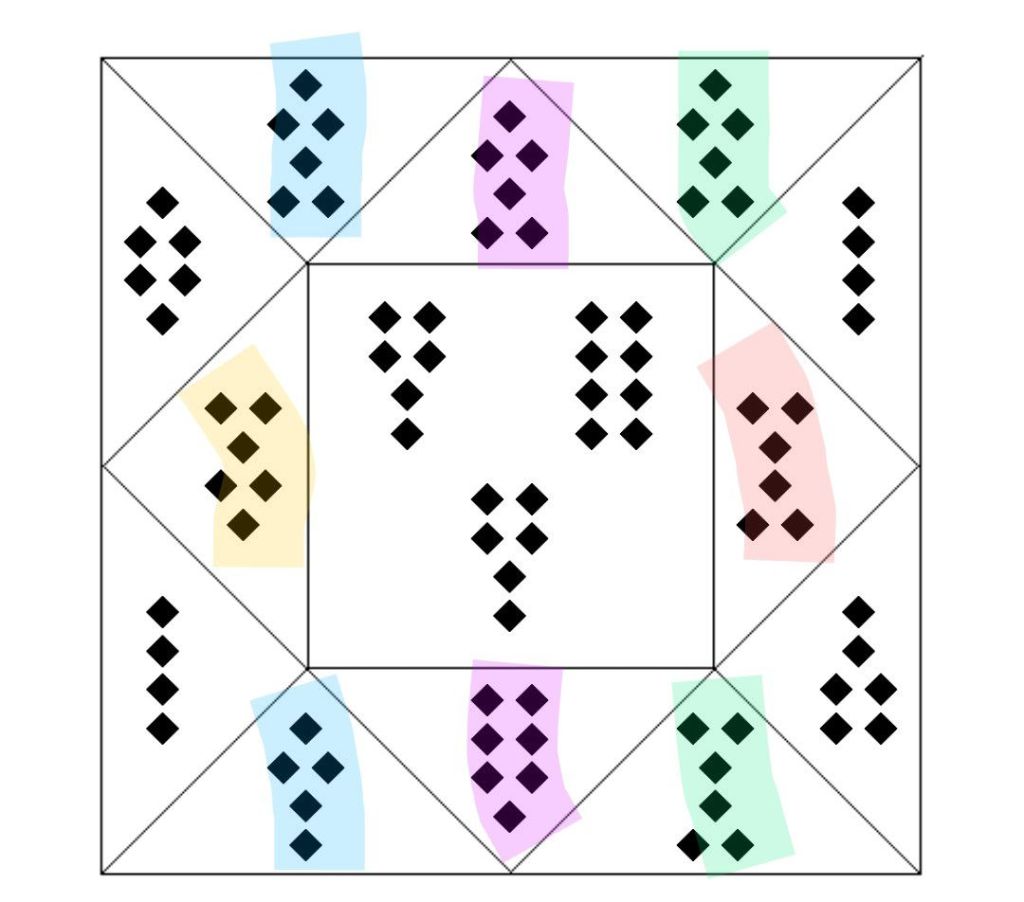
In geomancy, astrological aspects have been adapted to the chart as follows:

Astrological aspects in Geomancy (App used: Simple Geomancy)

If we take the figure in the first house (marked in yellow) as a reference point, then the figures in blue sextile it, because they are separated from it by a single sign; the figures in purple square it, because they are separated from it by two houses; the figures in green trine it because they are separated from it by three houses, and the figure in red opposes it, since it occupies the houses directly opposite.

This is supposed to shed some light on the relationship between the figures: two figures that fall into a square pattern have a difficult relationship, two figures in a trine a good one, etc.

The problem with using astrological aspects in Geomancy is that aspects work in a fundamentally different way: in Astrology, an aspect requires a planet to move in order to apply to another planet. After perfection, then, the aspect separates and its effect wanes.

Geomancy, though, is a static system with no real movement. Sure, we can say a figure moves from one house to another, but in reality that figure is already present in both houses. The only way to conceptualize movement in a geomantic chart is when we take a significator’s house to be the original position of the figure in it, and every other instance of that figure as a successive movement (e.g., in a career reading, if Laetitia is in the tenth house and in the seventh, we take it to move from the tenth to the seventh and not vice versa).

I am honestly not convinced that astrological aspects can find a meaningful place in geomancy. They certainly cannot bring matters to perfection, otherwise everyone would always be separating from their partner since the figure in the seventh house always opposes the figure in the first. Similarly, everyone would always get along with their siblings since the third house always sextiles the first.

One possibility which has been suggested is that of applying aspects only to figures that move. In a love reading, for instance, if the seventh figure moves to the tenth, it moves to square the querent, since the tenth house squares the first.

I personally find this application also problematic, because the tenth house represents the job, among other things, so that would mean that everytime the querent’s job is involved in their love life it causes trouble, which is a false assumption.

At most, I would take an aspect into consideration only if BOTH significators move. In the hypothetical love reading, for instance, if the first figure (querent) moves to the fourth house and the seventh (significant other) moves to the tenth, then they are in opposition to one another. Maybe they will argue. Or, if the first moves to the fourth and the seventh to the second, they sextile each other, which is good.

Even in a situation like this I am generally cautious about applying this theory. There are certain aspects of Astrology (pun intended) that simply don’t translate well to other systems of divination. You are of course welcome to try this theory on for size, but personally I believe Geomancy already has its particular version of aspects, and throwing other stuff into the mix feels more like an attempt at complicating this “brief and simple science” to find something more to tell the querent.

MQS

Reading Old Sources (for Geomancy, Astrology, Occultism)

I’m currently studying horary astrology under Chris Warnock’s supervision. He puts a great deal of emphasis on studying old sources, which is perfect for a guy like me who breaks out in hives when occultism is boiled down to “just wear a deep knowing expression, drink herbal tea and let the ascended masters guide your intuition.”

Geomancy is similar to horary astrology in that it allows you to answer questions, though it is less dependent on the time the question is asked. It is also similar in that you need to go back to really old books in order to study it seriously.

When reading premodern sources we always run a couple of risks:

  1. Unless they’ve been edited and discussed by a modern, they are probably written in a language that is not our own, or, even if it is, it’s an old version of it. This makes room for misunderstanding.
  2. More subtly, the world in which the author lived and wrote is not our world: it has different cultural, political and spiritual reference points.
  3. The source is written by someone who is just as fallible as we moderns (or rather postmoderns) are.

If one thing that grinds my gears is when people just turn occultism into their little escape from reality (“I wanna believe the world is magical but I’m too special for Christianity”), the other thing that equally grinds my gears is when people desperately seek a doctrine to follow blindly just because it happens to run against the Zeitgeist.

An occultist (and divination is a branch of occultism, though we often forget it) must be capable of being equally distant from intellectual lassitude and fanaticism, from scientism and religion. It takes a particular temperament that most people don’t possess, and I say this in a neutral sense: most people simply don’t have the temperament for most things, which is why only few people in any generation do any one thing.

Point three on the list is what I’m referring to here. The few on the occult path who have what it takes to move beyond the sanitized, advertiser-friendly version of occultism that gets tarot readers invited to corporate meetings often run the contrary risk: that of believing “if something says the opposite of what we hear everyday in our decadent world, it must be true and I must worship at its altar.”

When reading old sources (and I’m talking about geomancy, but it could refer to any other branch) this can turn us into fanatics if we don’t constantly remind ourselves that a book, even in the old days, could be written for a variety of reasons:

  1. to pass on important knowledge (but still from the author’s limited perspective)
  2. to record your experience
  3. to help others
  4. as a publicity stunt
  5. to impress others
  6. to confuse others
  7. a mix of all the above

Furthermore, old authors are just as capable as modern ones of believing crap. As such, while it is vital to question our own worldview, it is also just as vital to question all others. The moment you are asked (or you feel like you ought) to stop questioning is exactly the point where prejudice has crystallized, be it yours or someone else’s. It is also the point where you can break new ground if you proceed cautiously and with intelligence.

All this is to say, old books are treasure troves of information that we can study, learn from, adapt sensibly to our current needs, and much more. But if you are looking for a new Bible, you’re better off sticking to the old one.

MQS

Divination and Intellectual Honesty

When I was a teen, I remember stumbling upon Aristotle’s definition of the “educated mind” as being able to hold a thought without accepting it, and I remember thinking how silly and basic the definition was. The older I get, the more I find myself agreeing with him, as I see fewer and fewer people capable of doing it (the fact that Aristotle never actually wrote the sentence is a whole ‘nother can of worms)

A lot of people don’t have an educated mind per the definition above. One would like to think that tarot readers, astrologers and the like would not be like a lot of people, seeing how much the word “wisdom” gets thrown around in their circles. But one would be wrong. Leave it to the “spiritual community” to be among the most ideological and stiff. And, consequently, not among the brightest. If there is a group of people I don’t trust to be capable of holding any thought except the ones they agree with, that’s these people.

I believe I already talked a little about this, but one of the most memorable examples I can think of is the 2016 US election, when every tarot reader on youtube and their mom were busy predicting Trump would lose the election disgracefully, poop his pants, writhe on the floor, throw a tantrum and retreat into the hell that spawned him while Hillary Clinton swung her throbbing, veiny, 25 inch hard-on at the glass ceiling. While I am slightly exaggerating, this was pretty much the tone. (interestingly, those same readers routinely claim that the tarot is not for fortune-telling)

One such reader went as far as channeling Trump’s character. I do not remember the exact spread, nor most of the cards, but two things stuck with me: first, no egregiously bad card showed up, and second, the King of Cups featured prominently in the spread. She interpreted the card as Trump being a violent man prey to his base emotions and instincts. I took a quick look at some of that reader’s other videos, only to discover that she never, ever interpreted the King of Cups this way. In fact, she always interpreted it as the significator of a good man who takes care of the querent.

This is a good time to point out that I am fiercely apolitical, so this is not about politics. All ideologies are, as far as I am concerned, clouds over the mind’s clarity. I’m not saying everyone needs to think like me. Everyone has their delusion of choice, and everyone (including me) has their way of slanting reality in one direction or the other, whether politically, spiritually or philosophically (or even scientifically, for that matter). In fact, slanting reality is probably needed in order to filter information that might be useful to us.

Yet divination should be something else. What that reader did was merely using the cards as a mirror of her own (perfectly legitimate) bias. This is fine, and can even be useful at times–if you are aware that you are doing it. Even that would not be actual divination, but at least it wouldn’t be a waste of time.

I already discussed that divination is really a process of deification, that is, the process of allowing the dispassionate, bird-eye view clarity of the divine into one’s limited, subjective world by letting new information in. In other words, true divination is the opposite of retreating into one’s bubble: it’s the bursting of the bubble.

This, in turn, requires a certain readiness to accept the information we get (which is why it is always best to get someone you don’t know to read your cards.) Divination without intellectual honesty is just a crutch for one’s ego, and that’s how it is currently being used by the vast majority of diviners.

Unfortunately, intellectual honesty won’t make you many friends. Back in 2016 I had arguments with more tarot readers than I care to remember and was routinely labeled a dangerous extremist just because I called into question the usefulness of this type of reading (back then I still tried to entertain fruitful conversations with people). But occultism, in all its branches, is a narrow path.

Two lessons from all this: 1) if you are reading for yourself and the cards (or chart, or dice, or whatever) seem to confirm what you already think or wish, apply a bucketful of salt to the reading; 2) invest some money into a simple handbook of logic, or at least expand your knowledge of logical fallacies. This will repay you many times over, regardless of what branch of sorcery you practice.

MQS

Predictions that Change Behaviors

I don’t remember if I already talked about a reading I did for myself some time ago. I was expecting a parcel but needed to go somewhere else, so I asked the cards if the package would come on that day. The cards clearly answered in the negative, and I was right: I went out, and the parcel arrived the day after.

Thinking back on this, I was reminded of an experience reported by famous British astrologer John Frawley. I cannot remember if he discusses it in The Real Astrology or in his Horary Textbook, but it goes somewhat like this: he was waiting for some repairman to come to his house, but he also wanted to take a relaxing bath, so he cast a horary chart to know when the guy would come, only to discover that he wouldn’t. So he slipped into the bathtube, and his prediction proved correct

I believe this kind of readings is the most fun and instructive on the nature of divination. Ultimately, divination is intelligence-gathering. Sentient beings organize their behavior based on the information available to them. Therefore, new information is bound to change the being’s behavior.

The more complex the organism, of course, the more factors come into play, but the basic principle remains true. This is not to say that anything is possible, because only someone with infinite knowledge would know how to overcome all kinds of situations he or she finds unpleasant. We humble mortals are always restricted by difficult circumstances. Still, the information we gather through divination is not, in principle, different from the one we gather through other means which are all just as imperfect.

A fatalist might try to defend the idea of an all-encompassing destiny by arguing that the prediction is itself part of the person’s fate. I was destined to pull those cards and go out. But this stance, interestingly enough, invalidates the idea of prediction itself. If everything is destiny, then even knowledge that everything is destiny is destiny, rather than the truth.

I believe that divination is not simply communication with the divine, but also a form of deification: if we take God on one hand, that is, someone who is capable to be the pure consequence of its own choice, and a rock on the other, that is, something that simply passively receives whatever action external forces exert on it, then divination moves us closer to the divine condition of being the consequence of our own choice.

This is also why I am skeptical of airy-fairy forms of divination that try to take the focus away from concrete life in the name of some vapid divine idea. Ultimately, there is far more divine depth to Frawley’s ability to take a bath thanks to a horary chart than there is to questions like “How can I embody the divine feminine and honor my ancestral heritage more fully?”

MQS

The Company of Houses in Geomancy

The more I delve into medieval geomancy manuscripts, the more I realize how different authors tended to put together different bundles of go-to techniques for interpreting the geomantic chart. There is always some overalap, yet not every author mentions every technique. The company of houses is one such technique. The book from Peter of Abano I am currently translating does not mention it: he tends to have a very trimmed down, minimalistic approach. However, the technique is found in other authors, so I’ll discuss it and leave it up to the reader to decide whether to experiment with it or not.

The Technique

The technique is quite simple. We start from the presupposition that the aim of a geomancy chart is to see whether the figure of the querent comes into contact with the figure of the quesited, as already discussed, because such contact, called perfection, signals the querent coming into possession of the thing quesited about (though there are exceptions, when the querent wishes to get rid of something, for instance.)

Usually, if at least one of the four modes of geomantic perfection discussed in my previous article does not show up in the chart, it’s game over. According to some authors, though, we can also see perfection in other ways, and this is where the Company of Houses comes in.

The twelve houses of a chart are said to be paired as follows: the first with the second; the third with the fourth; the fifth with the sixth; the seventh with the eighth; the ninth with the tenth; the eleventh with the twelfth. It is important to note that, although, say, the third house is next to the second, the second and the third house are not in company: only the first with the second and the third with the fourth.

Let us suppose I want to know whether I will meet with my sweetheart. In general, I would want the house of the querent (me, the first house) to perfect geomantically with the house of the quesited (my sweetheart, the seventh house). Let us furthermore suppose that this does not happen. According to the proponents of the Company of Houses, this negative testimony can be overruled.

We look at the house my house is accompanied with, in this case the second, or the house the quesited is accompanied with, i.e., the eighth. Let’s take the second house as an example. The first kind of company is if the figure in the second house is the same figure as that of the first; the second kind of company is if the figure in the second is ruled by the same planet as the figure in the first; the third kind of company is if the figure in the second is opposite the figure in the first; the final kind of company is if the figure in the second shares the same Fire line (e.g., Via and Puella, who both have a single fire line).

This figure is the oppositeOf this figure      
CaudaCaput
ConjunctioCarcer
PuellaPuer
AcquisitioAmissio
AlbusRubeus
TristitiaLaetitia
Fortuna MinorFortuna Major
PopulusVia
Opposite figures

When any of these four conditions is realized, the figure in the second house can act as a co-significator for the querent, and may perfect the chart in his stead.

Do you need this?

Frankly? No. You can do what you please, of course, but this reeks of “Methinks I saw mine lass turn into a dragon”, that is, how people used to come up with stuff to fill books with. Even worse, it reeks of last-ditch effort at wringing a “yes” out of a negative chart.

In some cases, what is called Company of Houses is already covered by the four regular modes of perfection. When it isn’t, it is, as far as I am concerned, at most a very, very, very weak testimony, so much so that I don’t take it into consideration. Of course one may come up with all sorts of philosophical excuses why this technique is important, but if you ask me, it feels like a useless complication of a simple divination system.

MQS

To Understand Divination You Need to Understand Its Place in the World

While in Italy for the holidays, I retrieved my first notes from when I had started learning cartomancy from the person who taught me to read playing cards and the Sibilla. It’s just a couple of loose sheets on the basic meanings of the playing cards, the main combinations and two spreads (the row of cards, hardly a spread at all, and the cross).

This brought back so many memories of that period, but most of all it reminded me of how eminently practical divination used to be before its current glamorization. Of course, over time I learned a lot more from that lady than what is on that couple of now yellowed sheets, but the core of the system is there, and I believe she must have passed it on to me in no more than two sittings, if not just in one.

People who spend their time musing on the arcane meaning of the splotch of color on this or that card in the latest glossy and overly ornate oracle deck may laugh at how bare-bones that system is, but they would forget what significance divination had for the regular folks that used it to solve everyday matters.

Folk systems of fortune-telling, especially by cards, were designed to be quickly memorizable in their main lines, because they formed part of every housewife/househusband’s toolkit of remedies to the difficulties and uncertainties of life.

When an elderly person passed their meanings on to you, they did so not to introduce you to a different world detached from the real one, where you could dilly-dally with pleasant platitudes, but to send you into this life with another string to your bow. In principle, they revealed their system to you for the same reason that they taught you how to make preserves and liquors and how to best cultivate your garden.

Folk fortune-telling, in a word, was just another traditional remedy to the complexities of life. It did not involve stepping into a different plane of existence, because the everyday one was already enough, and it was looked on with the same pragmatic, solution-oriented gaze that was cast on all other problems people faced back in the day. “Don’t forget to add a small pinch of sugar to your tomato sauce. The Ace of Spades is a thorn in the heart.”

This is an attitude toward life that is hard to recapture nowadays. The idea of divination being useful has been so utterly eradicated from our mind that, when we approach it again, we do it as if it were an exotic, quaint, arcane world separate from our own. Our immediate reaction is therefore to keep it separate from our life, divorcing it from veriafiable prediction.

This stance is fatal, because it implies that our world is not inherently meaningful as it is; that meaning is found elsewhere and cannot be reconciled with our real life; that in order to find it, one must learn to look at one’s everyday struggles as illusions or as silly preoccupations not worthy of the attention of those in the know about the cosmic mechanism. All this ends up debasing both life and divination, because once life is debased, divination, which is the language of life’s drama, becomes a meaningless mirror only reflecting vague vapors.

MQS

The Via Puncti (Way of the Point) in Geomancy

I already said that I am not a big fan of complications in divination. Nor do I believe that the tendency to overcomplicate things is just modern: if we look in older Horary Astrology handbooks, for instance, they are filled to the brim with (often mutually contradictory) techniques that may be thrown at the chart in an attempt to smoke a positive judgement out of it.

Still, one technique that is relatively consistent in the tradition is that of the Via Puncti, or Way of the Point. Not all traditional sources talk about it, but I have found it to be occasionally helpful. As usual, techniques are not to be used blindly, but intelligently, like tools in the hand of a surgeon.

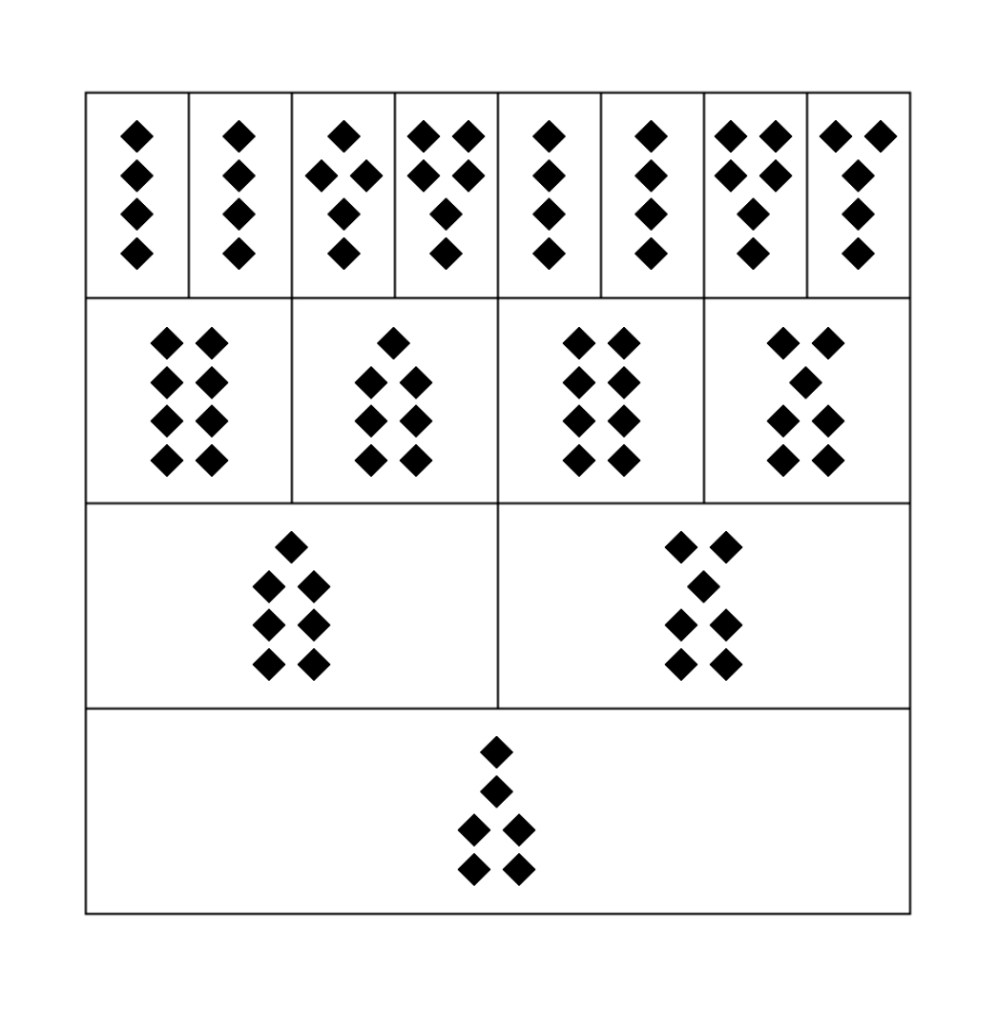
The long and short of this technique is as follows: some Judges have one point in their Fire line (the upmost one), while others have two. In fact, out of all eight possible Judges, four have one single Fire point (Carcer, Fortuna Minor, Via, Amissio), while the other four have two (Conjunctio, Fortuna Major, Populus, Acquisitio). Due to how Geomancy’s model works, whenever the Judge has one Fire line, it is possible to trace it back unequivocally to one of the four Mothers or Daughters (that is, to one of the eight figures at the top of the shield).

Geomantic Shield Reading, drawn with the Simple Geomancy app

In the above example, Fortuna Minor is the Judge. It has one point in its Fire line. This one point is found again in the Left Witness, Laetitia, and again in the third Niece, which is again Laetitia, and finally in the second Daughter Puella. No other path is possible. This is always so (if it isn’t so and you’ve calculated the chart by hand, you’ve made a mistake.)

Usually, the Via Puncti or Way of the Point can be looked at as a root cause for at least some aspects of the final answer. In the example above, for instance, a woman may be the cause (Puella). Or, if we take the House in consideration, since Puella is in the Sixth house, it may indicate that a sickness is the cause, or a servant/subordinate, or a pet, depending on the question.

I repeat: depending on the question. I make no effort to squeeze a consideration of the Via Puncti into my readings. If it is helpful, and if the question lends itself, I will consider it.

Geomantic Shield Reading, drawn with the Simple Geomancy app

In this second example, Acquisitio is the Judge. Immediately the Via Puncti branches off, as both Witnesses have two points in their Fire line. John Michael Greer says that this shows more complex causes, but he fails to mention that, in the old books, this is not considered a valid Via Puncti. I don’t know if I am unaware of some of the old material or if Greer gave in to his tendency to mix innovation (which is fine) with pretense that it is rooted in tradition. You can of course choose to experiment with Greer’s version of the Via Puncti. Personally, I don’t even always regard it when it is there (as in the first example) let alone when it is not there.

One thing that the existence of the technique shows, though, is that the Golden Dawn’s way of reading the astrological chart by placing the mothers in the angles is completely baseless, and is a typical example of the “let’s make up a secret” tendency of the occult community.

MQS