Category Archives: Geomancy

Psychological Hang-Ups of Diviners and Querents

When a person sits in front of a diviner, a number of preconceptions have often already been set off in their mind, and sometimes even in the mind of the diviner.

We must always remember that, nowadays, many people don’t visit an astrologer or card reader by chance, nor (usually) as their first go-to choice. Often, they have made a deliberate choice to step outside of the norm, for better or for worse, meaning that they have found the norm to be lacking in its ability to provide certainty. For many, therefore, the underlying presupposition seems to be: “I accept to take part in something that operates outside of consensus reality as long as it gives me the certainty I can’t find any other way.”

As diviners, we instinctively know it, and we may feel pressured to play into this presupposition or swim directly against it, thus falling into the opposite error.

Some diviners may feel they need to provide the querent with the unreasonable all-knowledge that only God can gift them with, only to end up providing uncertain information with unreasonable confidence. Others may push in the direction of vague self-help: We may not know if Mr. Right is behind the corner for our love-starved querent, but her divine feminine or other buzzword can still derive important lessons and “aha moments” from reflecting on the whole situation.
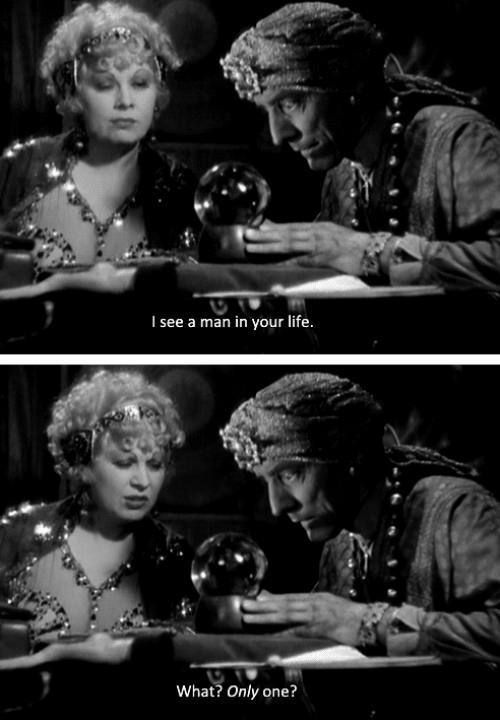
Mae West said it best. Picture by Sophie Charlotte on Pinterest

There are many dimensions to divination, some of which are indeed very deep. However, as far as our relationship with querents is concerned, we are simply an added means of intelligence-gathering, which, like all tools at our disposal, may fail for a variety of reasons, not the least of which is the diviner’s limited knowledge (our knowledge is always limited).

“But I came here to have undebiable, clearcut answers,” one might argue. To which I anwer: Tough titties! If you want undeniable clearcut answers shake a magic eightball. Divination is, quite literally, a divine language, and is not always so cleacut, either in itself or due to our limitations, or sometimes simply because the situation isn’t clearcut in itself. This is especially the case for issues involving human emotions.

As a rule, honesty is the best policy. I believe in voicing my procress to the querent, and the querent has a right to as clear an answer as I am capable of giving them, but we should never feel pressured to give them more certainty than we can truly see in the oracle.

It is perfectly acceptable to talk to the querent about our doubts or about the possible interpretations we are seeing in the oracle. For instance, it is ok to say “it seems like x, but y is also a possibility, while z seems less likely and w is out of the question.” It is also acceptable to say “these cards seem to point to such and such being the case, but I’m uncertain, as this other interpretation might also be right”. More often than not, the querent will say that both interpretations apply, and when this is not the case they can help us disambiguate the oracle.

Ultimately, the fact that divination has no legitimate place in our society implies as a consequence that, because our society believes itself to be held together by reasonable rules and processes, then divination must be either complete poppycock for delusional idiots or it must be capable of unreasonable fits of prowess in other to justify its existence in spite of its current ostracism.

This in turn creates expectations and hang-ups on both ends of the divination process that need to be analyzed and clarified to avoid them subconsciously ruling our practice. Doing so can make divination much more valuable and much more enjoyable.

MQS
Robert Fludd’s Geomancy – Book II Pt. 2

Previous / Back to Index / Next

Fludd introduces some preliminary classifications of the houses.

Of The First Twelve Figures Of a Shield

the first twelve shields of the geomantic house refer to the 12 signs of the zodiac, as we must understand in astrology. Therefore, the first house, both in astrology and in geomancy, is given to Aries, and is always by itself a movable house,1 the second to Taurus, and is a fixed house, and the third to Gemini, and is a common house. The fourth is Cancer and is movable, the fourth is Leo and is fixed, the sixth is Virgo and is common, the seventh is Libra and is movable, the eighth is Scorpio and is fixed, the ninth is Sagittarius and is common, the tenth is Capricorn and is movable, the eleventh is Aquarius and is fixed, the twelfth is Pisces and it is common, that is, neither fixed nor movable, but intermediate between both.

And it must be noted that, when the [geomantic] figures are in these houses, nevertheless the nature of the house is not changed, but remains in itself, that is, it will not change the nature of its sign: hence the first house will be called Aries, and so forth, so that every house, whatever attribute it may have, will stay movable, fixed, or common according to its own nature.

Rule I

Bad Houses make good figures bad, and they make bad ones worse: on the contrary, good figures are better in good houses.

Rule II

A figure in a house of contrary nature, that is to say a fixed figure in a movable house, or a movable figure in a fixed house, is rendered worse in judgment. But a fixed figure in a fixed house or a mobile figure in a mobile house are fortified.2

Rule III

The first four of the twelve houses, namely, the first house, the second, and the third will always signify the season of spring, and so on in the rest, as stated in astrology.3

MQS

Footnotes

  1. Today we call the astrological signs cardinal, fixed and mutable. A more archaic way of describing them is as movable, fixed and common. Note that Fludd is equating the signs with the houses, which is natural in geomancy. In traditional astrology, however, the houses are quite distinct from the signs. ↩︎
  2. Here the reference is to the classification of the geomantic figures shown in Book II, Part 1. ↩︎
  3. In astrology (as well as in magic), the four quarters of the Heaven hold much symbolic meaning, lending themselves to the allotment of various fourfold distinctions. ↩︎

Robert Fludd’s Geomancy – Book II Pt. 1

Previous / Back to Index / Next

Fludd gives some basic details about the geomantic figures.

Of the Names, Forms and Natures of the Geomantic Figures

those figures which can be drawn from the series of four geomantic lines are sixteen in number, which are distinguished from one another by name and form, as follows:1

NameForm
First: Acquisitio* *
*
* *
*
Second: Amissio*
* *
*
* *
Third: Laetitia*
* *
* *
* *
Fourth: Tristitia* *
* *
* *
*
Fifth: Caput Draconis* *
*
*
*
Sixth: Cauda Draconis*
*
*
* *
Seventh: Albus* *
* *
*
* *
Eighth: Rubeus* *
*
* *
* *
Ninth: Puer2*
* *
*
*
Tenth: Puella*
*
* *
*
Eleventh: Major Fortuna (sic)* *
* *
*
*
Twelfth: Minor Fortuna (sic)*
*
* *
* *
Thirteenth: Populus* *
* *
* *
* *
Fourteenth: Via*
*
*
*
Fifteenth: Conjunctio* *
*
*
* *
Sixteenth: Carcer*
* *
* *
*

And these figures are obviously referred to the signs of the Zodiac:

FigureZodiac Sign
AcquisitioAries
Laetitia and Fortuna MinorTaurus
Rubeus and PuerGemini
Albus and PopulusCancer
ViaLeo
Caput Draconis and ConjunctioVirgo
PuellaLeo
Tristitia and AmissioScorpio
Cauda DraconisSagittarius
PopulusCapricorn
Fortuna MajorAquarius
CarcerPisces

Similarly they are given to:

PlanetFigures
MarsRubeus (D), Puella (R)3
SunMajor (fast), Minor (slow)4
VenusPuer (D)5, Amissio (R)
MercuryAlbus (D), Conjunctio (R)
MoonPopulus (D), Via (R)6
Jupiter and VenusCaput Draconis (D)
Saturn and MarsCauda Draconis (R)

These Figures are also:

ElementFigures
Fiery, assigned to the SouthRubeus
Minor
Amissio
Cauda
Airy, assigned to the EastLaetitia
Acquisitio
Puella
Conjunctio
Watery, assigned to the NorthPopulus
Via
Puer
Albus
Earthy, assigned to the WestMajor
Caput
Carcer
Tristitia

The Figures are:

ValueFigures
Always positive and fortunateMajor
Laetitia
Caput
Albus
Puer
Acquisitio
Always negative and unhappyTristitia
Rubeus
Puella
Amissio
Cauda
Minor
Carcer
Neither always good nor always evil, but middling, that is, neither exceptionally good nor exceptionally badPopulus
Via
Conjunctio

The Figures are however:

StabilityFigures
Strong and stableMajor
Acquisitio
Laetitia
Puer
Albus
Caput
Weak and moveableAmissio
Tristitia
Puella
Rubeus
Cauda
Mediocre, that is, neither strong nor weakPopulus
Via
Conjunctio
Carcer7

Rule I
Strong and firm figures make a thing stable and firm, for better or worse, depending on whether the figure is found in a good or evil house.

Rule II
Weak figures are so called, because they render a weak judgement without stability, neither are they so good and stable as much as they are mediocre,8 whether in a question of illness or incarceration or pregnancy.

Rule III
Mediocre figures are so called, because they are between strong and weak figures, and they make a situation mediocre, that is, neither totally good nor totally bad.

MQS

Footnotes
  1. Fludd was fond of using tables. I will try to make the layout of the translation as clear as possible ↩︎
  2. Fludd gives here to Puer the form we typically assign to Puella and vice versa. ↩︎
  3. ‘D’ is for ‘direct’, ‘R’ for retrograde.
    ↩︎
  4. The Sun cannot go into retrogradation, which is why some sources, like Fludd, attribute the two Fortunes to the Sun at different speeds. This is still somewhat odd, considering the Sun is always rather constant in its speed (which is probably behind the traditional symbolic view of the Sun as a source of stability, as opposed to the Moon’s changeability). ↩︎
  5. Generally, today, we would assign Venus to Puella and Mars to Puer. It is unclear to me the extent to which Fludd was making a mistake or providing a blind to challenge the reader’s thinking. He is not the only traditional authority who swaps Puer and Puella, though. ↩︎
  6. The Moon cannot go into retrogradation. Usually, Populus is assigned today to the waxing Moon, Via to the waning Moon. ↩︎
  7. There exist other lists with partially different attributions. ↩︎
  8. It is unclear to me whether Fludd means that weak figures are mediocre or that they are worse than those called mediocre. Logic would dictate that the latter interpretation is correct. ↩︎

On Avoiding Food Poisoning (Example Reading)

As Christmas draws near I recently bought the ingredients for my home-made 5-hour lasagna sauce. Yesterday I set about preparing it, and I started noticing an odd smell coming from the minced meat, even though it was supposedly fresh.

At first it was barely detactable, so my Christmas spirit decided to interpret it as just a figment of the imagination. The immediate red flag was seeing my husband emerge from his den asking what the strange odor was. Hubby is extremely sensible to smells. Whenever I see him curling his nose I know something is off.

What’s worse, around three hours into the preparation the subtle whiff had turned into a miasma. So I did a geomancy reading, asking if the sauce would be safe to eat.

Before casting the reading I had some doubt on how I would interpret such a question: what astrological house rules food?

In old astrology and geomancy books, when a king asks if the food served at the banquet has been poisoned, usually the diviner consults the fifth house of parties and fun. On the other hand, astrologer John Frawley makes a compelling point that your food is what sustains your person and goes into your throat, which is the second house. I decided that it was useless to worry about these distinctions, and that the chart would find a way to show me the truth.

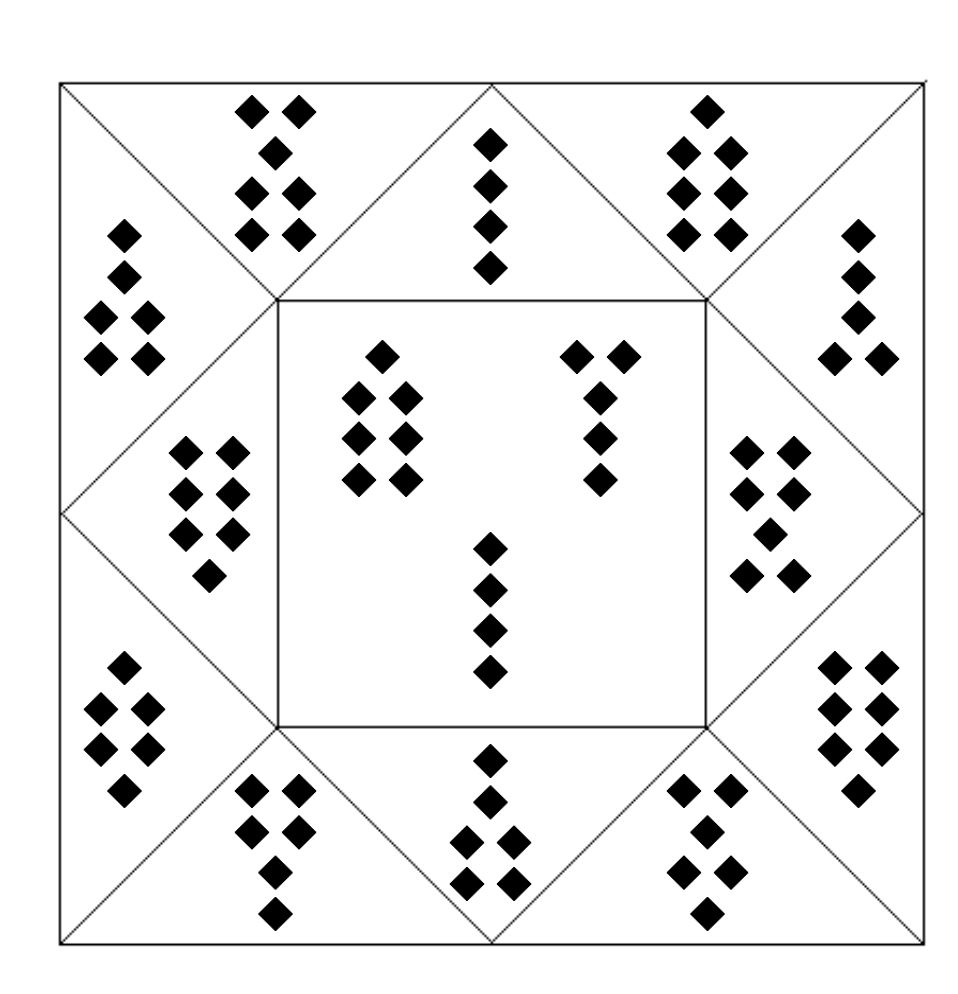
Is the sauce safe to it? Geomancy reading (app used: Simple Geomancy)

And show me it did. This is  a reading that requires very little interpretation. Tristitia is in the first house, portending trouble, and it springs into the sixth house, which is the house of sickness: neither the second house nor the fifth house were involved. The sauce is definitely unsafe.

True, the court is not negative, possibly showing that it wouldn’t cause any major trouble. On the other hand, the Way of the Point goes from the Judge Via to Cauda Draconis in the eighth house, and Cauda is a negative figure, but I doubt the sauce would be the end of us.

I still decided to dump everything out and start from scratch, meaning today I had to run to the market to get new ground meat.

MQS

Robert Fludd’s Geomancy – Book I Pt. 4

Previous / Back to Index / Next

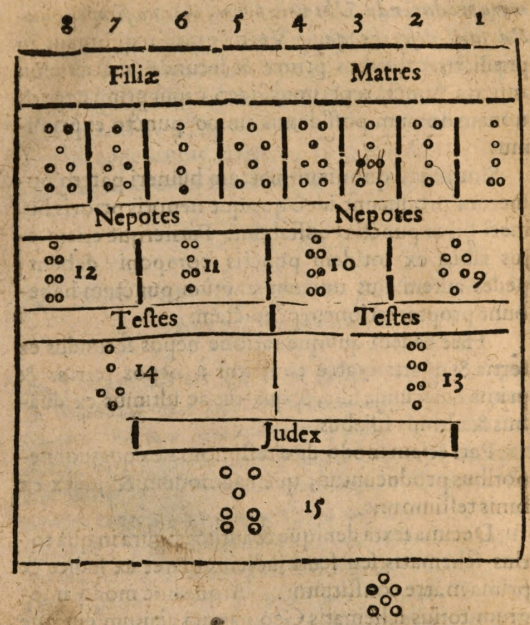
Fludd explains how a full geomantic shield is derived from the initial four mothers.

Of the Production of the Other Figures in the Geomantic Shield

It must be noted that from the said mothers,1 who constitute the first four figures of the geomantic shield, four daughters, constituting the fifth, sixth, seventh and eighth figures, arise, taking separately the parts of all the mothers. In the previous example we take from the first figure / . / from the second / . . / from the third / . / from the fourth / . . / And thus these four parts, joined together, generate the first daughter occupying the fifth house, namely, the figure called Amissio. From the mothers’ shoulders the second daughter is born occupying the sixth house, from the legs the third, from the feet the fourth.

But first the niece is derived from the two first mothers, for her head is fused from their two heads, etc. And this is a general rule: that where two heads, shoulders, legs, or feet joined together produce an odd number, namely three, they produce a single; but when they are even, they produce two points. For example: since we find only three points in the aforesaid heads of the first and second mothers, we therefore express the head of the first niece who occupies the ninth house with a single point.

In the same way, since the mothers’ shoulders produce an equal number, therefore also the shoulders of the first niece will consist of two points. Equally, her legs must also be composed of the same number of points, and her feet will have only one point for the above reason. For this reason also, the second niece is fused from the third and fourth mother; the third niece from the first and second daughter, and the fourth and last from the two and last daughters.

In the same way, two Witnesses are produced from four nieces, just as a Judge is produced from two Witnesses. Finally, the sixteenth, the last figure in which the whole shield is summarized, is made up of the Judge and the first mother. And in this manner the whole geomantic shield and its houses must be filled, from which the judgment in this art is to be taken.

A geomantic shield, from Robert Fludd’s Geomancy handbook
Footnotes
  1. Referring to Book I, Part 3. This section requires no commentary, as it describes the usual technique of deriving the full shield from the initial four figures. ↩︎

Cancelled Flights? (Example Reading)

One pro of using more than one system of divination is that sometimes they clarify each other: sometimes one reading is somewhat obscure in one system but clear in the other, and we can use the clear one to navigate the one that has us scratching our heads. Granted, obscurity is in the eye of the beholder, being always a consequence of our own limitations, but it is still an occasion to learn.

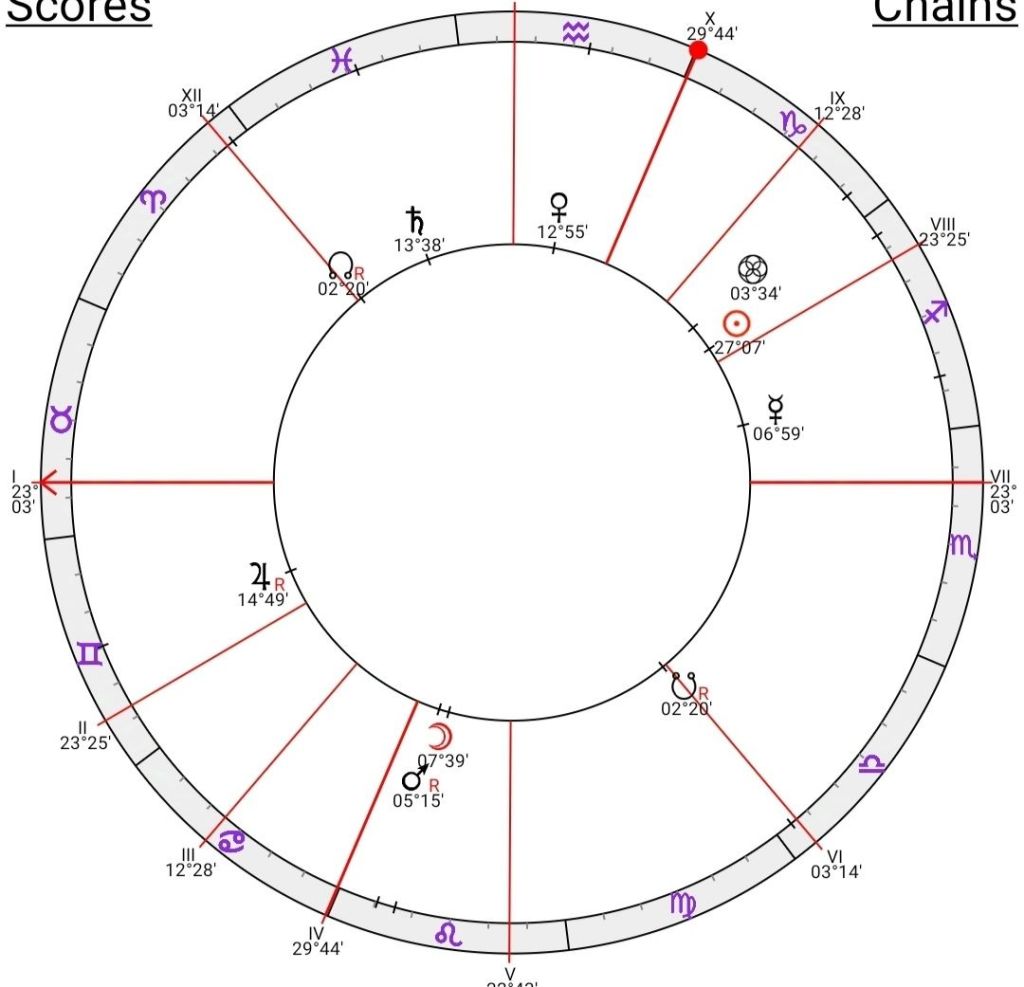
I was at the airport yesterday, trying to catch a flight to get back home. Suddenly, and to my horror, I noticed that plenty of flights were being cancelled due to the heavy mist, including one flight on the same route I needed. My first instinct was to cast a Horary chart, asking if I’d be able to get back home.

Will my flight go as planned or will it be cancelled? Horary Astrology

This was my first interpretation. I am represented by Venus, ruler of the ascendant. The place I want to get is my home, which is ruled by the Fourth House and therefore by the Moon (Cancer is on the cusp). The Moon is approaching an opposition of Venus. Bam! The flight will be cancelled.

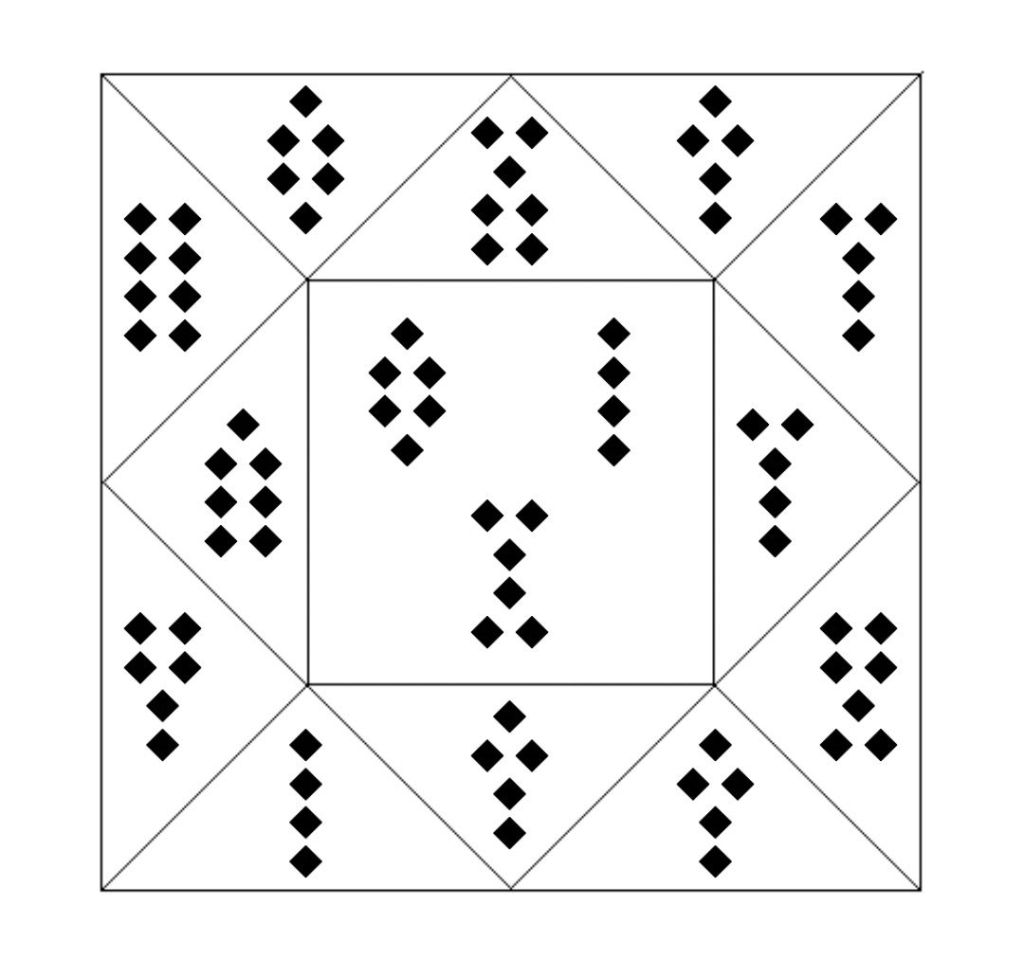
After a while, as I was waiting for information, I did a Geomancy reading on the same question. Here is the chart:

Will the flight go as planned or will it be cancelled? App used: Simple Geomancy

The first thing the struck me is the generally positive Judge, Conjunctio, which arises from Carcer and Via. It argues mobility more than stasis, and obstacles that are removed. The second important point is the figure that represents me: Laetitia in the first. Laetitia represents upward motion. It is an exiting figure, meaning movement. What a wonderful symbol for a plane taking off!

Even if we want to involve the Fourth house, we see that it is occupied by Puella, a mildly benefic figure, which is also connected to the ninth house of journeys (it occupies it). So the journey (Ninth) connects with the home (Fourth).

Obviously, two systems of divination cannot give contradictory answers if correctly interpreted, and the Geomancy seemed rather obviously positive. So I went back to the Horary Chart (again below)

Will my flight go as planned or will it be cancelled? Horary Astrology

I meditated on this chart quite a while (I had plenty of time, after all). Then it hit me. I am represented by Venus. Venus is in the Midheaven (up in the sky) in Aquarius, an *air* sign. Not only, but Aquarius is fixed: it doesn’t change. My being in the sky is fixed. So there will be a flight: I will be up in the sky as planned.

But what about that opposition by the Moon? Well, there was significant delay, so the Moon could show the flow of events causing trouble to my being up in the air.

Ultimately, the Fourth House didn’t need to get involved. The point of the question was not whether I would get home (I would have gotten home anyway at some point) but what would happen to me/my flight.

I managed to come home yesterday.

MQS

Handling Bad News

No matter what kind of divination we practice: if it’s worth its salt and is not just some feelgood angel therapy oracle, it has the potential to deliver bad news. How we handle bad news is a mark of how helpful we are capable of being as diviners.

People can come to us for a variety of reason. They may need reassurance, hope, advice or just a quick look ahead. They may even come to us for fun or curiosity, and as long as they are not disrespectful, there is nothing wrong in indulging them.

The principle of respect for our querent stems from seeing them as a whole person rather than a sack of meat endowed with more than its fair share of doubts. We, as diviners and as handlers of odd devices (decks, charts, counters of various kinds) hold a degree of power over them. It is symbolic power, for sure, but reality itself is symbolic (that’s how magic works), therefore symbolic power is real power, and must not be misused.

Finding the right balance between informing the querent and respecting them can be difficult. It’s all well and good as long as the cards talk about pleasant trips and job interviews. But occasionally we recognize messages that we know are going to deeply upset our querent.

Causing unnecessary anguish is a no-no, and there are things that cannot be said without causing unnecessary anguish (“You’ll die soon”, “You’ll lose the baby). Even less serious topics (at least, less serious than death), such as marital infidelity must be treated with caution. We cannot just destroy whole families willy-nilly simply because our cards seem to hint at untoward dealings.

We must also distinguish whether a querent directly asks for something or something unpleasant simply shows up in the cards. Usually, if the querent asks for something, we can be more forthcoming, if we can speak with tact. If they ask “Will I get the job?”, they need to be able to accept “I’m not infallible, but it seems they appear more inclined to go with someone else.”

If they ask “Is my spouse faithful?” and the cards show clear signs of interference, an answer like “Remember that I could be wrong, but there does seem to be someone who’s trying whisk them away from you. Maybe it’s time to have an honest talk and try to solve the issue.”

Incredibly enough, even some taboo topics may occasionally be addressed in this guise. For instance, there are plenty of non-morbid reasons querents might want to know about death: “Do you think my elderly father going to survive long? I want to be able to visit him one last time but the situation at home is just crazy.”

While we must not delude the querent, we have no right to rob them of all hope. Aside from the mantra “Remember I’m a fallible human being”, and even aside from potential advice we might sometime give the querent to soften the blows of bad luck, there are occasionally ways of preparing the querent for a difficult situation without hurting them.

“Is the pregnancy going to go alright?” This is a question I am become more and more skeptical of answering as time goes by, because there is no way of saying anything other than “yes” and still be able to look at myself in the mirror. If we do find ourselves somehow coerced into answering it and the cards are less than positive, the only thing we may say is something to the effect of “Yes, but remember to take it easy, and the cards are saying you should pay extra attention to the doctor’s orders.”

Where all else fails, human empathy is our last line of defense. Helping the querent even for just some minutes by sharing their burden is part of what we may have to sign up for when we choose the path of divination.

MQS

Robert Fludd’s Geomancy – Book I Pt. 3

Previous / Back to Index / Next

Fludd discusses some preliminary rules.

On the projection of sixteen lines, divided into four orders, constituting the first four geomantic figures

Before proceeding to the projection of the [geomantic] lines, which are made up of points, we shall lay down certain rules to explain the reason and manner of creating them.

Rule 1

It is not for the artist to make a judgment on any question relating to a matter which he has already known and understood before, for by doing this he is trying God and his divine knowledge, and will err on that account.1

Rule 2

Do not count the number of points of any line, for by that reason the soul will somehow be disturbed in the calculation.2

Rule 3

If you want to work in this science, you must first describe the proposed problem, so that your understanding is not disturbed otherwise.

Rule 4

You must not make a double question, but form the question in such a way that it asks for the knowledge of only one thing; otherwise your figure will be so disturbed that you will not be able to judge anything correctly. For this reason the question must be rectified in such a way that it has a single and complete purpose.

It must be noted that these geomantic lines merge from equally distant points and must have the form of the four fingers of the hand, as will be seen in the following example, and the points of each line we must connect and concatenate in such a way, proceeding from right to left, that at its extremity to the left one or two points are left free from concatenation.

Example of a geomantic projection

This also must be done with all the lines of the aforesaid four series, and in this way will come forth the four first figures of the geomantic shield, representing the four elements with their natures and combinations, likewise the four winds, and the four parts of the world; for, as regards the elements, the four first lines will signify the element of fire, the second four will denote the element of air, the second three the element of water, and the last four the element of earth.3

Of course, the figures coming out of each series will represent an element of their series, just as in the previous figure Caput will represent fire, Causa will represent air, Puer will represent water, and Albus will represent earth. Now these four figures are called Mothers, because from them all the following figures are produced.

MQS

Footnotes
  1. Asking a question whose answer we know implies that the actual question is “Does this really work?” which is a question no system can answer from within itself, therefore the question implies doubt in the author of the system ↩︎
  2. Counting the points not only implies trying to cheat the system, but it also robs the divination of its random, inspired aspect. ↩︎
  3. The elemental attributions of the figures is not of major practical importance, but it serves to respect the connection between microcosm and macrocosm and to anchor the question to a cosmic mechanism. ↩︎

“Will I Ever Be Happy?” Or, How to Torture Yourself With the Cards

I’ve already written a couple of articles on unanswerable questions. Some of them are unanswerable for logical reasons, others because they ask about something on which no objective standard of measurement exists. Some are also unanswerable for ethical reasons (“Tell me when is the best time to rob the bank.”)

But occasionally someone comes along who asks a question that we instinctively feel is unanswerable, yet we can’t put our finger on why. It’s happened a couple of times to me that someone would ask me something to the effect of “Will I ever be happy?

Obviously no one whose life is coming up roses would seek out a diviner of all people to ask such a question. These queries are put to the cards or the skies in a moment of weakness. My experience in these situations is that the cards behave in one of three ways. They:

  1. Show the cause of the person’s unhappiness rather objectively, and whether the problem is likely to be overcome over the next few months (usually not)
  2. Are generically very negative, without a specific sense to them
  3. Are generically very positive, without a specific sense to them

In the first instance, the cards usually show the problem not getting resolved, not necessarily because it never will be, but because the person is still knee-deep in it. The fact that they chose to frame their question in such tragic terms tells us that, whatever the nature of their problem, it goes beyond its specific objective nature and it has wounded the person in their soul.

Extreme care is advised in dealing with people in such a state of difficulty. They come to us broken and they should, at the very least, not leave even more broken. Furthermore, it is not unlikely that they have started consulting many diviners, obsessively asking the same question in hopes of getting a magical solution to their issue dropped in their lap. It would be good to advise them to stay away from divination for a while, unless we are capable of pointing out a solution they haven’t thought about, which unfortunately is rare.

When the cards are generically positive or generically negative, they are merely reflecting the person’s state of confusion: the bleakness of their outlook or the irrational hope for unexpected redemption. I don’t think there is much that we can do in such situations, except telling them that their upset shows in the cards and that, life being a succession of phases, even this one will pass. Sometimes, in such situations, talking to them in our quality of human beings is better than talking to them in our quality of diviners. In extreme cases, having a hotline number handy may be helpful.

Really there isn’t much sense in asking this question except to torture ourselves. We as diviners should know this when asking our own questions, but many people don’t, so it’s best to be prepared.

MQS

Robert Fludd’s Geomancy – Book I Pt. 2

Previous / Back to Index / Next

Fludd discusses how the diviner should prepare to a geomancy reading.

The Preparation of the Soul of the Diviner Prior to Making a Figure

Since this knowledge is founded on [an operation of] the soul,1 it is certain and manifest that no truth can be guaranteed in it, except in so far as the soul permits it.

Therefore it is required that he who wishes to be versed in this art, before he begins his operation, should have a good and clear conscience, and that his body and spirit should be governed without disturbance, and that he should not think worse of another than of himself,2 nor should his mind be spare in judgment, and not tend to negation more than to affirmation. He should be a just judge of the question proposed.

Finally, he must trust in God almighty, who is the author of all knowledge and truth,3 and pray to him that through this knowledge he will be allowed to find the truth that his heart longs to know.

All of this having been properly considered, and with a soul well established in the proposed matter, he will immediately make the projections of the points.

Hence it is that so much fallacy and uncertainty arise in this art. This is also the reason why the same art is immediately regarded as nothing, namely, because some, falsely ascribing the name of artists to themselves, neglecting God, and not being moved in the least by the pacification of their souls and of the pleasures of the body, falsely judge of the things proposed, and by this reason render this secret and very profound art so despised, that it is also commonly regarded as the most falsified of all.

The fault, then, is not in the science, but in those who profess it: the science is doubtless most truthful, but its proponents are often hindered by ambiguities and difficulties because of their vicious dispositions.

For who can doubt that the soul can direct any part of the body to the true knowledge of the future more easily than the whole body itself?4

When we perceive that she governs her whole body in such a way that she foresees the future every day and every hour, that is to say, that she will arrange such a business the next day, and ride to this or that city, and do other things the following week, or even that she will marry at this or some other time, or that he would carry out his purpose and plan at such or such an hour, etc.5

MQS

Footnotes
  1. As established in the previous chapter. ↩︎
  2. To the modern reader, these tips may seem to have a moralistic taste, but we should keep in mind that, aside from being in part a product of the times, they may be boiled down to the very sensible idea that a diviner, as intermediary between the querent and the divine, should purify himself of that which keeps him away from the divine. One cannot be a bridge between A and B without being capable of reaching both sides. Aside from being against Christian morality, “thinking worse of another than oneself” also implies being engrossed in outside world nonsense. ↩︎
  3. A fundamental truth of all divination is that its knowledge does not originate within the diviner. ↩︎
  4. That is, the soul is more capable of the body of considering the future. ↩︎
  5. This remark may appear odd, but from an occult standpoint it does make sense: our soul is capable of conceiving the future because it is integral part of an inner world (which opposes and complements the outside world, of which our body is an integral part) wherein the normal rules of time don’t unfold as they do outside. ↩︎