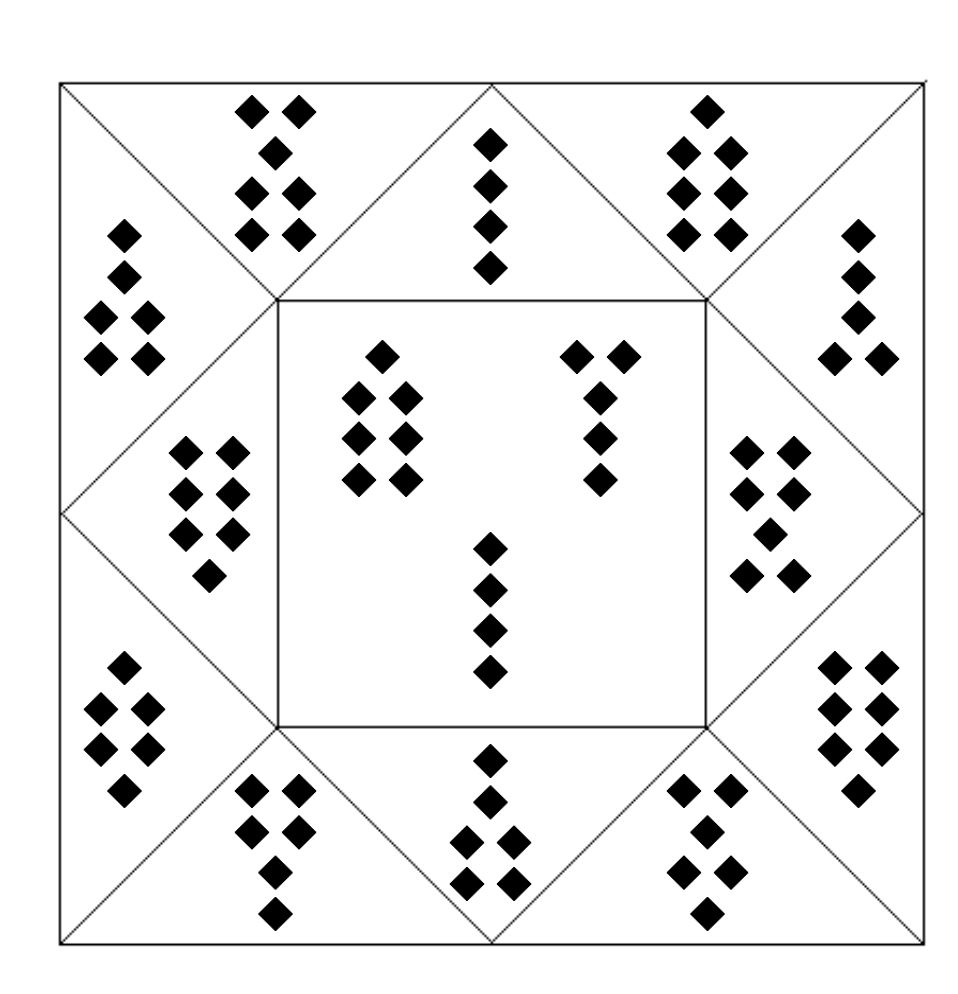
Fludd introduces some preliminary classifications of the houses.
Of The First Twelve Figures Of a Shield
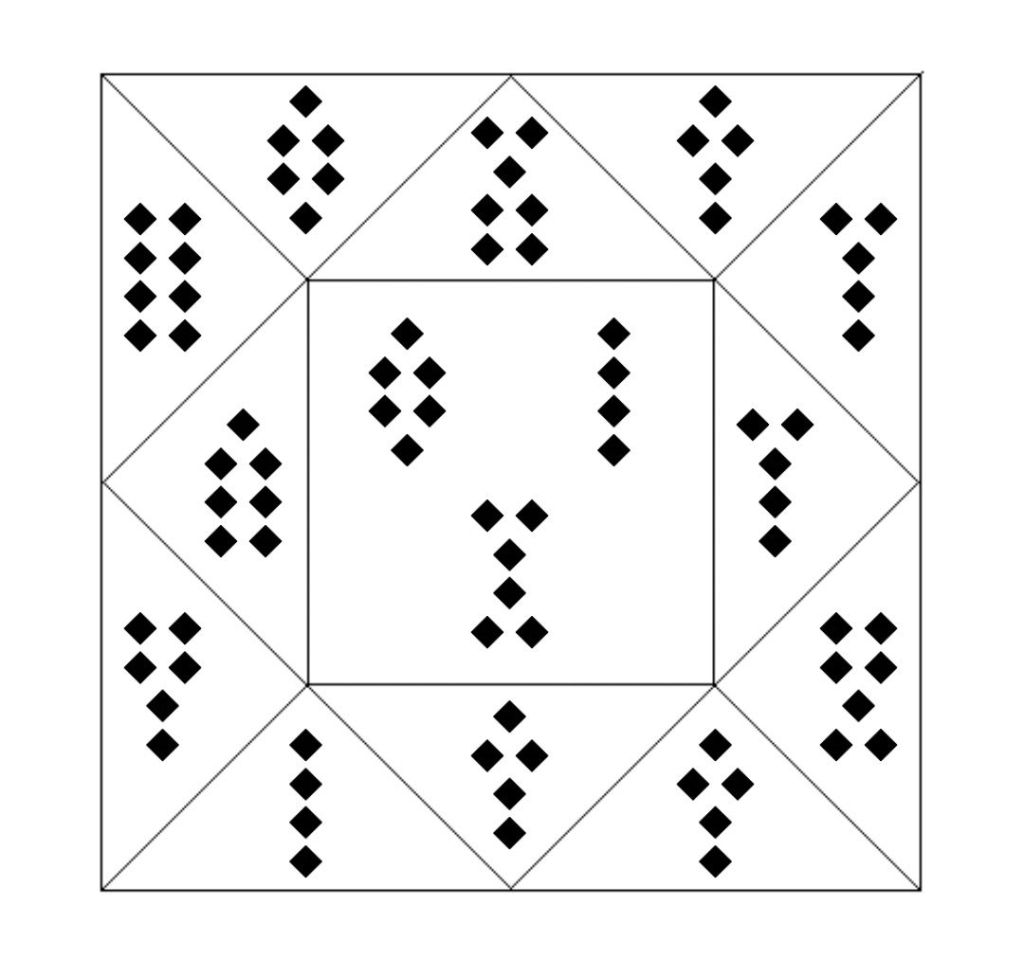
the first twelve shields of the geomantic house refer to the 12 signs of the zodiac, as we must understand in astrology. Therefore, the first house, both in astrology and in geomancy, is given to Aries, and is always by itself a movable house,1 the second to Taurus, and is a fixed house, and the third to Gemini, and is a common house. The fourth is Cancer and is movable, the fourth is Leo and is fixed, the sixth is Virgo and is common, the seventh is Libra and is movable, the eighth is Scorpio and is fixed, the ninth is Sagittarius and is common, the tenth is Capricorn and is movable, the eleventh is Aquarius and is fixed, the twelfth is Pisces and it is common, that is, neither fixed nor movable, but intermediate between both.
And it must be noted that, when the [geomantic] figures are in these houses, nevertheless the nature of the house is not changed, but remains in itself, that is, it will not change the nature of its sign: hence the first house will be called Aries, and so forth, so that every house, whatever attribute it may have, will stay movable, fixed, or common according to its own nature.
Rule I
Bad Houses make good figures bad, and they make bad ones worse: on the contrary, good figures are better in good houses.
Rule II
A figure in a house of contrary nature, that is to say a fixed figure in a movable house, or a movable figure in a fixed house, is rendered worse in judgment. But a fixed figure in a fixed house or a mobile figure in a mobile house are fortified.2
Rule III
The first four of the twelve houses, namely, the first house, the second, and the third will always signify the season of spring, and so on in the rest, as stated in astrology.3
MQS
Footnotes
Today we call the astrological signs cardinal, fixed and mutable. A more archaic way of describing them is as movable, fixed and common. Note that Fludd is equating the signs with the houses, which is natural in geomancy. In traditional astrology, however, the houses are quite distinct from the signs. ↩︎
Here the reference is to the classification of the geomantic figures shown in Book II, Part 1. ↩︎
In astrology (as well as in magic), the four quarters of the Heaven hold much symbolic meaning, lending themselves to the allotment of various fourfold distinctions. ↩︎
Fludd gives some basic details about the geomantic figures.
Of the Names, Forms and Natures of the Geomantic Figures
those figures which can be drawn from the series of four geomantic lines are sixteen in number, which are distinguished from one another by name and form, as follows:1
Rule I Strong and firm figures make a thing stable and firm, for better or worse, depending on whether the figure is found in a good or evil house.
Rule II Weak figures are so called, because they render a weak judgement without stability, neither are they so good and stable as much as they are mediocre,8 whether in a question of illness or incarceration or pregnancy.
Rule III Mediocre figures are so called, because they are between strong and weak figures, and they make a situation mediocre, that is, neither totally good nor totally bad.
MQS
Footnotes
Fludd was fond of using tables. I will try to make the layout of the translation as clear as possible ↩︎
Fludd gives here to Puer the form we typically assign to Puella and vice versa. ↩︎
The Sun cannot go into retrogradation, which is why some sources, like Fludd, attribute the two Fortunes to the Sun at different speeds. This is still somewhat odd, considering the Sun is always rather constant in its speed (which is probably behind the traditional symbolic view of the Sun as a source of stability, as opposed to the Moon’s changeability). ↩︎
Generally, today, we would assign Venus to Puella and Mars to Puer. It is unclear to me the extent to which Fludd was making a mistake or providing a blind to challenge the reader’s thinking. He is not the only traditional authority who swaps Puer and Puella, though. ↩︎
The Moon cannot go into retrogradation. Usually, Populus is assigned today to the waxing Moon, Via to the waning Moon. ↩︎
There exist other lists with partially different attributions. ↩︎
It is unclear to me whether Fludd means that weak figures are mediocre or that they are worse than those called mediocre. Logic would dictate that the latter interpretation is correct. ↩︎
As Christmas draws near I recently bought the ingredients for my home-made 5-hour lasagna sauce. Yesterday I set about preparing it, and I started noticing an odd smell coming from the minced meat, even though it was supposedly fresh.
At first it was barely detactable, so my Christmas spirit decided to interpret it as just a figment of the imagination. The immediate red flag was seeing my husband emerge from his den asking what the strange odor was. Hubby is extremely sensible to smells. Whenever I see him curling his nose I know something is off.
What’s worse, around three hours into the preparation the subtle whiff had turned into a miasma. So I did a geomancy reading, asking if the sauce would be safe to eat.
Before casting the reading I had some doubt on how I would interpret such a question: what astrological house rules food?
In old astrology and geomancy books, when a king asks if the food served at the banquet has been poisoned, usually the diviner consults the fifth house of parties and fun. On the other hand, astrologer John Frawley makes a compelling point that your food is what sustains your person and goes into your throat, which is the second house. I decided that it was useless to worry about these distinctions, and that the chart would find a way to show me the truth.
Is the sauce safe to it? Geomancy reading (app used: Simple Geomancy)
And show me it did. This is a reading that requires very little interpretation. Tristitia is in the first house, portending trouble, and it springs into the sixth house, which is the house of sickness: neither the second house nor the fifth house were involved. The sauce is definitely unsafe.
True, the court is not negative, possibly showing that it wouldn’t cause any major trouble. On the other hand, the Way of the Point goes from the Judge Via to Cauda Draconis in the eighth house, and Cauda is a negative figure, but I doubt the sauce would be the end of us.
I still decided to dump everything out and start from scratch, meaning today I had to run to the market to get new ground meat.
Fludd explains how a full geomantic shield is derived from the initial four mothers.
Of the Production of the Other Figures in the Geomantic Shield
It must be noted that from the said mothers,1 who constitute the first four figures of the geomantic shield, four daughters, constituting the fifth, sixth, seventh and eighth figures, arise, taking separately the parts of all the mothers. In the previous example we take from the first figure / . / from the second / . . / from the third / . / from the fourth / . . / And thus these four parts, joined together, generate the first daughter occupying the fifth house, namely, the figure called Amissio. From the mothers’ shoulders the second daughter is born occupying the sixth house, from the legs the third, from the feet the fourth.
But first the niece is derived from the two first mothers, for her head is fused from their two heads, etc. And this is a general rule: that where two heads, shoulders, legs, or feet joined together produce an odd number, namely three, they produce a single; but when they are even, they produce two points. For example: since we find only three points in the aforesaid heads of the first and second mothers, we therefore express the head of the first niece who occupies the ninth house with a single point.
In the same way, since the mothers’ shoulders produce an equal number, therefore also the shoulders of the first niece will consist of two points. Equally, her legs must also be composed of the same number of points, and her feet will have only one point for the above reason. For this reason also, the second niece is fused from the third and fourth mother; the third niece from the first and second daughter, and the fourth and last from the two and last daughters.
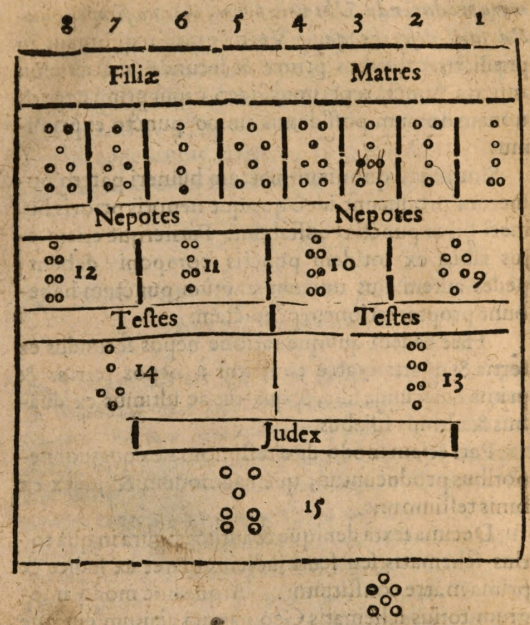
In the same way, two Witnesses are produced from four nieces, just as a Judge is produced from two Witnesses. Finally, the sixteenth, the last figure in which the whole shield is summarized, is made up of the Judge and the first mother. And in this manner the whole geomantic shield and its houses must be filled, from which the judgment in this art is to be taken.
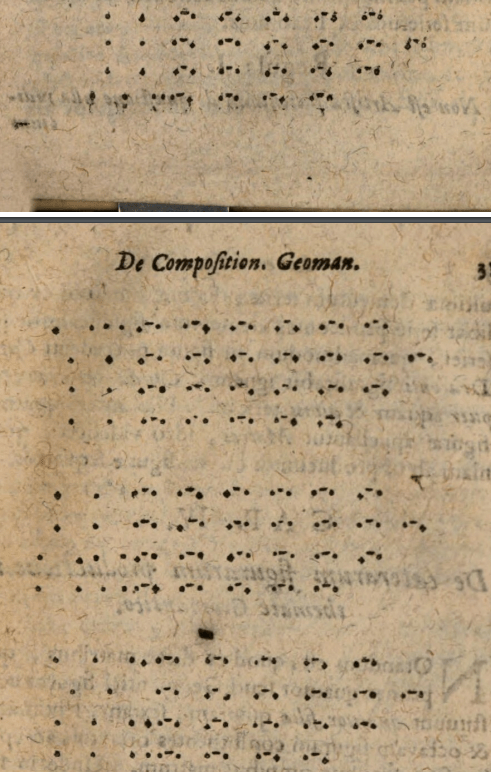
A geomantic shield, from Robert Fludd’s Geomancy handbook
Footnotes
Referring to Book I, Part 3. This section requires no commentary, as it describes the usual technique of deriving the full shield from the initial four figures. ↩︎
One pro of using more than one system of divination is that sometimes they clarify each other: sometimes one reading is somewhat obscure in one system but clear in the other, and we can use the clear one to navigate the one that has us scratching our heads. Granted, obscurity is in the eye of the beholder, being always a consequence of our own limitations, but it is still an occasion to learn.
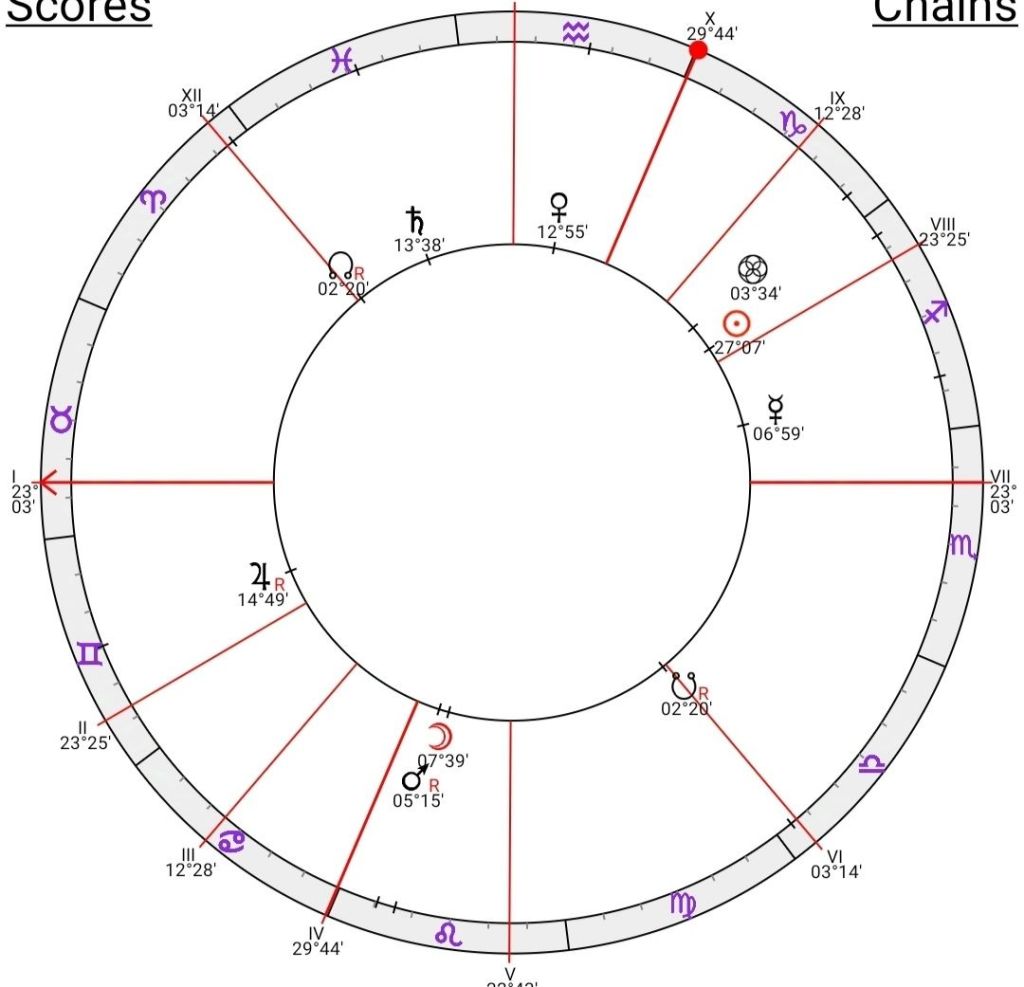
I was at the airport yesterday, trying to catch a flight to get back home. Suddenly, and to my horror, I noticed that plenty of flights were being cancelled due to the heavy mist, including one flight on the same route I needed. My first instinct was to cast a Horary chart, asking if I’d be able to get back home.
Will my flight go as planned or will it be cancelled? Horary Astrology
This was my first interpretation. I am represented by Venus, ruler of the ascendant. The place I want to get is my home, which is ruled by the Fourth House and therefore by the Moon (Cancer is on the cusp). The Moon is approaching an opposition of Venus. Bam! The flight will be cancelled.
After a while, as I was waiting for information, I did a Geomancy reading on the same question. Here is the chart:
Will the flight go as planned or will it be cancelled? App used: Simple Geomancy
The first thing the struck me is the generally positive Judge, Conjunctio, which arises from Carcer and Via. It argues mobility more than stasis, and obstacles that are removed. The second important point is the figure that represents me: Laetitia in the first. Laetitia represents upward motion. It is an exiting figure, meaning movement. What a wonderful symbol for a plane taking off!
Even if we want to involve the Fourth house, we see that it is occupied by Puella, a mildly benefic figure, which is also connected to the ninth house of journeys (it occupies it). So the journey (Ninth) connects with the home (Fourth).
Obviously,two systems of divination cannot give contradictory answers if correctly interpreted, and the Geomancy seemed rather obviously positive. So I went back to the Horary Chart (again below)
Will my flight go as planned or will it be cancelled? Horary Astrology
I meditated on this chart quite a while (I had plenty of time, after all). Then it hit me. I am represented by Venus. Venus is in the Midheaven (up in the sky) in Aquarius, an *air* sign. Not only, but Aquarius is fixed: it doesn’t change. My being in the sky is fixed. So there will be a flight: I will be up in the sky as planned.
But what about that opposition by the Moon? Well, there was significant delay, so the Moon could show the flow of events causing trouble to my being up in the air.
Ultimately, the Fourth House didn’t need to get involved. The point of the question was not whether I would get home (I would have gotten home anyway at some point) but what would happen to me/my flight.
No matter what kind of divination we practice: if it’s worth its salt and is not just some feelgood angel therapy oracle, it has the potential to deliver bad news. How we handle bad news is a mark of how helpful we are capable of being as diviners.
People can come to us for a variety of reason. They may need reassurance, hope, advice or just a quick look ahead. They may even come to us for fun or curiosity, and as long as they are not disrespectful, there is nothing wrong in indulging them.
The principle of respect for our querent stems from seeing them as a whole person rather than a sack of meat endowed with more than its fair share of doubts. We, as diviners and as handlers of odd devices (decks, charts, counters of various kinds) hold a degree of power over them. It is symbolic power, for sure, but reality itself is symbolic (that’s how magic works), therefore symbolic power is real power, and must not be misused.
Finding the right balance between informing the querent and respecting them can be difficult. It’s all well and good as long as the cards talk about pleasant trips and job interviews. But occasionally we recognize messages that we know are going to deeply upset our querent.
Causing unnecessary anguish is a no-no, and there are things that cannot be said without causing unnecessary anguish (“You’ll die soon”, “You’ll lose the baby). Even less serious topics (at least, less serious than death), such as marital infidelity must be treated with caution. We cannot just destroy whole families willy-nilly simply because our cards seem to hint at untoward dealings.
We must also distinguish whether a querent directly asks for something or something unpleasant simply shows up in the cards. Usually, if the querent asks for something, we can be more forthcoming, if we can speak with tact. If they ask “Will I get the job?”, they need to be able to accept “I’m not infallible, but it seems they appear more inclined to go with someone else.”
If they ask “Is my spouse faithful?” and the cards show clear signs of interference, an answer like “Remember that I could be wrong, but there does seem to be someone who’s trying whisk them away from you. Maybe it’s time to have an honest talk and try to solve the issue.”
Incredibly enough, even some taboo topics may occasionally be addressed in this guise. For instance, there are plenty of non-morbid reasons querents might want to know about death: “Do you think my elderly father going to survive long? I want to be able to visit him one last time but the situation at home is just crazy.”
While we must not delude the querent, we have no right to rob them of all hope. Aside from the mantra “Remember I’m a fallible human being”, and even aside from potential advice we might sometime give the querent to soften the blows of bad luck, there are occasionally ways of preparing the querent for a difficult situation without hurting them.
“Is the pregnancy going to go alright?” This is a question I am become more and more skeptical of answering as time goes by, because there is no way of saying anything other than “yes” and still be able to look at myself in the mirror. If we do find ourselves somehow coerced into answering it and the cards are less than positive, the only thing we may say is something to the effect of “Yes, but remember to take it easy, and the cards are saying you should pay extra attention to the doctor’s orders.”
Where all else fails, human empathy is our last line of defense. Helping the querent even for just some minutes by sharing their burden is part of what we may have to sign up for when we choose the path of divination.
On the projection of sixteen lines, divided into four orders, constituting the first four geomantic figures
Before proceeding to the projection of the [geomantic] lines, which are made up of points, we shall lay down certain rules to explain the reason and manner of creating them.
Rule 1
It is not for the artist to make a judgment on any question relating to a matter which he has already known and understood before, for by doing this he is trying God and his divine knowledge, and will err on that account.1
Rule 2
Do not count the number of points of any line, for by that reason the soul will somehow be disturbed in the calculation.2
Rule 3
If you want to work in this science, you must first describe the proposed problem, so that your understanding is not disturbed otherwise.
Rule 4
You must not make a double question, but form the question in such a way that it asks for the knowledge of only one thing; otherwise your figure will be so disturbed that you will not be able to judge anything correctly. For this reason the question must be rectified in such a way that it has a single and complete purpose.
It must be noted that these geomantic lines merge from equally distant points and must have the form of the four fingers of the hand, as will be seen in the following example, and the points of each line we must connect and concatenate in such a way, proceeding from right to left, that at its extremity to the left one or two points are left free from concatenation.
Example of a geomantic projection
This also must be done with all the lines of the aforesaid four series, and in this way will come forth the four first figures of the geomantic shield, representing the four elements with their natures and combinations, likewise the four winds, and the four parts of the world; for, as regards the elements, the four first lines will signify the element of fire, the second four will denote the element of air, the second three the element of water, and the last four the element of earth.3
Of course, the figures coming out of each series will represent an element of their series, just as in the previous figure Caput will represent fire, Causa will represent air, Puer will represent water, and Albus will represent earth. Now these four figures are called Mothers, because from them all the following figures are produced.
MQS
Footnotes
Asking a question whose answer we know implies that the actual question is “Does this really work?” which is a question no system can answer from within itself, therefore the question implies doubt in the author of the system ↩︎
Counting the points not only implies trying to cheat the system, but it also robs the divination of its random, inspired aspect. ↩︎
The elemental attributions of the figures is not of major practical importance, but it serves to respect the connection between microcosm and macrocosm and to anchor the question to a cosmic mechanism. ↩︎
I’ve already written a couple of articles on unanswerable questions. Some of them are unanswerable for logical reasons, others because they ask about something on which no objective standard of measurement exists. Some are also unanswerable for ethical reasons (“Tell me when is the best time to rob the bank.”)
But occasionally someone comes along who asks a question that we instinctively feel is unanswerable, yet we can’t put our finger on why. It’s happened a couple of times to me that someone would ask me something to the effect of “Will I ever be happy?“
Obviously no one whose life is coming up roses would seek out a diviner of all people to ask such a question. These queries are put to the cards or the skies in a moment of weakness. My experience in these situations is that the cards behave in one of three ways. They:
Show the cause of the person’s unhappiness rather objectively, and whether the problem is likely to be overcome over the next few months (usually not)
Are generically very negative, without a specific sense to them
Are generically very positive, without a specific sense to them
In the first instance, the cards usually show the problem not getting resolved, not necessarily because it never will be, but because the person is still knee-deep in it. The fact that they chose to frame their question in such tragic terms tells us that, whatever the nature of their problem, it goes beyond its specific objective nature and it has wounded the person in their soul.
Extreme care is advised in dealing with people in such a state of difficulty. They come to us broken and they should, at the very least, not leave even more broken. Furthermore, it is not unlikely that they have started consulting many diviners, obsessively asking the same question in hopes of getting a magical solution to their issue dropped in their lap. It would be good to advise them to stay away from divination for a while, unless we are capable of pointing out a solution they haven’t thought about, which unfortunately is rare.
When the cards are generically positive or generically negative, they are merely reflecting the person’s state of confusion: the bleakness of their outlook or the irrational hope for unexpected redemption. I don’t think there is much that we can do in such situations, except telling them that their upset shows in the cards and that, life being a succession of phases, even this one will pass. Sometimes, in such situations, talking to them in our quality of human beings is better than talking to them in our quality of diviners. In extreme cases, having a hotline number handy may be helpful.
Really there isn’t much sense in asking this question except to torture ourselves. We as diviners should know this when asking our own questions, but many people don’t, so it’s best to be prepared.
Fludd discusses how the diviner should prepare to a geomancy reading.
The Preparation of the Soul of the Diviner Prior to Making a Figure
Since this knowledge is founded on [an operation of] the soul,1 it is certain and manifest that no truth can be guaranteed in it, except in so far as the soul permits it.
Therefore it is required that he who wishes to be versed in this art, before he begins his operation, should have a good and clear conscience, and that his body and spirit should be governed without disturbance, and that he should not think worse of another than of himself,2 nor should his mind be spare in judgment, and not tend to negation more than to affirmation. He should be a just judge of the question proposed.
Finally, he must trust in God almighty, who is the author of all knowledge and truth,3 and pray to him that through this knowledge he will be allowed to find the truth that his heart longs to know.
All of this having been properly considered, and with a soul well established in the proposed matter, he will immediately make the projections of the points.
Hence it is that so much fallacy and uncertainty arise in this art. This is also the reason why the same art is immediately regarded as nothing, namely, because some, falsely ascribing the name of artists to themselves, neglecting God, and not being moved in the least by the pacification of their souls and of the pleasures of the body, falsely judge of the things proposed, and by this reason render this secret and very profound art so despised, that it is also commonly regarded as the most falsified of all.
The fault, then, is not in the science, but in those who profess it: the science is doubtless most truthful, but its proponents are often hindered by ambiguities and difficulties because of their vicious dispositions.
For who can doubt that the soul can direct any part of the body to the true knowledge of the future more easily than the whole body itself?4
When we perceive that she governs her whole body in such a way that she foresees the future every day and every hour, that is to say, that she will arrange such a business the next day, and ride to this or that city, and do other things the following week, or even that she will marry at this or some other time, or that he would carry out his purpose and plan at such or such an hour, etc.5
To the modern reader, these tips may seem to have a moralistic taste, but we should keep in mind that, aside from being in part a product of the times, they may be boiled down to the very sensible idea that a diviner, as intermediary between the querent and the divine, should purify himself of that which keeps him away from the divine. One cannot be a bridge between A and B without being capable of reaching both sides. Aside from being against Christian morality, “thinking worse of another than oneself” also implies being engrossed in outside world nonsense. ↩︎
A fundamental truth of all divination is that its knowledge does not originate within the diviner. ↩︎
That is, the soul is more capable of the body of considering the future. ↩︎
This remark may appear odd, but from an occult standpoint it does make sense: our soul is capable of conceiving the future because it is integral part of an inner world (which opposes and complements the outside world, of which our body is an integral part) wherein the normal rules of time don’t unfold as they do outside. ↩︎
Fludd offers interesting anecdotes from his life to elucidate the nature of Geomancy.
The Internal Principle of Terrestrial Astrology, or Geomancy
In the penultimate year of the life and reign of Elisateth, the glorious queen of England whose fame will never die, I was forced to stay in the city of Avignon during the whole of that winter, because of the severity of the weather, which covered the mountains with a lot of snow, and completely barred the journey to Italy.
In the house of a certain captain, together with many other noble and well-educated young men, and having received board from the Jesuits, I discussed philosophy with them one evening during supper, and perceived a variety of opinions concerning geomantic astrology. Some of them denied its virtue altogether, while others, on whose side I stood, vigorously defend the power of that art, and I adduced many reasons by which I proved that I was engaged in that knowledge of fate.
When the supper was over, as soon as I had betaken myself to my apartments, one of these men followed me and asked me to try my art, which he believed to be great, regarding some important matter whose resolution, he said, greatly concerned him.
After making many excuses, at last his prayers convinced me and I made him a geomantic figure in response to the question proposed by him, which was as follows: Whether the girl, by whose love he was vehemently captivated, would redeem him more than the others from the sufferings of mind and body.1
And after making him the figure, I affirmed that I could well describe the nature and disposition of the body of his beloved and, having done so, I noticed a particular mark or a certain spot, namely a fateful wart noticeable on her body, and so also I noted its place, indicating it to be on the left eyelid.2
This, of course, he also confessed. I also said that she was very fond of vineyards. He confirmed, as if exultant, adding that it was because her mother had built her house among vineyards. In short, I answered the question in this way: his beloved was inconstant and by no means firm, so much so that she loved someone else.
To which he said that he also suspected the same, and that he now saw it as if with open eyes. He then left my room with excited haste, and he reported [to the others] with some wonder the truth and power of my art.
But some of them, who happened to know this girl well, totally denied the existence of the mark described on her eyelids, until the next day, talking with her, they themselves also became witnesses to the truth of this matter, which I had explained to them by way of geomancy, and which they had not even observed before.
From here, therefore, more than I desired it, I became renowned, so that the report of this matter was carried to the ears of the Jesuits themselves. Two of them, hurrying to the steps of the palace, told the viceconsul all these things, and, moved by envy, said that there was a certain stranger present, an Englishman, who had foretold the future by a science rejected by the Catholic Church, that is, geomancy.3
These things were reported to me in the morning by the captain of the palace, named Johannes, who also referred to me the answer given to the viceconsul to these very things, which he affirmed to have been such:
“What?” said he, “This is not such an abomination as you make of it. Is there anyone among all the Cardinals of Italy who does not have his birth astrologically or geomantically described?”4 A few days afterward, the consul himself desired to speak with me, and kindly invited me to dinner. With a certain dear friend of mine, Monsieur Malceau, the apothecary of the Papal Palace, I went to the palace, where, having paid due respect in the usual manner, the viceconsul engaged with me in dialogue:
“I understand,” said he, “that you are well versed in the geomantic art; what is your opinion of that science?” To which I replied that I had proved by experience that this knowledge was essential and established by fundamental secret principles.
“How is this possible,” said he, “that there should be any certainty in something that consists of accidental points?”5
I told him: “The principle of these points made by the human hand is internal and very essential, since it is derived from the soul itself, which is the origin by this kind of movement. Moreover, the errors of this science are not caused by the soul itself, but by a perverse and incongruous movement of the body itself, moving against the intention of the soul.
Hence the general rule in this art is that the soul should be peaceful and that the body should obey it, and similarly, neither the body nor the soul should be confused or partial in the question, but let them be like a just and fair judge, and turn to God, praying from the heart that the truth may be revealed. At the same time, turn your soul energetically to the question proposed, and don’t be seduced by extraneous thoughts.”
“What then,” he answered, “is that soul of which you speak? Perhaps you understand by that your own soul, or the genius of Plato,6 or at least some angel?”
To which I answered: “An angel could not be the origin of that knowledge, since angels are divided into good and bad: good angels were seldom granted to the Arabs, Chaldeans, and Egyptians, who were the inventors of this art, and evil angels are all authors of lies rather than the truth, as the Holy Scripture testifies.”7
“From this, then,” said he, “it is evident that you yourself are not able to give a distinct and certain account of the principle in this science.”8
To which I answered that the human body is related to its soul as a servant is related to his master. A master may send his servant hither and thither with letters, without the servants in any way perceiving the intention of his master. Even a distinguished painter can send an excellent picture to a king through his servant; yet the servant is completely ignorant of the mixtures of colors and their symmetrical proportions.
In the same way, a king can impose taxes on his people through others, although the reason for these impositions is known only to the king himself. Similarly, of course, the body itself can perform what the soul commands, while remaining ignorant of the principles of this action except through its effects alone.
After hearing these things, he called me to a table standing in the midst of some of the bishops and deacons. There, taking pen and ink, he composed a geomantic figure, and very skilfully went over it, so that I could see that he himself was far more learned and expedient in that knowledge than me. Having thus finished my meal, I departed with his blessings, and visited him often afterwards; for I perceived that he was a very inquisitive prince, skilled in the sciences, kind to strangers, and in no way tyrannical.
Among the Jesuits, one was very desirous of conversing with me as a lecturer in philosophy. Therefore, at the entreaty of my dear Rheinaud, a young man of marked genius and modesty, I went to him, and was graciously received by him. There, after some philosophical discussions, he suddenly brought up geomancy, thinking perhaps that I would answer him easily.
“How is it possible” said he, “that by means of geomancy someone might be able to foretell the danger or death imminent to this or that person on his journey towards Rome? What is the participation and communication between his soul and yours, since both are contained within the human body?”
To which I answered briefly in this way: “Because the soul of each body is that chief light, having dominion over the rest of the body, no differently than the Sun in heaven has dominion over the other stars. Since the soul is the Sun of the microcosm, directing the whole body with her life-giving rays, there is no doubt that she also casts her invisible rays invisibly through the pores of the body in no other way than that Sun transmits his heavenly ones through the sieve of the elements toward the world below.9
In the same way that one star has a relation to another by ways of aspect, so that by application to one another they create the effects to be transmitted to the lower plane, so also without a doubt between the soul of one and the soul of another, which are invisible lights, rays are emitted, and by the emission they are joined together.
Thus, since either the petitioner himself or his friend is the one to who is in danger, and since the soul is very divine, and is the keeper of the body, she can foresee the future danger (for inasmuch as she is immortal, she can know the future and the present). So the soul will reveal to the querent the future secrets of the body, which the soul could not tell the body because of the body’s thickness. In this way the soul, quiet and peaceful, and prepared for judgment, very responsive to the bodily motion,10 can prognosticate without difficulty.
Moreover, Olaus Magnus,11 in his history of Finland, tells a great story about the amazing actions of the sorcerers of that region, among which he recounts the story of a certain enchantress.
It seems that when some from a remote country came to her in order to know about the state of his friends, the mode of operation was this: the witch, with some other woman and an assistant, entered the room, where, after many words muttered in silence, she took a serpent made of air, and, holding it by the tail, struck it twice with a small hammer, and having done so, she suddenly collapsed as if dead. And the other helped by driving away flies and other small animals, so that they might not touch her. Half an hour later the witch arose from her sleep, and told the truth about the petitioner’s friends.
But what does this mean, if not that the soul of that witch had communion with the souls of the querent’s friends? And since the semi-diameter of its rays was too short to reach the extremity of the soul of the friends, in order to fulfill the desire of the querent it was necessary for the her to depart from her heart to find a place where it could have communication and its application with the rays of the souls of the friends.
Doubtless the animal rays extend themselves insensibly outside the body, far beyond the field of vision, so readily can they penetrate the thinness and purity of their essential substance, as through elementary means without hindrance.
After making some other similar similar remarks, he embraced me in a friendly manner, swearing that he would regard me as his brother, and praying that I would often visit him and his brothers. This, however, I could not do because of my sudden departure from that city to the Duke of Guyse, who at that time was living in Marseilles, who sent for me to teach him and his brother, a Knight Militant, the mathematical sciences.
In conclusion, therefore, this art is a science directly dependent on the soul, in such a way that its root is the soul itself, and therefore it is more subtle than all the other sciences which man can learn in this corruptible world.
MQS
Footnotes
I am not sure I translated the question exactly. However, the gist is correct, as may be seen from Fludd’s answer. ↩︎
It is common for old geomancy and astrology manuals to teach how to find peculiar marks on the querent’s or other people’s body. It was a way of convincing them of the veracity of the art. ↩︎
The status of astrology has always been ambiguous in the West. However, geomancy was more unanimously rejected as dangerous. ↩︎
It was important for Fludd to establish the semi-official status of geomancy as a legitimate science by mentioning the common practice of horoscopy ↩︎
The objection of the viceconsul is similar to the one already discussed by Fludd in the introduction. ↩︎
In order to conform to the Christian orthodoxy, Fludd must deny the influence of angels, since Geomancy was not invented in the Christian West. ↩︎
The reason for the need to establish the principles of Geomancy as a science is twofold: on one hand, to justify it, and on the other in order to conform to the Aristotelean view of science typical of the time ↩︎
This answer is typical of the Renaissance point-of-view, which always sought to establish correspondences between the inner and the outer, the higher and the lower. ↩︎
probably the bodily motion of the creation of the geomantic figure ↩︎