Category Archives: Geomancy

Fatalism and the Moment of Divination (Notes on Divination)

This post is part of my Notes on Divination series. This gets somewhat philosophical and is rough and not organized, so bear with me.

In the previous post in this series, I started discussing some general ideas on why fatalism is an inherently flawed view, while in the one before I had shown why pure free will makes just as little sense. To summarize, pure free will simply doesn’t take into account the fact that we don’t live and move within a blank space that we can change at whim.

On the other hand, pure fatalism cannot even be articulated as a view without contradicting itself: if fatalism is real, then my fatalism is not due to me assessing reality and forming a fatalistic worldview that corresponds to how reality factually is, but it’s due to destiny forcing me to be a fatalist. This implies that when I say I am a fatalist, I don’t really mean it. I *cannot* really mean it – It is conceptually impossible. In order to be a fatalist, I must have the freedom to develop a fatalistic worldview. This is a contradiction.

My view of the universe is consequently inherently libertarian, though it is a reasonable and limited libertarianism.* No matter how small our personal freedom is, it exists and is the place we our soul inhabits. Freedom is the consequence of consciousness. When I become aware of something, I posit it as the object of my awareness, outside of myself, and therefore incapable of completely determining my whole being.

Now let us ask: what happens during a (serious) divination session? What does divination do, at heart? At the very least, divination must either make us aware of unknown facts about the past, present or future, or it must shed new light on known facts, thus revealing them from a different, previously unknown point of view. A divination session that does not do this is not a divination session. It may or may not be helpful in other regards, but it is not divination.
The Moment of Divination

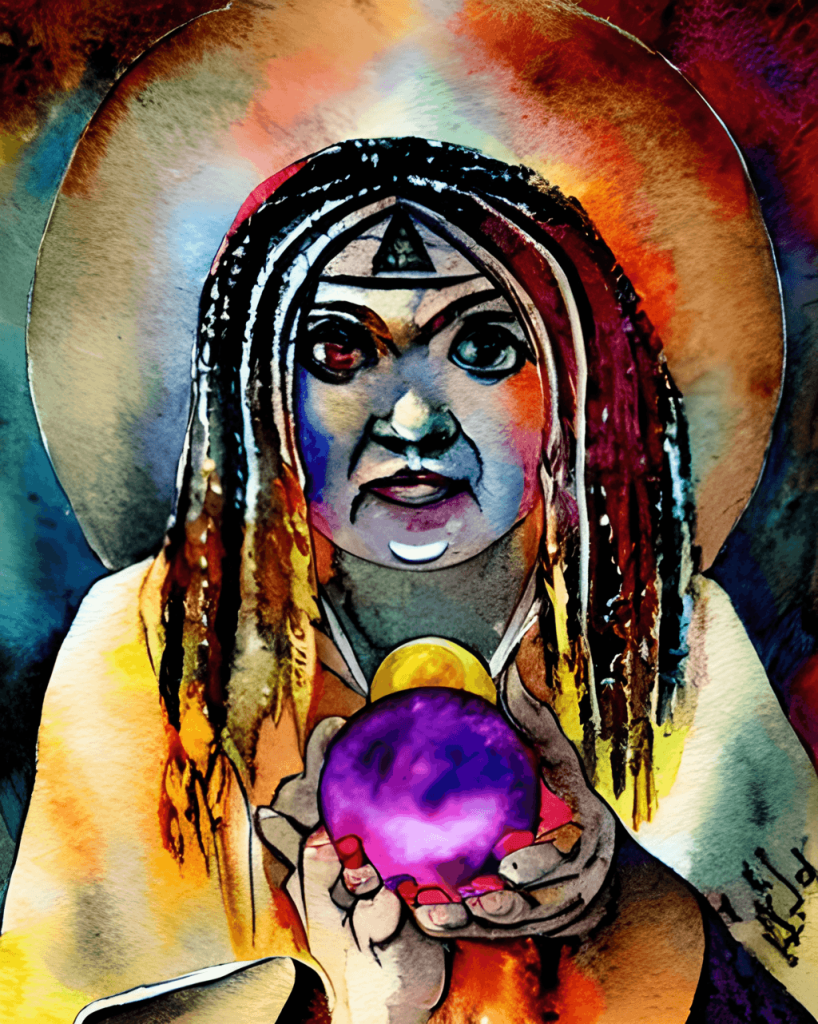
It is clear, therefore, that divination is inherently connected to consciousness and to increasing our conscious awareness of (our) reality. This is another reason why a (mildly) libertarian view of divination makes more sense. Suppose you cross the fortune-teller’s palm with silver and then you get told you will win over your crush: is the fortune-teller right because she actually sees this in the crystal ball or is she doomed to say this to you? If she is doomed to say it, then the fact that she is saying it has nothing to do with the statement being true and everything to do with destiny forcing her to say it.

Furthermore, in revealing your future to you, the fortune-teller cannot help but modify it. This has nothing to do with some odd theories I’ve read on the internet, about the fact that if you predict something you make it happen. If that were true, I could predict myself into a billionaire. Besides, even if the fortune-teller saw your future and didn’t tell you, she would still be modifying your future.

Reality is much more subtle. Suppose that X is going to happen to you. If the fortune-teller tells you, then you are aware of X happening. X happening with your awareness is different from X happening without your awareness. The fabric of the fact itself changes with your awareness of it, for the simple fact that something that happens with your knowledge is not something that happens without your knowledge.

The moment of divination, therefore, has a very important place in our life, because it is part of our life, but it is also a part of our life wherein our awareness of reality increases, thereby changing our reality. This does not automatically mean that divination can make us realize every whim that crosses our mind, nor that it can always save our butt. Sometimes the only choice possible is between accepting a fact and not accepting it.

I like to liken an oracle to a friend on top of a high building, who has a wider view of our surroundings than us as we move in a busy intersection of streets, and who texts us hints that increase our understanding of our reality and can help us make better choices, though sometimes the choices we can make are so severely limited as to border on predestination.

MQS
* I mean ‘libertarian’ from a metaphysical standpoint.

Geomancy – Reconciling the Judge and the Chart

We’ve seen that the process reading a Geomancy chart divides into two phases: the assessment of the chart and the assessment of the court.

If the chart and the court seem to hint at the same result all is well and good. Problems start when they appear to diverge and say different things. One way the old geomancers faced this possibility was by throwing random techniques at the chart so as to tease out a straight answer. In this, they were similar to old horary astrologers (“the significators are moving away and are in detriment, but ah, look at that Part of Fortune!”)

I like to keep things simple. An understanding of the first principles is more effective, I believe, than an endless array of techniques designed to allow the reader to say whatever he feels like saying at the moment. Geomancy is a “simple and short science” to quote Abano.

Abano himself, in his book, often talks about the Judge as if it described an ultimate state of affairs beyond the immediate result. This is something that I have found in other old books as well.

We only have eight possible Judges, so the Judge won’t be able to offer much subtlety in its verdict. Even after we factor in the Witnesses we still have a limited oracle. But think about it: a real-life judge doesn’t usually have much to say except to either rule for or against someone. Sure, he can tweak this or that detail, but that’s about it.

The judge’s ruling usually determines who’s happy with the result and who isn’t, but that’s not always the case. Sometimes a judge may rule in your favor but empty your victory, or conversely he may rule against you but still grant you the one small thing you care about.

Therefore, in a Geomantic reading the Judge usually describes the general tone of the answer, especially how the matter ends (well, so so or not so well). The interrelationship of the figures in the chart, though, is much more specific as it describes in more detail what happens concretely.

This is not a matter of “perfection means yes”. Perfection doesn’t mean yes. Perfection means contact or connection. Usually, of course, contact with something or someone is a positive sign as we generally want to obtain something, but context is key. “Will I be able to leave this abusive relationship?” with the two significators perfecting is a clear no.

Suppose in this example that the significators perfect, showing continuance, but the Judge is Fortuna Major. Maybe the spouse starts taking their AA meetings seriously, or depending on the other signs in the chart it may show that the querent isn’t capable of leaving now but will at a later point (Fortuna Major shows long term success)

On the other hand, there’s plenty of situations where we get our wish but later regret it. “Will I get the job?” and the first and tenth connect, but Carcer is the Judge: yes, but you won’t like it one bit.

Some like to bring in a sixteenth figure, usually called the Reconciler or the Judge of the Judge. This figure is obtained by adding the Judge to the first house figure. This can show you how the end of the matter affects the querent, but it is not a substitute for working out the meaning of the chart. All in all, the sixteenth figure only gives details, never the answer.

Greer, in his book, offers a ton of suggestions on how to deal with an obstinate chart that resists interpretation, including using certain figures to derive a new set of Mothers. Frankly, if you are that desperate, you may just as well interrupt the divination and ask the question again the next day. In all honesty, though, it has never happened to me.

The key to interpreting any oracle is to be reminded that divination is a language and language describes the world. The oracle is always a mirror of real life situations, not an abstract set of simbols.

MQS

Yes, Pregnancies May Be Predicted in Divination

I read somewhere that pregnancies cannot be predicted because it is impossible to bring someone into the equation who doesn’t yet exist. The cards (or any other method) supposedly cannot talk about inexistent people, and they may only be used to check on pregnancies that have already started.

I certainly agree that it may not be wise to use divination on health-related issues, especially on such delicate topics, since we diviners are fallible, and should never forget it.

That it *is* possible to use them to this end, though, is confirmed by experience. I believe I even discussed a spread where I predicted that a woman would become pregnant, even though the question wasn’t even about pregnancy.

The idea that the cards cannot talk about people that don’t exist, though, is poppycock. The child may not exist, but the woman’s body certainly does. If we can predict that the woman’s body will betake itself to a job interview, to the mall or to a date, it’s unclear why we shouldn’t be able to predict that an organism will start growing inside of it after a spirited round of nooky.

MQS

The Geomantic Court: Witnesses and Judge

The process of interpreting a Geomancy chart almost seems to split between two phases: 1. assessing the significators and their relationship (as discussed here) 2. interpreting the geomantic court. Some would even object to the order in which I give them, as, technically speaking, it’s the Judge that gives the answer.

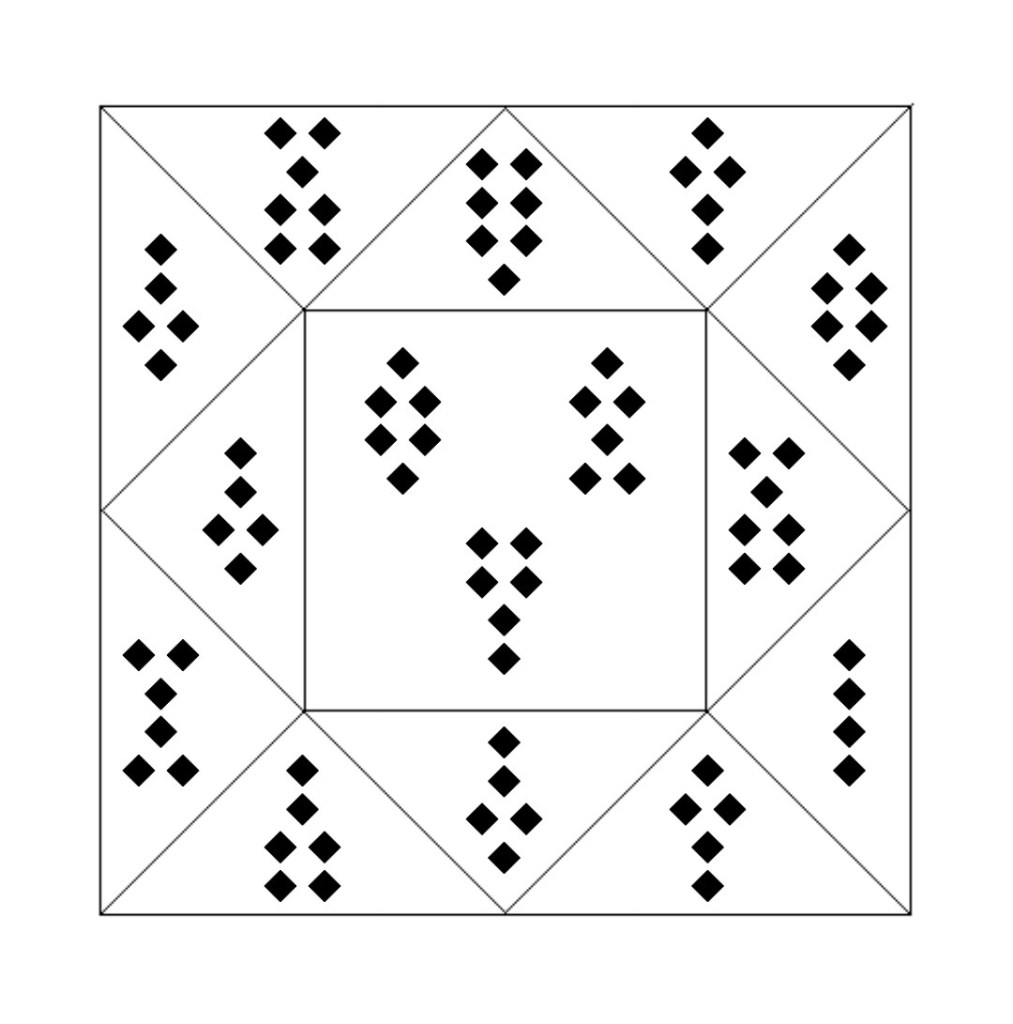
The Geomantic Court is copmosed of the two Witnesses and the Judge. The two Witnesses represent the culmination of the process of development of the two sides of the Geomantic Shield (as discussed here)

Example of a Geomancy Shield reading, with the App Simple Geomancy

The right and left Witnesses (the right one is Albus, the left one is Caput) are the last product of the right and left sides of the Shield respectively. The Judge represents the overcoming of this duality into a final unity that takes everything into consideration.

We can easily liken the two Witnesses to the two pans of a scale, where arguments in favor and against are weighed. The fact that, from a technical standpoint, the Judge can only be a figure with an even number of points speaks to the Judge’s consideration of both sides. Keep in mind that there’s a total of 65.536 possible shields when we allow for all possible permutations of the sixteen mothers. But only 8 Judge figures are possible. Obviously, the Judge’s sentence can only be a general bird-eye view of the situation from the throne of Heaven, as it were. This is very different from the concrete and specific interrelation of the geomantic figures on the Shield.

As for the two Witnesses, as said, they are the culmination of the process of discussion that is carried out on the two sides of the Shield, the right side belonging to the querent and the left side to the quesited, or, alternatively, the right side being what pleads for the querent and the left side what speaks against his or her success.

Peter de Abano, interestingly, likens the right Witness to the planet the Moon separates from in an astrology chart, and the left Witness to the planet she applies to. This is largely in keeping with the attempt of Medieval magi to reduce everything to astrology. If you follow this school of thought, since in traditional astrology the Moon represents the flow of the chart or the flow of action in the chart, then the right Witness is the past and the left Witness the future. Personally, I tend to see the two Witnesses as belonging to the same timeframe, of which they highlight the up and down sides.

Some rules have been passed down to us for assessing the relationship between the Witnesses and the Judge. For instance, it is said that if the Witnesses are positive and the Judge negative, it shows that the matter is easier at the beginning but doesn’t end well, and vice versa if the Witnesses are bad and the Judge good.

In general, if we accept that the Judge is nothing more than the sum of the two Witnesses, and that the two Witnesses are the ‘for’ and ‘against’, then in a way the Judge is nothing more than a recapitulation of the Witnesses’ discussion, seen from a higher, more general level.

If we take the example of the Geomantic court above, where Acquisitio is the Judge and it derives from Albus as the right Witness and Caput as the left Witness, and if we suppose the question is about a business deal, then the right Witness argues that the querent has good business sense or a good plan, while the left Witness adds that it’s going to be hard at the beginning, while the Judge surmises from the discussion that, in general, the deal is going to be profitable.

Alternatively, if we take the right Witness as a symbol of the querent and the left Witness as a symbol of the quesited, the querent is still shown as a competent businessperson, while the quesited, i.e., the deal, is shown as a promising new start, while the Judge still rules in favor of the deal being good.

In the next article I will talk about how to reconcile the Judge and court with the other aspects of the reading.

MQS

The Four Modes of Geomantic Perfection

Geomancy, like astrology, sets up a system of correspondences between houses and life sectors. In all cases, we use the first house to represent the querent. If the question is asked by the querent about themselves, this is enough. If the question is asked by the querent about someone else’s life, then the first house will be irrelevant, but admittedly, in most cases people ask about themselves.

In order to divine meaningfully with geomancy, we also need a quesited, that is, a topic of discussion. This will be represented by another one of the twelve houses, as discussed here. Once we have the querent and the quesited, we need to see what happens to them.

A first indication is given by the geomantic figure that occupies the respective houses. This can shed light on the querent’s and quesited’s current state or qualities. But this is not, in itself, good enough to predict that something will or will not come to pass. Something can be very good in itself, but if it doesn’t happen to me, it is of no great consolation.

This is where geomantic perfection comes in. We call geomantic perfection the way the querent and quesited relate to each other, allowing things to come to pass. In the vast majority of questions, we desire to obtain something, which involves coming into contact with that something. Geomantic perfection allows us to come into contact with it. It is to geomancy what aspects are to traditional astrology (more or less. I’ll come back to it in the next article)

There are four forms of perfection: occupation, conjunction, mutation and translation. Not all medieval handbooks describe all four, but I have found that they all work.

Occupation

Occupation is the simplest and strongest form of perfection. It occurs when the querent and the quesited are occupied by the same figure.

Example reading. App used: Simple Geomancy

Let us suppose the querent asks whether he will manage to buy a house he has seen, or whether he will meet with his father during the holidays. The querent is symbolized by the first house figure. The quesited is symbolized by the fourth house figure. In this case, both are Puer, so we can say that the first and the fourth house are connected by Occupation. There is a strong connection. In most cases this is good. It can also signify that there is perfect union between querent and quesited.

Conjunction

Conjunction is next in line in terms of strength. Conjunction happens when the first house figure (the querent) is also found in a house adjacent to that of the quesited, or vice versa if the figure of the quesited is found in a house adjacent that of the querent. This is the standard definition that has come to be accepted. In the old manuscript there are some variations (for instance, it seems that Abano did not accept the twelfth house as adjacent to the first.) In my experience, the standard definition is good enough.

Example reading. App used: Simple Geomancy

Using the same figure as before, let us suppose that the querent asks whether he shall meet with a friend, or a brother, or whether he shall go to a party. The first house is still represented by Puer. Puer moves to the twelfth, where it is adjacent to the eleventh, the house of friends. It also moves to the fourth, where it is adjacent to the house of brothers (the third) and to the house of parties (the fifth).

Note that if the querent moves to meet the quesited, it shows effort or interest on the part of the querent, while if the quesited moves to meet the querent the opposite is true. Of course, this needs to be interpreted: if the illness moves to meet you it doesn’t mean that the virus is besotted with you–it just shows that it comes to you easily. In a relationship reading, the figure that moves to meet the other is the one who is more interested or in love.

Mutation

Mutation happens when the querent and the quesited both move and end up meeting somewhere else in the chart.

Example reading. App used: Simple Geomancy

Let us suppose that the querent asks whether he shall meet with the girl he likes. The first house figure, Puer, moves to the twelfth and the seventh house figure, Rubeus, moves to the eleventh. The two houses are adjacent, so the two shall meet. Mutation indicates meeting in a third place or, depending on the question, it can show mutual effort. The houses where the figures meet can also shed light. For instance, in this case it is likely they will meet at a friend’s house (eleventh) or in some remote hidden place (twelfth).

Translation

Translation is the last form of perfection. It happens when a third figure is found in a house adjacent that of the querent *and* that of the quesited, so as to form a bridge between them.

Example reading. App used: Simple Geomancy

In this case, we have no translation to the first house. However, if we suppose the querent asked about the relationship between his father (fourth house) and his mother (tenth house), then we find that Puella forms a translation between them, being in the fifth house (adjacent to the fourth) and in the ninth (adjacent to the tenth). Translation usually shows the involvement of a third party. In this case Puella could show the influence of a woman or girl.

Prohibition

Prohibition is the absence of perfection. This is the most common way a chart has to tell us we won’t get what we want or, more broadly, that there is no connection between querent and quesited.

Example reading. App used: Simple Geomancy

Let us suppose the querent asks about the possibility of getting a job he applied for. There is no contact between first house (querent) and tenth house (quesited): no occupation, no conjunction, no mutation and no translation. The querent is unlikely to get that job.

Final Notes

  • Sometimes a figure passes into an unrelated house. This can add context and information for good or ill.
  • Perfection shows contact. It doesn’t tell us whether the contact is good or bad. In the example about the querent’s parents, if we suppose that the querent asks whether his parents will divorce, the translation by Puella may show that someone will convince them to stay together. However, if the translation were made by Cauda, it could show a mutual agreement to end the marriage.
  • The Court must always be taken into account, although we will discuss it in another article.

MQS

Cauda Draconis / Dragon’s Tail (Geomancy Figures)

Name of the Figure: Cauda Draconis (Dragon’s Tail); sometimes called Outward Threshold
Element: Fire
Planet: None, Moon’s South Node (some say also the malefics, Mars and Saturn)
Sign: Sagittarius
Quality: Exiting
Fortune: Bad

Cauda Draconis is the less lovable sibling of Caput Draconis. Like its counterpart, Cauda is not traditionally associated with any planet, although some classics say it belongs to the malefics of astrology, namely Mars and Saturn. However, in itself, Cauda is connected with the Moon’s South Node. Technically every planet has nodes, that is, points where they cross the Sun’s ecliptic. However, in traditional astrology, only the Moon’s nodes are considered, as the Moon’s connection with the journey of life is said to begin with the North and end with the South Node. Visually, the symbol of Cauda is said to show a series of steps leading away from a threshold, symbolizing the sense of ending.

Illustration of the geomantic figure Cauda Draconis, Dragon’s Tail

And ending is indeed one of the main meanings of Cauda. Ending is not necessarily bad. When you want to get rid of an illness, or really anything, Cauda can be positive, if not easy. It also shows quick, sharp change, so it can bring stagnant situations to an end.

Still, Cauda is mostly unwelcome in most readings. It can indicate the end of a relationship (or that a relationship won’t start). It can show unemployment and loss of money. It can announce difficult interpersonal relationships all around.

Due to its connection with the bad side of life, Cauda is one of the figures that, traditionally, prompted geomancers to break their figure and abandon divination if it shows up in the first house. Don’t do it. Just because Cauda is in the first house doesn’t mean your querent is a psychopath. Cauda is a challenging figure. It can simply mean the person is going through challenging times, that their life is changing dramatically and they have lost the plot.

Common Keywords: Ending, Loss, Abandonment, Evil, Quarrel, Evil intentions, Disruption, Letting go

Cauda Draconis in the Geomantic Houses (these are only examples. Use context to guide your interpretation)

HousePossible Meanings
FirstDangerous person, Person in danger, Person who is going through hell, Person who is ending something
SecondLoss of money or items
ThirdQuarrels among neighbors or siblings, Bad news, False rumors
FourthEnd of lineage, Death of father, Eviction, Loss of home
FifthDanger though excess, Loss of pregnancy, Questionable pastimes
SixthEnd of sickness (but if the chart is bad, it could end with death), stay way from your servants
SeventhDivorce, Quarrel, Theft, Untrustworthy individuals, Fraud
EighthDeath, Danger, Loss of money
NinthEvil religion or way, Inability to learn, Atheism, Materialism, Loss of faith
TenthBeing fired, Loss of employment, Revolution, Coup d’etat, Death of mother
EleventhEnd of a friendship, Fights, Quarrels, End of hope
TwelfthEscape, Freedom, Death of large animals
ThirteenthThere was upheaval, ending, disaster, the querent is capable of letting go
FourteenthThere will be upheaval, ending, disaster, the querent is unable to let go
FifteenthCauda cannot be Judge
Possible meanings of Cauda Draconis in the various Geomantic Houses. Note that this is not meant to be exhaustive, and it only serves to jog your interpretive muscles

MQS

Caput Draconis / Dragon’s Head (Geomancy Figures)

Name of the Figure: Caput Draconis (Dragon’s Head), sometimes called Inner Threshold
Element: Earth
Planet: None; North Node (some say also the benefics, Venus and Juputer)
Sign: Virgo
Quality: Entering
Fortune: Good

Caput Draconis, like its counterpart Cauda, is a special figure in the geomantic family. These are the only two that are not canonically assigned to any traditional planet. Instead, they are given to the nodes of the Moon, i.e. the points where the Moon intersects the Sun’s ecliptic. These were held in exceptionally high regard in traditional astrology, at least from Arab astrology moving forward (but apparently also in Hellenistic astrology, though their function there is debated.) Caput Draconis, the North Node, is usually said to be expansive and broadly positive, or at least augmenting. The symbol of the geomantic figure is usually likened to a series of steps leading toward a threshold.

Illustration for the geomantic figure Caput Draconis, the Dragon’s Head

Some say that Caput is associated with the two benefics of traditional astrology, Venus and Jupiter. More specifically, though, Caput is not automatically a good figure. It often represents an onrush of new energy, indicating everything new or everything that starts afresh.

More generally, it is associated with everything that develops, grows, becomes more stable and certain. This, of course, is a double-edged sword, as not everything that is stable is good for us. Often, Caput shows the impossibility to get rid of something, even if it is bad for us. It shows long illnesses, for instance.

Often, however, Caput is in fact a positive figure. It represents things coming to us, and as most questions get a positive answer when something comes to us, Caput is mostly a welcome figure.

Common Keywords: Arrival of new situations, beginning, fresh air, new enterprises, dynamic energy, development, deepening, stabilizing, long-lasting

Caput Draconis in the Geomantic Houses (these are only examples. Use context to guide your interpretation)

HousePossible Meanings
FirstPositive, taking initiative, going, doing, starting something, good luck
SecondIncome, new income stream
ThirdNews, important information, help from siblings
FourthBuying real estate, help from the father
FifthFun, pregnancy, conception
SixthLong illness, good servants
SeventhNew relationship, lasting bond
EighthBeing shielded from danger, gain from other people
NinthConversion, signing up for a course, good at learning, spiritual evolution
TenthNew job, lasting stability in one’s career
EleventhNew friends, realization of hopes
TwelfthLong prison sentence, safety from occult enemies
ThirteenthQuerent has initiative, something has already started
FourteenthQuerent lacks initiative or needs to exert it more, there will be a new beginning
FifteenthCaput cannot be Judge
Possible meanings of Caput Draconis in the various Geomantic Houses. Note that this is not meant to be exhaustive, and it only serves to jog your interpretive muscles

MQS

Carcer / Prison (Geomancy Figures)

Name of the Figure: Carcer (Prison)
Element: Earth
Planet: Saturn (direct)
Sign: Pisces
Quality: Common
Fortune: Bad

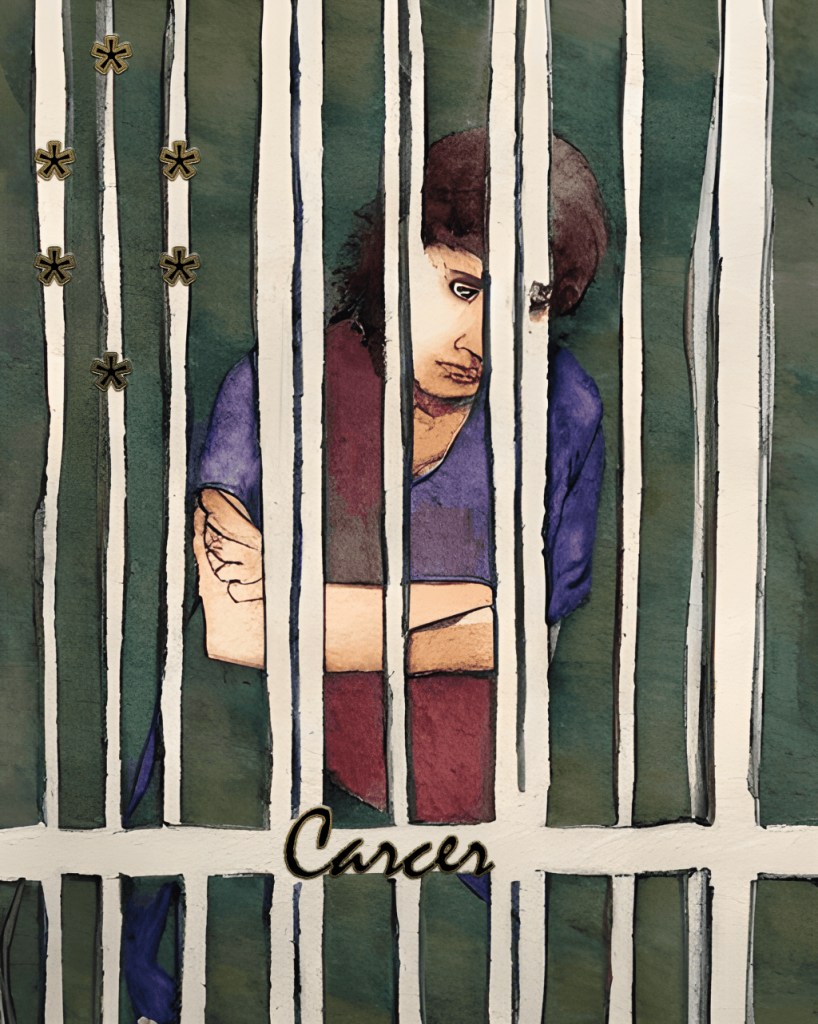
Carcer is a figure of Saturn direct. Its symbol is said to represent an enclosure, pen or prison of some kind. If we choose to look at the single dots as active elements, then Carcer is the opposite of Conjunctio, in that its active elements have in common the quality of dryness, which indicates difficulty in integrating and mixing together. Furthermore, the two elements are spread apart (one at the top, one at the bottom) and the figure can also be seen as two arrows pointing in opposite directions.

Illustration for the geomantic figure Carcer, prison

Carcer’s association with Saturn is very telling, as it embodies many of its qualities. It indicates loneliness, and in personal relationships it is broadly bad in its import. Although with positive indications it can show long-term commitment, it is more likely to show feelings cooling off, if not outright separation, or more simply it can speak of not finding anyone to be with. Lack of communication and personal contact all belong to the figure’s array of meanings.

Carcer can show prison and negative sentences in general, but the symbol of a prison or enclosed place can be interpreted metaphorically as obstacles, blockages and restriction. It indicates situations where we are in difficulty and it is difficult for us to act. However, on a brighter note, the symbol of the enclosed space can be interpreted as a womb, and Carcer is said in some sources to be good for pregnancy.

Another field where Carcer is generally positive is for building and laying the foundations of buildings (or maybe, metaphorically, for laying the foundations of something) and for keeping things secrets and solo endeavors such as meditation, study, etc. In most mundane questions, though, Carcer is one of the worst figures you can obtain, especially since it can become Judge, unlike other negative figures.

Common Keywords: Loneliness, sadness, blockage, obstacles, stoppage, building, laying foundations, separation, obligations, debts, poverty, pregnancy, secrets, deep knowledge

Carcer in the Geomantic Houses (these are only examples. Use context to guide your interpretation)

HousePossible Meanings
FirstLonely person, blocked, in difficulties, Stingy, Difficult to relate to
SecondPoverty, Lack of means, Hardships, Debt, Financial obligations
ThirdLack of communication, Isolation from the community, Only child, Lack of relationship with the siblings
FourthCastle, Large building, Constructing, Building, City, City walls, Tombstones, Loss of the father
FifthDepression, lack of fun or excitement, restraint, pregnancy
Sixthlong convalescence, difficult illness, lack of mobility, animal pens, death of animals
Seventhloneliness, interpersonal difficulties, person is already committed, lack of relationships, separation
EighthCemetery, death, fear, lack of progress, lack of money from the partner
Ninthserious study, hidden knowledge, atheism, a priest or hermit,
Tenthunemployment, lack of upward mobility, dead end
Eleventhloneliness, lack of help or friends
Twelfthprison, black magic
Thirteenthpast loneliness or hardships, person is serious, solid
Fourteenthfuture difficulties, person needs to face serious challenges
Fifteenthlack of success except in building and keeping secrets or pregnancy
Possible meanings of Carcer in the various Geomantic Houses. Note that this is not meant to be exhaustive, and it only serves to jog your interpretive muscles

MQS

Conjunctio / Union (Geomancy Figures)

Name of the Figure: Conjunctio (Union)
Element: Air
Planet: Mercury (retrograde)
Sign: Virgo
Quality: Common
Fortune: Mixed

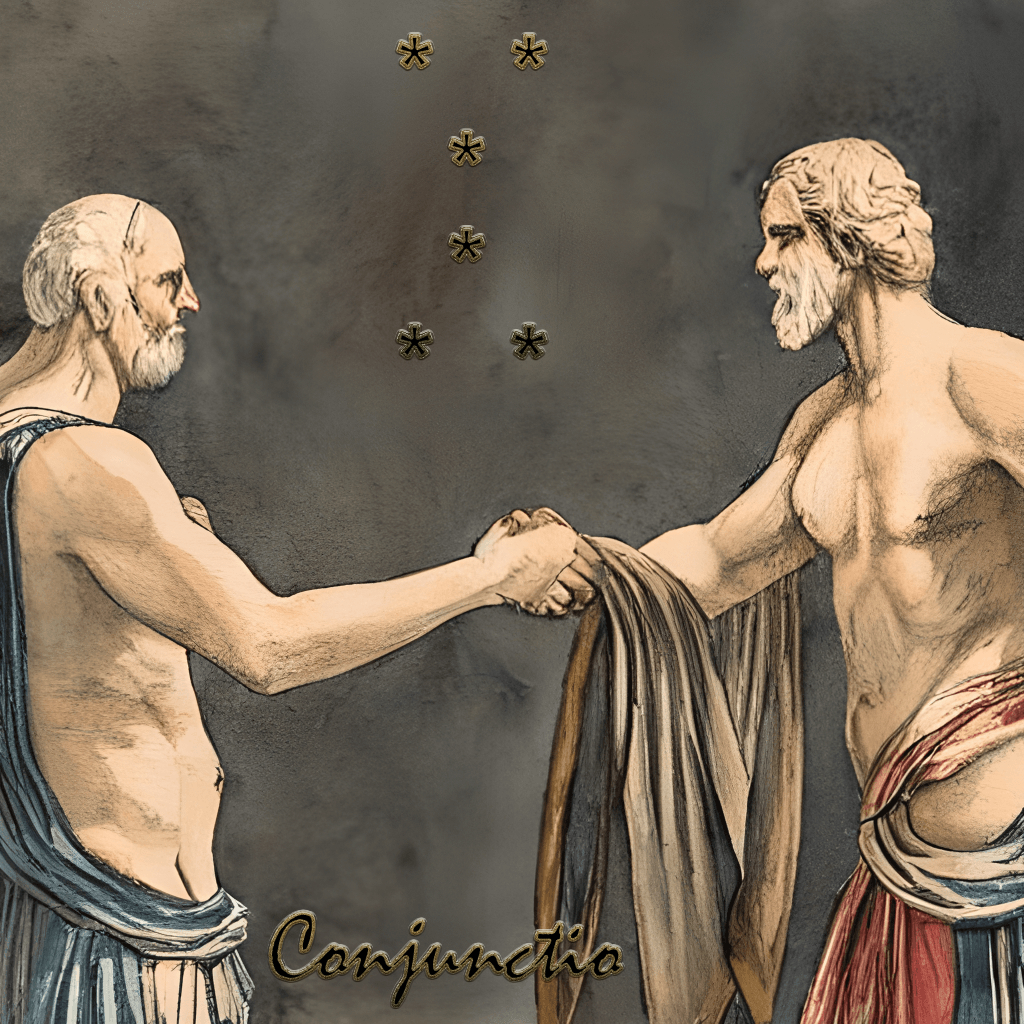
Conjunctio is a figure of Mercury retrograde. I always found it an interesting figure, as its array of possible meanings is actually quite ample. Its glyph seems to show two arrows converging in the middle. Interestingly, if we believe that a single dot represents an active element, then Conjunctio shows that only the two moist elements (Air and Water) are active. Moisture is associated with pliability and receptivity (remember that Thales, the canonical first philosopher, said that everything comes from Water, and aside from any biological observation, philosophically this means that water can take on any shape.)

Illustration for the geomantic figure Conjunctio, union

Conjunctio represents this mercurial lack of rigidity and convergence toward a middle point. As such, Conjunctio represents all situations that link two things or people together. It is a figure of communication, talking and being good at talking. It is not a figure that favors loneliness and solo endeavors. Togetherness is hinted at.

Because it highlights the two middling elements, Conjunctio is associated with compromise and agreements. It is a very good figure for commerce, employment and for getting out of an impasse, as it indicates moderation and finding commonalities. It is also a portent of marriage. Symbolically, it represents the marriage of various elements, thus showing admixture, mixing things, and all things that are made of various parts.

As it is a symbol of fluidity, it also speaks of exchange of fluids, also known as sex (the word ‘conjunctio’ itself can hint at it). After all, it does indicate unions of all kind. It is one of the double figures, so when asking about pregnancy, if supported by other factors, it can show twins.

On a slightly less positive note, Conjunctio does not promise astonishing results, especially when it is Judge and the question is not about contracts or retrieving lost objects. It is good, it is just not THAT good.

Common Keyword: Communication, convergence, agreement, compromise, contract, document, contact, convene, congratation, sex, exchange of fluids, moderation, temperance, middling outcome, mediocrity, retrieval, discovery, coming into contact with someone or something, mixing, admixture, multiplicity

Conjunctio in the Geomantic Houses (these are only examples. Use context to guide your interpretation)

HousePossible Meanings
FirstFlexible, able to compromise, intelligent, communicative, moderate
Seconddocuments, money-related paperwork, business contracts, retrieval of objects, buying and selling
Thirdnews, documents, social contacts in the neighborhood, contact with one’s siblings
Fourthreal estate contract, discovery of hidden treasure, talking to one’s father
FifthWriting, moderation in pleasure, sex, conception, twins
Sixthcatching an illness, taking meds, buying animals, agreement with servants
SeventhMarriage, business contract, social contacts, acquaintances, theft
Eighthmoney through marriage or business
Ninthlearning, studying, books, talking with spiritual people
TenthJob contract, agreement with one’s superiors, moderate leader, talking with one’s mother
EleventhTalking with friends, new frends, help
Twelfthbuying large animals, middling prison sentence, unable to let go of self-harming behavior
Thirteenthable to compromise, good at talking, sociable, past middling results
Fourteenthindecisive, without moral compass, future compromise, future middling results
FifteenthMiddling results, obtaining something, union
Possible meanings of Conjunctio in the various Geomantic Houses. Note that this is not meant to be exhaustive, and it only serves to jog your interpretive muscles


Tristitia / Sadness (Geomancy Figures)

Name of the Figure: Tristitia (Sadness)
Element: Earth
Planet: Saturn (retrograde)
Sign: Scorpio
Quality: Entering
Fortune: Bad

Tristitia is a figure of Saturn retrograde. As Saturn is the great malefic of traditional astrology, connected with restriction, gloominess and such other alluring concepts, its figures cannot be particularly pleasant. Tristitia’s symbol is said to represent a fallen tower or a stake driven into the ground. If we believe the theory that a single dot indicates an active element, then Tristitia only has the Earth element active.

Illustration of the geomantic figure Tristitia, sadness

This seems to be in harmony with the general meanings of Tristitia. For one, it represents melancholy, which is mostly associated with the element of Earth. It indicates all negative emotional reactions to the slings and arrows of life. Dejection, depression, being down are all meanings of the figure. It is also associated with anything that has a downward movement: “Will the stocks go up?” no, they will go down.

Furthermore, Tristitia’s earthiness shows up in the other important concept embodied by the figure, i.e., its quality of “stuckness”. Tristitia indicates all situations that are stuck, for good or ill. As a matter of fact, it is a good figure whenever you wish for things not to proceed or to have a solid foundation. This is especially true in questions about building and cultivating the land.

Finally, as the opposite of Laetitia, Tristitia indicates secrets, another meaning of Saturn. It shows everything that is done under cover of darkness or in secret. Whether this is good or bad will depend on what the querent asked: “Will my wife find out about my affair?” Tristitia says no.

Common Keywords: Sadness, depression, gloominess, loneliness, feeling stuck, blockages, decrease, diminution, going down, demotion, secrets, hiding,

Tristitia in the Geomantic Houses (these are only examples. Use context to guide your interpretation)

HousePossible Meanings
FirstPerson is sad, Depressed, discouraged, Saturnine
SecondLoss of money, economic decline, Loss of items
ThirdSad news, problematic neighborhood, false rumors, secret messages
FourthBurying, Digging, Building, Working the earth, Loss of the father, need for renovations
Fifthlack of enjoyment, A Debbie Downer, Loss of pregnancy
SixthLong illness, Problems through servants and helpers, sick pets
SeventhBad public relations, Bad image, Stuck in a marriage, Loneliness
EighthMourning, Death, Bereavement, Lack of income from the spouse
NinthSad journey, occult philosophy, atheism
Tenthrain, precipitation, loss of employment, demotion, difficulties with the mothers
EleventhLack of friends, loneliness, loss of hope, loss of support
TwelfthLong sentence, Black magic, loss through large cattle, self-undoing
ThirteenthSad past, depression, loss, ability to make efforts
Fourteenththere will be complications, it won’t be worth it, there will be toil and effort, decrease
FifteenthTristitia cannot be Judge
Possible meanings of Tristitia in the various Geomantic Houses. Note that this is not meant to be exhaustive, and it only serves to jog your interpretive muscles


MQS