Category Archives: Fortune-telling

Geomancy – From the Four Mothers to the Geomantic Shield Chart

In the previous article I’ve talked about how to generate the four Mothers of a Geomancy reading. These are the four geomantic figures you need in order to answer a question. As I discussed previously, the four Mothers, being actively created by you (or the questioner), represent your point of view, what you actively bring to the table. Afterward, we generate the four Daughters, which represent the consequence of your stance in the outside world around you.

This divides the Shield Chart into two halves: the right half, assigned to the querent or to what speaks in favor of the querent getting his wish; and the left half, assigned to the quesited or to the obstacles. These are like thesis and antithesis: as soon as the thesis is given, the antithesis is called into being automatically. The right half, the querent’s side, culminates into the Right Witness, while the left side culminates into the Left Witness. Here, the separation between thesis and antithesis reaches its apex, and can no longer be carried further, and must therefore be resolved. This is done by adding the Witnesses to form the Judge. This is the only figure in the chart that encompasses both right and left side, which is why the term “Judge” is fitting: the Judge must see the whole picture and take it into account in order to rule fairly.

Let us start with the Four Mothers, and let’s derive the Four Daughters from them.

the four Mothers of a Geomancy reading

Above you find the Four Mothers. These are seen from right to left. To obtain the first daughter, we need to take into account the first row of points in each of the four Mothers. In the example above, the first row of the first Mother has two points, the first row of the second Mother has one point, the first row of the third Mother has two points and the first row of the fourth Mother has one point. This means that the first Daughter is going to be formed of two points in the top row, one in the second, two in the third and again one in the fourth. The other three Daughters are formed in the exact same way, only, we take into account the corresponding row in the four Mothers (i.e., for the second Daughter, the second row of each of the four Mothers, for the third Daughter, the third row of each of the four Mothers, for the fourth Daughter, the fourth row of each of the four Mothers.) At this point, we have the base line of the Geomantic Shield.

From right to left, the four Mothers and the four Daughters

From this base line, which encompasses the two sides of the shield, we begin a new kind of operation, which will allow us to obtain the four Nieces. This operation is called Geomantic Addition. This is a very simple formula. Take the first two Mothers as an example. Now add the number of points in the top row of each. The sum is three (two in the first Mother, one in the second Mother.) Three is an odd number, and odd numbers are represented by a single point. Therefore, the result of this Geomantic Addition is going to be a figure whose first row is occupied by a single dot rather than two. Now we go through the same process row by row. Only at the end, with the fourth and final row, do we find that the operation gives a different result: here, both the first and the second Mother are made up of two points, so the result is four. Four is even, and even is represented by two points.

First MotherSecond MotherFirst Niece
O OOO
O OOO
O OOO
O OO OO O
The process to obtain the first Niece

In general, the process of Geomantic Addition can only yield four scenarios.

First VariableSecond VariableNumber of PointsOdd/EvenResult
O OO O4EvenO O
O OO3OddO
OO O3OddO
OO2EvenO O
All possible scenarios in the process of Geomantic Addition

By pairing first and second Mother together, we get the first Niece; third and fourth Mother yield the second Niece; first and second Daughter give us the third Niece; and third and fourth daughter result in the fourth and final Niece.

Four Mothers, four Daughters and four Nieces

At this point, we go over the process once more, pairing up the first and second Niece to obtain the Right Witness and the third and fourth to get the Left Witness.

the four Mothers, four Daughters, four Nieces and two Witnesses

The final addition yields the Judge, which is the only figure of the Geomantic Shield to result from the Left and Right side of the Shield communicating with each other.

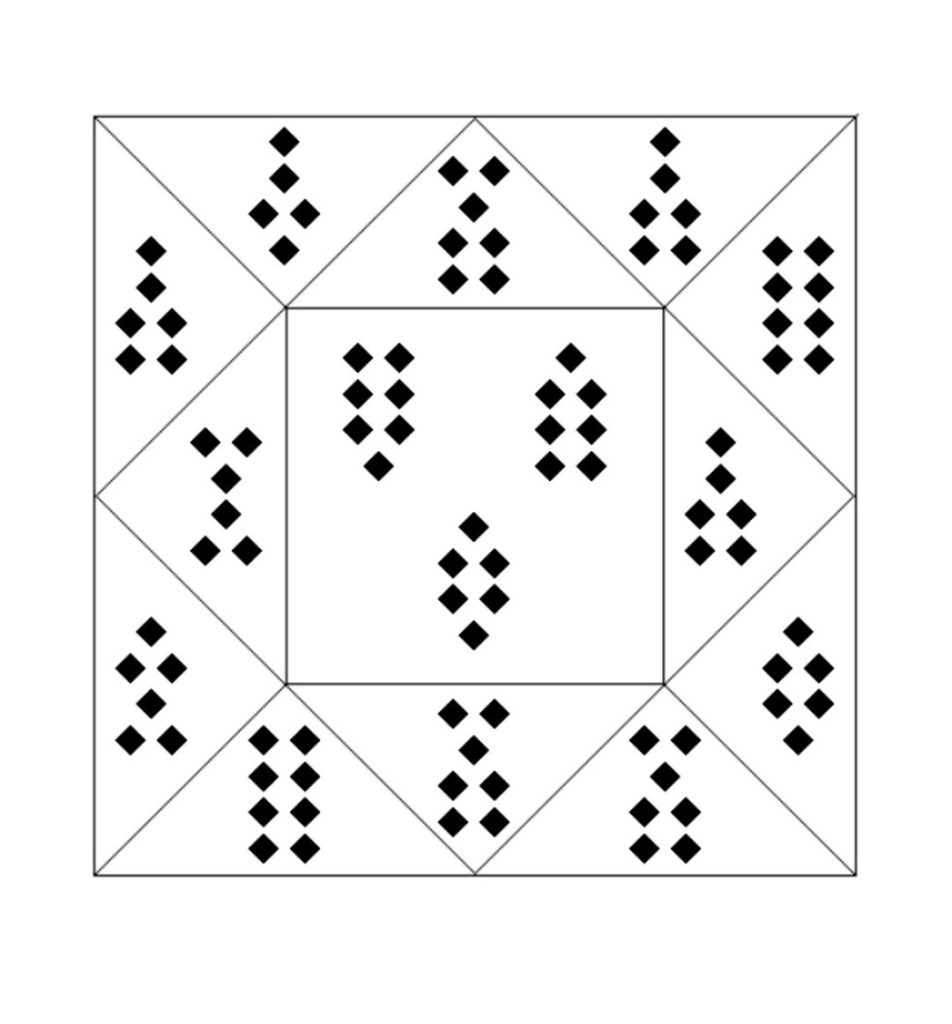
The complete Geomantic Shield

This completes the operation. It is customary to derive a sixteenth figure by adding the figure of the querent, i.e., usually the first Mother, with the Judge, but this sixteenth figure is often not explicitly drawn on the shield, though it might sometimes, and there are examples of it in the old literature.

Note: all images are from the App ‘Simple Geomancy’

Toward the Geomancy Shield – The Four Mothers

Geomancy has changed a bit since Medieval times, but one thing that remains constant is how a Geomantic figure or Geomantic Shield is formed. This is done in order to answer a question.

As I said in the previous article, we don’t draw the whole figure in the same way. We can divide the process in two parts: the creation of the four Mothers on one side; and the deriving of the rest of the figure from the four Mothers on the other side. The first is the “divinely inspired” part, i.e., the part where you allow chance into your life, while the second part is automatic and fixed and will follow with mathematical rigor from the first.

So, how do we get a set of four Mothers? In reality, Geomancy is a rather flexible oracle, as any method is technically valid. Once you are well versed in the main operations required to draw a Geomantic figure, you can pretty much use any method that suits you in order to obtain the four mothers.

Still, some methods are more traditional than others. It seems that the Arab Magi used a stick to poke points in the sands of the desert, a method that is still perfectly valid and has even been accepted and adapted by the Golden Dawn. By the time Geomancy reached Europe in the Middle Ages, it was customary to use a stylus or pen and a tablet or piece of paper or parchment. Dice were also used, and one could, and can use dried beans or pebbles or playing cards. Anything that can give you odd and even numbers will do.

Needless to say, some have devised software that calculate everything automatically. I don’t particularly trust this method, and yes, partly it’s because technology is still so new that my mind doesn’t accept it as a valid substitute for things that are more dependent on my direct manipulation–it may very well be that in five hundred years occultists will use geomantic software without thinking twice about it, but we’ll cross that bridge when we get to it.

The Pen and Paper Method

My personal favorite method remains pen and paper. I almost always use it, and I find it has an odd beauty, even power to it. It also reminds me of a playful oracle that we used to use as kids in middle school and high school in Italy to answer yes or no questions. Usually, some love-stricken teen would ask the fateful question, “does he love me?” and would start drawing random numbers of points on a piece of paper. Then she would pair up the points until either one point was left (yes) or none at all (no). I have no idea how this oracle originated, but I remember it being very much in vogue when I was a kid.

A set of geomantic Mothers is obtained in a similar, albeit more complex, manner. First off, it pays to write down the question. This has the incredible advantage that it forces you to think about it seriously, and it also makes it more real and objective.

Then, after concentrating on the question, you should ask for divine help. I’m not saying this to be preachy. Consult any Medieval handbook of Geomancy and you will find the same instruction: it’s the “Unmoved Mover” that sends his “vertue” down from the skies to answer your question. At the very least, you should take a moment to relax.

Once you feel ready, start drawing sixteen consecutive rows of points. Try to be orderly, but don’t worry too much: as long as the rows don’t cross or merge you are fine. Also, I have found that it is better to draw I’s instead of points, for the simple reason that it makes it easier to recognize the marks instead of leaving you wondering “is it a point or a random inkblot?”

Do not count the points or I’s you are making, and do not bother counting the rows as you make them. Do not engage in any kind of mathematical or rational thinking. In fact, I have found it pays to write down numbers from 1 to 16 before starting the operation, so as to be free from the worry of drawing too many or too few rows of points. Still, in the traditional instruction, you are normally told not to bother if you end up with an extra row of two–just go overboard and then discount the extra ones. Either way you will end up with something like this:

  • 1) IIIIIIIIII
  • 2) IIIIIIIIIIIII
  • 3) IIIII
  • 4) IIIIIIIIIIIIIIIIIIII
  • 5) IIIIIIII
  • 6) IIIIIIIIIIIIIIIIII
  • 7) IIII
  • 8) IIIIIIIIIIIII
  • 9) IIIIIIIIIIIII
  • 10) IIIIIIIIIIIIIII
  • 11) IIIIIIIIIIII
  • 13) IIIIIII
  • 14) IIIIIIIIIIIIIIIIIIIII
  • 15) IIIIIIIII
  • 16) IIIIIIIIIIIIIII

Once this operation is over, you have your four Mothers, but only in a raw form. Each Mother figure is made up of four rows (4×4 = 16). Now you need to pair up the I’s in each row until either one is left over or two. Let’s make the example of the first Mother, which is made up of rows 1 through 4:

  • 1) I-I I-I I-I I-I I I = O O
  • 2) I-I I-I I-I I-I I-I I-I I = O
  • 3) I-I I-I I = O
  • 4) I-I I-I I-I I-I I-I I-I I-I I-I I-I I I = O O

The figure we have received as first Mother is comprised by a sequence of two points on top, then one point, then one point, then two points. The same process of pairing up must be done for all sixteen rows to obtain the four Mothers (the second Mother being made up of rows 5 through 8, etc.) The first Mother we have obtained is called Conjunctio.

The Geomantic figure Conjunctio. From the App ‘Simple Geomancy’

Once this operation is over, you will be left with four figures, each made up of four rows of either one or two points. From these figures you will need to derive the rest of the chart, which I will go over in the next post.

A Step by Step Deconstruction of a Geomancy Reading

In all Medieval handbooks of Geomancy, this method of divination is called something like “a brief science”, meaning an art that can be mastered with little effort. It was often sold as some kind of quick, “portable” oracle. This, I presume, is in comparison with Astrology, which back then required no small amount of mathematical knowledge, astrological software still being a couple of years away.

By comparison, anyone who can memorize a couple of meanings and rules and is capable of producing a Geomantic Shield (i.e., the chart) can obtain a quick answer.

The more I delve into Geomancy’s Medieval practice, the more I realize that all modern attempts at reviving it hinge on some kind of rationalization or optimization of what was, essentially, a rather chaotic (though not random) method. It is typical of the pre-modern approach to rely on older authority and compile as many observations and rules as possible from previous sources, even when contradictory with each other, so as to have an endless array of techniques to throw at the chart in hopes of teasing out the wanted response. This is not unlike what modern astrologers do when they interpret birth charts, though I must say, unlike contemporary astrology, traditional geomancy does work.

Producing a Geomantic Shield, Step by Step

If rationalization it must be, then it makes sense first to understand what it is that a geomancy reading does, that is, what it accomplishes from a structural standpoint. This is a Geomancy Shield.

Example of Geomantic Shield

In this shield, not all the figures are generated by the querent/diviner. In fact, only the figures circled in red are actively produced by the person interested in the reading. These are made from right to left, following the numbered order.

The Four Mothers produced by the querent are in red, the Four Daughters in blue

Once the four main geomantic figures (called the “four Mothers“) are produced, every other passage is automatic and relies on certain geomantic operations to fill out the Shield. One such operation is very particular, in that it only occurs once throughout the reading, while the other one is repeated many times. I’m talking about the operation that produces the “four Daughters.” This consists in taking the first line from every one of the first four figures (the mothers) to produce the fifth figure or first daughter; then taking the second line from each of the four mothers to produce the sixth figure or second daughter, and so on, until we have four mothers and four daughters (the daughters are circled in blue.)

As you can see, for instance, if you take the first line from each of the four mothers, you get a first line of two points, a second line of one point, then a third line of two points and a last, fourth line of one point, which now occupies the fifth house.

Once this operation is over, it is never repeated again, and it leaves us with a double set of four figures each. These two sets are not unrelated (hence the names of mothers and daughters.) They must of necessity be comprised of the same number of points, albeit differently shuffled around. Still, as much as they are related, they represent a split of some type, a doubling of reality from one into two related but separate sides.

Now it is a matter of producing the rest of the chart. This is done by taking the figures two by two and “adding” them line by line. We pair the first and second mother together, then the third and fourth, then the fist and second daughter together, and then the third and fourth. Adding here means taking the points that comprise each line in the two figures, adding them and seeing if you get an odd or even number: if you get an odd number, the resulting line will have one point; if you get an even number, the resulting figure line will have two points. This produces the “four Nieces” which occupy the second row in the Shield. Take careful notice that, at this point, Mothers and Daughters have not interacted with each other yet.

The Four Nieces in Geomancy

Once we have the Mothers, the Daughters and the Nieces, we repeat the second operation once more by pairing up the Nieces, the first with the second and the third with the fourth. As you can appreciate, once more, Mothers and Daughters haven’t come into contact: the split hasn’t been mended.

The Two Witnesses coming out of the Four Nieces

The two figures resulting from the addition of the four Nieces are the two Witnesses, which are the first two members of the “Geomantic Court.” The Right Witness is the ultimate consequence of the four Mothers, while the Left Witness is the ultimate consequence of the four Daughters. We can’t produce any more figures without finally bridging the gap between the right side of the Shield and the left side. This is done by producing the fifteenth figure, the last one, called the Judge. This brings the operation to a close.

The Geomantic Court complete with the Judge is in blue

So, What are we doing in Geomancy?

Anyone familiar with Hegel’s dialectics cannot but look in admiration at what I have just described. We begin the operation with a set of four symbols (the four Mothers) which represent the querent’s active involvement, in the hope of knowing something. A querent that doesn’t want to know anything does not consult an oracle: he is not a querent, ‘querent’ meaning ‘asker’. Therefore, the four Mothers represent the question itself, not in a divinatory sense, but in a structural one: if someone doesn’t want to know something, the Four Mothers don’t appear.

Once this happens, reality splits into two, the Right side representing the querent, the Left side the quesited. This culminates in the reading of the Geomantic Court, in which the Right Witnesses pleads for the querent and the Left one for the quesited, among other possible interpretations. Other variants are: Right side good, Left side bad, Right side past, Left side future, Right side helpful, Left side hindering. These are all variations on the same theme.

The point is that from a Geomantic standpoint, duality comes into being as a result of someone either desiring something they don’t have or fearing they might lose something they have. Objective reality comes into being by “lapsing away” as it were from the Subject, creating a would of sort that requires a series of steps in order to be healed again (‘heal’ literally meaning ‘to make whole’). Try to think of a situation where you don’t need anything: you don’t need food, clothes, air, light, aspirations. You’d be very godly or very dead.

What I just said, therefore, is not a disparaging of dualism: without duality, unity cannot manifest, and remains a sterile, barren field. Without the split, the querent wouldn’t be able to know, or, indeed, to get. By pronouncing his sentence, the Judge makes the situation whole again, which is signified by the fact that only the eight figures with an even number of points can become Judge. Either the querent gets his wish or he doesn’t. But the making whole again presupposes the split, just as in dialectics the synthetic moment cannot be understood and appreciated but through the process of opposition that led to it.

What I just described is, as far as I know, never mentioned in Medieval or Renaissance works on Geomancy–one obvious reason being that dialectics in the Hegelian sense hadn’t been invented yet. Platonic dialectics (that is, conceptual dialectics) comes close, but again, all this seems implicit in the operations of Geomancy and never articulated. I harbor no delusion therefore of having discovered the secret meaning of the art. I am conscious, in fact, that I am merely organizing it according to a model that is familiar to me. But I must say Geomancy wears this model beautifully. It contains a whole philosophy of what it means to ask a question and to get an answer.

Geomancy | Master Post

Here I gather all my articles on (mostly European) Geomancy.

Geomancy has been an ongoing interest of mine. It is an ancient divination system that is being rediscovered after a couple of centuries spent in obscurity. It exists in various flavors, the most commonly recognized in the West being the one practiced by Medieval and early Modern magi. It derives in its main lines from Arabic Geomancy, and is only distantly related to African practices that use similar figures.

Of course, at the time when Geomancy was introduced to the West, Astrology was all the rage, which means that European Geomancy has a marked astrological bent. In most of its variations, Geomancers obtain a response by generating a random number of points which are then organized according to a fixed series of rules. Note that geomancy has nothing to do with Feng Shui and related practices (Flying Stars, Qi Men Dun Jia, Ba Gua Sectors, etc.)

Translations of Old Books
Peter of Abano’s Geomancy Handbook
Robert Fludd’s Geomancy Handbook (from the Fasciculus Geomanticus)

General
A step by step Deconstruction of a Geomantic Reading
Obtaining the Four Mothers
From the Four Mothers to the Geomantic Shield
Anatomy of a Geomantic Figure
Meanings of the Houses
Which House is Next to Which?

The Figures
Via
Populus
Fortuna Major
Fortuna Minor
Puer
Albus
Puella
Rubeus
Acquisitio
Amissio
Laetitia
Tristitia
Conjunctio
Carcer
Caput Draconis
Cauda Draconis

Interpretation
Geomantic Perfection: how things come to pass
Interpreting the Judge and Witnesses
Reconciling the Judge with the Chart
The Via Puncti or Way of the Points
The Company of Houses
Astrological Aspects in Geomancy

Readings
A question about Study
Friend or Acquaintance?

My Articles on Geomancy

Something went wrong. Please refresh the page and/or try again.

Geomancy Reading – Study-related question

I’m currently translating an old manuscript on Geomancy from Italian into English and I wanted to seize the opportunity to give someone a reading. My husband proved to be the guinea pig I needed. He was about to enroll in a course at the local VHS (Volkshochschule, a network of continuing education institutes in Germany) and wanted to know if he would be happy with the course.

Will I be happy with the course I’m about to start?

The lord of the first is Conjunctio, which indicates mental flexibility and the ability to learn. The quesited is the lord of the ninth house, Fortuna Minor, which is outside help. It often indicates good opportunities that need to be seized.

Fortuna Minor moves to the twelfth house, perfecting the chart. This is a very good indication, as it shows contact between querent and quesited, in this case the transfering of knowledge/skill. The perfection happens by the ninth figure moving, showing that the course organizer(s) will do their best.

However, F. Minor also moves to the seventh house, from which it opposes the querent. Furthermore, Minor plus Conjunctio gives Amissio, Loss, which shows either waste of money or the inability/impossibility to learn everything.

Carcer is the Judge, which indicates that overall it’s a wash, especially since the Right Witness is Laetitia but the Left Witness is Tristitia, indicating a downward or negative trend. The Judge of the Judge (Judge + Lord of the First) is Via, which in general can be seen as something of little consequence, something that is there and then is gone.

The Way of the Points leads back to Amissio in the second house, it’s an investment that is not wholly justified.

Outcome: my husband was somewhat happy with the course, but his interest waned with every class, especially because he found that he disagreed with some of what the teacher was saying (that opposition) although the teacher was generally enthusiastic and helpful. He didn’t get buyer’s remorse. He was still happy he had done it, but he had hoped for way more, especially considering the price.

MQS

Cartomancy with Playing Cards | Queen of Spades and King of Spades

In cartomancy with playing cards, the Queen of Spades (Q♠) and the King of Spades (K♠) can represent two people, usually rivals.

They are normally people who are, at the very least, cold toward the querent, and do not further his aims in any way, unless it is through pain (such as in the case of a doctor, or a judge). Sometimes they are openly hostile and will have plans and aims that are opposite to those of the querent. This is a big difference with Diamond figures, for the latters are neutral, and their objectives may or may not align with those of the querent.

With Spade people, however, it is clear that someone is going to try to throw a wrench in our plans. In love readings they are often the third party, and it is important to note that when the rival in love shows up as a Spade, it is very hard for the querent to get rid of them, meaning that usually these people have a serious relationship going on with the querent’s partner. It is not merely a flirt. The same is true in all other aspects of life.

With Spade Face cards, however, it is possible that they represent something other than a real person. The Queen of Spades is a symbol of falsehood, lies, deceit, gossip, slander. The card comes up whenever someone is being less than upfront with us. It also stands for things that are rotten, noxious, overripe, decaying, and it is also associated with lack of acceptance, privation, loss.

The King of Spades is also the card of the law and of all official authority. It can represent the legal system, organized religion and all those structures that are unbending and cold toward the querent, though not necessarily evil. Furthermore, it can represent science, but usually those aspects of science that are less pleasant, such as medicine.

Combinations:

Q♠ + 5♣ + 3♠ = a woman who does everything she can to interfere

Q♠ + 4♣ = lies (even when there’s no woman involved)

Q♠ + J♥ = a bad mother (if with cards of pregnancy, a pregnant woman who doesn’t want the child)

Q♠ + 5♠ + 4♠ = a destitute or desperate woman

A♠ + 6♠ + Q♠ = in a health reading, the removal of a body part

K♠ + 6♠ = a doctor (if Q♠ can be a female doctor, although more rarely. Often the K♠ indicates a doctor regardless of sex)

K♠ + 4♣ = official talks, a court case (again, here the King is the authority, regerdless of sex)

K♠ + 3♣ = official contract, can also be a civil marriage

3♥ + K♠ = a concession from an authority

9♣ + K♠ = it can be a foreign authority if it makes sense, otherwise it may show legal entanglements causing delays

Cartomancy with Playing Cards | Queen of Diamonds and King of Diamonds

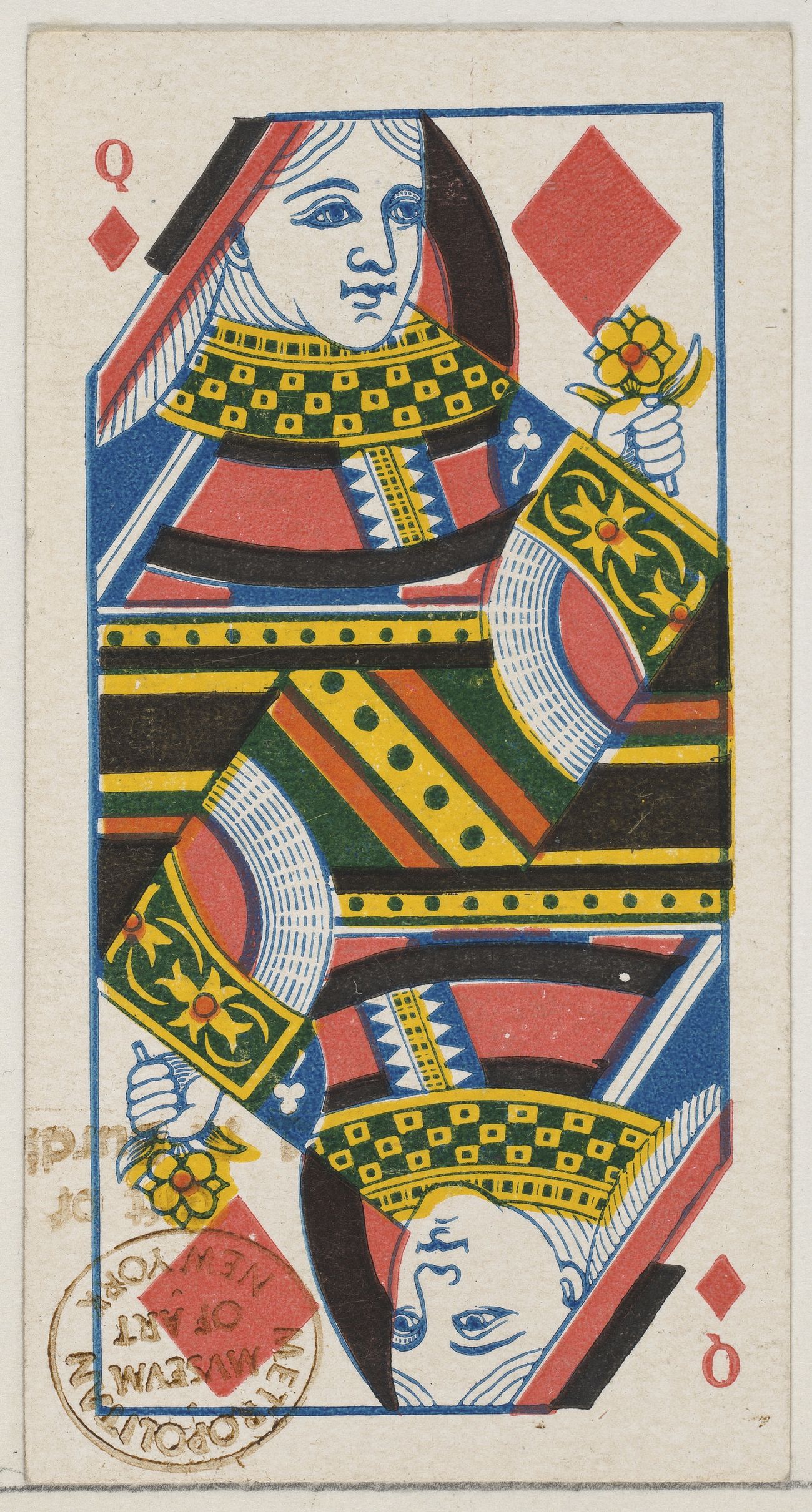
The Queen of Diamonds (Q♦) and King of Diamonds (K♦) are representative of a lady and a gentleman.

if the Heart figures indicate people that are close to the querent, the Diamond figures show other people, usually unrelated (except when they represent relatives by marriage.)

In general, they can also stand for people who have wealth or power over the querent, although usually not legal power, as would be the case with Spade cards. With Diamonds we deal with money or knowledge, so they are often a boss, a professor, someone knowledgeable, a specialist doctor, etc.

In love readings, they are neutral. They indicate other people influencing the situation. They can also stand for third parties, or, when the querent is the third wheel, the official partners, especially if there is no love between them and the querent’s partner anymore. Broadly, Diamonds don’t love. This doesn’t mean they actively hate, but their primary loyalty is not to their heart. Keep in mind, though, that just because a partner shows up as a Diamond, it doesn’t mean the story is going to end. Plenty of people stay in relationships out of habit or for questions of interest (and interest must be construed broadly. Even children are a question of interest, as they may give some people a reason beyond love to stay together). Also, unlike Spade cards, Diamonds are usually not actively malicious or aggressive, unless they are surrounded by cards that say otherwise.

In material readings the two Diamond figures are more positive, as they signify wealthy people. This is especially good if the querent is looking for a job–the presence of a wealthy person together with appropriate cards, can indicate finding employment, i.e., a wealthy person to work for. Traditionally this is especially true for the King of Diamonds, but nowadays it may happen with the Queen as well.

Even when they don’t represent people (and this is very rare), the two cards stand for wealth: the Queen indicates increase of wealth, and the King indicates the manipulation of wealth, including commerce, banks, financial institutions and similar things.

Psychologically the cards denote a practical mindset, which can become callous materialism with negative cards, or ability to help and find practical solutions with good cards.

Combinations:

Q/K♦ + 9♦ = an influencial man or woman will play an important role

Q/K♦ + 3♣ = a married man or woman (but he or she doesn’t love her partner)

Q/K♦ + A♥ = it can be a wealthy family member or a distant relative, but depending on the context it can also be a landlord/lady, broadly it shows a homeowner

Q/K♦ + 4♦ = if the Face card doesn’t represent a person, it indicates a wealthy deal

A♠ + K/Q♦ = traditionally a divorced person, but take the context into account (if it were Q/K♠, a widow or widower)

Cartomancy with Playing Cards | Queen of Clubs and King of Clubs

In cartomancy with playing cards, the Queen of Clubs (Q♣) and King of Clubs (K♣) are the significator cards for the female and male querents respectively.

As such, they do not require much in the way of explanation. Their meaning is obvious in so far as they have one. They are perfectly neutral. In cartomantic systems of old they were assigned positive significations, but that’s because old systems tended to flatter querents. So the Queen of Clubs was called a woman of high virtue and the King of Clubs a man of honor. Whether they are of high or low virtue, in reality, will be shown by the surrounding cards.

Most of the times, the other significator card will indicate the partner. However, if this person doesn’t exist, or if it doesn’t make sense within the context of the reading, they still indicate people that will have a central role. Usually, they are more involved and closer to the querent than the Diamond figures, but more neutral than the Heart face cards.

Extremely rarely, so rarely, in fact, that I should probably not even mention it, these card can show something other than people. In this case, the Queen of Clubs can indicate serious and honest effort, although usually the Club suit precludes great realizations. The King of Clubs can have the meaning of sound judgment, fairness and much activity.

Combinations:

K/Q♣ + 3♥ + 10♠ + 7♥ = the person is secretly planning a surprise, it will be a gift

K/Q♣ + A♥ + K/Q♣ = they live or will live together

3♠ + 2♥ + K♣ + 7♣ + Q♣ = in this example, his family interferes, causing problems between them

9♥ + J♥ + K♣ + 2♠ + Q♣ + 4♠ = he wants a child, she doesn’t (if you switch the two significators around it’s the opposite)

K♣ + 3♣ + Q♣ + 10♠ + Q♦ + 3♠ = she is secretly bisexual and seeing another woman

Cartomancy with Playing Cards | Queen of Hearts and King of Hearts

In cartomancy with playing cards, the Queen of Hearts (Q♥) and King of Hearts (K♥) represent loved ones.

They are slightly positive cards, although their true meaning will be revealed by the surrounding cards. In themselves, they portray a man or a woman in a positive light, because the suit of Hearts is positive in itself. Often, they indicate people whom the querent already knows and have an emotional connection (or a blood one) with him or her. They may show up as parents.

In love readings, it’s important to remember that the official querent is the Q♣ or K♣, and their partner will be the other Club card. However, if the cards want to show, for instance, that the male querent will break up with his partner and will then find a new girlfriend, the Q♥ would show the new one. Same for the woman with the K♥. In gay relationships, though, the Q♥ and K♥ can show the official or perspective partner.

In career readings, usually these are positive figures who have the querent’s best interest at heart and often an emotional connection to him (though not necessarily a romantic one). Keep in mind that it’s a little weird for a boss to show up as a Heart figure, unless they are your parents or you have very close bond of affection with them. Still, if the question is “will he or she help me?” the fact that they show up as a Heart is encouraging.

Usually Queens and Kings are people. Rarely, they can take on allegorical meanings. In that case, the Queen of Hearts indicates acceptance, receptivity, obedience (not necessarily submission), docility and nurturing situations. The King shows positive decisions made by or for the querent, including in a legal setting.

Finally, the Q♥ and K♥ represent all things feminine and all things masculine, respectively.

Spiritually, they can indicate deities (in Catholic Italy, the Queen of Hearts is Mary and the King God).

Combinations:

Q/K♥ + 2♥ + 9♥ = the realization of your wish is dependent on a man or woman who is very close to you and will further you (same if 3♥ instead of 9♥), usually a very close friend or a relative
Q/K♥ + 10♠ + J♠ = a man/woman that appears good but harbors negative feelings
A♦ + J♣ + Q/K♥ = a new positive friendship with a man/woman
4♣ + Q♥ = it can mean a lot of things, but broadly, if the Q is not a woman, it shows that your words are deeply understood by other people, what you say is accepted by others. If K♥, it still means the man is truthful
A♠ + Q♥ + 5♦ + K♥ = transition female to male (if you swap the Q and the K, it’s male to female)

Cartomancy with Playing Cards | Jack of Spades

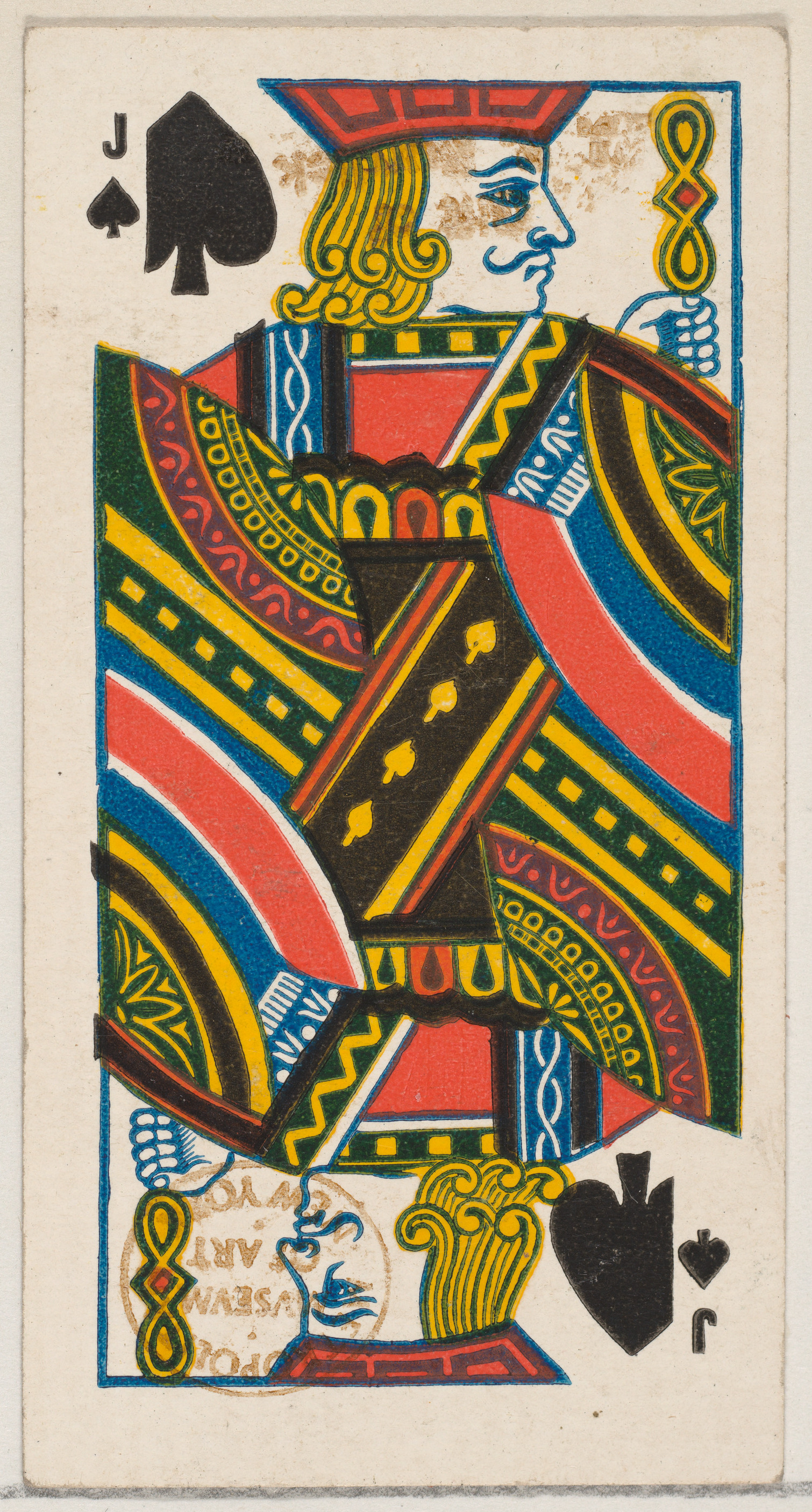
In cartomancy with playing cards, the Jack of Spades (J♠) is the card of enmity.

Like all Jacks, it can represent a child, albeit rarely. When it does, the child is “problematic”, to use an abused word. He or she is either difficult or has a problem (for instance, he could be sick, and this is especially bad in pregnancy readings).

In general, this card represents the opposite of the Jack of Hearts, as it indicates a negative attitude and ill-will. It personifies the desire to hurt or to do something bad or illegal or at least somewhat shady.

In relationship readings, the Jack of Spades indicates poor communication, disharmony and possibily the desire to cheat. Together with a face card indicating another person outside of the couple, it can show a rival. Broadly, it shows underhandedness. It can also mean spying.

It can also signify more mundane things. For instance, after a disagreement, having the Jack of Spades near your partner’s card simply shows they still need time to get over their anger. In this sense, they are still your “enemy”. This can be true for every kind of personal relationship.

In work readings, the Jack of Spades can show the presence of ill will on the workplace, rivals and enemies of all kind. However, this is also the card of the uniform, and it is connected to jobs in the armed forces in a neutral sense.

Psychologically the card shows malice and a poor attitude in general, pettiness, double standards and slyness. Spiritually it’s connected to evil spirits,evil thought forms and being “bad” in general.

Combinations:

J♠ + K♠ = if pertinent, it indicates a policeman or soldier (if also 5♠, arrest)
J♠ + 9♦ + 3♠ = one possible combination of slander (9♦ is the reputation)
A♥ or 2♥ + J♠ = disharmony and enmity at home or close to you
J♠ + 5♦ + J♣ or any positive card, especially a ♥ = enmity turns to friendship
J♠ + 6♠ = it can indicate a morbidly negative attitude, in a health reading it can indicate parasites or viruses