Certain topics are exceedingly rare, and they should remain so, because people otherwise tend to see the supernatural at play everywhere. Traditional divination takes these topics very seriously, which is why it rarely discusses them. In most systems, a vocabulary is given to describe most situations in life, including encounters with ghosts. We are, of course, free to disbelieve, but the cards can still talk about it.
A querent asked me if there was a ghost in her (very old) apartment complex. As I said when talking about curses and hexes, the answer is almost invariably no (although, to be fair, ghosts and other entities are far more common than competent witches). Here’s the spread (it started as a three card spread, I kept adding cards until I was satisfied).
I asked the querent an open question (to avoid influencing her), that is, I asked her to describe the ghost she thought she saw. She said she thought it was the spirit of an ugly, angry woman moving in the hallways of the building. This fits very well with the Queen of Spades and Two of Spades. The Ace of Spades, aside from indicating death, is also a card of great evil.
What about the rest of the spread? Usually the Heart court cards indicate either positive spirits (God, etc.) or religious people. I asked the querent if she was planning on contacting a priest, shaman or other such figure. She said she wasn’t really thinking about it, but another tenant was.
I said that it was a good idea. Look at the King’s action: he is taking steps (Two of Clubs) by uttering words (Four of Clubs) which are positive (Nine and Ten of Hearts). But what about the Five of Spades? My sense is that the presence will not be eradicated or banished for good, since the Five of Spades is a card of imprisonment, but it will be contained in some form (the two Hearts hemming in the Spade).
The interesting thing was that, according to the querent, the other tenant (who had been living in the building for much longer than the querent) told her that many years ago they had had a problem with the same presence and had managed to somehow exorcise it.
My view is that even this time the situation will not be remedied completely, but the situation should improve by calling in someone to perform a religious ritual.
Abano gives some examples of the possible meanings of Fortuna Major and Fortuna Minor in the various houses.
Fortuna Major
Fortuna Major in the first house means good luck for the querent, science, honor, fame, noble people, health, long life, good in all. In the second it means gain, good luck, science, victory, money, and good through women1 and animals. In the third it means good luck, happiness with brothers, relatives, friends, usefulness in travel and through women, obtaining what you wish.
In the fourht it means usefulness in stable things, inheritance, good things from one’s parents and older relatives. In the fifth it means good fame, friendship, good grace, happiness through children, good news, favors from women, obtaining your wish. In the sixth it means health, except for women, and gain through animals and servants.
In the seventh it means marriage, increase of wealth, good partnership with gain, overcoming your enemies, good and tranquil life. In the eighth it means gaining wealth through other people’s death, freedom from danger and from death, gain, increase of wealth. In the ninth it means travel with honor, gain through it, and through science in foreign countries and with foreign people, good change of place, quietude, divine spirit, true judgment.2
In the tenth it means honor, dignity, riches through one’s ingeniousness and speeches, and thanks to one’s mother, and in things related to God, good fame, gain through great and noble people, and through one’s job, and from prelates.3 In the eleventh it means good luck, gain, increase through friends, servants, kids, and from the King or from lords and prelates and noblemen. In the twelfth it means health, freedom from danger and fear, gain through animals and servants, but the sick person won’t heal and the prisoner won’t be released, or with difficulty.
In the thirteenth it means gain through travel or from the king or a lord, parties, banquets, and toils and difficulties to have health. In the fourteenth it means good luck in all you wish, and in animals, agriculture, buildings, long life.4 In the fifteenth it means good success, good outcome, succession, good friendship.
Fortuna Minor
Fortuna Minor in the first means King, Queen, lord, nobleperson, dignity, honor, fortitude, noblewoman, noble things, animals, good journey.5 In the second it means gain, gain through merchandise, and in selling and in buying, and from family or servants. In the third it means a sister or (female) relative or (female) neighbor, good luck, good science.
In the fourth it means bringing secret things to light, fixed term employment or office, inheritance, unmovable goods, buildings. In the fifth it means honor, dignity, spouses, happiness among the common folk, happiness through journey and children. In the sixth it means sickness of a servant, problems through them, female servants, gain through toil.
In the seventh it means marriage, congregation of people, but with problems, partnership, gain throguh movable things. In the eighth it means quick long travel bringing gain, but with danger of death, good fame followed by death, being killed. In the ninth it means change of place, honorable journey, peregrination, good sceince, occult things.
In the tenth it means empress, king, lord, dignity, magistrate, mother, judge, excellent master/teacher, law, institutions. In the eleventh it means happiness, chanting, dancing, various sounds, noble friends, fortitude, travel, obtaining your wish. In the twelfth it means honor and dignity, fear of enemies and subjects and servants and sick people, freedom from prison, good for animals.
In the thirteenth it means travel with honor, sacraments, faith, gain, quick positive results. In the fourteenth it means good luck and fortune in all you wish to gain. In the fifteenth it means good succession, fame, honor among people, obtaining or accumulating wealth.
MQS
Footnotes
It is not clear why women should be connected with the Second House or with Fortuna Major. ↩︎
It is not clear what the word ‘judgment’ refers to here. In some old astrology books the Ninth house represents the court in a court case, though usually, for instance in Horary, we take the Tenth house as the judge. Furthermore, the Ninth House represents the wise people whose judgment was held in great esteem in the community. ↩︎
Although some of these subjects are usually Ninth House matter, gain through them is the second from the Ninth, so the radical Tenth House. ↩︎
The associations of the two Witnesses are taken mostly, as I’ve already discussed, from the two houses they derive from on the Shield. ↩︎
Journeys are not normally associated with the First House, but Fortuna Minor is a mobile figure and the First House can represent the querent’s location and the means of transport they use to move (buggy, ship, etc.) ↩︎
Getting things wrong hurts, but is part of the human condition. In fact, I would argue that if a reader says they are infallible, that’s a good time to put as much distance between you and them as possible. An infallible reader is either so delusional that they block out all negative feedback from their reality or so dishonest that they’ll constantly be looking for the right bridge to sell you. Either way, they are best kept at a distance.
Still, there’s no denying that getting a reading wrong is disheartening because, as much as we should keep the ego out of the equation, the ego always seeps into it. I think it’s fair to share our failures as well as our triumphs. Here is a reading I got wrong relatively recently.
The querent was asking about her recent pregnancy.
Q♣️ – 7♣️ – J♥️ – 3♠️ – 2♥️
Accepting the question was my first mistake, as such issues are way too delicate. There is no situation where “you will miscarry” is an acceptable thing to say, and if we can’t be honest there is no point in giving a reading. Even if I had interpreted the cards correctly I would never have told the querent.
Thing is, though, that I wanted to give her good news, albeit subconsciously, and so I ended up interpreting a clearly negative spread positively. The querent falls first in the spread, and there is a card of obstacles between her and the child (the Jack of Hearts). The Three of Spades in questions of pregnancy often leads to loss, but I interpreted the Two of Hearts as the solution of the problems, while in fact it was merely saying that the loss would happen soon (it was knocking at the door). In hindsight, I probably should have added some cards.
I told the querent the pregnancy would go fine, though with minor problems which would be solved, but that she should always listen to the doctor. In reality, the cards point to a situation that not even doctors would be able to salvage (the doctors don’t show up in the spread).
Two things can be learned: first, never accept questions you are not really comfortable answering; second, always keep your desire to give a skewed answer in check. It is human nature to want other people to be happy (or sad, if we don’t like them) but this gets in the way of our objectivity.
One of the questions that occupy way too many people in the esoteric community is whether divination or even magic require the person to believe in it in order for it to work. If you’ve ever watched the movie The Skeleton Key, you’ll know that this concept has seeped into the collective consciousness enough for it to find its way into mainstream products (I will not spoil the movie here, since it is actually a fun watch, but it depends heavily on its twist).
If you open most premodern books on magic, you’ll be stunned to discover that their content bears very little resemblance to the post-Golden Dawn landscape. This, by the way, is neither good nor bad. Things change. But we need to be aware of the change to avoid being unconsciously ruled by it. One clear difference is that the magician’s will1 or his imagining/manifesting faculties are barely taken into consideration in older sources, at least outwardly.
This is not to say that there aren’t sources that encourage the practitioner to be of firm mind and clear intent (after all, you’d want your doctor to focus, too, even though their focus is not what make their science work), but even those old sources do not consider, generally speaking, the magician’s mind to be the cause of the change. Broadly speaking, when dealing with sources that date back to before the invention of modern psychoanalysis and psychology, we must be extremely careful when interpreting their concept of mind, soul, psyche, etc.
An example will suffice. In his De Vita, Neoplatonic Renaissance philosopher and magus Marsilio Ficino encourages us, among other things, to “think solar thoughts”, or jovial, or venusian, depending on the aim. Similar remarks are found, in various form, in many old sources. A contemporary practitioner might be tempted to interpret Ficino’s invitation as saying that we must envision solar things in order for them to manifest. But neither the language nor the substance of this interpretation belong to his worldview.
Ficino’s view of the cosmos is essentially the same as Agrippa’s and that of many other premodern magi: we are surrounded by chains of sympathy and antipathy between universal powers (typified by the planets). When we think “solar thoughts” we are doing essentially nothing except stepping inside a current of power that has its own metaphysical reality regardless of our attitude toward it. This is because in Renaissance naturalism, the mind is essentially like the body, i.e., a part of the cosmos, and a movement of the mind is like a movement of the body, and just like the body can create a talisman or a concoction, so can the mind shape images that allow it to shower in certain currents of universal power.
Thus, the invitation to think certain thoughts found in Ficino (and others) is not a precursor to manifestation, attraction and other modern concepts, but a natural consequence of the old view of the mind and the world.
On the other hand, from a postmodern standpoint, reality is for us to create at will. Yes, I am exaggerating, but not too much. Therefore, there is the widespread idea, or at least the widespread implication, that what happens happens because we believe in it.
Let us leave magic alone for now and concentrate on divination. Does divination work because we believe in it? Well, no. Certainly divination doesn’t require the querent to believe in it in order for it to work. In fact, it is my belief that, considering how many frauds there are in this field, a querent should be borderline psychotic to blindly believe in divination without a healthy dose of scepticism.
What about diviners? Do they need to believe in divination in order for it to work? That’s complicated, in my view. On the surface of it I would argue that, again, no, we don’t need to believe in divination for it to work. Divination systems work because they have their own internal consistency. The most obvious is Natal Astrology, which presents us with an objective set of symbols that have nothing to do with the manipulation of counters on the part of the diviner.
On the other hand, we need to allow for the fact that divination is not a mechanic set of behaviors, especially with the overwhelming majority of divination systems that do require manipulation (cartomancy, geomancy, dice, etc.) As I often repeat on this blog, divination is and remains something extraordinary. The honest desire for an answer, or at least for a picture of the future, tends to guarantee a crisp and clear answer. This is because the honest desire for an answer allows us to honestly connect with the symbols in a way that makes them fall in the appropriate order.
The querent doesn’t need to be honest in his or her desire, unless they are also the diviner. But if the diviner does not have at least a degree of confidence in what he or she is doing, then the question they put to the system is not the surface question (e.g., “Does X love Y?”) but “Do you really work?” which is an impossible question for the system to answer (if the answer is no, then the system does work).
Even then, I would be cautious in overexaggerating the importance of the diviner’s attitude. As I believe I have mentioned, one of the ways my teacher trained me was by asking me to discover secrets about her past. Clearly, the exercise was not meant to discover something new that might benefit my querent or me, but rather to build my confidence and skill. Yet it worked, and it worked well. Maybe the diviner doesn’t need to believe in divination (I know I am always skeptical until proven right), but they do need to at least be open to the idea that this is a legitimate way of receiving information, just enough to enter into the system rather than operating it from the outside as a scientist would manipulate a bunch of molecules.
My general belief at this point is that the esoteric arts do not require our consent in order to work, but they are also not the product of the mechanistic application of abstract principles. It is indeed a fine balance.
MQS
Let’s leave aside the fact that the concept of Will found in modern magic is actually more complex than what it appears to be on the surface ↩︎
Change is a vague concept. Much of contemporary occultism is predicated on the equation of change and stability, so that essentially everything is change. Still, even if we subscribe to this notion, our everyday life is made up of things that change relatively as opposed to things that remain relatively stable. It may be true that my body is a Swiss cheese of chaotic particles constantly being swapped with new ones, but from the standpoint of our daily experience, my body is a relative constant.
Therefore, divination does deal with what changes and what stays the same. Here I talk about cards that indicate change. As usual, the list is not meant to be exhaustive.
Ace of Hearts Reversed – The Conversation
When upright, the Ace of Hearts, aside from being the card of words, represents a relatively stable situation (as indicated symbolically by the table in the image). When reversed, the Ace of Hearts represents change, transformation, revolution. This may be good or bad, depending on the cards that follow.
Two of Hearts Reversed – The House
Again, when upright this card indicates a house, a very stable thing. When reversed, it shows instability. This time the connotation is quite negative, as it can indicate a couple breaking up, a family falling out, and similar situations depending on the other cards. This is rarely a positive card when reversed.
Five of Hearts – Happiness
As I discussed in the article for this card, the Five of Hearts is the card of commitment to someone or something. Traditionally it is the card of engagement, a transition phase between being single and being married. As such, the Happiness card symbolizes a positive, happy transition (when upright). It often rids us of problems and shows fidelity and the ability to honor commitments.
Ten of Hearts Reversed – Perseverance
When upright, the Ten of Hearts represents things that persevere, go on, stabilize. When reversed it shows situations going legs up, becoming shaky or stormy. It is a wildly negative card of volatile emotions and deep instability.
Three of Clubs Upright or Reversed – The Journey
When upright, the Journey card is indicative of travel, that is, change of place. However, it also indicates physical movement, or even mental movement, such as changing one’s mind. It is a card of transition, seen in a neutral to slightly positive sense (but always take the other cards into account). When reversed, the Journey card becomes intensely positive, representing the interruption of negative trends, freedom from addiction or vicious cycles in general. It represents situations starting to evolve in a positive direction, unless followed by very negative cards.
Five of Clubs Upright or Reversed – Fortune
Representing the power of fate in our life, the Five of Clubs is emblematic of strokes of luck, situations taking a different (usually positive) turn, things getting into motion in a positive way. When reversed, the card is slowed down and weakened, and it acquires the meaning of long-term transformations.
Ten of Clubs Reversed – Levity
Much like the Fortune card, the Ten of Clubs reversed represents strokes of luck shaking up the routine, offering us opportunities and chances. Its power, however, is much smaller.
Five of Diamonds – Melancholy
The Melancholy card is rather static in itself, especially when hemmed in by cards indicating a negative situation. However, it can also show situations which were once positive and are starting to show some cracks or situations that are negative but which won’t be negative forever. Therefore, in spite of its mild negativity, often the card implies future change.
Eight of Diamonds – The Handmaid
A symbol of social and personal ascent thanks to its symbolism of the stairs, the Handmaid indicates positive evolution, transition from one phase to the next, entering new segments of one’s life. This is especially true when it shows between cards indicating different situations, or when it shows up at the beginning of a spread. In general it represents positive change.
Two of Spades – The Old Lady
It may seem strange to find the static Old Lady card on this list. However, when we think about it, the Two of Spades is about things that are old and are reaching their natural conclusion. When followed by cards indicating a different situation, therefore, the Old Lady can act as a card of transition (for instance, showing that a contract is expiring.)
Four of Spades Reversed – Sickness
The Sickness card reversed is usually a card of deep stasis and blockage. There is, however, one exception: when it is preceded by negative cards and followed by positive cards. In this case, it indicates the end of the negative situation (tha situation is blocked in favor of what followed.) Of course, when the situation is reversed, i.e., with positive cards before and negative ones after, it shows a change for the worse.
Five of Spades – Death
The most archetypal card of change, the Death card usually indicates a sharp and often difficult cut in one’s life. The result is not necessarily bad, as the outcome depends on what follows. However, since it is a Spade card, it is always difficult and comes at a great price.
Six of Spades Reversed – Sighs
When upright, the Sighs card signifies sighing for something, pining and waiting. It is very static. When reversed, one of its (many) meanings is of showing the end of sighing. This doesn’t necessarily mean you get what you’ve been sighing for. Often, it shows giving up on something and moving on, letting go of it.
Seven of Spades – Tragedy
In spite of its name, the Seven of Spades can indicate a sharp turn for the better if followed by positive cards (if followed by negative ones then, yes, it can indicate being struck by tragedy). What it does imply is that the situation followed by the other cards strikes us from the outside, without us planning it, and usually in a very sudden way.
Nine of Spades Reversed – The Prison
This card acts in very much the same way as the Sickness card reversed. Attention must be paid to the cards preceding and following it.
(Note: this is a collection of the meanings attributed to the cards by some occultists in the past centuries. It does not reflect my own study or opinion of the cards. It is only meant as a quick comparative reference as I develop my own take.)
The Two of Cups from the Builders of the Adytum (BOTA) tarot deck
Paul Foster Case (and Ann Davies)
The Two of Cups, astrologically, is assigned to the first decanate of Cancer, ruled by the Moon, time period June 22 to July 1. The specific divinatory ideas associated with this Key are: Well Dignified: reciprocity, reflection; gain and benefit through parents; favors from the opposite sex; changes of residence. Ill Dignified: reverses and losses through parents or the opposite sex; unfortunate changes of residence; fluctuations of mood; unwise decisions. Keyword: Response to environment. (From the Oracle of Tarot course)
A. E. Waite
A youth and maiden are pledging one another, and above their cups rises the Caduceus of Hermes, between the great wings of which there appears a lion’s head. It is a variant of a sign which is found in a few old examples of this card. Some curious emblematical meanings are attached to it, but they do not concern us in this place. Divinatory Meanings: Love, passion, friendship, affinity, union, concord, sympathy, the interrelation of the sexes, and–as a suggestion apart from all offices of divination–that desire which is not in Nature, but by which Nature is sanctified. (From The Pictorial Key to the Tarot)
Aleister Crowley
The Two always represents the Word and the Will. It is the first manifestation. Therefore, in the suit of Water, it must refer to Love, which recovers unity from dividuality by mutual annihilation.
The card also refers to Venus in Cancer. Cancer is, more than any other, the receptive Sign; it is the House of the Moon, and in that Sign Jupiter is exalted. These are, superficially, the three most friendly of the planets.
The hieroglyph of the card represents two cups in the foreground, overflowing upon a calm sea. They are fed with lucent water from a lotus floating upon the sea, from which rises another lotus around whose stem are entwined twin dolphins. The symbolism of the dolphin is very complicated, and must be studied in books of reference; but the general idea is that of the “Royal Art”. The dolphin is peculiarly sacred to Alchemy.
The number Two referring to Will, this card might really be renamed the Lord of Love under Will, for that is its full and true meaning. It shows the harmony of the male and the female: interpreted in the largest sense. It is perfect and placid harmony, radiating an intensity of joy and ecstasy.
Of necessity, the realization of the idea in the Four (as the suit develops) will gradually diminish the purity of its perfection. (From the Book of Thoth)
A somewhat mundane AI-generated illustration for the Two of Cups
Golden Dawn’s Book T
A WHITE Radiant Hand, issuant from the lower part of the card from a cloud, holds lotuses. A lotus flower rises above water, which occupies the lower part of the card rising above the hand. From this flower rises a stem, terminating near the top of the card in another lotus, from which flows a sparkling white water, as from a fountain. Crossed on the stem just beneath are two dolphins, Argent and Or, on to which the water falls, and from which it pours in full streams, like jets of gold and silver, into two cups; which in their turn overflow, flooding the lower part of the card. Venus and Cancer above and below.
Harmony of masculine and feminine united. Harmony, pleasure, mirth, subtlety: but if ill dignified — folly, dissipation, waste, silly actions. Chokmah of HB:H (Marriage, love, pleasure). Therein rule the Angels HB:AVa’aAL and HB:ChBVYH.
Etteilla
Love Upright. This card, as far as the medicine of the spirit is concerned, means, in its natural position: Love, Passion, Inclination, Sympathy, Attraction, Propensity, Friendship, Benevolence, Affection, Attachment, Taste, Bonding, Galantry, Attraction, Affinity. Reversed. Desire, Augury [= Aspiration], Vow, Will, Want, Cupidity, Concupiscence, Jealousy, Passion, Illusion, Appetite.
Abano starts a discussion on the meaning of the various figures in each of the houses, beginning with Acquisitio and Amissio.
I have already discussed how every figure has two properties, one by virtue of its essence, and one by virtue of its accidental placement in the chart. What follows is the meaning of each figure in each of the fifteen houses.1
Acquisitio
Acquisitio in the first house means gain through partnerships,2 obtaining what one wishes, acquisition, gain, honor, good life, health, property. In the second house it means gain, merchandise, money, good outcome, usefulness. In the third house it means good luck for one’s siblings and relatives or neighbors, and in science, and the dream is true,3 good outcome through journey.
In the fourth house it means inheritance, goods from the deceased, increase of wealth and of stable things, abundance. In the fifth house it means good luck with children, or through them, recognition, happiness, what one wishes to gain, following one’s lords. In the sixth house it means sickness, falling ill, relapsing,4 gain through animals and servants and subjects.
In the seventh it means good change of place, good friendship, good partnership, usefulness, properties. In the eighth it means gaining back the money you loaned, gain through dead people, mediocre outcome in all things, except for sickness, where it lengthens the process. In the ninth it means gain through travel, honorable travel, especially if of elevated people and people who have fear of God.
In the tenth it means exaltation, lordship, lords, honor, dignity, gaining through one’s masters, kings, emperors. In the eleventh it means good luck in every question, gain, good friends, happiness and friendship and offspring. In the twelfth it means prison, loss, toil, problems, fear, gain through serfs, subjects, animals.
In the thirteenth it means honorable journey or journeying with great people or in their stead, or with one’s mother. Gain.5 In the fourteenth it means obtaining what one wishes but with trouble, problems, difficulties.6 In the fifteenth it means good outcome in everything, good brother, good things from brothers and relatives.7
Amissio
Amissio means damage, loss, especially in movable things, coins, in wealth, theft, gossip, evil in everything, except for sickness or prison or travel.8 In the second it means loss of wealth, damage through merchandise, and in everything where gain is hoped for. In the third it means enmity with siblings and relatives or through them, wrath, discord, malice, good outcome for journeys.
In the fourth it means damage, loss, misfortune in secret things, loss of inheritance, destruction of the city, of the home, of the land, of the fortress. In the fifth it means problems and misfortune with children, loss of wealth, famine.9 In the sixth it means healing of sickness, liberation of the fled servant, loss due to animals, and when one is sick, depending on the other houses, there might still be doubts [about his health].10
In the seventh it means fraud, treachery from women and enemies, loss through marriage and partnership and friendship. In the eighth it means loss of inheritance, loss of money and wealth, death of the sick person. In the ninth it means long but good journey. Late journey in a distant land, problems on the road, with changes, harlots.11
In the tenth it means loss and problems in all you wish to gain, and if Rubeus is born from it it means being harmed, if Tristitia it means prison.12 In the eleventh it means misfortune in everything you wish to get, discord, enmity with friends, bad for prisoners. In the twelfth it means bad journey, loss through animals and loss of wealth, toil, loss of merchanidse, and you’ll collect a debt at a loss, freedom from prison and sickness.
In the thirteenth it means loss of wealth, damage through one’s lords, change of country, misfortune. In the fourteenth it means loss of friends, toil, great problems. In the fifteenth it means bad outcome, flight, not retreiveing what you wish to retrieve, misfortune in all.
MQS
Footnotes
This way of proceeding is rather typical of medieval handbooks of geomancy and even of astrology. It generally aims at allowing the reader to form an idea of the abstract properties of each figure by showing its concrete manifestation. ↩︎
It is unclear why Acquisitio in the First House should indicate gain through partnerships. In most medieval handbooks of astrology, for instance, a planet showing gain in the First House usually indicates the querent’s industriousness. ↩︎
Dreams and science are usually Ninth House matters, although the distinction is not as rigid as some modern traditional astrologers make it out to be. ↩︎
This is a typical example of a broadly positive figure having a negative meaning: people usually don’t want to ‘gain’ an illness. ↩︎
Why Abano characterizes the Thirteenth Figure, i.e., the Right Witness, as meaning all these things is obscure, until we remember that, for Abano, the Right Witness is in connection with the Ninth and Tenth houses, from which it is formed. ↩︎
Probably from the mixing of Eleventh and Twelfth House meanings. ↩︎
The connection to relatives and brothers escapes me. ↩︎
Abano does not say “Amissio in the first house means…” but “Amissio means…” I suspect though that it is just a mistake. ↩︎
Because it shows loss of the products (second from) of the earth (Fourth House) ↩︎
Amissio is generally favorable in case of illness, but what Abano is saying is that we should always look at the picture as a whole, without focusing on a single testimony. ↩︎
To be clear, I have the same interest in soccer that a koala has in space exploration. Two days ago I didn’t even know that Italy was playing Switzerland, and I would have kept not knowing it if I hadn’t been at a friend’s birthday party, where I met a fellow Italian, one who does care about soccer. Since she knows of my interest in occultism and divination, she asked if Italy would win. I used horary astrology to answer.
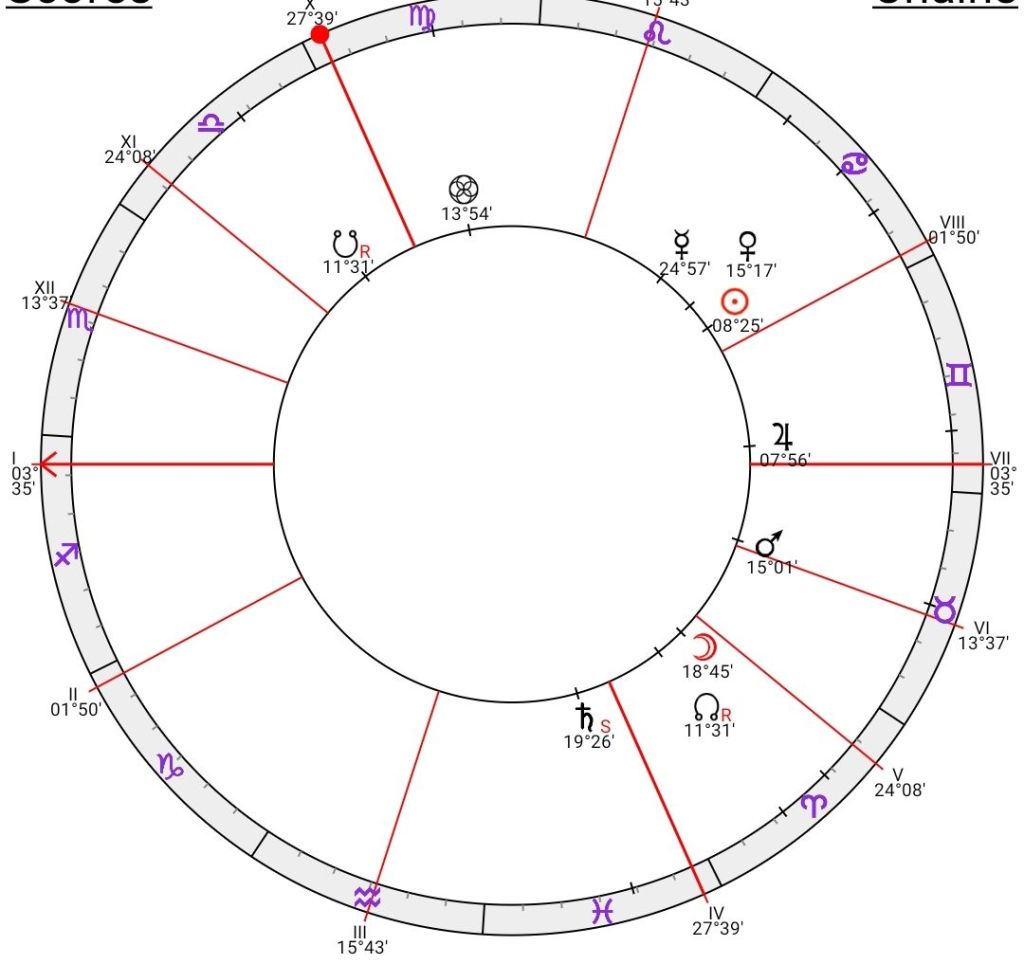
Note that the match had already started when she asked me the question, though I knew nothing of how it was going and I asked her not to tell me to avoid influencing my judgment. Furthermore, I forgot to screenshot the chart, so this is a recreation that I believe to be close to the original.
Will Italy win? App used: Astro Charts
Since the querent is Italian and wants Italy to win, Italy takes the First house. Switzerland is given the seventh house of the enemy. The first, and decisive, clue is given by the position of Jupiter, significator of the First house. It is stuck inside the Seventh house, in the grips of the opposing team.
Once we see this, pretty much nothing else matters. The opposing team, signified by Mercury, is in the Eighth house, which is not great, but by antiscion it is right inside the Seventh, which is bad for Jupiter but again good for Mercury. The Moon is moving to square Mercury with reception. Bonatti says that a square with reception is like a sextile without reception, so it is generally smooth. At any rate, Switzerland should win. And indeed they won 2 to 0.
Important note: Horary astrology requires the querent to have some kind of emotional involvement in the question. Since I couldn’t care less about soccer, despite being Italian, if I had asked the question I would have regarded the chart with some suspicion. It is only because the querent is a soccer fan that the chart was accurate.
In a relatively straightforward passage, Abano gives the reader examples of what it may mean when a figure moves from one house to another.
To truly understand mutation and the variety of the figures, you need to consider the property of the figure, whether it be fortunate or not, entering or exiting, fixed or mobile, and judge according to its meaning the effect of the mutation, always keeping in mind the question, the quesited and the querent. Another mutation1 to be kept in mind with its meaning in order understand better what has been said so far, is the one that happens to every figure as it changes from one house to another.
If the first figure changes to the second, and is good, fortunate, entering, it means gain, good luck for oneself, and when it is evil it means ill; if it moves to the third it bodes well for neighbors, relatives, traveling; when to the fourth, it means small losses, except if it is Cauda or if the question is about older relatives, friends and things fixed and immobile, endings, buildings and possessions; if to the fifth it’s excellent, except if it is Cauda; if to the sixth, it is very bad, except if it is Via or Cauda, or if the question is about sixth house matters; if to the seventh it has a very bad meaning, unless it is for seventh house matters, as said above, or unless it is Via or Cauda; if to the eighth it means ill luck, accident, loss, death, fear, except if you are asking about your enemy’s wealth or of the wealth of another person; if to the ninth it is good, unless it is Cauda or Rubeus, and if the question is about travel it won’t be made as scheduled; if to the tenth, it is very good, except if it is Via or Cauda; if to the eleventh it is also excellent; if to the twelfth, it is the worst of all, unless it is Cauda and in twelfth house questions.2
If the second figure moves to the third house, it means good luck and gain through siblings and relatives, or due to them, but if the figure is bad it shows the opposite; if it moves to the fourth it shows good outcomes in stable things, and through one’s older relatives; if to the fifth, it means well through messengers, letters, etc; when to the sixth it means infirmity, even of the family, and loss in moble things, and of servants. If it moves to the seventh, if it is good it means well, but if it is bad it shows loss through enemies or women, or games of chance,3 or thieves; if it moves to the eighth it shows that the absent party comes back with good news, and maybe the death of some relative, or loss depending on the angles of the chart; when it moves to the ninth it shows gain or loss from the church or through travel; if to the tenth it means gain from the profession or from one’s lords and good luck; if to the eleventh it shows good luck and good friends, and good luck from the community; if to the twelfth, it means one of his relatives will fall ill or be imprisoned, or shall lose wealth, but if the figure is good it shows buying animals, and things unthought of.
The third figure, when it moves to the fourth, shows gain or loss through relatives; when to the fifth, it shows happiness and new things, and messengers, clothes, etc. When to the sixth, it shows sickness, servitude, toil, small animals; to the seventh, it means copulation,4 change of place, fights, separation; when to the eighth it means gain or loss, death, fear; when to the ninth it means long travel, churches, religious people; when to the tenth it shows the army, profession, dominion, lordship, honor; when to the eleventh it means good luck, noble servants; when to the twelfth, prison, long sickness, retrieving lost animals or buying them.
When the fourth figure goes to the fifth it shows goods from one’s relatives or children, clothes, food, and other things of the home; when to the sixth, it means sickness in the family or animals, relatives, servants; when to the seventh it means getting married, a bandit coming back for you,5 the home becomes inimical; when to the eighth it shows inheritance, the absent party comes back; dying in one’s home country or home; to the ninth, it means death of a religious person, acquisition of church things; when to the tenth, honor of the house, lordship, honors, etc; when to the eleveth, it shows good luck in one’s home, family, congregation of friends, etc.; when to the twelfth, if good, it shows good things, but when bad it means sickness, long prison sentences, toil, difficulties in one’s home or country, or through one’s relatives.
When the fifth figure goes to the sixth house, it means sickness through being hexed6 or food, or issues with children, or messengers, or animals; when to the seventh, it means marrying off one’s child, merchandise, fights, enemies rejoicing, problems with children or a woman giving birth; to the eighth, problems and death of one’s child, or [acquiring] other people’s wealth, and the absent party is doing well; when to the ninth, a child entering the clergy, long travel, happiness and gain, a churchman having a child, gain from things of the church; to the tenth, it means a happy mother, lordship or [happiness] of one’s lord; when to the eleventh it means good news for the child, and a messenger resolving all kinds of issues, and friends are happy for or with the querent; to the twelfth it means sickness or imprisonment for the child, large animals and a prisoner or wayfarer who is doing well.
When the sixth moves to the seventh house, it means sickness, wrath, problems through small animals, servants or one’s wife or other people; when to the eighth, it means death of animals or servants, loss of wealth, sickness of the absent party, and servants helping one’s enemies; when to the ninth, it means a journey full of issues, and sickness during the journey, or a sick churchman, occupation, problems with the church; when to the tenth, it means sickness and problems, but also having good and faithful [servants?], obtaining a lordship; when to the eleventh it means sickness of self or of a friend, or contrarieties with friends; when to the twelfth it means sickness of great animals, loss through them, prison, pilgrimage.
When the seventh goes to the eighth house, if it is good, it means good things for the absent party, but if bad, death, loss and issues for those represented by the seventh; when to the ninth, it means the absent party will come back, the bandit goes away, the querent gets married, the enemy makes peace, long travel, religious people, or a churchman becomes your enemy; to the tenth, the lord gets married or becomes inimical, lordship, honors; when to the eleventh it means a friend becomes an enemy, and what’s good for him is bad for you, the partner won’t keep his promise, the thief is a false friend, the marriage or partnership is changeable; when to the twelfth loss of animals through enemies, or due to sickness of animals, and prison, and the prisoner gets married, problems during a pilgrimage, long pilgrimage, betrayal from hidden enemies.
The eighth figure, when it goes to the ninth house, means wealth, help from the church, death of a priest, travel full of fear and problems, the absent party is traveling; when to the tenth, it means death, occupation of stable things, the absent party comes back to the country; to the eleventh, it means death of a friend, gain through a dowry, inheritance, misfortune, loss through friends, good luck of the absent party if the figure is good; when to the twelfth, it means the prisoner or sick person is seriously sick, death of the same, and of the wayfarer, and being imprisoned due to enemies.
When the ninth goes to the tenth, it means ecclesiastical dignity, increase of church things, an honorable journey or for religious purposes; when to the eleventh it means good luck in travel, good company or partnership, luck with friends and things of the church, recognition within the church; when to the twelfth it means issues while traveling, danger through horses, being imprisoned, the prisoner may be released, the wayfarer comes back, the horse is found, and this causes more or less trouble to the querent depending on how good or bad the figure is.
When the tenth figure goes to the eleventh it means good in all things, and one’s lord or master is good and friendly, the year abundant; when to the twelfth it means prison, sickness, one’s enemies are not seen in a good light, and are hated by your friends and by your masters.
When the eleventh goes to the twelfth it means sickness, prison, adversities, problems, and one’s hidden enemies are lucky, and all is good for the querent.
MQS
Footnotes
It is rather typical, in premodern occultism, to use the same word to signify different things depending on the context. ↩︎
The general principle in judging the mutation of one figure to another house is whether it bodes well for the question at hand and whether the figure accords with the question and is fortunate. As such, in Abano’s example, a figure moving from the first to the seventh is unfortunate because it oppses itself, but the same movement is positive if the question is about Seventh House matters (marriage, alliances, etc.) ↩︎
Gambling is often seen as a Fifth house matter, but in this case the relationship with the Seventh House is through the fact that we are playing against ‘other people’. ↩︎
it is not clear why the conjunction of Third House and Seventh House matters should produce sex. ↩︎
‘Ritorna il bandito’. Bandito is an ambiguous word in Italian, as it can mean both bandit and banished. In this case it is probably the latter meaning which is relevant: someone who has been banished will come back. ↩︎
‘per fature’, similar to the current Italian word ‘fattura’, which in this context would mean a hex. It is possible the word has another meaning which escapes me. ↩︎
(Note: this is a collection of the meanings attributed to the cards by some occultists in the past centuries. It does not reflect my own study or opinion of the cards. It is only meant as a quick comparative reference as I develop my own take.)
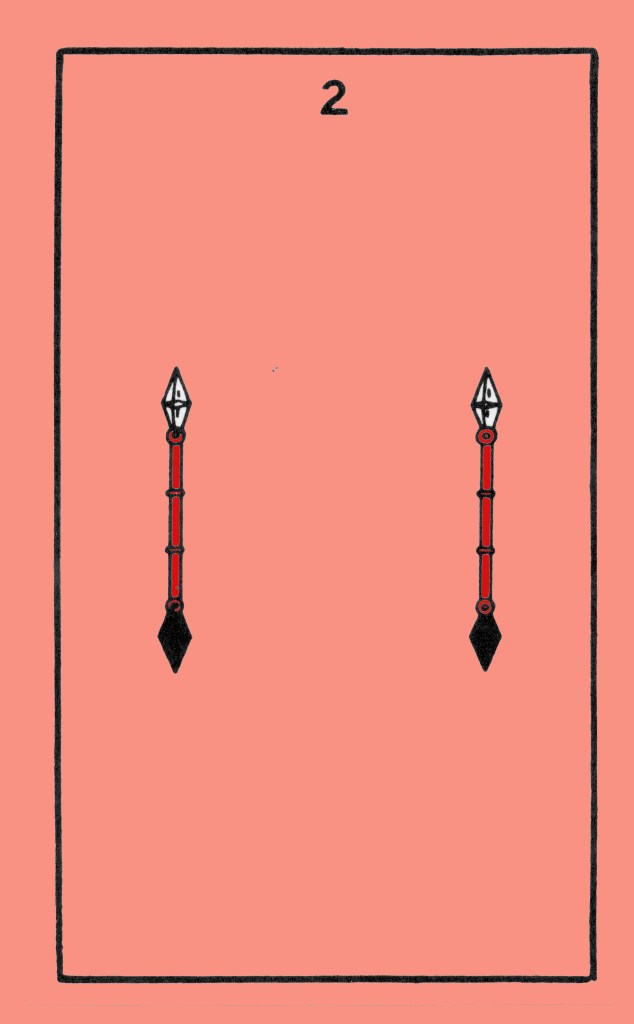
The Two of Wands from the Builders of the Adytum (BOTA) Tarot deck
Paul Foster Case (and Ann Davies)
In Tarot divination the Two of Wands has these key meanings: Well Dignified: it shows force, enterprise, boldness, resolution, some combativeness, much originality. lll Dignified: it signifies restlessness, fierceness, shamelessness, inordinate ambition, turbulence, obstinancy, revenge. A card of enthusiasm, but of strong self-interest. Keyword: Dominion (From the Oracle of Tarot course)
A. E. Waite
A tall man looks from a battlemented roof over sea and shore; he holds a globe in his right hand, while a staff in his left rests on the battlement; another is fixed in a ring. The Rose and Cross and Lily should be noticed on the left side. Divinatory Meanings: Between the alternative readings there is no marriage possible; on the one hand, riches, fortune, magnificence; on the other, physical suffering, disease, chagrin, sadness, mortification. The design gives one suggestion; here is a lord overlooking his dominion and alternately contemplating a globe; it looks like the malady, the mortification, the sadness of Alexander amidst the grandeur of this world’s wealth. Reversed: Surprise, wonder, enchantment, emotion, trouble, fear. (From The Pictorial Key to the Tarot)
Aleister Crowley
The Two of Wands is called the Lord of Dominion, and represents the energy of fire; fire in its best and highest form.
[…]
This card, pertaining to Chokmah in the suit of Fire, represents the Will in its most exalted form. It is an ideal Will, independent of any given object.
“For pure will, unassuaged of purpose, delivered from the lust of result, is every way perfect.” AL. 1. 44.
The background of this card shows the power of the planet Mars in his own sign Aries, the first of the Signs. It there represents Energy initiating a Current of Force.
The pictorial representation is two Dorjes crossed. The Dorje is the Tibetan symbol of the thunderbolt, the emblem of celestial Power, but more in its destructive than its creative form.
More, that is, in its earlier rather than its later form. For destruction may be regarded as the first step in the creative process. The virgin ovum must be broken in order to fertilize it. Fear and repulsion are therefore the primary reaction to the assault. Then, with understanding of the complete plan, willing surrender rejoices to co-operate. Six flames issue from the centre. This indicates the influence of the Sun, who is exalted in Aries. This is the creative Will.
Mars in Aries is the attribution of the Geomantic Figure Puer. The meaning of these figures is to be studied in the Handbook of that science: “The Equinox” Vol. I, No.2. Remember that the Geomantic Intelligences (see Liber 777 Cols. XLIX and CLXXVIII) are all primarily Gnomes. (From the Book of Thoth)
Weirdly religious AI-generated illustration of the Two of Wands
Golden Dawn’s Book T
A WHITE Radiating Angelic hand, issuing from clouds, and grasping two crossed wands. Flames issue from the point of junction. On two small wands above and below, with flames of five issuing therefrom, are the symbols of Mars and Aries for the Decan. Strength, domination, harmony of rule and of justice. Boldness, courage, fierceness, shamelessness, revenge, resolution, generous, proud, sensitive, ambitious, refined, restless, turbulent, sagacious withal, yet unforgiving and obstinate. Chokmah of HB:Y (Influence over others, authority, power, dominion). Therein the Angels HB:VHVAL and HB:DNYAL bear rule.
Etteilla
Sadness Upright. This card, as far as the medicine of the spirit is concerned, signifies, in its natural position: Sadness, Misery, Melancholy, Affliction, Sorrow, Desolation, Mortification, Mood, Discontent, Vapors, Gloomy Ideas. – Bitterness, Anger, Spite. Reversed. Surprise, Enchantment, Shock, Upset, Unexpected event, Unexpected fact, Excitement, Fear, Fright, Terror. – Consternation, Stunning, Domination, Abduction, Alarm. – Marvel, Phenomenon, Miracle.