Category Archives: Fiction

What is the Heart of a Good Story?

One of my favorite writers is Jorge Luis Borges. One of his shortest stories is On Exactitude in Science, which goes as follows:

…In that Empire, the Art of Cartography attained such Perfection that the map of a single Province occupied the entirety of a City, and the map of the Empire, the entirety of a Province. In time, those Unconscionable Maps no longer satisfied, and the Cartographers Guilds struck a Map of the Empire whose size was that of the Empire, and which coincided point for point with it. The following Generations, who were not so fond of the Study of Cartography as their Forebears had been, saw that that vast Map was Useless, and not without some Pitilessness was it, that they delivered it up to the Inclemencies of Sun and Winters. In the Deserts of the West, still today, there are Tattered Ruins of that Map, inhabited by Animals and Beggars; in all the Land there is no other Relic of the Disciplines of Geography.
(translation by Andrew Hurley)

We can discuss for days about the meaning and philosophical implications of this story. You may like it or dislike it. But it is a *complete* story. It tells about something that has a beginning, a middle and an end, where the end is not clear from the beginning. It does so in a very short space, but it is complete. It has a plot, and nothing is missing from it. We are not left hanging. It has nothing to do with postmodern crap. This is traditional story-telling at its finest.

Though the story may have a deep significance and several layers of interpretation, from a structural standpoint nothing differentiates it from a penny dreadful or an early XX century pulp magazine story.

It is far from me to want to push all story-telling within the confines of a single structure, but the thing that makes Borges’ story a satisfying, well-written story worth telling is that it has some kind of twist to it. Someone is doing something, but then something else happens. X is Y-ing when Z.1

X, in this case, are the Empire’s cartographers. Y-ing is the attempt to perfect the science of cartography. Z is the fact that their success in perfecting said science renders it unserviceable.

So if we had to condense the essence of the story into a short sentence, we would say: The cartographers of an old empire manage to perfect the science of cartography, whereupon they discover that perfecting it makes it useless. X is Y-ing when Z (you can substitute ‘when’ with ‘whereupon’, ‘but’, ‘and then’, ‘but then’, etc.)

If the story had been:

In that Empire the cartographers made huge maps in an attempt to make them as accurate as possible. One day they managed to make a map that was as large as the Empire itself, and then they went home.

You’d be justified in thinking that this is no story at all. That’s because here we only have ‘X is Y-ing’, but only the Z makes the story worth telling. Pretty much every memorable, complete story has an ‘X is Y-ing when Z’ structure. In fact, even the single scenes of a story generally follow this structure (though, in Borges’ case, there is only one scene.)

When I say that this structure is near-universal I do not mean it in the same way as people rave about the Hero’s journey and other semi-academic tools of analysis. All these may have their place, but ultimately they are external models, while fiction is much freer than most people would like. Still, a story without an internal ‘Z’ factor is like a joke without a punchline, and in order for the ‘Z’ factor to make sense it must be nestled within a context in which X is Y-ing. Again, ‘X is Y-ing when Z’.

There *are* reasons to tell a joke without a punchline (to waste people’s time, maybe), just as there may be reasons to tell a story without a point. For instance, plenty of critically acclaimed writers write pointless stories for the sake of them being pointless, usually to show their intellectual peers that they, too, are possessed of the smarts or irony necessary to understand how meaningless life is.

But at this point we are just playing with semantics here: if the point of the story being pointless is that it is pointless, then it becomes its point. It’s just that the point is now external to the story, and found in the writer’s delusion of grandeur.

Of course there is much more that goes into crafting a good story than a simple formula. But, as far as I am concerned, this is not even a formula. It is the reason people have been telling stories since the beginning of times: to be enchanted by the witnessing of meaningful change. This is what makes story-telling so similar to magic: something changes before our eyes and we are left dazzled by it.

MQS
Footnotes
  1. Holly Lisle, one of the people whom I learned writing from, had a different formula, but still to the same effect. I recommend you check her out. I have link to her website in my recommended links. ↩︎

Blending In With The Locals

Previous / Back to Index / Next

From the Microcosmicon, 29:

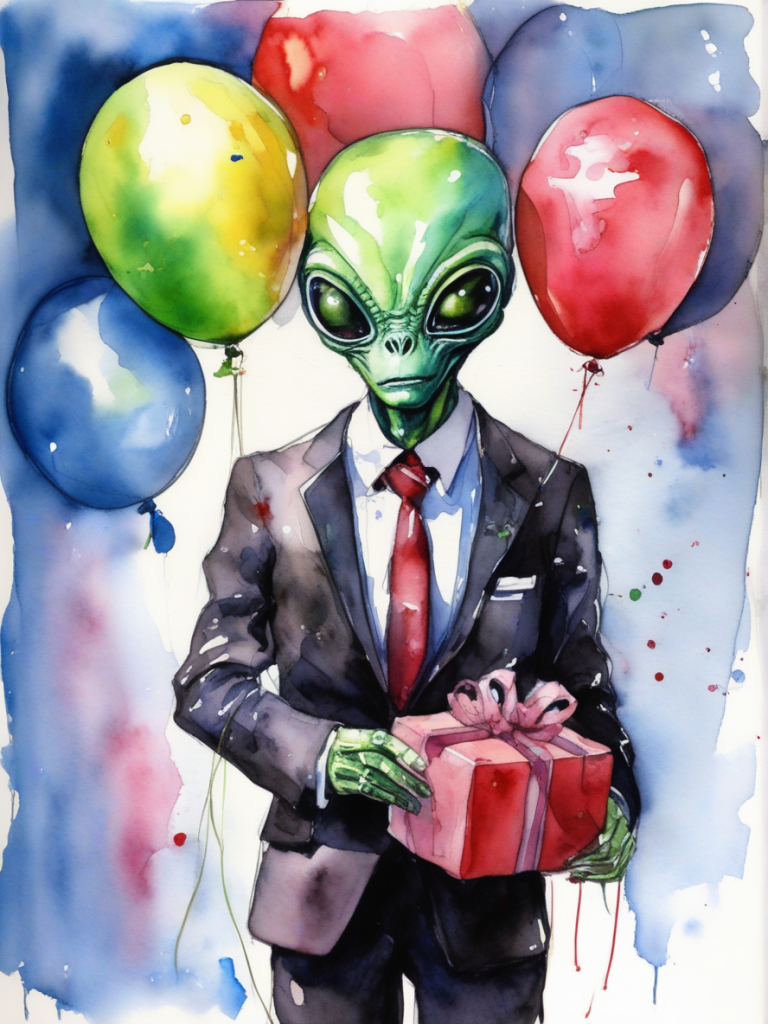
“They celebrate the day of their birth?” Tannuz asked, puzzled, as he adjusted his holographic camouflage. Humans were delicious, but also easily startled.
“Yup. Help me with the card,” Xondon said.

Tannuz thought about it, then scribbled something.
“What do you think?”
“It just says ‘Happy Birthday,’” Xondon mumbled, “be more creative or they’ll become suspicious.”
Tannuz got back to work.
“Better?”
“’Happy Birthday, hope it’s the best.’ Ok… But wouldn’t that imply the next one’s gonna be worse?”
Tannuz corrected the card again.

“Now?”
“’Happy Birthday, hope it’s the best (and last) one!’ Perfect! No one will suspect anything!”

MQS

blending in with the locals

Learning From Experience

Previous / Back to Index / Next

From the Microcosmicon, 28:

The doctor told Jade I’d be better than her late wife. I immediately shocked her with my mannerisms.
“That’s so Ana!”

For months I kept surprising Jade with my impression. In fact, I was more pliable than Ana: we never fought over the remote or her cooking, as Ana would have. I could learn and adapt, without prejudice.

Yet this bothered her.
“Ana wouldn’t have done it.”
She started sleeping on the couch. I didn’t disturb her, because that was her wish.

Rotting in the cellar, I realize she wanted me to do what she didn’t want. But I can’t.

MQS

learning from experience without prejudice

The Great Watcher

Previous / Back to Index / Next

From the Microcosmicon, 27:

The psychonauts’ submarine plunged into the Inmost Ocean, the depths of the collective unconscious where the whirlpool roared. A wound throbbed at the bottom of it, through which meaning bled out of reality, leaving the world stunned under a pall of grayness.

“There’s something,” one of them shouted, as the sub spiraled down toward the abyss.
“Don’t be silly, there can’t be anything beyond reality,” another responded.

“Wake up!” Dr. Ferguson’s voice broke in, saving them just as they were approaching the point of no return.
Their vision disappeared from the screen as they awoke.

“What did you see?”
“An eye.”

MQS

The Great Watcher

Mrs. Pettigrew’s Cat

Previous / Back to Index / Next

From the Microcosmicon, 26:

To Mrs. Pettigrew’s relief, the cat came back five days later.

Initially, everything seemed fine. Then Mrs. Pettigrew noticed something was off about the creature, though she could not put her finger on it. It kept meowing, but this in itself was not strange—Admiral was a talkative cat. It was the monotonous way it meowed.

Then, one night, as she was falling asleep trying to disregard the noise, it occurred to her—it was a looped recording.

She stood up and bolted into the living room. But Admiral was already taking off through the window with her biometric data.

MQS

Mrs. Pettigrew’s Cat

Eternal Life

Previous / Back to Index / Next

From the Microcosmicon, 25:

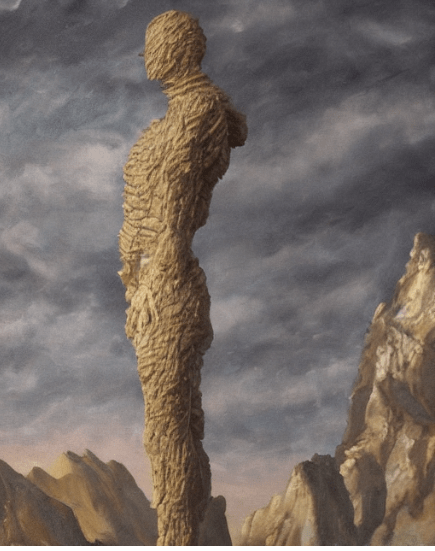
They called it the Hermit Planet, though no one existed who spoke its native tongue.

Lured by the promises of eternal life found in its electromagnetic field, travelers came to it from all over, meandering through its statue-rimmed roads, hunting the promised wondrous resin.

When they found it, they drank of it exclusively for three thousand days, waiting for the miracle.

Thus did vitality slowly dim in their stiffening limbs; thus did their minds drown in syrup, till life was evened out in their stilled nature, and fear merged with bliss, and flesh with bone and earth.
Pure, unobstructed presence.

The Planet of Eternal Life

MQS

A Loose Page From Dr. Ferguson’s Copy of the DSM

Previous / Back to Index / Next

From the Microcosmicon, 24:

It is not a place, but a state of mind. No one is especially predisposed. You reach it the same way you reach the wrong conclusion or the wrong address.

Initially, you are aware of it. It begins as a deviation in your thinking patterns, like a secondary route through the woods. All made perfect sense a minute earlier. Now something doesn’t. Then, nothing makes sense, so there’s nothing to be aware of.

And suddenly an endless residential area stretches out before your mind’s eyes, empty under an empty sky.
Now you are where barely any psychonaut can find you.

A loose page from Dr. Ferguson’s Copy of the DSM

MQS

The Love Dimension

Previous / Back to Index / Next

From the Microcosmicon, 23:

They approached the thing stretched out mutely on the table. Its nervous system unfolded like a web out of its brain, suspended on hooks. This was their forbidden gateway to the fullness of life.

“Lock the door,” one of them said apprehensively. The other obeyed.
Then each of them took a connector, forced one extremity of it inside the thing and the other into their temple socket.

Finally, one pushed a button, and the life latent in the thing unfurled. Their perception collapsed, absorbed into that of the thing.

Kids playing, dogs barking, the smell of meatloaf.
“I’m home, honey!”

The Love Dimension

MQS

The Fuel of History

Previous / Back to Index / Next

From the Microcosmicon, 22:

After their liberation, two centuries of fights were required for the Xandal’uc to achieve equality with their former human masters. During the so-called Golden Era, a generation of enlightened humans and Xandal’uc moved closer, working hand in hand like brothers.

Then a blind evil began uncoiling in the hearts of many Xandal’uc. Having tasted equality, they thirsted after superiority. When the final choice had to be made between moving on and getting even, they chose unwisely.

This proved that they were indeed equal to humans. And so History’s cogs screeched into motion, and the pendulum of evil was kept swinging.

The Pendulum of History

MQS