Enneagram Type Eight, sometimes called the Boss or the Challenger, belongs to the Body triad. Those of this Enneatype tend to be powerful, assertive and present in their body. They have seemingly endless endurance and stamina. They highly value their own independence and hate submitting to people, especially if they consider them unworthy. Their best defense is often offense, in the form of being imposing and challenging, but they also have a sense of duty toward their friends and associates, especially if they feel they need to defend them.
Enneagram Type Eight
Enneatype Eight Grows: Move to Two
Average Eights are known for their power-exuding, in-control behavior. In a way, they go through life as if they were a fortress constantly redying for war (and occasionally attacking a neighboring country to be on the safe side). They generally seem to believe that the best way of maintaining their autonomy is to behave in an assertive, hands-on way.
In general, Enneagram Type Eight is deeply aware of a weakness or softness within them that they feel they need to defend from exploitation and aggression. This is what leads them to being defensive (or aggressive, depending on the circumstances) and to wanting to establish themselves above other people, because once they know that they are the reference point for everyone else in the room, they know how to deal with them directly and head-on, which is Eight’s favorite kind of confrontation, as it leaves little space for subtlety and underhandedness.
As they grow and learn to relax their mechanism, Eights become capable of taking care of their soft side in a more nurturing way. They learn to see that not everyone is out to get them and that, in fact, other people have a tender, weak spot too that is deserving of love and protection. As they recognize this, maturing Eights take on some of the healthy traits of Enneagram Type Two.
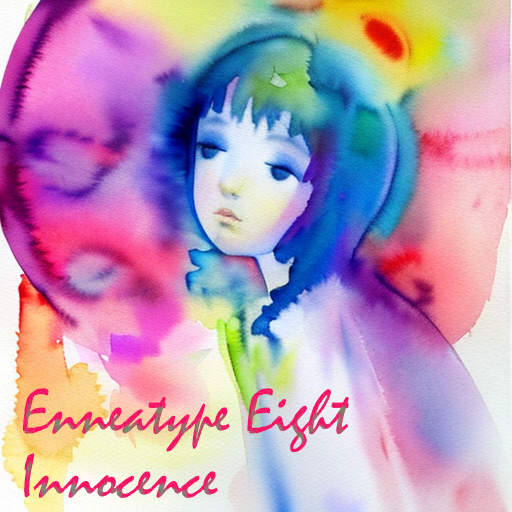
At their best, Twos are caring, interpersonal, giving, motherly and see the needs of others as theirs to take care of. In growing toward Two, Eights become capable of putting their warrior qualities to a higher use in honoring others’ need and defending them. They become extremely giving (in a more neutral, less manipulative way than unhealthy Twos) and their energy is expressed in a way that is innocent because it places itself beyond the rigid distinction between friend and foe.
Innocence, the Virtue of Enneagram Type Eight
Enneatype Eight Under Stress: Move to Five
All Eights tend to act assertively in order to protect a part of them that they consider vulnerable and tender. In a way, it is as if they were padding the space around that vulnerable point with their boldness and in-your-face behavior, so that others can’t take advantage of it.
Unfortunately, it is not always possible for them to succeed in this effort. Sometimes their vulnerability comes to light, especially in the form of not feeling adequate or smart enough or strong enough to meet the challenges of life. While average to healthy Eights can enjoy meeting the resistance of the world and can appreciate worthy sparring partners, unhealthy Eights can feel that big challenges threaten their independence as individuals. In these circumstances, receiving a reaction that is equal to or stronger than the action they exert can cause Eights to lose their balance.
When this happens, Eights move to their stress point, where they develop some of the less healthy traits of Enneagram Type Five. Seeing an Eight move to Five is like seeing a bloated baloon letting out the air all at once. Suddenly all the assertive energy of Type Eight implodes toward the center of their being and they become insecure, silent and almost invisible.
Eights, like average to unhealthy Fives, now tend to feel exposed and in need of putting distance between them and the threat, and it is not uncommon for stressed out Eights to physically remove themselves from others’ presence. In doing so, Eights hope to regain some power and energy and to strategize a way out of the impasse.
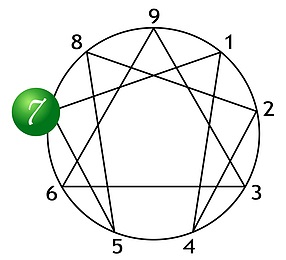
Enneagram Type Seven, sometimes called the Epicurean or the Enthusiast, belongs to the Head triad. Those of this Enneatype are usually positive, upbeat, energetic and fun-loving. They are mainly driven by the desire to avoid negative sensations and to maximize their options of experiencing the world and its potentials without being held back or restricted. They often make lots of plans and are engaged in many projects, activities, side activities, etc, some of which are bound to be left incomplete. They are usually possessed of quick wits and have an aptitude toward picking up new skills and interests. They rarely focus on the negative side of life, and even when they do, they tend to snap out of it quickly (or more quickly than other people.)
Enneagram Type Seven
Enneatype Seven Grows: Move to Five
One of the common themes in most Sevens’ lives is their fear of being confined to just one option, which will lead them (in their perception) to not experiecing life to the fullest or to not having back-up plans if one option fails. This tendency can cause Sevens to remain perpetually stuck on the surface of life, to the point that some unhealthy Sevens believe the surface is all there is. Sometimes this belief can cause Sevens to make rash decisions out of fear of being chained down in one place or situation.
As they grow and learn to relax their mechanism, though, Sevens start to develop a keener appreciation for the depth and complexity of life and a greater focus in pursuing certain options as more obviously right for them as opposed to others. In this, they start to take on some of the better qualities of Enneagram Type Five. Fives are the intellectuals of the Enneagram. They rarely make rash decisions and are often laser-focused, as though their mind were a blade that they use to cut through the surface of things to reach their core. They also don’t shy away from the negative side of life.
In general, even healthy Fives tend to lead a more sober life than their Seven friends, with a preference for a few well-chosen activities (or a few well-chosen possessions, friends, etc.) as opposed to the epicurean sludgeflow that usually clutters the lives of unhealthy Sevens. This is not to say that Sevens must become minimalistic, but as they grow they do become more stably anchored to their own core.
As they do so, Sevens realize that they are not necessarily foregoing anything essential if they choose to pursue one option to the exclusion of another, and instead they learn to cultivate what they do choose with care and persistence, while bringing their sense of humor, childlike wonder and almost endless adaptability with them.
Sobriety, the Virtue of Enneagram Type Seven
Enneatype Seven Under Stress: Move to One
Perceptive Sevens can sometimes feel that they are being led on a leash by their fear of restriction and pain. While healthy Sevens face their demons directly (like all healthy types) less healthy individuals can become absorbed in an endless whirlwind of meaningless novelty-chasing and hype traps, whereby they drop their toy as soon as the next shiny trinket catches their attention.
Because Sevens are very sharp-witted, they usually notice this trend, but they also feel that they must keep going, because stopping for a second (they feel) would cause more obscure feelings and fears to catch up with them. Unhealthy Sevens generally know that they are caught in a loop, but they feel that it’s too late to stop (Sevens in general have a tendency to excuse away their lack of restraint).
In moving toward their direction of stress, Sevens can pick up some of the less healthy qualities of Enneatype One. Like unhealthy Ones, they become critical and rigid, usually toward those around them who refuse to jump on the next hype train with them. Furthermore, perceiving the futility of their behavior, Sevens may also try to organize themselves to bring more structure to their life and activities (especially if it is spiralling out of control due to poor decision-making), but they tend to organize them to death, until all the wonderful Seven-ish spontaneity is sucked out of them and all that is left is the unhealthy One’s grayish sense of bureaucratic doom.
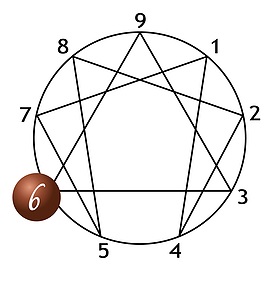
Enneagram Type Six, sometimes called the Loyalist or the Skeptic, belongs to the Head triad. Those of this Enneatype tend to feel the need for an external source of security, whether it be in the form of social connections, love, a political ideology or religion, etc. They are often friendly and want to show themselves as dependable and trustworthy to avoid danger and controversy, but they also have a skeptical streak that undermines their ability to find the security they need. They are often given to catastrophizing, questioning and poking holes into everything in hopes of finding the one thing that they can trust, but once they feel they have found it, they rarely question it.
Enneagram Type Six
Enneatype Six Grows: Move to Nine
The beginning of a Six’s fear lies in their inability to give themselves the security and stable ground that they need. Because they lack a sense of inner guidance, they usually look outside of themselves, finding it in people, institutions, systems of all type, etc. Ultimately, Sixes want their anchor to be beyond doubt (that is, in a way, perfect).
This is obviously a problem, since an honest look at anything and anyone will reveal their flaws. Although some Sixes manage to convince themselves to stick to something even if imperfect, the nagging sense of uncertainty remains.
When a Six learns to trust themselves, their decisions, their own processes and learn to see the difference between a healthy dose of skepticism and an excessive one, they can also relax and, in doing so, they pick up certain qualities of healthy Nines. Enneagram Type Nine is often trusting of others and allows space for honest interaction without the drama that average Sixes often stir up when they haven’t yet sorted a person in trustworthy or dangerous.
Usually, Nines tend to see beyond division and can capture the unitary essence of all processes, including interpersonal ones. In integrating aspects of Enneatype Nine, Sixes, usually become much calmer and more capable of seeing the simple essence of a situation without getting lost in a myriad contradictions and doubts. More importantly, healthy Sixes develop the kind of self-assurance that they usually lack.
Courage, the Virtue of Enneagram Type Six
Enneatype Six Under Stress: Move to Three
Enneatype Six tends to create secure and stable social connections, which they reinforce by being trustworthy and friendly. Largely they do it to reduce the uncertainty of life (it wouldn’t be a stretch to say that the Six’s socially cohesive instinct is what brought humanity together and created the basis for society)
Unfortunately, this strategy is not always effective. Depending on their particular situation, Sixes may feel that their life is too unpredictable and dangerous. They may feel like they are swimming in a sea of ungraspable alternatives whose consequences they can’t pin down and anticipate. When this happen, a Six may still try to create certainty, but if the strategy fails, they will go to their stress point, where they embody the less healthy qualities of Ennneagram Type Three.
Threes are the workaholics of the Enneagram, constantly trying to emerge and establish themselves as worthy of respect. At their worst, Threes are unreasonably competitive and tend to see everyone as an opponent to outdo, outfox, outperform at any cost and using any trick possible. Stressed Six embody this more antisocial aspect of Type Three, as they feel they can no longer trust others and must therefore learn to compete with them.
Highly cynical and with a generally negative outlook, unhealthy Six can try to constantly undermine others, as though doing this was necessary to deactivate the potential threat associated with other untrustworthy human beings. This behavior is often seen together with panicked responses to every minor setback and a tendency toward authoritarianism as a coping mechanism.
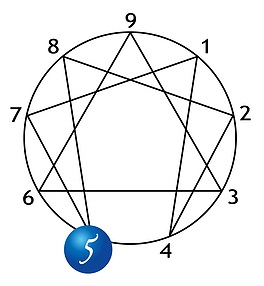
Enneagram Type Five, sometimes called the Observer, belongs to the Head triad. Those of this Enneatype are often recognizable for their tendency to withdraw from social contact and interaction with the world in order to observe it and accumulate knowledge and understanding. Fives tend to have a sense of energetic dearth, as though their inner resources weren’t enough for them to meaningfully impact the world, or even just to be in the world. Highly intellectual, they value objectivity and facts, which they often recombine in new and creative way, and are generally unsentimental and unbothered by social conventions.
Enneagram Type Five
Enneatype Five Grows: Move to Eight
Many Fives report that at some point they realized they were going through life as though they were constantly getting prepared for it, with the result that when they felt ready, life was already over. This is an understandably heartbreaking situation to be in, so it’s vital that Fives come to terms with it as soon as possible in order to live life before it’s gone.
A large chunk of a Five’s growth path comes from understanding that it is ok to get started without knowing everything, and that their marvelous mental abilities will inevitably go to waste if they don’t cultivate them in a practical setting and in the midst of real life action. Ultimately, Fives’ tendency to withdraw from others, withhold their presence and accumulate knowledge is a defense mechanism against fear, but as long as they withdraw they reinforce the implicit notion that the world is so fear-inducing that it must be seen from a distance.
The only way to break the cycle is for Fives to gradually let go of their tendency to let go of the world (it’s a letting go of the letting go) and to dive into it and take full charge of their body and their instincts, taking up space and showing up. In doing this, they start to embody the better qualities of Enneagram Type Eight, the most physically expansive and assertive of the nine type. Interestingly, Eights, like Fives, deal a lot with the idea of truth, but Eights have an instinctive awareness of it, whereas Fives have an analytical understanding of it.
In allowing their insights to take physical form, Fives reduce their tendency to detach from reality and become capable of bringing their objectivity and knowledge to fruition. Their ability to let go of things is used not to renounce the world, but to experience it all equally in all its transient permutations. Detachment thus becomes non-attachment.
Non-Attachment, the virtue of Enneagram Type Five
Enneatype Five under Stress: Move to Seven
Fives generally hate having to jump into things without preparation. They tend to plan ahead as if they possessed half the energy, time and resources they actually have and often don’t communicate their thoughts unless they have had the time to polish, proof and justify them. This is why going to war with a Five in a field they know a lot about is often a lost cause: they are always five or six steps ahead in the argument.
But, as much as they would like to be omniscient, Fives aren’t. The world is too complex to hold it all inside one’s mind before one ventures into it (which is how Fives get started on their journey of observation.) Variables are bound to intrude into one’s views. More importantly, Fives may not always have the chance to step back from quickly unfolding situations to take a breath and organize their mental response.
When this happens, Fives may initially still try to withdraw, but if their usual strategy becomes impossible, it is not uncommon to see them make fools of themselves, like unhealthy Sevens. This is not because Fives (or Sevens, for that matter) are actually fools, but because they panic at the prospect of not being able to employ their typical strategy.
Often, Fives that move to Seven under stress become volatile, scattered, given to missing the mark with odd jokes or comments. Because they haven’t had the time to establish clear boundaries within which they feel secure, they become erratic and aimless, thus lending credence to their own worst fear of being incompetent and needing to withdraw even further.
Enneagram Type Four, sometimes called the Individualist, belongs to the Heart triad. Those of this Enneatype generally feel a strong sense of deficiency compared to other people, and tend to recast this sensation of lack by perceiving themselves as special or unique. They have a complicated relationship with others, as they both feel a powerful need to belong, be seen and find deep and meaningful connections, while also feeling that they can never truly form such relationships. Because of their focus on their own deficiencies, they tend to be well-acquainted with the negative side of life.
Enneagram Type Four
Enneatype Four Grows: Move to One
Average Fours have a very diffuse sense of agency. Sometimes Fours feel like a cruel destiny has doomed them to a life of suffering, and the best they can do is bear this burden with artistic grace by exploring their inner landscapes. This is, of course, nonsense, just like all other Enneagram mechanisms. Still, it is not uncommon for average Fours to be incredibily mopey and defeated even in conditions that others would consider relatively normal, if not optimal.
The path out of this mechanism lies in giving up their habit of navel-gazing and actually planning their way to self-actualization. It happens often that aging Fours often pine over lost opportunities (If I just hadn’t quit those piano lessons) because all paths to success usually involve the kind of drudgery that Fours feel they are too sensitive or special to persevere in. This can lead to Fours feeling that they have wasted their life, which only reinforces their sense of being doomed.
If they give themselves a roadmap, though, Fours can become more principled and disciplined, like healthy Ones. Ennatype One is known for their ability to stick to plans and principles for dear life. Furthermore, Ones tend to put their own feelings on the backburner to take a hard look at how things truly areand how they can be concretely improved, and this attitude certainly benefits self-absorbed, feeling-oriented Fours.
In integrating One into their life, Fours learn to balance themselves and to see and perceive the whole spectrum of feelings, not just the negative ones, and learn that the positive side of life is just as authentic as the negative one.
Equanimity, the Virtue of Enneagram Type Four
Enneatype Four Under Stress: Move to Two
Fours are one of the most self-centered Enneatypes, not necessarily because they are egotistic, but because they relate everything to themselves and measure themselves against others and others against themselves. This is where their passion of Envy comes from. For a Four, life is like being on one dish of a pair of scales, with others on the other dish, and one dish cannot go up without the other going down.
This complicated relationship with other people results in a typical push-and-pull behavior which expresses the unresolved tension within the Four’s mechanism: others are both the object of desire and of spite. Furthermore, Fours usually see themselves as more authentic than others because of their acquaintance with their inner darkness and their sense of loss and grief, and this often causes them to want to show their own authenticity in front of others, without regard for proper time and place. Unhealthy Fours may even rub salt in people’s emotional wounds (which Fours are very good at sensing) both to make them feel what “real life” feels like and to make themselves feel a bit better by comparison.
When this inevitably leads to people becoming stressed out about their behavior, Fours are suddenly reminded that, ultimately, their own sense of self is highly dependent on others (as for all Heart types). In an effort to patch things up, the stressed Four abandons all emotional honesty and becomes clingy, unctuous and pleasing, like average to unhealthy Twos. Like Twos, they feel that they can only find meaning in the eyes of someone else and become accomodating to a fault.
Enneagram Type Three, sometimes called the Achiever, belongs to the Heart triad. People of this type are dynamic, goal-oriented, driven to excel and stand out. Threes are often very aware of what it takes to have success in a certain field, social situation or career path, and they often do all they can to meet whatever idea of success is implied in these contexts. Because of this intense drive, Threes tend to have problems with competitiveness, as well as with authenticity, as they are used to putting their true self and their true feelings on the back burner while they strive their utmost to comply with expectations and to sell an image of themselves as winners.
Enneagram Type Three
Enneatype Three Grows: Move to Six
Threes are the ‘sellers’ of the Enneagram. While in the presence of an average to unhealthy Three, perceptive people tend to constantly have the feeling that the person is trying to sell them something. This something can vary based on the context of the interaction, but deep down, what Threes are trying to sell is their successful, socially acceptable image of winners.
As they learn that their worth as individuals cannot be measured purely on the basis of performance, Threes may at first find themselves in a bit of a crisis, as they are not used to giving weight to much else. However, as they become more centered, they learn to become more accepting of their true feelings and identity, to see others as companions rather than as competitors and to value honesty above presentation.
In doing so, Threes move toward Enneatype Six. Sixes are inherently companionable, they tend to form strong connections based on trust and they put great emphasis on truthfulness and doing away with double meanings and sophistication. This is because Sixes want to know how things really are, so as to be able to trust them.
In their move to Six, Threes often find meaning in the forging of meaningful connections and in striving together toward common goals, while the need to emerge is transmuted into the desire to uplift others together with oneself.
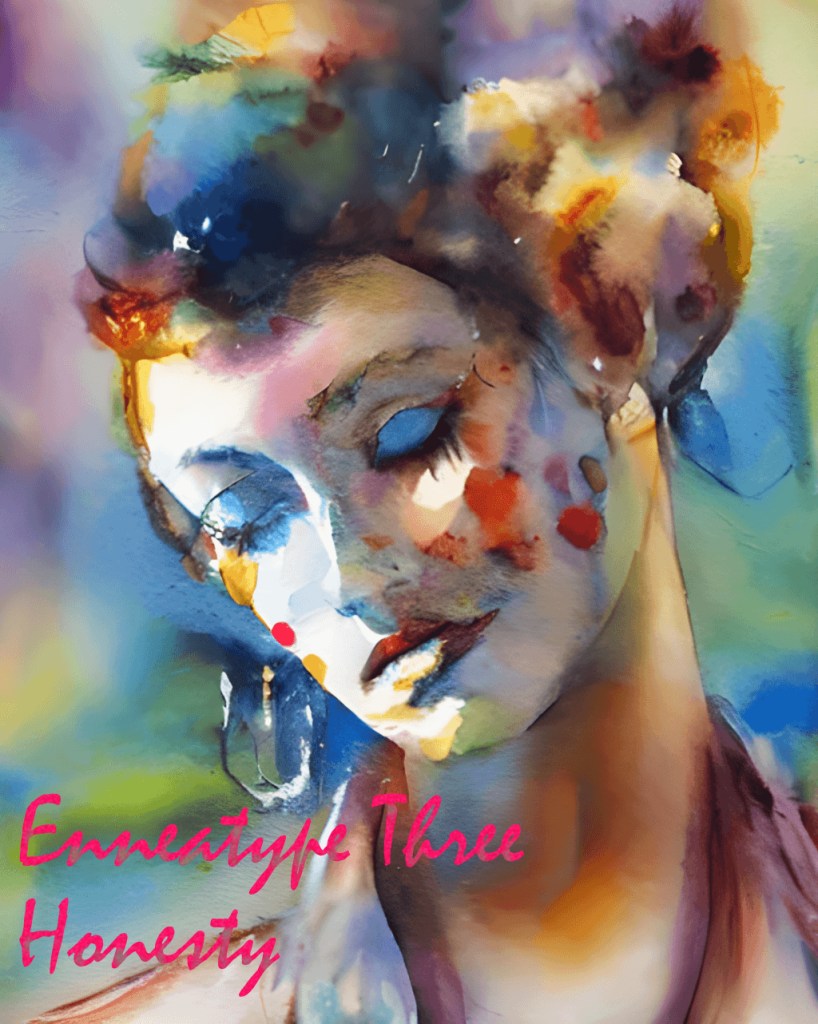
Honesty, the Virtue of Enneagram Type Three
Enneatype Three Under Stress: Move to Nine
The kind of drive that Enneagram Type Three tends to inject into everything they do is rarely matched by any other type. Threes have a sense of mission in them, as it were: they are the chosen ones to be the best, the prettiest, the most admirable, the most intelligent, the most wealthy, the most creative, the most spiritual, etc. (which of these it is largely depends on their upbringing, familial context and personal values and beliefs)
In their most lucid moments, Threes also have a keen awareness of all that they are sacrificing in their bid to excel and outshine everyone else. What they know they are sacrificing is their authenticity, their inner well-being, their emotional needs. There is often a lurking feeling that all is in vain, because even if they manage to succeed in whatever field they choose (or is chosen for them) their inner self is not truly part of it, having been swept under the rug for later.
This often brings a sense to unease, as though a part of the Three were aware of their commitment to a mere facade with little substance. This may cause them to break down or have identity crises on occasion. And this is even when they succeed.
When they don’t succeed, Threes may try to switch horses and find something else to excel at. If they don’t find it, they may become apathetic and lethargic, like unhealthy Nines. Aware that nothing matters and that all avenues for social acceptance have been destroyed, they may retreat into themselves and simply let the world and life move about them without engaging in them, knowing that they have sacrificed their well-being for something that brought nothing.
Enneagram Type Two, sometimes called the Helper, belongs to the Heart triad. People of this Enneatype often seek validation, appreciation and affection from others by meeting their needs, real or perceived. Their hope is generally to find significance for themselves by becoming important (or even vital) to others. Often, Twos have a hard time trying to take care of their own needs without either feeling selfish and guilty or trying to reformulate them in such a way that they can be seen as favors to others and good for other people’s well-being.
Enneagram Type Two
Enneatype Two Grows: Move to Four
Average Twos are horrified at the prospect of being considered selfish or self-centered. Somehow they have learned that taking care of one’s needs first is wrong. As we know that the person who hasn’t secured his oxygen mask cannot help the person sitting next to him, this a wrong conviction. Still, Twos tend to irreflexively sacrifice themselves for others (which is why they feel scorned when they don’t get appreciation for it)
A Two’s growth begins by being honest with themselves about their own needs and learning to disentangle them from those of other people. There is often a painful spot right in the center of the Two’s heart, where the Two feels alone, hurt and unloved. Normally, Twos tend to stay away from this spot by being cheerful and by filling up their schedule with ‘useful activities’. Obviously, as long as this spot goes unrecognized and unelaborated it will be the one thing that drives the Two around.
By learning to accept and integrate this aspect of themselves, Twos begin to showcase some of the positive traits of Enneagram Type Four, which is definitely a more self-centered type. But healthy Fours have a remarkable emotional honesty and have great compassion for themselves and the darker side of their life, which is why they are also full of compassion for the suffering of others.
In moving to Four, Twos paradoxically learn to truly be loving, in a more humble and authentic way, as their kindness won’t stem from odd psychological gymnastics to create a bond of codependence with another, but from the true desire to help that overflows from their empathy with themselves.
Humility, the virtue of Enneagram Type Two
Enneatype Two Under Stress: Move to Eight
A Two moving to Eight is a sight to behold. Hell truly hath no fury like a Two scorned. I would go as far as to say that it is one of the great wonders of the Enneagram. Since my husband is a Two and since I am not the easiest person to live with, I know this well.
The way I would formulate it is that every Two has a raging lunatic locked in the basement of their mind, which they do all they can to keep at bay, but when the pressure becomes excessive, the monster escapes, and at that point the person you regularly know has no longer any control over the situation.
This raging lunatic is really the accumulated scorn that Twos are unable to work through in a positive way. Twos are a seductive type: they seek to besiege selected people whose appreciation they want with attentions, kindness and favors. When the strategy fails to get the Two the sort of recognition and appreciation they feel they deserve, this aggravates them, but because Twos generally have a positive, upbeat outlook, they tend to brush it off. They don’t forget about it, but they choose to ignore it for the time being.
They therefore double down on their seductive efforts. When it becomes clear that they aren’t getting anywhere, or when they feel cornered or at the end of their rope, Twos explode, and that’s when the lunatic escapes the basement. The accumulated aggravation, anger, resentment and hurt pride is let out all at once. They therefore display some of the less positive traits of Enneagram Type Eight, such as aggressiveness, rashness, authoritarianism.*
MQS
*on a personal note I may add that Twos become very sexy when they move to Eight, as they tend to emanate the type of choleric energy that is, in principle, channeled through sexual activity. Make-up sex with a Two is wonderful.
As of today, I have officially doubled the amount of single visitors that reached my blog compared to last year and almost tripled the amount of page views, and for this I thank you wholeheartedly!
Fun facts: 1) despite my Sibilla section being older and therefore better indexed online, my playing cards section has been visited more. I am not surprised, as playing cards are more popular, but I am surprised that it happened so quickly. 2) I officially have visitors from all inhabited continents! 3) The US have by far overtaken Italy as the country that visits my blog the most 4) The UK, Brazil, Greece, Peru, Canada, Japan, South Korea and Malaysia also have a strong presence 5) In total 84 countries have visited! 6) I have no statistics for this, but I have also interacted with a lot more people through private messages. It’s always fun to exchange opinions and experiences
Future Projects
This year I have been active as never before. I started branching off in various directions that interest me, and I have plans for more. In addition to adding to the sections I have already opened, I plan to start talking more about Tarot, as well as a new interest of mine, the I Ching.
I also want to open a section on magic and occultism, as well as expanding the section on spirituality. I’ve been thinking about it a lot–I usually prefer to heed the old advice to keep silent about occult endeavors, but I don’t think there’s anything wrong.
A section on philosophy is also probably going to come, as I find it hard to separate serious occultism from philosophy, but it’s unlikely to come next year (though never say never). The thing is, my PhD in philosophy makes me rather anal when it comes to philosophical topics.
As I started dabbling in video editing, a small youtube channel may be coming at some point, but I don’t want to put myself under too much stress, so that’s just a thought at the moment.
Also, in my spare time I have started editing old manuscripts on various occult topics, which I plan to make available on amazon. In one case I simply updated the English, but I am also translating a couple of books from Italian, French and Latin.
Finally, I’ve been thinking of moving the blog from wordpress.com to wordpress.org, but I’m still undecided on the matter. One thing’s for sure: I want to get rid of the ads.
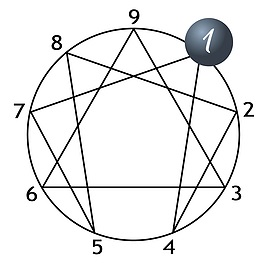
Enneagram Type One, sometimes called the Perfectionist, belongs to the Body Triad. People of this Enneatype tend to have a strong inner critic that judges everything they (and other people) do based on norms, ideals and right precedures or methods. Ultimately, Ones derive a sense of justification for their existence in the world by adhering to standards and ideas of how things ‘ought to’ go. They often feel that they have a duty to uphold these standards and to put them into practice in the world around them.
Enneagram Type One
Enneatype One Grows: Move to Seven
Ones’ sense of duty is part of their subconscious deal with themselves, which states that they are okay and are allowed to take up space in the world only if they do it the right way, usually by asserting an ideal or implementing or upholding certain standards.
It is always hard for anyone to accept the world as it is, but especially for Ones. They tend to see the world as if it were in a fallen state and needed to be amended. There is nothing wrong with changing what needs to be changed, but doing so in order to obey a harsh inner critic who will latch on to anything to demand improvement is a recipe for unhappiness, both for the One and for those around them. Remember that history is full of visionaries who tried to reform the world and ended up making it worse.
As Ones learn to let go of the resentment they feel toward the world and toward themselves for not being the perfect mirror image of an ideal, Ones move toward point Seven on the Enneagram. Sevens are a mundane type. They love finding always new ways of enjoying the world and the variety it has to offer. Even average Ones can sometimes display this childlike curiosity and sense of adventure in their best moment.
The great gift that Ones can develop by developing this sevenish side is that they learn to improve the world around them by developing its inherent promises from moment to moment rather than by trying to impose foreign ideals onto it. No longer angry at themselves and at the world, Ones learn to accept different opinions and different ways of acting, and their behavior becomes less reactive.
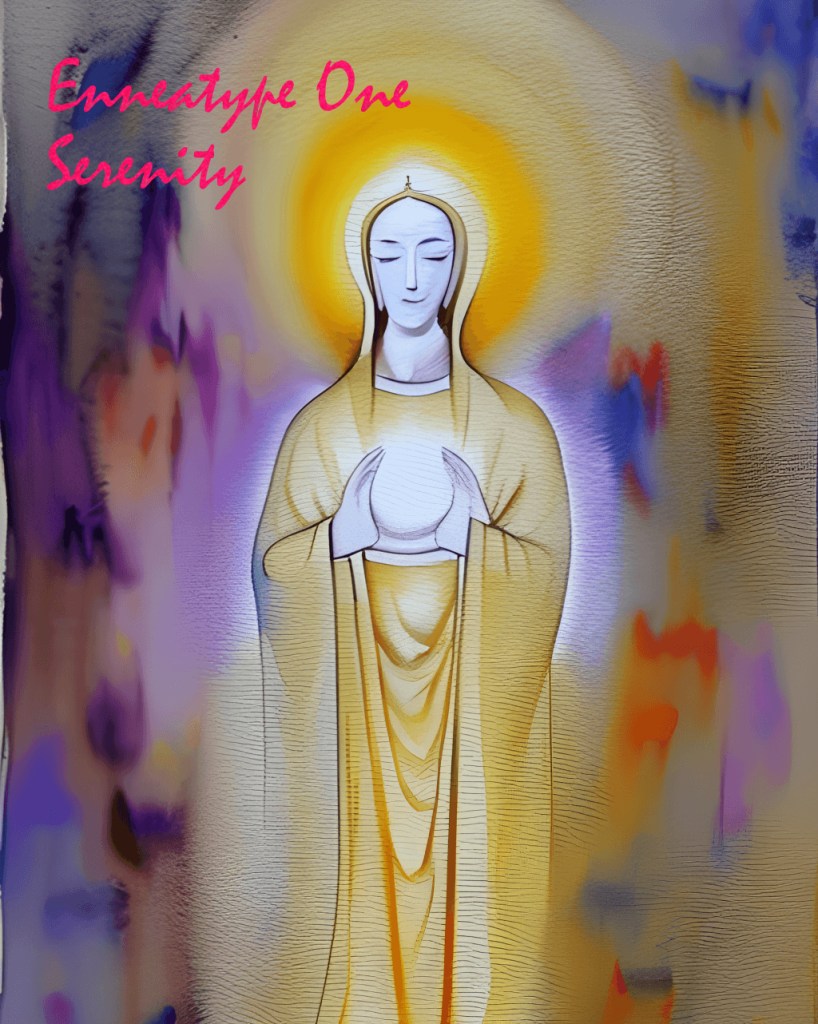
Serenity, the virtue of Enneagram Type One
Enneagram One Under Stress: Move to Four
I said that average Ones see the world as if it were in a fallen state. It makes sense that, under stress, Ones move to Four, the type that more than any other feels like a fallen being.
Ones have considerable faith in their ideals and in the fact that their way of doing things is the right one. They can keep beliving so under the harshest conditions and against all oppositions. Since they usually have a large reservoir of pent up anger inside of them, when challenged beyond a certain or when witnessing something they do not approve of, they may explode.
However, if Ones lose their faith in their ability to change themselves and the world around them to make them match how they ought to be, Ones may move toward their direction of stress at Four. Average to unhealthy Fours are melancholic, dramatic and reserved. They have an air of defeat about them, as though they had lost something of great value that used to make them happy, or if they had been shipwrecked in the wrong world.
Under stress, Ones tend to take on some of these less healthy characteristics of Enneatype Four, becoming pessimistic and despairing. Ones thus begin to witness a world of irredeemable lawlessness and wrongdoing around them. Since they feel that all is lost, they may start indulging unhealthy pastimes, while at the same time feeling bad about it as they alternate between their “OCD streak” and their depressive, defeatist one.
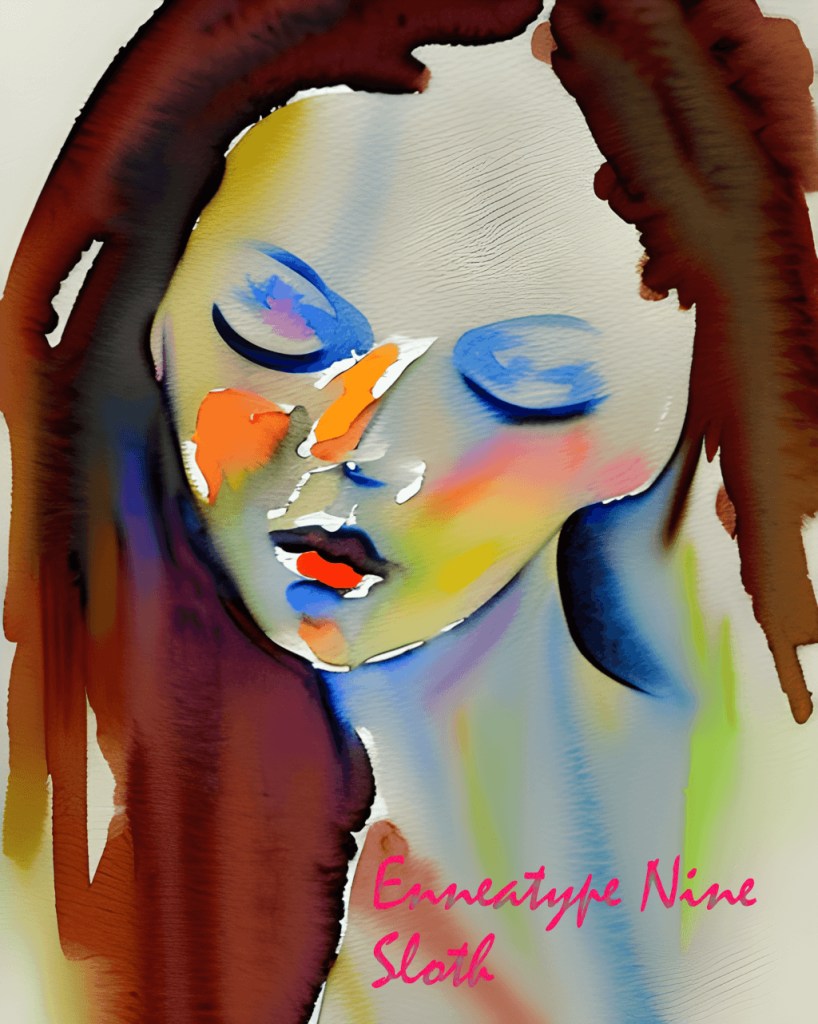
Often Known As: Diplomat, Mediator, Peacemaker (note that names are as limiting as they are revealing.) Sin/Passion: Sloth Focus: on harmony Fear: of rocking the boat and creating conflict Energy Center: Body (energy is suppressed) Social Stance: Withdrawing Key Positive Traits (embodied at their best): Peaceful, Conciliatory, Friendly, Irenic, Serene, Placid, Flexible, Welcoming, Easy-going, Tolerant, Undemanding, Able to hold space for others, Facilitating others’ self-expression, Defusing, Deescalating, Kind, Tactful, Unbothered, Always capable of finding common ground Key Negative Traits (embodied at their worst): Inert, Self-forgetting, Self-suppressing, Diffuse, Vapid, Platitudinous, Bland, Soporific, Flavorless, Vanilla, Immovable, Complacent, Oversimplifying, Both self-sabotaging and passively sabotaging others, Passive-aggressive, Unable to assert themselves clearly, A secondary character in their own life Directions of Growth and Stress: to Three and Six respectively
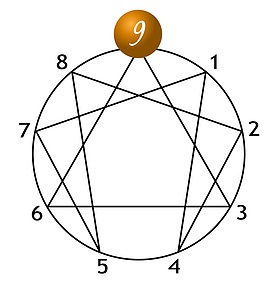
Enneagram chart with Type Nine highlighted.
Introduction
Nines are generally easygoing, accepting, positive and agreeable. They are placid, hardy and normally unbothered by the difficulties of life, as though they wore a waterproof jacket. It is often easy for people to open up to them, and Nines usually like creating connections and cultivating harmonious relationships. In fact, harmony is probably the one word that best describes Enneagram Type Nine.
Within a group of friends, Nines are the ones that will always seem happy no matter what the others decide, and others may find that Nines are very easy to get along with, since they rarely pose challenges or raise serious problems, so much so that, on occasion, they may even stop thinking or worrying about them. This often leads to Nines slipping under the radar and not getting the recognition and attention they deserve, which may make them feel overlooked.
Whenever problems do arise, Nines often prioritize harmony and stability, so they will usually seek to solve conflicts as quickly as possible, sometimes by giving in on others’ demands or giving up their own preferences. Even in their own private life, regardless of other people, Nines normally prefer to entertain positive and uplifting thoughts rather than dwell on the negative side of things.
Nines usually give importance to togetherness and unity with others, and often have a marked mystical bent, where they seek to blur the line between themselves and the divine (or nature, if they prefer) just as they often seek to blur the line between themselves and others in a social context. They usually prefer activities that stress and strengthen cohesion and group work.
Deep inside, Nines may struggle to find a definite identity, as they perceive themselves as showcasing the traits of other people (often, their standard reaction to hearing about the Enneagram is that they see a bit of every type in themselves.) This lack of a strong profile contributes to their being taken for granted by others, which in turn feeds their insecurity.
The sleepy koala, a good symbol for Enneagram Type Nine
Core Mechanism
Peace is a very important thing for Nines. They value peace with others and peace of mind within themselves. This is obviously not a bad thing. However, the quest for peace can become inauthentic and even dangerous if it stifles conflicts and oversimplifies problems without looking them in the face. This is exactly what average to unhealthy Nines tend to do.
Nines belong to the Body triad of the Enneagram, which means that they are concerned with issues of autonomy and instinctual bodily energy. Nines usually seek to maintain their autonomy not, like Eights, by becoming confrontational toward others, but by going along with them and avoiding rocking the boat. More or less unconsciously, Nines believe that if they cause problems, they will sever their connection to other people, and this could lead to problems snowballing.
To avoid this feared outcome, Nines suppress their bodily energy, their urges, their preferences and their claims to autonomy by becoming accepting of other people’s agendas and aims. Their hope is that this will make them more valuable to others. Unfortunately, this behavior often leads to others actually undervaluing or disregarding Nines, and being disregarded is often a painful feeling for Nines (as it usually is for most people).
When they feel trampled over by people with a more decisive attitude, Nines often retaliate by exerting a kind of peaceful passive resistance, where they do not outright tell people that they feel hurt (or, if they do, they still minimize it) but this of course makes it even harder for others to understand the Nine’s boundaries and preferences.
Passion
Nine’s passion is Sloth. Sloth does *not* mean laziness. Nines may actually lead quite active lives, full of activities and diversions. Sloth must be rather understood as a spiritual ‘falling asleep’ toward oneself and one’s nature.
Note how point Nine is at the top of the Enneagram symbol. This is because, in a way, Enneagram Type Nine represents the blueprint for all other types. Regardless of who we are, the basic premise of the Enneagram is that we have fallen asleep toward the whole of reality, becoming blind to a section of it to emphasize another section (for instance, Ones, the perfectionists, fall asleep to perfection, overemphasizing faults and errors, which they learn to see everywhere.)
Nines fall asleep to reality in a slightly different manner from other types, as they fall asleep to their own falling asleep. This explains why it is not uncommon for Nines to believe they are very advanced spiritual seekers, when in fact they haven’t even started the real work.
Part of our spiritual work consists in reconnecting with the unity of all things. Nines are very good at emphasizing unity and oneness, and often feel fundamentally connected to everyone and everything. But their condition is like that of a seed that hasn’t sprouted yet but believes itself to be the flower.
Nines’ connection to everything is not that of the experienced seeker who finally returns to the great source of everything after experiencing the ups and downs of life: it is the connection of the baby in the mother’s womb before birth.
Duality is an oft-reviled concept in spiritual circles, but in reality duality is just as fundamental to existence as unity itself. In fact, the two terms are coessential: unity cannot express but through duality, and duality cannot do anything except giving voice to unity. Unity without duality is a barren white light without change and without life; duality without unity is an explosion of incoherence without stability. As such, emphasis on one to the exclusion of the other is always a form of delusion.
Nines’ sloth consists in their tendency to run away from all forms of separation, conflict and dualism, retreating into a sort of dreamy oneness, be it with God, their friends, their community, their spouse or their fantasy. Everything that threatens to tear them away from this vapid, hazy unity is ignored or downplayed.
Their slothfulness is their unconscious refusal to go through the pains of being born as separate individuals and experience both sides of life, happiness and sorrow, joy and despair, doubt and certainty, pain and pleasure. Deprived of the journey, the end result that Nines cling to can only engender shallow insights and a kind of cheap mysticism that works more as a psychological crouch than as a stimulus to growth.
Sloth, the passion of Enneagram Type Nine
Misconceptions
A rather common misconception about Type Nine is that they are the pushovers of the Enneagram. Although unhealthy to average Nines do have a hard time asserting themselves and are often accomodating to a fault, this doesn’t mean that they will just allow anyone to disrupt their flow and sweep them along.
Anyone who tries to force a Nines to do something that they don’t want to do usually experiences that everything suddenly takes five times as much energy to accomplish.Nines are excellent saboteurs of all plans that they don’t want to go along with. And they do it often without so much as lifting a finger. Going to war against a Nine is like going to war against a fog bank: you usually just end up getting lost and giving up.
It is also not true that Nines don’t have their own aims, though they may not voice them (sometimes not even to themselves). If we imagine each person as a different current in the sea, a Nine is the leaf on the surface that rides each current as long as it is needed to get where they want to be (at least, this is ideally how Nines get things done).
This doesn’t necessarily mean that Nines “use” people, at least, not more than anyone else. Nines merely seek to reconcile their own presence in the world with the presence of everyone else, and they often feel that the only way for them to do it is going along with other people as long as they need to, kind of like cosmic itch-hikers: they don’t impose their route to others, they only borrow their momentum.
The problem is that Nines can become resentful of their “drivers” when it becomes clear that they have their own aims and do not show the same tact that the Nine has displayed. Once this resentfulness builds up, Nines start their sabotaging, trying to sweep everything under a blanket of stillness where nothing gets done.
Wings
9w8: Nines with an Eight wing are an interesting combination, as Nines often have a hard time connecting to their bodily energy, while Eights definitely don’t have such issues. This subtype usually has a somewhat more forceful and practical demeanor and a slightly stronger presence. They are often very instinctual and tend to have stronger likes and dislikes. Often they mediate between people and solve conflicts by taking a more active approach, and it is not rare for them to become beacons for the community or for those that know them.
9w1: Nines with a One wing are doubly idealist. To be fair, Nine’s ideal is closer to La La Land than the well-ordered and precisely regulated world Ones aspire toward, but combined, the two tendencies give rise to a person with a strong desire for a peaceful and quiet world. There is a strong tendency to value high ideals, but without being very precise in how they would work in reality. This subtype often yearns for a world of kindness and general ‘nicety’ and they usually have an eye for when people and situations don’t live up to this idea.
(note that wings can have some minor descriptive power in terms of superficial behavior, but they are irrelevant in terms of what motivates the person. Many people have no noticeable wing, while few show signs of both.)