MQS
MQS
Nothing prohibits anyone from using whatever spread they prefer, or even just from laying out a row of cards. However, traditionally, the smallest spread used with the Bolognese Tarot is the thirteen card spread, which is a small tableau of cards used to answer a specific question or explore a specific theme (although nothing prevents you from laying it out for a general reading. It will respond anyway). This is a spread I have already presented, and it is one that is used with many decks in Central and Northern Italy in particular. The layout is as follows:
| 1 | 2 | 3 |
| 4 | 5 | 6 |
| 7 | 8 | 9 |
| 10 | 11 | 12 |
| 13 |
Some readers take out the significator for the querent or even the significator for the question and put them on top of the layout (above card 2) before starting to shuffle. I prefer to have all cards in the deck and have not found it necessary, but feel free to experiment.
The cards may be read in rows or in columns, and which direction is the primary one depends on which tradition you come from. Personally I tend to see rows as the primary reading direction, but I will look at columns if there is clear information contained in them. I have found that the columns tend to describe the situation rather than to predict it. But don’t force yourself to read in every direction possible: simply read the information where it is found, and leave the rest.
There is no strict differentiation between past, present and future. However, I have found, personally, that at least the first row, or sometimes two (and on occasion even three), contains the past or present of the situation. Occasionally the cards simply jump ahead into the future from the start.
Be open about it: it may sound confusing in theory but in practice it is often quite clear. For instance, if you see the cards changing from good to bad or vice versa (or simply changing “tone”) in the first row or two, that’s usually a sign that the cards before the change happens are the past/present, and the others the future. In doubt, simply ask the querent: we are not there to play Nostradamus, so it’s fine to ask for help in interpreting the spread.
The final card, number 13, doesn’t have any specific preassigned meaning. However, I have found that it can either simply be a regular part of the spread (simply coming after card 12 or under card 11), or it can highlight an important detail, or something that will be true, regardless of what the previous cards say. For instance, if the spread is a disaster but the thirteenth card is good, it can tell us the querent will have some kind of satisfaction, or will be protected.
Now we come to an odd bit of tradition. I will relay it as it has been taught to me, and then I’ll give you my two cents. Although the thirteen card spread is not unique to the Bolognese Tarot, the Bolognese Tarot adds another layer to the spread.
This is relevant only when the question is a yes-or-no question. If it is, then, according to some traditions, the answer is yes if the Death card comes up in the spread or while cutting the deck (it says: “yes, as sure as the fact we all die”). If the Angel card comes up, according to some it’s a maybe, while according to others it’s a no but with positive developments; if the Death and Angel cards both come up, not necessarily together, it’s the best possible outcome (a super yes, as it were). If neither card comes up, it’s a no.
Some also add that if the Death card doesn’t come up but the Angel and Devil card come up in the spread, not necessarily together, it’s also a yes (the Devil card alone would be a no, but if you remember the combinations, Angel+Devil means good news or satisfaction). Others still also believe the answer is yes if three or four Kings come up in the spread.
Now I’m going to tell you what my experience is. My experience is that there is something to these rules, but it is not all so cut-and-dry. The spread always needs to be interpreted as describing a concrete situation, and the yes or no comes from our evalutation of whether the picture presented by the cards matches what the querent wants or not. It’s happened more than once that the Death card was present but the answer (confirmed by experience) was a no, or vice versa, the answer was yes with no yes-marker present.
Focus on interpreting the cards. If the Death card comes up, what does it say in the context? Does it show some sharp change? Does it show inner suffering? Does it confirm something? If so, look at the cards around it: what is it saying yes to? Sometimes it is obvious that the Death card comes up for no reason other than to say “yes” to the question, while at other times it is a regular card, like the others. Again, be flexible, record your experience and learn from it.
MQS
As a diviner, I have no objection to making predictions about what is likely to happen. I see the current taboo about the future as a mix of delusion and ignorance. Our current culture comes at the tail-end of the myth of the self-made man that has animated much of our recent (and even not-so-recent) past. This myth has strongly influenced the Zeitgeist of the current occult wave, which started at the end of the XVIII century and continues, though declining–putrefying, even–to this day.
The occult developments have in turn trickled down into pop spirituality and have fostered the belief, now extremely popular, that all it takes to change one’s reality is to tune into the wavelength where one’s delusion corresponds to objective facts, and that nothing about one’s identity is more than a socially-conditioned self-identification that can be simply deconstructed and cast off like a cloak in favor of something else as the whim of the day dictates.
This implies the idea that the future is a completely blank slate and that therefore divination can only be used as a tool for self-reflection on the present to facilitate this process of self-making and self-remaking. Unfortunately, the self-reflection in question regularly resolves itself into simply telling the querent what they already think or would like to think of themselves, but packaged in empowering language within a context in which they assume they are communing with divinity. “Wow, the Gods think exactly the same as I do! How wise!”
Anyone who lives in actual reality and has spent five minutes reflecting on it know that this view of existence is demonstrably false (although, like many false things, it contains faint traces of truth). Each of us has a path in life that is unique, containing specific challenges and opportunities, possibilities and impossibilities. Divination is good at detecting these patterns and their likely outcome in the near future.
Still, I find that there is value in employing traditional divination in exploring the present. The language of traditional divination is frank, crisp and concrete, as it comes from a deep understanding of the fact that, if what is above is as what is below and what is within is as what is without, then what is above or within cannot be a metaphysical soup of saccarine inanities, but must correspond to the complex interplay of pleasure and sorrow of the below and without.
In other words, if a tiktok psychic might tell you that you always end up with the wrong guy because you have a soul contract that stipulates that you need to come into contact with your inner queen, traditional divination is more than happy to let you know that it’s because you are a basic harlot who chooses basic idiots.
This is not to say that there is a god or a spirit judging the querent through us or through the oracle: it is merely a dispassionate look at your life from a dispassionate observer on a simple example of causality. It also does not imply that we, as diviners, shouldn’t learn to speak with tact and diplomacy. However, the employment of actual divination techniques allows us to shed light on the querent’s present in terms that might actually be helpful to them.
We never leave a divination session unaltered. The knowledge we gain changes us necessarily: me knowing about X is not the same as me not knowing about it. If X is in my hands, then knowing about it can give me some power over it. If it isn’t in my hands, then knowing about it gives me awareness of the limits that define my unique path through life. That’s growth, too.
MQS
(Note: this is a collection of the meanings attributed to the cards by some occultists in the past centuries. It does not reflect my own study or opinion of the cards. It is only meant as a quick comparative reference as I develop my own take.)
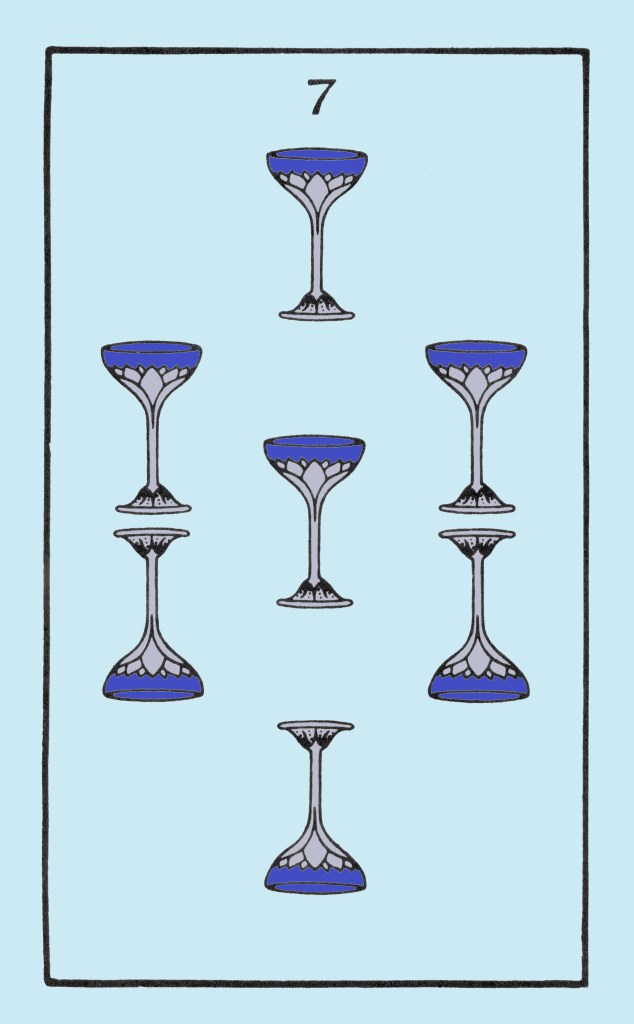
The time period is the third decanate of Scorpio, November 11 to November 20, under the subrulership of the Moon.
Well-Dignified: possible victory, but the person to whom the card applies may be too indolent to take advantage of his opportunities for commanding circumstance. Success may be gained, but not followed up; necessity for choosing only the highest objectives.
lll-Dignified: illusionary success; lying and deceit; drunkenness; violence, even lust.
Keyword: Illusion
(From the Oracle of Tarot course)
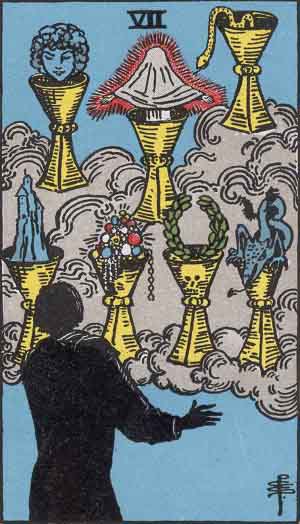
Strange chalices of vision, but the images are more especially those of the fantastic spirit. Divinatory Meanings: Fairy favours, images of reflection, sentiment, imagination, things seen in the glass of contemplation; some attainment in these degrees, but nothing permanent or substantial is suggested. Reversed: Desire, will, determination, project.
(From The Pictorial Key to the Tarot)
The Seven of Cups is called Debauch. This is one of the worst ideas that one can have; its mode is poison, its goal madness. It represents the delusion of Delirium Tremens and drug addiction; it represents the sinking into the mire of false pleasure. There is something almost suicidal in this card. It is particularly bad because there is nothing whatever to balance it-no strong planet to hold it up. Venus goes after Venus, and Earth is churned into the scorpion morass.
[…]
This card refers to the Seven, Netzach, in the suit of Water. Here recurs the invariable weakness arising from lack of balance; also, the card is governed by Venus in Scorpio. Her dignity is not good in this Sign; one is reminded that Venus is the planet of Copper, “external splendour and internal corruption”. The Lotuses have become poisonous, looking like tiger-lilies; and, instead of water, green slime issues from them and overflows, making the Sea a malarious morass. Venus redoubles the influence of the number Seven.
The cups are iridescent, carrying out the same idea. They are arranged as two descending triangles interlaced above the lowest cup, which is very much larger than the rest. This card is almost the “evil and averse” image of the Six; it is a wholesome reminder of the fatal ease with which a Sacrament may be profaned and prostituted.
Lose direct touch with Kether, the Highest; diverge never so little from the delicate balance of the Middle Pillar; at once the holiest mysteries of Nature become the obscene and shameful secrets of a guilty conscience.
(From The Book of Thoth)

THE seven cups are arranged as two descending triangles above a point: a hand, as usual, holds lotus stems which arise from the central lower cup. The hand is above this cup and below the middle one. With the exception of the central lower cup, each is overhung by a lotus flower, but no water falls from these into any of the cups, which are all quite empty. Above and below are the symbols of the Decanate Venus and Scorpio.
Possible victory, but neutralized by the supineness of the person: illusionary success, deception in the moment of apparent victory. Lying, error, promises unfulfilled. Drunkenness, wrath, vanity. Lust, fornication, violence against women, selfish dissipation, deception in love and friendship. Often success gained, but not followed up. Modified as usual by dignity.
Netzach of HB:H (Lying, promises unfulfilled; illusion, deception, error; slight success at outset, not retained).
Herein the Angels HB:MLHAL and HB:ChHVYH rule.
Thought
Upright. This card, as far as the medicine of the spirit is concerned, means, in its natural position: Thought, Soul, Spirit, Intelligence, Idea, Memory, Imagination, Understanding, Conception, Meditation, Contemplation, Reflection, Deliberation, Viewpoint, Opinion, Feeling.
Reversed. Plan, Design, Intention, Desire, Will, Resolution, Determination, Forethought.
MQS
In this article I discussed a horary reading I did for myself on whether the new house we moved to would be good. My interpretation was that the house was generally good, but that there might be problems with the neighbors due to Saturn, ruler of the third house, afflicting the cusp. It turned out that the neighbors were normal people, it seemed, and that there was a problem with the manager.
Well, that was until last week, when the new manager contacted my husband, who represents the homeowners, to tell him that one of our neighbors hasn’t been paying his share of the bills for some months. Hopefully we won’t have to end up in front of a judge, but it is turning out to be quite an annoyance.
There is a small lesson to be learned, I think, from this whole thing. Often when I read for others, they contact me after a week telling me that they were excited about the prediction but nothing has come to pass. It is easy, right after a reading, to forget that readings can take months (sometimes many months) to materialize.
This is also where we, as readers, need to be honest with the querent. It is easy to turn our sitters into addicts hanging on to our every word, asking for a reading on whether they should shift their weight on their right or left ass cheek when sitting on the toilet, needing to be reassured every week of what we are saying.
Personally, I rarely accept to redo readings unless enough time has passed, or unless something absolutely new and unforeseen comes up that I hadn’t predicted. Still, it is normal for querents (and for us, when we are the querent) to assume that the first thing that happens is the materialization of the final result instead of a step in its unfoldment.
MQS
Life is a recipe, and the art of living consists in large part in detecting the ingredients to know if and how to mix them differently. Divination is a mirror of life, and oracular systems usually have some kind of vocabulary to create descriptions of life.
In traditional divination by cards, each card carries small bits of meaning that must be mixed together to form coherent pictures. If divination mirrors life, then it stands to reason that the recipe for something in real life should be mirrored by a recipe for that same thing in the divinatory language. This is how all card reading systems I know work, and that’s how the Bolognese tarot works, with the exception of a couple of universal combinations with odd meanings (Angel + Devil = Good news or satisfaction; Sun + Moon = sorrow; Angel + Death = yes, confirmed).
Let us make an example. What are the ingredients of an inheritance in real life? I would say the ingredients are: death (no inheritance without someone croaking); family ties (usually we inherit from someone whom we are related to, though not always); the law (inheritances are generally regulated by the law and require a bureaucratic mechanism to be set in motion); material possessions (the things we inherit).
In the language of the Bolognese tarot, these ingredients correspond to the following cards: Death: Death; Family ties: Ace of Cups and/or Seven of Cups; The Law: Justice and/or King of Coins; Material Possessions: The Star and/or a money card.
Do we need all the cards to be present? It much depends on the context. If the question is directly about an inheritance, then we could do without many of these cards, while if it is a general reading then the more cards, the clearer the message. But we might also find other cards to flavor the basic recipe: the Moon is also connected with death (the realm of shadows); tears may sometimes be expected, so the Seven of Coins could come up; the court card of the deceased person could show up, etc.
Let us make another example. Let’s take surgery. What’s the recipe for surgery in real life? I would say: a hospital, a bed, a doctor, a cutting instrument. In the Bolognese tarot these same ingredients are: Hospital: The Tower; Bed: The Chariot; Doctor: King of Coins; Cutting instrument: Knight of Swords.
Again, there can be additions and variations. The doctor or the bed might be absent, while the Ten of Cups (blood) or the Moon (unpleasantness) or the Eight of Swords (suffering) might be present. A King or Queen of Swords may take the doctor’s place to show someone holding the knife. Just like my lasagne recipe might differ from yours, but it would still be recognized as lasagne, so the way the deck mixes the ingredients might vary slightly from time to time, but the broad picture remains the same.
One last example. Let’s take marriage. In many situations, a marriage requires the following ingredients: a commitment; love (let’s assume the best intentions in this case); a celebrant. The same ingredients are, in the language of the Bolognese tarot: Love: Love; Commitment: Ace of Wands or Ace of Swords; Celebrant: The Stranger. This is the basic recipe. But we might also expect the main significators to show up. A marriage is a celebration, so the Ten of Cups (fun) might be expected; the family life is certainly impacted, so some Cup cards could be there.
Once we start recognizing that life is made up of ingredients mixed together, it becomes easy (or at least easier) to see how the tarot might mix its own ingredients, the cards, to match the recipe. In many cases, while it is useful to reason out the combinations handed down by tradition, it is much easier to understand the basic principles and be flexible in our observations.
Ultimately, divination starts with logic, not with psychic powers, even though psychic abilities may occasionally be of help. The more we immerse ourselves in the logic of divination, the easier it becomes to decode its messages.
MQS
Previous / Back to Index / Next
Fludd discusses the meanings of Populus, Via, Conjunctio and Carcer in the various houses.
In the First House, a multitude of thoughts about water, journeys, peoples and nations.
In the Second House, with good (figures), a much fortune and riches; with evil much trouble.
In the Third House, multitude of relatives, neighbors, and little journeys, both good and bad, according to the nature of the figures.1
In the Fourth House, abundance of water, laboring for an inheritance, fruits, according to figures.
In the Fifth House, a multitude of children, letters and news, joy or sorrow, kisses and embraces, gathering of people for delights and joys, fruits, according to figures, and so on in the rest according to figures.
In the Sixth House, a number of animals, slaves, sickness, injuries, and other things according to the figures.
In the Seventh House, a multitude of people gathered, women, enemies, good or bad according to the nature of the figures.
In the Eighth House, a multitude of people assembled for a death, or a multitude of good or evil, according to the goodness or malice of the figures.
In the Ninth House, a multitude of journeys, dreams, knowledge, people on the way, multitudes.
In the Tenth House, a multitude of enemies, kings, of people before judges, doctrines, assembly for good or for evil, according to figures.
In the Eleventh House, a multitude of friends, good fortune, beasts, servants, children, or inconveniences, according to the nature of the figures which have been found in the vicinity.2
In the Twelfth House, a multitude of enemies, inconvenience, long imprisonment, tears, debts, beasts, and slaves.
In the Thirteenth House, much profit to him that goes to any magnate,3 of loss, change, and the like.
In the Fourteenth House, a multitude of people, assembled, either for good or for evil, according to the figures next to it.
In the Fifteenth House a multitude of good or evil, a gathering of people for good or for evil, according to the figure from which it comes, for if it comes from good figures, it denotes much good, if from bad, the opposite.
Note that this figure, found in the first house, represents a merchant of various things passing through the countryside.
In the First House, a good journey, little profit, thoughts of small fruits.
In the Second House, loss or gain, according to the neighboring figures.
In the Third House, brothers, neighbors, water, a good journey, light4 business, journeys for a brother or cousin, comparison of wealth.5
In the Fourth House, parents, labors, lands, the concealment of tainted things, the end of things, poverty, poor parents, poor inheritance.
In the Fifth house, letters, messages of little importance, little fruits, poor manners, poor children, little joy.
In the Sixth House, poor animals, bad luck, unstable servants, sudden increase of disease, deliverance from disease,6 misfortune of animals.
In the Seventh House, robbers, poor women, little sense,7 poor and weak enemies, a harlot, death of robbers.
In the Eighth House, poverty in a foreign country, loss of inheritance.
In the Ninth House, a change of letters,8 messengers of little knowledge, a good journey, benefit of the church, little gain and profit
In the Tenth House, small offices, little profit from lords and noble women, an old judge, little wisdom, loss in any thing.
In the Eleventh House, poor friends, little fortune, little profit, gifts of merchandise and letters of joy.
In the Twelfth House, useless animals, poor friends, easily coming out of prison, liberation from debts or from misery, and sometimes death in prison, according to the good or bad figures around, and from whom it is generated.9
In the Thirteenth House, profitable journeys and changes.
In the Fourteenth House, loss in any matter, according to good or bad figures.
In the Fifteenth House, travel, good outcome according to the figures from which it comes.
Note that when Via is found in the First House, it means a changeable, false and poor person.
In the First House, a man of good speech, eloquence, subtlety, art and goodness, and if it is combined with good figures, goodness of heart and friends.
In the Second House, the acquisition of good fortune, profits in commerce.
In the Third House, the good will of relatives, the gathering of relatives and neighbors.
In the Fourth House a good path, a good end, a good friend, a profitable inheritance and legal proceedings, letters for inheritance.
In the Fifth House, letters, news, gathering of good people.
In the Sixth House, a long illness, evil servants and robbers.10
In the Seventh House, good company, thieves and subtle and eloquent enemies, whether in litigation or in battle.
In the Eighth House, a gathering to divide the property of the dead.
In the Ninth House, knowledge, a bad journey, robbers on the road, knowledge and eloquence in clerics and ecclesiastical men.
In the Tenth House, the service of lords, kings and profits in teaching or profession.
In the Eleventh House, good luck, the gathering of all things, conjunction of love.11
In the Twelfth House, prisons, bad journey, bad assembly, bad people and bad life.
In the Thirtteenth House, goods and profits from one’s lord.
In the Fourteenth House, a lot of luck in love and work.
In the Fifteenth House, good luck in good things, bad in bad things according to the figures.
Note, when this figure is found in the First House, it signifies a prudent man, a clerk, or occupied in an office for money, of moderate build, as quickly consuming his fortunes as he is acquiring them, skilled in the liberal arts, and so on.
In the First House, loss and imprisonment of men, timidity, sadness, sadness of heart, secret thoughts, hindrance of journey.
In the Second House, servitude in all secret things, and thoughts of love of money.12
In the Third House, love of parents and profit, the love of God, hindrance and retardation of the journey, greedy brothers and neighbors.
In the Fourth House, inheritance, hidden treasures, underground houses, hidden and dark places, good inheritance.
In the Fifth House, a few children, a pregnant woman, writing letters and news, rude people, raw food, dirty clothes, secret love affairs.
In the Sixth House, disease in prison, a pregnant woman, a useless servant, a bad man and woman, death or a long illness, disease in a man’s secret place,13 a brute.
In the Seventh House, accidents, bad company, adultery and secret fornication with another’s woman, secret enemies, a vile thief who is caught in his robbery, ships going on water.14
In the Eighth House, death, inheritance of the dead, bad profits in a foreign land, fear of death.
In the Ninth House, a road or journey from the country, death, letters and secret knowledge, secret roads, obstacles on the way, sadness in the church, sad and dangerous dreams, good sense.
In the Tenth House, good fortune, strength of dominion, a sad judge, secret opinions, dishonorable offices.
In the Eleventh House, profitable friends, little profit from lords, profitable in trade through travels, gathering of good kings.
In the Twelfth House, prisons, debts, graves, evil beasts, incurable disease, long imprisonment, long debts, secret enemies, but timid by nature.
In the Thirteenth House, profitable journeys, brothers and friends, gathering of good things, sad and secret thoughts.
In the Fourteenth House, various thoughts, imprisonment with sadness and pain and work, debts and obligations, and these especially when it doesn*t come from good figures.
In the Fifteenth House, much fire15 and destruction.
Note, when this figure is in the First House, it signifies a dark man, with a thick head, curly hair, and often ignorant carpenters, or otherwise working with wood.
It must be noted that good or evil, profit or loss, is promised through each house, according to the nature of the figures with which the figure of each house is conjoined, or from which it is generated.
MQS
This article is going to be as vague as it gets. It pertains to certain observations I’ve made over the course of the years practicing divination, first with playing cards and the Sibilla, then with regular Tarot and now with the Bolognese Tarot, but it is not a unified theory, and in fact, it is even hard for me to put it into words.
We all know how time is difficult to define in divination, especially by cards. Sometimes it’s even hard to say if the cards are describing the past, the present or they are directly starting off with the future. This is even more true when using non positional spreads, where one or more lines of cards are interpreted together. My observations are mainly about non positional spreads, and how sometimes they seem to signal that they are talking about the past.
In all decks (at least, in all decks I use) there are cards connected with the person’s thoughts, or at least with their inner or emotional world. A person’s inner world is a complex thing, since it is a mix of hopes for the future, memories of the past, illusions, dreams, traumas, etc. All decks I use also contain cards that show ending, death, disruption and radical change, indicating the end of a life path.
The thing I’ve noticed is that, when in the first couple of lines of a spread (or within the first couple of cards in a longish one-line spread) there is a card connected to the person’s inner world and then a card of ending, that section of the spread usually talks about the past, and more specifically the distant past (that is, not just a couple of months back). This is because the card of disruption tells me that the situation the cards are talking about is over, while the card relating to thoughts or emotions says that the thing exists only as a memory, something that has left a mark on the person’s soul.
I recently did a spread for someone with the Bolognese Tarot. Unfortunately I didn’t save a picture of it and forgot most of it (it was one of those “I’m sure I won’t forget it” moments). It was a question about love, and in it both querent and quesited (the love interest) showed up only as thoughts, followed by cards of disruption. It turned out they had been together eight years ago, she had left him on the advice of a friend who thought causing drama would strenghthen his commitment. Instead he moved on, and she was still waiting for him to come back. In this instance, the thoughts reenacting the break-up were like ghost impressions reliving that pivotal moment in her past.
Obviously, this sort of things tend to happen for major events, whether positive or negative, and it shows how our inner structure is a bit like a geological section, with different eras still present, but hidden from view.
MQS
Two of Hearts – The House
In most situations, the House card is relatively neutral, as it often indicates the person’s home environment or family, or some other place depending on the combinations. However, in itself the card, when upright, symbolizes a protective environment where the querent feels safe and taken care of. Figuratively, it shows situations that are solid, positive and protective (so you feel at home).
Eight of Hearts – Hope
The Hope card’s main meaning is that of representing the hopes and wishes of the querent, and the cards following it will tell us if they come true or not. However, it also indicates the solution of trouble or compensation for it, as the card says “there is hope”. This is especially the case when the Eight of Hearts comes up after a negative sequence of cards. Sometimes the Hope card’s intervention may not be enough to give us what we want, but it will make sure that we come out of a situation still alive and breathing, and with some kind of hope.
King of Hearts – The Gentleman
The King of Hearts is, in most situation, a neutral person card, indicating a married man or an older man. However, it does indicate someone who has our interest at heart (unless it is reversed or surrounded by cards of dubious moral quality). He is the archetype of the philanthropist who is out to help others. For this reason, in spiritual readings, it represents God or a saint.
Two of Clubs – The Peacock
The best card in the deck, the Two of Clubs represents divine intervention (due to its symbolism of completeness and rebirth). It often shows up to protect us from the worst that could happen, or to increase the quality of something that is already good. It often shows positive undercurrents that do not manifest immediately in all their positive import, but which will save us, protect us or enrich us when they do manifest. For this reason it is known as the talisman card.
Five of Clubs – Fortune
While the Two of Clubs indicates divine intervention, the Five of Clubs represents gifts from heaven in the form of good luck. It often indicates positive turns of events, a turn of the wheel that brings us something we want us, or at least something good. Unlike the Two of Clubs, it retains its positivity when reversed, but it becomes delayed or less blatant, maybe a bit less satisying
Seven of Clubs – Gratification
The Seven of Clubs is a card of satisfaction, but it also represents our ability to reach our aims and ambitions in the real world. It represents the achievement of goals and reaching of landmarks in one’s life (marriage, promotion, property, recognition, etc.) However, the card can also represent “a light at the end of the tunnel” when it falls after negative cards, indicating, as it were, our ability to pick ourselves up.
Ten of Clubs Reversed – Levity
The Butterfly is a symbol of carefreeness, lack of focus and lack of attention. When it is reversed, however, it shows carefulness with one’s finances and, even more importantly, the arrival of good occasions that need to be seized. Although it is not a card of protection per se, it does show us a way out (a new therapy, a new job opportunity, a new meeting, etc.)
Three of Diamonds Reversed – The Gift
Again, not a card of protection, but still a welcome sight. It shows situations that somehow sort themselves out, at least in part. It is a relatively weak card, so the presence of very difficult situations may be mitigated only in part, and often it shows some kind of improvement rather than triumph.
Four of Diamonds Reversed – Falsehood
When upright, the cat brings falseness and negativity in general. Negativity is to be understood broadly as situations that are negative or bad for us (even when there is no direct lying involved). When it is reversed, the same card brings positivity, relief, solution of trouble.
MQS