Category Archives: Divination

Free Will and Real Estate (Tarot Reading Example)

In the previous article I started talking about free will and prediction. There I talked about some factors that influence our freedom of decision.

Another incredibly important aspect is information. We orient ourselves by interpreting available information. If our free will were absolute, our knowledge of how the world works and how we move in it would not matter, because we’d be able to reach any result regardless of the initial conditions.

This is patently absurd, yet it is maintained by some diviners (appropriately, those who are incapable of deriving specific information from the divination process). It kind of reminds me of one of the definitions of God in the Book of the 24 Philosophers, where it says that God is that whose will is equivalent to his power and knowledge (or wisdom).

This was a fancy way of saying that God’s every action is always exactly the right one at the right moment because the fact that he wants it is the same with the fact that it can be done and also the fact that it is the right thing to do. This may be very true of God, and if we conceive (as I do) that the divine is immanent in the world, it is also true of humans, but only in so far as they understand themselves as limited fractions of this whole process. In so far as we crave things and don’t know how to get them, this view of the world is fairly deceiving, especially if you plan on charging people who expect to be given reliable information.

From a more mundane and practical standpoint, we have limited knowledge (or wisdom) and this always changes from moment to moment. As our information changes, so do our decisions. This has nothing to do with “destiny”: if we did not adjust our behavior to match our knowledge we’d already have died out. It is about survival.

The First Spread

Here’s an example. As I mentioned in my journal section, my husband and I are looking for a bigger home. We had eyed an apartment some weeks ago that seemed perfect, and upon visiting it, we were even more convinced to buy it. Some days ago I asked the tarot if we would be able to buy it.

“Will we be able to buy the apartment?”
Tarocchi di Layla, design by Elisa Scerrato

As can be seen from the cut (Strength and Justice) we were very determined (Strength) to buy (Justice).

The opening of the spread repeats the statement by showing that we are gung-ho about buying the apartment (Stars and Chariot) but that we are not considering everything (Moon) as we head toward the handshake (Lovers)

The second line shows the clarifying (Sun) intervention of a woman (Empress) who will bring certain less than pleasant aspects to light (Devil). The result is that my husband (Pope) will lose all interest in buying (Hanged Man)

This is exactly what happened. Two days after I did this spread, my husband came home and told me that one of his friends from an Enneagram group he is in has some experience with real estate and could help us decide. We set up a Zoom meeting with her, where she went through the apartment’s documents with us and raised some serious red flags we had completely missed that would have turned buying that apartment into a financial and bureaucratic nightmare. Needless to say, my husband (and I) lost all interest after that.

As you can probably guess, nobody forced us NOT to buy. Nor did destiny force our hand. In fact, we probably could have gone on with the deal, and fairly quickly (Strength + Justice in the cut of the first spread can signify a signed contract). But we would have been idiots.

And note how skewed my question was: we were completely besotted with the place, so I asked if we would be able to buy it, not if it was a good idea to buy it. The tarot clearly overrode my question and told me that certain unknown facts would surface that would influence our decision. Note also that the tarot did not say that we should not buy (my experience is that divination reflects reality, not what reality should be). The tarot said that we would change our mind.

The question is: were we destined to change our mind? Well, it is complicated, and the complication arises from the fact that the moment of divination is a very special moment, where spirit reflects on itself through the diviner. I will need to come back on this issue in more detail in some future articles.

The thing is, though, that we were not forced to change our mind: we simply realized it was the smart thing to do. Sure, you may say, if we had been more gullible, or if the apartment had completely blinded us out of our wits, we would have gone on with the deal anyway and regretted it later.

But being gullible or not is neither a choice nor an imposition: it is part of one’s being, at least to an extent, even if it is originally a learned behavior. The tarot simply computed the available information, both that which we could change and that which we had no control over, added the information about who we are at our core, and came to the conclusion that someone like my husband and I, in such a situation, would probably change their mind upon receiving better data.

The tarot predicted our behavior in the same way your mom who knows you are obsessed with chocolate icecream can predict you had chocolate icecream for dessert after dinner with your friends: it is a prediction based on knowledge of your nature and of the available information. The difference between your mom and the tarot is that the tarot (like all oracular forms) has a wider and deeper view of reality. The Tarot is, in a way, like a cosmic botanist who knows a red rose bush will sprout from this or that seed, even though this knowledge does not force the rose to be red. It is simply part of its nature.

The Second Spread

By the way, today before writing this article, I did a second spread just for kicks (the tarot is very tolerant of my shenanigans) to ask if that apartment was seriously off the table, as I am still a bit in love with it. Here’s the result

“Is the apartment really off the table?”
Tarocchi di Layla, design by Elisa Scerrato

In the cut we have Death and the Wheel: definitive change (the Death card can never be undone, just like real death). The spread itself is even more blunt. The Devil and the Moon show hidden dangers, and the contract, signified by Justice, is blocked (Hanged Man) thanks to a woman (Popess / High Priestess). Note how much more concise and harsh the spread is compared to the first one: it’s as if the cards were saying “Dude, really, knock it off already…”

Side note: I don’t know exactly why my husband’s friend came up as Empress in the first spread and as Popess in the second one. My best guess is that the tarot didn’t want me to get confused in the first one: if she had come up as the Popess, I would have linked her to the Pope, and would not have interpreted him as my husband, but since in the new spread neither I nor my husband show up, the cards were free to use a more natural significator for her.

MQS
General Cross Spread / Cartomancy with Playing Cards

In the Sibilla section of this site I posted some spreads that may also be used with playing cards. One type of spreads is generally used for broad readings without a specific focus. I must confess I don’t often use these spreads myself when reading for others (especially the 21 card spread which I will cover in another post), although I have found them invaluable for a quick glance into my own future.

A typical general spread is the cross spread. The disposition of the cards, after shuffling and having the deck cut by the querent, is as follows:

4 – 9 – 14
2 – 7 – 121 – 6 – 113 – 8 – 13
5 – 10 – 15
Cross spread for cartomancy with playing cards

The center of the spread (cards 1, 6, 11) indicates the querent’s present situation, or something that is happening that is very important to them. To the querent’s left (2, 7, 12) is his or her recent past. To the querent’s right (3, 8, 13) is his or her future in the next month or so. Above the querent (4, 9, 14) are his or her thoughts or something they are aware of, while underneath (5, 10, 15) shows something the querent doesn’t like or doesn’t know.

This spread is general, but I am sure it can be adapted to answer broad questions (“Tell me about my career”). It can also be used to investigate a person the querent is interest in knowing about (“My friend’s been behaving strangely lately…”)

One variation of this spread consist in shuffling the remaining cards again and dealing out an additional three cards for the further future or for the “answer”.

Here’s an example. I asked a friend of mine if we could do a spread for her as a demonstration and she graciously accepted. Here’s what came out.

3♣ – 3♥ – 9♣
J♥ – A♦ – 4♠8♥ – 6♠ – 8♠K♠ – 6♦ – A♥
7♠ – J♠ – 7♦
Example of a general cross spread with playing cards

It is never a good idea to start talking immediately, especially when the spread is general. It is always better to simply let your eyes absorb the cards as a whole.

Still, it is quite evident that the central heap is rather problematic, as it shows illness. This is not the querent’s own illness, but that of a relative (Eight of Hearts). This is confirmed by the future cards, where there is worry in the house, with the King of Spades in this case as the doctor. The querent’s grandma needs some minor surgery, it turns out, but given her age, her family is understandably concerned. Fortunately there is no indication of great difficulties, let alone bereavement.

The querent’s thoughts, however, are occupied by the desire for a lasting love union (upper fan), which however she doesn’t have, considering the past fan (blocked news concerning romance).

The bottom fan is difficult to interpret, as it doesn’t appear to link up with the others. It is very possible that, in her life in general, the querent doesn’t feel seen or appreciated (the Seven of Diamonds is money, but also rewards, broadly construed) and she feels unlucky.

This spread, as can be seen, is short and quick, and should ideally only be used as an “opener” to break the ice, before moving on to specific spreads.

MQS

Cauda Draconis / Dragon’s Tail (Geomancy Figures)

Name of the Figure: Cauda Draconis (Dragon’s Tail); sometimes called Outward Threshold
Element: Fire
Planet: None, Moon’s South Node (some say also the malefics, Mars and Saturn)
Sign: Sagittarius
Quality: Exiting
Fortune: Bad

Cauda Draconis is the less lovable sibling of Caput Draconis. Like its counterpart, Cauda is not traditionally associated with any planet, although some classics say it belongs to the malefics of astrology, namely Mars and Saturn. However, in itself, Cauda is connected with the Moon’s South Node. Technically every planet has nodes, that is, points where they cross the Sun’s ecliptic. However, in traditional astrology, only the Moon’s nodes are considered, as the Moon’s connection with the journey of life is said to begin with the North and end with the South Node. Visually, the symbol of Cauda is said to show a series of steps leading away from a threshold, symbolizing the sense of ending.

Illustration of the geomantic figure Cauda Draconis, Dragon’s Tail

And ending is indeed one of the main meanings of Cauda. Ending is not necessarily bad. When you want to get rid of an illness, or really anything, Cauda can be positive, if not easy. It also shows quick, sharp change, so it can bring stagnant situations to an end.

Still, Cauda is mostly unwelcome in most readings. It can indicate the end of a relationship (or that a relationship won’t start). It can show unemployment and loss of money. It can announce difficult interpersonal relationships all around.

Due to its connection with the bad side of life, Cauda is one of the figures that, traditionally, prompted geomancers to break their figure and abandon divination if it shows up in the first house. Don’t do it. Just because Cauda is in the first house doesn’t mean your querent is a psychopath. Cauda is a challenging figure. It can simply mean the person is going through challenging times, that their life is changing dramatically and they have lost the plot.

Common Keywords: Ending, Loss, Abandonment, Evil, Quarrel, Evil intentions, Disruption, Letting go

Cauda Draconis in the Geomantic Houses (these are only examples. Use context to guide your interpretation)

HousePossible Meanings
FirstDangerous person, Person in danger, Person who is going through hell, Person who is ending something
SecondLoss of money or items
ThirdQuarrels among neighbors or siblings, Bad news, False rumors
FourthEnd of lineage, Death of father, Eviction, Loss of home
FifthDanger though excess, Loss of pregnancy, Questionable pastimes
SixthEnd of sickness (but if the chart is bad, it could end with death), stay way from your servants
SeventhDivorce, Quarrel, Theft, Untrustworthy individuals, Fraud
EighthDeath, Danger, Loss of money
NinthEvil religion or way, Inability to learn, Atheism, Materialism, Loss of faith
TenthBeing fired, Loss of employment, Revolution, Coup d’etat, Death of mother
EleventhEnd of a friendship, Fights, Quarrels, End of hope
TwelfthEscape, Freedom, Death of large animals
ThirteenthThere was upheaval, ending, disaster, the querent is capable of letting go
FourteenthThere will be upheaval, ending, disaster, the querent is unable to let go
FifteenthCauda cannot be Judge
Possible meanings of Cauda Draconis in the various Geomantic Houses. Note that this is not meant to be exhaustive, and it only serves to jog your interpretive muscles

MQS

Free Will and Prediction (Notes on Divination)

This post is part of my Notes on Divination series. This gets somewhat philosophical and is rough and not organized, so bear with me.

I have been playing with the idea of writing a book on the philosophy of divination. In fact, I have been playing with ideas for a lot of books on occultism, but I need to start somewhere. This is the first in a series of articles on such topics. Don’t take the following as an organized treatise–it is more like a random gathering of thoughts.

It’s impossible to be self-aware diviners without sooner or later stumbling upon the question of free will, the two most simplistic options being that we have complete free will and therefore divination is not about the future or that we have no free will at all and everything is predestined. I will argue in another article that both options actually prevent meaningful prediction.

Often people talk about “compatibilism” that is, the idea that prediction and free will can be seen as compatible. This is all very well, but it means nothing unless one explains how. Inevitably, explaining it requires one to clearly define the space alloted to both. Here I talk about all things that limit our choice, while in a future article I will talk about the limits of prediction.

Firstly, we need to acknowledge that when it comes to divination, it is not at all clear that we talk about prediction. After decades of New Age nonsense, divination has largely been relegated to the uttering of ‘inspired wisdom’, wisdom apparently being the consolation prize for those that can’t look at reality for what it is.

People who usually manage to compose their faces in a mask of sanity abandon all commonsense as soon as they pick up a tarot deck: you create your own destiny, you can do whatever you want. Well, you don’t. This is provably so. We cannot treat people as if they were bundles of free will floating in empty space. People come from specific backgrounds and have specific problems, idiosyncrasies and preferences that dictate their course.

You may be free, for instance, to choose between vanilla and chocolate, but if you hate chocolate you’ll probably pick vanilla. This is often seen as part of people’s free choice, but if we think about it for a second, it is actually a limit to personal freedom: an inner disgust toward something leads you toward something else without you being able to control it.

Free Will and Destiny

In other words, your choice, which is theoretically open to everything, is already limited by a number of psychological hangups that push you around like a sock puppet. That is a limit to free will in my book. Divination may very well be used to delve into these issues and to widen your options. In fact, it is a very good use of divination. But we cannot use divination to do so if we don’t first acknowledge that our options are limited, sometimes severely so.

But preferences are just one kind of limit. Another one comes in the form of ( the much reviled in spiritual circles) objective reality. If you are in a blind alley, know no martial arts, have no means of self-defense and an armed thug is walking toward you, that’s a pickle you can’t meditate or visualize your way out of.

This is not to say that you’ll inevitably lose. Maybe the dude is drunk and collapses to the ground as soon as he stumbles on that banana peel; maybe you are very good at talking and you persuade him to let you go by striking the right note; maybe a falling bit of debris from a ramshackle building takes care of him.

All this (and more) is possible. But the objective fact that you are in the blind alley in a less-than-desirable situation instead of sucking on a Capri Sun on your way to Hawaii imposes certain limits (just as this latter scenario imposes other limits)

The example above is situational, but our whole life is a series of determining factors that limit our trajectory. Look back on your personal history and you’ll probably be able to see traces of many, many past situations that still accompany you to this day, for better or worse. Even past choices become hard, unchangeable facts once enough time passes. You cannot, for instance, ungraduate from that useless gender studies degree in order to pursue a STEM subject. Although you can divorce, you cannot unmarry the person you married. Although you can abandon your child, you cannot unbirth it.

We could go on, but this point is clear enough: at any given moment in time we find ourselves shaped by a series of objective, subjective and intersubjective factors that limit us and our possible trajectory.

The delusional New Age view that we are the product of our current decisions does happen to stumble upon a little bit of truth, though it mischaracterizes it. It is true that, in so far as we abstract from ourselves and we move toward the universal, we peel backs layers of individual conditioning and we move toward the unconditional, however you may choose to call it (God, Being, One, Reality, Ensoph, etc.)

But there is a catch: moving toward the unconditional means not just letting go of our limits, but also of the aims that would lead us to want to overcome those limits as, however we may understand the unconditional, it is not conditioned by this or that choice. The fact of the matter is that free will may very well be the substance of reality, but in so far as it is the substance of reality it is not the substance of my limited whims.

In practice, therefore, the idea of unconditional free will is untenable from the standpoint of a diviner, as abiding by it renders the divination process futile, however we may understand it. This is not to say that complete determinism fares much better, as I shall show in the next article.

MQS

Caput Draconis / Dragon’s Head (Geomancy Figures)

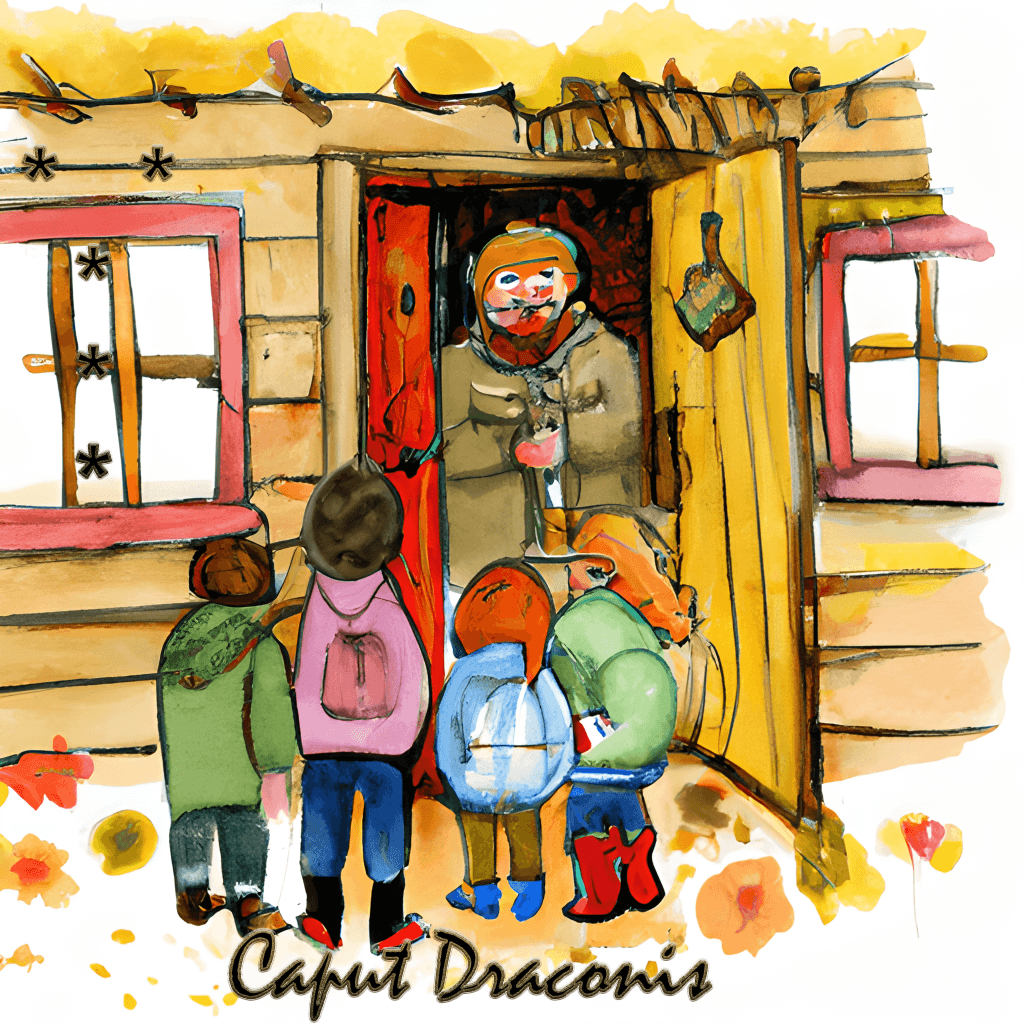
Name of the Figure: Caput Draconis (Dragon’s Head), sometimes called Inner Threshold
Element: Earth
Planet: None; North Node (some say also the benefics, Venus and Juputer)
Sign: Virgo
Quality: Entering
Fortune: Good

Caput Draconis, like its counterpart Cauda, is a special figure in the geomantic family. These are the only two that are not canonically assigned to any traditional planet. Instead, they are given to the nodes of the Moon, i.e. the points where the Moon intersects the Sun’s ecliptic. These were held in exceptionally high regard in traditional astrology, at least from Arab astrology moving forward (but apparently also in Hellenistic astrology, though their function there is debated.) Caput Draconis, the North Node, is usually said to be expansive and broadly positive, or at least augmenting. The symbol of the geomantic figure is usually likened to a series of steps leading toward a threshold.

Illustration for the geomantic figure Caput Draconis, the Dragon’s Head

Some say that Caput is associated with the two benefics of traditional astrology, Venus and Jupiter. More specifically, though, Caput is not automatically a good figure. It often represents an onrush of new energy, indicating everything new or everything that starts afresh.

More generally, it is associated with everything that develops, grows, becomes more stable and certain. This, of course, is a double-edged sword, as not everything that is stable is good for us. Often, Caput shows the impossibility to get rid of something, even if it is bad for us. It shows long illnesses, for instance.

Often, however, Caput is in fact a positive figure. It represents things coming to us, and as most questions get a positive answer when something comes to us, Caput is mostly a welcome figure.

Common Keywords: Arrival of new situations, beginning, fresh air, new enterprises, dynamic energy, development, deepening, stabilizing, long-lasting

Caput Draconis in the Geomantic Houses (these are only examples. Use context to guide your interpretation)

HousePossible Meanings
FirstPositive, taking initiative, going, doing, starting something, good luck
SecondIncome, new income stream
ThirdNews, important information, help from siblings
FourthBuying real estate, help from the father
FifthFun, pregnancy, conception
SixthLong illness, good servants
SeventhNew relationship, lasting bond
EighthBeing shielded from danger, gain from other people
NinthConversion, signing up for a course, good at learning, spiritual evolution
TenthNew job, lasting stability in one’s career
EleventhNew friends, realization of hopes
TwelfthLong prison sentence, safety from occult enemies
ThirteenthQuerent has initiative, something has already started
FourteenthQuerent lacks initiative or needs to exert it more, there will be a new beginning
FifteenthCaput cannot be Judge
Possible meanings of Caput Draconis in the various Geomantic Houses. Note that this is not meant to be exhaustive, and it only serves to jog your interpretive muscles

MQS

Describing Court Cards, Part 3 / Cartomancy with Playing Cards

We’ve been talking a little bit about identifying court cards in cartomancy. Another possible key for identifying them, of course, is combinations. There is no need to memorize endless lists of combinations, as they are generally self-explanatory.

The difficulty comes when a reading contains many Court Cards, or even just court cards. Usually, this indicates a situation that involves many people, often a reunion of some kind. Note that when a bunch of Court Cards are together, Jacks usually count as people, that is, they strengthen the meaning of “many people together” even if they don’t indicate any specific person. However, if many Jacks show up, this can indicate that there will be children.

I know that some readers panic when a string of cards consists only or mostly of Court Cards, but I have learned to see this possibility as one of the easiest to deal with. This is because readers coming from a tarot background (especially in America) want to drown questioners in saccarine or self-helpy words, and Court Cards are hard to use in this respect.

But if we learn to see cartomancy (with the tarot or with playing cards, or any other means) as a way of decoding simple sentences, then Court Cards become very easy to interpret, even if a lot of them shows up. Usually there isn’t much to say, only that there has been or will be shortly a reunion of some kind. Here’s a recent example. I was visiting a friend and she asked me to do a reading about her job prospects. Here are the cards that came up:

8♥ – Q♣ – K♥ – J♥ – Q♥ – K♠ – Q♦

I asked her if there was a family reunion of some kind coming up, and she said that she was invited as a photographer to the christening of a friend’s child. She would get paid and, of course, she would also be there as a guest. Since this is something she already knew, we tried asking again, this time with five cards. Here’s what came up:

Q♣ – J♥ – K♠ – K♥ – Q♦

Clearly, the cards still wanted to talk about the christening, so we decided to let it go for now and I told my friend we would do another reading after the event. A couple of weeks later she told me that at the party she had been introduced to one of her friend’s relatives (probably the Queen of Diamonds here) who put her in contact with a photographer she knows personally, and who has a studio and hired her for some gigs.

I found it fascinating that the cards managed to talk about something partly unrelated to the question, but yet so pertinent to my friend’s job situation.

MQS

Carcer / Prison (Geomancy Figures)

Name of the Figure: Carcer (Prison)
Element: Earth
Planet: Saturn (direct)
Sign: Pisces
Quality: Common
Fortune: Bad

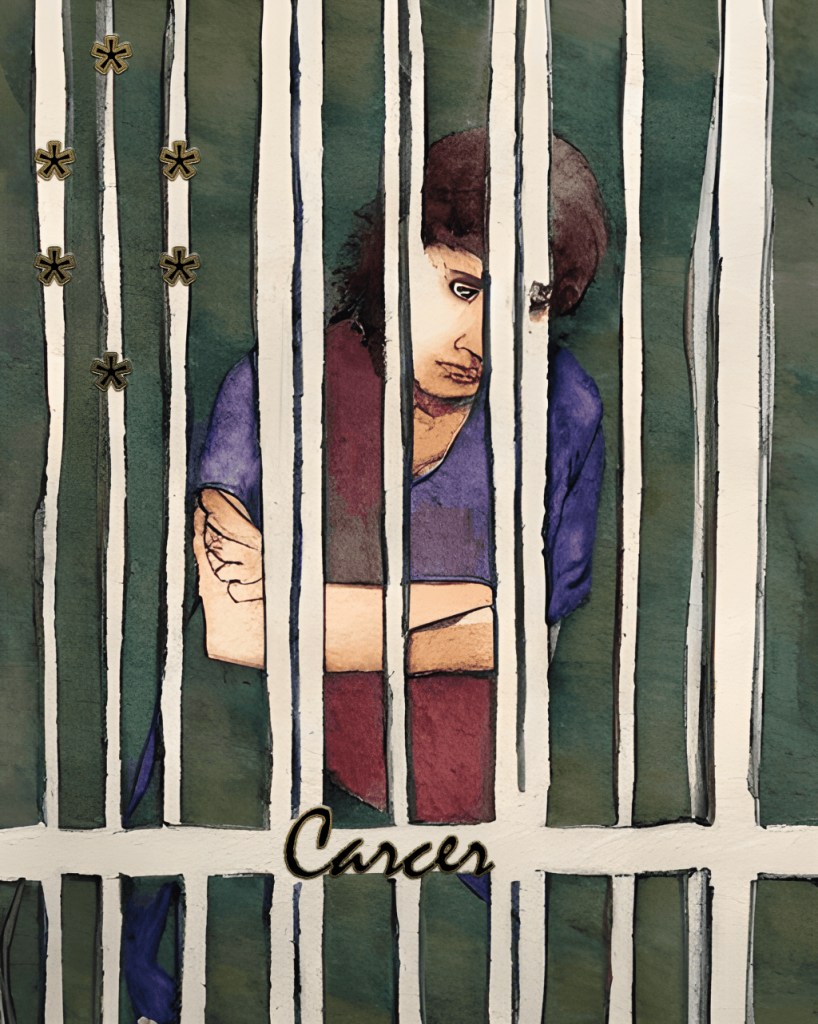
Carcer is a figure of Saturn direct. Its symbol is said to represent an enclosure, pen or prison of some kind. If we choose to look at the single dots as active elements, then Carcer is the opposite of Conjunctio, in that its active elements have in common the quality of dryness, which indicates difficulty in integrating and mixing together. Furthermore, the two elements are spread apart (one at the top, one at the bottom) and the figure can also be seen as two arrows pointing in opposite directions.

Illustration for the geomantic figure Carcer, prison

Carcer’s association with Saturn is very telling, as it embodies many of its qualities. It indicates loneliness, and in personal relationships it is broadly bad in its import. Although with positive indications it can show long-term commitment, it is more likely to show feelings cooling off, if not outright separation, or more simply it can speak of not finding anyone to be with. Lack of communication and personal contact all belong to the figure’s array of meanings.

Carcer can show prison and negative sentences in general, but the symbol of a prison or enclosed place can be interpreted metaphorically as obstacles, blockages and restriction. It indicates situations where we are in difficulty and it is difficult for us to act. However, on a brighter note, the symbol of the enclosed space can be interpreted as a womb, and Carcer is said in some sources to be good for pregnancy.

Another field where Carcer is generally positive is for building and laying the foundations of buildings (or maybe, metaphorically, for laying the foundations of something) and for keeping things secrets and solo endeavors such as meditation, study, etc. In most mundane questions, though, Carcer is one of the worst figures you can obtain, especially since it can become Judge, unlike other negative figures.

Common Keywords: Loneliness, sadness, blockage, obstacles, stoppage, building, laying foundations, separation, obligations, debts, poverty, pregnancy, secrets, deep knowledge

Carcer in the Geomantic Houses (these are only examples. Use context to guide your interpretation)

HousePossible Meanings
FirstLonely person, blocked, in difficulties, Stingy, Difficult to relate to
SecondPoverty, Lack of means, Hardships, Debt, Financial obligations
ThirdLack of communication, Isolation from the community, Only child, Lack of relationship with the siblings
FourthCastle, Large building, Constructing, Building, City, City walls, Tombstones, Loss of the father
FifthDepression, lack of fun or excitement, restraint, pregnancy
Sixthlong convalescence, difficult illness, lack of mobility, animal pens, death of animals
Seventhloneliness, interpersonal difficulties, person is already committed, lack of relationships, separation
EighthCemetery, death, fear, lack of progress, lack of money from the partner
Ninthserious study, hidden knowledge, atheism, a priest or hermit,
Tenthunemployment, lack of upward mobility, dead end
Eleventhloneliness, lack of help or friends
Twelfthprison, black magic
Thirteenthpast loneliness or hardships, person is serious, solid
Fourteenthfuture difficulties, person needs to face serious challenges
Fifteenthlack of success except in building and keeping secrets or pregnancy
Possible meanings of Carcer in the various Geomantic Houses. Note that this is not meant to be exhaustive, and it only serves to jog your interpretive muscles

MQS

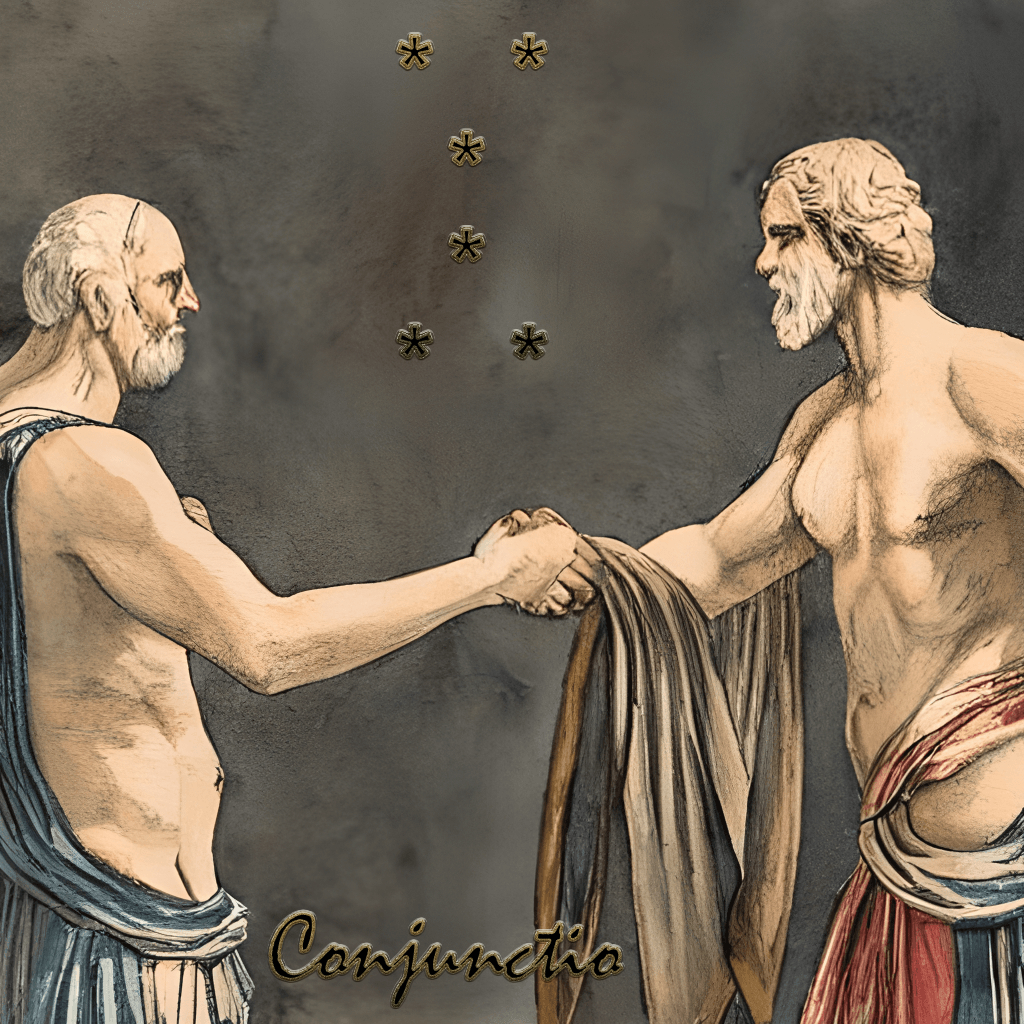
Conjunctio / Union (Geomancy Figures)

Name of the Figure: Conjunctio (Union)
Element: Air
Planet: Mercury (retrograde)
Sign: Virgo
Quality: Common
Fortune: Mixed

Conjunctio is a figure of Mercury retrograde. I always found it an interesting figure, as its array of possible meanings is actually quite ample. Its glyph seems to show two arrows converging in the middle. Interestingly, if we believe that a single dot represents an active element, then Conjunctio shows that only the two moist elements (Air and Water) are active. Moisture is associated with pliability and receptivity (remember that Thales, the canonical first philosopher, said that everything comes from Water, and aside from any biological observation, philosophically this means that water can take on any shape.)

Illustration for the geomantic figure Conjunctio, union

Conjunctio represents this mercurial lack of rigidity and convergence toward a middle point. As such, Conjunctio represents all situations that link two things or people together. It is a figure of communication, talking and being good at talking. It is not a figure that favors loneliness and solo endeavors. Togetherness is hinted at.

Because it highlights the two middling elements, Conjunctio is associated with compromise and agreements. It is a very good figure for commerce, employment and for getting out of an impasse, as it indicates moderation and finding commonalities. It is also a portent of marriage. Symbolically, it represents the marriage of various elements, thus showing admixture, mixing things, and all things that are made of various parts.

As it is a symbol of fluidity, it also speaks of exchange of fluids, also known as sex (the word ‘conjunctio’ itself can hint at it). After all, it does indicate unions of all kind. It is one of the double figures, so when asking about pregnancy, if supported by other factors, it can show twins.

On a slightly less positive note, Conjunctio does not promise astonishing results, especially when it is Judge and the question is not about contracts or retrieving lost objects. It is good, it is just not THAT good.

Common Keyword: Communication, convergence, agreement, compromise, contract, document, contact, convene, congratation, sex, exchange of fluids, moderation, temperance, middling outcome, mediocrity, retrieval, discovery, coming into contact with someone or something, mixing, admixture, multiplicity

Conjunctio in the Geomantic Houses (these are only examples. Use context to guide your interpretation)

HousePossible Meanings
FirstFlexible, able to compromise, intelligent, communicative, moderate
Seconddocuments, money-related paperwork, business contracts, retrieval of objects, buying and selling
Thirdnews, documents, social contacts in the neighborhood, contact with one’s siblings
Fourthreal estate contract, discovery of hidden treasure, talking to one’s father
FifthWriting, moderation in pleasure, sex, conception, twins
Sixthcatching an illness, taking meds, buying animals, agreement with servants
SeventhMarriage, business contract, social contacts, acquaintances, theft
Eighthmoney through marriage or business
Ninthlearning, studying, books, talking with spiritual people
TenthJob contract, agreement with one’s superiors, moderate leader, talking with one’s mother
EleventhTalking with friends, new frends, help
Twelfthbuying large animals, middling prison sentence, unable to let go of self-harming behavior
Thirteenthable to compromise, good at talking, sociable, past middling results
Fourteenthindecisive, without moral compass, future compromise, future middling results
FifteenthMiddling results, obtaining something, union
Possible meanings of Conjunctio in the various Geomantic Houses. Note that this is not meant to be exhaustive, and it only serves to jog your interpretive muscles


Tristitia / Sadness (Geomancy Figures)

Name of the Figure: Tristitia (Sadness)
Element: Earth
Planet: Saturn (retrograde)
Sign: Scorpio
Quality: Entering
Fortune: Bad

Tristitia is a figure of Saturn retrograde. As Saturn is the great malefic of traditional astrology, connected with restriction, gloominess and such other alluring concepts, its figures cannot be particularly pleasant. Tristitia’s symbol is said to represent a fallen tower or a stake driven into the ground. If we believe the theory that a single dot indicates an active element, then Tristitia only has the Earth element active.

Illustration of the geomantic figure Tristitia, sadness

This seems to be in harmony with the general meanings of Tristitia. For one, it represents melancholy, which is mostly associated with the element of Earth. It indicates all negative emotional reactions to the slings and arrows of life. Dejection, depression, being down are all meanings of the figure. It is also associated with anything that has a downward movement: “Will the stocks go up?” no, they will go down.

Furthermore, Tristitia’s earthiness shows up in the other important concept embodied by the figure, i.e., its quality of “stuckness”. Tristitia indicates all situations that are stuck, for good or ill. As a matter of fact, it is a good figure whenever you wish for things not to proceed or to have a solid foundation. This is especially true in questions about building and cultivating the land.

Finally, as the opposite of Laetitia, Tristitia indicates secrets, another meaning of Saturn. It shows everything that is done under cover of darkness or in secret. Whether this is good or bad will depend on what the querent asked: “Will my wife find out about my affair?” Tristitia says no.

Common Keywords: Sadness, depression, gloominess, loneliness, feeling stuck, blockages, decrease, diminution, going down, demotion, secrets, hiding,

Tristitia in the Geomantic Houses (these are only examples. Use context to guide your interpretation)

HousePossible Meanings
FirstPerson is sad, Depressed, discouraged, Saturnine
SecondLoss of money, economic decline, Loss of items
ThirdSad news, problematic neighborhood, false rumors, secret messages
FourthBurying, Digging, Building, Working the earth, Loss of the father, need for renovations
Fifthlack of enjoyment, A Debbie Downer, Loss of pregnancy
SixthLong illness, Problems through servants and helpers, sick pets
SeventhBad public relations, Bad image, Stuck in a marriage, Loneliness
EighthMourning, Death, Bereavement, Lack of income from the spouse
NinthSad journey, occult philosophy, atheism
Tenthrain, precipitation, loss of employment, demotion, difficulties with the mothers
EleventhLack of friends, loneliness, loss of hope, loss of support
TwelfthLong sentence, Black magic, loss through large cattle, self-undoing
ThirteenthSad past, depression, loss, ability to make efforts
Fourteenththere will be complications, it won’t be worth it, there will be toil and effort, decrease
FifteenthTristitia cannot be Judge
Possible meanings of Tristitia in the various Geomantic Houses. Note that this is not meant to be exhaustive, and it only serves to jog your interpretive muscles


MQS

Describing Court Cards, Part 2 / Cartomancy with Playing Cards

Locating the court cards within the querent’s life is probably one of the hardest tasks of a card reader. The Suit of the court card in question can help, of course. A Heart shows someone with a close connection, a Club is an official partner, a Diamond has a more distant connection or is unknown, a Spade tends to either be unknown, a stranger or an enemy.

However, far more revealing than the suit of the card are the suits surrounding it. Let us start simple. Suppose you have a Heart figure (Queen or King) surrounded by Spades. Hearts are usually positive, but IF the question is about a family member, the fact that it shows up as a Heart does not matter much: Hearts simply show consanguinity. However, if the question is about a friend, then their showing up as a Heart is in itself positive, as it shows core positive feelings. The fact that the figure is surrounded by Spades can indicate obstacles or a fight with the person.

As a very vague and general rule of thumb, the suit of the person shows their core, while the cards surrounding them show either their role or their current (or immediate future) way of relating to us. If the friend had shown up as a Diamond, it would have been worse, as then there would be no good feelings left and any fight might cause the end of the friendship.

In general, being surrounded by Hearts indicates good feelings, Clubs show either a solid relationship or a static one (it depends on the cards and the context), Diamonds show a transactional attitude for better or worse or, more rarely, one based on intellectual pursuits, while Spades show enmity. It is easy to predict, for instance, that a Heart figure surrounded by Diamonds shows the positive side of transactions (they may help us financially, for instance), while a Spade card surrounded by Diamonds may show the person will damage us financially.

Here is an example. A person asked if they could trust someone as a business partner:

5♥ – K♠ – 4♥

Regardless of the specific meanings of the cards, we have a Spade court card surrounded by Hearts. The Hearts show that the person is not trying to scam the querent. However, the fact that the person shows up as a Spade indicates that he is at his core a difficult person to get along with and this may cause difficulties along the way. Let us suppose that there had been Diamonds instead of Hearts. In this case the warning would have been more substantial: he may not be a scammer, but he is rather cutthroat and will only look after his profit. If there had been Clubs, the partnership would have probably ended up stranded due to differences of opinion, while Spades would have shown a dangerous individual.

MQS