Sometimes a spread doesn’t give us enough information and we need to dig deeper. I know that there is a number of way to do it. The way that has been taught to me is called ‘opening the spread‘ and it simply means adding one to three cards in one point to obtain further information. At this point I should say that I try to use this technique only when I find it is strictly necessary. The cards are fickle friends, so they are best kept on a short leash, lest they start confuse us. Here is an example. A querent asked me about his career. This is what came out:
Career reading
He didn’t ask a specific question, but the first two cards, the Six of Diamonds and the Five of Diamonds, represent worry about change. The center of the spread is occupied by the Jack of Diamonds, which indicates messages. Note, also, that the spread is ovverrun with Diamonds.
At this point, I asked him to draw two cards to add to the Jack of Diamonds, and we got the Four of Clubs and the Eight of Diamonds, clearly an interview. Then I asked him to open the spread again on the Eight of Clubs, the job card, and the Ace of Clubs and Seven of Clubs came up, indicating the overcoming of obstacles.
The question I asked him was if he was waiting for a message about some change, possibly to do with a raise or another positive change, where he would need to solve new problems, and he said he had applied for a promotion with came with new tasks, and he was waiting for an answer. I told him he’d get it (Ten of Diamonds and Eight of Clubs). Yesterday he confirmed he got the promotion.
When you pull three cards to describe a person (as I just did) and you get:
9♦ – J♠ – 3♠
This is a meddler, someone who interferes in others’ lives (J♠, 3♠), not out of self-interest or to get something, but due to a bloated belief in themselves (the Nine of Diamonds following the negative Court card). If the court card were positive, it would still be meddling, but out of love (Hearts, for instance)
English Version (scroll down for the Italian version)
It is an exciting time to be practicing divination. Among the occult arts it is probably the most popular for its immediate practical usefulness. The tarot is enjoying a divinatory revival after being brought to its knees by decades of pseudodeep elucubrations, and even lesser known systems of fortune-telling are being slowly fished out the obscure underbelly of folk tradition.
And occult folk tradition is especially rich in Italy, a country which, in part due to its chaotic and conflicted history, can boast a huge diversity of divinatory systems, especially (but not exclusively) of the card-based kind. It is especially reassuring to see that, unlike in the past, people of considerable education are taking these folk systems seriously.
It’s the case with Ernesto Fazioli’s latest book: Carte Piacentine. Divinare con le Briscole (Piacentine Cards. Divining with Briscola* Cards), a book dedicated to one of the many dozens of cartomancy systems based on the many types of Italian playing cards — in this case, Piacentine Cards–
Carte piacentine, one of the most popular playing card decks in Italy
Fazioli’s book is part of the same series as Germana Tartari’s Book on the Bolognese Tarot and it shares some of its traits: it is short (84 pages) and goes straight to the point; it is prefaced by a very quick but well-documented historical introduction; finally, it is aimed at shining a light on a small part of the Italian folk tradition while giving the reader the tools to work with it in today’s world.
I could quibble on a couple of points that made me wrinkle my nose, such as the association of the four suits with the four elements following the Golden Dawn pattern (which is not rooted in folk tradition, Italian or otherwise) but in reality all this is of very little account, as it can be very easily overlooked. The bulk of the book is solid and it teaches a traditional and little-known method of fortune-telling using a reduced pack of 30 Piacentine cards.
Each of the 30 cards is dedicated a small paragraph, which is enough, considering that, in traditional fortune-telling, one doesn’t spend a great deal of time musing on the quaint design of this or that card based on the latest fashion. For what little I know about this deck, the meanings retrieved by Fazioli feel genuine and even show a degree of overlap with the meanings of the Bolognese tarot.
This should not be a surprise, as fortune-telling and divination were born as methods of “gathering intelligence” about the world, meaning that, whatever system one uses, one must be given access do an adequate vocabulary–that is, a vocabulary that is adequate to describing the real world.
The spreads that Fazioli present also come from the folk tradition, and vary from the easier ones (the five card spread) to the very complex (a tableau of all 30 cards).
All in all, I am very pleased with my purchase, and will probably be posting a spread or two following the system. I am especially surprised by the good amount of information that Mr. Fazioli could pack into such a short booklet, and am endlessly fascinated, once again, by how folk divination emerges in its quality of spontaneous and creative remedy to life’s uncertainty.
* Briscola refers to one of the most popular game cards in Italy, usually played with Piacentine cards or a similar 40 card regional deck. For this reason, regional playing cards are often known as “carte da briscola” (briscola cards) in common parlance.
Versione Italiana
È un momento storico molto entusiasmante per chi pratica la divinazione. Tra le arti occulte è probabilmente la più popolare per la sua immediata utilità pratica. I tarocchi stanno vivendo un revival divinatorio dopo essere stati messi in ginocchio da decenni di elucubrazioni pseudointelletuali, e anche sistemi di cartomanzia meno conosciuti vengono lentamente ripescati dal ventre oscuro e creativo della tradizione popolare.
E la tradizione popolare occulta è particolarmente ricca in Italia, un Paese che, anche a causa della sua storia caotica e frammentata, può vantare un’enorme varietà di sistemi divinatori, soprattutto (ma non esclusivamente) del tipo basato sulle carte. È particolarmente rassicurante vedere che, a differenza del passato, persone di notevole cultura prendono sul serio questi sistemi popolari.
È il caso dell’ultimo libro di Ernesto Fazioli: Carte Piacentine. Divinare con le Briscole, un libro dedicato a una delle molte decine di sistemi di cartomanzia basati sui numerosi tipi di carte da gioco italiane – in questo caso le carte piacentine -.
Il libro di Fazioli fa parte della stessa collana del Libro sui Tarocchi Bolognesi di Germana Tartari e ne condivide alcuni tratti: è breve (84 pagine) e va dritto al punto; è preceduto da un’introduzione storica molto rapida ma ben documentata; infine, si propone di far luce su una piccola parte della tradizione popolare italiana dando al lettore gli strumenti per metterla a frutto nel contesto odierno.
Potrei cavillare su uno o due punti che mi hanno fatto storcere il naso, come l’associazione dei quattro semi con i quattro elementi secondo lo schema della Golden Dawn (che non ha radici nella tradizione popolare, italiana o meno), ma in realtà tutto ciò è di ben poco conto, perché può essere facilmente trascurato da chi non è interessato. Il libro ha solidi contenuti e insegna un metodo di cartomanzia tradizionale e poco conosciuto, utilizzando un mazzo ridotto di 30 carte piacentine.
A ciascuna delle 30 carte è dedicato un piccolo paragrafo, il che è sufficiente, considerando che, nella cartomanzia tradizionale, non si passa molto tempo a riflettere sul design pittoresco di questa o quella carta in base all’ultima moda. Per quel poco che so di questo mazzo, i significati recuperati da Fazioli nella sua attenta indagine sembrano genuini e mostrano persino un certo grado di similitudine con i significati dei tarocchi bolognesi.
Ciò non deve sorprendere, poiché la cartomanzia e la divinazione sono nate come metodi di “raccolta di informazioni” sul mondo, il che significa che, qualunque sia il sistema utilizzato, ci deve dare accesso a un vocabolario adeguato, cioè un vocabolario che sia adeguato a descrivere il mondo reale.
Anche le stese che Fazioli presenta provengono per lo più dalla tradizione popolare e variano da quelli più semplici (la stesa delle cinque carte) a quelli molto complessi (una stesa di tutte le 30 carte).
Nel complesso, sono molto soddisfatto del mio acquisto e probabilmente pubblicherò una o due stese seguendo il sistema. Sono particolarmente sorpreso dalla buona quantità di informazioni che Fazioli è riuscito a racchiudere in un libricino così breve e sono infinitamente affascinato, ancora una volta, da come la divinazione popolare emerga nella sua qualità di rimedio spontaneo e creativo all’incertezza della vita.
This spread is proof that we always need to have good communication with the querent, because sometimes readings are deceptive.
Sometimes spreads don’t answer the question at hand. This happens in two cases: when something more important is going on (or about to happen) in the querent’s life or when the cards want to give us details about the question that we haven’t asked for. This latter case requires great care, especially if the question is of a delicate nature.
A woman asked me if she will get pregnant. This is the spread (this is a rather old reading):
A pregnancy question answered with playing card divination
You’d probably think (and you’d be right) that my first instinct was to say “no” due to the horrible mesh of Spades following the Jack of Hearts, which is the child card.
However, something didn’t sit right with me about this spread. I wasn’t at all convinced the spread was answering the question directly. The reason is that the cards Ace of Spades, Nine of Spades and Ten of Spades can show bereavement, and bereavement can only happen if there *is* a child.
The King of Spades could be a doctor performing an abortion, but this isn’t confirmed by any other card (e.g. the Six of Spades). In this case, the King of Spades seems to be more like a priest celebrating a funeral.
I asked the querent if she already had a child, and she said that she unfortunately had a miscarriage in the recent past when the pregnancy was already relatively advanced.
So the cards were not saying that she wouldn’t have a child: they were merely reflecting a recent trauma. With that in mind, I interrupted the reading, telling her the cards were telling her to take time for herself. This was an excuse, of course: I could have done another reading, but I didn’t want to risk having to predict another miscarriage.
Fortunately, today the woman is the happy mother of two twins.
(Note: this is a collection of the meanings attributed to the cards by some occultists in the past centuries. It does not reflect my own study or opinion of the cards. It is only meant as a quick comparative reference as I develop my own take.)
The Queen of Cups from the Builders of the Adytum (BOTA) tarot deck
Paul Foster Case (and Ann Davies)
The time period is the beginning of the last decanate of Libra to the end of the second decanate of Scorpio, October 13 to November 11, combining the rulerships of Mercury, Mars, Jupiter and Neptune. Well Dignified: through the influence of Mercury in Libra the Queen of Cups personifies a woman, mentally alert, yet somewhat superficial, who probably has a touch of the poetic in her nature. She is kindhearted though not likely to go to too much trouble for anyone. The Scorpio influence added gives her strong desires and makes her emotionally responsive and attractive to the opposite sex; very psychic, and if her hig he r nature is developed she depicts a very powerful spiritual force akin to the influence of the purified desire nature and the influence of Neshamah. Ill Dignified: a woman who is subtle, decidedly coquettish and may even be a deliberate heart-breaker. Usually gold-brown hair with blue eyes. (From the Oracle of Tarot course)
A. E. Waite
Beautiful, fair, dreamy–as one who sees visions in a cup. This is, however, only one of her aspects; she sees, but she also acts, and her activity feeds her dream. Divinatory Meanings: Good, fair woman; honest, devoted woman, who will do service to the Querent; loving intelligence, and hence the gift of vision; success, happiness, pleasure; also wisdom, virtue; a perfect spouse and a good mother. Reversed: The accounts vary; good woman; otherwise, distinguished woman but one not to be trusted; perverse woman; vice, dishonour, depravity. (From The Pictorial Key to the Tarot)
Aleister Crowley
The Queen of Cups represents the watery part of Water, its power of reception and reflection. In the Zodiac it rules from the 21St degree of Gemini to the 20th degree of Cancer Her image is of extreme purity and beauty, with infinite subtlety; to see the Truth of her is hardly possible, for she reflects the nature of the observer in great perfection.
She is represented as enthroned upon still water. In her hand she bears a shell-like cup, from which issues a crayfish, and she bears also the Lotus of Isis, of the Great Mother. She is robed in, and veiled by, endless curves of light, and the sea upon which she is enthroned conveys the almost unbroken images of the image which she represents.
The characteristics associated with this card are principally dreaminess, illusion and tranquillity. She is the perfect agent and patient, able to receive and transmit everything without herself being affected thereby. If ill-dignified, all these qualities are degraded. Everything that passes through her is refracted and distorted. But, speaking generally, her characteristics depend mostly upon the influences which affect her.
In the Yi King, the watery part of Water is represented by the 8th hexagram, Tui. The commentary is as colourless as the card; it consists of mild exhortations on the subject of pleasure. It may really be said that, normally, people of this type have no character at all of their own, unless it can be called a characteristic to be at the disposition of every impact or impression.
There is, however, a hint (line 6) that the chief pleasure of people of this type is to lead and attract others. Such are accordingly (often enough) exceedingly popular. (From The Book of Thoth)
AI-Generated illustration for the Queen of Cups
Golden Dawn’s Book T
A VERY beautiful fair woman like a crowned Queen, seated upon a throne, beneath which is flowing water wherein Lotuses are seen. Her general dress is similar to that of the Queen of Wands, but upon her crown, cuirass and buskins is seen an Ibis with opened wings, and beside her is the same bird, whereon her hand rests. She holds a cup, wherefrom a crayfish issues. Her face is dreamy. She holds a lotus in the hand upon the Ibis. She is imaginative, poetic, kind, yet not willing to take much trouble for another. Coquettish, good-natured and underneath a dreamy appearance. Imagination stronger than feeling. Very much affected by other influences, and therefore more dependent upon dignity than most symbols. She rules from 20 Degree Gemini to 20 Degree Cancer.
Etteilla
Blonde Woman Upright: As far as the medicine of the spirit is concerned, this card, when upright, means: Blonde Woman, Honest Woman, Virtue, Wisdom, Honesty Reversed: Distinguished woman, Vice, Dishonesty, Debauchery, Corruption, Scandal
(Note: this is a collection of the meanings attributed to the cards by some occultists in the past centuries. It does not reflect my own study or opinion of the cards. It is only meant as a quick comparative reference as I develop my own take.)
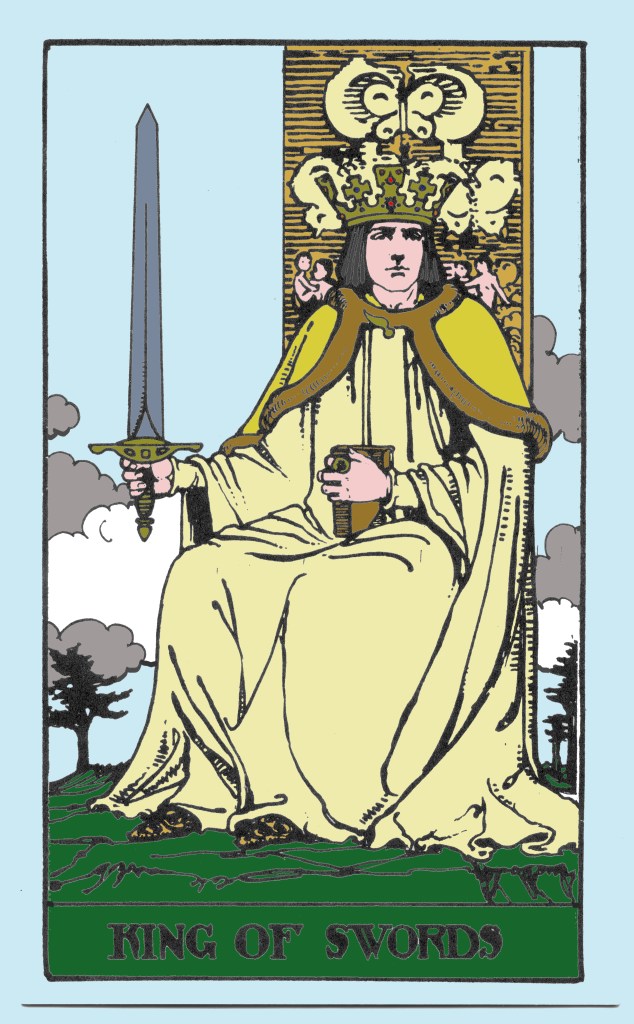
The King of Swords from the Builders of the Adytum (BOTA) tarot deck
Paul Foster Case (and Ann Davies)
The time period is from the beginning of the last decanate of Virgo to the end of the second decanate of Libra, September 13 to October 12, under the combined rulerships of Venus in Taurus, Venus in Libra, and Saturn-Uranus in Aquarius. Meanings: a man of strong and powerful imagination; hard worker and having authority; keen in understanding law and capable of excellent cooperation; somewhat distrustful and suspicious and therefor e hard to convince. He sometimes surprises his friends by sudden changes of attitude, although he is usually overcautious and analytical. In a divinatory lay-out: Well Dignified: he is friendly to the Querent and will cooperate with him. lll Dignified: he is inimical, harsh, malicious and plotting, obstinate and wholly unreliable. Dark hair and dark eyes. (From the Oracle of Tarot course)
A. E. Waite
He sits in judgment, holding the unsheathed sign of his suit. He recalls, of course, the conventional Symbol of justice in the Trumps Major, and he may represent this virtue, but he is rather the power of life and death, in virtue of his office. Divinatory Meanings: Whatsoever arises out of the idea of judgment and all its connexions-power, command, authority, militant intelligence, law, offices of the crown, and so forth. Reversed: Cruelty, perversity, barbarity, perfidy, evil intention. (From The Pictorial Key to the Tarot)
Aleister Crowley
(Note: Crowley and the Golden Dawn swapped around King and Knight. This is in part true of Waite as well.)
The Knight of Swords represents the fiery part of Air; he is the wind, the storm. He represents the violent power of motion applied to an apparently manageable element. He rules from the 21st degree of Taurus to the 20th degree of Gemini. He is a warrior helmed, and for his crest he bears a revolving wing. Mounted upon a maddened steed, he drives down the Heavens, the Spirit of the Tempest. In one hand is a sword, in the other a poniard. He represents the idea of attack.
The moral qualities of a person thus indicated are activity and skill, subtlety and cleverness. He is fierce, delicate and courageous, but altogether the prey of his idea, which comes to him as an inspiration without reflection.
If ill-dignified, the vigour in all these qualities being absent, he is incapable of decision or purpose. Any action that he takes is easily brushed aside by opposition. Inadequate violence spells futility. “Chimaera bombinans in vacuo”.
In the Yi King, the fiery part of Air is represented by the 32nd hexagram, Hang. This is the first occasion on which it has been simple to demonstrate the close technical parallelism which identifies Chinese thought and experience with that of the West. For the meaning is long continuance: “perseverance in well-doing, or continuously acting out the law of one’s being”, as Legge puts it in his note on the hexagram; and this seems incongruous with the Qabalistic idea of violent energy applied to the least stable of the elements. But the trigram of Air also indicates wood; and the hexagram may have Suggested the irresistible flow of the sap, and its effect in strengthening the tree. This conjecture is supported by the warning in line 6: “The topmost line, divided, shows its subject exciting himself to long continuance. There will be evil.”
Allowing this, the image of “the extended flame of mind”, as Zoroaster calls it, may well be subjoined to the former description. It is the True Will exploding the mind spontaneously. The influence of Taurus makes for steadiness, and that of the first decanate of Gemini for inspiration. So let us picture him, “integer vitae scelerisque purus”, a light-shaft of the Ideal absorbing the entire life in concentrated aspiration, passing from earthy Taurus to exalted Gemini. Here, too, is shewn (as in the Yi) the danger to the subject of this symbol; for the first decan is the card called “Interference”; or, in the old pack, “Shortened Force”. (From the Book of Thoth)
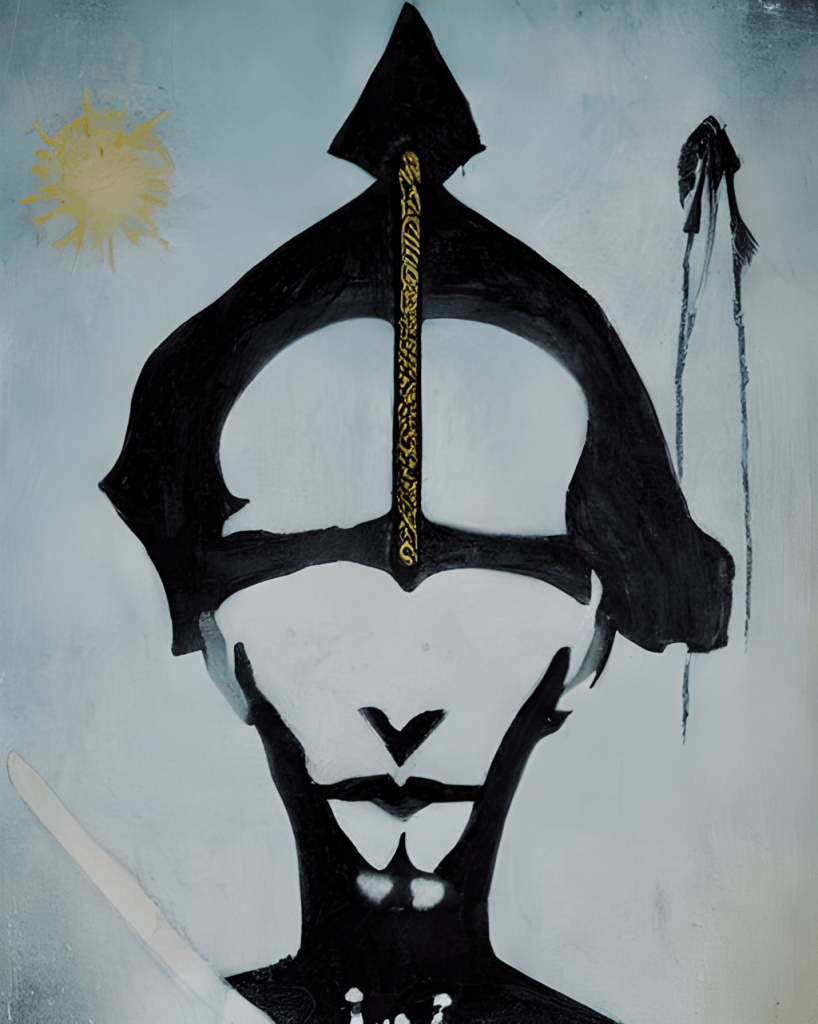
Oddly Bismarckian AI-generated Illustration for the King of Swords
Golden Dawn’s Book T
A WINGED Warrior with crowned Winged Helmet, mounted upon a brown steed. His general equipment is as that of the Knight of Wands, but he wears as a crest a winged six-pointed star, similar to those represented on the heads of Castor and Pollux the Dioscuri, the twins Gemini (a part of which constellation is included in his rule). He holds a drawn sword with the sigil of his scale upon its pommel. Beneath his horse’s feet are dark-driving stratus clouds. He is active, clever, subtle, fierce, delicate, courageous, skilful, but inclined to domineer. Also to overvalue small things, unless well dignified. If ill dignified, deceitful, tyrannical and crafty. Rules from 20 Degree Taurus to 20 Degree Gemini.
Etteilla
Man in Uniform Upright: This card, as far as the medicine of the spirit is concerned, means, in its natural position: Man in Uniform, Man of the Law, Judge, Councilor, Assessor, Senator, Business Man, Medical Practitioner, Lawyer, Prosecutor, Doctor, Physician. – Jurist, Law-making. – Litigant [= Party to litigation], Jurisconsult. Reversed: Malicious, Maliciousness, Perversity, Perfidy, Crime, Cruelty, Atrocity, Inhumanity.
I already said that I am not a big fan of complications in divination. Nor do I believe that the tendency to overcomplicate things is just modern: if we look in older Horary Astrology handbooks, for instance, they are filled to the brim with (often mutually contradictory) techniques that may be thrown at the chart in an attempt to smoke a positive judgement out of it.
Still, one technique that is relatively consistent in the tradition is that of the Via Puncti, or Way of the Point. Not all traditional sources talk about it, but I have found it to be occasionally helpful. As usual, techniques are not to be used blindly, but intelligently, like tools in the hand of a surgeon.
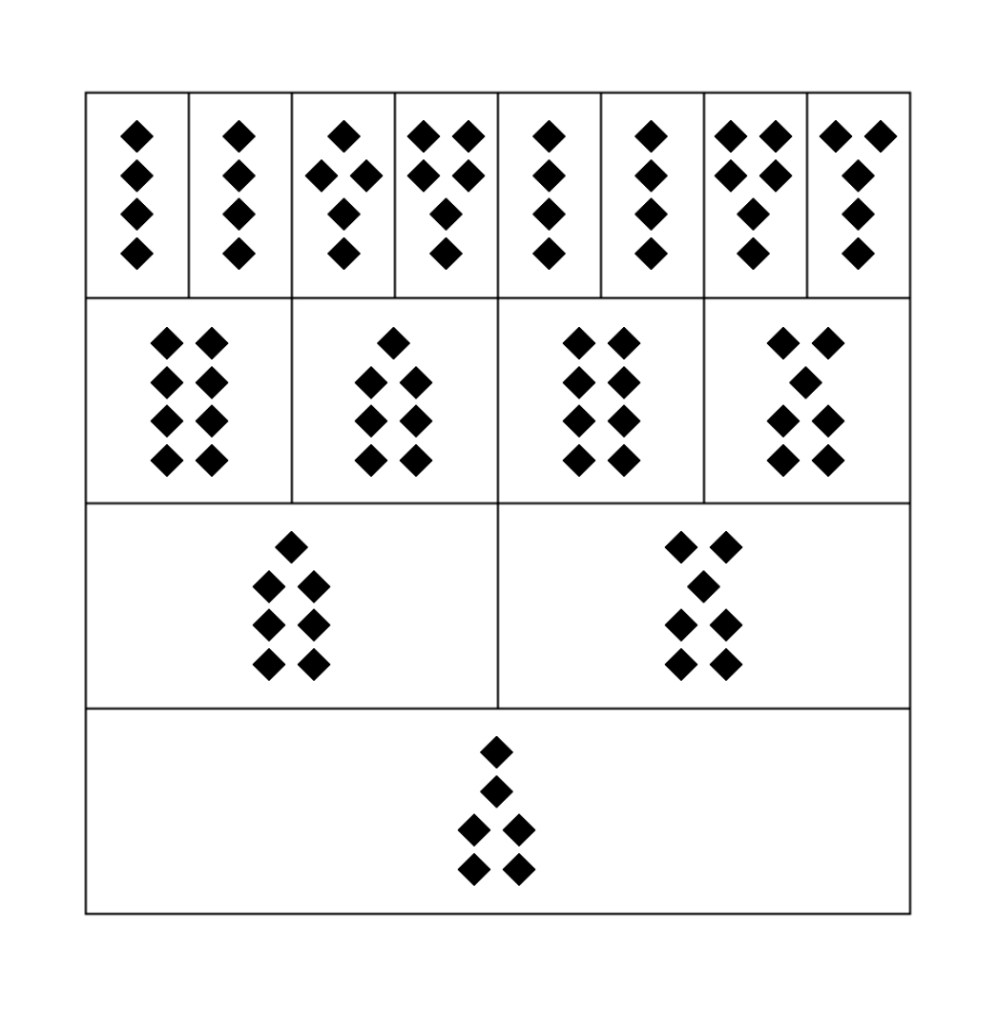
The long and short of this technique is as follows: some Judges have one point in their Fire line (the upmost one), while others have two. In fact, out of all eight possible Judges, four have one single Fire point (Carcer, Fortuna Minor, Via, Amissio), while the other four have two (Conjunctio, Fortuna Major, Populus, Acquisitio). Due to how Geomancy’s model works, whenever the Judge has one Fire line, it is possible to trace it back unequivocally to one of the four Mothers or Daughters (that is, to one of the eight figures at the top of the shield).
Geomantic Shield Reading, drawn with the Simple Geomancy app
In the above example, Fortuna Minor is the Judge. It has one point in its Fire line. This one point is found again in the Left Witness, Laetitia, and again in the third Niece, which is again Laetitia, and finally in the second Daughter Puella. No other path is possible. This is always so (if it isn’t so and you’ve calculated the chart by hand, you’ve made a mistake.)
Usually, the Via Puncti or Way of the Point can be looked at as a root cause for at least some aspects of the final answer. In the example above, for instance, a woman may be the cause (Puella). Or, if we take the House in consideration, since Puella is in the Sixth house, it may indicate that a sickness is the cause, or a servant/subordinate, or a pet, depending on the question.
I repeat: depending on the question. I make no effort to squeeze a consideration of the Via Puncti into my readings. If it is helpful, and if the question lends itself, I will consider it.
Geomantic Shield Reading, drawn with the Simple Geomancy app
In this second example, Acquisitio is the Judge. Immediately the Via Puncti branches off, as both Witnesses have two points in their Fire line. John Michael Greer says that this shows more complex causes, but he fails to mention that, in the old books, this is not considered a valid Via Puncti. I don’t know if I am unaware of some of the old material or if Greer gave in to his tendency to mix innovation (which is fine) with pretense that it is rooted in tradition. You can of course choose to experiment with Greer’s version of the Via Puncti. Personally, I don’t even always regard it when it is there (as in the first example) let alone when it is not there.
One thing that the existence of the technique shows, though, is that the Golden Dawn’s way of reading the astrological chart by placing the mothers in the angles is completely baseless, and is a typical example of the “let’s make up a secret” tendency of the occult community.
One of my favorite things in life is when idiots in the online spiritual community are outed for the entitled, narcissistic, exploitative asses that they are.
I don’t know if you are aware of this story, but a TikTok psychic literally accused an innocent person of being the mastermind behind a series of murders, and she had other leg to stand on except that she’d done a reading.
I have honestly no idea if this psychic was just doing it to drive traffic to her profile or if she is seriously that deluded. The fact that, whenever a celebrity dies, swathes of psychics get their 15 minutes by “channeling their spirit” on youtube would argue in favor of the woman being just another tacky, phony con artist. However, the fact that she apparently chose to represent herself in court does lend the possibility of her being delusional some credibility.
Either way, she’s royally screwed herself up, though the damage she’s done both to the innocent person she’s accused and to the families of the murder victims can hardly be repaid.
I feel one day a study should be made on the incredible mix of ignorance, entitlement and sheer delusion that pervades the community, especially the online one. (I am aware of studies done on the new age community, but I believe the modern, online community should be studied critically)
(To be clear, I also do readings on current events as case studies for myself. I never publish nor talk about them for the obvious reason that exploiting personal tragedies is not my idea of a good time. )
The astounding thing about all oracular forms is that they reflect the real world in the same way a recording of a scene does. This reading is from five or six months back, and it was partially confirmed a couple of weeks later, but the final feedback came only very recently.
I friend of ours was dating a new man. She’d been out of the dating scene for a while due to focusing on other things in her life. But she noticed that the guy was acting weird, as if he was looking for any excuse to cause a fight that would end the (still budding) relationship. We asked the cards and this is what happened:
Relationship reading with the tarot (Tarocchi di Layla, by Elisa Scerrato)
The cards of the cut are the Fool and Justice. Justice usually represents a solid union, not one that has just started and where the partners don’t even live together. The instability caused by the fool was already an alarm bell.
Then we have a full scene playing out: the Tower breaks up the relationship between her (Empress) and him (Emperor), but there is an obscure (Moon) influence next to him. Another woman (Popess / High Priestess). This is not even a new girl he met. The Popess has the World card next to her, showing a solid family, and the Hanged Men indicates being bound to someone, a serious commitment. I told our friends that I didn’t think the relationship had much of a future, and that she should be careful that there wasn’t any other woman around the dude.
A couple of weeks later he left her abruptly via text message. A couple of days ago, we met with our friend and she confirmed the guy was married all along, although he has an on again, off again relationship with his wife and, due to his cultural background, he doesn’t see it as strange to date multiple women, even without them knowing.
Notice how the readings flows from one card to the next in true cinematic fanshion. This ability of divination to act as a mirror is partly why I don’t believe in asking the cards for advice. This would be like asking a map for advice on where to go. The map gives you a larger picture, but the advice doesn’t come from the map: it comes from checking your plans against the available options.
I was asked in a private message about the difference between the Ace of Spades and the Five of Diamonds in my way of reading playing cards, since both seem to signify change. This is a nice question, so I thought I’d write an article about it. Maybe I’ll write other comparative articles if I feel inspired to.
First off, let’s start with two obvious facts. The Ace of Spades belongs to the Suit of Spades, which is the most negative in the deck. Spades have very few redeeming qualities. They represent the dark side of existence, pain, grief and sorrow. The Suit of Diamonds, on the other hand, is neutral, with some positive undertones. It is a symbol of energy, change, progress. It is connected to technology and science, to money, wealth, intelligence. Broadly, it shows impulses and new impulses. This fact alone indicates that the Ace of Spades must have more negative connotations than the Five of Diamonds.
Furthermore, the Ace of Spades is, well, an ace. Aces have a powerful impact on any reading, as they can show the manifestation of new currents of destiny, new life phases, etc. They indicate the beginning of something. Even when they don’t, they are still very dominant cards, and we must always pay close attention to them. Fives, on the other hand, are roughly in the middle of the sequence, so the change they indicate is more akin to a transition within the same sequence or current of events.
This is, of course, somewhat vague and needs to be understood within the context of each reading. However, when we combine the suit with the number, we do have a general picture of the Ace of Spades as a very drastic card, whereas the Five of Diamonds, unless supported by drastic cards, tends to show a smoother transition, which is also less all-encompassing.
There is something else to take into account. Calling the Ace of Spades the card of change is somewhat reductive, as if we were trying to neutralize it. The Ace of Spades is, for the most part, a negative card. One of the ways my teacher called it, in addition to ‘the Death card’ was also ‘a thorn in the heart‘ though I don’t remember if I talked about this in the post. Perhaps I, too, have been guilty of playing it down.
A thorn in the heart is something that makes us suffer beyond words. It symbolizes grief, bereavement, sometimes even trauma. Even when followed by positive cards, the Ace of Spades represents painful changes that take a toll on our psyche, changes we are likely to perceive as some kind of great loss. The somewhat sterile concept of ‘change’ pales in comparison to this description.
The Five of Diamonds has, by itself, none of these connotations. It shows transition in the most neutral sense possible. For instance, when found next to the Ace of Hearts, i.e., the house, the Five of Diamonds can show renovations or changing the place of some piece of furniture, depending on the accompanying cards. The Ace of Spades next to the House can show grief in the family or coming from the family, and if it does indicate change, it is more likely to indicate an eviction or an unwanted change of residence.
Again, this is rather vague: we need to understand the cards within the context of a concrete reading, but by and large that’s my experience.