Category Archives: Divination

On Death (Example Reading)

Of the many subjects that have been banished to the realm of shadows in contemporary divination, none have become more unspeakable than death. Under no circumstances should we be reminded of our mortality and finitude, largely because these are all things that fly in the face of the “you can be whatever you want” ideology that many diviners now espouse. Divination proves that no, we can’t be whatever we want. Certain patterns of our life are laid out for us and there is precious little we can do about them except, maybe, work on our ability to accept them.

Obviously, as diviners we wield a certain degree of power over our querents, and as such we ought not to abuse it to terrorize them. I don’t usually talk about death unless the question is specifically about it or unless the context somehow allows for such a discussion. But I am also no moralist lecturing the querent on what they should be asking. In this case I was asked by a woman about her father’s wellbeing after being diagnosed with a serious illness. I told her I would not diagnose anything, but I would merely look at the general flow of his life.

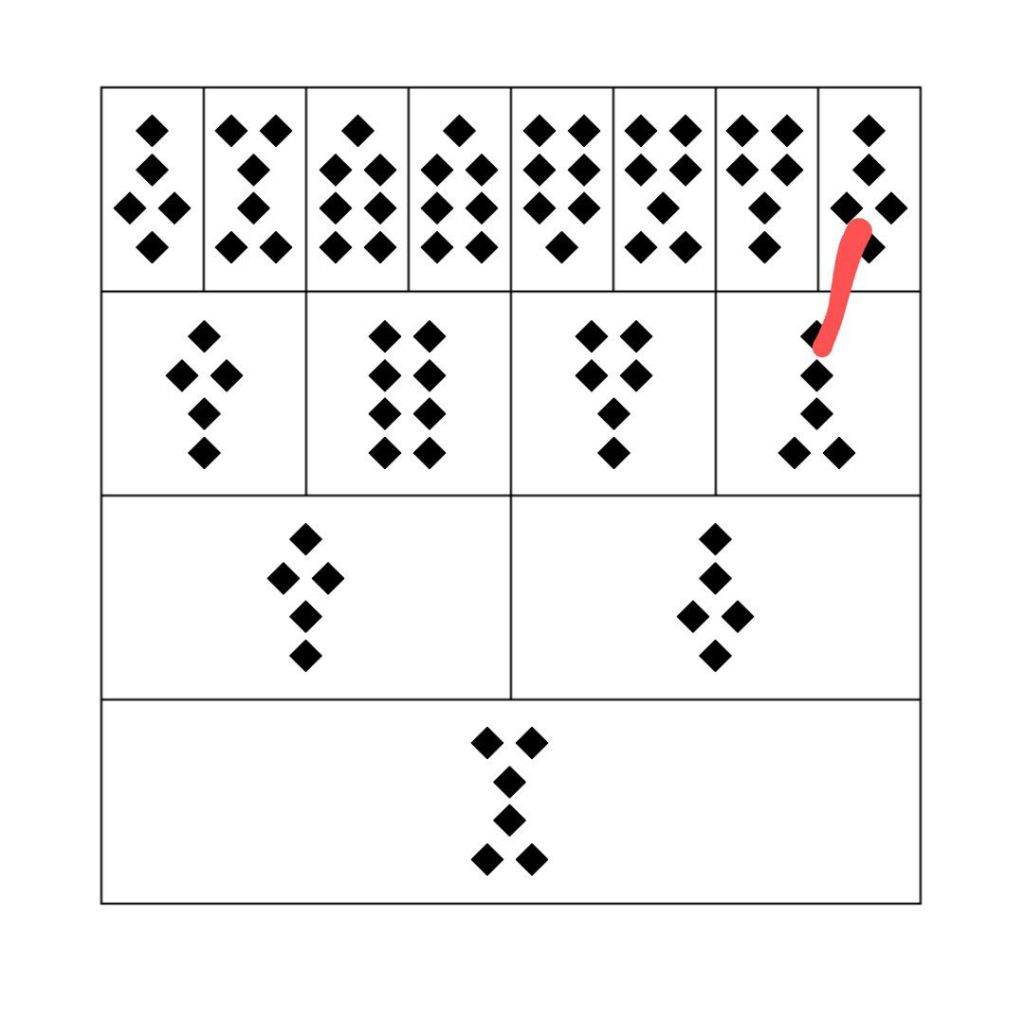
2♥ – Q♥ – Q♠ – K♠
10♠ – K♣ – 9♠
8♠ – Q♦
10♥

I said it largely to comfort her, but the cards have their own language that cannot be overruled by any consideration. The pyramid can largely be summarized in one word: “funeral“. There isn’t much to discuss or interpret. Look at that group of people cards: these are not specific individuals. They are just meant to indicate many people together.

Then we have the Nine of Spades, Eight of Spades and Ten of Speads interspersed. These show great evil, tears, darkness. You get the picture. In the context of this question, many people together for something tear-related is called a funeral. So there is going to be a funeral: the father won’t survive.

Due to the Two of Hearts, I thought this was going to be within two weeks (not the funeral, but the death). It ended up being almost a month (timing is always tricky). In general, I think the cards meant “soon”.

But what about the Ten of Hearts at the end? Shouldn’t it nullify the evil meaning of the other cards? Usually it does, but the Ten of Hearts also represents Heaven or paradise. In the context of readings about this sort of issues it indicates that death comes as a release from the sufferings of life. As such, as weird and unfathomable as this sounds to us in the realm of the living, the spread is positive: it ended well because it ended in death. As a matter of fact, I have been told that the father was serene and peaceful till the end.

Why Predict Death? Philosophical and Practical Implications

I hope I haven’t put off anyone with this post, but the fact is that death is possibly the most salient event in life, so it makes sense that divination should be able to address it. The readings I do about this sort of issues are very rare, and I generally warn the person that I am fallible and have been and will be wrong again.

Other readers may choose to avoid such questions altogether. This is a legitimate choice, as no one should be forced to read about topics they feel uncomfortable about. However, it is also important to recognize that such questions are legitimate and that there is nothing inherently dark about them. It all depends about the context and about the attitude of the diviner (and of the querent, of course).

One may ask what the point is of divining about death and other such topics, since the querent cannot do much about it. In reality, there is plenty of non-morbid reasons to want to know about it: one may wish to set their affairs in order, or simply get a head start in getting closure. In pre-modern Western astrology, as well as in Chinese astrology, the prediction of the native’s death, or at least of whether they had enough life force in them to lead a relatively long life, was one of the first things the astrologer looked for. This is obvious: you can’t predict fame to someone for next year if they’ll be gone tomorrow.

Most importantly, a sober and serviceable approach to such topics has the ability to make us appreciate life from the point of view of the eternal, from the recognition that many things escape our control and we are truly actors in a cosmic play.

MQS
Friend or Acquaintance?

In Astrology, and therefore in Geomancy, we distinguish between a friend and an acquaintance, the former being eleventh house matter, the latter seventh house. Obviously, the difference is not as clear cut as it may seem, especially in the age of social media, where all it takes to be someone’s friend is to click on the ‘add’ button.

In the old texts, both of Geomancy and Astrology, we often find examples of how to judge questions like “Will my friends be useful to me?” This may sound callous compared to our sentimental notions of friendship, but keep in mind that 1) the old notion of usefulness was broader back then, and it included everything concerned with the person’s well-being, both inner and outer 2) friends formed part of the person’s network of alliances in tackling the hardships of life 3) the eleventh house is the second from the tenth, which represents heaven, so it represents friends as wealth from heaven. Clearly friends were highly revered (just read Plato, Seneca, Xenophon or even Confucius for proofs).

As I mentioned somewhere else, my husband and I are in the process or moving, and as usual when moving, we suddenly discovered that we own three times more stuff than we thought. One friend volunteered to help us the following day, bringing us boxes and helping us with her car. In the evening though she said she didn’t know if she would make it. I cast a reading to see whether she would come:

Will she come to help us? (app used: Simple Geomancy)

Let us forget the Judge for a second and concentrate on the chart. If we take the girl as ‘our friend’ she should be eleventh house, and the eleventh house is occupied by Cauda, which also doesn’t move anywhere.

Now if my mom asked me who she is, I would say ‘a friend’. Yet she is more my husband’s friend. I am just on good terms with her, but I wouldn’t call her to spill my guts or even to ask for help, though it was of course very nice of her to volunteer.

If I take her to be my acquaintance, she is seventh house, and occupied by a more promising Conjunctio, which does spring to the second toward me. And she did end up coming.

The negative Judge, Amissio, possibly refers to the fact that we ended up losing a couple of objects due to recklessness (notice the Via Puncti reaching back to Puer in the fourth house). I also ended up losing a friend to gain an acquaintance, it seems.

MQS

The Geomancy of Peter of Abano – Book I Pt. 2

Previous / Back to Index / Next

Here Abano teaches how to cast a reading and then explains the main meanings of the astrological houses.

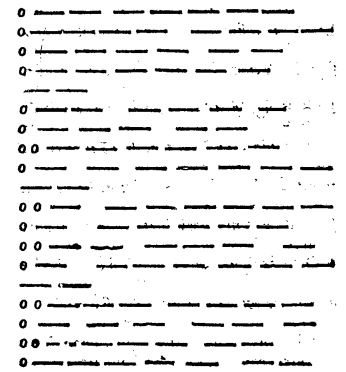
The method of forming the above mentioned sixteen figures is to use a pen to mark sixteen rows of points on a piece of paper. These must then be paired two by two, until, at the end of each row, either two points are left or only one.

Abano’s illustration of how the four mothers are formed

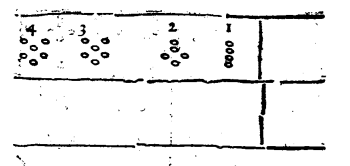
Then one must take the geomantic figures that emerge, in the following way.

Abano illustrates how to add the Four Mothers to their place

Note, however, that the previous operation is not carried out by counting the points one makes, nor by following one’s fancy, but rather by virtue of the Primum Mobile and First Motor God the Eternal, who moves one’s hand, and is to be carried out with good intentions and by invoking God’s grace and help.1

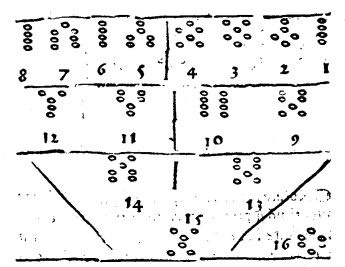
From the first four figures, four other figures are derived by taking the first points of each of the first four figures, which go to form the fifth figure; then by taking the second points of each figure to form the sixth figure, and so on with the third row of points to form the seventh, and the fourth row to form the eighth, as shown below.

Abano’s illustration of the Geomantic Shield

Once the eighth figure has been drawn, take the first and second [figure] and, proceeding in the same way as at the beginning, form the ninth; then take the third and fourth to form the tenth; then the fifth and sixth to form the eleventh; then the seventh and eighth to form the twelfth.

Then, add the tenth and the eleventh to form the thirteenth, known as the First Witness, and the eleventh and the twelfth to form the fourteenth, known as the Second Witness. Add the witnesses to discover the Judge.

This completes the chart, with every figure in its necessary place according to the question asked, as will be explained.
However, often one may take the Judge and the first figure and add them together to obtain the Judge of the Judge,2 which is the sixteenth figure, which we will discuss later.

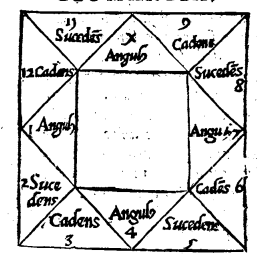
It is to be noted that the main figures are the first twelve, of which four are strongest. The first and the tenth are the best, but the first is even better. The seventh and fourth are also good. These four figures are called the angles, noting which one may know the strength and virtue of the chart. Following them, the second and fifth figure, and the eighth and the eleventh are known as succedent. Finally the last four are the third, the sixth, the ninth and the twelfth, which are called cadent, as shown in the following figure.3

Abano’s illustration of the principle of angularity as it applies to geomancy

And the first figure is called the strongest and best of all, because it signifies the virtue of the Heavens on the querent, that is, he who asks the question.4 It is called the Ascendant.
Following that, the tenth is in the middle of the heavens and has great power and influence. When it is good it bodes well, but when it is unfortunate it means great misfortune in terms of how the question is going to end.5

The seventh figure is opposite the Ascendant and is called the Western Angle, and it bodes well when good, ill when bad, especially in questions concerning the seventh house, as will be shown.
The fourth figure or house, although categorized as an angle, is called the feeblest of them, because it is at the bottom of the skies in our hemisphere. Nonetheless it indicates the end of the matter and of the querent’s intention.

Then we have the second, fifth, eighth and eleventh, which are succedent houses because they come after the angles, and are good or bad according to the figure [that falls in them] and the question asked, and they indicate the present and what is yet to come for the question asked.
The third, sixth, ninth and twelfth figure are called cadent, meaning what runs against the question, and the worst are the sixth are twelfth. The eighth is also among the evil houses.

The above is especially to be noted because every figure has two virtues, one according to its nature and an accidental virtue depending on where it falls in the chart.6 As such, if a good figure falls in the first house, its goodness is amplified, and similarly in any other angle. When it falls in a succedent house, it has less power, and when it is cadent it has even less.
And this point holds true for evil figures as well in their ability to cause bad fortune. An evil figure in an angle, therefore, will mean a great bad fortune, especially in the fourth.

Nonetheless, among the bad houses, the sixth and eighth and twelfth are the worst, and every figure falling therein is dangerous in any question.7 And they are especially dangerous if they are evil by their own nature.
Said figures are considered not just according to their virtue and the places where they fall, but also according to the question, that is, according that they are appropriate or inappropriate concerning the thing asked.8 As such, what follows is the signification and the property of each of the houses.

The first house signifies the life and body, the being and soul and intention of the querent or the one for whom the question is asked. It also means the beginning of all things. It sits opposite the seventh, and signifies the goods and money of the prisoner. It is the joy of Mercury.9

The second house is wealth,10 gain and loss, and all that the querent owns. It is opposite the eighth, and it signifies the gain of the querent’s family.

The third house indicates siblings, blood relatives, short journeys and enemies of faith and of the Roman Church,11 neighbors, etc. This house is opposite the ninth. It also signifies rumors, and travel companions. It is the joy of the Moon.

The fourth house indicates buildings, buried things, the end of every question. Also, the father, the wealth of a brother or sister.12 It is opposite the tenth.

The fifth house indicates mirth and happiness, children, messengers and letters, music, food, clothes, mid-range travel, the father’s wealth. It is opposite the eleventh and it is the joy of Venus.

The sixth house indicates wrath and an evil mind, toil, malady, servants, people who are subjected to the querent, small animals. This house is the joy of Mars.

The seventh signifies the wife,13 the lover, an opponent, public enemies, games of chance, thieves, bandits, partners. The place the querent goes to, medicine, the wealth of one’s servants. It is opposite the fist house, and is absent.14

The eighth house indicates death, fear, danger, the wealth of the enemy, inheritance from the dead, the wife’s dowry, gain from the land one moves to,15 debts, Necromancy, evil spells. It is opposite the second.

The ninth house signifies religion, Ecclesiastics, the Pope, preferment, priests, the Christian faith, burials, fame or infamy, long travels, the wealth of the absent party.16 It is opposite the third, and is the joy of the Sun.

The tenth signifies the Emperor, the King, the lord,17 great honor, a doctor, a master, art, profession, sea, ship, towers, the thing stolen, famine, fertility, the church’s wealth, and advantages gained from the church. It is opposite the second.18

The eleventh signifies friends, hopes, fortune, courtesans, a lord’s wealth, common goods, the mother’s dowry. It is opposite the fifth, and is the joy of Jupiter.

The twelfth house signifies prison, prisoners, pilgrims and endless wandering, long violence,19 adversities, traitors, occult enemies, great beasts, the friend’s wealth. It is opposite the sixth. It is the joy of Saturn.

Whenever a question is asked, the issue always involves the first house, and in the second place the figure found in the house that is appropriate for the question, and depending on whether it is fortunate or not, together with the four angles, thus does one judge the issue. And especially [it is to be considered] whether the Witnesses and Judge are good.

MQS

Footnotes
  1. Here again, as in Part 1, Abano insists on the role of the divine (and again, he does it in a typical Christian Aristotelean fashion). He is doing more than just paying lip service to the religious ideas and institutions of the time, in so much as he asserts a central point common to all forms of divination: that it is divine nature that shines through the divination process. This explains his assertion that the points must not be counted nor be created following one’s fancy: the diviner’s ego must be switched off in order for the divine to act through it. ↩︎
  2. ‘Sopragiudice’ in Italian, which literally means Superjudge or Overjudge. ↩︎
  3. Abano follows the relatively standard (by that time) association of the astrological houses with varying degrees of strength. ↩︎
  4. The first house is given to the querent, so a good figure in it would indicate something positive for them or that they are positive. ↩︎
  5. This seems intended more to emphasize the importance of the angles than to link the tenth house with the ‘end of the matter’, which is a meaning typical of the fourth house. ↩︎
  6. This is meant to reflect the notions, common in Medieval astrology, of accidental and essential dignity of the planets, though the concept must be modified a little in order for it to apply to geomancy. ↩︎
  7. There is a certain digree of ambiguity concerning this issue, as it is not always clear if a figure in a weak house will see its power decreased or its evil import amplified. This ambiguity is present in astrology as well. ↩︎
  8. This is an important concept. A good figure becomes bad if its meaning is opposite to the querent’s intention, and vice versa. ↩︎
  9. Joy is an astrological term. The joys of the planets are houses where the planets are supposed to perform their heavenly duty better. A typical attribution is: the first to Mercury, the third to the Moon, the fifth to Venus, the sixth to Mars, the ninth to the Sun, the eleventh to Jupiter, the twelfth to Saturn. Abano follows this scheme. ↩︎
  10. The term used by Abano is ‘robba’ or, in current Italian, roba. This literally means ‘stuff’. Keep in mind that in the Middle Ages, for many people, stuff was more important than money, and that the moneyed economy we have today was barely in its infancy back then. The second house indicates stuff, and therefore all moveable possessions. ↩︎
  11. Because the third house sits opposite the ninth, which is the house of God. Obviously, Abano wrote at a time when Catholicism was the dominant and (for the most part) only allowed creed. ↩︎
  12. This is by the principle of turned houses. The second house from every house indicates the wealth of the thing or person signified by that house. ↩︎
  13. or husband, if the querent is a woman or a man interested in men. ↩︎
  14. It’s unclear to me what Abano means by this. The seventh house is sometimes given to ‘the absent party’ to know if the person will come back, but the wording Abano uses is strange. ↩︎
  15. The land one moves to is ‘there’, which is the opposite of ‘here’, signified by the first house. ↩︎
  16. I don’t understand why the ninth should indicate the absent party’s wealth. ↩︎
  17. ‘Signore’ i.e., the ruler of a Signoria, a small Italian monarchy typical of the time. ↩︎
  18. Actually it is opposite the fourth. ↩︎
  19. ‘longa violentia’ ↩︎

Vera Sibilla Cards That Indicate Loss

I’m going to write a few articles on the similarities and differences between cards in the Sibilla deck based on certain topics or concepts. Because I’m a positive person, let’s start with the concept of loss.

This list is not meant to be exclusive (for instance, most bad cards next to the Money card can show loss of money). Context is key, and each spread must be studied as its own thing. Furthermore, loss is not the only meaning of the cards I talk about here.

Five of Hearts Reversed (Happiness)

The 5♥R generally indicates failing to meet aims and failing to live up to promises and commitments. These ideas can easily be what leads to loss, whether material or in the field of relationship (though it also has a strong connection with cheating in the latter field).

Six of Hearts Reversed (Money)

This one doesn’t require much in terms of explanation. The Money card, when reversed, can indicate money troubles.

Eight of Hearts Reversed (Hope)

When upright, the 8♥ is connected with investments (things where there is a hope placed on future returns). When it is reversed, it often shows bad investments causing losses. It also indicates relationships that go up in smoke.

Ten of Hearts Reversed (Perseverance)

Traditionally, the 10♥R is really bad for commerce, as it shows loss of contracts and even of merchandise. More broadly, though, this card bodes ill for anything where you wish for smooth sailing.

Six of Clubs Reversed (Surprise)

When upright, the 6♣ represents a positive discrepancy between effort and returns: you get more than you hoped for based on your efforts. The 6♣R is the opposite: you put much effort into something but get little in return. It also shows excess confidence and ambition causing losses.

Five of Diamonds Upright or Reversed (Melancholy)

In general, this card represents unsatisfactory situations, but next to the card of something we hope to get it shows either we don’t get it or we are unsatisfied with it. When reversed it speaks more clearly of loss and debts.

Eight of Diamonds Reversed (Handmaid)

The 8♦R often speaks of the need of spending money or money going out in general. By itself not a tragic card, but its meaning can be exaggerated by the presence of other difficult cards. It also indicates lack of skill in balancing a checkbook.

Ten of Diamonds (Thief)

Obviously, a thief takes something from us, so we lose that something. The 10♦ represents all situations where we lose someone or something, and if other cards of dubious moral import add their meaning, foul play may be suspected.

Ace of Spades (Sorrow)

The A♠ is a strong card, which can modify most readings for the worse. It represents feelings of bereavement and loss, not necessarily material in nature. If it is material, it is likely to be a big loss, as it will shake the querent to the core, like a letter containing tidings of death (which is what the card represents). When reversed its meaning is lessened.

Three of Spades (Widower)

This is the ‘loss’ card. It represents the notion of ‘without’ and it brings loss to the fore as a concept. The loss doesn’t need to be material, so the 3♠ can show loss of friends or social support. As the title implies, it can show widowhood. When reversed the loss is more traumatic.

Five of Spades (Death)

The 5♠ is similar to the Widower in its depiction of loss, but the loss is sharper and is more likely to radically change (usually for the worse) the querent’s life.

Seven of Spades (Tragedy)

The 7♠ represents disruption, the surfacing of unaccounted or unexpected factors bringing the loss of what we hoped to achieve. As with most really bad cards, the Seven of Spades can add its meaning to other cards to bring most projects to their knees.

Eight of Spades (Desperation and Jealously)

The 8♠ is specifically connected with a crisis in material affairs (though of course it can bring problems to relationships as well). It is not uncommon to find it when the question is about investments or debts, showing a critical situation where the querent must tread carefully to avoid making mistakes they’ll deeply regret.

MQS

The Spiritual Aim of Divination

I had a short but interesting conversation with a visitor of this site. He quite liked many of my articles but was somewhat perplexed by my iconoclastic attitude toward the spiritual side of divination. I think this is a good time to clarify my views further, since the reason I am so scathing is not that I hate spiritual work, but that I take it seriously.

First off, let us distinguish inspired divination from technical divination. Inspired divination is the downloading of information, as it were, from a spirit, a deity, an inner contact or some such. This depends wholly on either the inborn talent or the level of initiation of the diviner.

Technical divination works for the same reason that stones fall: because that’s how things are. One learns it the same way one learns math: they must be predisposed to it and must put in the work. Of course, one can mix the two types of divination, but they are essentially different.

Either type can be used to obtain concrete information. Either type can be used to fool yourself or others (but especially yourself). The difference is that inspired divination, especially as a consequence of initiation, has the perk that the diviner must have somewhat balanced themselves out of many of the delusions typical of the spiritual community at large. Technical divination may be just as hard for other reasons, but the counters used in the prediction are available to everyone.

From here come the hordes of tarot readers and astrologers that (believe they) are using divination for spiritual aims, or inner work, when in fact they are sinking more and more into Delululand, as most of the time they aren’t really speaking to gods or angels or ancestors but rather to their own ego (have you ever heard any tarot reader or astrologer that uses this approach say something that goes against their convictions? How come their gods or ancestors always have their same values, their same political bias, their same preferences?)

The preconception here is that divination, in order to be spiritual, must be about spiritual topics. This is as a result of two widespread phenomena: 1) most people in our society see spirituality as something separate from concrete life, something that takes place in a bubble of white light 2) most people who become interested in divination are initially interested in concrete answers, but finding that getting these is hard and not immediately rewarding, they reframe divination as ‘not really to know the future but to improve yourself’. This is at the heart of the deadly divination/fortune-telling distinction that plagues our art.

In reality, divination is an inherently spiritual practice: 1) by the mere fact of working it deflates the modern ego 2) by its ability to pinpoint how the future is likely to pan out it puts a stop to the marketable but untrue ‘you are the master of your own destiny’ nonsense 3) by showing how the intricacies of real life can be mirrored in a microcosmic mirror it teaches the diviner to rise above himself and his preconceptions and adopt a more universal standpoint 4) by proving that some things are fated it teaches the practitioner to have compassion for themselves and others and to reevaluate their priorities.

Once again, a geographic analogy could help. A traditional diviner who seeks to understand life is like one using a map of a territory to find his way around. By studying it closely the traveler can eventually form a good understanding of the land he is in. A (pseudo)spiritual approach to divination though is like that same traveler painting the map with a uniform white paint because, at the end of the day, everything is one divine unity. That may very well be, but now the traveler is lost without the map and can only sink deeper in his preconceptions in trying to picture the route.

MQS

Veggie Delivery Service! (Double reading)

Background: hubby and I are on a weekly veggie delivery service from a nearby farm. Yesterday they told us they might come a bit later than usual (normally they deliver at around 12-13pm). As hubby needed to go to work and I had a ritual to carry out and carefully timed, I needed to know that I wouldn’t be disturbed during the ceremony. So I asked when the veggies would come.

Horary Astrology

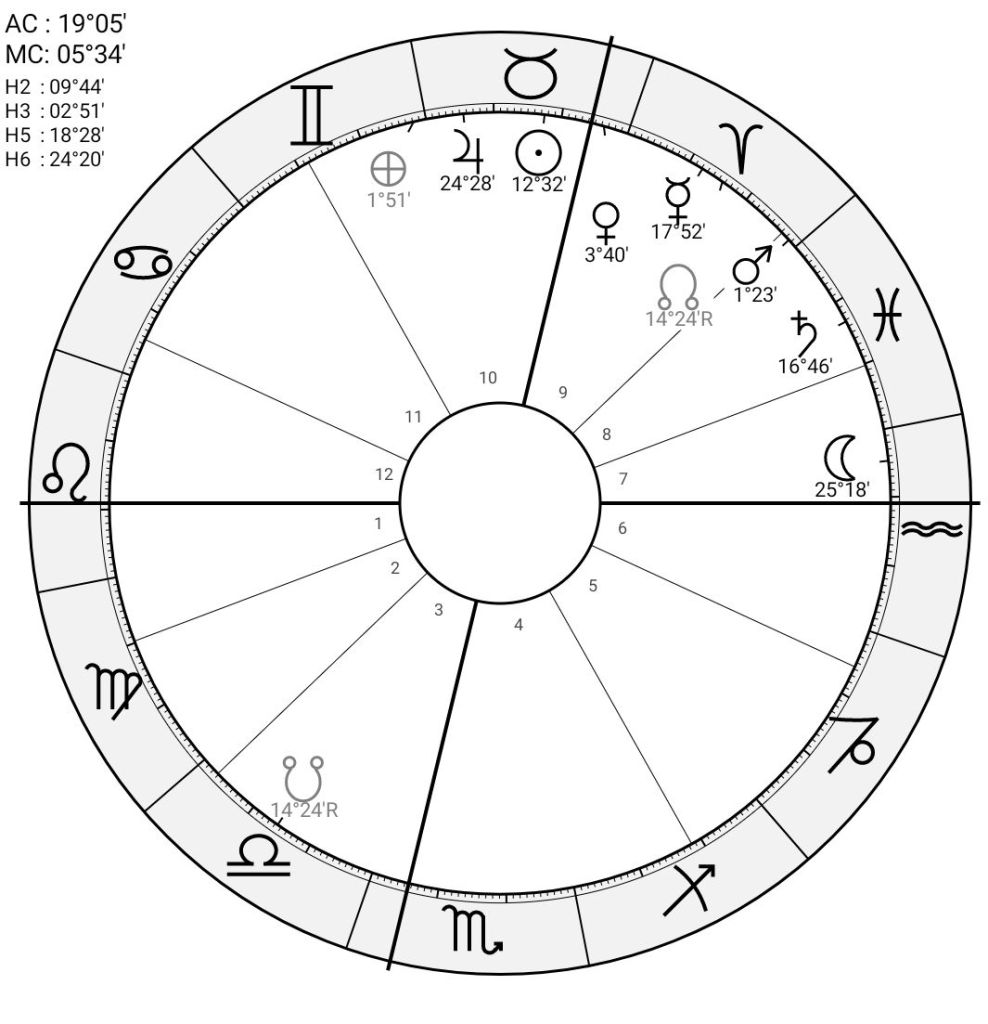
Here’s the horary chart (the time was 12:56)

Horary question: when will the veggies arrive? App used: Aquarius2go

Leo rises, so Leo’s ruler, the Sun, is my significator. The delivery service is our business partner, since we buy stuff from them and they bring it to us, so they are signified by the seventh house ruler Saturn (ruling planet of Aquarius). The veggies are their moveable possession, so they are indicated by the second house from the seventh, i.e., the eighth house, and its ruler Jupiter. The Moon is given to us as cosignificator and indicator of the flow of action.

Right off the bat we notice the Moon, weakly dignified in the seventh house, so action (obviously) starts from the delivery service. The Moon has separated from a square with reception with Jupiter, i.e., the veggies, and is now void of course. Clearly there are some problems (a square with reception is still a square). Still, there is a promising sextile (a positive aspect) between the Sun and Saturn, though it’s odd to see our significator applying to theirs (see the Outcome for why).

The Sun perfects the aspect at 17 degrees and 10 minutes of Taurus. The difference from its current position is of 4 degrees and 38 minutes, so they will come in 4 and 38 somethings. I would need to see serious testimonies to judge they won’t come. The Moon being void of course can delay them, but there is a clear aspect showing they’ll come. So they will come today, I thought.

Therefore, they will either come in 4 minutes and 38 seconds or in 4 hours and 38 minutes. I thought the second option was the most likely, so since the chart was cast at 12:56, and allowing some wiggle room for reality to follow astrology, I judged they’d come anywhere between 17.30 and 18, though I was somewhat skeptical, since this timing would have been unprecedented for them, and they’d told us they would come only a little bit later than usual. But at least this gave me plenty of time for my ritual.

Geomancy

After my ritual, which was timed for around 15 in the afternoon, I decided to have a look at what Geomancy had to say about this delivery:

Geomancy reading: veggie delivery service. App used: Simple Geomancy

The Geomantic court is positive, with the Judge Acquisitio showing we’ll get the veggies, but the Witnesses are mixed, showing problems. Albus is in the first, and it’s a good figure for commerce. A very unpromising Cauda Draconis is in the seventh house (which is also the left witness). I must say that I have seldom seen things resolved satisfactorily when Cauda is involved. However, Cauda does spring to the second house, perfecting. I was also relieved, but also a bit puzzled, to see Albus spring to the eighth, also perfecting the chart. Usually, the figure that moves makes the effort. In this case, it seems both of us will make some effort, and that our effort is better than theirs.

Outcome

They did come between 17.30 and 18 (around 17.45). However, they gave us the wrong delivery, which we only noticed when they’d already gone away. So we had to call them back and go meet them to exchange the wrong veggies for the right ones. Note how in the horary our significator applies to theirs and how, in the Geomantic chart, Albus moves to the eighth.

Lessons to be learned

1. Horary questions must not be idle, but they need not be life-changing. Knowing when a delivery service will arrive may seem idle curiosity, but I had a serious reason to want to know the answer (I take my magic work seriously)

2. The divination device, whatever it may be, ALWAYS knows best, though we may be fallible in interpreting it. People like to say that divination lets you contact your unconscious. I think there is altogether too much talk about the unconscious, and not enough talk about the superconscious. I saw from the Geomancy reading that there were problems connected with the delivery, though I could not pinpoint them exactly. In hindsight it is clear what the chart meant.

3. It is a humbling and inspiring experience to see how perfectly the cosmic mechanism works.

MQS

How Waite’s Contempt for the Minor Arcana Reinvented Tarot

I am old enough to remember a time when people did videos of tarot unboxings and would be shocked to discover that their deck had either unillustrated pips or different designs incompatible with the Rider-Waite-Smith tradition (which is not a tradition. I’ll come back to it)

In this regard, the average literacy of tarot enthusiasts has slightly increased in the last fifteen years or so. For whatever reason, people online still rave about the latest RWS clones, but they are also aware that the RWS is not THE tarot deck. It just happens to be a very popular variant.

As a matter of fact, its illustrated pips are probably the single major contributor to its success (it certainly wasn’t for Pamela Colman Smith’s talent or Waite’s approachable writing). Although the Waite deck is not the first to have illustrated minors (the the Sola Busca has this honor, and centuries later also the Tarot of the Master) it was the one which, after a couple of decades of obscurity between World Wars, accompanied the New Age-themed Tarot revival that lasts to this day.

The Waite deck essentially redifined tarot for decades as needing illustrated pips. People have come up with all sorts of fantastic interpretations of the most minute and inconsequential details found in the pips. We also have a relatively consolidated tradition that has nothing to do with Waite’s (or Smith’s) vision, such as for instance the Eight of Pentacles being the apprentice card, the Nine of Pentacles being basically the strong independent woman who don’t need no man card, the Seven of Swords as the thief card and so on.

This, I must confess, I find very amusing, considering Waite’s own attitude toward the minor arcana. Whoever takes the time to wade through Waite’s turgid prose quickly finds out that Waite couldn’t care less about the minor arcana in his deck (so much so that he had them almost completely eliminated from his later deck, the so-called Waite-Trinick)

Waite had been a member of the Golden Dawn, and as such he must have had to draw or color in his own deck at some point or another. He was instructed in the Golden Dawn system, wherein the pips (except the aces) are assigned to the decans of the zodiac (usually the Picatrix version) and given titles. So, for instance, the Two of Wands is the Lord of Dominion (and, lo and behold, the Two of Wands in the Waite deck has a lord observing his own dominion.)

All this is no secret, and has been discussed at length already. However, what is often not discussed enough is how scathing Waite’s attitude was toward both the Golden Dawn system and the minor arcana in general. He clearly believed that the Major Trumps were a separate, mystical device that had been merged with a regular playing deck with no meaning whatever. He certainly was intelligent enough to see that the Golden Dawn system was essentially made up and had no historical authenticity to it (though this is not to say one cannot work with it. Symbols are symbols.)

It is for this reason that he notoriously “spoon-fed” Smith the design of the Major Trumps. Because he deeply cared about them, or at least about his own interpretation of them. As far as the minor arcana are concerned, he generally had Smith follow the Golden Dawn system in illustrating the names of the pips.

This is clear when we read Waite’s interpretation of cards such as the Five of Pentacles, where the meaning of the Golden Dawn card (Lord of Material Trouble) cannot be harmonized with the other sources Waite draws from (such as Etteilla, for whom the Five of Coins is the Lovers card). That is, Waite seeks to find a harmony of the various meanings, but when this is impossible, he goes with the Golden Dawn variant, though not out of true conviction that the system is valid. He also very likely left Smith more creative freedom in decorating a bunch of cards he felt were useless distractions.

So what we have today is people finding meaning into something that never was intended to have much meaning in the first place. Surely it must be one of the great ironies of history that one of the most radical developments in the structure of the tarot, i.e., illustrated pips, came about not because the inventor cared about pip cards, but because he didn’t.

MQS

Peter of Abano’s Geomancy, Translated and Annotated / Index

Back to the Geomancy Page

My translation and comments on Pietro d’Abano’s Geomanzia. Please note that I am no professional translator of older texts and sometimes I had to paraphrase. Feel free to leave comments on how this project could be improved. Note that the translation and commentaries are copyrighted to me, so please ask for my permission before using it.

Introduction to Abano’s Geomancy – And why it makes for an interesting read

Book I
Part I – The Figures
Part II – The Chart
Part III – Meanings of the Figures
Part IV – Meanings of the Planets
Part V – The Witnesses, Judge and Sixteenth Figure
Part VI – Judging the Figures in the Houses

Book II
Part I – The First House and Second House
Part II – The Third and Fourth House
Part III – The Fifth House and Sixth House
Part IV – The Seventh House and Eighth House
Part V – The Ninth House and Tenth House
Part VI – The Eleventh House and Twelfth House
Part VII – Example of Various Dynamics
Part VIII – Geomantic Perfection

Book III
Part I – Geomantic Mutation
Part II – Acquisitio and Amissio in the various houses
Part III – Fortuna Major and Fortuna Minor in the various houses
Part IV – Laetitia and Tristitia in the various houses
Part V – Albus and Rubeus in the various houses
Part VI – Puella and Puer in the various houses
Part VII – Populus and Via in the various houses
Part VIII – Carcer and Conjunctio in the various houses
Part IX – Caput Draconis and Cauda Draconis in the vatious houses

Book IV
Part I – Acquisitio, Amissio, Major and Minor as they derive from other figures.
Part II – Via, Populus, Caput and Cauda as they derive from other figures.
Part III – Albus, Rubeus, Conjunctio and Carcer as they derive from other figures.
Part IV – Laetitia, Tristitia, Puella and Puer as they derive from other figures.

MQS

The Geomancy of Peter of Abano – Book I Pt. 1

Back to Index / Part 2

Here Abano introduces the subject matter and the names and main qualities of the sixteen figures.

Geomancy is a simple science to master. It employs the same methods of astrology to answer any question the person might have—whether what one wants to undertake will meet with success or not, according to natural virtue and celestial influence.1

This method of judging [questions] and receiving information avails itself of four figures made of ink points on a piece of paper by the Geomancer’s hand, which is moved by the heavenly influence of God’s eternal grace.2 As such, one must ask one’s question with sincerity and a pure soul.

From the initial four figures, sixteen are derived (and no more than sixteen) to answer any question the person might desire to know [the answer to]. However, not all the figures are necessary in answering a specific question. Only fifteen are, and they are enough to answer any question.3
These fifteen figures don’t always come up in the same way, but only as Heaven influences them to come up.4

These are the sixteen figures and their names:

Abano’s illustration of the sixteen figures with their latin name

Four figures are assigned to each quadrant of the Heaven (North, South, East, West) and to the four elements (Fire, Air, Water, Earth) as will become clear shortly. They are called fortunate or unfortunate.

Rubeus, Amissio, Fortuna Minor and Cauda are Fiery, that is, hot and dry, and of choleric complexion,5 southern, diurnal, masculine, strongly malicious, haughty and furious.6

Acquisitio, Laetitia, Conjunctio and Puer are airy, that is, hot and wet, of sanguine complexion, eastern, masculine and diurnal, very good and temperate, and good wherever they fall in the chart.7

Puella, Populus, Via and Albus are cold and wet, of phlegmatic complexion, northern, feminine and nocturnal. Generally fortunate and good where they fall in the chart.

Caput, Fortuna Maior, Tristitia and Carcer are earthy, that is, cold and dry, and of melancholic complexion, western, feminine, nocturnal. Two are good, Caput and Fortuna Maior, while two are bad, Tristitia and Carcer. They are slow and slothful in their meanings, but they cause what they promise nonetheless.

All the above is to be noted when a figure represents a person and another figure a different person, that we may know their character and how well they may get along.

The sixteen figures have yet another cycle of attributes that renders them positive or negative. Depending on whether they are mobile or fixed, we may know how soon or how late the effect will manifest, and how the situation shall be resolved according that they are entering or exiting or mixed.

Acquisitio, Fortuna Maior, Albus, Caput, Puella and Tristitia are entering, fixed, good and fortunate, except Tristitia, which is always bad.

Amissio, Fortuna Minor, Rubeus, Cauda, Puer and Laetitia are exiting, mobile, bad and malicious, except Letitia, which is always good.

Populus, Via, Conjunctio and Carcer are said to be common, that is, neither very quick nor very slow, and they are also neither too good nor too bad, though they tend to err on the side of goodness, except for Carcer, which is always evil.8

And yet another meaning must be added, which shows whether the people signified by the figures conform to one another in terms of will and soul, according that the figures are mobile, quick or slow, and according that they are single-bodied or accompanied [double-bodied].9

Acquisitio, Fortuna Maior, Puella, Caput, Tristitia and Albus are fixed, single-bodied and regular.

Amissio, Puer, Cauda, Letitia and Rubeus are mobile, half-bodied and diminished.10

Fortuna Minor, Carcer, Conjunctio, Via and Populus are common, that is, between mobile and fixed, and they are neither too quick nor too slow, and are double-bodied and accompanied, except for Via.

And in order that one may easily know the virtue and influence of the Heavens through the sixteen figures, we must also note their correlation with the twelve zodiac signs. Similarly, they are attributed to the seven heavenly planets, according to their influence on the twelve signs.

Abano’s illustration of the astrological attributes of the geomantic figures

However, each figure does not mean the same as the other [assigned to the same planet]. Each has a separate meaning. As such, Carcer is Saturn direct, Tristitia is Saturn retrograde; Acquisitio is Jupiter direct; Letitia is Jupiter retrograde; Rubeus is Mars direct, Puer is Mars retrograde;11 Fortuna Maior is the Sun when elevated, Fortuna Minor is the Sun when depressed and obscured; Puella is Venus direct, Amissio is Venus retrograde; Albus is Mercury direct, Conjunctio is Mercury retrograde; Populus is the waxing Moon, Via the waning Moon. Consequently, the direct signs are better than the retrograde. Furthermore, Caput is attributed to Jupiter and Venus, Cauda to Saturn and Mars.12 But this is not always the case, but rather depends on the question asked.

MQS

Footnotes
  1. The concept of natural virtue underpins the Western magical worldview. The word ‘virtue’ must not be understood in a moral sense, but rather in the sense of ‘property’ or ‘power’. It forms part of the Hermetic doctrine of Signatures. The virtues of the things under the Heavens are generally seen as corresponding to certain celestial factors. ↩︎
  2. This is a rather typical phrasing found in various premodern handbooks. It is connected with the Christian Aristotelean worldview prevalent at the time, whereby God, the unmoved mover, ruled the world not directly, but through a series of concentric spheres, each one corresponding to a planet, except the sphere of the fixed stars and that of the primum mobile. ↩︎
  3. The sixteenth figure is what is commonly referred to as the Judge of the Judge, formed by the Judge plus the first Mother. ↩︎
  4. In other words, they are ‘random’. ↩︎
  5. The word ‘complexion’ is used in a slightly different way from today. It refers to the theory of the four humors (black bile, yellow bile, blood and phlegm). These humors influenced not just the character, but also, up to a point, the appearance of the subject as well as their being prone to this or that illness. ↩︎
  6. Abano seems to include Fortuna Minor among the malicious figures, though later in the text he treats it as generally positive. ↩︎
  7. Abano however does not always treat Puer as a positive figure. ↩︎
  8. In all this section Abano seems to be painting with a very broad brush, talking of the figures as “always good” or “always bad”. Of course things get more complicated. ↩︎
  9. This is borrowed, as so much in geomancy, from astrological practice, where the mutable signs (Gemini, Virgo, Pisces and Sagittarius) are also called double-bodied. Double-bodied signs, and therefore geomantic figures, can indicate the involvement of more than one person. ↩︎
  10. The concept of half-bodied does not, to the best of my current knowledge, come from astrology, but I may be wrong. ↩︎
  11. This seems prima facie counterintuitive, as a retrograde planet is generally considered worse than a direct one, and Puer is generally not considered worse than Rubeus. ↩︎
  12. This is in accordance with the relatively standard Medieval practice of attributing the North Node of the Moon to the two benefics, Jupiter and Venus, and the South Node to the two malefics, Saturn and Mars. This practice developed over time and does not seem to originate in older astrology of the Hellenistic period, when both nodes appear to have been considered more or less malefic, when considered at all. ↩︎

The Shield Chart is the Only Chart

One of the things newcomers to Geomancy learn first is the distinction between shield chart and astrological chart. This distinction has been popularized by Greer in his two books on Geomancy, but it doesn’t originate with him, though he is, to my limited knowledge, the first to insinuate that the shield chart is a beginner’s tool and the astrological chart a more advanced one (his attitude changes in his Golden Dawn writings, where he tries to purge astrology from geomancy and render the shield chart autonomous).

Agrippa (followed centuries later by the Golden Dawn) clearly has the astrological chart in mind, since he advocates putting the four Mothers in the four angles, the four Daughters in the four succedent houses and the four Nieces in the four cadent houses. This idea can only come to mind to someone who primarily uses the astrological square chart, or at least pictures the geomantic reading in those terms.

There are other authors, however, like Cattan, Abano and Alfakini (note that some attribute Alfakini’s work, found in the Fasciculus Geomanticus, to Gerard of Cremona) who clearly think of geomantic practice in terms of the shield chart alone. Not because they are unaware of the possible correspondence with the astrological houses, which all employ, nor because they never attempt to draw the square astrological chart (Christopher Cattan does it in the first part of his book), but because it is clear to them that the twelve astrological houses are meant as a technique to be used to draw meaning out of the shield chart and not as a new or different way of doing geomancy.

This can be seen from the fact that both Abano and Alfakini (and possibly also Cattan, but I have to study his text more closely) clearly consider the twelfth house NOT to be contiguous to the first, as it would be in the square chart. On the other hand, both consider the ninth house, which in an astrological square chart would have no relation to the first, to be contiguous to the first, just because in a shield chart it belongs to the same triplicity as the first and is close to it (see below)

Shield chart in Geomancy, with first and ninth house connected. App used: Simple Geomancy

In this chart, Puer in the first is close to Cauda in the ninth, but not to Puella in the twelfth.

This new way of looking at the chart is also making me reevaluate the doctrine of the company of houses, which I have somewhat disparaged in a previous article, and it might even shed light on the strange doctrine of the triplicities, which Greer makes much of but which is barely present in the old texts except in an apparently purely decorative sense. I will need to read the texts more closely and experiment.

What seems clear to me though is that there was never meant to be an astrological square chart, for many authors of the Medieval tradition, but rather merely an astrological lens in looking at the shield chart.

MQS