Category Archives: Divination

Tarot Encyclopedia – The Three of Pentacles or Coins

(Note: this is a collection of the meanings attributed to the cards by some occultists in the past centuries. It does not reflect my own study or opinion of the cards. It is only meant as a quick comparative reference as I develop my own take.)

The Three of Pentacles from the Builders of the Adytum (BOTA) deck

Paul Foster Case (and Ann Davies)

The time period is the second decanate of Capricorn, under the rulership of Venus, from January 1 to January 9.
Well-Dignified: construction; increase, growth; financial gain; the building up of favorable conditions; gain in commercial transactions; rank or prestige in vocation or business; beginning of matters to be perfected later.
Ill-Dignified: selfishness; cleverness in business, but lack of scruples;
narrowness and prejudice; too much ambition.
Keyword: Constructiveness.
(From the Oracle of Tarot course)

A. E. Waite

A sculptor at his work in a monastery. Compare the design which illustrates the Eight of Pentacles. The apprentice or amateur therein has received his reward and is now at work in earnest. Divinatory MeaningsMétier, trade, skilled labour; usually, however, regarded as a card of nobility, aristocracy, renown, glory. Reversed: Mediocrity, in work and otherwise, puerility, pettiness, weakness.
(From The Pictorial Key to the Tarot)

Aleister Crowley

The Three of Pentacles, in a similar manner, exhibits the result of the idea of Earth, of the crystallization of forces; and so the Three of Pentacles is called the Lord of Work. Something has definitely been done.

[…]

The influence of Binah in the sphere of Earth shows the material establishment of the idea of the Universe, the determination of its basic form. It is ruled by Mars in Capricornus; he is exalted in that Sign, and therefore at his best. His energy is constructive, like that of the builder or engineer. The card represents a pyramid viewed from above the apex. The base is formed by three wheels-Mercury, Sulphur, and Salt; Sattvas, Rajas, and Tamas in the Hindu system; Aleph, Shin, and Mem-Air, Fire, and Water-the three Mother letters of the Hebrew alphabet.

This pyramid is situated in the great Sea of Binah in the Night of Time, but the sea is solidified; hence the colours of the back-ground are mottled, a cold thin dark grey with a pattern of indigo and green. The sides of the pyramid have a strong reddish tint, showing the influence of Mars.
(From The Book of Thoth)

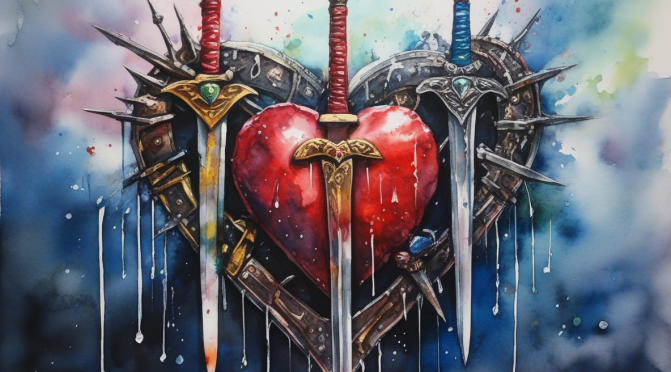
AI-generated illustration for the Three of Pentacles or Coins

Golden Dawn’s Book T

A WHITE-WINGED Angelic Hand, as before, holding a branch of a rose tree, of which two white rosebuds touch and surmount the topmost Pentacle. The Pentacles are arranged in an equilateral triangle. Above and below the symbols Mars and Capricorn.
Working and constructive force, building up, creation, erection; realization and increase of material things; gain in commercial transactions, rank; increase of substance, influence, cleverness in business, selfishness. Commencement of matters to be established later. Narrow and prejudiced. Keen in matters of gain; sometimes given to seeking after impossibilities.
Binah of HB:H (Business, paid employment, commercial transaction).
Herein are HB:YChVYH and HB:LHChYH Angelic Rulers.

Etteilla

Important
Upright. This card, as far as the medicine of the spirit is concerned, means, in its natural position: Noble, Considerable, Famous, Important, Great, Major, Extended, Vast, Sublime, Renowned, Famous, Powerful, Elevated, Illustrious. – Excellence, Consideration, Greatness of mind, Nobility of conduct, Generous deeds, Magnificently, Splendidly.
Reversed. Puerility, Childhood, Infantilism, Frivolity. – Weakening, Lowering, Diminishing, Education, Modicity, Mediocrity, Minuity, Inezia, Frivolity, Lowness, Vileness, Poltrony, Rampant, Small, Puerile, Petty, Low, Servile, Vile, Abject, Humble. – Abjection, Humility, Humiliation.

MQS
A World of Odd Coincidences

Yesterday I was cleaning in my office. I took my playing card deck (the one I use for divination) and was about to put it on the windowsill to dust my desktop, when it fell to the floor and the cards went flying in all directions.

So I gathered the cards without thinking anything of it and went on with my day. Later on I realized that one of the cards was the wrong way around: the Six of Spades, the sickness card.

Around an hour later my husband was on the phone with my mother-in-law, when she suddenly started slurring her words and being unable to move one side of her face. Fearing a stroke, we immediately called an ambulance and they were there a few minutes later.

We are still not sure what it was, but it was thankfully gone. She seems to be doing fine now, but the paramedics told her to remain in contact in case the situation presents itself again.

It is a good thing that we were on the phone with her when it happened, and I find the way the cards forewarned me endlessly fascinating, though I didn’t put two and two together until after the fact.

MQS

Regina Russell’s Answer Spread (with Example Reading)

The Answer Spread was popularized by Regina Russell in her Card Reader’s Handbook.1 Here, Russell details a system of fortune-telling by playing cards that is different from mine, but still quite interesting as a reference. She also gives examples of some spread layouts, including a small one to answer specific question.

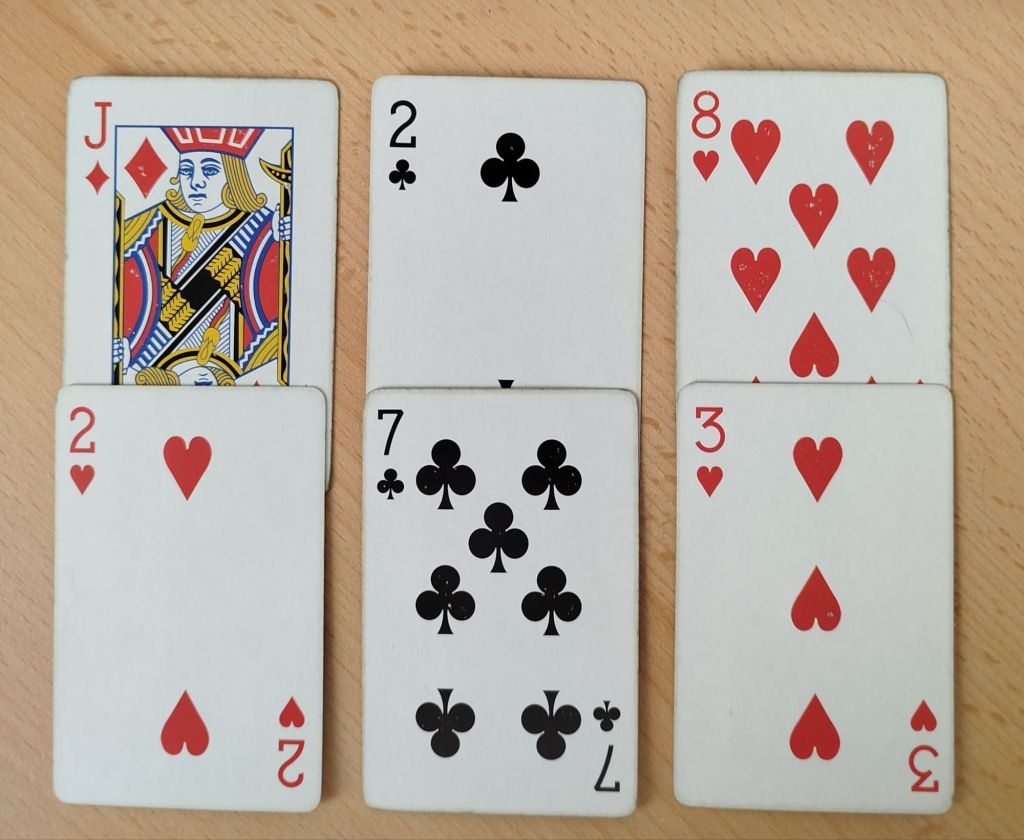
I have rarely used this spread, but I added it to my repertoire just for variety, and I have found it to be quite reliable. You’ll need to shuffle or have the querent shuffle the deck after formulating a clear question. Then, have the querent take out six cards from the fanned out deck (or pull them yourself, if you’re doing a phone reading). Lay the cards out in this order

123
456
Layout for Regina Russell’s Answer Spread

Russell explains that the cards are read exclusively in columns (1-4, 2-5, 3-6). Each column has a different meaning: the first (1-4) indicates the background of the question or the current situation; the second (2-5) answers the question; the third (3-6) adds information about the answer. The sixth card can on occasion be of special importance and may contain the answer or some information on which everything hinges, but I have generally found this not to be the case.

As you may have guessed, this is a very short spread to receive information quickly. Here is an example from the recent past with my husband as a guinea pig: his birthday was approaching and he wanted to know relatives would drop by unannounced to celebrate. These were the cards (note that I am not using Russell’s meanings, but those I am familiar with):

Will there be a surprise visit? Regina Russell’s Answer Spread

Since the question is so specific, you have the right to wonder why he thought they would throw him a surprise party. If we look at the column on the left, the one that talks about background information, we have the Jack of Diamonds and the Two of Hearts, an exciting message or a message from relatives. I didn’t know this at the time of hubby pulling the cards, but in talking to his family on his family chatgroup there had been odd remarks that had made him suspect something was being prepared. So this is the background information we need to understand the spread.

The answer, however, is somewhat disappointing. There are steps (Two of Clubs) being taken, so something is indeed being organized, but the Seven of Clubs causes trouble.

If we look at the right column, where additional information is found, we see a party (Eight of Hearts) and a gift (Three of Hearts). If these two cards had been in the center column, the answer would have been positive. As it stands though, these cards merely explains what steps had were being taken. So the answer is no, they won’t come on the day of his birthday.

It turned out that they did not come, though his brother would have liked to and was making plans for, because his mother was still recovering from a minor operation she’d had: this is the problem (Seven of Clubs). However, looking at this spread, I wouldn’t be surprised if a little celebration did take place next time we get together.

MQS

  1. Which you may buy here if interested. I’m not affiliated with them, I just think the book is a good reference to have. ↩︎

The Geomancy of Peter of Abano – Book IV Pt. 1

Previous / Back to Index / Next

Here Abano begins a discussion of how the genesis of each of the figures from other two figures can modify their meaning.

Since one is not only supposed to consider the springing of the figures from one place to the other, but also their origin and generation one from the other,1 an esposition of of the meanings of each of the figure depending on the figures it is born from is in order, without forgetting the inherent meaning of the figure, as well as that of the querent’s and quesited’s, and those figures in the angles, and those conjoined to them.

Acquisitio

From Populus and Acquisitio: recovering one’s losses or recovery from damage; gain, profitable journey.
From Amissio and Via: dishonorable journey, but useful, recovering something lost.
From Fortuna Major and Conjunctio: good luck, mediocre gain, and [it is positive for] the thing asked.
From Fortuna Minor and Carcer: love between husband and wife,2 and [it is good for] the thing asked.
From Puella and Cauda Draconis: gain, usefulness in things of merchandise, and gain from difficulties.

From Puer and Laetitia: gain from minerals, gain from merchandise.
From Tristitia and Rubeus: fortitude, stability in everything, good outcome, victory, loss of merchandise.
From Conjunctio and Fortuna Major: good luck, mediocre gain.
From Carcer and Fortuna Minor: usefulness; kings and lords, noble people.
From Albus and Caput Draconis: good luck in material things, loss of objects.

Amissio

From Populus and Amissio: loss, trouble, good luck for the ill and the imprisoned, good for traveling.
From Acquisitio and Via: damage, trouble, loss, the lost or stolen thing is not found, vain friends or servants.
From Carcer and Fortuna Major: trouble, problems, little gain.
From Caput Draconis and Puer: good luck in things connected with women; in other questions, gaining what one wants results in damage.
From Rubeus and Cauda Draconis: misfortune [or accident], injury, fear, fighting, trouble, damage, illness.

From Conjunctio and Fortuna Minor: loss of animals, lots of trouble, desperation for the thing lost.
From Albus and Laetitia: freedom from illness or prison, the absent party will come back, white clothes, mobile things, quick ending.
From Puella and Tristitia: poverty, vile things, trouble due to secrets, desperation, mirth, luck in debauched things.
From Fortuna Major and Carcer: recovering the lost or stolen thing.3

Fortuna Maior

From Populus and Fortuna Maior: luck in everything, getting what one wishes to get, but with delay.
From Carcer and Amissio: being very lucky and obtaining what one wants, but with difficulties.
From Albus and Tristitia: it means good news, messenger, usefulness, dignity, good salary [remuneration].
From Caput Draconis and Rubeus: great accident or misfortune, hanging, health problems, violent death.

From Amissio and Carcer: accident, problems, prison, good ending but with difficulties.
From Fortuna Minor and Via: fighting, good news, quick dispatch, honorable journeys.
From Acquisitio and Conjunctio: good fortune, prosperity, getting one’s wish.
From Puer and Cauda: good fortune, tranquillity after much trouble, getting one’s wish with much delay.
From Puella and Laetitia: mediocrity in everything, good things.

Fortuna Minor

From Populus and Fortuna Minor: its meaning has more virtue in good as in bad depending on the question.
From Acquisitio and Carcer: stability, certainty, mediocre fortune.
From Amissio and Conjunctio: good but mediocre fortune, especially in mobile things, less in stable things.
From Fortuna Major and Via: great virtue, great good fortune.

From Caput and Puella: good luck, especially in friendship and marriage.
From Albus and Cauda Draconi: mediocre good luck, especially in feminine things.
From Laetitia and Rubeus: very noble things, luck in mobile, outgoing things.
From Puer and Tristitia: mediocrity, but more bad and mutable than otherwise.

MQS

Footnotes
  1. This seems to imply that we must consider how the figures are generated on the shield. Whether this applies only to the Judge is not clear, though Abano seems to hint at the need to consider all figures, since he also considers those that cannot be Judge. ↩︎
  2. Admittedly, some of these explanations are hard to follow. I do not know, for instance, why this combination should indicate positive things between husband and wife. ↩︎
  3. Abano does not present all possible combinations. It is not clear whether he forgot or he thought it was enough to give some examples. Note also that some explanation almost seem contrary to reason. ↩︎

Vera Sibilla Cards Connected With Work

In the Vera Sibilla there are a couple of cards that connect more or less directly to the topic of work. Here we review them quickly to show their similarities and differences. As usual, this isn’t meant to be exclusive.

Six of Hearts – Money

Not directly related to work per se, the Six of Hearts is the money card, and as such it shows where money comes from, where it goes, whether one has it or not, etc. However, in a consultation about work, it can also indicate whether the pay is good or not, whether the business one works for flourishes or not, etc.

Seven of Hearts – The Scholar

This card is always welcome when we want to know whether we’ll get a job, as it can show the signing of a contract. It is also related to talent in one’s field, as well as certain types of job (intellectual or desk jobs).

Ace of Clubs – Marriage

Again a card that can represent the signing of something. Marriage is anything that gives us rights and obligations with respect to someone else, and a job contract is exactly that. It is also an important card for business deals and partnerships

Six of Clubs – The Surprise

This is a small money card, but because it represents money being received, it can symbolize the wages and therefore being employed. For instance, together with the House card it can sometimes represent the place where you gain money, i.e. the workplace.

Seven of Clubs – Realization

The Seven of Clubs is the card of worldly ambition and it can therefore stand for the querent’s career (I’m always reminded that in German the word Beruf, work, comes from the word Ruf, fame, the name you make for yourself in the world).

Eight of Diamonds – The Handmaid

This is another card that is strongly connected with money and where it comes from and where goes toward, but it is also a card of employment (a handmaid works for someone else). When it signifies the querent’s work, it is essentially a synonym of the Merchant card.

King of Diamonds – The Merchant

This is THE work card, the one you usually want to see in a question about work, and four times out of five, when it pops up in a different kind of question it still indicates the influence of the querent’s job on question, though the card also has other less common meanings.

King of Spades – The Priest

Not directly related to the querent’s job, but this card can represent the institution or company the querent works for (especially if it is relatively big). Needless to say it can stand for many other things, such as works related with the law or religion (with specific cards) or even works where one wears a uniform (the Soldier also represents a uniform, but usually it shows less socially important types of employment, such as being a builder).

MQS

Tarot Encyclopedia – The Three of Swords

(Note: this is a collection of the meanings attributed to the cards by some occultists in the past centuries. It does not reflect my own study or opinion of the cards. It is only meant as a quick comparative reference as I develop my own take.)

The Three of Swords from the Builders of the Adytum (BOTA) tarot deck

Paul Foster Case (and Ann Davies)

The time period is the second decanate of Libra, under the combined rulership of Saturn and Uranus, October 3 to October 12. Because Libra is involved, remember that the qualities of the Seventh house are prominent.
Well-Dignified: this is nevertheless a Key depicting sorrow, disappointment and tears, but it can be the beginning of deep understanding as to the basis and cause of our problems; disruption of friendship; interruption of cherished projects; quarrels; occasionally the position in the layout may indicate platonic friendships; in money matters this card is almost always a symbol of loss, but indicates that whatever money matters are under consideration have been fair and honest, so that no blame attaches to anyone for the loss.
Ill-Dignified: slander; selfishness and dissipation; deceit with respect to promises; loss in legal affairs.
Keyword: Sorrow
(From the Oracle of Tarot course)

A. E. Waite

Three swords piercing a heart; cloud and rain behind. Divinatory Meanings: Removal, absence, delay, division, rupture, dispersion, and all that the design signifies naturally, being too simple and obvious to call for specific enumeration. Reversed: Mental alienation, error, loss, distraction, disorder, confusion.
(From The Pictorial Key to the Tarot)

Aleister Crowley

The idea of division, of mutability, the idea of the airy quality of things, manifests itself in the Three of Swords, the Lord of Sorrow. Here one is reminded of the darkness of Binah, of the mourning of Isis; but this is not any vulgar sorrow dependent upon any individual disappointment or discontent. It is Weltschmerz, the universal sorrow; it is the quality of melancholy.

[…]

Binah, the Great Mother, here rules the realm of Air. This fact involves an extremely difficult doctrine which must be studied at length in The Vision and the Voice: Aethyr 14.
Binah is here not the beneficent Mother completing the Trinity with Kether and Chokmah. She represents the darkness of the Great Sea.
This is accentuated by the Celestial Lordship of Saturn in Libra.
This card is dark and heavy; it is, so to speak, the womb of Chaos. There is an intense lurking passion to create, but its children are monsters. This may mean the supreme transcendence of the natural order. Secrecy is here, and Perversion.
The symbol represents the great Sword of the Magician, point uppermost; it cuts the junction of two short curved swords. The impact has destroyed the rose. In the background, storm broods under implacable night.
(From The Book of Thoth)

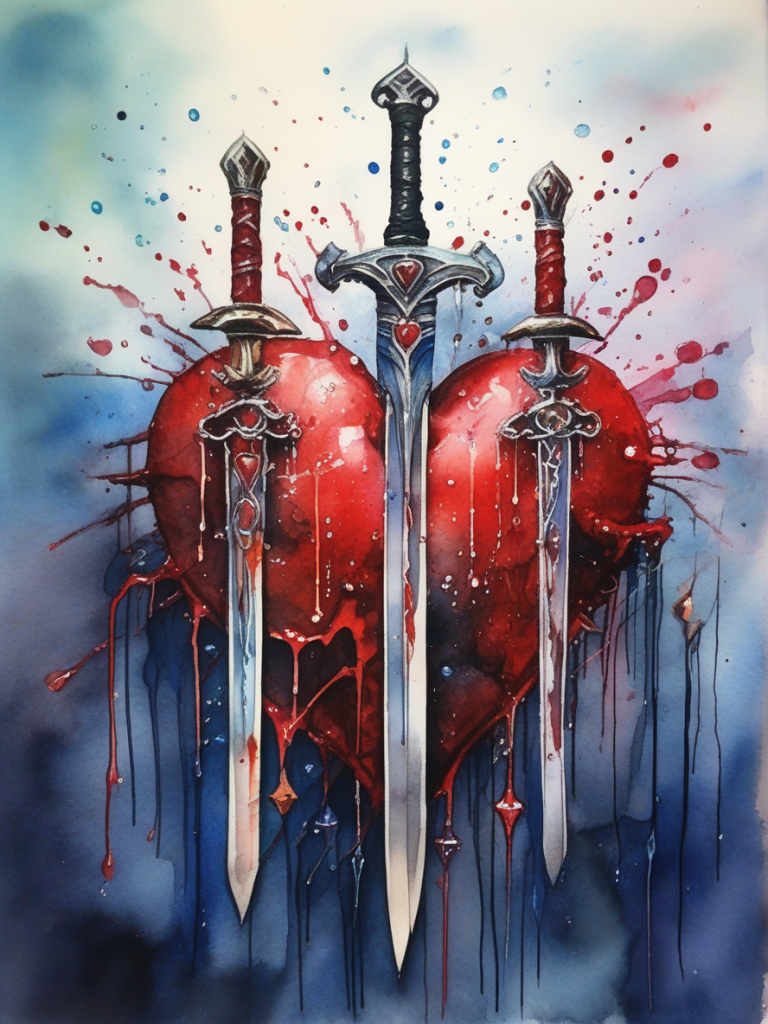
A gruesome AI-generated illustration for the Three of Swords

Golden Dawn’s Book T

THREE White Radiating Angelic Hands, issuing from clouds, and holding three swords upright (as though the central sword had struck apart the two others, which were crossed in the preceding symbol): the central sword cuts asunder the rose of five petals, which in the previous symbol grew at the junction of the swords; its petals are falling, and no white rays issue from it. Above and below the central sword are the symbols of Saturn and Libra.

Disruption, interruption, separation, quarrelling; sowing of discord and strife, mischief-making, sorrow and tears; yet mirth in Platonic pleasures; singing, faithfulness in promises, honesty in money transactions, selfish and dissipated, yet sometimes generous: deceitful in words and repetitions; the whole according to dignity.
Binah of HB:V (Unhappiness, sorrow, and tears).
Herein rule the Great Angels HB:HRYAL and HB:HQMYH as Lords of the Decan.

Etteilla

Removal
Upright. This card, as far as the medicine of the spirit is concerned, means, in its natural position: estrangement, Departure, Absence, Discarding, Dispersion, Remoteness, Delay. – Contempt, Repugnance, Aversion, Hatred, Disgust, Horror. – Incompatibility, Contrariness, Opposition, Unsociability, Misanthropy, Incivility. – Separation, Division, Breaking, Antipathy, Section, Cutting off.
Reversed. Misdirection, Dementia, Vanity, Alienation of spirit, Distraction, Insane conduct. – Error, Miscalculation, Loss, Deviation, Discard, Dispersion.

MQS

Answering Airy-Fairy Questions… Meaningfully (Example Reading)

As someone who advocates a grounded approach to divination, you’d expect me to scoff at questions that deal with more philosophical or spiritual themes. But this is not so. Airy-fairy is in the eye of the beholder, or rather, of the reader. Just like many airy-fairy readers can drown concrete topics in a deluge of commonplace spiritual-but-not-religious buzzwords, so can a grounded reader approach complex, ‘soulful’ topics from a grounded standpoint, while always following what the oracle says.

Someone asked me what was the goal of her current incarnation. Right off the bat we are confronted with a dilemma: firstly, the question presupposes that there is such a thing as reincarnation, which I don’t believe (at least, not in a sense that is compatible with what most people think of as reincarnation);1 secondly, it presupposes that this happens with a goal.

The first problem (reincarnation) we may circumvent by simply asking what’s the goal of the querent’s life. The second question (the goal) is trickier, but as I show in the example, it is not unanswerable.

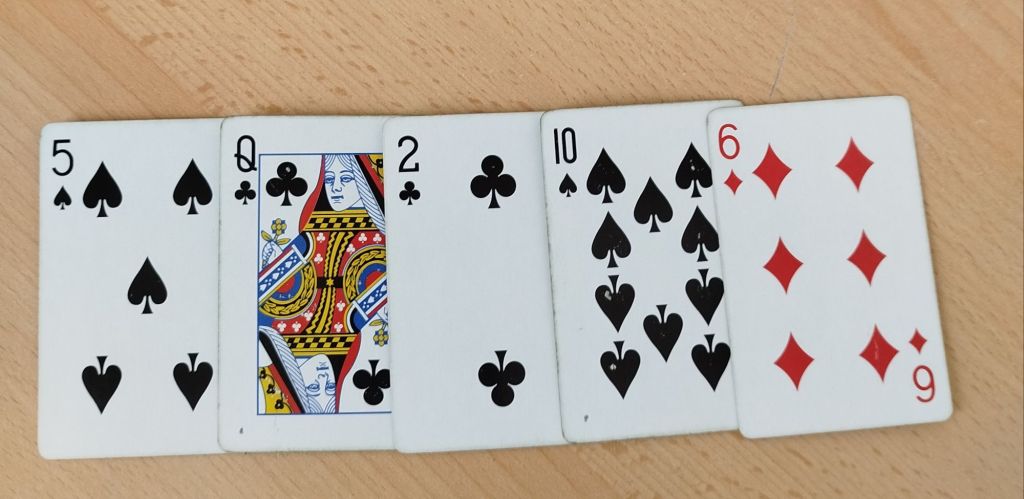
What is my life’s goal? Playing card divination

Since we have absolutely nothing to go off on, we can start by noting that the querent’s significator shows up (the Queen of Clubs), though not in a very good spot. She comes after the Five of Spades which is the card of sacrifice, imprisonment and the inability to move. So we can already sort of guess that the querent is feeling trapped in some form or another.

The spread ends with the Six of Diamonds, which represents worry, insecurity and the like. Often it shows financial problems, but not necessarily: it can be a card of general nervousness and uncertainty. The spread is now starting to reek of psychological hang-ups.

Usually, the Two of Clubs after a person card indicates the person taking steps. Toward what? Toward the Ten of Spades. This is the card of secrets, of the night and of unknown situations.

At this point I asked the querent if she’s someone who never leaps into unclear, unknown situations. She said that that was one of the things keeping her from enjoying life, since she always prefers to avoid risk or put off taking it until she feels prepared, which is never.

Bingo. This is the answer: she must learn to step into the dark, take risks and be ok with not having everything figured out. She must learn to swim by swimming rather than by reading up on how to swim. If she doesn’t do it, she will spend her whole life by the poolside waiting for every condition to be perfect.

So, have the cards talked about the purpose of the querent’s whole life? You may disagree with me, but I don’t think so. I do not think that this is the purpose of her whole life (I think there is much, much more to anyone’s life), nor do I think that this is the reason she was born or has reincarnated (if you believe in reincarnation at all). And I told the querent as much, in the spirit of transparency.

What I do mean is that, at least at this juncture in her life, this is a recurring pattern that weighs her down and that needs addressing because it influences her general quality of life. That’s already enough to be worth being mentioned by the cards.

Ultimately, almost every airy-fairy woo woo question is the voluntary or involuntary corruption and modernization of some kind of longing that is deeply seated in the human soul. Questions about the purpose of one’s life may be often answered with the usual mix of mind body spirit platitudes, but the human desire for purpose is not to be lightly dismissed, whether the purpose is really there or not. And divination can address this desire in some form or another.

I believe that divination should be able to run the whole gamut of the human experience, from the most concrete questions to the most abstract, because this is the extension of the human soul. The problem arises only when we try to reduce one order of problems (Will I the chicken cross the street?) to another order of problems (What kind of psychospiritual drama do you think caused the chicken to want to cross the street?)

MQS

  1. I will probably discuss it more at length in another section, but my belief is that there is only one, universal soul that is constantly incarnating and reincarnating through everything. ↩︎

The Geomancy of Peter of Abano – Book III Pt. 9

Previous / Back to Index / Next

Here Abano talks about the meanings of Caput Draconis and Cauda Draconis in the various houses.

Caput Draconis (The Dragon’s Head or North Moon Node)

Caput Draconis in the first house means good luck, noble people, wise people, leaders, captains, honor, dignity, a prelate.1
In the second it means good success, gaining wealth or dignity or money.
In the third it means noble brothers and sisters, lucky siblings, good through them, isolated gardens2, pleasures.

In the fourth it means good for the parents, inheritance, buildings, cities, citizens, noble people, good end to an issue.
In the fifth it means science, good children, gain and help through them.
In the sixth it means good servants, faithful servants, good officials, grave infirmity, melancholic infirmity,3 long fevers.

In the seventh it means honorable women, good marriage, good company, gain from noble people or from women and thanks to them.
In the eighth it means inheritance, goods gain from the dead, usefulness through women and noble people, gain through war and by violence against life, being beheaded.4
In the ninth it means honoring God, ecclesiastical dignity, religious people, noble people, good journeys, delay in coming back but with good results, a messenger with bad news, messenger bearing news of legal issues, ingeniousness in a noble science.

In the tenth it means the king, the emperor, the lord, a magistrate, dignity, honor, good regents and orators, noble people.
In the eleventh it means noble soldiers, captains, dignity, sublimation5, succeeding one’s lord, faithfulness, valor, good luck.
In the twelfth it means noble inheritance through the mother, honorable things for [or through] women, few enemies, weak enemies, certainty, fame.

In the thirteenth it means journeys, messengers, a king, lords, usefulness, gain, honor, dignity, friendship and good recoglientia.6
In the fourteenth it means coming back from a journey with dignity and mirth and gain, letters, positive answer, honors, dignity, usefulness.
In the fifteenth it means a good end to the question and strong hope.7

Cauda Draconis (The Dragon’s Tail or South Moon Node)

Cauda draconis in the first house means evil disposition of the querent or of the quesited, fear of death, being murdered.8
In the second it means wealth gain through illicit means, theft, violence.
In the third it means iniquity against siblings and relatives, remains, retaliations, killings on the streets.

In the fourth it means loss of inheritance, evil lands, evil people, betrayals, false rumors, destruction of a city or fortress.
In the fifth it means evil children or women, loss of children, danger during childbirth, loss of blood.
In the sixth it means evil servants, runaways, grave illness, bodily fluids, killing, desperation, damage.

In the seventh it means a harlot, vile marriage, evil company, unfaithfulness, betrayal, violence, enmity.
In the eighth it means fear of death for [or through] women, rumors, freedom from prison and from illness, loss through women, being killed, loss of blood and flobotomia.9
In the ninth it means being forced on a journey, loss, danger of death, toil, changing one’s religion, evil or false religious people, evil Christians,10 evil messengers, death during a journey.

In the tenth it means an evil lord, traitors of one’s country, iniquitous judges or orators, overthrowing tyrants, loss of dignity, destruction of one’s kingdom.
In the eleventh it means wrongful succession, betrayal, violence, rebellion, death of one’s lord.
In the twelfth it means hidden enemies of the kingdom, machinations, treason against one’s lord, assassinations both public and private, violence.

In the thirteenth it means betrayals during a journey, hate from noble people, the absent party doesn’t come back.
In the fourteenth it means toiling for gain and honor, bad luck, hatred from underlings and very evil enemies, overcoming one’s enemies,.
In the fifteenth it is the worst of all, eccept for doing evil things.11

MQS

Footnotes
  1. Possibly due to the Moon’s North Node connection with beginnings and with increase, as well as the connection of the term ‘head’ with leadership. ↩︎
  2. The text seems to say “giardini solati”, and I am not sure if it means isolated gardens or gardens in the sun or something else that escapes me. The connection with gardens is clear, as the Third House rules neighborhoods and therefore what’s around the house. ↩︎
  3. Illnessess were traditionally categorized based on the prevailing humor. ↩︎
  4. This is another excellent example of how to read the meaning of the figure into the meaning of the house. Caput Draconis is the head, and the Eighth House rules death, thus giving beheading (death by losing one’s head). Of course much depends on the question and the rest of the Shield. ↩︎
  5. This is not clear. ↩︎
  6. An archaic Italian word of whose meaning I am unaware. ↩︎
  7. Caput cannot be the Judge. ↩︎
  8. It is usually said that Cauda being in the First House is enough to break the figure. However, here Abano gives us coherent interpretations. Most of them are very dramatic, but it’s the principle that counts and needs to be assimilated. ↩︎
  9. A term belonging to the vocabulary of Medieval medicine. I do not know what it means. ↩︎
  10. Probably to be interpreted as evil believers in general, nowadays. ↩︎
  11. Cauda cannot be the Judge. ↩︎

Is He Coming Back? Example Reading

This is a super-quick reading I did for a friend of a friend. She doesn’t believe in the cards, which is fine, but decided to try them by asking a silly question. She asked if her ex would come back to her. Here are the cards:

K♣️ 3♣️ 10♥️

On the surface of it, the cards seem positive: they show the man she’s asking about, they show a union (the Three of Clubs) and they show happiness (the Ten of Hearts).

Unfortunately, what the cards seem to be saying is that he has a marriage going on, and he is happy in it. When I told the querent, she confirmed that they haven’t spoken in years and he is married and has children.

This is not the first time someone asks me a fake question, either purposefully or out of self-delusion, and it is not rare for people to ask about old sweethearts who have moved on.

It goes without saying that we, as diviners, must always come to terms with our finitude and fallibility, but the more the querent is deluded or insincere, the harder it becomes to interpret the cards. This time I was doubtlessly lucky that the cards came up very clear.

NOTE: if the querent had told me that the man she was asking about is not married, then I would have asked if they had just broken up. In this case, the spread would have probably meant that their relationship was still going on strong, and that the break-up was something so fleeting the cards didn’t feel the need to describe it.

MQS

The Many Ways of Reading the I Ching

The I Ching (usually translated as Classic of Changes) is primarily known to the West as an oracular book in which people look up answers to their questions after casting a Hexagram. In reality, the I Ching (or Yi Jing, following the newer transliteration) permeates traditional Chinese culture much more thoroughly and its symbols are found in many methods of divination. Here are the most common ones (the list is not meant to be exclusive and it is limited by my ignorance, no doubt).

Zhou Yi (Reading Commentaries)

Zhou Yi means ‘the changes of the Zhou [dynasty]’ and refers to the oracular text we and Legge, Wilhelm, Jung, Philip K. Dick, Aleister Crowley, Ursula Le Guin etc. knew. This is what we usually mean when we cast an I Ching reading in the West (and also in much of the Eastern world).

We flip coins or manipulate yarrow stalks or pick up small handfuls of rice, depending on the method, in order to obtain a symbol made up of six lines that may change or remain stable (solid). The changing lines are then flipped to their opposite (yin to yang and yang to yin) and a new Hexagram is derived, so that we can interpret the initial Hexagram as the beginning of a matter and the final Hexagram as the likely conclusion or result.

We then look up the Hexagram(s) we got, as well as the text pertaining to any changing line, and we patch together an interpretation. This method of consulting the I Ching, which is traditionally called Zhou Yi, is very old and seems to have been the preferred method of interpretation of the Confucian or Neoconfucian school, the semi-official school of the intellectual bureaucracy of Imperial China.

And this school is exactly the one that the Western missionaries came into contact with first and foremost when they arrived in China and started studying Chinese culture. Although compared to other methods of Hexagram interpretation it may seem the most straightforward, it is complicated by the arcane and hermetic nature of the text, which is notoriously difficult even in Chinese, let alone to translate.

Yet I must say that, in my experimentations with the I Ching, the text method has revealed a subtle, beautiful simplicity. Often the answer is very clear and elegant, just clouded by one’s preconceptions.

Mei Hua Yi Shu (Plum Blossom Numerology Method)

Far wackier, but also far more interesting than the text and commentaries method, Plum Blossom Divination seems to have been devised by a Medieval scholar, Shao Yung. This method does not consist in looking up interpretations in an old book (and this probably accounts for the fact that it has fallen out of favor among most Neoconfucians). Instead, it applies certain rules of interpretation to the Trigrams.

The Eight Trigrams are the building blocks of the sixty-four Hexagrams of the I Ching text. They are also found in Feng Shui, traditional medicine and other forms of divination (e.g., Qi Men Dun Jia or Da Liu Ren) as well as in Chinese alchemy, philosophy and magic. They are, in a word, among the most important symbols in traditional Chinese culture. Everything can be categorized under one of the Trigrams.

Plum Blossom Numerology is essentially a form of Trigram divination that interprets the meanings of the eight Trigrams rather than considering the Hexagrams as a whole with their own commentaries. In Plum Blossom, we usually get a Hexagram made up of two Trigrams and we look at how the Trigrams interact based on certain fixed rules such as the five phases theory. In this method of divination we usually accept only Hexagrams with one mandatory changing line (and no more than that), so that the Trigram without the changing line represents the subject, and the one that does change is the object.

What is most interesting about Mei Hua Yi Shu is how we derive the Trigrams. This is done by way of augury. For instance, if you hear a short metallic sound and want to know if this has a particular meaning or announces a particular event, you search your mind for the Trigram that symbolizes short metallic sounds (this would be Qian). To derive the second Trigram, as well as the changing line, you generally take the time of day into account, similarly to horary astrology.

In essence, Plum Blossom allows one to interpret the world around them based on the signals the world sends them in that moment. It is both a very simple method and a very complicated one, because it requires a certain disposition and flexibility of mind that most people only achieve through much training.

Wen Wang Gua

This is, as far as I know, the most complex way of interpreting Hexagrams. To cover it would require much more than a short section in a short article. Wen Wang Gua (usually translated as King Wen’s Oracle) is a form of Chinese horary astrology that applies many of the rules of Chinese metaphysics (Chinese astrology, the Five phases, the Six Animals, etc.) to the interpretations of a Hexagram (usually cast using coins).

It is a favorite among fortune-tellers, and if we were to apply the (faulty) distinction between divination and fortune-telling that is en vogue in the West, we would say that the Zhou Yi, i.e., the commentaries, are divination, while Wen Wang Gua is fortune-telling. This because Wen Wang Gua can often predict situations very specifically, even down to the day or month something will happen.

In reality, the more I delve into Wen Wang Gua, the more I realize that it is as philosophically deep as it is captivating and accurate from a divinatory standpoint. The Hexagram one casts symbolizes the spatial, earth-related aspect of a matter, while the application of astrological rules to said Hexagram allows one to see the connection of the earthly element to the celestial element.

This is the form of I Ching divination I am devoting most of my study, and I will in time present my (very faulty and very partial) understanding of it, not because I consider myself the most qualified, but because I hope to awaken some interest for it in more people who may be more gifted than me and can comprehend its mysteries.

MQS