Category Archives: Divination

Unanswerable Questions

Not every question is fit for divination, and as diviners who get approached by people, discernment and, if necessary, gate-keeping is among our rights and duties. I say this not because I want to feel part of a superior caste of priests, but because our practice should be informed by two great principles: the well-being of our querents and the honor of our art.

It is perfectly fine to ask questions out of mere curiosity or for fun, but the ultimate decision on whether a question shall be put to the cards rests with us. I, for one, have dodged more questions about controversial politicians in the last couple of weeks than in the last couple of years altogether, largely because the question, when boiled down to its essential meaning, was “Is it true this politician I hate is a spawn of Satan?”

Such questions are unanswerable not merely because they are idle, but because they are ultimately unverifiable: unless you are that politician’s cleaning lady you have few ways of verifying my answer. Furthermore, consider this: if my answer is anything except “yes, you’re absolutely justified in your hatred,” the person is going to be inclined to dismiss my answer as superstitious nonsense. Why, then, whould a positive answer be of any value?

But unanswerable questions are not just those that belong to the “is it true that my particular preferences are absolutely valid and I don’t ever need to question them?” category. Some are more tragic. Recently I got asked something heart-breaking: “Is my life still worth living?”

No matter how we slice it, THIS is an unanswerable question, which doesn’t make it a meaningless string of sounds. On the contrary, it is a clearly formulated cry for help. As someone who has been struggling with depression since my teen years and has gone dangerously close to the edge on more than one occasion, I resonate strongly with it. But the fact remains that divination is not the tool to solve this issue.

I refused to open the cards on this question, obviously, but suppose I had, and suppose that, predictably, the cards had shown me the absolute mess that is this person’s life: does this make their life less worth living?

There is no answer. In this case, not because we cannot verify the details (I could easily point at the cards and say “your career is in shambles and your family life is a museum of red flags”) but because the reality of the situation has no bearing on the answer. Worth is subjective. The exact same set of circumstances that might drive someone to walk into a lake with stones in their pockets would be taken by someone else as life throwing a little challenge their way.

Therefore, in this case the question would translate as “What is your personal opinion on what makes life worth living and do you think I still meet those criteria?” I don’t think anyone would be foolish enough to even consider taking such a responsibility for themselves.1 It is much wiser to talk to the person, encourage them to open up and direct them to an appropriate source of (medical) help.

Again, though, the fact that the question cannot be answered does not imply that there isn’t a deep, real, visceral experience behind it. It is just that divination is not the way to go. It is like asking a pair of scales to measure whether you are pretty.

MQS

  1. Furthermore, people in a seriously distressed state are especially prone to esoteric influences, and would to better to avoid them, even if it’s just a simple card reading ↩︎
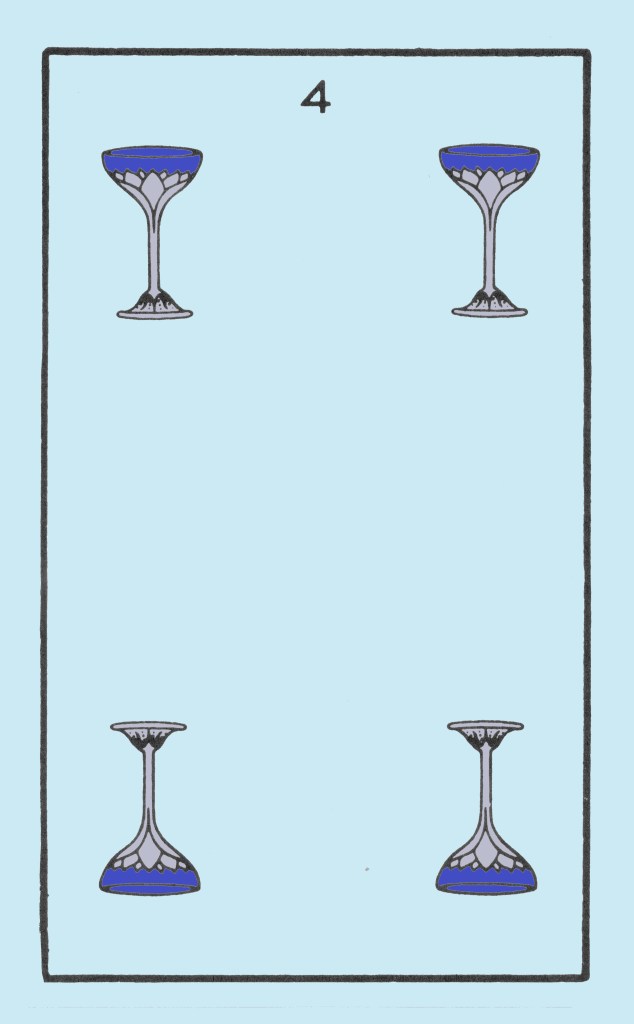
Tarot Encyclopedia – The Four of Cups

(Note: this is a collection of the meanings attributed to the cards by some occultists in the past centuries. It does not reflect my own study or opinion of the cards. It is only meant as a quick comparative reference as I develop my own take.)

The Four of Cups from the Builders of the Adytum (BOTA) tarot deck

Paul Foster Case (and Ann Davies)

The specific divinatory meanings are thus based on the attributions of Chesed, the planetary forces of Jupiter and Neptune, the zodiacal influences of Cancer ruled by the Moon, and the astrological fourth house. Jupiter’s sphere of influence is Chesed. It co-rules the third decanate of Cancer besides being exalted in this zodiacal sign. Therefore the Four of Cups has a very strong Jupiterian influence of wealth and expansiveness. The Four of Cups corresponding to the third decanate of Cancer is the time period July 13 to July 22, ruled by Jupiter and Neptune.
In specific Tarot Divination its key meanings are:
Well Dignified: success in material things, but desire for something higher; a period of comparative comfort, yet a little confining, thus suggesting a measure of satiety; it is a symbol of contemplation and of the turning away from pleasure in quest of higher things; it intimates strong psychic influences in the life or environment of the Querent.
lll-Dignified: material gain, but through injustice; sorrows resulting from satisfaction of desire; getting what one has wanted but finding no joy in it.
Keyword: Surfeit
(From the Oracle of Tarot Course)

A. E. Waite

A young man is seated under a tree and contemplates three cups set on the grass before him; an arm issuing from a cloud offers him another cup. His expression notwithstanding is one of discontent with his environment. Divinatory Meanings: Weariness, disgust, aversion, imaginary vexations, as if the wine of this world had caused satiety only; another wine, as if a fairy gift, is now offered the wastrel, but he sees no consolation therein. This is also a card of blended pleasure. Reversed: Novelty, presage, new instruction, new relations.
(From The Pictorial Key to the Tarot)

Aleister Crowley

The Four of Cups is called Luxury.

The masculine nature of fire permits the Four of Wands to appear as a very positive and clear-cut conception. The weakness in the element of water threatens its purity; it is not quite strong enough to control itself properly; so the Lord of Pleasure is a little unstable. Purity has somehow been lost in the process of satisfaction.

[…]

This card refers to Chesed in the sphere of Water. Here, below the Abyss, the energy of this element, although ordered, balanced and (for the moment) stabilized, has lost the original purity of the conception.

The card refers to the Moon in Cancer, which is her own house; but Cancer itself is so placed that this implies a certain weakness, an abandonment to desire. This tends to introduce the seeds of decay into the fruit of pleasure.

The sea is still shown, but its surface is ruffled, and the four Cups which stand upon it are no longer so stable. The Lotus from which the water Springs has a multiple stem, as if to show that the influence of the Dyad has gathered strength. For although the number Four is the manifestation and consolidation of the dyad, it is also secretly preparing catastrophe by emphasizing individuality.

There is a certain parallelism between this card and the Geomantic figures Via and Populus, which are attributed to the Moon in her decrease and increase respectively. The link is primarily the “Change=Stability” equation, already familiar to readers of this essay. Four is an “awkward” number; alone among the natural numbers, it is impossible to construct a “Magic Square” of four cells. Even in the Naples Arrangement, Four is a dead stop, a blind alley. An idea of a totally different Order is necessary to carry on the series. Note also the refolding-in-upon-itself suggested by the “Magic Number” of Four 1 + 2 + 3 + 4 which is Ten. Four is the number of the Curse of Limitation, of Restriction. It is the blind and barren Cross of equal arms, Tetragrammaton in his fatal aspect of finality, as the Qabalists knew him before the discovery of the Revolving Formula whereby the Daughter, seated upon the Throne of the Mother, “awakens the Eld of the All-Father”.

For the meanings of Via and Populus, refer to the “Handbook of Geomancy” (Equinox Vol. I, No.2).

(From The Book of Thoth)

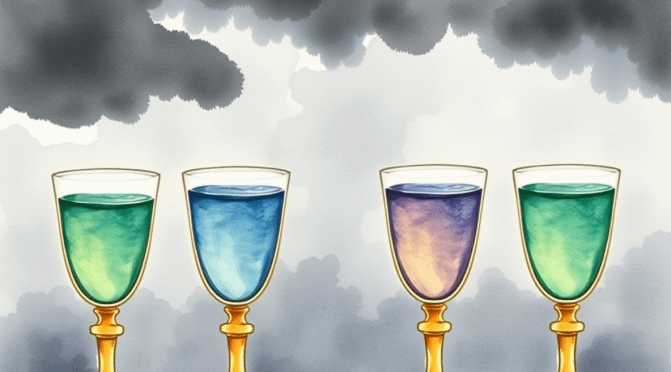
An AI-generated illustration for the Four of Cups

Golden Dawn’s Book T

FOUR cups: the two upper overflowing into the two lower, which do not
overflow. An Angelic Hand grasps a branch of lotus, from which ascends a stem bearing one flower at the top of the card, from which the white water flows into the two upper cups. From the centre two leaves pass right and left, making, as it were, a cross between the four cups. Above and below are the symbols Moon and Cancer for the Decan.

Success or pleasure approaching their end. A stationary period in happiness, which may, or may not, continue. It does not mean love and marriage so much as the previous symbol. It is too passive a symbol to represent perfectly complete happiness. Swiftness, hunting and pursuing. Acquisition by contention: injustice sometimes; some drawbacks to pleasure implied.
Chesed of HB:H (Receiving pleasure or kindness from others, but some
discomfort therewith).
Therein rule the great Angels HB:HYYAL and HB:MVMYH.

Etteilla

Boredom
Upright. This card, as far as the medicine of the spirit is concerned, means, in its natural position: Boredom, Displeasure, Discontent, Disgust, Aversion, Enmity, Hatred, Horror, Restlessness, Pain of spirit, Slight sadness, Affliction, Painful, Annoying, Unpleasant. – Saddening, Distressing.
Reversed. New Directive, New Light. – Index, Indication, Conjecture. – Augury, Foreboding. – Presentment, Foreboding, Predilection, Novelty.

MQS

Introduction to Abano’s Geomancy – Who Was He?

The modern mind is used to neat distinctions and a more or less monolithic theoretical scaffolding where everything finds its little place. To our sensibility, what belongs to natural science does not belong to literature or art, let alone to astrology or occultism. Though some eccentrics try to straddle the gorge, within the current worldview they must remain what they are: eccentrics. This is largely a consequence of the evolution of science away from the mother root of philosophy and the triumph of the technical-scientific worldview. It is neither a good process nor a bad one: it is what it is, but it hasn’t always been this way.

Pietro d’Abano, who lived between the XIII and XIV century, was, like many of his time, an encyclopedic learner. This was certainly easier back then, when owning a couple of dozens books was considered a marvel and the hyperspecialization typical of our contemporary organization of knowledge hadn’t yet taken place.

The extent of Abano’s involvement in occult practices is not clear. The famous grimoire Heptameron (Book of the Seven Days) is traditionally attributed to him, though it is, in actual fact, an anonymous work. What we do know is that his knowledge of languages allowed him to study many authors (like the Averroes or Ibn Ezra) who had considerable influence on the later development of magical theory, though this influence is still little understood by contemporary occultists.

We also know that he taught a number of subjects ranging from medicine to astrology, and that he was a very adept astrologer. This is not a unicum in the history of science. Astrology was one of the few forms of divination that was, if not tolerated, at least not as consistently persecuted as other branches of occultism in the Middle Ages, largely due to the fact that a reasonable argument could be made that the astrological influence of the planets was a natural consequence of how the cosmos was believed to work according to the Platonic-Aristotelean view accepted by the Church. It was simply not always practical to distinguish astrology as astronomy from astrology as divination, though attempts were made.

Finally, Abano is the subject of a number of urban legends. For instance, he was brought before the inquisition twice, largely due to his immense erudition. Once he was acquitted, the second time he was condemned. Unfortunately, he died in custody before the sentence had been pronounced, so the tribunal ordered his body exhumed and burned. But they dug up an empty grave, since a friend of the philosopher had gotten to his body first. This fact alone was enough to cement in people’s mind the image of Abano as an ominous magus and necromancer whose body was capable of disappearing from the grave.

As for the present book on Geomancy, it is not a stretch to think that someone as versed in astrology as Abano should be interested in this form of divination, which, at least in Europe at the time, was reduced as much as possible to astrological principles. The treatise is divided into four books: in the first, Abano explains the principles and astrological correspondences of geomancy; in the second, he discusses the meanings of the various houses and the principles of geomantic perfection; in the third, he gives examples of the meanings of the figures in the houses; in the fourth, he talks about the good or bad fortune of the figures depending on which figures they derive from.

What makes this book an interesting read for any student of geomancy is that it confronts us with a way of reading the Geomantic Shield that is not typical of how geomancy has been rationalized in the late XX and early XXI centuries. This is in itself worthy of consideration, especially because it proves beyond doubt that the distinction between Shield Chart and Astrological Chart is artificial and only serves to complicate matters. Furthermore, Abano’s interpretation of the figures affords us a rare glance in the workings of the mind of an adept of geomancy, by whose example we can derive solid principles for interpreting our divinations. Abano’s examples are therefore not meant to be taken as the last word, but as a contribution to our study of the interrelation of the Geomantic figures.

MQS

The Car Keys (Example Reading)

I’m currently visiting my parents in Italy, so I’m going to keep this short and sweet. I lost my  keys. As I probably already mentioned, I hate lost object readings because they are incredibly difficult to decipher, but I figured it wouldn’t hurt to try. The cool thing about playing cards is that most people have them at home. This is the reading that came up:

7♠️ – 8♥️ – 10♠️ – 2♦️ – J♦️

If I had to tell you I understood this reading I’d be lying. The one thing that seemed clear to me is that it was in a place made for people (Eight of Hearts), so the living room was an option, though it seemed strange, since I always keep my keys in my old bedroom. There were also those two diamonds indicating messages, which I didn’t understand.

Well, it turned out I suddely lost (Seven of Spades) the keys the previous evening (Ten of Spades) during a dinner (Eight of Hearts), and I was contacted by the owners through a friend of mine who knows them.

MQS

Robert Fludd’s Geomancy – Introduction Pt. 1

Back to Index / Next

Fludd discusses how we may know that geomancy works, and why we should consider it a science of the soul.

1. The Science of Geomancy is the True Act of the Intellectual Soul

Before we speak of the properties of geomancy and of divination from the east (to be discussed later in a separate book), we think that it is appropriate to deal with its essence here, which we will clearly illustrate with sufficiently probable reasons.1

If we consider the origin of this science, we will certainly perceive that it is a very occult and internal science,2 wherefore it is that common men, paying attention only to their senses, habitually blather that this art is merely accidental, foolish, and empty, and has nothing of value to it. In reality, men endowed with a strong imagination are able to grasp the reason of this secret knowledge, and to behold or perceive it with their spiritual eyes, since its consideration passes the limits of ordinary reason.3

In fact, if we try to account for the effects in this science, the work will surely be arduous and painful. Indeed, who, even among the commoners, would not regard him as a foolish man, who, upon seeing a servant carrying out the commands of his master, would wish to inquire about the master’s secret plan and intention and, wanting to know and explore them from that servant, he would directly answer thus: “My Lord usually commands this or that; so, however, that he does not in the same way indicate the account of the mandate to his executors or servants.”4

Thus we receive the feeling of life in a wonderful manner from the higher planes,5 while, however, as to its source, vehicle, and reason, men usually only reason from the effect by conjectures, and do not know or have anything certain. Similarly the divine mind produces wonderful effects in man and acts marvelously, while, however, the obstacle of the flesh and the mind prevents us from correctly knowing the reason of these actions. The mind therefore acts upon the intellect, and the intellect patiently fulfills the acts of its ruler, and yet the principal cause is hidden in the center of the mind, that is, in the divine word.6

Similarly a Lord hands his money to his servant, that he may take it to such and such a city: yet the servant does not understand what his Lord intends to do with such money, since the reason is hidden in the heart of the Lord. that is, of the mind. Thus the intellect and reason impel the imagination to bear and carry the impressions of its king, that is, the mind.

In a similar manner the servant puts his master’s money into the cart, so that he may carry the master’s burdens into the visible world; and in this way also the horses draw the cart to the city. Yet in the meantime reason or imagination or sense do not understand the intention of the mind any more than a servant or a cart, or the horses perceive the secret and hidden will of their Lord. However, human reason can conjecture better than imagination or sense,7 just as even a servant may in a certain way imagine and conjecture to reach the conception of his master, if he wishes to have nothing certain.

From these considerations it is evident, therefore, that just as we cannot know God except a posteriori,8 so also we do not perceive or understand the mind or the reason of its actions, except from the effect. Moreover, from its effect, the Artists9 understood that this knowledge was true and admirable, inasmuch as by means of it the future and the present, even the unknown things of the past, were discovered in a wonderful divine manner.

But if fools wish to penetrate to the center of this act, that is, to the unity and the point of the mind itself, they will indeed waste their time, since there is a level beyond reason and understanding, to which no one can ever reach, unless he takes off his bodily abode: it is sufficient, therefore, that we know the monk by his tunic, and the art by its effect.

And so this knowledge is divine, because it allows one to divine, which is close to prophecy, because through it the mind, by its own power, performs, although weakly, that which it is accustomed to perform at other times (but more powerfully and clearly because of the multitude of higher rays coming to us at the same time) united and conjoined with the divine mind.10

And hence, considering it in the proper manner, we see that the human mind is of the same essence of which the divine mind is, since it usually performs the same to a lesser degree as it performs in a greater one: for a greater power produces a greater effect, and consequently a smaller one also a smaller effect.11

Man’s mind, being at the receiving end of the divine rays, if only it is preserved from the harm of the body and flesh, and is not clouded by darkness, or is not affected by the allurement of the senses,12 can pour out its prophetic power into a sensible effect, and perform miracles, the effects of which are indeed unaccounted for. It is no more possible to account for this, than it is possible to recognize the nature of prophecy itself.

2. Why Geomancy Is Considered an Absurd and Silly Science Among the Ignorant

Those who are ignorant are wont to esteem this knowledge of the soul absurd and ridiculous, since they think that it flows out and proceeds from points made by the movement of the hand.13

But the wise and the learned could answer them easily that there is nothing certain, nor any constant resolution in the mind of man, to execute this or that thing, or to set out to seek this or that place on such a day, and yet that the mind of man is somehow made up, and man accomplishes this regardless of all hindrance.14

Therefore, even though the movement of the hand, constituting points corresponding to the disposition of the mind in its certain number and proportion, appears to accomplish nothing in the projection of the points,15 yet many things are concealed under the multitude of points: namely, the prediction of the soul itself, driven by the ethereal and elemental vehicles of the Microcosm, as far as the twelve signs, the seven planets, and the four elements,16 and their powers are hidden under such points.

For as the mind and intellect could not descend into man without the aforesaid vehicles of the Macrocosm, so also nothing real and essential proceeds from the mind, as from its origin, except through these means.

This movement is therefore not accidental, inasmuch as it proceeds from the human soul, which is the complete essence of man,17 and acts essentially and by itself, unless it is hindered by the accidents of the flesh and the senses.

In this way we also say that the mineral nature of lead and iron tends in its essence to the nature of gold: but by accidents, that is, it is hindered by impure sulphur, so that it cannot reach the goal set by nature.18

But the ignorant will reply that such impediments always happen to the body, because of the impurity of the flesh and the error of ignorance. This, then, should at least be granted: That the more the rays of the mind are impeded in their motion by the pollutions of the body, the more the effect of its action is weakened, just as when a cloud is interposed between our eye and the solar rays, so that the rays cannot penetrate to our sight, and hence their manifest effects are removed.

MQS

Footnotes
  1. As will be seen shortly, Fludd says his reasonings are “sufficiently probable” because there cannot be true certainty in this science, though this is not, for him, a negative thing, but rather a feature of its mystical origin. ↩︎
  2. “scientiam valde occultam et internam.” The word ‘occult’ here is probably to be simply understood as ‘hidden’. ↩︎
  3. The word ‘imagination’ here is not to be mistaken as ‘fancy’. Imagination is treated as a valid aid to understanding. ↩︎
  4. This sentence, like many in Fludd’s writings, is exceedingly convoluted. The metaphor of the servant carrying out the master’s order runs through this section. In this first instance, the general sense (provided my translation is correct) seems to be that asking for proofs about something too mysterious in the same way one would ask for them in everyday matters is useless. ↩︎
  5. literally “from the superior things”. The translation “from the superior planes” probably sounds a touch too modern, but it clarifies the idea. ↩︎
  6. This sentence cannot be understood without reference to Fludd’s Neoplatonic view of the world, which, like all forms of Neoplatonisms, sees the universe as a series of spheres of emanation which find their correspondence in the microcosm of man. The universe, like humans, finds its center in the divine. ↩︎
  7. That is, we can arrive at probable conjectures, even though we cannot be sure. ↩︎
  8. ‘a posteriori’ is a philosophical term which means, broadly speaking, that we know something from its effects in our concrete experience, rather than from abstract logical reasoning (‘a priori’) ↩︎
  9. Probably in reference to the ancient geomancers. ↩︎
  10. Divination, therefore, is but a step down from prophecy. The reference to ‘rays’ is Fludd’s way of conceptualizing our relationship with the Divine, as if the divine world sent rays to us, and the more we receive of these rays, the more we approach God in his power and ability (such as seeing the future). ↩︎
  11. Again, this is to be seen within the context of Fludd’s Neoplatonism, whereby the Microcosm of man is like a small replica of the Macrocosm and, indirectly, of God. ↩︎
  12. Neoplatonism’s relationship to the material world of senses is ambivalent. Generally speaking, the material world is seen as the last emanation, and therefore as a final concretization of the divine worlds above it. Therefore, it is good in so far as it comes from a divine source, but it is seen as corrupt because, being the last stretch of being before the abyss of nothingness, in it the perfection of the divine plane is obscured, both in nature and within humanity (through bad behavior). ↩︎
  13. That is, the ignorants believe that geomancy’s powers reside in its exterior signs rather than in the inner chain that links those signs to the divine source. ↩︎
  14. This metaphor seems a bit obscure. Possibly, its meaning is that, just like our external behavior is inconstant and unpredictable, and yet the mind manages to force us to accomplish clear results, so the inner mechanism that makes geomancy work can create meaning in a bunch of hand gestures and lines and points. ↩︎
  15. The points are those traced during the ‘inspired’ section of a geomancy session. ↩︎
  16. All these are the universal symbols that allow us to derive meanings from the geomantic figures. ↩︎
  17. The human soul is not a random fragment of life animating a body. It is a universal power which is found whole within each of us, and is impeded in its manifestation by our imperfect nature to various degrees. ↩︎
  18. This paragraph is a reference to the alchemical and chemical beliefs of the time, and similar statements can be found in many alchemical texts. ↩︎

Robert Fludd’s Geomancy, Translated and Annotated / Index

Back to the Geomancy Index

My translation and comments on Robert Fludd’s Animae Intellectualis Scientia seu Geomantia (The Intellectual Science of the Soul or Geomancy). Please note that I am no professional translator of old texts and sometimes I had to paraphrase. Feel free to leave comments or contact me on how this project could be improved. The translation and commentaries are copyrighted to me, so please ask for my permission before using it.

Introduction
Part I – Geomancy is an Act of the Soul
Part II – Preparing to Divination, the Hermetic Way
Part III – The Mystical Presuppositions of Divination

Book I
Part I – Anecdotes on the veracity of Geomancy
Part II – How to Prepare to Divination
Part III – Basic rules on projecting the points
Part IV – Filling out the geomantic shield

Book II
Part I – Elemental and astrological attributes of the figures
Part II – The Houses
Part III – The First Four Geomantic Figures
Part IV – The Second Four Geomantic Figures
Part V – The Third Four Geomantic Figures
Part VI – The Final Four Geomantic Figures
Part VII – When the Same Figure is Found in Two Houses
Part VIII – Interpreting the Judge, based on the two Witnesses

MQS

Self-Fulfilling Prophecies And How to Avoid Them

A couple of weeks ago I received a message about the question of whether we, as readers, risk causing self-fulfilling prophecies with our predictions. For instance, if I tell a querent that the relationship she is in is going to end, I may end up causing the break-up. What follows is a slight elaboration on my response.

First off, we need to recognize that some things we can change or at least improve, others we can’t and they will happen regardless of what we do and what a reader tells us. Most people who go about their life with their brain switched on can recognize this. It is only when we get into delulu territory and body-mind-spirit-section pseudomysticism that we encounter people who deny the existence of unavoidable happenings.

On the other hand, sheer fatalism is also a gross misunderstanding. Consider simply this fact: if two people X and Y are exactly the same and go exactly through the same life experience, except that X also uses divination or consults a diviner, this is enough to tell them apart.

The fact that X knows about what is going to happen in advance is enough to make him a different individual, which in turn is enough to change the nature of his fate, because our ability to change a situation is contingent on our knowledge of what the situation truly is. Even if X cannot change a certain fact in any meaningful way, but knows about it enough in advance that he can make his peace with it, the same event Z won’t be the same if X’s attitude toward it changes, because X is part of the event that takes place in his life, and so if X change, the event changes. Even if X cannot bring himself to accept Z, his knowledge of Z is enough to change Z, because X with knowledge of Z is not equal to X without knowledge of Z.

Fate patterns are a difficult topic to tackle without a previous sound philosophical and occult discussion, and I plan on starting that discussion at some point, once I’ve organized my notes. For now, it suffices to say that we, as readers, can play a rather important role in the querent’s life if we are consulted at the right moment.

Yet, this doesn’t mean that we are capable of empowering querents to always turn their life around, and I don’t even think empowering is our mission: our mission is to provide information. On a number of occasions, especially when I was less experienced, I gave querents the wrong prediction on purpose because I didn’t want to disappoint them, even though the cards were clearly negative: Yes, you’ll get the job, yes the relationship is going to last and be wonderful. But it didn’t happen. 

On some of those occasions you may even think that because I didn’t bring up the negative aspects, the querent wasn’t prepared to tackle them, so my not bringing them up may have been just as bad as another diviner handing out negative predictions willy-nilly. That’s because I wasn’t able to give accurate information.

It is nice that some things can be changed even if some things can’t, but unfortunately we don’t always know which is which. Therefore, we must also recognize that we have a degree of power over our querent just by virtue of using odd, mysterious counters to give our predictions, and we must not abuse this power. 

Whenever possible, we should either frame our predictions as potentials and/or accompany them with positive suggestions. These suggestions, though, must ALWAYS be based on what the oracle describes, never on vague self-help platitudes. Sometimes (many times) it is best to highlight critical points so that the querent can become conscious of them (e.g., “you know, this relationship is headed down a pumpy road. You should address x, y and z if you want to try to make it work”) while avoiding drastic predictions unless necessary.

Furthermore, we must never frame our predictions in such way as to take away all hope. It is not our right to do so. Deluding and disillusioning are the two capital sins that we must avoid, even though striking the right balance is sometimes hard. There is plenty of space between being a pushover to our querent’s wishes and being an insufferable sassy tough-love prick.

If there are positive aspects to a situation, we should emphasize those and try to put them at the center of the querent’s life so that they can address the negative points more positively.

Finally, we ought to always remind our querent that diviners are people and are therefore fallible. In a world where doctors, lawyers, judges, scientists and bakers can get things wrong it would be absurd to expect diviners to always be right. Always encourage the querent to take your predictions as an additional input. 

MQS

The Job Interview (Example Reading)

Since I began reviewing my geomancy reading method I started nagging some friends for an opportunity to read for them. I am especially interested in seeing whether we can consider the houses in the shield to be adjacent across the shield (like, for instance, the First with the Ninth), as Peter of Abano seems to suggest in his handbook. This would open up the Geomantic Shield to a whole host of interactions.

A friend of mine was applying for a job, so he asked me if he would get it. This is the Shield I got:1

“Will I get the job?” Geomancy reading. App used: Simple Geomancy

The Querent is represented by the First House and the first figure, Tristitia. The Job is represented by the Tenth House and the tenth figure, Caput Draconis. Tristitia is not a great figure, indicating trouble and difficulties. The querent has been having trouble holding down a job or having contracts renewed, so it is fitting that he should be troubled by the situation. Caput is an encouraging figure, showing things beginning, but without contact between the two houses I wouldn’t predict him being hired.

Fortunately, contact is provided by Tristitia, which springs to the Eleventh House. The fact that Tristitia moves, and not Caput, indicates that the querent will need to put quite a bit of effort into the hiring process. Tristitia also springs to the Third House, and, according to Abano, this seems to count as being in contact with the Tenth House. I cannot make any definitive judgment on this issue. I will merely file it away for future consideration.

The Judge is Fortuna Maior, which is a very encouraging indication of success through effort. Possibly, I thought, the hiring process will stretch out and take longer than the querent thinks. The fact that Maior emerges from a very difficult set of Witnesses adds to the obstacles and the delay.

The outcome, thankfully, was positive. He got hired, but the pay was not as satisfying as he thought it would be (note Amissio as Left Witness) and the hiring process definitely lasted way longer than he thought it would.

MQS

  1. Someone asked me if I do my geomancy readings with the app I use to show the chart. I don’t. I always do my readings with pen and paper. The App is only for presentation. ↩︎

An Overview of the Opening of the Key Spread

A recent exchange in the comment section made me go back to some notes I’ve been sitting on for a while about how different card spreads used to be in the past, compared to how they tend to be nowadays. A good example for this is the famous spread used by the Golden Dawn, which has become known as the Opening of the Key.

The Opening of the Key is a complex, multi-stage spread that was (and still is) used within the Golden Dawn system and has been adopted by Paul Foster Case’s and Crowley’s followers as well.

From a magical standpoint, the allure of this spread is that it mirrors within its layouts the whole GD system, being therefore a tool for learning it. Since I do not particularly advocate the Golden Dawn system, I’ll leave this aspect to your consideration, should you be so inclined.

From a purely divinatory standpoint, though, the interesting aspect of the Opening of the Key is that it affords us a glance at how card spreads used to work in traditional cartomancy.

Nowadays we are used to what many call “positional spreads“, that is, spreads where each single card is read more or less independently from the others based on the meaning of the position. The most famous positional spread is certainly the Celtic Cross, also taken from the GD system and popularized by Waite. Over time, though, more and more ridiculous spreads have emerged, with positional meanings as abstracted from actual reality as possible.

If we take a look at many books on divinations published before the 60s, when the Rider Waite deck truly took off, and with it the Celtic Cross spread, we find very different spreads.

Many traditional spreads, used both for tarot and for playing cards, share the following characteristics:

  1. They tend to be large and unwieldy. Many of them take up a whole table. In part, this reflects the old idea that you wouldn’t be potentially in contact with your go-to fortune-teller 24/7 via social media, and so the diviner ought to be able to cover as much of your life as possible in one go. There was also a certain old-fashioned mistique to these spreads, it being the idea that your life unfolds like a book that can be read page to page. Furthermore, the way of reading the cards was different: you didn’t waste too much time on each single card, but simply used it as a building block to be added to the others. Therefore, you needed many building blocks.
  2. Very few positional meanings. Many old spreads used to be either sequential or tableau-like, or a mix of the two. If certain chunks of spread did have a particular positional meaning attached to them, such positions were always covered by more than one card (usually three or more). The cross spread I was taught to use with playing cards is one such example.
  3. Strange techniques. In the English-speaking world, the idea that there are special reading techniques has largely gone lost for over half a century, as tarot became a tool for psychological masturbation that eschews all technicality in favor what one’s heart palpitations. This was until some people, tired of how ineffectual and watered-down the new-age version of the tarot had become, discovered Lenormand cards. In reality, reading techniques have been part of many cartomancers’ toolkit for centuries. Two of the most common techniques (though not the only one) used in old tarot and playing card divination were card counting (starting from a card and counting a certain number of cards to land on the next card to be read) and card pairing (pairing the cards on the opposite sides of a row two by two.)
  4. More than one stage. It was not uncommon for many spreads to have more than one stage to them. Back then, divination was not seen as something to run to for every minor inconvenience, but rather as something affording a general overview of one’s main issues and prospects. Cartomancy was, at least in part, a parlor game, though a serious one, with serious implications.

One of the characteristics of the early Golden Dawn, before it became a battle of egos, was its (relatively intelligent) syncretism, as well as its attempt to act as a reservoir of everything the occult Western tradition had created over the centuries. Many of the founding members of the Golden Dawn were very well acquainted with, and even contributed to the then-growing literature on fortune-telling.

It comes therefore as little surprise that THE Golden Dawn spread, the Opening of the Key, is just as much an occult compendium as it is a compendium of quaint fortune-telling techniques. Let’s read the original instructions together (From Book T):

A Method of Divination by the Tarot

  1. THE Significator.
    Choose a card to represent the Querent, using your knowledge or
    judgment of his character rather than dwelling on his physical
    characteristics.
  2. Take the cards in your left hand. In the right hand hold the wand over
    them, and say: I invoke thee, I A O, that thou wilt send H R U, the great
    Angel that is set over the operations of this Secret Wisdom, to lay his hand invisibly upon these consecrated cards of art, that thereby we may obtain true knowledge of hidden things, to the glory of thine ineffable Name. Amen.
  3. Hand the cards to Querent, and bid him think of the question attentively, and cut.
  4. Take the cards as cut, and hold as for dealing.

“First Operation”
This shows the situation of the Querent at the time when he consults you.

  1. The pack being in front of you, cut, and place the top half to the left.
  2. Cut each pack again to the left.
  3. These four stack represent I H V H, from right to left.
  4. Find the Significator. It be in the HB:Y pack, the question refers to work,
    business, etc.; if in the HB:H pack, to love, marriage, or pleasure; if in the
    HB:H pack, to money, goods, and such purely material matters.
  5. Tell the Querent what he has come for: if wrong, abandon the divination.
  6. If right, spread out the pack containing the Significator, face upwards.
    Count the cards from him, in the direction in which he faces.
    The counting should include the card from which you count.
    For Knights, Queens and Princes, count 4.
    For Princesses, count 7.
    For Aces, count 11.
    For small cards, count according to the number.
    For trumps, count 3 for the elemental trumps; 9 for the planetary trumps;
    12 for the Zodiacal trumps.
    Make a “story” of these cards. This story is that of the beginning of the affair.
  7. Pair the cards on either side of the Significator, then those outside them, and so on. Make another “story,” which should fill in the details omitted in the first.
  8. If this story is not quite accurate, do not be discouraged. Perhaps the
    Querent himself does not know everything. But the main lines ought to be
    laid down firmly, with correctness, or the divination should be abandoned

“Second Operation”
Development of the Question

  1. Shuffle, invoke suitably, and let Querent cut as before.
  2. Deal cards into twelve stacks, for the twelve astrological houses of
    heaven.
  3. Make up your mind in which stack you ought to find the Significator,
    “e.g.” in the seventh house if the question concerns marriage, and so on.
  4. Examine this chosen stack. If the Significator is not there, try some
    cognate house. On a second failure, abandon the divination.
  5. Read the stack counting and pairing as before.
    “Third Operation”
    Further Development of the Question
  6. Shuffle, etc., as before.
  7. Deal cards into twelve stacks for the twelve signs of the Zodiac.
  8. Divine the proper stack and proceed as before.

“Fourth Operation”
Penultimate Aspects of the Question

  1. Shuffle, etc., as before.
  2. Find the Significator: set him upon the table; let the thirty-six cards
    following form a ring round him.
  3. Count and pair as before.

Fifth Operation
Final Result

  1. Shuffle, etc., as before.
  2. Deal into ten packs in the form of the Tree of Life.
  3. Make up your mind where the Significator should be, as before; but failure
    does not here necessarily imply that the divination has gone astray.
  4. Count and pair as before.

There are many characteristics to the Opening of the Key that mirror the checklist I’ve created above:

  1. The spread is large. Especially in its fourth operation, it requires a big table to perform.
  2. Few positional meanings. No individual card signifies anything in particular. What counts is the diviner’s ability to string the meanings together into coherent sentences that apply to the querent’s concrete life. The stacks themselves do have general meanings (business, pleasure, etc.) but these are broad, and you will never find yourself applying them to just one card.
  3. Techniques. These are, more specifically, card counting and card pairing, which are plucked straight out of the fortune-telling tradition.
  4. More than one stage. This is quite evident. Although many GD initiates ended up simplifying the method (more on this in a later article), the complete operation, which could take up upwards of two hours, consisted of five stages which offered a glimpse into the various facets of a situation.

Quite clearly, there is more to the Opening of the Key than what I’ve listed, aside from the heavy occult overlays. For one, the GD added a method for discerning whether the divination is valid: one needs to find the significator in the appropriate stack. This is in part due to the desire to import the notion of ‘radicality’ used by many horary astrologers, according to which certain charts cannot be judged if certain configurations are present or absent; and in part it is a system of magical checks and balances to avoid idle curiosity (again, more on this in a later post).

MQS

Vera Sibilla Cards That Indicate Negative Feelings

I already made a post about positive feelings. This is a follow-up on the other side of the coin. As usual, this isn’t meant to be exhaustive. Note that many cards indicating difficult feelings are just reversed cards whose upright meaning is positive.

Three of Hearts Reversed – The Balcony

When upright, the Three of Hearts relates to the sense of sight, both literally and figuratively. Reversed, it can represent someone who is blinded by emotion, especially such emotions as rage or lust (the “red” emotions). It can indicate the inability to control oneself as a result of such emotions.

Four of Hearts Reversed – Love

Aside from being an indication of depravity, the reversed Love card can, and in fact is more commonly found to relate to unrequited feelings, emotional dryness and deep emotional scars from disappointment, usually in love.

Seven of Hearts Reversed – The Scholar

Upright, the Scholar card represents the mind in its best aspects of intelligence, creativity and having a solid grip on reality and on one’s problems. When it is reversed, it represents either someone who is cold and calculating (the lower octave of the mind) or someone who feels impotent and easily overwhelmed by problems.

Eight of Hearts Reversed – Hope

When reversed, the Eight of Hearts is a harbinger of sorrow, disappointment and unfulfilled hopes and wishes. Being a card that is strongly connected with one’s inner optimism, the reversed Hope card becomes one of pessimism or even of mild depression (by itself).

Nine of Hearts Reversed – Faithfulness

Upright, the Dog card of the Sibilla indicates friendship and loyalty, as well as deep and strong attachment to someone, something or an idea. Reversed, it is an indicator of rebellion, unreliability and biting the hand that feeds you, from thankless teens to political activists depending on the context.

Ten of Hearts Reversed – Perseverance

Upright, the Ten of Hearts can indicate solid, reliable people, lasting feelings and certainty. When it falls reversed in a reading, the Ten of Hearts become an indication of turmoil and of not being able to control oneself, one’s instinct and one’s rage.

Two of Clubs Reversed – The Peacock

When it comes up reversed, the Peacock card embodies the negative side of the symbolism of the animal, namely pride, haughtiness, an inflated ego that is easily slighted and self-centeredness. Depending on the surrounding cards this can go from a mild drama-queen complex to serious pathological deviancy.

Seven of Clubs Reversed – Realization

The Upright Seven of Clubs represents our realization in the world, our ambitions and our sense of accomplishment. When it comes up reversed, it shows insecurity, dissatisfaction with one’s existence, and fear, especially understood as feeling under attack in one’s life projects.

Eight of Clubs Reversed – The Reunion

Reversed, the Reunion card has many difficult meanings relating to groups and one’s social contacts. However, it is also a card of disillusion, sadness and depression. It represents someone who has lost momentum and is prey to inner turmoil, self-doubt and similar feelings.

Nine of Clubs Reversed – Merriment

Coming up reversed in a reading, the Nine of Clubs reverses the hakuna matata feeling of its upright counterpart. It becomes a card of joylessness, and it can also represent feeling isolated from others, sometimes even as a consequence of other people taking shots at us.

Four of Diamonds – Falsehood

The Falsehood of this card must be understood broadly as a feeling of “wrongness” and negativity. In this sense it is the opposite of the Dog card. It represents being ill-disposed or displeased with something, and negative feelings brewing right below the surface.

Five of Diamonds – Melancholy

The title speaks for itself. Upright, the card can be an indicator of disappointment, sadness, pining, melancholy and dissatisfaction. By itself it is not a tragic card, but it does slow you down. Reversed, the card becomes much more impactful and its effects long-lasting.

Seven of Diamonds Reversed – The Child

When it falls reversed, the Child card embodies the negative side of children: childishness, in the main, but also a general sense of inexperience and that the world is too complex for us to understand and tackle.

Nine of Diamonds – The Fools

The Fools indicate feelings of unwarranted exaltation and self-confidence, mistaken conceptions, as well as easily aroused feelings of aggression. They depict a volatile atmosphere where things can go seriously south.

Ten of Diamonds – The Thief

The Thief is a card of betrayal, whether literal or metaphorical. It represents ill-will toward someone or something, and the desire to do wrong things. This needn’t be tragic, as there are many situations where the sneakiness of the Thief borders on amorality rather than immorality. Still, this card is always a warning.

Ace of Spades – Sorrow

The Sorrow card is the card of tears, of the broken heart and of the sense of being cut off from one’s source of happiness. In itself it is a very difficult card to go through, but when not piled on by other problematic cards it can show just a sense of discouragement that the person can muscle through with some mental discipline.

Three of Spades – The Widower

Another difficult card, the Widower represents isolation, loneliness and serious interpersonal issues. Being the card that signifies “oneness” and the single individual, sometimes it can show things done alone, with no negative connotation, but more often than not it foretells difficulties in one’s loneliness. When reversed, it becomes a rather tragic card.

Four of Spades – Sickness

Although this is the card that indicates literal sickness, it can also be interpreted metaphorically on occasion. It often signifies feeling sick, disturbed or down, but it can also be the card of sick and morbid feelings which cannot find a healthy expression.

Six of Spades – Sighs

Among the less difficult Spades in the deck, the Six of Spades represents everything we desperately long for and await, hoping it will come to us. It is a less serene version of the Eight of Hearts, as it contrasts its composure with a sense of uncertainty and fear of losing what one wishes to get.

Seven of Spades – Tragedy

Another card of “red” feelings, this one indicates anger and wrath. It shows explosive energy disrupting one’s life, which, from an emotional standpoint, usually signifies that we are feeling slighted or wronged or somehow unable to restrain our ire.

Eight of Spades – Desperation and Jealousy

In the main, the Eight of Spades is a card of literal jealousy and envy, but it can represent all those situations where we look at others with toxic feelings in our heart. It can also signify desperation and tears, and a sense of being trapped in a corner with no way out.

MQS