Category Archives: Divination Master Post

A Cartomantic Chaos

The Bolognese Tarot is traditionally read using a reduced pack of either 45 or 50 cards (the 35 card system, of historical interest, is no longer practiced today). However, since it is a tradition that varies locally, the make-up of the deck varies. In other words, the 45 cards I use are not necessarily the same used by another person who uses 45 cards. The same is true for the 50 card deck.

This uncertainty is what contributes to the relative obscurity of the method. At the end of the day, many people want a clear standard to follow. For my part, I practice the systems I have been taught: the 45-card system you often see in my readings, which I was taught three or four years ago but had left alone until recently, and the 50-card system I have been taught by Germana Tartari.

Many of the sources I have consulted seem to believe that the 45-card system is older, and later five extra cards were added by some. Germana herself told me she remembers her grandma telling her that she (her grandma) had seen the full pack of 62 used (this reconstructed system is the topic of Germana’s newer book, which I will review in the near future).

So we have several systems, which isn’t surprising: if we look at Piacentine playing cards, there are at least several full-deck methods, at least one method with 30 cards and several with 25 cards.

Going back to the tarocchino bolognese, and limiting ourselves to the two most used systems of 45 and 50, usually the cards that overlap tend to have the same or similar meanings, at least in part. For instance the Ace of Coins can be the table or desk in all systems I am aware of. Additionally, in the 45-card system I know, the Ace of Coins can also be the card of money (relatively big money). In Germana’s 50-card system, the Ace of Coins can be a table, but also a letter or document. In Ingallati’s system, the Ace of Coins is the table or the work card.

As for the work card, both Germana’s 50-card system and the 45-card system I know assign it to the Star, but the Star is also the card of material possessions and possibly of gifts, which is the main meaning assigned to the card by Ingallati. In another book on the 45-card method I have yet to review, the Star represents the health status (in my system it can represent meds), but also ‘good job opportunities’.

As you can see, there is overlap, but also space for divergence. To avoid confusion, both for myself and for the readers, I tend to stick to the meanings I know, but I think it’s fair that I bring this up.

As for the five extra cards that some add to the initial 45, there isn’t great uniformity either. Some don’t even add five cards: I know a reader who uses a pack of 49, while Giliberti, whose book I reviewed, seems to use 51 in one video I saw (how many cards she uses in the book I don’t know, due to the book’s chaotic nature).

All this chaos may be frustrating for someone who is approaching the bolognese tarot for the first time, especially from outside of Italy. One thing is growing up with a particular system, another thing is having to randomly choose one.

I don’t believe any system is inherently better or worse. All have the same potential for describing life, if properly used, and much also depends on the person’s inclination. For instance, having studied the 50-card system under Germana’s supervision, there should apparently be no reason for me to go back to the 45-card system. Yet I found myself always coming back to it, despite integrating insights from Germana’s system and from the books I read.

Ultimately I recognized that the 45-card system simply resonates with me beautifully, and while we are still in an open relationship, I tend to gravitate toward it. Certainly, if I had to write a full guide on the Bolognese tarot, I would illustrate this method. You may find otherwise.

I think anyone who is interested in this deck should take their time to explore their options. Mixing and matching randomly without having first studied the various strands of the tradition is not recommended, but as we study and practice we may find that a more individual approach emerges.

MQS

Fixed Significators and Modern Issues

Some decks have variable significators, while others assign certain cards to always represent the querent and their partner. This can cause confusion when reading for people who would not have lived their life out in the open back when cartomancy emerged, such as gay or trans people. Following are some experimental notes on how to deal with such instances in the various decks I use.

I want to stress that these are based on my practical experience, not on that of someone else and not on some theory I am trying force onto the cards. My aim is to improve my accuracy as a diviner, not to pontificate on academic eventualities.

Vera Sibilla

The Sibilla doesn’t have fixed significators, meaning that the querent will, if at all, be represented by a court card that indicates their role in the situation and/or society at the moment of the reading, always compatibly with their sex.1

And this is already problematic nowadays. I haven’t read for too many trans people, but I have noticed that if the person has either transitioned, fully or in part, or has at least adapted considerably to the other sex, then they are represented by a court card of that sex (ftm as a male, mtf as a female).

To be blunt: Jane, cashier, who has been living as Jane despite being born as Jim, and lives out her concrete life as Jane, is described as a woman in the cards, although the cards may hint at the transition, if relevant in the context; Jim, cashier, who would like to become Jane and maybe one day will, is represented as a man, even if he’s started to play with makeup since watching Myra Breckinridge; Becky, professional TikTok cheese grater, special traits no personality, who thinks an androgynous look makes her stand out, still comes up as a woman even if she pretends to identify as a man on every day with an R in it.

This has nothing to do with politics or tolerance or “passing as the other sex” and everything to do with concrete life: divination mirrors life, but social media clout simply doesn’t transfer to the cards, and there’s nothing I can do about it, even if it may offend some. The good news is that indentification with a significator is just a divinatory device and lasts only for the fifteen minutes needed to conduct a reading, and then is over.

IMPORTANT: we are talking about trans people, not crossdressers. A crossdressing man is a man who cosplays as a woman for whatever reason, but remains a man and lives as a man, at least until that fake business trip to Atlanta that his wife knows nothing about.

Talking about gay people, the Sibilla is very straightforward. In the few readings I do for myself, I usually come up as the Boyfriend, my husband as the Gentleman, and some years ago I came up as the Helper and my husband as the Boyfriend.

As for “but what about…” particular cases about any of the identities that are created daily, the best I can offer is: I’ll cross that bridge when I get to it. I trust the cards to simply describe the situation as it is and I accept the risk of not being able to understand how complex it may be, either in reality or in someone’s perception.

Playing cards and Bolognese Tarot

In some systems of cartomancy with playing cards, significators are not fixed. The way I was taught, though, the male querent is the King of Clubs and the female querent the Queen of Clubs, and the other card is the person they love. Similarly, in the Bolognese tarot the male querent is the King of Wands and the female querent the Queen of Wands.

For trans people, I think what I said about the Sibilla still holds true. Again, all I can say is to keep your mind and your eyes open (on the cards, I mean. Looking if the querent has an adam’s apple doesn’t count.)

For gay people, I have generally found that a degree of flexibility is required on the diviner’s part. Some readers seem to believe that you can just dictate to the cards how to behave, including in the case of gay querents. If that works, then bully for you, but I have always found the cards to have a mind of their own, regardless of the conventions we try to establish for them, so all I can do is be flexible.

Some people think the querent is represented by the court card of their gender, the partner by the other main significator, regardless of their sex. This theory is predicated on the fact that the two main significators are meant to show those people, and the fact that they are of two different genders is accidental or a matter of historical bias.

This may sound convincing, but have I found it to be true in practice? Sometimes. Sometimes the partner will come up as the other Club/Wand figure and there is simply no way of interpreting it other than as the partner, even if the stuff under the dress doesn’t match. Sometimes the cards will represent the partner as a court card of another suit that matches them. Sometimes the cards will throw in both cards for good measure: hubby has come up as the Queen of Clubs + King of Hearts together on more than one occasion in the past. Talk about a big personality.

Tarot

This is like the Sibilla, and doesn’t require much discussion. The male querent is usually the Emperor or the Pope, the female querent is usually the Empress or the Popess. Two men in a relationship can be shown as Emperor and Pope.

MQS

  1. I am aware of the difference between the word ‘sex’ and the word ‘gender’, but I am going to use them quasi-interchangeably to avoid too many repetitions that hurt the ear. ↩︎

An Experiment (Example Reading)

A friend and I have decided to do a little experiment with the German skat deck. He has applied for a job and we wanted to see if he’ll be hired.

An Experiment with the German Skat deck

According to the meanings I’ve received, the Eight of Diamonds (here the Eight of Bells) is the card of work and business, so the cards seem to be on the ball. We also have the Ten of Hearts which is a contract (a marriage/union) with the Ten of Diamonds/Bells indicating it’s a relatively well-paid full-time opportunity. The Seven of Hearts here should indicate relief and pleasantness in general. It could also mean the querent is going to have fun, but considering it comes before the contract, I incline more toward the former interpretation.

There’s that King of Spades / King of Leaves there, which puzzles me. Technically the querent is the King of Hearts. This could show that someone else gets the contract, but this would be a really weird way for the cards to communicate (“Will I get the job?” “Someone else is going to be really pleased”). It can happen that the cards say someone else gets the job, but they would show this as a negative for the querent. Also, this cannot be the boss, because two women are the boss and are looking for someone to hire.

Maybe the King of Leaves could represent the type of job. It is in the medical field. Technically, medical subjects would be indicated by the Ten of Clubs/Acorns or the King of Clubs/Acorns, however I have seen many sources that assign the meaning of doctor to the King of Leaves / Spades. It could indicate that the job is going to have to do with lots of bureaucracy and office stuff, and that would true.

I will update this article when I get the result.

MQS

Bolognese Tarot – Manuale Pratico di Lettura di Tarocchino Bolognese by Rossella Giliberti (Review)

In recent years, a small number of new books on the Bolognese tarot have been published to meet the demands of the small but growing niche of afficionados. This, as I explained, is largely the merit of Ingallati’s book, which, in spite of some limitations, managed to create that niche outside of Bologna.

Rossella Giliberti’s book is one of these new books. The title of the slim publication literally translates as ‘Practical Handbook for Reading the Bolognese Tarot’. It is a wonderful title, one that is likely to arouse hope in many people. Unfortunately, it has very little to do with the actual content of the book.

Giliberti uses a similar deck as Ingallati (49 cards plus the Joker). I have already explained in my review of Ingallati’s book why I don’t like this selection of cards, which however is unique to Ingallati’s style and must be accepted as such.

Seeing Giliberti’s choice of deck, one would think that she’s just a copycat of Ingallati. But this would be unfair to Giliberti. As short as it is, her book is filled to the brim with notes on combinations and meanings that Ingallati doesn’t talk about, plus she swaps certain cards for others. It is clear that Giliberti, despite obviously being inspired by Ingallati, also had other sources for learning the tarocco bolognese, and this alone makes her book worth buying if one is serious about this deck.

That said, there are some glaring issues with it. For starters, there is absolutely nothing practical or handbookish about it. It is a very (VERY) disorganized collection of notes which would have been fine as initial preparatory work for a book. After the skippable part (the initial chapter about history, which however is more interesting than that in Ingallati’s work) the book gives the usual rundown of the cards one by one, with their core meanings and a couple of classical combinations. For whatever reason, the picture of the Hanged Man is from the Marteau Marseille Tarot.

The merit of this section is that it is clearer, more concise and less fluffed up than Ingallati’s, and the symbolic interpretation more down-to-earth and more informed by Bolognese folklore, as it should be. The possible drawback is that there is space left for the reader to take notes, possibly in an attempt to make the book longer, with the result that the sections seem a bit disjointed and separated from one another. I guess that’s the ‘practical’ part of the book.

When Giliberti comes to the description of the minor arcana, the book starts to fall apart more clearly in terms of organization, with some cards often repeated, some out of order, lack of punctuation and proof-reading, tips on how to read the cards thrown in the mix in random places, some paragraphs all in caps lock, etc. At this point one would be excused for thinking the book is self-published, but it’s not. Some publisher took a look at this and said “yes, I want our brand to be liked to it”.

Giliberti also offers the meanings of the other minor arcana, the ones that are discarded from the 62-card deck. Unfortunately the meanings are taken from a famous discussion board post dating back several years, where one user had assigned the meanings of the Rider Waite deck to the discarded minor arcana.

Afterward there is a section on combinations, all rigorously in caps lock, all rigorously with huge amounts of blank space left between paragraphs. The wording of some of them even makes one think they were taken from other books that I shall review in the future. Some combinations make no sense (e.g., the Page of Coins and the Ace of Cups is a marriage). Some are repeated multiple times with different meanings. Typos and mistakes abound. Still, for all its limitations, an interesting section.

Then there is another section, organized differently in the form of a table, this time on… Combinations? And then there is another section, organized in yet another manner, which is about… Meanings and combinations, some of which have little to do with the ones presented in the first section, and which are more clearly taken “as is” from other sources.

At the end comes an extremely slim final section with some layouts, one of which is taken from Ingallati’s book (I do not mean the layout itself, which is traditional. I mean the actual spread, down to the cards shown in the example). The thirteen card spread is explained in two different ways. The cross spread is also explained in two different ways. You get the picture.

So, what to think of this book? It depends on how one sees it. As a ‘practical handbook’, as promised in the title, it is a bad joke bordering on false representation. As a disorganized mess of poorly edited notes taken from many different sources, some of which are credible, it is somewhat serviceable, especially if you know where and how to look, where and how to block out the information, and if there are no linguistic barriers between you and the text.

Whether it is worth your money depends on the level of autistic fixation you have for the Bolognese Tarot. As I am definitely on that spectrum, I’d rather have it than not, but I am not going to sit here and pretend it is a finished book worth 20€.

Where to buy: Amazon

MQS

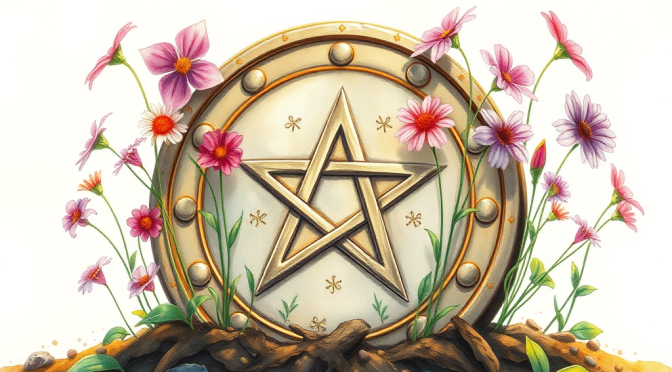
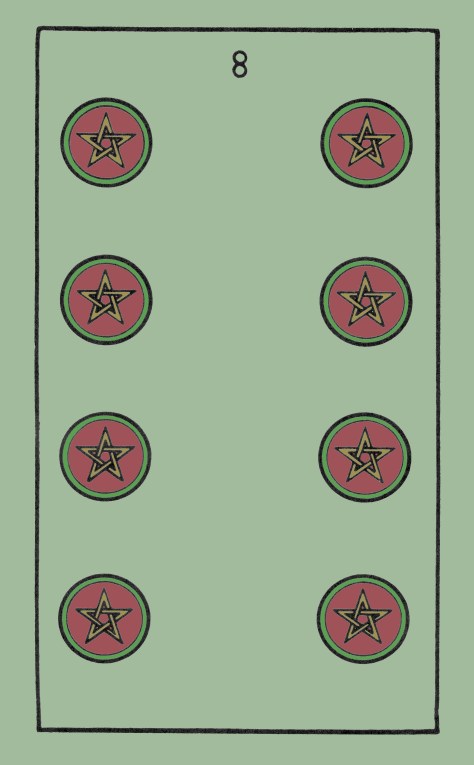
Tarot Encyclopedia – The Eight of Pentacles or Coins

(Note: this is a collection of the meanings attributed to the cards by some occultists in the past centuries. It does not reflect my own study or opinion of the cards. It is only meant as a quick comparative reference as I develop my own take.)

The Eight of Pentacles from the Builders of the Adytum (BOTA) tarot

Paul Foster Case (and Ann Davies)

The time period is the first decanate of Virgo, under the rulership of Mercury, from August 23 to September 2. Meanings:
Well-Dignified: skill in the management of material affairs; industry; gain in subordinate positions through writing, clerical work or travel; gain of ready money in small sums.
lll-Dignified: avarice and hoarding; penny wisdom and pound foolishness; meanness in money matters; loss through travel or writings; the Querent is likely to be in difficulties with superiors and also with inferiors; he may lose through trying to overreach somebody else.
Keyword: Prudence
(From the Oracle of Tarot course)

A. E. Waite

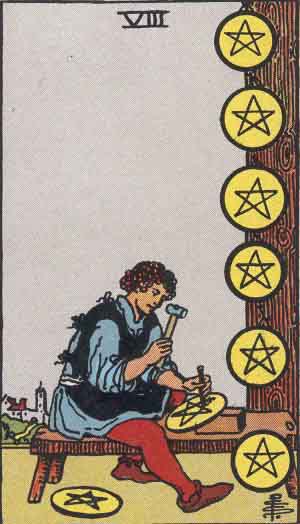
An artist in stone at his work, which he exhibits in the form of trophies. Divinatory Meanings: Work, employment, commission, craftsmanship, skill in craft and business, perhaps in the preparatory stage. Reversed: Voided ambition, vanity, cupidity, exaction, usury. It may also signify the possession of skill, in the sense of the ingenious mind turned to cunning and intrigue.
(From The Pictorial Key to the Tarot)

The Eight of Pentacles from the Rider Waite Smith tarot

Aleister Crowley

The Eight of Disks is called Prudence. This card is a great deal better than the last two [Eights], because, in purely material matters, especially those relating to actual money, there is a sort of strength in doing nothing at all. The problem of every financier is, first of all, to gain time; if his resources are sufficient, he always beats the market. This is the card of “putting something away for a rainy day”.

[…]

The number Eight, Hod, is very helpful in this card, because it represents Mercury in his most spiritual aspect, and he both rules and is exalted in the sign of Virgo, which belongs to the Decan, and is governed by the Sun. It signifies intelligence lovingly applied to material matters, especially those of the agriculturalist, the artificer and the engineer.

One might suggest that this card marks the turn of the tide. The seven of Disks is in one sense the fullest possible establishment of Matter-compare Atu XV-the lowest fallen and therefore the highest exalted. These last three cards seem to prepare the explosion which will renew the whole Cycle. Note that Virgo is Yod, the secret seed of Life, and also the Virgin Earth awaiting the Phallic Plough.

The interest of this card is the interest of the common people. The rulership of the Sun in Virgo suggests also birth. The disks are arranged in the form of the geomantic figure Populus. These disks may be represented as the flowers or fruits of a great tree, its solid roots in fertile land.

In the Yi King, Sol in Virgo is represented by the 33rd Hexagram, Thun, “Big Air”. It means “retiring”; and the commentary indicates how best to make use of that manoeuvre. This is congruous enough with the essence of Virgo, the secret withdrawing of Energy into the fallow Earth. Populus, moreover, is the Moon retiring from manifestation to her conjunction with the Sun.
(From The Book of Thoth)

The Eight of Disks from the Thoth tarot

Golden Dawn’s Book T

A WHITE Radiating Angelic Hand, issuing from a cloud, and grasping a branch of a rose tree, with four white roses thereon, which touch only the four lowermost Pentacles. No rosebuds even, but only leaves, touch the four uppermost disks. All the Pentacles are similar to that of the Ace, but without the Maltese cross and wings. They are arranged like the geomantic figure Populus:

* *
* *
* *
* *

Above and below them are the symbols Sun and Virgo for the Decan.
Over-careful in small things at the expense of great: “Penny wise and pound foolish”: gain of ready money in small sums; mean; avaricious; industrious; cultivation of land; hoarding, lacking in enterprise.
Hod of HB:H (Skill: prudence: cunning).
Therein rule those mighty Angels HB:AKAYH and HB:KHThAL

Etteilla

Brunette Girl
Upright. This card, as far as the medicine of the spirit is concerned, means, in its natural position: Brunette Girl, Passive, Great Night.
Reversed. Empty aspiration, Avarice, Usury.

MQS

Playing Cards That Indicate Stability

Let’s move on with our look at the playing cards divided by concept. This time, we see which cards represent stability.

Ace of Hearts
The Ace of Hearts, like in many systems of reading playing cards, represents the home. It is a symbol of durability and stability, since houses tend to be stable things that don’t change. Mostly, the Ace of Hearts symbolizes the house or the family, however, when describing someone’s character, for instance, it shows them to be family-oriented, looking at stabilizing their life, being rooted in traditional values, etc.

Four of Hearts
The Four of Hearts usually brings agreement in all fields of life. However, the type of agreement it shows is effortless, and it resembles more a state of peace where the waters aren’t ruffled (and if they are, the waves calm down immediately). Usually this card indicates harmony, harmonious surroundings and ease.

Six of Hearts
Unlike the previous two cards, the Six of Hearts, which represents such things as reconciliation, healing, etc. does often imply the presence of some disturbing factors (though not necessarily. We need to look at the spread as a whole), but it shows that these disturbing factors, such as a break-up or a disagreement, can and probably will be overcome, returning the situation to its previous stability.

Ten of Hearts
The Ten of Hearts is one of the most powerful in the deck, as it is often capable of diminishing the negative impact of negative cards. Since it is symbolic of paradise, heaven or ultimate attainment of one’s happiness, it hints at a situation either being stable (and happy) or becoming stable (and happy). When it is followed by very negative cards, though, it can show this paradise being lost. In fact, it is sometimes a bad sign when we find the Ten of Hearts at the beginning of the spread without other strong cards, because it shows that the best is already in the past.

Three of Clubs
The Three of Clubs brings union and unity. It causes situations or people to become locked in place, usually by signing contracts, celebrating a marriage of making a commitment to each other or doing things together. Sometimes it can show that a situation perseveres (it remains married to us).

Six of Clubs
A somewhat obnoxious card, the Six of Clubs isn’t tragic, but it brings disturbance. It shows situations that have lost their momentum, and problems that we thought we had overcome reemerging. It shows a sort of static discontent with no disruption in sight, either for good or bad, unless other cards clearly show it.

Nine of Clubs
This is the card of distance, either in terms of miles or in terms of time. As such, it lengthens out the timeframe, but unlike the Six, the Nine of Clubs has no negative undertones, except in the sense that often we want all the good in the world to happen to us quickly, and this card stalls us for some time. However, it can also make a good situation last longer.

Four of Diamonds
Unlike the Four of Hearts, which shows effortless stability and agreement, the Four of Diamonds represents agreement following either tensions or negotiations. Thus it represents all things to do with bureaucracy and the government that seek to regulate life and make it more stable within the borders of a country.

Ten of Diamonds
Of the Ten of Diamonds we can say something similar to the Ten of Hearts, except that the success promised by Diamonds tends to be more material, and doesn’t necessarily imply happiness. However, it does represent situations that have developmed to their utmost in a positive sense and have reached their aim.

Five of Spades
Being the card of prison, the Five of Spades symbolizes constraints, blockages and the need to make great sacrifices. As such, it means that the person (symbolized by the central pip, hemmed in by the four other pips at the corners) cannot move and is bound to a situation. Usually this is in a negative sense. Even when surrounded by positive cards, thus showing a positive commitment, it still indicates a certain sense of being stifled.

Six of Spades
The Six of Spades is the card of illness, and it shows all situations that are ill, broken, suffering, etc. In itself it is not the most tragic card in the suit, but it represents a state of suffering stillness, which may be overcome or lead to disruption, depending on the cards that follow this one.

MQS

A Quirk of the Thirteen-Card Spread

The last thirteen-card spread I posted was interesting for a couple of reasons. One reason I already talked about: the need to be flexible with significators.

Another reason is that it showcases what I suspect to be an interesting quirk of the thirteen-card spread. This is a purely experimental anecdote, so take it with a pinch of salt, but I have found it to be true on more than one occasion.

The quirk is that, in the thirteen-card spread (which I discussed here), the rows seem to be connected not just one after the other, but also alternately, i.e., the first row with the third row and the second row with the fourth row.

I cannot stress this enough: this is NOT a rule, it is simply something I have found to be true on occasion. There are situations where the thirteen-card spread is perfectly smooth from start to finish, reading like a little story with a beginning, a middle and an end. In this sort of situation we don’t need to pair up the rows 1-3 and 2-4.

However, sometimes we can recognize snippets of story mixed together in an odd way. I have found that pairing odd rows together and then even rows together can help sort these snippets out, giving them a more logical order.

In the example of the spread I posted, the second and fourth rows seemed to talk more about material issues, whereas the first and third were more centered on the person’s emotional life. Pairing them odd-with-odd and even-with-even, the spread became more clear.

If the spread is talking about more than one issue at once (which can happen), then this kind of pairing often makes sense. However, sometimes it makes sense even if there is only one topic in play, and this particular case the rows that we pair up talk about subtopics within the same topic.

It may be that this technique simply stems from my limitations as a reader, so that I find ways to circumvent difficulties in the interpretation of the spread. Still, I found this to be accurate enough to bring up, in case anyone wants to experiment with it.

Finally, it may simply be that we need to be very flexible with the rows, and take for granted that they may pair up in unlikely ways. Who knows, maybe I’ll find that the first and fourth row really go well together in some readings. The point is always that the techniques we apply need to shed light on the querent’s life, not simply add flourishes and complications to the interpretation.

MQS

Three Decks For One Inheritance (Example Reading)

We did a little experiment with a friend. She wanted to know if the bureaucratic process to get the inheritance from the recently deceased grandfather would finally come to an end, since there had been several delays (leave it to the Italian bureaucracy). We started with the Sibilla.

Sibilla

A three card reading with the Vera Sibilla

In this case, the Handmaid reversed indicates money going out (of the querent’s wallet). The Sighs card simply indicates that the person worries they’ll have to pay money. The Ten of Hearts here is not a positive influence, because it is a card that makes the uncertain certain (in the context of a trial, for instance, it might indicate the sentence being decided). So in this case the worries shown by the Sighs are confirmed.

I asked my friend if she was worried about having to pay some extra money, and she said that this was her and her dad’s worry, but that they had looked into inheritance law and thought they were safe and wouldn’t need to pay . Clearly the Sibilla begs to differ.

Playing cards

A three card reading with regular playing cards

In this case we don’t have the querent’s state of mind (which the Sibilla talked about). However, we do have, once again, the loss of money, indicated by the Three of Diamonds being covered by the Ace of Spades. The Ace of Hearts shows us that the money going out is due to family issues, something which was absent from the Sibilla.

Skat cards

A three card reading with the Skat / Piquet deck

I decided to make an experiment with the Skat cards as well, just for kicks. The Eight of Diamonds is technically the card of work. However, if I understand the meanings correctly, it represents work because it shows the flow of money, money being exchanged. So it can represent, more broadly, the economy. With the Seven of Clubs, which indicates tears, the economy will take a hit. The King of Spades might be the office worker who will give the querent the news.

A week ago they received news that they needed to pay an extra 3000€ to unfreeze the granddad’s money. My friend doesn’t know if the office worker who worked on their case was a man (the King). Still I think the Skat cards were rather accurate.

MQS

My New (Old) Lenormand Deck

I was accompanying hubby to the optometrist in another city, when we came across one of those easily overlooked book shops selling second-hand books. And right on display was this deck (I’ll do a flip-through video soon):

An old Lenormand deck

Also, get a load of this: the backs are completely plain, like in days of yore!

The cards’ back

The deck came with a book. The author gives off German Mary Greer vibes, in the sense that he published on a variety of topics while trying to appeal both to the casual as well as to the psychotically fixated at the same time.

However, being an old book (I believe it came out in 1992 or so) I was hoping for less psychology. He has the (suspicious to me) tendency to read way too much into the symbols, bringing in Freud, among others. He also tries to combine the meaning of the skat cards with that of the symbols, with mixed results. Sometimes it makes sense, sometimes it doesn’t.

But this is only from leafing through the book cursorily. Maybe I’m judging him too harshly. An interesting thing is that he uses the Grand Tableau / Große Tafel in the less known 6×6 variant.

However good or bad the book may be, I only bought it because it was attached to the deck, which is lovely, and the set cost only a little over 5€. The deck has an old-timey feel to it. Some of the symbols are a bit hard to see. For instance, the Clouds look more like a sea, and the Mice are actually a single mouse which almost disappears in comparison to the pudding and wine he is stealing: while looking at the card I was thinking “Wait, did the Lenormand deck have a Bistro card?” Oh well, at least the mouse doesn’t have to share the wine with the others.

Still a really cute deck and a good buy. I am not planning on studying the Lenormand deck soon (I have way too many irons in the fire) but I just couldn’t resist it.

MQS