Most systems of divination can also be used to explore esoteric topics. For instance, I have answered the question “have I been hexed?” way more than I would like. The answer is no 95% of the times. Only two times in my life have I sent someone straight to see a priest because something supernatural was objectively at play. Most of the times, people use dark magic as a scapegoat to rationalize natural periods of bad luck.
Of the the two times I did detect a curse I can only find records of one (my notes tend to be rather messy). The girl in question asked me if she’d received the evil eye (malocchio). This was the spread:
10♠ – 5♠ – 5♥ – J♠ – Q♠
I added two cards to the queen, and I got the Q♦ and the 2♥. The reading is quite obvious: a woman cursed her (the Queen of Spades with the Jack) on behalf of a relative (the Queen of Diamonds and Two of Hearts) though probably not a blood relative. The Ten and Five of Spades, when read together with the other spades, indicate the use of negative occult powers, probably at night.
The Five of Hearts in the center of the spread probably showed the sector of the querent’s life that was impacted by the curse: the ‘abundance’ sector. The young woman had lost a ton of weight in a short timeframe, she looked wasted, had started losing her hair and her beauty, had started developing money problems (in that she couldn’t retain any money she made). Her significator is absent, meaning she was completely passive to the hex.
It seems her mother-in-law had gone to see a country witch to try to harm her. This is far more troublesome than the evil eye, which sometimes can even be cast inadvertently without a ritual. The hex was broken by a priest, or rather, thanks to a priest who put her in contact with a monk specializing in this kind of stuff.
I’m bringing up the topic because I was recently asked the same question by a friend of mine who is going through a rough patch (lost her job, broke up with her boyfriend, argued with her sister, etc), which she believed was due to some ‘bad vibes’ or the malocchio. The spread was:
3♠ – 6♣ – Q♣ – 7♠ – 5♦
This time we have the querent in the middle of the spread. This, coupled with the fact that there are no combinations of curse, is encouraging: the querent has not been displaced from the center stage of her life.
The cards are negative, but they don’t reference supernatural phenomena: the Three of Spades could indicate curses or evil eye in combinations, but here there is no such combo, so it just indicates problems, things that don’t go smoothly. The querent is surrounded by the Six of Clubs and the Seven of Spades, the latter showing unfortunate events, the former reiterating the idea of difficulties. The Seven of Spades connects to the Five of Diamonds to indicate a period of misfortune, that is, of natural bad luck, which will pass (there will be change, it won’t stay that way forever).
In Medieval and early modern times, Astrology was everything. Being a natural consequence of the philosophical worldview tolerated by the church (that is, Aristoteleanism), Astrology was not seen, strictly speaking, as a Bible-prohibited practice, but merely as an extension of the science of the day. Though it always had its detractors, it was generally accepted. Therefore it was normal to try to astrologize everything.
We’ve already discussed geomantic perfection. This takes place thanks to something resembling aspects. But some old books go a step further and seek to introduce the actual astrological aspects of the time into geomantic practice.
In Astrology, an aspect happens when two planets occupy the same degree in different signs: a sextile happens to planets that are 60 degrees apart (e.g., Venus at 10 Aries and Jupiter at 10 Gemini); a square is between planets that are 90 degrees apart (e.g. Venus at 10 Aries and Jupiter at 10 Cancer); a trine is between planets that are 120 degrees apart (e.g., Venus at 10 Aries and Jupiter at 10 Leo); an opposition is between planets that are 180 degrees apart (e.g., Venus at 10 Aries and Jupiter at 10 Libra)
Aspects are key to astrological perfection. They show the things signified by the planets coming together, with sextile and trine indicating good contact on one hand and square and opposition showing bad or difficult contact. For instance, if in a love question my significator aspects my love interest’s significator, it shows us coming together. If by trine, we get along, if by square we argue.
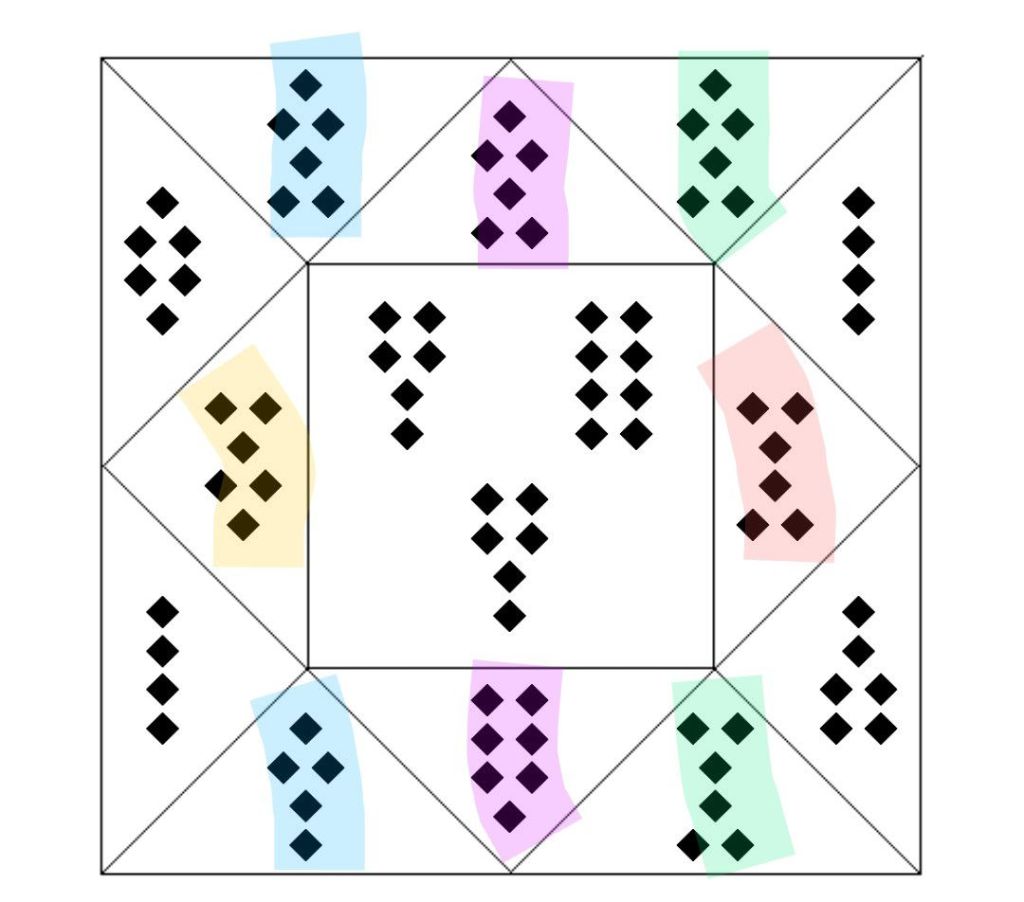
In geomancy, astrological aspects have been adapted to the chart as follows:
Astrological aspects in Geomancy (App used: Simple Geomancy)
If we take the figure in the first house (marked in yellow) as a reference point, then the figures in blue sextile it, because they are separated from it by a single sign; the figures in purple square it, because they are separated from it by two houses; the figures in green trine it because they are separated from it by three houses, and the figure in red opposes it, since it occupies the houses directly opposite.
This is supposed to shed some light on the relationship between the figures: two figures that fall into a square pattern have a difficult relationship, two figures in a trine a good one, etc.
The problem with using astrological aspects in Geomancy is that aspects work in a fundamentally different way: in Astrology, an aspect requires a planet to move in order to apply to another planet. After perfection, then, the aspect separates and its effect wanes.
Geomancy, though, is a static system with no real movement. Sure, we can say a figure moves from one house to another, but in reality that figure is already present in both houses. The only way to conceptualize movement in a geomantic chart is when we take a significator’s house to be the original position of the figure in it, and every other instance of that figure as a successive movement (e.g., in a career reading, if Laetitia is in the tenth house and in the seventh, we take it to move from the tenth to the seventh and not vice versa).
I am honestly not convinced that astrological aspects can find a meaningful place in geomancy. They certainly cannot bring matters to perfection, otherwise everyone would always be separating from their partner since the figure in the seventh house always opposes the figure in the first. Similarly, everyone would always get along with their siblings since the third house always sextiles the first.
One possibility which has been suggested is that of applying aspects only to figures that move. In a love reading, for instance, if the seventh figure moves to the tenth, it moves to square the querent, since the tenth house squares the first.
I personally find this application also problematic, because the tenth house represents the job, among other things, so that would mean that everytime the querent’s job is involved in their love life it causes trouble, which is a false assumption.
At most, I would take an aspect into consideration only if BOTH significators move. In the hypothetical love reading, for instance, if the first figure (querent) moves to the fourth house and the seventh (significant other) moves to the tenth, then they are in opposition to one another. Maybe they will argue. Or, if the first moves to the fourth and the seventh to the second, they sextile each other, which is good.
Even in a situation like this I am generally cautious about applying this theory. There are certain aspects of Astrology (pun intended) that simply don’t translate well to other systems of divination. You are of course welcome to try this theory on for size, but personally I believe Geomancy already has its particular version of aspects, and throwing other stuff into the mix feels more like an attempt at complicating this “brief and simple science” to find something more to tell the querent.
I’m currently studying horary astrology under Chris Warnock’s supervision. He puts a great deal of emphasis on studying old sources, which is perfect for a guy like me who breaks out in hives when occultism is boiled down to “just wear a deep knowing expression, drink herbal tea and let the ascended masters guide your intuition.”
Geomancy is similar to horary astrology in that it allows you to answer questions, though it is less dependent on the time the question is asked. It is also similar in that you need to go back to really old books in order to study it seriously.
When reading premodern sources we always run a couple of risks:
Unless they’ve been edited and discussed by a modern, they are probably written in a language that is not our own, or, even if it is, it’s an old version of it. This makes room for misunderstanding.
More subtly, the world in which the author lived and wrote is not our world: it has different cultural, political and spiritual reference points.
The source is written by someone who is just as fallible as we moderns (or rather postmoderns) are.
If one thing that grinds my gears is when people just turn occultism into their little escape from reality (“I wanna believe the world is magical but I’m too special for Christianity”), the other thing that equally grinds my gears is when people desperately seek a doctrine to follow blindly just because it happens to run against the Zeitgeist.
An occultist (and divination is a branch of occultism, though we often forget it) must be capable of being equally distant from intellectual lassitude and fanaticism, from scientism and religion. It takes a particular temperament that most people don’t possess, and I say this in a neutral sense: most people simply don’t have the temperament for most things, which is why only few people in any generation do any one thing.
Point three on the list is what I’m referring to here. The few on the occult path who have what it takes to move beyond the sanitized, advertiser-friendly version of occultism that gets tarot readers invited to corporate meetings often run the contrary risk: that of believing “if something says the opposite of what we hear everyday in our decadent world, it must be true and I must worship at its altar.”
When reading old sources (and I’m talking about geomancy, but it could refer to any other branch) this can turn us into fanatics if we don’t constantly remind ourselves that a book, even in the old days, could be written for a variety of reasons:
to pass on important knowledge (but still from the author’s limited perspective)
to record your experience
to help others
as a publicity stunt
to impress others
to confuse others
a mix of all the above
Furthermore, old authors are just as capable as modern ones of believing crap. As such, while it is vital to question our own worldview, it is also just as vital to question all others. The moment you are asked (or you feel like you ought) to stop questioning is exactly the point where prejudice has crystallized, be it yours or someone else’s. It is also the point where you can break new ground if you proceed cautiously and with intelligence.
All this is to say, old books are treasure troves of information that we can study, learn from, adapt sensibly to our current needs, and much more. But if you are looking for a new Bible, you’re better off sticking to the old one.
Daily readings are not always very clear, for a couple of reasons. First, since we don’t live in an action movie, not every day is the setting of some memorable event. Second, the cards could sometimes bring up a minor situation that we barely pick up on. Third, I have personally found in my practice that torturing the cards for daily glimpses is not always a good idea, if done systematically, as sometimes it causes me to feel I’m losing my connection with the cards. That’s why I only draw three cards for the day every once in a while, when I feel inspired to.
Today was one such day, and it was very clear:
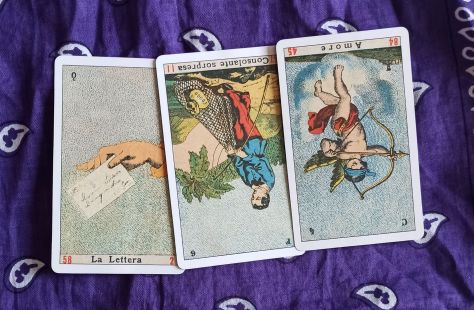
Daily vera sibilla reading
The cards talked about a communication reaching me, but that was the extent of my interpretation. I did not try to read further into it, because what is valid for a general reading is not always valid in a daily reading, where the interpretation needs to often be toned down.
If I were to interpret these cards for someone in a regular reading, I would tell them that their partner would communicate to them that they no longer have anything in common and it’s over. The Surprise, The Six of Clubs, represents, when upright, all situations that flourish easily, and therefore it shows compatibility, while, when reversed, it represents falling out of love due to growing apart.
Well, this is exactly what happened today. Only, not to me. I was the one who received the communication, but not from my husband. I received it from a friend who told me she and her partner were breaking off their relationship, because “they don’t even recognize each other anymore”
When I was a teen, I remember stumbling upon Aristotle’s definition of the “educated mind” as being able to hold a thought without accepting it, and I remember thinking how silly and basic the definition was. The older I get, the more I find myself agreeing with him, as I see fewer and fewer people capable of doing it (the fact that Aristotle never actually wrote the sentence is a whole ‘nother can of worms)
A lot of people don’t have an educated mind per the definition above. One would like to think that tarot readers, astrologers and the like would not be like a lot of people, seeing how much the word “wisdom” gets thrown around in their circles. But one would be wrong. Leave it to the “spiritual community” to be among the most ideological and stiff. And, consequently, not among the brightest. If there is a group of people I don’t trust to be capable of holding any thought except the ones they agree with, that’s these people.
I believe I already talked a little about this, but one of the most memorable examples I can think of is the 2016 US election, when every tarot reader on youtube and their mom were busy predicting Trump would lose the election disgracefully, poop his pants, writhe on the floor, throw a tantrum and retreat into the hell that spawned him while Hillary Clinton swung her throbbing, veiny, 25 inch hard-on at the glass ceiling. While I am slightly exaggerating, this was pretty much the tone. (interestingly, those same readers routinely claim that the tarot is not for fortune-telling)
One such reader went as far as channeling Trump’s character. I do not remember the exact spread, nor most of the cards, but two things stuck with me: first, no egregiously bad card showed up, and second, the King of Cups featured prominently in the spread. She interpreted the card as Trump being a violent man prey to his base emotions and instincts. I took a quick look at some of that reader’s other videos, only to discover that she never, ever interpreted the King of Cups this way. In fact, she always interpreted it as the significator of a good man who takes care of the querent.
This is a good time to point out that I am fiercely apolitical, so this is not about politics. All ideologies are, as far as I am concerned, clouds over the mind’s clarity. I’m not saying everyone needs to think like me. Everyone has their delusion of choice, and everyone (including me) has their way of slanting reality in one direction or the other, whether politically, spiritually or philosophically (or even scientifically, for that matter). In fact, slanting reality is probably needed in order to filter information that might be useful to us.
Yet divination should be something else. What that reader did was merely using the cards as a mirror of her own (perfectly legitimate) bias. This is fine, and can even be useful at times–if you are aware that you are doing it. Even that would not be actual divination, but at least it wouldn’t be a waste of time.
I already discussed that divination is really a process of deification, that is, the process of allowing the dispassionate, bird-eye view clarity of the divine into one’s limited, subjective world by letting new information in. In other words, true divination is the opposite of retreating into one’s bubble: it’s the bursting of the bubble.
This, in turn, requires a certain readiness to accept the information we get (which is why it is always best to get someone you don’t know to read your cards.) Divination without intellectual honesty is just a crutch for one’s ego, and that’s how it is currently being used by the vast majority of diviners.
Unfortunately, intellectual honesty won’t make you many friends. Back in 2016 I had arguments with more tarot readers than I care to remember and was routinely labeled a dangerous extremist just because I called into question the usefulness of this type of reading (back then I still tried to entertain fruitful conversations with people). But occultism, in all its branches, is a narrow path.
Two lessons from all this: 1) if you are reading for yourself and the cards (or chart, or dice, or whatever) seem to confirm what you already think or wish, apply a bucketful of salt to the reading; 2) invest some money into a simple handbook of logic, or at least expand your knowledge of logical fallacies. This will repay you many times over, regardless of what branch of sorcery you practice.
(Note: this is a collection of the meanings attributed to the cards by some occultists in the past centuries. It does not reflect my own study or opinion of the cards. It is only meant as a quick comparative reference as I develop my own take.)
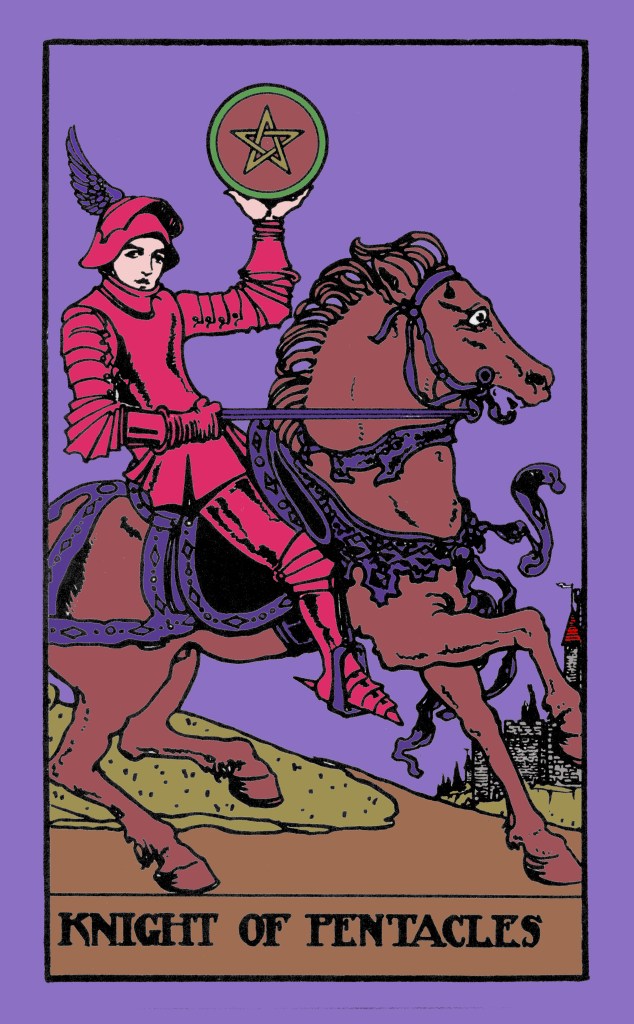
The Knight of Pentacles from the Builders of the Adytum (BOTA) tarot deck
Paul Foster Case (and Ann Davies)
The time period is from the beginning of the third decanate of Leo to the end of the second decanate of Virgo, August 13 to September 12. This period is under the rulership of Mars, Mercury and Saturn. Meanings: Well-Dignified: ability to use actions effectively; good mind, able to see through the veils of sense experience to their true import. In specific divination, a man younger than the King and though intelligent, somewhat matter-of-fact; not original or imaginative; good at carrying out any plan calling for intelligent action on the physical plane. Ill-Dignified: avaricious, mean, jealous, somewhat violent and cruel. Dark brown hair and dark eyes. (From the Oracle of Tarot course)
A. E. Waite
He rides a slow, enduring, heavy horse, to which his own aspect corresponds. He exhibits his symbol, but does not look therein. Divinatory Meanings: Utility, serviceableness, interest, responsibility, rectitude-all on the normal and external plane. Reversed: inertia, idleness, repose of that kind, stagnation; also placidity, discouragement, carelessness. (From The Pictorial Key to the Tarot)
Aleister Crowley
(Note: Crowley and the Golden Dawn make a mess with the Kings and Knights) The Prince of Disks represents the airy part of Earth, indicating the florescence and fructification of that element. He rules from the 21st degree of Aries to the 20th degree of Taurus.
The figure of this Prince is meditative. He is the element of Earth become intelligible. Clothed in light armour, his helmet is crowned with the head of a bull; and his chariot is drawn by an ox, this animal being peculiarly sacred to the Element of Earth. In his left hand he holds his disk, which is an orb resembling a globe, marked with mathematical symbols as if to imply the planning involved in agriculture. In his right hand he bears an orbed sceptre surmounted by a cross, a symbol of the Great Work accomplished; for it is his function to bring forth from the material of the element that vegetation which is the sustenance of the Spirit itself.
The character denoted by this card is that of great energy brought to bear upon the most solid of practical matters. He is energetic and enduring, a capable manager, a steadfast and per severing worker. He is competent, ingenious, thoughtful, cautious, ‘trustworthy, imperturbable; he constantly seeks new uses for common things, and adapts his circumstances to his purposes in a slow, steady, well-thought out plan.
He is lacking almost entirely in emotion. He is somewhat in sensitive, and may appear dull, but he is not; it so appears because he makes no effort to understand ideas which are beyond his scope. He may often appear stupid, and is inclined to be resentful of more spiritual types. He is slow to anger, but, if driven, becomes implacable. It is not very practicable to distinguish between the good and evil dignities in this card; one can merely say that, in case of his being ill-dignified, both the quality and quantity of his characteristics are somewhat degraded. The reaction of others to him will depend almost entirely upon their own temperaments.
In the Yi King, the airy part of Earth is represented by the 53rd hexagram, Kien. The commentary concerns the flight of wild geese, “gradually approaching the shore”, then “the large rocks”, then “advanced to the dry plains-the trees-the high ~ finally, to “the large heights”. It thus symbolizes slow, steady emancipation from repressive conditions.
The description is even happier than that given by the Qabalah, although in every way congruous with it. Practical considerations are never absent from Chinese thought, even at its most abstruse and metaphysical. The fundamental heresy of the Black Lodge is con tempt for “the world, the flesh, and the devil”, all which are essential to the plan of the Universe; it is cardinal to the Great Work for the Adept so to order affairs that “even the evil germs of Matter shall alike become useful and good”.
The error of Christian Mystics on this point has been responsible for more cruelty, misery, and collective insanity than all others put together; its poison can be traced even in the teaching of Freud, who assumed that the Unconscious was “the devil”, whereas in fact it is the instinct which expresses, beneath a veil, the inherent Point-of-View of each, and, properly understood, is the key to Initiation, and a hint of what seed may blossom and fructify as the “Knowledge and Conversation of the Holy Guardian Angel”. For “Every man and every woman is a star”.
But no doubt the judgment of the Adepts Exempt (for it is they who determine, under the guidance of the Masters of the Temple, all such details of doctrine) in respect of this card has been influenced by its transition from Aries to Taurus. It is too often forgotten that Taurus is the House of Venus, and that Luna is exalted therein. The new doctrine set forth in this present Essay makes the primary colour of Earth not black, but green; it insists that every Disk is a living and revolving symbol. The central thesis of the Book of the Law asserts the Perfection of the Universe. In its pantheistic conception all possibilities are equal in value; each and every Point-Event is “a play of Nuit”, as it is written in the Book of Wisdom or Folly, “Bind nothing! Let there be no difference made among you between any one thing & any other thing; for thereby there cometh hurt. But whose availeth in this, let him be the chief of all!” Liber Al. 1. 22. Or, yet more comprehensively and simply: “Every number is infinite; there is no difference.” Ib I.4. (From The Book of Thoth)
Weirdly adorable AI generated illustration for the Knight of Coins
Golden Dawn’s Book T
A WINGED Kingly Figure seated in a chariot drawn by a bull. He bears as a crest the symbol of the head of the winged bull. Beneath the chariot is land, with many flowers. In the one hand he bears an orb of gold held downwards, and in the other a sceptre surmounted by an orb and cross.
Increase of matter. Increases good or evil, solidifies; practically applies things. Steady; reliable. If ill dignified he is selfish, animal and material: stupid. In either case slow to anger, but furious if roused. Rules from 20 Degree Aries to 20 Degree Taurus. Air of Earth
Etteilla
Utility Upright. This card, as far as the medicine of the spirit is concerned, means, in its natural position: Useful, Advantageous, Gainful, Profitable, Interesting. – Interesting, Important, Necessary, Obligatory. Reversed. Peace, Tranquility, Rest, Sleep, Apathy, Inertia, Rest, Inactivity, Unemployment. – Leisure, Pastime. – Recreation, Carefreeness, Indifference, Indolence, Laziness, Poltrony, Numbness, Discouragement, Annihilation.
I don’t remember if I already talked about a reading I did for myself some time ago. I was expecting a parcel but needed to go somewhere else, so I asked the cards if the package would come on that day. The cards clearly answered in the negative, and I was right: I went out, and the parcel arrived the day after.
Thinking back on this, I was reminded of an experience reported by famous British astrologer John Frawley. I cannot remember if he discusses it in The Real Astrology or in his Horary Textbook, but it goes somewhat like this: he was waiting for some repairman to come to his house, but he also wanted to take a relaxing bath, so he cast a horary chart to know when the guy would come, only to discover that he wouldn’t. So he slipped into the bathtube, and his prediction proved correct
I believe this kind of readings is the most fun and instructive on the nature of divination. Ultimately, divination is intelligence-gathering. Sentient beings organize their behavior based on the information available to them. Therefore, new information is bound to change the being’s behavior.
The more complex the organism, of course, the more factors come into play, but the basic principle remains true. This is not to say that anything is possible, because only someone with infinite knowledge would know how to overcome all kinds of situations he or she finds unpleasant. We humble mortals are always restricted by difficult circumstances. Still, the information we gather through divination is not, in principle, different from the one we gather through other means which are all just as imperfect.
A fatalist might try to defend the idea of an all-encompassing destiny by arguing that the prediction is itself part of the person’s fate. I was destined to pull those cards and go out. But this stance, interestingly enough, invalidates the idea of prediction itself. If everything is destiny, then even knowledge that everything is destiny is destiny, rather than the truth.
I believe that divination is not simply communication with the divine, but also a form of deification: if we take God on one hand, that is, someone who is capable to be the pure consequence of its own choice, and a rock on the other, that is, something that simply passively receives whatever action external forces exert on it, then divination moves us closer to the divine condition of being the consequence of our own choice.
This is also why I am skeptical of airy-fairy forms of divination that try to take the focus away from concrete life in the name of some vapid divine idea. Ultimately, there is far more divine depth to Frawley’s ability to take a bath thanks to a horary chart than there is to questions like “How can I embody the divine feminine and honor my ancestral heritage more fully?”
It is well-known that the Sibilla is damn chatty, sometimes too much. Every deck can veer off topic if it needs to, but the Sibilla has a penchant for it, whereas, for instance, regular playing cards are usually easier to keep on a leash. Still, I believe what I’m about to show would have popped up with any other deck, since the cards usually warn us of unexpected happenings, whether positive or negative. This is a spread we did for a friend of mine in January. He wanted to know about his love life.
Vera Sibilla Reading, my friend’s misadventure
The thing that immediately struck me is that the cards clearly were not talking about my friend’s love life. Instead, judging by the first line, they were depicting something difficult that was going to happen. I must confess I was not capable of organizing my garbled thoughts into a coherent prediction back then, even though looking at it now it seems obvious. I believe a part of me knew what the cards were talking about but didn’t want to give the news to my friend. I knew the cards were talking about danger at the hand of some people, and that a man would help him. I told him so much, but of course this was too vague to be of help.
Here is what happened around a month later, as told by the cards. While out of his house (Journey) he was attacked (Widower reversed. I made a mistake in reenacting the spread) by a small gang of criminals (Enemy, Fools). Fortunately (Levity reversed) a man saw the whole thing, chased off the strangers and helped my friend (Friend reversed, Fortune reversed). My friend sprained his ankle badly, I’m guessing this is why the Fortune card is reversed, showing delayed fortune, but is otherwise unharmed, except the anxiety (Sighs).
I think part of the problem of reading for friends is that, because you don’t want them to come to any harm, your mind tends to censor you a bit. Still, an interesting case study, and a story that could have ended much worse.
(Note: this is a collection of the meanings attributed to the cards by some occultists in the past centuries. It does not reflect my own study or opinion of the cards. It is only meant as a quick comparative reference as I develop my own take.)
The Knight of Wands in the Builders of the Adytum (BOTA) tarot deck
Paul Foster Case (and Ann Davies)
Astrologically the Knight of Wands includes the time period from the third decanate of Scorpio through the second decanate of Sagittarius, November 12 to December 11, representing, as we have seen, the combined influences of the Moon in Scorpio and of Jupiter and Mars in Sagittarius. In Divination we find the more specific meanings of each Key, but always remember that as advanced B.O.T.A. members, treading the Path of Return, you must use this art with discretion. It is best not to give querents for your help too specific instruction. Try to act as an emissary for the Hierophant and give them the principles behind their problems as they are unveiled to you by the sequence of Keys. Leave it to those you are helping to apply universal principles to specific problems in their lives. Well Dignified: an active, generous, impetuous, quickmoving man, younger than the King of Wands. He is secretive, probably interested in the occult, somewhat psychic and mysterious. He is friendly to the querent and may bring him news relating to his enterprises. Ill Dignified: e vil-minded, false, cruel, bigoted, brutal young man (or situation), dangerous or unfriendly to the querent1 s affairs. This card sometimes signifies departure or change of residence. (From the Oracle of Tarot course)
A.E. Waite
He is shewn as if upon a journey, armed with a short wand, and although mailed is not on a warlike errand. He is passing mounds or pyramids. The motion of the horse is a key to the character of its rider, and suggests the precipitate mood, or things connected therewith. Divinatory Meanings: Departure, absence, flight, emigration. A dark young man, friendly. Change of residence. Reversed: Rupture, division, interruption, discord. (From The Pictorial Key to the Tarot)
AI-generated illustration for the Knight of Wands
Aleister Crowley
(note that Crowley and the Golden Dawn made a mess with the knights and kings) The Prince of Wands represents the airy part of Fire, with its faculty of expanding and volatilising. He rules from the 21st degree of Cancer to the 20th degree of Leo. He is a warrior in complete armour of scale mail, but his arms are bare on account of his vigour and activity. He wears a rayed crown surmounted by a lion’s head winged, and from this crown depends a curtain of flame. On his breast is the sigil of To Mega Therion. In his left hand he bears the Phoenix wand of the Second Adept in the Ritual of 5○=6□ of R.R. at A.C.), the wand of Power and Energy, while with his other arm he reins the lion which draws his chariot, the chariot which is fortified by a wheel radiating flame. He rides upon a sea of flames, both waved and salient.
The moral qualities appropriate to this figure are swiftness and strength. But he is sometimes inclined to act on impulse; sometimes easily led by external influences; sometimes, especially in trifles, a prey to indecision. He is often violent, especially in the expression of an opinion, but he does not necessarily hold the opinion about which he is so emphatic. He states a vigorous proposition for the sake of stating it. He is in fact very slow to make up his mind thoroughly on any subject, but always sees both sides of every question. He is essentially just, but always feels that justice is not to be attained in the intellectual world.
His character is intensely noble and generous. He may be an extravagant boaster, while slyly laughing both at the object of his boast and at himself for making it. He is romantic, especially in matters of history and tradition, to the point of folly, and may engineer “stunts” or play elaborate practical jokes. He might select some inoffensive nobody, and pursue him for years with every weapon of ridicule) as Swift tormented the unhappy Partridge, all without the least animus, ready to give the shirt off his back, should his victim be in need. His sense of humour is omnivorous, and may make him a mysterious figure, dreaded without reason by people who actually know nothing about him but his name-as a symbol of Terror.
This is due to the influence of the last decan of Cancer upon this card. One of his greatest faults is pride; meanness and pettiness of any kind he holds in infinite scorn. His courage is fanatically strong, and his endurance indefatigable. He is always fighting against odds, and always wins in the long-the very long-run. This is principally due to his enormous capacity for work, which he exercises for its own sake, “without lust of result”; perhaps his haughty contempt for the world at large-which however coexists with profound and ecstatic respect for “every man and every woman” as “a star”-is responsible for this.
When this card is badly dignified, the character degenerates. Each of the qualities mentioned above is found in its antithesis. There is great cruelty in him, partly sadistic and partly due to callousness arising from indifference-and, in a sense, laziness! So too he may be intolerant, prejudiced and idle-principally because it saves trouble. He may furthermore be an empty boaster and a great coward.
In the YI King, the airy part of Fire is represented by the 42nd Hexagram, Yi, which signifies addition, increase. Full of virtue, and confident therein, he contemplates work of stupendous scope, often with the idea expressed in line 5: “with sincere heart seeking to benefit all below”. In this he may achieve immense success. But this course is fraught with commensurate danger. “We see one to whose in crease none will contribute, while many will seek to assail him. He observes no regular rule in the ordering of his heart”. (line 6) This peril avoided, there come “parties adding to the store of its subject ten pairs of tortoise shells whose oracles cannot be opposed-Let the King employ them in presenting his offerings to God….” (line 2). (From The Book of Thoth) Note: Crowley clearly sees himself in this card, which is why he depicts the Prince as the adorable occult prankster he saw himself as.
Golden Dawn’s Book T
A KINGLY Figure with a golden, winged crown, seated on a chariot. He has large white wings. One wheel of his chariot is shewn. He wears corslet and buskins of scale armour decorated with a winged lion’s head, which symbol also surmounts his crown. His chariot is drawn by a lion. His arms are bare, save for the shoulder-pieces of the corslet, and he bears a torch or fire-wand, somewhat similar to that of the Zelator Adeptus Minor. Beneath the chariot are flames, some waved, some salient. Swift, strong, hasty; rather violent, yet just and generous; noble and scorning meanness. If ill dignified — cruel, intolerant, prejudiced and ill natured.
Etteilla
Departure Upright: This card, as far as the medicine of the spirit is concerned, means, in its natural position: Departure, Displacement, Removal, Absence, Abandonment, Change, Escape, Desertion, Transmigration, Emigration. – Transposition, Translocation, Transplantation, Transmutation, Evasion. Reversed: Disunion, Disagreement, Rupture, Dissension, Division, Competition, Separation, Partition. – Faction, Party. – Complaint, Altercation. – Cut, Fracture, Discontinuity, Interruption.
Not even the best card readers are 100% correct, and I’m far from being the best card reader. This is an example from some time ago. The querent was a woman she asked me, generally, about her finances.
Cartomancy with playing cards – a cross spread about money
Looking at the spread as a whole, it is clear that it’s about money. In the upper position there are money issues highlighted, particularly a sudden (Seven of Spades) expense. The position below, which often needs to be connected to the one above, indicates issues connected with authority, possibly a bank or other financial institution (the King of Spades and King of Diamonds). In the past position we have a situation of slowness and difficulties for a long time, while in the heart position there are difficulties, possibly either obtaining something or getting it back (the Six of Hearts can mean that) or just simply difficulties finding one’s footing.
I ask the querent and she tells me that she’s a small business owner and business has been slow, and she’s been having trouble applying for financial help in the form of loans to renovate her business (note the Six of Hearts) and make it more appealing.
Encouraged by how responsive the spread seems to be, a look at the future positions. This is where I got everything wrong. I tell her that, although there is trouble (Six of Spades) she will get a positive answer (the last fan with the Three of Clubs and the Jack of Hearts). Looking back it is quite obvious the cards were saying something else.
She didn’t get the loan. The fan with the Six of Spades is not positive at all, even though I had decided to interpret it positively: it merely shows she will be quickly (Two of Hearts) refused the loan, possibly because she is not deemed to have her finances in order.
However, she later did end up partnering (Three of Clubs) with another woman (Queen of Diamonds) to start something new (Jack of Hearts).