Category Archives: Divination Master Post

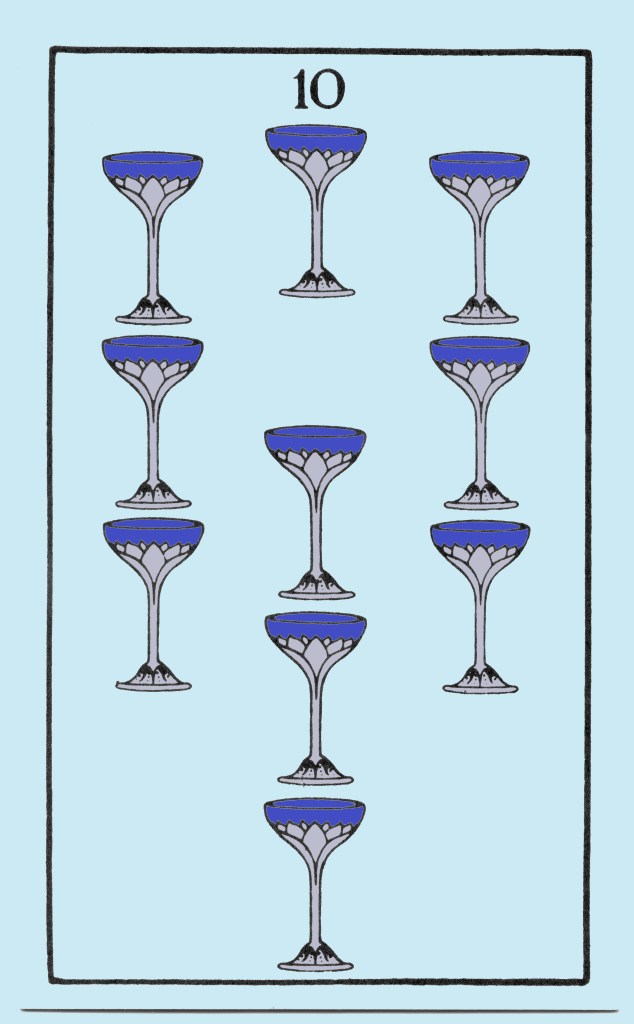
Tarot Encyclopedia – The Ten of Cups

(Note: this is a collection of the meanings attributed to the cards by some occultists in the past centuries. It does not reflect my own study or opinion of the cards. It is only meant as a quick comparative reference as I develop my own take.) 

The Ten of Cups from the Builders of the Adytum (BOTA) tarot deck

Paul Foster Case (and Ann Davies)

The time period is the third decanate of Pisces, from March 11 to March 20, under the sub-rulership of Mars in its Scorpio aspect.
The meanings are unfortunate unless the divination refers to spiritual
matters; for the combined forces of Mars, Jupiter and Neptune in Pisces on the physical levels, while they mean tremendous power of desire and sometimes the satisfaction of desire, point rather to unbalanced force than otherwise,
Well-Dignified: if relating to spiritual matters, permanent and lasting success through inspiration from higher levels of consciousness; high psychic development; realization of the highest aspirations; happiness. On questions at a lower level, even if well dignified: great ambition; ultra sensitiveness; great power of realizing desires, but equally great danger of misusing that power.
lll-Dignified: in spiritual questions, danger from psychism; probability of being injured mentally through unwise attempts at meditation. On all other questions: danger of self-undoing from psychism; prodigality; possibility of being influenced by others through the desire-nature; tendency to drug habits and drunkenness; disgust resulting from overindulgence; excess in pleasure.
Keyword: Excess .
(From The Oracle of Tarot course)

A. E. Waite

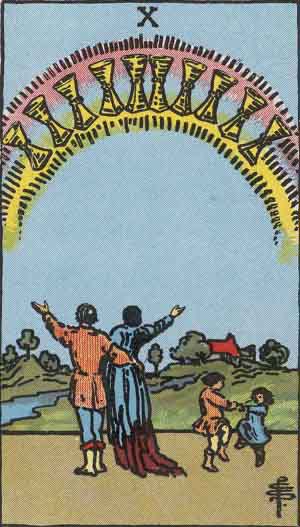
Appearance of Cups in a rainbow; it is contemplated in wonder and ecstacy by a man and woman below, evidently husband and wife. His right arm is about her; his left is raised upward; she raises her right arm. The two children dancing near them have not observed the prodigy but are happy after their own manner. There is a home-scene beyond. Divinatory Meanings: Contentment, repose of the entire heart; the perfection of that state; also perfection of human love and friendship; if with several picture-cards, a person who is taking charge of the Querent’s interests; also the town, village or country inhabited by the Querent. Reversed: Repose of the false heart, indignation, violence.
(From The Pictorial Key to the Tarot)

The Ten of Cups from the Rider Waite Smith tarot

Aleister Crowley

The Ten of Cups is called Satiety. Its attribution is Mars in Pisces. The watery sign has sunk into a stagnant dream, but in it broods and breeds the violent quality of Mars, to putrefy it. As it is written: “Until a dart strike through his liver.” The pursuit of pleasure has been crowned with perfect success; and constantly it is discovered that, having got everything that one wanted, one did not want it after all; now one must pay.

[…]

This card represents a conflicting element. On the one hand, it receives the influence of the Ten, Malkah the Virgin. The arrangement of the cups is that of the Tree of Life. But, on the other hand, they are themselves unstable. They are tilted; they spill the water from the great Lotus which overhangs the whole system from one into the other.

The work proper to water is complete: and disturbance is due. This comes from the influence of Mars in Pisces. Mars is the gross, violent and disruptive force which inevitably attacks every supposed perfection. His energy displays the greatest possible contrast with that of Pisces, which is both peaceful and spiritualized.
(From The Book of Thoth)

The Ten of Cups from the Thoth tarot deck

Golden Dawn’s Book T

HAND, as usual, holding bunch of water-lilies or lotuses, whose flowers pour a white water into all the cups, which “all run over.” The uppermost cup is held sideways by a hand, and pours water into the left-hand upper cup. A single lotus flower surmounts the top cup, and is the source of the water that fills it. Above and below the symbols Mars and Pisces.

Permanent and lasting success and happiness, because inspired from above. Not so sensual as “Lord of Material Happiness,” yet almost more truly happy.
Pleasure, dissipation, debauchery, quietness, peacemaking. Kindness, pity, generosity, wantonness, waste, etc., according to dignity.

Malkuth of HB:H (Matter settled: complete good fortune).
Herein the Great Angels HB:a’aShLYH and HB:MYHAL rule.

Etteilla

The city
Upright. In terms of spiritual medicine, this card, in its natural position, signifies: City, City Center, Homeland, Country, Town, Village, Place, Site, Dwelling, Home, Residence. – Citizen, Group of citizens, City dweller.
Reversed. Anger, Indignation, Agitation, Irritation, Outburst of rage, Wrath, Violence.

MQS

Vera Sibilla Cards That Indicate Ambiguity

There is a number of cards in the Vera Sibilla that can indicate ambiguity and unreliability. As usual, context is key, but the following ones are the most common.

Four of Hearts Reversed – Love

As I discussed in my recent video about the Fours, traditionally the Four of Hearts is the card of homosexuality. And it can still mean that in particular situations, but more broadly, aside from the other main meaning of ‘lack of love’, it can also indicate an unhealthy approach to love (hence the XIX century association with homosexuality). An unhealthy approach to love can also involve secret perversions or cheating, so the Love card reversed can be an indicator of unreliability in love.

Five of Hearts Reversed – Happiness

Being a card that represents more than one person, being in the suit of Hearts and being reversed, the Happiness card can indicate betrayal. However, traditionally, this more commonly refers to relatives (since the upright card can stand for relatives in a neutral sense). It can show disharmony among relatives, and relatives you must guard against, especially with people cards next to it.

Seven of Hearts Reversed – The Scholar

Upright, the Scholar is a symbol of the positive use of the intellect in a creative or constructive way. Reversed, the card can symbolize nonsensical or useless abstraction from reality, impotence (in all senses) but also the negative use of the intellect. Hence, the card can indicate ulterior motives and a sneaky disposition of character.

Eight of Hearts Upright/Reversed – Hope

The Hope card has many spiritual and moral virtues, among them that of choosing the high road and doing what’s good. When the card is next to cards of ambiguity, or when reversed, it can stand for someone who is extremely fickle and even promiscuous in love.

Nine of Hearts Reversed – Faithfulness

Upright, the dog symbolizes fidelity, friendship, sincerity in the affections. Reversed it can, quite literally, indicate unfaithfulness. It is also the proverbial dog biting the hand that feeds it, showing ungratefulness, anarchy, rebellion.

Ten of Hearts Reversed – Perseverance

Upright, the Ten of Hearts can indicate a stable, reliable character. Like the dog card, it reversed this symbolism when reversed, showing situations that are not stable, but also people who are unreliable.

Two of Clubs Reversed – The Peacock

When upright, the card emanates the positive energy of the peacock symbolism, showing beauty, marvel, art, beauty, completion, immortality. Reversed, it takes on its more sinister characteristics: vanity, being full of oneself, being blinded by one’s ego, which can all of course make us unreliable.

Ten of Clubs – Levity

The butterfly symbol speaks for itself. It shows someone who is fickle, not thorough, changeable, too easygoing or carefree. Still, the unreliability indicated by this card, unless supported by cards of dubious moral character, can also be of the innocent kind, due to superficiality rather than to some grand secret plan.

Four of Diamonds – Falsehood

The cat card is obviously the opposite of the dog: it indicates everything that isn’t as it seems, and so is the card of lies and cover-ups. But don’t go crying foul too easily: this is also the card of everything that is wrong, and so it also covers such things as mistakes and oversights. Still, it is never good when coming up next to a significator.

Six of Diamonds Reversed – Thought

Somewhat similarly to the Scholar, the Thought card is connected with what goes on between one’s ears. When it is reversed, the card indicates negative thoughts, which must be understood broadly to signify negative thinking or the thought of doing something negative. As such, if a significator comes up with the Thought card reversed after it, look at the other cards to see if they are feeling down, are deluded or a plotting something.

Seven of Diamonds Upright/Reversed – The Child

The Child card is neutral and has many positive undertones, but it is also card of immaturity. If it comes up upright with cards that highlight this side of its symbolism, or even worse if it comes up reversed, then you may be dealing with people who are not mature enough to be trusted, in whatever sense that might be meaningful in the context.

Eight of Diamonds Reversed – The Handmaid

Upright, the Handmaid is a card of morality and education. But when it is reversed, it becomes a card of the shallow trashy character that you should not take seriously. It can stand for someone who will betray your confidence.

Ten of Diamonds – The Thief

Obviously, the Thief is the card of betrayal par excellence. It always shows something that sneaks into a situation to ruin it from the inside. A person card with the Thief card next to it should make you think twice about trusting them.

Six of Spades Reversed – Sighs

The Sighs card is complex in its meanings, especially when reversed. Its broadest meaning is that of “no sighs”, so it can be good. But this can also signify that someone is not losing any sleep over the evil they are concocting, and so it can be a symptom of an unscrupulous character. This submeaning of the card usually emerges when other cards of similar signification are next to it.

Nine of Spades Reversed – The Prison

As with the Sighs card, the Prison reversed can be positive, as it shows freedom, being unchained or unburdened, repentance, and similar concepts. But with cards of dubious moral character it can indicate that someone is unhinged, lacking restraint and giving into unscrupulous ambitions.

Ten of Spades Upright/Reversed – The Soldier

The Soldier is the card of the night, and of everything that happens at night, including shady dealings. Because of this, especially when reversed, it can sound the alarm on the fact that something is going on behind your back. A person card next to the Soldier reversed is rarely someone you can trust.

People Cards

The general rule is that a person card reversed is either suffering or is against the querent. Especially the Heart court cards must be treated with caution, as they can become traitors and cheaters. It goes without saying that the two Enemy cards already have this potential indication baked into their upright meaning.

A Warning

You may have noticed that a lot of cards in the Sibilla can indicate unreliability. Follow these indications strictly and you’ll go around accusing everyone and their mother of being a cheater and a fraud. Interpretation is never a matter of a single card: it is important to see if cards of similar import accumulate, how the court cards relate to them and if there aren’t more likely explanations.

MQS

The Cards Won’t Tell You What’s Right

Morality is a complex thing, though this fact is lost in an age in which debates are reduced to exchanges of snarky remarks on social media. Morality is complex because it deals not in what is but in what ought to be, and what ought to be is invisible to the eyes. How ideas about what ought to be came to exist has kept philosophers and scientists occupied for thousands of years.

And this may account for a good deal of the blind desperation with which people seek something or someone who will tell them how to act. For those of a speculative mindset, reaching definitive conclusions is less a priority than exploring possibilities.

But most people feel the urgent need of external guidance. So some give themselves over to group leaders, others adhere rigidly to an ideology or religion. And those with a more woo woo view of life turn to oracles.

But divination is not a good judge of what’s morally right. If you want proof, when was the last time you laid out a spread that gave you advice that was based on moral principles completely incompatible with your own?

Having the stamp of approval of whatever projection we may make onto pretty bits of cardboards is not that good of an idea. It is a surefire way to delude ourselves and it can rob us of our agency and of our responsibility to think for ourselves.

Divination is good at telling us what is, or was, or has a good chance of being in the future. What ought to be is for us to make up our mind about.

MQS

Push and Pull (Example Reading)

There are couples who stay together a lifetime, couples who break up at the first sign of hardship, and then couples that seem to follow some kind of fated path made of pushing and pulling. This is one example.

8♥️ 6♣️ 7♣️ 4♠️

Q♣️ J♦️ K♣️

9♣️ 3♣️

6♥️

Note the absolude predominance of Clubs. Clubs are a heavy suit that causes difficulties and slowness. There is no card of great love, but the Eight of Hearts is a card of fun and good times.

Followed by two problematic Club cards, the Six and the Seven, which end up in break-up (Four of Spades) it is clear that the two didn’t break up from one day to the other never to see each other again, but have been on a constant path of ups and downs ending up in separation.

At the time of the reading the two were broken up, so when I told the (female) querent what I was seeing she confirmed that they’ve been on again off again for quite some time.

Look the second line! We have the two significators united by the messenger card (Jack of Diamonds). So the two have broken up but are still in contact. The querent told me it’s not so much that they send each other messages as they communicate and cause misunderstandings with one another through mutual friends (the Jack of Diamonds can show a go-between). Clearly not a very healthy situation!

The final cards, the Three of Clubs and Six of Hearts, show a reconciliation in the union, but the Nine of Clubs before them implies this is going to be a long-term goal rather than a matter of days or weeks. So the unsatisfactory situation is likely to persist for a while.

As far as giving the querent some advice based on this spread is concerned, I would personally be wary of that Jack of Diamonds between them. It is much better to clear up misunderstandings directly instead of playing up the drama by involving friends as if the two were still high-schoolers (they are in their 40s).

All in all, this spread gives off bad vibes for a relationship. It seems the two are attached more to the drama than to each other. To each their own.

MQS

Tarot Encyclopedia – The Ten of Wands

(Note: this is a collection of the meanings attributed to the cards by some occultists in the past centuries. It does not reflect my own study or opinion of the cards. It is only meant as a quick comparative reference as I develop my own take.)

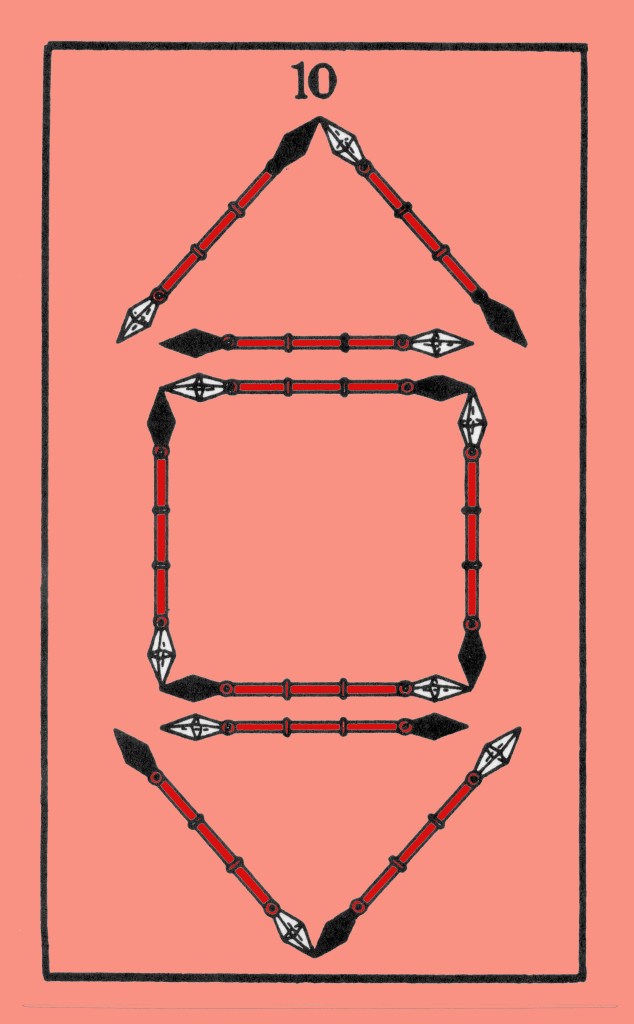
The Ten of Wands from the Builders of the Adytum (BOTA) tarot deck

Paul Foster Case (and Ann Davies)

The third decanate of Sagittarius is the time period from December 12 to December 21. In divination its meanings are those of the Tenth Sephirah combined with the planetary forces of the Sun and Jupiter, the zodiacal sign of Sagittarius together with its natural Ninth house of the Higher Mind.
Well-Dignified: generosity; success and honor in connection with the law, religion or philosophy; possibility of post of responsibility; gain through travel.
Ill-Dignified: ostentation; dogmatism; overbearing pride.
Note :- this card often carries the significance of a burden of responsibility of ‘too many irons in the fire’, or the need for a rearrangement of the Querent’s affairs or activities so as to get them in better order.
Keyword: Fullness of power.
(From The Oracle of Tarot course)

A. E. Waite

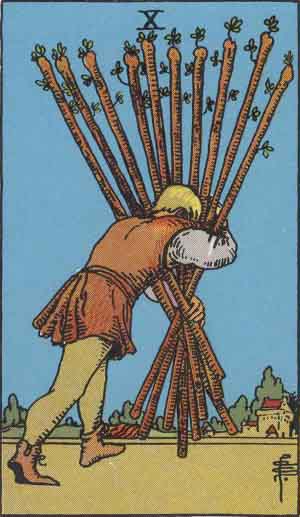
A man oppressed by the weight of the ten staves which he is carrying. Divinatory Meanings: A card of many significances, and some of the readings cannot be harmonized. I set aside that which connects it with honour and good faith. The chief meaning is oppression simply, but it is also fortune, gain, any kind of success, and then it is the oppression of these things. It is also a card of false-seeming, disguise, perfidy. The place which the figure is approaching may suffer from the rods that he carries. Success is stultified if the Nine of Swords follows, and if it is a question of a lawsuit, there will be certain loss. Reversed: Contrarieties, difficulties, intrigues, and their analogies.
(From The Pictorial Key to the Tarot)

The Ten of Wands from the Rider Waite Smith tarot

Aleister Crowley

The Ten of Wands is called Oppression. This is what happens when one uses force, force, and nothing else but force all the time. Here looms the dull and heavy planet Saturn weighing down the fiery, ethereal side of Sagittarius; it brings out all the worst in Sagittarius. See the Archer, not shooting forth benign rays, but dealing the sharp rain of death! The Wand has conquered; it has done its work; it has done its work too well; it did not know when to stop; Government has become Tyranny. One thinks of the Hydra when one reflects that King Charles was beheaded in White hall!

[…]

The number Ten refers to Malkuth, which depends from the other nine Sephiroth, but is not directly in communication with them. It shows the Force detached from its spiritual sources. It is become a blind Force; so, the most violent form of that particular energy, without any modifying influences. The flames in the background of the card have run wild. It is Fire in its most destructive aspect.

The card also refers to the influence of Saturn in Sagittarius. Here is the greatest antipathy. Sagittarius is spiritual, swift, light, elusive, and luminous; Saturn is material, slow, heavy, obstinate, and obscure.

The eight Wands are still crossed, showing the enormous power of the completed energies of Fire; but they have lost their patents of nobility. Their ends seem more like claws; they lack the authority and intelligence shown in the earlier cards; and in front are the two formidable Dorjes of the Two of Wands, but lengthened to bars.

The whole picture suggests Oppression and repression. It is a stupid and obstinate cruelty from which there is no escape. It is a Will which has not understood anything beyond its dull purpose, its “lust of result”, and will devour itself in the conflagrations it has evoked.
(From The Book of Thoth)

The Ten of Wands from the Thoth tarot deck

Golden Dawn’s Book T

FOUR hands holding eight wands crossed as before. A fifth hand holding two wands upright, which traverses the junction of the others. Flames issuant. Saturn and Sagittarius.

Cruel and overbearing force and energy, but applied only to material and selfish ends. Sometimes shows failure in a matter, and the opposition too strong to be controlled; arising from the person’s too great selfishness at the beginning. Illwill, levity, lying, malice, slander, envy, obstinacy; swiftness in evil and deceit, if ill dignified. Also generosity, disinterestedness and self-sacrifice, when well dignified.
Malkuth of HB:V (Cruelty, malice, revenge, injustice).
Therein rule HB:RYYAL and HB:AVMAL.

Etteilla

Betrayal
Upright. In terms of spiritual medicine, this card, in its natural position, signifies: Betrayal, Perfidy, Cunning, Deception, Trickery, Surprise, Misdirection, Dissimulation, Hypocrisy, Prevarication, Duplicity, Dishonesty, Darkness, Falsehood, Conspiracy, Collusion. – Imposture.
Reversed. Obstacle, Concern. – Barrier, Hindrance, Contradiction, Difficulty, Pain, Work. – Inconvenience, Abjection, Dispute, Complaint, Stumbling block, Enclosure, Entrenchment, Fort, Fortification.

MQS

How ‘Topic’ Cards Behave

In every deck there are what we might call topic cards, that is, cards that represent a specific field of life: family, work, money, health, love, the law, etc.

All or most of these cards also have general meanings that apply to various contexts. For instance, the Ace of Cups in the Bolognese Tarot is the home card (just like the Ace of Hearts in playing cards or the Two of Hearts in the Vera Sibilla), so it is the topic card for everything relating to family and house questions. But it can also indicate that someone belongs to the family, e.g., when it comes up next to a court card. It can also indicate the inner side of one’s experience of life, one’s inmost, intimate world, etc. So it can also show that something is close to us and touches us.

We need to distinguish between a card acting as a stand-in for a specific topic and the same card acting out a particular meaning. To keep with the Ace of Cups example, when it comes up in a question about work, it might show that the querent’s work life interferes with their family life or vice versa, or that they work from home, or that their work environment is family-like. In all these cases, the house card qualifies the other cards by adding details of its own.

But when the House card is simply a stand-in for the topic ‘home and family life’, the card says nothing about the topic itself. It doesn’t qualify the reading. It simply tells us, “this is the topic.” It is then the role of the other cards to describe the situation, qualifying it in a positive or negative way.

When we are doing a general reading with no question, or with all the cards down on the table, this is all well and good: we see if the person’s significator is next to any of the topic cards, showing that that topic is important, and then we read the cards surrounding the topic card relating them to the topic.

When the question has been specified, though, extra care must be taken trying to figure out if the topic cards that appear are qualifying the topic of the question or if they are coming up to ignore the question and talk about something else. This is not always easy.

Let’s say you asked about work, but the house card comes up. Why? Is it because the home is involved? Or is it because the cards have decided to bypass your question and discuss something else? Or is it both? (It CAN be both). One way to solve this issue is to see if there are topic cards relating to the question, or if at least the cards seem to be predominantly of a nature that seems more akin to the question asked (e.g., lots of Diamonds and Clubs in a work-related question).

The other way is to see if the cards next to the rogue topic card coalesce with it to form a coherent statement that has nothing to do with work, or if instead the topic card allows itself to be absorbed into the querent’s question.

The third way is simply to work with the querent. This is always a good idea. After all, our aim is to interpret the oracle correctly, not to impress people.

Cards that have the potential to be topic cards are always quite strong in a reading, so it is always good to observe them first. Often they form focal points in the interpretation of the spread. Sometimes some cards in some readings can even be ignored, but topic cards always seem to have something to say. We ignore them at our peril.

MQS

Get Out And Read!

When it comes to divination, theory can only get you so far. The best way to improve your reading skills is to learn the basics of a *valid* system and then start reading.

For most of us, we are our own first querents, and that is a problem. I don’t have a 100% accuracy record when reading for others, but I barely reach 60% when reading for myself, especially if I’m invested in the topic. It is not just a matter of wrong interpretation, which can and does happen. I am more and more convinced that sometimes, when we read for ourselves and we are not perfectly at peace, we tend to get readings that reflect what we think rather than what is happening or will happen.

Furthermore, the tendency that many people have to start obsessively putting questions to the cards just to see if they say something vaguely understandable (which doesn’t mean true) is dangerous, and can get us in a warped frame of mind.

I know that for many, especially coming from certain societal backgrounds, reading for others can be a big step into the unknown, but I would advise anyone to start reading for some sympathetic friends or relatives (and when I say for them I mean in front of them, not asking questions about them) and then to graduate as soon as possible to readings for people we don’t know or know little about.

I don’t have too many friends, but they do a good job of talking about me to their friends and to their friends’ friends, which is how I get my supply of test anim-ehm, querents. If you start reading for your friends and ask them to spread the word the same will happen to you.

The cool thing about reading for people we don’t know is that it is so much easier than you might think. Divination DOES work! And divining for someone when there is no chance of you knowing the information in advance is very impressive for them and very satisfying for us as diviners. It will build your confidence much more quickly than torturing the cards about your own mental dramas. Plus, the oracles always seem to be much clearer and much more crisp when I divine for strangers.

One thing I would advise is to be as scientific as possible: record the question, the reading, your interpretation and the results. Don’t think you cannot build your vocabulary because the only right answer is the one offered to you by your intuition. 99% of intuitive readers are terrible, and what they call intuition is not actual intuition: it’s their stupidity echoing in the empty chambers of their mind. Be systematic and slowly you will gain experience.

MQS

A Note On The Ten Of Cups

I always maintain that the Golden Dawn were not great astrologers, largely because the XIX century astrology they had access to was not very good. Still, for the purposes of deriving symbolism for magical operations, their take was acceptable.

One thing that has always fascinated me about the Golden Dawn’s take on astrology was how they tried to synthesize it into their tarot system. Aside from the attributions of Zodiac signs and planets to the Hebrew letters and of the Hebrew letters to the major trumps, they also assigned the thirty-six decans to the thirty-six minor cards two through ten and, in different ways, to the aces and court cards as well.

This way of allocating the symbolism was not unique to them, but (as someone who doesn’t like to mix cartomancy and astrology) I must say that it probably produced the most coherent system.

Crowley generally doesn’t stray too far from the GD interpretation of the minors, but there are a couple of exceptions, the most obvious of which is the Ten of Cups.

For the GD, the Ten of Cups is an excellent card (which is what inspired Waite’s take on it). Crowley, however, disagrees on account of the decan assigned to the card, which is the third decan of Pisces, ruled by Mars. This leads Crowley to argue that this is a card ruled by two disarmonious symbols (Pisces and Mars) and so it produces bad results.

The problem with Crowley’s take is that he constantly, throughout the book, mistakes decan rulership with the influence of a planet in a sign. This is wrong. Rulerships represent affinities of a planet with a sign or subdivision of the sign.

For instance, Aries is ruled by Mars, which means there is an affinity and so when Mars is in Aries it is said to be well-dignified, at least according to the astrological practice that developed in the middle ages. The Sun is also exalted in Aries, which means there is also an affinity. Then we have the three decans: the first ten degrees ruled my Mars, the second ten by the Sun and the last ten by Venus.

Now, Venus is in detriment in Aries, which means there is disharmony between Venus and Aries, so Venus is ill-dignified in it. She is like a dainty ballerina stranded in a war-torn country. It’s not her place. However, in the last ten degrees of Aries, Venus has subrulership by decanate. This means that, even though she is the anti-venusian environment of Aries, she has a small room where she is a bit more comfortable, though not by much: it’s as if our dainty ballerina had been hired to entertain the troops in the barracks. She’s still in the wrong place, but in a less uncomfortable subplace.

Therefore, when Crowley says that Mars is not compatible with Pisces he is saying something that is irrelevant: by definition, the fact that Mars rules the third decan of Pisces means that Mars is at least a bit comfortable in the last ten degrees of the sign. This is because the last decan of Pisces has some kind of Mars-like quality to it: it is the part of Pisces that expresses through Mars.

This is not to say that his system is more right or wrong than the GD (one can stretch symbolism in almost any direction by abusing it long enough), but his misunderstanding runs through the whole minor arcana section, and I thought it would be interesting to bring it up.

MQS

A Tale of Two Friends (Example Reading)

I think this reading is interesting because it showcases the odd behavior of the Death card in the Bolognese tarot of answering yes to a question. I have already written that I prefer to take this traditional rule with a grain of salt, but it does seem to apply in several cases.

Here the question the (male) querent asked is if there would be reconciliation with a friend he had had a fight with. The reason I included the cards of the cut (the King of Wands and the Angel) will become clear shortly.

Two Friends

Right off the bat, the death card comes up in the last position, and this, added to the Angel in the cut, should give us a sort of super yes. But we always need to interpret the reading.

The second thing that caught my attention was the Page of Coins (words) next to the Knight of Swords (cuts, problems, arguments, hurt) and the Love (affection). So there is affection between the two, even now (how could there not be, since they were friends?) but the Sword card creates problems.

In the next line we find the Eight of Swords, which is a card of suffering. If we see the Eight of Swords as coming after the Love card in the line before, then there is great emotional suffering surrounding this argument. However, all is not lost, as the Knight of Cups (agreement, conciliation) and the Sun (positivity, clarity) follow. So this, together with the Death card, seems to confirm there will be a great improvement after a period of uncertainty.

In the last line we have two kings. One is the friend probably the Sword. The other king, the Cup, can possibly identify him as like family, or, paired with the third king in the cut, it constitutes a triplet of success in the matter (three Kings are a success). Then the World card comes. Talking to the querent, I discovered the friend lives quite far away, but I believe the deeper meaning here is that their relationship’s path is still an open road, so it is not over.

I don’t have much to say about the first line. It isn’t clear to me. The Ace of Coins can be money, but the argument wasn’t about money, but it can also be the table, their conviviality (especially with the Seven of Cups, which is a relationship of closeness), which suffers a hiccup (the Stranger). That’s my best guess.

As for advice, the querent (the King of Wands) comes up in the cut together with the Angel, so clearly he has feelings of deep friendship. I told him to show them better, since this is what leads to the Sun card in the spread overtaking the Eight of Swords.

MQS