Here’s a quick one I thought was interesting. A querent wanted to know if her boyfriend would propose to him. This is the reading:
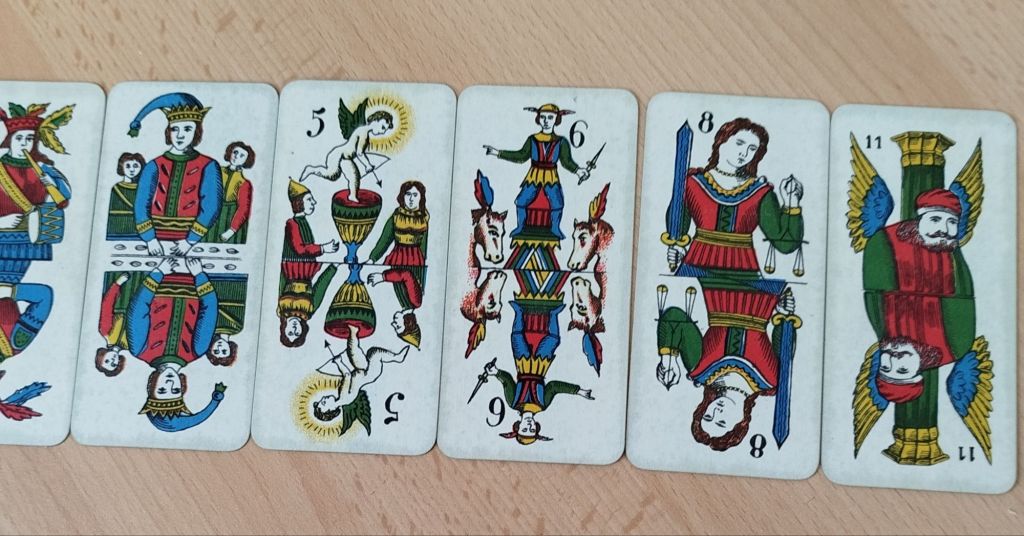
K♣️ – 3♦️ – J♥️ – Q♣️ – 2♣️
Notice that the two querent cards both come up in the reading. They are separated by the Three of Diamonds and the Jack of Hearts. I didn’t think the Jack could represent a literal child, but to be on the safe side I asked the querent and she said they have no children. If they did, it could have shown a relatively loose relationship but with children.
The Three of Diamonds represents small projects within the couple. It is not negative, but falling next to the querent’s boyfriend it made me think that he was still a bit immature (especially with the Jack) or at least that he didn’t have big projects in mind. However, we find the Queen followed by the Two of Clubs which represents some steps taken. To me it looked as though she would be the one to take action, either proposing herself or pressuring him to commit further.
What ended up happening is that the querent fell pregnant and told the boyfriend she wanted to at least move together. They are apparently making arrangements to find a place, and an engagement may be on the horizion in the next few years.
Could I have foreseen the pregnancy? Maybe, with the Jack of Hearts so central to the spread. Still, it didn’t feel like a pregnancy spread (and after all it wasn’t even the question).
What I find interesting about the spread is how it describes the nature of the querent’s relationship and who wants to take it to the next level
Fludd discusses how the diviner should prepare to a geomancy reading.
The Preparation of the Soul of the Diviner Prior to Making a Figure
Since this knowledge is founded on [an operation of] the soul,1 it is certain and manifest that no truth can be guaranteed in it, except in so far as the soul permits it.
Therefore it is required that he who wishes to be versed in this art, before he begins his operation, should have a good and clear conscience, and that his body and spirit should be governed without disturbance, and that he should not think worse of another than of himself,2 nor should his mind be spare in judgment, and not tend to negation more than to affirmation. He should be a just judge of the question proposed.
Finally, he must trust in God almighty, who is the author of all knowledge and truth,3 and pray to him that through this knowledge he will be allowed to find the truth that his heart longs to know.
All of this having been properly considered, and with a soul well established in the proposed matter, he will immediately make the projections of the points.
Hence it is that so much fallacy and uncertainty arise in this art. This is also the reason why the same art is immediately regarded as nothing, namely, because some, falsely ascribing the name of artists to themselves, neglecting God, and not being moved in the least by the pacification of their souls and of the pleasures of the body, falsely judge of the things proposed, and by this reason render this secret and very profound art so despised, that it is also commonly regarded as the most falsified of all.
The fault, then, is not in the science, but in those who profess it: the science is doubtless most truthful, but its proponents are often hindered by ambiguities and difficulties because of their vicious dispositions.
For who can doubt that the soul can direct any part of the body to the true knowledge of the future more easily than the whole body itself?4
When we perceive that she governs her whole body in such a way that she foresees the future every day and every hour, that is to say, that she will arrange such a business the next day, and ride to this or that city, and do other things the following week, or even that she will marry at this or some other time, or that he would carry out his purpose and plan at such or such an hour, etc.5
To the modern reader, these tips may seem to have a moralistic taste, but we should keep in mind that, aside from being in part a product of the times, they may be boiled down to the very sensible idea that a diviner, as intermediary between the querent and the divine, should purify himself of that which keeps him away from the divine. One cannot be a bridge between A and B without being capable of reaching both sides. Aside from being against Christian morality, “thinking worse of another than oneself” also implies being engrossed in outside world nonsense. ↩︎
A fundamental truth of all divination is that its knowledge does not originate within the diviner. ↩︎
That is, the soul is more capable of the body of considering the future. ↩︎
This remark may appear odd, but from an occult standpoint it does make sense: our soul is capable of conceiving the future because it is integral part of an inner world (which opposes and complements the outside world, of which our body is an integral part) wherein the normal rules of time don’t unfold as they do outside. ↩︎
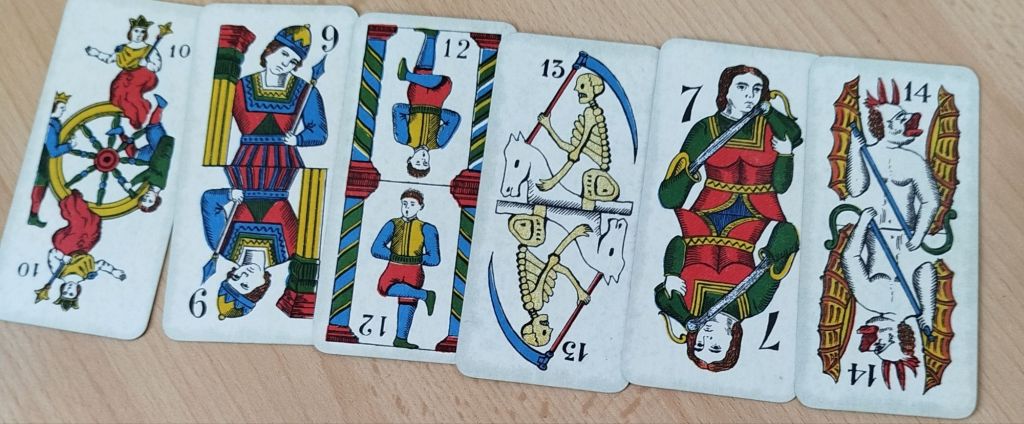
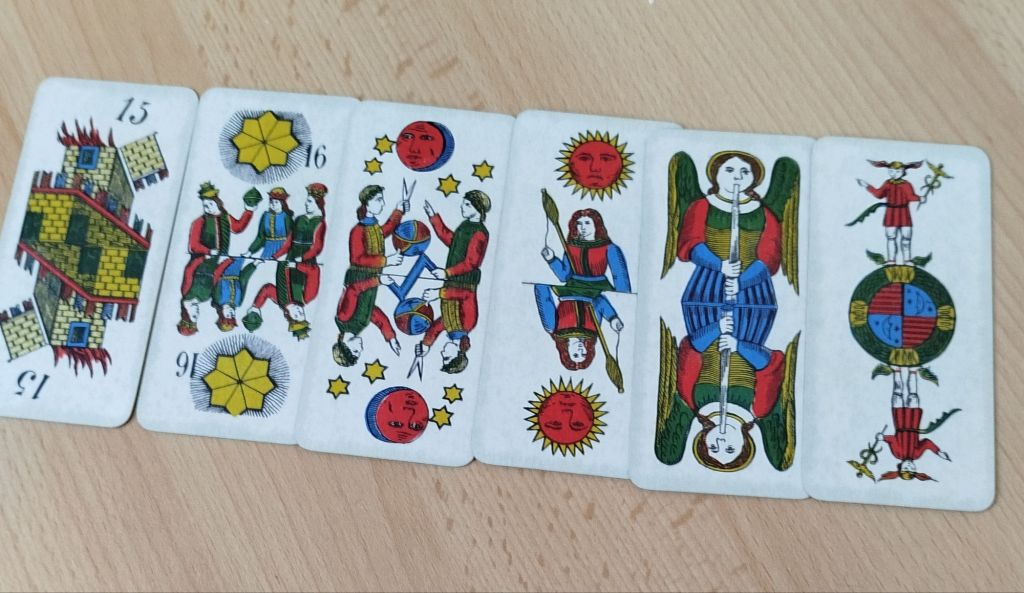
In another post, I detailed the main meanings of the 50-card method, which is the one my teacher uses. Here I am going to talk about the other main method for using the Bolognese tarot using 45 cards. I have this from a contact of mine, who gave me permission to explore it and talk about it. The two methods are equally powerful: the absence of 5 cards does not reduce the ability to predict, because the meanings, though similar to the 50-card method, are distributed slightly differently across the cards. Supposedly, the 45-card method is slightly older.
Note that 1) there are some books (in Italian) that discuss the 45-card method, but each gives its own version, and the method I know is also partially different. This is normal: every village and city has its own folk tradition, especially in a country as culturally decentralized as Italy 2) again, the meanings are eminently practical 3) as with the 50-card method, I arranged the majors in the usual order, even though it is different from the Bolognese order of the trumps
Major Trumps
Bolognese Tarot, Major Trumps
The Fool. Strangeness, Instability, Creativity The Juggler. A Child, A pet, Immaturity, Something New Love. Love, Feelings, Affection, Passion, Harmony Chariot. The bed card, Sickness, Static Situations (because the horses seem to rest) Justice. Justice, The Law, Fairness, Equilibrium The Hermit. Obstacle, Blockage, Small ailments
Bolognese Tarot, Major Trumps
The Wheel. Fortune, Chance Strength. Energy, Power, Fortitude, Good Health, Active stance The Hanged Man. Betrayal,1 Upending Death. Loss, Mortification, Change, Yes to a yes-or-no question Temperance. Time, Patience, Waiting Devil. Being bedeviled, Anger, Jealousy
Bolognese Tarot, Major Trumps
The Tower. Prison, Hospital, Sacrifice, Being impeded or limited The Star. “Stuff”, Objects, Material things, Your work life, Business The Moon. By Night, Darkness, Sadness, Falsehood, Negativity The Sun. By Day, Light, Happiness, Positivity The Angel. Help, Friendship, Peace, Protection, Solution The World. Travel, Journey (literal or metaphorical), Around the world
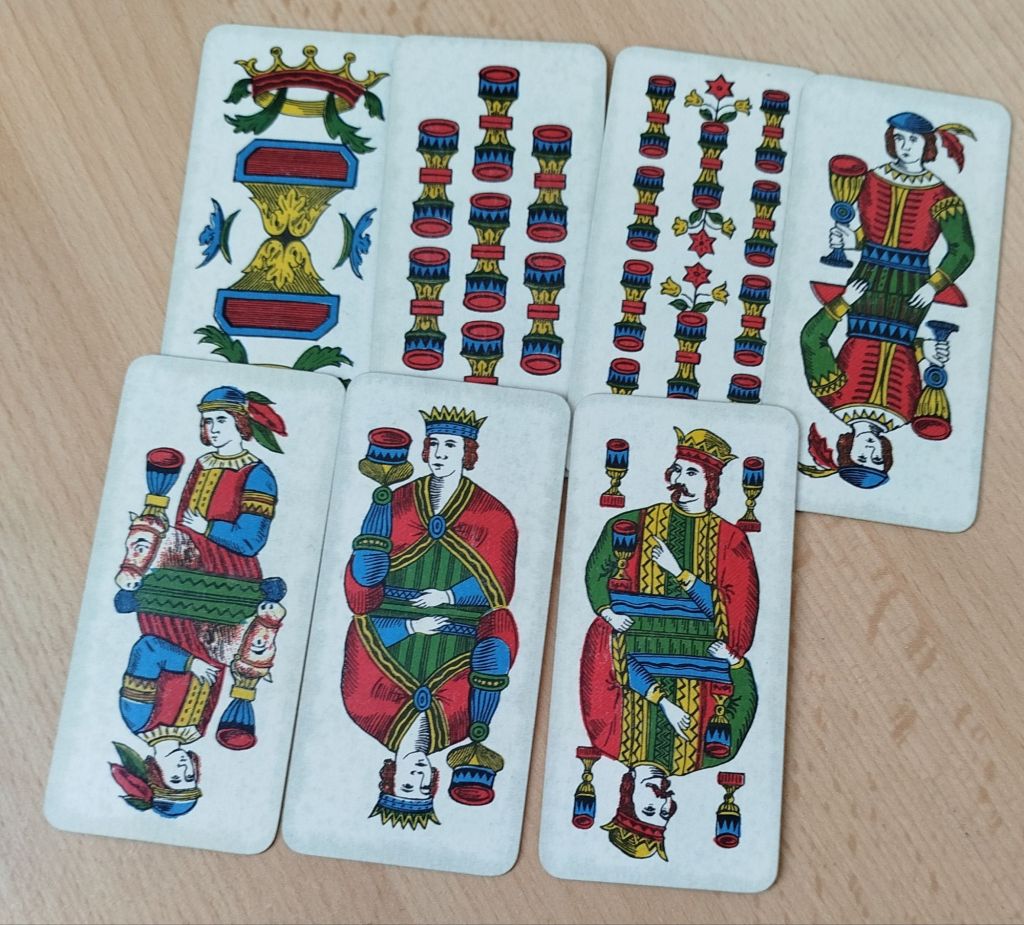
The Suit of Cups
Bolognese Tarot, Suit of Cups
Ace. The Home, The House, The Family Seven. The City, The Surroundings, Also the family, Protection Ten. Blooming, Flourishing, Celebrating, Fun, Happiness Page. A young woman, sometimes a female rival, Comfort, Help Knight. Adjustment, Agreement, Positive development Queen. A mother, A woman in your family, A motherly figure King. A father, A man in your family, A fatherly figure
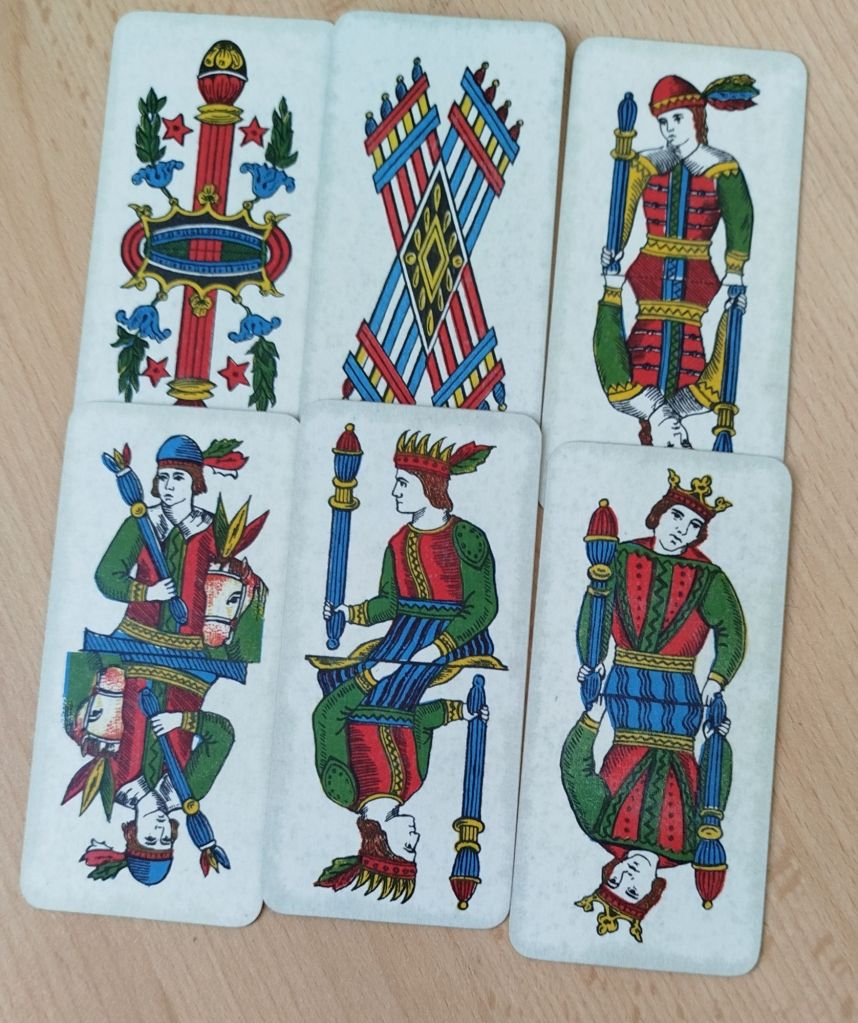
Suit of Wands
Bolognese Tarot, Suit of Wands
Ace. Victory, Union, Sex, Ability to succeed Eight. A road, A path, Taking Steps Page. The thoughts of the female querent Knight. The thoughts of the male querent Queen. The female querent, An important woman King. The male querent, An important man
Bolognese Tarot, Suit of Coins
Ace. Big Money, Abundance, Satisfaction, The table Seven. Tears, Sadness, Melancholy Ten. Small money card, Small satisfactions, Tranquillity Page. Discussions, Talks, Communications Knight. News (especially good news, but news in general), Sometimes a young man Queen. The Truth, Truthfulness, Wisdom, Knowledge, A blonde woman King. An important man, A doctor, A graduate, A professional, “Important” in general
Bolognese Tarot, Suit of Swords
Ace. Something knocking at the door, About to happen, Contract, Relationship, Being bound, Hands tied Eight. Suffering, A thorn in the heart The Moor.2 A priest, A person in uniform, A surprise, Unexpectedness Page. Letter, Message, Post, Contacts Knight. Fighting, Ill-disposition, Cutting, Problems Queen. A dark-haired woman, A problematic woman, Affliction in general King. A dark-haired man, A young man, A problematic man, Immaturity in general
(Note: this is a collection of the meanings attributed to the cards by some occultists in the past centuries. It does not reflect my own study or opinion of the cards. It is only meant as a quick comparative reference as I develop my own take.)
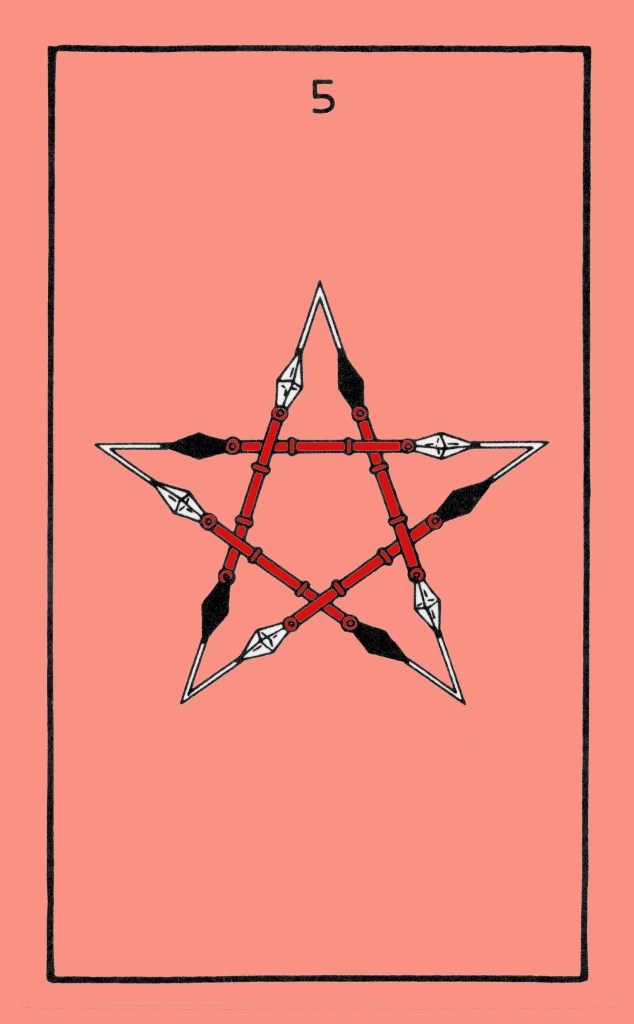
The Five of Wands from the Builders of the Adytum (BOTA) tarot deck
Paul Foster Case (and Ann Davies)
The first decanate of Leo encompasses the time period from July 23 to August 1. It is ruled doubly by the Sun, so that the Sun and its attributions have a marked influence on the meanings of this Key. Thus the Five of Wands is a combination of the powers of Mars, active in Geburah and the powers of the Sun in Leo, together with the meanings of the number five and the pentagram. Key ideas associated with the Five of Wands are power and pleasure in exercising it. This is the combined influence of the strength resident in Geburah together with the pleasure associated with Leo and its natural fifth house in astrology. The Martian influence gives a spirit of adventure and speculation, together with some uncertainty in carrying out plans. The Leo influence, a fixed fire sign, intimates strong attachments, either to family or in love affairs. Well-Dignified: boldness, command and generosity. lll-Dignified: cruelty, violence, lust, prodigality. – Keyword: Competition. (From the Oracle of Tarot course)
A. E. Waite
A posse of youths, who are brandishing staves, as if in sport or strife. It is mimic warfare, and hereto correspond the Divinatory Meanings: Imitation, as, for example, sham fight, but also the strenuous competition and struggle of the search after riches and fortune. In this sense it connects with the battle of life. Hence some attributions say that it is a card of gold, gain, opulence. Reversed: Litigation, disputes, trickery, contradiction. (From The Pictorial Key to the Tarot)
Aleister Crowley
This card is referred to Geburah of the suit of Fire. Geburah itself being fiery, it is a purely active ,force. It is ruled also by Saturn and Leo. Leo shows the element of Fire at its strongest and most balanced. Saturn tends to weigh it down and to embitter it. There is no limit to the scope of this volcanic energy.
The symbol represents the wand of the Chief Adept, showing that the authority is derived from the superiors; were it not so, this card would be thoroughly disastrous. Moreover, there are also two wands of the Second, or Major Adept. They have the head of the Phoenix, which gives the idea of destruction (or rather purgation) through fire, and the resurrection of the energy from its ashes.
There is also a pair of wands of the Third, or Minor, Adept, which are daughters, so to speak, of the wands in the Three of Wands. In this card there is the mitigating influence of the Mother. One of the most difficult doctrines with regard to Geburah is that, while it represents all this tameless irrational energy and disturbance, yet it derives from the benign and gentle influence of the feminine.
The Egyptians understood this doctrine perfectly. Their Lion goddess, Pasht, was hailed as “saeva” and “ferox”, was even called “red in tooth and claw” by those fanatical devotees who wished to identify her with Nature. The idea of sexual cruelty is often inherent in the highest divine nature; compare Bhavani and Kali in the Hindu system, and observe the Shiva-Sakti coition portrayed on many Tibetan banners. See also Liber 418,4th, 3rd, and 2nd Aethyrs; and the description supra of Atu XI. (From The Book of Thoth)
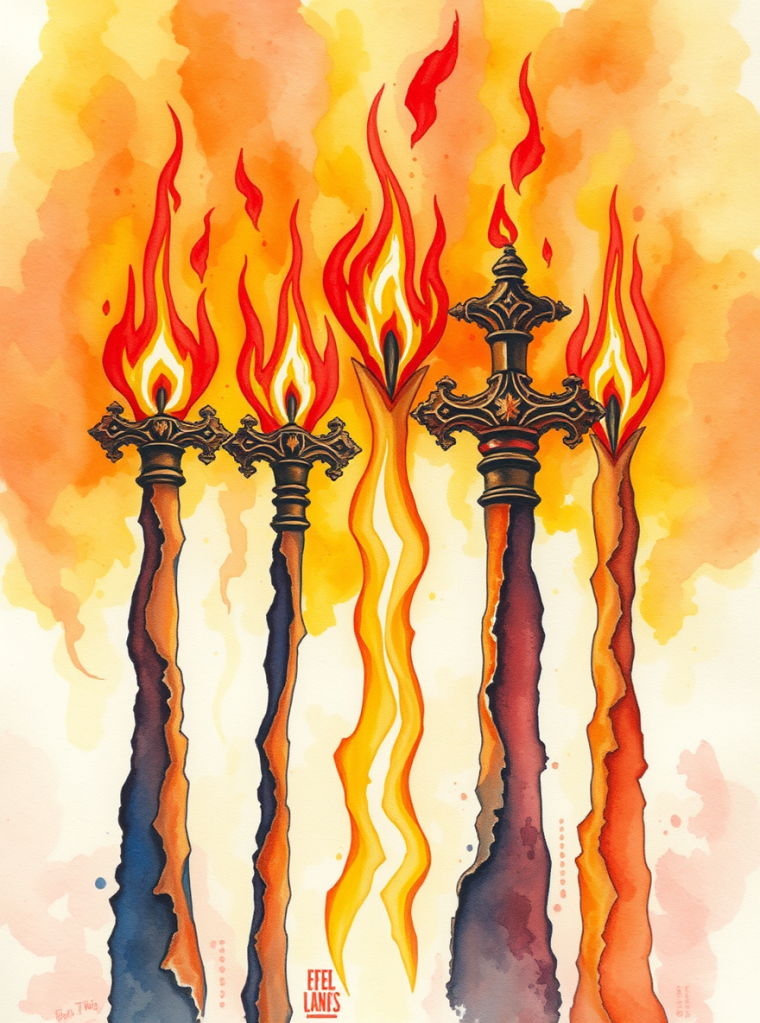
AI-generated illustration for the Five of Wands
Golden Dawn’s Book T
TWO White Radiant Angelic Hands issuant per nubes dexter and sinister. They are clasped together in the grip of the First Order, “i.e.” the four fingers of each right hand crooked into each other, the thumbs meeting above; and they hold, at the same time, by their centres, five wands or torches which are similar unto the wands of a Zelator Adeptus Minor. One wand is upright in the middle; the others cross each other. Flames leap from the point of junction. Above the middle wand is the sign Saturn, and below is that of Leo: thus representing the Decante.
Violent strife and boldness, rashness, cruelty, violence, lust, desire, prodigality and generosity; depending on whether the card is well or ill dignified. Geburah of HB:Y (Quarrelling and fighting). This Decan hath its beginning from the Royal Star of Leo: and unto it are allotted the two great Angels of the Schemhamphorash HB:VHVYH and HB:YLYAL.
Etteilla
Gold Upright. This card, as far as the medicine of the spirit is concerned, means, in its natural position: Gold, Wealth, Opulence, Magnificence, Sumptuousness, Splendor, Luxury, Abundance, Good. – Physical, philosophical and moral sunshine. Reversed. Trial, Arguing, Differences, Altercations, Disputes, Disputes, Instance, Investigation, Judicial proceedings. – Contradictions, Arguments, Brig, Harassment. – Contradiction, Inconsistency.
Fludd offers interesting anecdotes from his life to elucidate the nature of Geomancy.
The Internal Principle of Terrestrial Astrology, or Geomancy
In the penultimate year of the life and reign of Elisateth, the glorious queen of England whose fame will never die, I was forced to stay in the city of Avignon during the whole of that winter, because of the severity of the weather, which covered the mountains with a lot of snow, and completely barred the journey to Italy.
In the house of a certain captain, together with many other noble and well-educated young men, and having received board from the Jesuits, I discussed philosophy with them one evening during supper, and perceived a variety of opinions concerning geomantic astrology. Some of them denied its virtue altogether, while others, on whose side I stood, vigorously defend the power of that art, and I adduced many reasons by which I proved that I was engaged in that knowledge of fate.
When the supper was over, as soon as I had betaken myself to my apartments, one of these men followed me and asked me to try my art, which he believed to be great, regarding some important matter whose resolution, he said, greatly concerned him.
After making many excuses, at last his prayers convinced me and I made him a geomantic figure in response to the question proposed by him, which was as follows: Whether the girl, by whose love he was vehemently captivated, would redeem him more than the others from the sufferings of mind and body.1
And after making him the figure, I affirmed that I could well describe the nature and disposition of the body of his beloved and, having done so, I noticed a particular mark or a certain spot, namely a fateful wart noticeable on her body, and so also I noted its place, indicating it to be on the left eyelid.2
This, of course, he also confessed. I also said that she was very fond of vineyards. He confirmed, as if exultant, adding that it was because her mother had built her house among vineyards. In short, I answered the question in this way: his beloved was inconstant and by no means firm, so much so that she loved someone else.
To which he said that he also suspected the same, and that he now saw it as if with open eyes. He then left my room with excited haste, and he reported [to the others] with some wonder the truth and power of my art.
But some of them, who happened to know this girl well, totally denied the existence of the mark described on her eyelids, until the next day, talking with her, they themselves also became witnesses to the truth of this matter, which I had explained to them by way of geomancy, and which they had not even observed before.
From here, therefore, more than I desired it, I became renowned, so that the report of this matter was carried to the ears of the Jesuits themselves. Two of them, hurrying to the steps of the palace, told the viceconsul all these things, and, moved by envy, said that there was a certain stranger present, an Englishman, who had foretold the future by a science rejected by the Catholic Church, that is, geomancy.3
These things were reported to me in the morning by the captain of the palace, named Johannes, who also referred to me the answer given to the viceconsul to these very things, which he affirmed to have been such:
“What?” said he, “This is not such an abomination as you make of it. Is there anyone among all the Cardinals of Italy who does not have his birth astrologically or geomantically described?”4 A few days afterward, the consul himself desired to speak with me, and kindly invited me to dinner. With a certain dear friend of mine, Monsieur Malceau, the apothecary of the Papal Palace, I went to the palace, where, having paid due respect in the usual manner, the viceconsul engaged with me in dialogue:
“I understand,” said he, “that you are well versed in the geomantic art; what is your opinion of that science?” To which I replied that I had proved by experience that this knowledge was essential and established by fundamental secret principles.
“How is this possible,” said he, “that there should be any certainty in something that consists of accidental points?”5
I told him: “The principle of these points made by the human hand is internal and very essential, since it is derived from the soul itself, which is the origin by this kind of movement. Moreover, the errors of this science are not caused by the soul itself, but by a perverse and incongruous movement of the body itself, moving against the intention of the soul.
Hence the general rule in this art is that the soul should be peaceful and that the body should obey it, and similarly, neither the body nor the soul should be confused or partial in the question, but let them be like a just and fair judge, and turn to God, praying from the heart that the truth may be revealed. At the same time, turn your soul energetically to the question proposed, and don’t be seduced by extraneous thoughts.”
“What then,” he answered, “is that soul of which you speak? Perhaps you understand by that your own soul, or the genius of Plato,6 or at least some angel?”
To which I answered: “An angel could not be the origin of that knowledge, since angels are divided into good and bad: good angels were seldom granted to the Arabs, Chaldeans, and Egyptians, who were the inventors of this art, and evil angels are all authors of lies rather than the truth, as the Holy Scripture testifies.”7
“From this, then,” said he, “it is evident that you yourself are not able to give a distinct and certain account of the principle in this science.”8
To which I answered that the human body is related to its soul as a servant is related to his master. A master may send his servant hither and thither with letters, without the servants in any way perceiving the intention of his master. Even a distinguished painter can send an excellent picture to a king through his servant; yet the servant is completely ignorant of the mixtures of colors and their symmetrical proportions.
In the same way, a king can impose taxes on his people through others, although the reason for these impositions is known only to the king himself. Similarly, of course, the body itself can perform what the soul commands, while remaining ignorant of the principles of this action except through its effects alone.
After hearing these things, he called me to a table standing in the midst of some of the bishops and deacons. There, taking pen and ink, he composed a geomantic figure, and very skilfully went over it, so that I could see that he himself was far more learned and expedient in that knowledge than me. Having thus finished my meal, I departed with his blessings, and visited him often afterwards; for I perceived that he was a very inquisitive prince, skilled in the sciences, kind to strangers, and in no way tyrannical.
Among the Jesuits, one was very desirous of conversing with me as a lecturer in philosophy. Therefore, at the entreaty of my dear Rheinaud, a young man of marked genius and modesty, I went to him, and was graciously received by him. There, after some philosophical discussions, he suddenly brought up geomancy, thinking perhaps that I would answer him easily.
“How is it possible” said he, “that by means of geomancy someone might be able to foretell the danger or death imminent to this or that person on his journey towards Rome? What is the participation and communication between his soul and yours, since both are contained within the human body?”
To which I answered briefly in this way: “Because the soul of each body is that chief light, having dominion over the rest of the body, no differently than the Sun in heaven has dominion over the other stars. Since the soul is the Sun of the microcosm, directing the whole body with her life-giving rays, there is no doubt that she also casts her invisible rays invisibly through the pores of the body in no other way than that Sun transmits his heavenly ones through the sieve of the elements toward the world below.9
In the same way that one star has a relation to another by ways of aspect, so that by application to one another they create the effects to be transmitted to the lower plane, so also without a doubt between the soul of one and the soul of another, which are invisible lights, rays are emitted, and by the emission they are joined together.
Thus, since either the petitioner himself or his friend is the one to who is in danger, and since the soul is very divine, and is the keeper of the body, she can foresee the future danger (for inasmuch as she is immortal, she can know the future and the present). So the soul will reveal to the querent the future secrets of the body, which the soul could not tell the body because of the body’s thickness. In this way the soul, quiet and peaceful, and prepared for judgment, very responsive to the bodily motion,10 can prognosticate without difficulty.
Moreover, Olaus Magnus,11 in his history of Finland, tells a great story about the amazing actions of the sorcerers of that region, among which he recounts the story of a certain enchantress.
It seems that when some from a remote country came to her in order to know about the state of his friends, the mode of operation was this: the witch, with some other woman and an assistant, entered the room, where, after many words muttered in silence, she took a serpent made of air, and, holding it by the tail, struck it twice with a small hammer, and having done so, she suddenly collapsed as if dead. And the other helped by driving away flies and other small animals, so that they might not touch her. Half an hour later the witch arose from her sleep, and told the truth about the petitioner’s friends.
But what does this mean, if not that the soul of that witch had communion with the souls of the querent’s friends? And since the semi-diameter of its rays was too short to reach the extremity of the soul of the friends, in order to fulfill the desire of the querent it was necessary for the her to depart from her heart to find a place where it could have communication and its application with the rays of the souls of the friends.
Doubtless the animal rays extend themselves insensibly outside the body, far beyond the field of vision, so readily can they penetrate the thinness and purity of their essential substance, as through elementary means without hindrance.
After making some other similar similar remarks, he embraced me in a friendly manner, swearing that he would regard me as his brother, and praying that I would often visit him and his brothers. This, however, I could not do because of my sudden departure from that city to the Duke of Guyse, who at that time was living in Marseilles, who sent for me to teach him and his brother, a Knight Militant, the mathematical sciences.
In conclusion, therefore, this art is a science directly dependent on the soul, in such a way that its root is the soul itself, and therefore it is more subtle than all the other sciences which man can learn in this corruptible world.
MQS
Footnotes
I am not sure I translated the question exactly. However, the gist is correct, as may be seen from Fludd’s answer. ↩︎
It is common for old geomancy and astrology manuals to teach how to find peculiar marks on the querent’s or other people’s body. It was a way of convincing them of the veracity of the art. ↩︎
The status of astrology has always been ambiguous in the West. However, geomancy was more unanimously rejected as dangerous. ↩︎
It was important for Fludd to establish the semi-official status of geomancy as a legitimate science by mentioning the common practice of horoscopy ↩︎
The objection of the viceconsul is similar to the one already discussed by Fludd in the introduction. ↩︎
In order to conform to the Christian orthodoxy, Fludd must deny the influence of angels, since Geomancy was not invented in the Christian West. ↩︎
The reason for the need to establish the principles of Geomancy as a science is twofold: on one hand, to justify it, and on the other in order to conform to the Aristotelean view of science typical of the time ↩︎
This answer is typical of the Renaissance point-of-view, which always sought to establish correspondences between the inner and the outer, the higher and the lower. ↩︎
probably the bodily motion of the creation of the geomantic figure ↩︎
(Note: this is a collection of the meanings attributed to the cards by some occultists in the past centuries. It does not reflect my own study or opinion of the cards. It is only meant as a quick comparative reference as I develop my own take.)
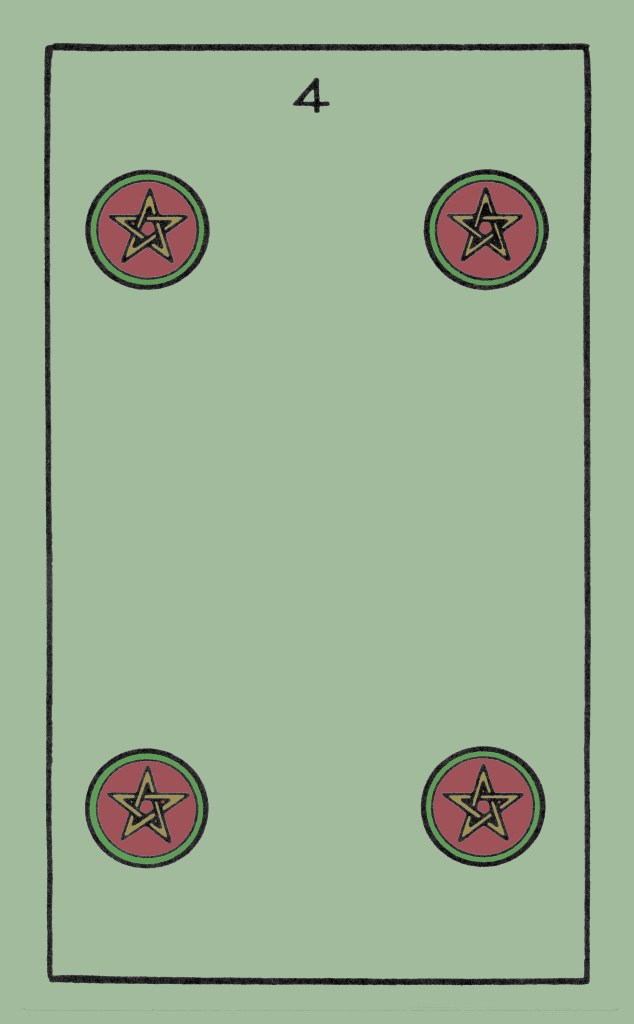
The Four of Pentacles from the Builders of the Adytum (BOTA) Tarot deck
Paul Foster Case (and Ann Davies)
The time period is the third decanate of Capricorn, under the rulership of Mercury, January 10 to 19. Well-Dignified: opportunities for public service; an acute, sharp, penetrating, tactful temperament; economy in the arrangement of material affairs; activity in money matters. Ill-Dignified: dangers to reputation; troubles through changes not carefully considered; desire for money, but unwisdom in its management; the Querent will meet with sharp criticism. Keyword: Management. (From the Oracle of Tarot course)
A. E. Waite
A crowned figure, having a pentacle over his crown, clasps another with hands and arms; two pentacles are under his feet. He holds to that which he has. Divinatory Meanings: The surety of possessions, cleaving to that which one has, gift, legacy, inheritance. Reversed: Suspense, delay, opposition. (From The Pictorial Key to the Tarot)
Aleister Crowley
As to the Disks, the heaviness of the symbol rather outweighs any considerations of its weakness. The card is called Power. It is the power which dominates and stabilizes everything, but manages its affairs more by negotiation, by pacific methods, than by any assertion of itself. It is Law, the Constitution, with no aggressive element.
[…]
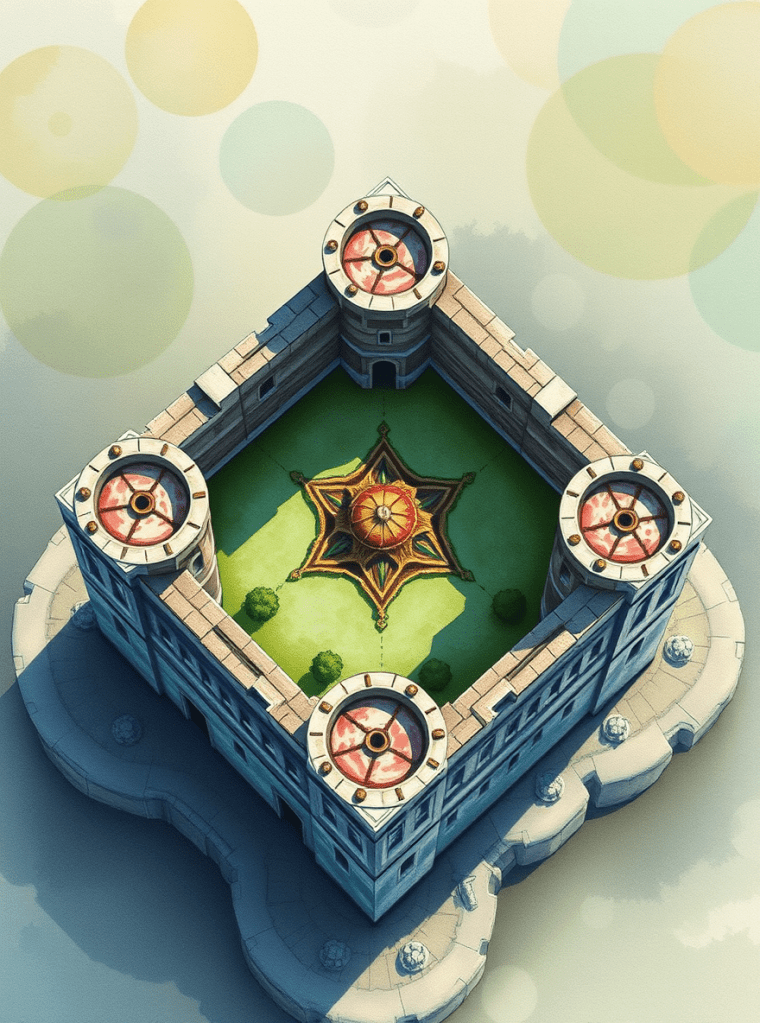
The Four, Chesed, shows the establishment of the Universe in three dimensions, that is, below the Abyss. The generating idea is exhibited in its full material sense. The card is ruled by the Sun in Capricornus, the Sign in which he is reborn. The disks are very large and solid; the suggestion of the card is that of a fortress. This represents Law and Order, maintained by constant authority and vigilance. The disks themselves are square; revolution is very opposite to the card; and they contain the signs of the Four Elements. For all that, they revolve; defence is valid only when violently active. So far as it appears stationary, it is the “dead centre” of the engineer; and Capricornus is the point at which the Sun “turns again Northward”. The background is of deep azure, flecked yellow, suggesting a moat; but beyond this is a pattern of green and indigo to represent the guarded fields whose security is assured by the fortress.
In the Yi King, Sol in Capricornus is represented by the Second Hexagram, Khwan, which is the Female Principle. Compare the English word Queen, Anglo-Saxon Cwen, old Mercian Kwoen. Cognate are Icelandic Kvan, Gothic Kwens, woman. The Indo-Germanic type is g (w)eni and the Sanskrit root GwEN. Note also Cwm, coombe, and agnate words, meaning an enclosed valley, usually with water running from it. Womb—possibly a softened form?
Compare also the innumerable words, derived from the root Gas, Which imply an enclosed and fortified space. Case, castle, chest, cyst, chaste, incest and so on.
The primary radicle in all this class of words is the guttural. Observe the Hebrew attributions: Gimel, the moon; Cheth, Cancer, the house of the moon; Kaph, the Wheel; Qoph, the Moon, XVIII, Guttur, the throat. Sounds so made suggest the other throat; one is the channel of respiration and nutrition, the other of reproduction and elimination. (From The Book of Thoth)
A Crowley-esque AI-generated illustration for the Four of Pentacles
Golden Dawn’s Book T
A HAND holding a branch of a rose tree, but without flowers or buds, save that in the centre is one fully blown white rose. Pentacles are disposed as on the points of a square; a rose in its centre. Symbols Sun and Capricorn above and below to represent the Decan. Assured material gain: success, rank, dominion, earthy power, completed but leading to nothing beyond. Prejudicial, covetous, suspicious, careful and orderly, but discontented. Little enterprise or originality. According to dignity as usual. Chesed of HB:H (Gain of money or influence: a present). Herein do HB:KVQYH and HB:MNDAL bear rule
Etteilla
Benefit Upright. This blade, as far as the medicine of the spirit is concerned, means, in its natural position: Present, Gift, Generosity, Beneficence, Liberality, Strenna, Grace, Offering, Giving, Gratification, Service. – White color, Lunar medicine, Stone to white. Reversed. Enclosure, Circuit, Circumvolution, Circumscription, Circumference, Circle, Circulation. – Intercept, Obstruction, Engorgement, Hoarding, Cloister, Monastery, Convent. – Stop, Fixed, Determined, Definite, Extremity, Boundaries, Limits, Terms, End, Barrier, Dividing wall, Wall, Hedge, Wall. – Obstacles, Bars, Impediment, Suspension, Delay, Opposition.
I’ve already discussed why I don’t do readings on public events and public figures, but it largely boils down to two reasons: 1) it would merely serve my ego 2) I would just be adding to the useless spectacle of divination being paraded around as a form of silly entertainment.
But something interesting happened that made me chuckle a little at the simple complexities of life. I heard from a friend of mine for whom I had done a short reading before she went back to the USA, where she resides. This was an unfocused reading, done more for fun than seriously. These were the three cards:
A♦️ – 3♦️ – 9♠️
Most people can guess that this spread was about money, and loss of money more specifically. With nothing to go off of, I simply warned her about the possibility of losing a small amount of money, as she would get news about it. She was rather perplexed as she wasn’t expecting anything of this kind.
Well, it turned out she had betted money on Harris in the presidential election.
So, am I saying that I predicted Trump’s reelection? Of course not. When I did the reading I had no idea it could be referring to it, especially since I don’t keep up with American politics that much. All I predicted was bad financial news for my friend who, unbeknownst to me, had a horse in that race, but life has a way of weaving the most disparate threads together in way we cannot foresee. Life is always a system if circles within circles, the smaller within the larger, by the hermetic principle. And the more I practice divination, the more I am grateful for the unpredictable side of things.
In some card-based divination systems, reversals carry a negative connotation. Reversed cards are said to either decrease the influence or deteriorate the positive aspects of the card. The Vera Sibilla does not adhere to this view. Reversed cards have peculiar meanings which may sometimes be even unrelated to the upright counterpart, at least at first (in reality, if you think about it, you will almost always find the correlation).
Consequently, some Sibilla cards are actually better when reversed than when they are upright, at least generally speaking. Sometimes this better connotation is general, while at other times it refers to specific topics. Here are some examples.
Ace of Clubs – Marriage The Ace of Clubs reversed is not automatically better than when upright, and on occasion it may even be worse. However, it carries a connotation of materiality that can be very welcome in readings about wealth or about physical relations (as opposed to legal/spiritual relations when the card is upright.)
Three of Clubs – The Journey The Journey card in the Vera Sibilla usually refers to physical movement, though it can sometimes represent a change of heart or a change of pace. When it falls reversed in a reading, it can indicate trouble when journeying, but its broader meaning is that of positive evolution of a situation. The card is powerfully benefic and it can free us from vicious cycles and other sticky situations.
Four of Clubs – The Friend When upright, the Friend card can refer to a literal (female) friend or to the idea of friendship and support in general. When it is reversed, it indicates help, recommendations, being taken care of. Usually, the help represented by the reversed card is more on the material side, or it can show in the form of a professional’s advice.
Ten of Clubs – Levity The Butterfly is a problematic card in the deck, as it shows lack of focus, fleeting situations. Reversed, it can represent a serious effort, the ability to hold on to your money and, more broadly, to fleeting situations that bring positive chances. If I were to liken this reversed card to a geomantic figure, I would choose Fortuna Minor.
Three of Diamonds – The Gift The Gift card is generally positive when upright. When it is reversed, however, it does not diminish, but rather increases its positive significance. It indicates the solution of problems, especially material problems. When it is upright, the gift usually comes from someone, whereas the reversed Gift card shows the gift coming to us from the situation itself, which becomes more positive or less complicated.
Four of Diamonds – Falsehood The upright Falsehood card is rarely neutral and almost never positive. When it is reversed, however, it shows the positive unmasking of lying, the discovering (usually in time) of hidden factors that could have caused harm and, in general, it shows situations that end with a sigh of relief.
Ace of Spades – Sorrow The Ace of Spades is a very difficult card to receive in one’s reading. When it is reversed, the blow is softened. The sorrow of the title is still there, but it is dimeanished diminished and can be overcome. It is also a symbol of toil and focused struggle or work as opposed with just crying with your head in your hands.
Four of Spades – Sickness When it comes up reversed, the Four of Spades has a variety of meanings, some of which negative, though less legative than when the card is upright. However, when it is followed by positive cards, it can represent the end of a stagnant and blocked situation.
Six of Spades – Sighs My experience has shown that the reversed Six of Spades is one of the most complex cards in the deck. Although it can have negative meanings (see here an example), broadly speaking it indicates the end of sighs. It shows moving on, overcoming torment, accepting what you cannot change, etc.
Nine of Spades – Prison Like the Four of Spades, the Nine of Spades reversed can have a variety of meanings. However, in and by itself, this card represents the end of imprisonment, freedom and having paid your dues/done your time, literally or figuratively.
The spread used for this reading is a spread of thirteen cards that I’ve learned from the person who’s teaching me to read the Bologna Tarot, and it is typical of that tradition. It is a small tableau of cards that is generally used to explore a single issue (though nothing forbids you to use it for general readings.)
1
2
3
4
5
6
7
8
9
10
11
12
13
There are several traditions varying from town to town. According to one, the cards are to be read in columns only, with one indicating the past, one the present and another one the future. My teacher however reads them primarily in rows, though sometimes columns can be read too, and usually, the central column holds some importance. More often than not, the last card is especially important because it will either contain a general answer or give you an important detail, or determining factor.
Although this spread is especially linked to the Northern Italian tarot tradition, I’ve seen it used with regional playing cards as well, and I don’t think there is any reason why it wouldn’t work with any deck tradition you practice. I will certainly use it with the Sibilla as well, one of these days.
Will She Learn to Love Herself?
The querent in this case is an acquaintance of mine, but the question was not about her, but rather about her sister. The question was “Will she learn to love herself?” and it came with no further detail. This is fine, as often when a querent feels the need to talk there is a risk that they end up feeding me their perspective. So here are the cards that came out:
Will she learn to love herself? Divination with playing cards, thirteen-card spread
Right off the bat, we notice that the significator for the querent (the Queen of Clubs) is present, so since this is a tableau we might as well look at the cards surrounding it. She has the Jack of Hearts, the Queen of Spades and the Eight of Spades above her. These cards could mean a number of things, such as problems with a daughter or problems with an immature woman, or problems in the person’s childhood. Let’s file all this away and move on.
Next to the Queen of Clubs we have the Nine of Clubs and the Six of Clubs, which represent long-term toil and struggle. Clearly, whatever this is, it is not something that is going away soon. But the spread ends with the Nine of Hearts which indicates triumph. There is light at the end of the tunnel.
Technically, we already have our answer: the querent’s sister will struggle with self-love a long time, but she will improve. But the cards tell us more. Let’s turn to the first row, where we find the Queen of Hearts hemmed in by Spades. There is some kind of blockage or problem (Four of Spades) that causes the shedding of tears (Eight of Spades) relating to a woman (the Queen of Hearts).
Usually, the Queen of Hearts is either a relative or someone with our best interest at heart. In this case, though, she is strongly afflicted by the Spades. So I asked the querent if the issue relates to the sister’s poor relationship with her mother or another female figure close to her that impacted her self-love negatively. The querent confirmed that their mother was a raging alcoholic who worked overtime to tear them down when they were little. Note how the cards highlight the cause of the sister’s suffering by placing it right on top of the spread!
Right underneath we have the Queen of Spades, the Four of Clubs and the Five of Diamonds. This line was a little cryptic, and I must confess I did rely a little bit on my intuition, but the interpretation was still logical. There is a woman of spades who is saying words (Four of Clubs) that cause change (Five of Diamonds). Who is this woman? Usually the Spade suit is problematic, but it can also indicate certain professional figures (doctors, military figures, judges, etc.) It stood to reason that this figure could be a female therapist that is helping the sister. I asked and the querent confirmed to me that the sister is seeing a female psychologist who “means business but is very competent” (Spades).
The line just above the querent contains the Jack of Hearts, the Six of Hearts and the Three of Spades. This time I felt confident interpreting the Jack of Hearts as the sister’s “inner child” or, to avoid woo woo terminology, it represents the issues accumulated since childhood. The Six of Hearts talks about healing, and the Three of Spades indicates intrigue, but also in the metaphorical sense of a knot, something that needs to be unravelled or clarified. For the time being, therefore, the sister’s issue will persist, but the final Nine of Hearts is promising.
Fludd discusses the mystical implications of using divination.
5. The Act of a True Geomancer Is Like a Movement of the Mind in Ecstasy, or Rather a Sort of Rapture, in Which There Is Prophecy
Rapture in general is called the abstraction, alienation, and illumination of the human mind, proceeding directly from God, through which prophecy is obtained.1
Thus also a certain kind of rapture and ecstasy is required for divination by Geomancy, which is not called the illumination of the mind directly emanating from God, but rather the act of gathering of the mind’s rays into a narrower place, that is to say, into the seat of the human body and its own home, so that through them the divining soul discerns the simple truth more clearly.2
As such, ecstasy is first of all required in this knowledge, that is, the abstraction of the rays of the mind from all external things or affairs, so that they are contracted within themselves: for in a great rapture of the mind and soul the rays are lifted up to the divine essence of God, or into the region of the mental world.3
Thus, even in this minor rapture of the human soul, the rays sent out from without, and scattered here and there, are recalled to their center, and are reflected in the mind, and thus man, who was formerly dark because of the diffusion of his own light, is now enlightened and glorious by the aggregation of the expanded rays.
In a similar manner, as we gather from the opinion of the learned men, on the third day of creation the rays created by the light scattered evenly throughout the sky, and all appeared in a dark manner, as if darkness were mixed equally with light, or night with day.4
But when, on the fourth day, all that light scattered everywhere was collected in the center of the solar body by a certain magnetic property, there was produced that glorious and worthy example of light, in which God himself is said to have had his tabernacle.5
We also see, for instance, that in a fortress equipped with a thousand soldiers, if the greater part of these soldiers, either for the purpose of preparing for defeat or for some other attempt, goes out and runs to and fro, then that fortification is rendered weak, and those who are left experience great fear.
But if those who had gone forth should return safe and sound, those who had been left in the stronghold recover their former confidence and their former hope, and putting aside all fear, they are in no way afraid of the invasions of the enemy, since that place is already well-furnished with warriors.
Here, therefore, things are in the same way with the bright rays of the human soul. For the human body is a stronghold or fortress, where the rays of the mind and the middle soul are likened to soldiers, of whom we may compare those who are sent out of the body to attend to foreign affairs, to soldiers running hither and thither outside the fortress, the absence of which renders the body less confident, and more insecure and timid, and weak in facilitating some noble and bright aim, such as divination, which is the best and highest thing.
We say, therefore, that the recollection of rays of this kind is the reduction of man’s internal nature from multitude to simplicity.6 As a result the soul, recalled from external meditations, and reflected and recollected within itself, renders a man, as it were, raptured and ecstatic, because he thinks of himself and within himself, he is only present to himself, oblivious of strangers, so that it appears to the ignorant that he is not aware of himself. when, in truth, he is now more than ever before.7
For he who neglects worldly things is sure to care for himself more, and he who withdraws himself from the multitude into himself seems to be most present to himself, since there will not be a great interval of distance between him and God.8
To such an attitude or disposition must he reduce himself, who endeavors to procure for himself the gift of future divination. For those thinking of externals divert the powers of the soul from the judgment of truth, so that the uncertainty of the geomancer is great in his judgment, or to be more precise, the truth in him will be as great as the variation of the soul from its unity.9 Indeed, in the multitude of things, tricks, vanities, and lies are concealed; in true unity and simplicity perfection, identity and unity [are found].
Let the soul therefore snatch from the Macrocosm that which is its own, given to it by the Creator in its creation, and internalize it into its own Microcosm, and let no one else enjoy what is its own.
By virtue, I say, of his own excellency, he is snatched from the world, and restored to himself and recollected, and clings to ecstasy, so that in his most refined mirror or spirit he may reflect not only worldly things, but also divine ones. For the more clarity he achieves, the more effective will be his visions and motions for prophesying the truth
6. About the Hidden Properties of Geomancy, and How the Soul or Mind Passes in Its Operation Through the Whole Nature of the Macrocosm
Nor is it right that those who are ignorant of geomancy should regard a series of points as mere lines, formed from the act of divination, since under these characters, the objects of the eye and the senses, many things, both spiritual and material, are concealed. Indeed, these series of lines comprise no less the idea of the universe than the human body itself.10
In fact, although in man his body can only be seen from the outside, yet with spiritual eyes we contemplate his spirit and soul and mind inwardly. Of course, in the body we see the elements invisibly mixed in composition;11 in the spirit and soul we observe the ethereal nature, in the intellect and mind we observe the empyrean nature.
the same can be observed also in Geomancy, since readings consist of four lines of points, and we perceive that the four elements are concealed in it, that is to say, the element of fire under the first line, of air under the second, of water under the third, and of earth under the fourth. 12
Furthermore, in the figures produced by those series of points, the seven planets and the twelve heavenly signs are included, which can only be perceived by the eyes of the spirit.
Thus the figure of Carcer is attributed to Saturn direct and Tristitia retrograde: the figure Laetitia signifies Jupiter direct, Acquisitio retrograde; Rubeus denotes Mars direct, and Puella retrograde; Major indicates the Sun in a certain direction, and the Minor in retrogradation; although the astrologers deny the retrogradation of the Sun, because of its epicycle; Puer is given to Venus direct, Amissio retrograde;13 Albus is attributed to Mercury direct, Conjunctio when retrograde; the direct Moon is symbolized by Populus, the retrograde by Via;14 Caput Draconis is represented by a figure bearing the same name, and Cauda Draconis is represented by a figure bearing the same name as well.
So also those figures contain in themselves the natures of the twelve signs. For Acquisitio is of Aries in an abstract manner; Laetitia and the Minor of Taurus, Rubeus and the Puer of Gemini; Albus and Populus of Cancer; Via of Leo; Caput and Conjunctio of Virgo; Puella of Libra; Tristitia and Amissio of Scorpio; Caput of Sagittarius; Cauda of Capricorn; Major of Aquarius; Carcer of Pisces.
Furthermore, Rubeus, Minor, Amissio and Cauda denote the element of Fire and the Southern part of the world; Laetitia, Acquisitio, Puella and Conjunctio denote Air and the Eastern part of the world; Populus, Via, Puer and Albus denote Water and the Northern corner of the world; Major, Caput, Carcer and Tristitia denote Earth and the Western part of the world.
Even deeper towards the center of the sky lies the empyrean spirit,15 which is the revealer of the future and the present, that is to say, the rational or intellectual collection of these figures and the worldly things contained in them.
From all this it is evident how purely and sincerely the intellectual spirit must be preserved from the inconveniences and harms of the flesh and filth, when from it the movement to produce the Geomantic points first arises, taking with it in a secret manner the natures of the heavenly signs, the planets, and the elements, and finally hiding all these under the number and in proportion to the points, like a certain treasure in a chest.16
If, therefore, we wish to open that chest, first to the elements, then to the planets and celestial signs, and finally to the boundary from which these movements originally flowed, we shall penetrate in the sanctuary of the mind, its will, in the mythotheque of the intellect, of the will, of the signs and planets; in the closet of the ether we shall find the act or execution of the mind; and in the storehouse of the elements, we shall find the effect of the mind’s will, reason, and act (all of which are contained and hidden under figures, as if in a chest).
From the aforesaid, therefore, it is evidently clear that, just as the prophecy of the inspired is the union of the divine mind with the human mind (whence it is the most complete and greatest, this species of prophecy), so also the prophecy of the uninspired sometimes happens, when the soul is united, with its rays drawn back to itself from the multitude toward its summit, that is, with the human mind, which, without doubt, if united with the soul and collected, can perform enormous things by itself, and can lead to the summit and a happy outcome.
MQS
Footnotes
The words ‘abstraction’ and ‘alienation’ must not be understood in their usually negative sense. In Neoplatonism (and mostly in Plato himself as well), the dialectical method allows the spiritual seeker to climb up the ladder of being through a process that leads from the particulars of the material world upward and inward to unity with the divine. Ecstasy, which is the goal of Neoplatonic spirituality, literally means “going out of oneself”. This is the process of abstraction and alienation. ↩︎
That is, prophecy stems from direct union with the divine and is harder to control, while divination (such as Geomancy) happens by focusing inward. ↩︎
See Note 1. Fludd describes the Neoplatonic method of retreating inward and upward. ↩︎
If the light is evenly distributed, no difference appears and everything is as equally dark as it is equally radiant. ↩︎
In the Hermetic interpretation of Astrology, the Sun is a symbol of divinity. ↩︎
Broadly speaking, the path of magic in all its branches (and divination is one of these branches) require an endless attempt at simplifying one’s life and one’s external nature. ↩︎
This is a common theme in mystical and occult literature, and one of the great truths of our art. As we reach what some have called ‘superconsciousness’ we appear to be less aware, while in fact we exceed regular awareness. ↩︎
The phrasing here is clearly very careful to avoid scandal. As for the words “caring for himself”, this is not to be understood as being egoistic. ↩︎
that is, we are capable of seing the truth in the measure that our soul is unified. This is probably part of the reason why divining for oneself is especially difficult, since divination implies doubt about an external topic. ↩︎
Here lies a great and central secret about all functional systems of divination: that their symbolic vocabulary is complete in itself, so as to be able to reflect within its permutations the truth of things to come. Here, Fludd compares the language of Geomancy to the human body, which is a symbol of the completeness of the universe. ↩︎
He means the four elements, which were thought to be mixed to form the material bodies. ↩︎
This is a reference to the fact that in Geomancy each figure is made up of four series of points, and each series is assigned to one of the elements. ↩︎
compared to the usual attributions, Fludd switches Puer and Puella ↩︎
The Moon cannot go into retrogradation. Usually, Populus is assigned to the waxing Moon and Via to the waning Moon. ↩︎
with reference to the Aristotelean and Ptolemaic view of the cosmos. ↩︎
This comparison is very much a consequence of Fludd’s Renaissance worldview, according to which Nature is replete with symbols. ↩︎