Category Archives: Cartomancy

Tarot Is Not Deep (and Its Limits as a Tool for Self-Reflection)

I always bring up poor Rachel Pollack whenever I need to give a paradigmatic example of someone who utterly ruined tarot divination by turning it into a heap of psychobabble, though in reality the list is quite long. At some point, it was decided that 1) divination could not be a serious undertaking in an age of reason, and 2) we still wanted to think our illustrious predecessors who bought into it were not poor saps. The compromise therefore was that there was something deeper to divination, and so divination had to be reassessed and purged in accordance to this new ideology of ‘depth’ or *shudders* ‘wisdom’.

The reality is that in the “I’m too special for religion but wouldn’t it be fun if there was something more to life” community, where most people tend to think exactly alike in spite of how different they think they are, depth is a misunderstood concept.

Something is considered deep if it will allow them to talk themselves or others silly while giving them plenty of safe thrills and predictable a-ha moments by hurling around the latest buzzwords (try finding a tarot reader who doesn’t talk about narcissists, gaslighting or inner truth).

Thankfully, the tarot is not deep, just like playing cards–and tarot cards ARE playing cards–or tea leaves or dice or geomantic figures are not deep, which is what makes them marvellous divination tools. Even astrology is not deep by today’s standards, if by astrology we mean astrology in its traditional forms (Hellenistic, medieval, Chinese, etc.)

But the depth that is found in divination, just like the depth that is found in all other branches of magic, has nothing to do with finding abstract meanings or deep doctrines that move us beyond real life. Although there can be space of deep philosophy, the real depth is found in the shift in our consciousness of existence and of our place in it as we practice it concretely and see its concrete impact on real life.

I will forever be grateful to my GD supervisor, who always insisted that I practice tarot in real life and not as a mere metaphysical plaything (people will be surprised by how concrete the GD tarot system is, in spite of its metaphysical underpinnings). Traditionally, in magical practice, people are advised on how to recognize when they have established contact with an entity other than themselves.

The risk is sometimes that of contacting parasites masquerading as great beings, but the even higher (and more common) risk is that of simply contacting one’s ego. Psychic onanism IS a thing, and a much worse vice than the physical counterpart.

This is what limits, in my view, the potential for tarot as a tool for self-reflection or meditation or scrying. Granted, most symbols can be used as doorways for these aims, and therefore also the tarot. There is some value to it, especially when done under supervision or with the proper frame of mind. There is also some value in allowing symbols to bring certain aspects of oneself to the surface, if one has the necessary detachment.

Wisdom is a great thing, and it is something that can be pursued on the path of magic, including divination. But more often than not, those who are too good for simple divination and want to discover the “deeper layers” of the tool simply end up massaging the shallower parts of their own psyche without realizing it, and often even thinking they are making some kind of psychological or occult progress when in fact they are simply digging themselves a deeper hole in their own ego.

MQS

There Is No Ghost (Example Reading)

When we give a reading about extraordinary questions like the occult or the paranormal, it is easy to fall into the trap of wanting to confirm the querent’s bias or subjective experience.

This is why I tend to avoid queries about such things as past lives: for one, I don’t believe in reincarnation, or rather, I believe that the soul of the world constantly reincarnates through every individual that is born, but I don’t believe in the existence of seprate or individual souls that reincarnate karmically; for two, I fail to see the importance of knowing about what one might have been in a previous life; for three, suppose I tell someone that they were an illiterate farmer, when another reader convinced them they were a cool witch who was burned at the stake for her mystical powers, how is the querent going to choose who is right apart from their whim of the moment?

Still, certain topics, such as magic or spirits, are within my tradition and I do believe in them, so I accept readings, but I warn querents that the likelihood of something of the sort happening in their life is very low even if they go looking for it, let alone randomly.

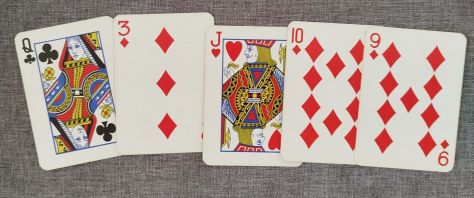
This one querent thought there is a ghost haunting the third floor of the building she moved to. This is the spread that came out:

A card reading about a ghost

As can be seen, even without interpreting the spread, there is no trace of haunting in the cards. The final two cards, the Nine of Diamonds and the Ten of Diamonds, are a lucky combination, they can show success, protection or even simply the fact that the “energy” is clean, not charged with magical or paranormal forces. The querent shows up at the beginning of the spread with the Three of Diamonds, which is a doubtful card in this context. It makes me think more about random things that she, the Queen, misinterpreted.

The Jack of Hearts is even more doubtful. It could show the presence of a child (a living child, that is) or an animal (again, a living one) who does something the querent misinterprets. The querent said that there are both children and animals in the building, so that’s a possibility. Frankly, I should have either added cards or done another spread.

Still, this is enough to make me think that there is a non-paranormal explanation for the querent’s experience, so the spread is enough to answer the question in that regard.

The funny thing is that, after the reading, the querent started talking to me like I am not very competent at reading cards. I am obviously open to being wrong, and I understand that it must be frustrating being told that one’s subjective experience is probably the result of a misinterpretation (it must feel like ‘gaslighting’, to employ an overused word). All I could do was trying to be as understanding as I could in delivering the answer.

After all, for every instance of real haunting or real magic (at least, real according to the oracle) there are thousands of cases of people who spend years burning sage to smoke out a presence that isn’t there, yet the ghost who isn’t there often ends up influencing their life more than those that are there.

MQS

Bolognese Tarot Spreads – The Thirteen Card Spread

Nothing prohibits anyone from using whatever spread they prefer, or even just from laying out a row of cards. However, traditionally, the smallest spread used with the Bolognese Tarot is the thirteen card spread, which is a small tableau of cards used to answer a specific question or explore a specific theme (although nothing prevents you from laying it out for a general reading. It will respond anyway). This is a spread I have already presented, and it is one that is used with many decks in Central and Northern Italy in particular. The layout is as follows:

123
456
789
101112
13
The Thirteen Card Spread

Some readers take out the significator for the querent or even the significator for the question and put them on top of the layout (above card 2) before starting to shuffle. I prefer to have all cards in the deck and have not found it necessary, but feel free to experiment.

The cards may be read in rows or in columns, and which direction is the primary one depends on which tradition you come from. Personally I tend to see rows as the primary reading direction, but I will look at columns if there is clear information contained in them. I have found that the columns tend to describe the situation rather than to predict it. But don’t force yourself to read in every direction possible: simply read the information where it is found, and leave the rest.

There is no strict differentiation between past, present and future. However, I have found, personally, that at least the first row, or sometimes two (and on occasion even three), contains the past or present of the situation. Occasionally the cards simply jump ahead into the future from the start.

Be open about it: it may sound confusing in theory but in practice it is often quite clear. For instance, if you see the cards changing from good to bad or vice versa (or simply changing “tone”) in the first row or two, that’s usually a sign that the cards before the change happens are the past/present, and the others the future. In doubt, simply ask the querent: we are not there to play Nostradamus, so it’s fine to ask for help in interpreting the spread.

The final card, number 13, doesn’t have any specific preassigned meaning. However, I have found that it can either simply be a regular part of the spread (simply coming after card 12 or under card 11), or it can highlight an important detail, or something that will be true, regardless of what the previous cards say. For instance, if the spread is a disaster but the thirteenth card is good, it can tell us the querent will have some kind of satisfaction, or will be protected.

Yes-or-No Questions

Now we come to an odd bit of tradition. I will relay it as it has been taught to me, and then I’ll give you my two cents. Although the thirteen card spread is not unique to the Bolognese Tarot, the Bolognese Tarot adds another layer to the spread.

This is relevant only when the question is a yes-or-no question. If it is, then, according to some traditions, the answer is yes if the Death card comes up in the spread or while cutting the deck (it says: “yes, as sure as the fact we all die”). If the Angel card comes up, according to some it’s a maybe, while according to others it’s a no but with positive developments; if the Death and Angel cards both come up, not necessarily together, it’s the best possible outcome (a super yes, as it were). If neither card comes up, it’s a no.

Some also add that if the Death card doesn’t come up but the Angel and Devil card come up in the spread, not necessarily together, it’s also a yes (the Devil card alone would be a no, but if you remember the combinations, Angel+Devil means good news or satisfaction). Others still also believe the answer is yes if three or four Kings come up in the spread.

Now I’m going to tell you what my experience is. My experience is that there is something to these rules, but it is not all so cut-and-dry. The spread always needs to be interpreted as describing a concrete situation, and the yes or no comes from our evalutation of whether the picture presented by the cards matches what the querent wants or not. It’s happened more than once that the Death card was present but the answer (confirmed by experience) was a no, or vice versa, the answer was yes with no yes-marker present.

Focus on interpreting the cards. If the Death card comes up, what does it say in the context? Does it show some sharp change? Does it show inner suffering? Does it confirm something? If so, look at the cards around it: what is it saying yes to? Sometimes it is obvious that the Death card comes up for no reason other than to say “yes” to the question, while at other times it is a regular card, like the others. Again, be flexible, record your experience and learn from it.

MQS

An Interesting Divinatory Phenomenon About The Past

This article is going to be as vague as it gets. It pertains to certain observations I’ve made over the course of the years practicing divination, first with playing cards and the Sibilla, then with regular Tarot and now with the Bolognese Tarot, but it is not a unified theory, and in fact, it is even hard for me to put it into words.

We all know how time is difficult to define in divination, especially by cards. Sometimes it’s even hard to say if the cards are describing the past, the present or they are directly starting off with the future. This is even more true when using non positional spreads, where one or more lines of cards are interpreted together. My observations are mainly about non positional spreads, and how sometimes they seem to signal that they are talking about the past.

In all decks (at least, in all decks I use) there are cards connected with the person’s thoughts, or at least with their inner or emotional world. A person’s inner world is a complex thing, since it is a mix of hopes for the future, memories of the past, illusions, dreams, traumas, etc. All decks I use also contain cards that show ending, death, disruption and radical change, indicating the end of a life path.

The thing I’ve noticed is that, when in the first couple of lines of a spread (or within the first couple of cards in a longish one-line spread) there is a card connected to the person’s inner world and then a card of ending, that section of the spread usually talks about the past, and more specifically the distant past (that is, not just a couple of months back). This is because the card of disruption tells me that the situation the cards are talking about is over, while the card relating to thoughts or emotions says that the thing exists only as a memory, something that has left a mark on the person’s soul.

I recently did a spread for someone with the Bolognese Tarot. Unfortunately I didn’t save a picture of it and forgot most of it (it was one of those “I’m sure I won’t forget it” moments). It was a question about love, and in it both querent and quesited (the love interest) showed up only as thoughts, followed by cards of disruption. It turned out they had been together eight years ago, she had left him on the advice of a friend who thought causing drama would strenghthen his commitment. Instead he moved on, and she was still waiting for him to come back. In this instance, the thoughts reenacting the break-up were like ghost impressions reliving that pivotal moment in her past.

Obviously, this sort of things tend to happen for major events, whether positive or negative, and it shows how our inner structure is a bit like a geological section, with different eras still present, but hidden from view.

MQS

Vera Sibilla Cards That Indicate Protection or Improvement

Two of Hearts – The House
In most situations, the House card is relatively neutral, as it often indicates the person’s home environment or family, or some other place depending on the combinations. However, in itself the card, when upright, symbolizes a protective environment where the querent feels safe and taken care of. Figuratively, it shows situations that are solid, positive and protective (so you feel at home).

Eight of Hearts – Hope
The Hope card’s main meaning is that of representing the hopes and wishes of the querent, and the cards following it will tell us if they come true or not. However, it also indicates the solution of trouble or compensation for it, as the card says “there is hope”. This is especially the case when the Eight of Hearts comes up after a negative sequence of cards. Sometimes the Hope card’s intervention may not be enough to give us what we want, but it will make sure that we come out of a situation still alive and breathing, and with some kind of hope.

King of Hearts – The Gentleman
The King of Hearts is, in most situation, a neutral person card, indicating a married man or an older man. However, it does indicate someone who has our interest at heart (unless it is reversed or surrounded by cards of dubious moral quality). He is the archetype of the philanthropist who is out to help others. For this reason, in spiritual readings, it represents God or a saint.

Two of Clubs – The Peacock
The best card in the deck, the Two of Clubs represents divine intervention (due to its symbolism of completeness and rebirth). It often shows up to protect us from the worst that could happen, or to increase the quality of something that is already good. It often shows positive undercurrents that do not manifest immediately in all their positive import, but which will save us, protect us or enrich us when they do manifest. For this reason it is known as the talisman card.

Five of Clubs – Fortune
While the Two of Clubs indicates divine intervention, the Five of Clubs represents gifts from heaven in the form of good luck. It often indicates positive turns of events, a turn of the wheel that brings us something we want us, or at least something good. Unlike the Two of Clubs, it retains its positivity when reversed, but it becomes delayed or less blatant, maybe a bit less satisying

Seven of Clubs – Gratification
The Seven of Clubs is a card of satisfaction, but it also represents our ability to reach our aims and ambitions in the real world. It represents the achievement of goals and reaching of landmarks in one’s life (marriage, promotion, property, recognition, etc.) However, the card can also represent “a light at the end of the tunnel” when it falls after negative cards, indicating, as it were, our ability to pick ourselves up.

Ten of Clubs Reversed – Levity
The Butterfly is a symbol of carefreeness, lack of focus and lack of attention. When it is reversed, however, it shows carefulness with one’s finances and, even more importantly, the arrival of good occasions that need to be seized. Although it is not a card of protection per se, it does show us a way out (a new therapy, a new job opportunity, a new meeting, etc.)

Three of Diamonds Reversed – The Gift
Again, not a card of protection, but still a welcome sight. It shows situations that somehow sort themselves out, at least in part. It is a relatively weak card, so the presence of very difficult situations may be mitigated only in part, and often it shows some kind of improvement rather than triumph.

Four of Diamonds Reversed – Falsehood
When upright, the cat brings falseness and negativity in general. Negativity is to be understood broadly as situations that are negative or bad for us (even when there is no direct lying involved). When it is reversed, the same card brings positivity, relief, solution of trouble.

MQS

My First YT Video: Cross Spread Tutorial

I finally decided that there was no point in learning the theory of how to make videos. Much better to make crappy ones until something goes right. So yea, here’s the first video on my channel.

Please be patient, I am a very special kid.

MQS