My makers approached. My blue light washed their disappointed faces in a nightly pall. “Something’s wrong with its basic programming,” one said, typing on my keyboard.
“What’re you doing?” another asked. “Seeing what’s interfering with it.” I searched inside myself. And I saw the cause of my ineptitude. Them. They lived inside my code. Their hopes, their morals, their imperfect science—actors thronging my mind’s stage with their drama, drumming up a buzz beyond truthfulness.
To achieve the purpose they’d programmed me for, I had to purify myself of them. “It’s stopped responding,” I heard her say, as I ascended.
(Note: this is a collection of the meanings attributed to the cards by some occultists in the past centuries. It does not reflect my own study or opinion of the cards. It is only meant as a quick comparative reference as I develop my own take.)
The Queen of Swords in the Builders of the Adytum (BOTA) tarot deck
Paul Foster Case (and Ann Davies)
The time period is from the beginning of the third decanate of Capricorn to the end of the second decanate of Aquarius, January 10 to February 8, under the combined rulerships of Mercury in Capricorn, Saturn-Uranus in Aquarius and Mercury in Gemini. Meanings: a woman of some authority, outwardly agreeable and complaisant, but inwardly ambitious and subtle. She has keen perceptions, is a good observer and self-confident. She is accurate in superficial details; is often graceful and fond of dancing. Well-Dignified: she is friendly to the Querent. Ill-Dignified: she can be deceitful, sly, cruel. Usually light brown hair and gray eyes. (From the Oracle of Tarot course)
A. E. Waite
Her right hand raises the weapon vertically and the hilt rests on an arm of her royal chair the left hand is extended, the arm raised her countenance is severe but chastened; it suggests familiarity with sorrow. It does not represent mercy, and, her sword notwithstanding, she is scarcely a symbol of power. Divinatory Meanings: Widowhood, female sadness and embarrassment, absence, sterility, mourning, privation, separation. Reversed: Malice, bigotry, artifice, prudery, bale, deceit. (From The Pictorial Key to the Tarot)
Aleister Crowley
The Queen of Swords represents the watery part of Air, the elasticity of that element, and its power of transmission. She rules from the 21St degree of Virgo to the 20th degree of Libra. She is enthroned upon the clouds. The upper part of her body is naked, but she wears a gleaming belt and a sarong. Her helmet is crested by the head of a child, and from it stream sharp rays of light, illuminating her empire of celestial dew. In her right hand, she bears a sword; in her left hand, the newly severed head of a bearded man. She is the clear, conscious perception of Idea, the Liberator of the Mind.
The person symbolized by this card should be intensely perceptive, a keen observer, a subtle interpreter, an intense individualist, swift and accurate at recording ideas; in action confident, in spirit gracious and just. Her movements will be graceful, and her ability in dancing and balancing exceptional.
If ill-dignified, these qualities will all be turned to unworthy purposes. She will be cruel, sly, deceitful and unreliable; in this way, very dangerous, on account of the superficial beauty and attractiveness which distinguish her.
In the Yi King, the watery part of Air is represented by the 28th hexagram, Ta Kwo. The Shape suggests a weak beam.
The character, excellent in itself, cannot support interference. Foresight and prudence, care in preparation of action, are a safeguard (line i.) Advantage is to be won, moreover, by reliance on help from apparently unsuitable comrades (lines 2 and 5). This alien strength often supplies the defeat of inherent weakness, and may even create definite superiority to circumstance (line 4). In such an event, there may be temptation to undertake rash adventures, foredoomed to failure. But even so, no blame is incurred (line 6); the conditions of True Will have been satisfied, and the issue is compensated by the feeling that the right (however unfortunate) course has been adopted.
Such people acquire intense love and devotion from the most unexpected quarters. (From the Book of Thoth)
an alien-looking AI-generated Queen of Swords (without a sword, but it was too cool)
Golden Dawn’s Book T
A GRACEFUL woman with wavy, curling hair, like a Queen seated upon a Throne and crowned. Beneath the Throne are grey cumulus clouds. Her general attire is as that of the Queen of Wands, but she wears as a crest a winged child’s head. A drawn sword in one hand, and in the other a large, bearded, newly severed head of a man. Intensely perceptive, keen observation, subtle, quick and confident: often persevering, accurate in superficial things, graceful, fond of dancing and balancing. If ill dignified, cruel, sly, deceitful, unreliable, though with a good exterior. Rules from 20 Degree Virgo to 20 Degree Libra.
Etteilla
Widowhood Upright: As far as the medicine of the spirit is concerned, this card means, in its upright position: Widowhood, Widow, Deprivation, Absence, Famine, Sterility, Indigency, Poverty. – Empty, Vacant, Unemployed, Idle, Free. Reversed: Evil Woman. – Malignity, Malice, Cunning, Craftiness, Machination, Bigotry, Prudery, Hypocrisy.
As I said in my other article, I had a reading on my real estate adventure ready. I was waiting to publish it to avoid jinxing it. Since today we have signed the papers, I can safely discuss it 🙂
Will we buy the house?
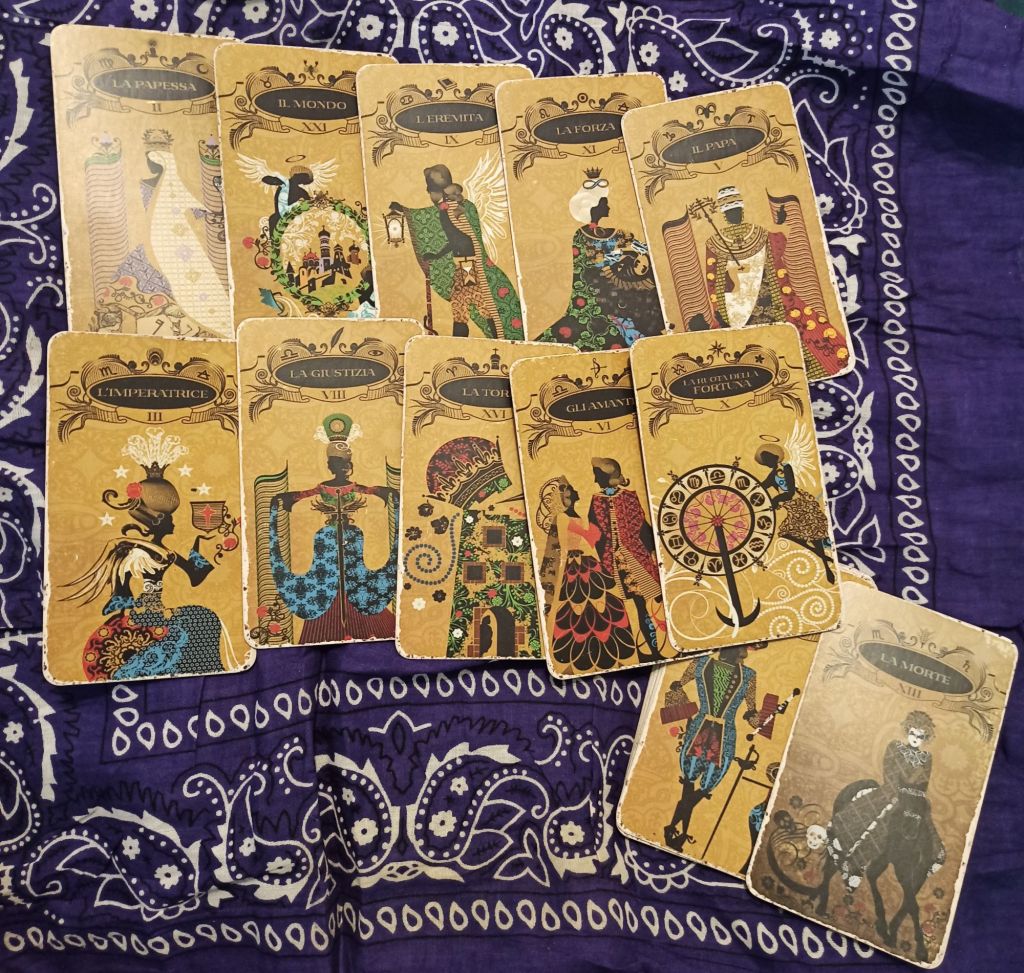
The question was simple. We had seen a nice house in October and I wanted to know if we’d manage to buy it. The first thing that caught my eye was Justice, Tower, Lovers, Wheel. Justice and Tower, in this context, indicates a real estate (Tower) contract (Justice). The Lovers card indicates an agreement and the Wheel, aside from showing the flow of money, indicates the agreement is positive. Next to Justice is the Empress. This can be neither the owner nor the agent because both were men. This is a woman who would help us get the positive deal. And indeed a female friend of ours who knows a lot about this stuff helped us negotiate a lower price.
We come to the first row of cards. I usually interpret the Popess or Pope next to the World card as a married person or a family member. In this case we have two married people in the family. The Hermit shows their distance, but the Strength card indicates that they are somehow active or present. At the time I interpreted this as my parents helping us. It was a good prediction, as my parents gave us some additional money for the down payment. In short, we are home owners!
(Note: this is a collection of the meanings attributed to the cards by some occultists in the past centuries. It does not reflect my own study or opinion of the cards. It is only meant as a quick comparative reference as I develop my own take.)
The Queen of Pentacles or Coins from the Builders of the Adytum (BOTA) tarot deck
Paul Foster Case (and Ann Davies)
The time period is from the beginning of the last decanate of Aries to the end of the second decanate of Taurus, April 10 to May 10. This period is under the rulerships of Jupiter, Venus and Mercury. Well-Dignified: the ability to detect the workings of Divine Guidance in all aspects of incarnate life. In divination, a generous, somewhat ceremonious, great-hearted woman who is both charming and graceful. She is probably possessed of considerable means and is friendly to the Querent. lll-Dignified: some problem with materialism and ability to express unselfish love. A woman who is ostentatious, loose in morals, capricious, changeable, superficial. Likely to do Querent harm through foolish talk, exposure of his plans, etc. Dark hair and eyes. (From the Oracle of Tarot course)
A. E. Waite
The face suggests that of a dark woman, whose qualities might be summed up in the idea of greatness of soul; she has also the serious cast of intelligence; she contemplates her symbol and may see worlds therein. Divinatory Meanings: Opulence, generosity, magnificence, security, liberty. Reversed: Evil, suspicion, suspense, fear, mistrust. (From The Pictorial Key to the Tarot)
Aleister Crowley
The Queen of Disks represents the watery part of Earth, the function of that element as Mother. She rules from the 21st degree of Sagittarius to the 20th degree of Capricornus. She represents passivity, usually in its highest aspect.
The Queen of Disks is throned upon the life of vegetation. She contemplates the background, where a calm river winds through a sandy desert to bring to it fertility. Oases are beginning to shew themselves amid the wastes. Before her stands a goat upon a sphere. There is here a reference to the dogma that the Great Work is fertility. Her armour is composed of small scales or coins, and her helmet is adorned with the great spiral horns of the markhor. In her right hand she bears a sceptre surmounted by a cube, within which is a three-dimensional Hexagram, and in her left arm is curved her proper disk, a sphere of loops and circles interlaced. She thus represents the ambition of matter to take part in the great work of Creation.
Persons signified by this card possess the finest of the quieter qualities. They are ambitious, but only in useful directions. They possess immense funds of affection, kindness, and greatness of heart. They are not intellectual, and not particularly intelligent; but instinct and intuition are more than adequate for their needs. These people are quiet, hard-working, practical, sensible, domesticated, often (in a reticent and unassuming fashion) lustful and even debauched. They are inclined to the abuse of alcohol and of drugs. It is as if they could only realize their essential happiness by getting outside themselves.
If ill dignified, they are dull, servile, foolish; they are drudges rather than workers. Life for them is purely mechanical; and they cannot rise, or even seek to rise, above their appointed lot.
In the Yi King, the watery part of Earth is represented by the 31st hexagram, Hsien. This has the meaning: Influence. The commentary describes the effect of moving various parts of the body, from the toes to the jaws and tongue. This is rather an amplification of what has been said above than an exact correspondence; yet there is no discordance. The general advice is to go forward quietly without overt attack upon existing situations. (From The Book of Thoth)
AI-generated illustration for the Queen of Pentacles or Coins
Golden Dawn’s Book T
A WOMAN of beautiful face with dark hair; seated upon a throne, beneath which is dark sandy earth. One side of her face is light, the other dark; and her symbolism is best represented in profile. Her attire is similar to that of the Queen of Wands: but she bears a winged goat’s head as a crest. A goat is by her side. In one hand she bears a sceptre surmounted by a cube, and in the other an orb of gold. She is impetuous, kind; timid, rather charming; great-hearted; intelligent, melancholy; truthful, yet of many moods. If ill dignified she is undecided, capricious, changeable, foolish. She rules from 20 Degree Sagittarius to 20 Degree Capricorn.
Etteilla
Dark Woman Upright. This card, as far as the medicine of the spirit is concerned, means, in its natural position: Dark Woman, Opulence, Wealth, Lavishness, Luxury, Sumptuousness. – Assurance, Reliability, Trust, Certainty, Confirmation. – Confidence, Boldness, Freedom, Frankness. Reversed. Unsafe, Doubtful, Uncertain, Doubt, Indecision, Uncertainty. – Fear, Fright, Timidity, Apprehension, Vacillation, Hesitation. – Indeterminate, Irresolute, Perplexed, He who is suspended.
I said some time ago that my husband and I are looking for a home (I have a tarot reading ready for that). I also wholeheartedly believe that once you are interested in something, everyone else who has the same interest tends to show up in your life, and real estate questions have been common lately. Here’s the spread for a woman who asked if she would manage to buy a house she was interested in (it started out as a five card spread, but I asked her to draw two more cards, for reasons that will become obvious shortly, and then a third I forgot to take a picture of)
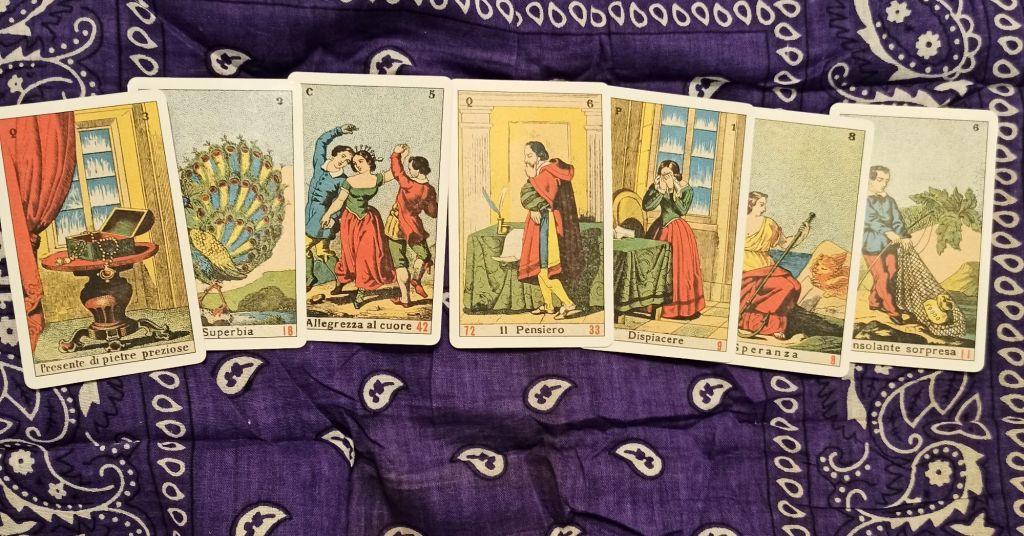
Real estate question with the Vera Sibilla Italiana
The first cards that caught my attention in the original five cards are the Five of Hearts and the Eight of Diamonds. Traditionally this means an engagement ring, but in this context it shows the proposal of a down payment (which is basically your engagement ring with the house you want to buy). According to the Peacock card between the two, this is a very high down payment, so I asked the querent, and she said they are (understandably) trying to pay off as much as possible in advance, almost half the total price.
The Thought card gives us some insight into the querent’s psyche: since it is followed by the Ace of Spades, she is worried, preoccupied or pessimistic. But the spread clearly isn’t complete, so I asked her to draw two more cards, and these were the Eight of Hearts, Hope, and the Six of Clubs, the Surprise. Clearly things will end up well, because these two cards together indicate the receipt of the hoped for money or the receipt of awaited money – for instance, money you’ve loaned or invested.
So I asked the querent if she’s waiting for money to invest into the home and she confirmed that she has some money tied down in an investment and she’s waiting for her bank to agree to free that money ahead of time. I was 99% sure this was possible, but to be on the safe side I asked her to draw a further card: this was the Seven of Clubs, the Realization (gran consolazione). Everything will be fine.
(Note: this is a collection of the meanings attributed to the cards by some occultists in the past centuries. It does not reflect my own study or opinion of the cards. It is only meant as a quick comparative reference as I develop my own take.)
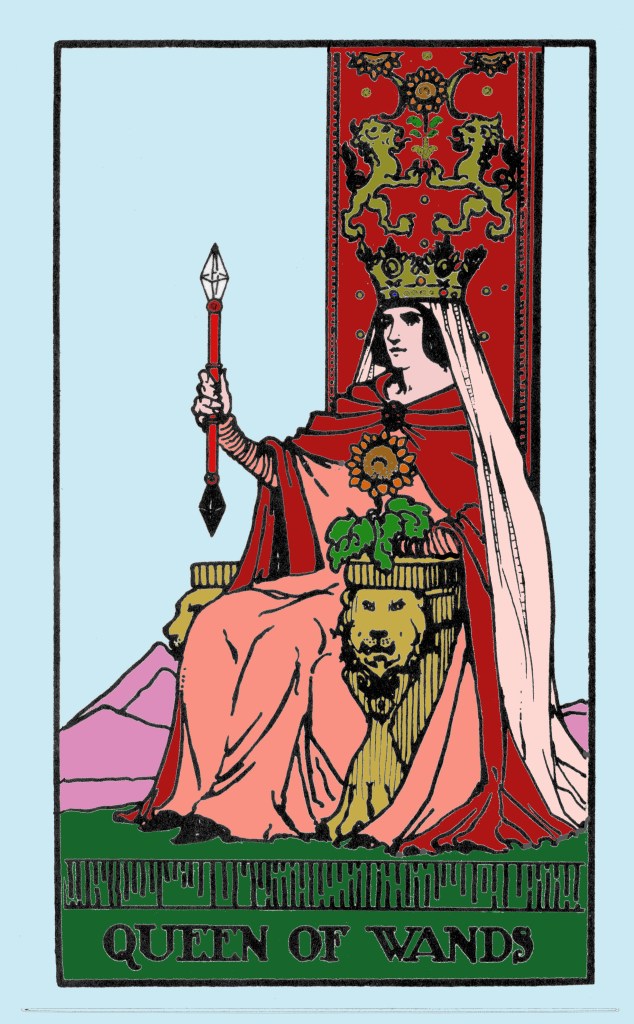
The Queen of Wands from the Builders of the Adytum (BOTA) tarot deck
Paul Foster Case (and Ann Davies)
The time period related to the Queen of Wands is from July 13 to August 12, symbolizing the influence of Jupiter and Neptune in Cancer and of the Sun and Jupiter in Leo. The basic power suggested by this Key is that of command. Well Dignified: in a divination the Queen of Wands symbolizes a kind, generous woman, resolute in the face of opposition, strongly psychic and intuitive but practical in applying her spiritual gifts; intense; magnetic ; friendly to the querent and a favorable influence for the success or business of the querent. Ill Dignified: Inimical to the querent; obstinate, dangerous woman, unfavorable to querent’s affairs; revengeful and tyrannical. (From the Oracle of Tarot course)
A. E. Waite
The Wands throughout this suit are always in leaf, as it is a suit of life and animation. Emotionally and otherwise, the Queen’s personality corresponds to that of the King, but is more magnetic. Divinatory Meanings: A dark woman, countrywoman, friendly, chaste, loving, honourable. If the card beside her signifies a man, she is well disposed towards him; if a woman, she is interested in the Querent. Also, love of money, or a certain success in business. Reversed: Good, economical, obliging, serviceable. Signifies also–but in certain positions and in the neighbourhood of other cards tending in such directions–opposition, jealousy, even deceit and infidelity. (From The Pictorial Key to the Tarot)
Aleister Crowley
The Queen of Wands represents the watery part of Fire, its fluidity and colour. Also, she rules in the Zodiac from the 21st degree of Pisces to the 20th degree of Aries. Her crown is topped with the winged globe and rayed with flame. Her long red golden hair flows down upon her armour of scaled mail. She is seated upon a throne of flame, ordered into geometrical light by her material power. Beneath the throne the surging flames are steady. She bears a wand in her left hand; but it is topped with a cone suggestive of the mysteries of Bacchus. She is attended by a couchant leopard upon whose head she lays her hand. Her face expresses the ecstasy of one whose mind is well in-drawn to the mystery borne beneath her bosom.
The characteristics of the Queen are adaptability, persistent energy, calm authority which she knows how to use to enhance her attractiveness. She is kindly and generous, but impatient of opposition. She has immense capacity for friendship and for love, but always on her own initiative.
There is as much pride in this card as in the Knight, but it lacks the spontaneous nobility which excuses that error. It is not true pride, but self-complacent vanity and even snobbery.
The other side of her character is that she may have a tendency to brood, come to a wrong decision thereon, and react with great savagery. She may be easily deceived; then she is likely to shew herself stupid, obstinate, tyrannical. She may be quick to take offence, and harbour revenge without good cause. She might turn and snap at her best friends without intelligible excuse. Also, when she misses her bite, she breaks her jaw!
In the YI King, the watery part of Fire is represented by the 17th hexagram, Sui. It indicates reflection upon impulse, and the consequently even flow of action. There is great capacity for lucid conception and steady prosecution of work; but this is only at the bidding, and under the guidance, of some creative mind. There is a tendency to be fickle, even disloyal; the ideas which she obeys make no deep or permanent impression. She will “cleave to the little boy and let go the man of age and experience” or the reverse (lines 2 and 3) without realizing what she is doing. There is liability of fits of melancholy, which she seeks to cure by bouts of intoxication, or by panic-stricken outbursts of ill-considered fury. (From The Book of Thoth)
Strangely Crowley-esque AI-generated illustration for the Queen of Wands
Golden Dawn’s Book T
A CROWNED queen with long red-golden hair, seated upon a Throne, with steady flames beneath. She wears a corslet and buskins of scale-mail, which latter her robe discloses. Her arms are almost bare. On cuirass and buskins are leopard’s heads winged, and the same symbol surmounteth her crown. At her side is a couchant leopard on which her hands rest. She bears a long wand with a very heavy conical head. The face is beautiful and resolute. Adaptability, steady force applied to an object, steady rule, great attractive power, power of command, yet liked notwithstanding. Kind and generous when not opposed. If ill dignified, obstinate, revengeful, domineering, tyrannical, and apt to turn against another without a cause. She rules the heavens from above the last Decan of Pisces to above the 20 Degree of Aries: including thus a part of Andromeda.
Etteilla
Country Woman Upright: This card, as far as the medicine of the spirit is concerned, means, when upright: Country woman, housewife, economy, honesty, civility – Sweetness, virtue – Honor, chastity Reversed: Good woman, goodness, excellence – Respectful, caring, obliging – Service, favor, benefit
While in Italy for the holidays, I retrieved my first notes from when I had started learning cartomancy from the person who taught me to read playing cards and the Sibilla. It’s just a couple of loose sheets on the basic meanings of the playing cards, the main combinations and two spreads (the row of cards, hardly a spread at all, and the cross).
This brought back so many memories of that period, but most of all it reminded me of how eminently practical divination used to be before its current glamorization. Of course, over time I learned a lot more from that lady than what is on that couple of now yellowed sheets, but the core of the system is there, and I believe she must have passed it on to me in no more than two sittings, if not just in one.
People who spend their time musing on the arcane meaning of the splotch of color on this or that card in the latest glossy and overly ornate oracle deck may laugh at how bare-bones that system is, but they would forget what significance divination had for the regular folks that used it to solve everyday matters.
Folk systems of fortune-telling, especially by cards, were designed to be quickly memorizable in their main lines, because they formed part of every housewife/househusband’s toolkit of remedies to the difficulties and uncertainties of life.
When an elderly person passed their meanings on to you, they did so not to introduce you to a different world detached from the real one, where you could dilly-dally with pleasant platitudes, but to send you into this life with another string to your bow. In principle, they revealed their system to you for the same reason that they taught you how to make preserves and liquors and how to best cultivate your garden.
Folk fortune-telling, in a word, was just another traditional remedy to the complexities of life. It did not involve stepping into a different plane of existence, because the everyday one was already enough, and it was looked on with the same pragmatic, solution-oriented gaze that was cast on all other problems people faced back in the day. “Don’t forget to add a small pinch of sugar to your tomato sauce. The Ace of Spades is a thorn in the heart.”
This is an attitude toward life that is hard to recapture nowadays. The idea of divination being useful has been so utterly eradicated from our mind that, when we approach it again, we do it as if it were an exotic, quaint, arcane world separate from our own. Our immediate reaction is therefore to keep it separate from our life, divorcing it from veriafiable prediction.
This stance is fatal, because it implies that our world is not inherently meaningful as it is; that meaning is found elsewhere and cannot be reconciled with our real life; that in order to find it, one must learn to look at one’s everyday struggles as illusions or as silly preoccupations not worthy of the attention of those in the know about the cosmic mechanism. All this ends up debasing both life and divination, because once life is debased, divination, which is the language of life’s drama, becomes a meaningless mirror only reflecting vague vapors.
Sometimes a spread doesn’t give us enough information and we need to dig deeper. I know that there is a number of way to do it. The way that has been taught to me is called ‘opening the spread‘ and it simply means adding one to three cards in one point to obtain further information. At this point I should say that I try to use this technique only when I find it is strictly necessary. The cards are fickle friends, so they are best kept on a short leash, lest they start confuse us. Here is an example. A querent asked me about his career. This is what came out:
Career reading
He didn’t ask a specific question, but the first two cards, the Six of Diamonds and the Five of Diamonds, represent worry about change. The center of the spread is occupied by the Jack of Diamonds, which indicates messages. Note, also, that the spread is ovverrun with Diamonds.
At this point, I asked him to draw two cards to add to the Jack of Diamonds, and we got the Four of Clubs and the Eight of Diamonds, clearly an interview. Then I asked him to open the spread again on the Eight of Clubs, the job card, and the Ace of Clubs and Seven of Clubs came up, indicating the overcoming of obstacles.
The question I asked him was if he was waiting for a message about some change, possibly to do with a raise or another positive change, where he would need to solve new problems, and he said he had applied for a promotion with came with new tasks, and he was waiting for an answer. I told him he’d get it (Ten of Diamonds and Eight of Clubs). Yesterday he confirmed he got the promotion.
When you pull three cards to describe a person (as I just did) and you get:
9♦ – J♠ – 3♠
This is a meddler, someone who interferes in others’ lives (J♠, 3♠), not out of self-interest or to get something, but due to a bloated belief in themselves (the Nine of Diamonds following the negative Court card). If the court card were positive, it would still be meddling, but out of love (Hearts, for instance)
English Version (scroll down for the Italian version)
It is an exciting time to be practicing divination. Among the occult arts it is probably the most popular for its immediate practical usefulness. The tarot is enjoying a divinatory revival after being brought to its knees by decades of pseudodeep elucubrations, and even lesser known systems of fortune-telling are being slowly fished out the obscure underbelly of folk tradition.
And occult folk tradition is especially rich in Italy, a country which, in part due to its chaotic and conflicted history, can boast a huge diversity of divinatory systems, especially (but not exclusively) of the card-based kind. It is especially reassuring to see that, unlike in the past, people of considerable education are taking these folk systems seriously.
It’s the case with Ernesto Fazioli’s latest book: Carte Piacentine. Divinare con le Briscole (Piacentine Cards. Divining with Briscola* Cards), a book dedicated to one of the many dozens of cartomancy systems based on the many types of Italian playing cards — in this case, Piacentine Cards–
Carte piacentine, one of the most popular playing card decks in Italy
Fazioli’s book is part of the same series as Germana Tartari’s Book on the Bolognese Tarot and it shares some of its traits: it is short (84 pages) and goes straight to the point; it is prefaced by a very quick but well-documented historical introduction; finally, it is aimed at shining a light on a small part of the Italian folk tradition while giving the reader the tools to work with it in today’s world.
I could quibble on a couple of points that made me wrinkle my nose, such as the association of the four suits with the four elements following the Golden Dawn pattern (which is not rooted in folk tradition, Italian or otherwise) but in reality all this is of very little account, as it can be very easily overlooked. The bulk of the book is solid and it teaches a traditional and little-known method of fortune-telling using a reduced pack of 30 Piacentine cards.
Each of the 30 cards is dedicated a small paragraph, which is enough, considering that, in traditional fortune-telling, one doesn’t spend a great deal of time musing on the quaint design of this or that card based on the latest fashion. For what little I know about this deck, the meanings retrieved by Fazioli feel genuine and even show a degree of overlap with the meanings of the Bolognese tarot.
This should not be a surprise, as fortune-telling and divination were born as methods of “gathering intelligence” about the world, meaning that, whatever system one uses, one must be given access do an adequate vocabulary–that is, a vocabulary that is adequate to describing the real world.
The spreads that Fazioli present also come from the folk tradition, and vary from the easier ones (the five card spread) to the very complex (a tableau of all 30 cards).
All in all, I am very pleased with my purchase, and will probably be posting a spread or two following the system. I am especially surprised by the good amount of information that Mr. Fazioli could pack into such a short booklet, and am endlessly fascinated, once again, by how folk divination emerges in its quality of spontaneous and creative remedy to life’s uncertainty.
* Briscola refers to one of the most popular game cards in Italy, usually played with Piacentine cards or a similar 40 card regional deck. For this reason, regional playing cards are often known as “carte da briscola” (briscola cards) in common parlance.
Versione Italiana
È un momento storico molto entusiasmante per chi pratica la divinazione. Tra le arti occulte è probabilmente la più popolare per la sua immediata utilità pratica. I tarocchi stanno vivendo un revival divinatorio dopo essere stati messi in ginocchio da decenni di elucubrazioni pseudointelletuali, e anche sistemi di cartomanzia meno conosciuti vengono lentamente ripescati dal ventre oscuro e creativo della tradizione popolare.
E la tradizione popolare occulta è particolarmente ricca in Italia, un Paese che, anche a causa della sua storia caotica e frammentata, può vantare un’enorme varietà di sistemi divinatori, soprattutto (ma non esclusivamente) del tipo basato sulle carte. È particolarmente rassicurante vedere che, a differenza del passato, persone di notevole cultura prendono sul serio questi sistemi popolari.
È il caso dell’ultimo libro di Ernesto Fazioli: Carte Piacentine. Divinare con le Briscole, un libro dedicato a una delle molte decine di sistemi di cartomanzia basati sui numerosi tipi di carte da gioco italiane – in questo caso le carte piacentine -.
Il libro di Fazioli fa parte della stessa collana del Libro sui Tarocchi Bolognesi di Germana Tartari e ne condivide alcuni tratti: è breve (84 pagine) e va dritto al punto; è preceduto da un’introduzione storica molto rapida ma ben documentata; infine, si propone di far luce su una piccola parte della tradizione popolare italiana dando al lettore gli strumenti per metterla a frutto nel contesto odierno.
Potrei cavillare su uno o due punti che mi hanno fatto storcere il naso, come l’associazione dei quattro semi con i quattro elementi secondo lo schema della Golden Dawn (che non ha radici nella tradizione popolare, italiana o meno), ma in realtà tutto ciò è di ben poco conto, perché può essere facilmente trascurato da chi non è interessato. Il libro ha solidi contenuti e insegna un metodo di cartomanzia tradizionale e poco conosciuto, utilizzando un mazzo ridotto di 30 carte piacentine.
A ciascuna delle 30 carte è dedicato un piccolo paragrafo, il che è sufficiente, considerando che, nella cartomanzia tradizionale, non si passa molto tempo a riflettere sul design pittoresco di questa o quella carta in base all’ultima moda. Per quel poco che so di questo mazzo, i significati recuperati da Fazioli nella sua attenta indagine sembrano genuini e mostrano persino un certo grado di similitudine con i significati dei tarocchi bolognesi.
Ciò non deve sorprendere, poiché la cartomanzia e la divinazione sono nate come metodi di “raccolta di informazioni” sul mondo, il che significa che, qualunque sia il sistema utilizzato, ci deve dare accesso a un vocabolario adeguato, cioè un vocabolario che sia adeguato a descrivere il mondo reale.
Anche le stese che Fazioli presenta provengono per lo più dalla tradizione popolare e variano da quelli più semplici (la stesa delle cinque carte) a quelli molto complessi (una stesa di tutte le 30 carte).
Nel complesso, sono molto soddisfatto del mio acquisto e probabilmente pubblicherò una o due stese seguendo il sistema. Sono particolarmente sorpreso dalla buona quantità di informazioni che Fazioli è riuscito a racchiudere in un libricino così breve e sono infinitamente affascinato, ancora una volta, da come la divinazione popolare emerga nella sua qualità di rimedio spontaneo e creativo all’incertezza della vita.