Category Archives: Cartomancy

Tarot Encyclopedia – The Ace of Swords

(Note: this is a collection of the meanings attributed to the cards by some occultists in the past centuries. It does not reflect my own study or opinion of the cards. It is only meant as a quick comparative reference as I develop my own take.)

The Ace of Swords from the Builders of the Adyum (BOTA) tarot deck

Paul Foster Case (and Ann Davies)

The time period is from the beginning of Libra to the end of Sagittarius, Sept. 23 to Dec. 21., representing the conjoined power of Venus, Mars and Jupiter. In divination , when the sword is turned downward it is ill-dignified and has a negative significance. In ceremonial magic the sword in this position is used for the invocation of evil forces, while with the point upward it denotes invocation of spiritual forces. Keep this in mind in divination , as an ill-dignified Ace of Swords shows need to control and overcome negative emotions and thoughts.
Keyword: Activity (particularly mental force in operation).
(From the Oracle of Tarot course)

A. E. Waite

A hand issues from a cloud, grasping as word, the point of which is encircled by a crown. Divinatory Meanings: Triumph, the excessive degree in everything, conquest, triumph of force. It is a card of great force, in love as well as in hatred. The crown may carry a much higher significance than comes usually within the sphere of fortune-telling. Reversed: The same, but the results are disastrous; another account says–conception, childbirth, augmentation, multiplicity.
(From The Pictorial Key to the Tarot)

Aleister Crowley

The Ace of Swords is the primordial Energy of Air, the Essence of the Vau of Tetragrammaton, the integration of the Ruach. Air is the result of the conjunction of Fire and Water; thus it lacks the purity of its superiors in the male hierarchy, Fire, Sol and the Phallus. But for this same reason it is the first card directly to be apprehended by the normal consciousness of Mankind. The errors of such cards as the 7 and 10 of Cups are yet of an Order altogether higher than the apparently much milder 4 of Swords. The study of the subtle and gradual degradation of the planes is excessively difficult.

In nature, the obvious symbol of Air is the Wind “which bloweth whithersoever it listeth”. It lacks the concentrated Will of Fire to unite with Water: it has no corresponding passion for its Twin Element, Earth. There is indeed, a notable passivity in its nature; evidently, it has no self-generated impulse. But, set in motion by its Father and Mother, its power is manifestly terrific. It visibly attacks its objective, as they, being of subtler and more tenuous character, can never do. Its “all-embracing, all-wandering, all-penetrating, all-consuming” qualities have been described by many admirable writers, and its analogies are for the most part patent to quite ordinary observers.

But, it will instantly be asked, what of the status of this Element in the light of other attributions? In the Yetziratic World, is not Air the first element to follow Spirit? Is not Vayu the first emergence of the phenomenal from the arcane obscurity of Akasha? How may one reconcile the doctrine of Mind with the fact that Ruh, or Ruach, actually means Spirit itself? “Achath Ruach Elohim Chiim” (777) means “One is the Spirit (not Air) of the Gods of the Living”? And is not Air, the element attributed to Mercury, also most properly the Breath of Life, the Word, the Logos itself?

The student must be referred to some less raw, cursory, elementary and superficial Treatise than this present bat-eyed, penguin-winged, bluebottle-brained buzzing. Nevertheless, although Air is in no system the lowest, and so cannot claim benefit of clergy from the doctrine that Malkuth automatically resolves into Kether, the following reference seems not wholly to lack either cogency or pertinence.

The Ruach is centred in the airy Sephira, Tiphareth, who is the Son, the first-born of the Father, and the Sun, the first emanation of the creative Phallus. He derives directly from his mother Binah through the Path of Zain, the sublime intuitive sense, so that he partakes absolutely of the nature of Neschamah. From his father, Chokmah, he is informed though the Path of Heh’, the Great Mother, the Star, our Lady Nuit, so that the creative impulse is communicated to him by all possibilities soever. [How strikingly this fact confirms the counterchange of IV and XVII, above fully expounded: as a link between Chokmah and Tiphareth, the Emperor would have no great significance, and this exquisite doctrine of the Three Mothers would be lost.] Finally, from Kether, the supreme, descends directly upon him, though the Path of Gimel, the High Priestess, the triune light of Initiation. The Three-in-One, the Secret Mother in her polymorphous plenitude; these, these alone, hail him thrice blessed of the Supernals!

The card represents the Sword of the Magus (see Book 4, Part II) crowned with the twenty-two rayed diadem of pure Light. The number refers to the Atu; also 22=2 X II, the Magical manifestation of Chokmah, Wisdom, the Logos. Upon the blade, accordingly, is inscribed the Word of the Law, This Word sends forth a blaze of Light, dispersing the dark clouds of the Mind.
(From The Book of Thoth)
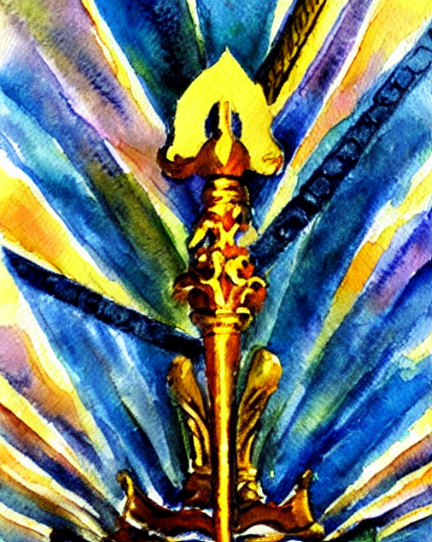
AI generated illustration for the Ace of Swords, looking more like a spear

Golden Dawn’s Book T

A WHITE Radiating Angelic Hand, issuing from clouds, and grasping the hilt of a sword, which supports a White Radiant Celestial Crown; from which depend, on the right, the olive branch of Peace; and on the left, the palm branch of suffering.
Six Vaus fall from its point. It symbolizes “Invoked,” as contrasted with Natural Force: for it is the Invocation of the Sword. Raised upward, it invokes the Divine crown of Spiritual Brightness, but reversed it is the Invocation of Demonic Force; and becomes a fearfully evil symbol. It represents, therefore, very great power for good or evil, but invoked; and it also represents whirling Force, and strength through trouble. It is the affirmation of Justice upholding Divine Authority; and it may become the Sword of Wrath, Punishment, and Affliction.

Etteilla

Fructification
Upright. This card, as far as the medicine of the spirit is concerned, means, in its natural position: Extreme, Great, Excessive. – Exaggerated, Furious, Choleric. – Extremely, Passionately, Excessively. – Vehemence, Animosity, Carriage, Impetus, Anger, Fury, Rage. – Extremity, Terms, Boundary, End, Limits. – Last sigh, Last extremity. – Divergence.
Reversed. Pregnancy, Germ, Seed, Sperm, Matter, Impregnation, Generation, Conception, Fructification. – Childbirth, Puerperium. – Fertilization, Production, Composition. – Enlargement, Increase, Multiplicity.

MQS
Vera Sibilla Cards That Indicate Groups

There is a number of cards in the Vera Sibilla that can indicate groups or at least hint at them. Each card stresses a different aspect of the experience of groups, and must be read within the context of the whole spread. As usual, this list is not meant to be exhaustive. Context is key.

Ace of Hearts (Conversation)

The Conversation card represents the act of talking, and therefore (except the querent is a lunatic) it implies someone else. It can broadly refer to the ability to express one’s thoughts or even one’s qualities with others, and is a deeply interpersonal card. It also refers to a usually tight-knit group of people, often people living together or family members,

Two of Hearts (House)

The House card does not directly refer to people, but it does refer to a close environment where people either live (a literal house) or are found (any kind of building). For instance, next to negative cards, or if reversed, it can show that the querent isn’t happy in their house, usually due to interpersonal conflict with family members or other people who spend time in that place.

Five of Hearts (Happiness)

The Happiness card can refer to relatives and blood relations or, in general, one’s “clan”. It can be another significator for the querent’s family, but it refers to relatives in a usually broader sense. However, it can also indicate groups of people held together by common interests, a clan of sorts, such as a political party. This is quite rare though. When reversed, it shows trouble with relatives.

Ten of Hearts (Perseverance)

Traditionally this card can refer to the querent’s town or motherland. Occasionally it can show how they are seen or if they are talked about in their town. This is somewhat rare.

Ace of Clubs (Marriage)

The Ace of Clubs represents all official acts binding two or more people together. It is the card of pacts, agreements, marriage, contract, partnerships. It can represent a business where people cooperate in the creation of something (a product).

Four of Clubs (Friend)

The Friend card can refer to a literal (female) friend or relative, but it can also represent a circle of friends, and the idea of a supportive environment where the querent is taken care of in a spirit of friendship or cooperation.

Eight of Clubs (Reunion)

Traditionally this is the card of reconciliation, of meetings, etc. However, it represents also a coming together, and this coming together doesn’t need to involve only two people. It can also more generally represent the querent’s interpersonal skills. When reversed, these skills are not present or are put to the test by difficult people. This is also the “more than one” card of the Sibilla (e.g., more than one job, more than one child, etc.)

Nine of Clubs (Cheerfulness)

This card can indicate one’s wider circle of acquaintances, but in general also friends or groups of people, often not tied by very deep bonds of affections. When reversed, or when near negative cards, it can refer to bullying by other people or serious problems in a particular environment due to being hated. Traditionally it also represented people from the countryside, but this is an older reading.

Ace of Diamonds (Room)

Like the House card, the Room doesn’t refer to people directly, but it can represent them indirectly by pointing to the environment they spend time in, usually an office, a shop or similar.

Nine of Diamonds (The Fools)

This card is the opposite of the Cheerfulness card, and is the only (upright) card that directly points to interpersonal problems, problematic groups, enmity and instability in a group setting and similar situations. It can represent hooligans, gangs, rioters or, more simply, a disunited family.

Three of Spades Reversed (Widower)

In general, the Widower reversed is the card of trauma, of serious loss and of bad behavior. However, it can also point to ritual settings that involve more than one person. The ritual setting needn’t be negative (it can be a christening, for instance). However, with negative cards it can signify dangerous groups, especially sects.

MQS

Spirituality and the Sibilla (Example Reading)

As promised in a previous post, I’m discussing a (rather old) reading on spiritual issues. It is common to believe that the Tarot is better suited to talk about spiritual issues and oracles such as the Sibilla or Lenormand are more useful for practical, everyday events. This is not true. The Tarot can be just as practical, and the Sibilla (and, I assume, other oracles) can be just as clear about spiritual issues. The thing that makes people think otherwise is that they are used to that kind of tarot reading where the psychic spends the whole time pulling pseudodeep psychobabble out of their butt by looking at the pictures on the cards. That’s not a tarot reading, that’s a therapy session (for the reader, not for the querent).

Spirituality is part of real life, and as such all oracles can talk about it, but always in real-life terms. Here the querent was a man and had asked me generically about his spiritual life.

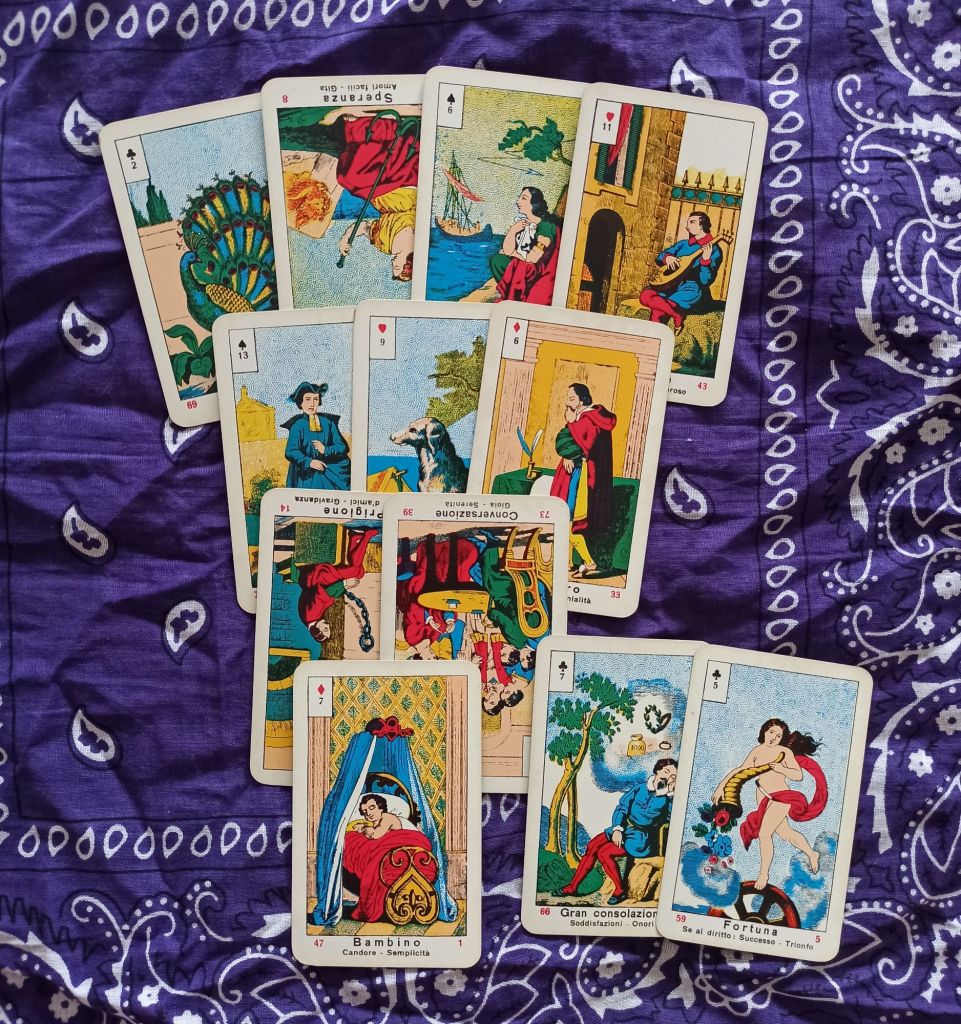
A spiritual reading with the Vera Sibilla cards

The first thing I was able to detect was the presence of the Priest in the second row. The Priest is usually not a real priest, and rather indicates a figure of authority. We also have, it seems, the significator card for the querent, represented by the Boyfriend, or Jack of Hearts, in the first line. The Priest is accompanied by the Dog/Faithfulness. This is a very good card, even outside of a love reading. It shows that, whoever the Priest is, he (or she) is good, trustworthy and has the querent’s best interest at heart. Furthermore, they are true believers.

The Thought card perplexed me a little, so I skipped over it (though you can see that the Thought card is just under the querent, so it turned out that it was the querent’s thinking process setting into motion). However, I did ask the querent if he was in contact with some kind of spiritual authority and he confirmed it, though he said it wasn’t a traditional priest or minister. This doesn’t matter: all kind of spiritual authorities can be signified by the Priest card.

The querent’s line, the first, has the card of God in it. This is the Peacock (when reversed, it represents the Devil and demons, as well as pride and haughtiness). The Peacock indicates totality, wholeness, miracles, etc. when upright. But it is followed by the Hope card reversed. Hope is the card of faith, but it is reversed, thus showing unbelief.

Yet it is not a clear atheism. Look at the Six of Spades, the Sighs card, right between the querent and the combination of lack of faith in God: the querent is sighing about his lack of faith. He is uncertain and tormented. I remember judging that he was probably a wobbly agnostic, and upon asking he confirmed that he had doubts (I didn’t ask him “are you a wobbly agnostic?” of course. We need to be kind to the querent).

It turned out, the querent had long banished spirituality from his life, had gone for an engineering degree, had been active in the skeptic community online, etc. However, some personal experiences had made him doubt his position.

Look at the last three cards of the pyramid. The Prison reversed shows unburdening, unshackling, freedom, etc. (when not followed by negative cards). Then we have the Conversation card. When reversed, it shows change. Finally, the Child, which shows a new beginning. I don’t know about you, but liberation + change + new beginning sounds like a spiritual conversion.

Furthermore, look at the angles of the pyramid plus the center: the Peacock (God), the querent, the new beginning (Child) and the Faithfulness card. This is a very positive indication.

Still, just to make sure, I asked the querent to draw two cards, and these were the Gratification and Fortune, confirming the good outcome.

As far as I know, the querent has since chosen his spiritual path.

MQS

Tarot Encyclopedia – The Ace of Wands

(Note: this is a collection of the meanings attributed to the cards by some occultists in the past centuries. It does not reflect my own study or opinion of the cards. It is only meant as a quick comparative reference as I develop my own take.)

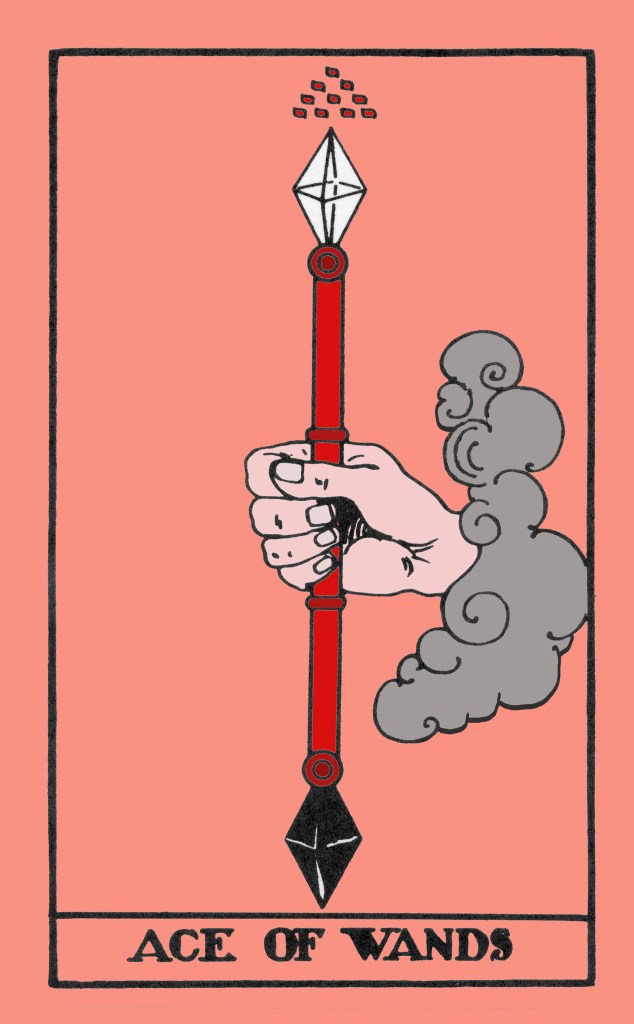
The Ace of Wands from the Builders of the Adytum (BOTA) Tarot deck

Paul Foster Case (and Ann Davies)

In Tarot Divination the Ace of Wands has these key meanings: natural as opposed to invoked force; strength; force; vigor; vitality; particularly the force of concentrated will; the principle of beginning; initiation or inception of any enterprise or activity; concentration of power; involution of force.
Keyword: Initiative
(From the Oracle of Tarot course)

A. E. Waite

A hand issuing from a cloud grasps a stout wand or club. Divinatory Meanings: Creation, invention, enterprise, the powers which result in these; principle, beginning, source; birth, family, origin, and in a sense the virility which is behind them; the starting point of enterprises; according to another account, money, fortune, inheritance. Reversed: Fall, decadence, ruin, perdition, to perish also a certain clouded joy.
(From The Pictorial Key to the Tarot)

Aleister Crowley

This card represents the essence of the element of Fire in its inception. It is a solar-phallic outburst of flame from which spring lightnings in every direction. These flames are Yods, arranged in the form of the Tree of Life. (For Yod, see Atu IX supra.) It is the primordial Energy of the Divine manifesting in Matter, at so early a stage that it is not yet definitely formulated as Will.

Important: although these “small cards” are sympathetic with their Sephirotic origin, they are not identical; nor are they Divine Persons. These (and the Court Cards also) are primarily sub-Elements, parts of the “Blind Forces” under the Demiourgos, Tetragrammaton. Their rulers are the Intelligences, in the Yetziratic world, who go to form the Schemhamphorasch. Nor is even this Name, “Lord of the Universe” though it be, truly Divine, as are the Lords of the Atu in the Element of Spirit. Each Atu possesses its own private, personal and particular Universe, with Demiourgos (and all the rest) complete, just as every man and every woman does.

For example II’s or VI’s Three of Disks might represent the establishment of such an oracle as that of Delphi, or VIII’s might be the first formula of a Code such as Manu gave to Hindustan; V’s, a cathedral, XVI’s, a standing army; and so on. The great point is that all the Elemental Forces, however sublime, powerful, or intelligent, are Blind Forces and no more.
(From The Book of Thoth)

Golden Dawn’s Book T

A WHITE Radiating Angelic Hand, issuing from clouds, and grasping a heavy club, which has three branches in the colours, and with the sigils, of the scales. The Right-and Left-hand branches end respectively in three Flames, and the Centre one in four Flames: thus yielding Ten: the Number of the Sephiroth. Twoand-twenty leaping Flames, or Yodh, surround it, answering to the Paths; of these, three fall below the Right branch for Aleph, Men, and Shin, seven above the Central branch for the double letters; and between it and that of the Right twelve: six above and six below about the Left-hand branch. The whole is a great and flaming Torch. It symbolizes Force — strength, rush, vigour, energy, and it governs, according to its nature, various works and questions. It implies Natural, as opposed to Invoked, Force.

Etteilla

Birth
Upright. This card means, in its natural position, as far as the medicine of the spirit is concerned: Birth, Beginning. – Nativity, Origin, Creation. – Source, Beginning, Primacy. – Extraction, Race, Family, Condition, House, Lineage, Posterity, Occasion, Cause, Reason, First, First fruits.
Reversed. Fall, Decadence, Decay, Decline, Decay, Decay, Dissipation, Failure, Bankruptcy, Ruin, Destruction, Demolition, Damage, Devastation. – Guilt, Error, Contempt, Abatement, Depression, Discouragement. – Perdition, Abyss, Chasm, Precipice. – Dying, Falling, Decay, Derogation. – Depth.

MQS

Divination vs Fortune-Telling: History of a False Dichotomy

The founder of BOTA, Paul Foster Case, proudly started his short book “Oracle of the Tarot” with the assertion that Tarot divination is not fortune-telling. The reason, he explains, is that fortune-telling is grounded in the belief in luck, chance or fate, while divination understands that everything is about our personality. The same statement is found at the beginning of the advanced BOTA course on tarot divination (Oracle of Tarot, without the ‘the’). Ann Davies clearly had a hand in rewriting it, considering how verbose the course is, but the substance was similar.

Paul Case was tapping into the spirit of the times when he made that statement. Since Tarot had the (mis)fortune of attracting the attention of XVIII and XIX century occultists, it hasn’t enjoyed a moment of peace: everyone wants to believe it to be not an obvious masterpiece of Renaissance art and Medieval philosophy, but an occult device made to transmit mystical knowledge unknown to most people (even though most people prior to the Enlightenment and the French revolution would have been able to tell you what the Tarot was about).

The same has happened to Astrology. Once a practical art for foretelling the ups and downs of actual life, it became the victim of the occult intelligentsia of the last couple of centuries and was turned into a hodgepodge of pseudomysticism, ill-digested psychoanalytic concepts and “it’s true if you believe it” New Thought crap.1

But this is not the whole story. If one takes the time to study, say, the Golden Dawn system, one quickly finds out that their traditional way of reading the Tarot is grounded in fortune-telling (just read MacGregor Mathers’ example of the Opening of the Key spread). Even the BOTA system, which derives from it, preserves very concrete meanings to be strung together into sentences, despite Ann Davies’ attempt to turn divination into a form of Kabbalistic meditation.

In other words, the occultist attempt at reappropriating the Tarot and Astrology (which in part continues to this day with some bogus theories about the so-called Tarot of Marseille, but more on this in another post) is only partly responsible for the divination/fortune-telling dichotomy. Much of contemporary occultism is grounded in the psychoanalyzation of magic and spirituality, which, in turn, is a defense mechanism against the death of the classical spiritual worldview. Yet, for all its shortcomings, it at least preserves some core tenets of the magical worldview.

But the problem with this is that while it does preseve in some ways the roots of the worldview in which divination can flourish, it has lost the intellectual basis for defending it. Intellectually speaking, even today occultism is largely stuck in the pre-WWII era, with its myths of scientific positivism, of constant historical progress and of magic as misunderstood technology (while I would argue the opposite, namely that technology is misunderstood magic).

Essentially, what has gone lost is the philosophical framework that allows us to keep together divination as spiritual practice and divination as uttering of concrete, verifiable truths.2 That’s largely because spirituality, in the post-XVIII-century Western world, was only allowed to survive as private indulgence in irrational behavior, a weakness to be tolerated.

Thus the split was born: 1) on one hand divination: a ‘serious’, and therefore unverifiable endeavor, a tool for vague self-reflection, cheap catharsis and shallow instagrammable aha moments. In other words, something that the small judgmental scientist constantly perched on most people’s shoulder could smile upon as at least benign, if not really true; 2) on the other hand fortune-telling: a crass or quaint superstition that is just a scam when it gets things wrong and just a coincidence when it gets them right. The little scientist can be free to frown on it. In other words, the distinction was born out of the guilty conscience of “spiritual” people, i.e., out of their subconscious scientism, as a way of telling themselves and society “I indulge in this silliness, but I am just quirky, not stupid.”

The occultists of yore were at least intelligent men and women who actually had something to say. They may have worked in an intellectually hostile environment, but they at least gave it their best shot, and for this they deserve leniency. What happened next is worse: that the already battered art of divination fell into the hands of stoned hippies and people with degrees in the most useless branches of socially acceptable knowledge. Then along came the Liz Greene’s and the Rachel Pollack’s (to make just two examples) who destroyed Astrology and Tarot even further. From then on it could only go in one direction: past life readings, divine feminine, empty motivationalism and strategizing, healing of generational traumas and all the attendant nonsense.3

Interestingly, the more contemporary divination’s fake husk rots, the more one needs to be intellectually dead to practice it, the more it becomes reintegrated in the higher spheres of society. I believe I already talked about a friend of mine who works for Google and has to endure meaningless meetings with tarot readers and astrologers because her boss is the manifestation-obsessed boss babe type. Nor are tarot readers a rarity in corporate America. This probably says something about how brain-damaged this kind of environments is. The nicest thing we can say about this part of society and this strand of divination is that they deserve each other.

MQS

  1. This is not to say that Astrology or divination were unanimously accepted, but the debate was much more complex. ↩︎
  2. This, by the way, is not a call to “go back” to some long lost good old times. I am no reactionary. Nor am I a progressive. I am a realist. ↩︎
  3. By which, of course, I do not mean that there is not a feminine side of the divine, nor that trauma cannot be a real thing. I only mean that these words correspond to nothing but the most vapid pseudointellectual nonsense when coming out of most people’s mouths nowadays. ↩︎

Is He An Atheist? (Card Reading Example)

Traditional cartomancy, like all traditional divination systems, is full of tips on how to handle spiritual topics. The difference with contemporary psychobabble is that in traditional cartomancy we deal with a spirituality that is rooted in the earth and in everyday life rather than in Mind/Body/Spirit section poppycock. As I often remark, in such systems spirituality is seen as the logical next step for someone who is acquainted with real life, not as a consolation prize for someone who is trying to avoid it.

The querent asked if her boyfriend believes in “a superior being”, by which I assume she meant God (“being” is probably a more reassuring term compared to “bearded guy holding a lightning bolt”). She places great importance on the topic, but he seems to avoid talking about it. This is a playing card reading. In the next days I will also post a Vera Sibilla reading done on a similar question by a different person some time ago.

A♥ – 8♣ – 9♣ – K♥ – 7♣

Seeing this, I asked the querent to draw three more cards to open the reading on the Ace of Hearts, which yielded the 2♠, the 2♣ and the 6♣.

The first thing I noticed was the complete absence of Spades (except in opening the spread, but that’s a very weak Spade). This generally bodes well for spirituality. However, there is also a majority of Clubs, which indicate struggles and difficulties. There is no need to interpret the spread card by card. The spread indicates a slow or difficult relation with the divine. Belief is not denied, but it is rendered heavy, problematic.

The first card is the Ace of Hearts, which can indicate “inner” issues, but because the first card in a spread can also represent the cause of a situation described by the following cards, I ventured to interpret it as issues relating to the home causing the querent’s boyfriend to falter in his faith. The three additional cards with which I opened the spread on the Ace of Hearts reinforced my idea that there must have been a difficult atmosphere at home surrounding the topic.

What about the King of Hearts? Is it the dad? Well, no. Traditionally, in spiritual readings the King of Hearts is God himself (just like in the Sibilla): he is the lord (King) of your inner life (Hearts). Surrounded by all those Clubs, the God-side of the boyfriend’s life suffers, is stifled. Yet it is there, since the King of Hearts comes up and is not surrounded by Spades.

I asked the querent to give another three cards to open the spread on the King of Hearts. These were the 10♠, the 4♣ and the 10♥. At night (Ten of Spades) he speaks (Four of Clubs) spiritually/finding consolation (Ten of Hearts). He prays to God at night.

MQS

Tarot Encyclopedia – Index

Back to the Tarot Index

This is intended as a collection of meanings attributed by some sources to the Major Arcana and Minor Arcana of the Tarot. I will add sources as I study them. If you have sources to recommend, hit me up.

If you are interested in a (partial) list of the meanings I attribute to the Major arcana in my reading examples and case studies, click here.

Court Cards

Kings Wands, Cups, Swords, Coins/Pentacles
Queens Wands, Cups, Swords, Coins/Pentacles
Knights Wands, Cups, Swords, Coins/Pentacles
Pages Wands, Cups, Swords, Coins/Pentacles

Small Cards

Aces Wands, Cups, Swords, Coins/Pentacles
Twos Wands, Cups, Swords, Coins/Pentacles
Threes Wands, Cups, Swords,Coins/Pentacles
Fours Wands, Cups, Swords, Coins/Pentacles
Fives Wands, Cups, Swords,Coins/Pentacles
Sixes Wands, Cups, Swords, Coins/Pentacles
Sevens Wands, Cups, Swords, Coins/Pentacles
Eights Wands, Cups, Swords, Coins/Pentacles
Nines Wands, Cups, Swords, Coins/Pentacles
Tens Wands, Cups, Swords, Coins/Pentacles

MQS

Vera Sibilla Cards That Indicate Gain

Following up on my previous post about Sibilla cards that show loss, today we discuss the opposite idea, i.e., that of gain. As usual, the list is not meant to be exclusive, and gain is not the only meaning of the following cards.

Six of Hearts (Money)

As the main significator card for money, the 6♥ often shows the querent’s (or another person’s) liquid assets. By itself it doesn’t necessarily show increase of money, but it can indicate that a situation will bring money, and so increase can be implied in the context.

Eight of Hearts (Hope)

The 8♥ can indicate investments, but more in general it shows a favorable situation, so if gain is looked for, it will probably come.

Ace of Clubs Reversed (Marriage)

When reversed, the Ace of Clubs can indicate wealth. However, it is a neutral card, so if followed by negative cards it can point to loss of wealth. By itself it speaks not only of money but of property in general.

Two of Clubs (the Peacock)

Being the talisman card of the deck, the 2♣ represents prosperity. It shows freedom from want and positive situations all around (the Peacock’s wheel is the counterpart to the World card’s garland in the tarot).

Five of Clubs (Fortune)

Both upright and reversed, the Fortune card shows positive situations and movement in the querent’s life, especially as it pertains to finances, so gain is implied. When reversed, the positivity is diminished or delayed.

Six of Clubs (Surprise)

Even in its design the card represents obtaining money. It can shows the querent’s income in general, but more specifically it indicates money coming in, usually without much effort on the querent’s part (it is a surprise, after all).

Seven of Clubs (Realization)

Although this card is geared more toward the querent’s patrimony or realization in the world, it can imply prosperous finances and its power is greater than that of the preceding card. When the 5♣, 6♣ and 7♣ fall together they represents major wealth.

Ten of Clubs Reversed (Levity)

When reversed, the Ten of Clubs indicates the ability to manage one’s finances wisely and to save. It can also represent lucky opportunities to make money, and by itself it can show a small sum of money coming in.

Ace of Diamonds (Room)

This one is a card of material prosperity. When upright, it can represent a well-balanced checkbook or positive upcoming news concerning one’s finances. Reversed it can show the same, but with bad cards it points to mismanagement.

Three of Diamonds (Gift)

It can be a literal gift, of course, but often it represents the act of receiving or being offered something. This can be very comforting for someone waiting for a loan to be approved. It is also a card of luxury, so gain is implied in some way.

Eight of Diamonds (Handmaid)

This one is the card of money coming and going. When upright, it usually shows money coming in, positive financial evolution and ascent. Like the Gift card, the 8♦ can represent the idea of receiving.

King of Diamonds (Merchant)

In the main this is the card of work and career. However, it is still a merchant, so it can be indicative of business, banking and money changing hands.

MQS

Tarot Encyclopedia – The Page of Swords

(Note: this is a collection of the meanings attributed to the cards by some occultists in the past centuries. It does not reflect my own study or opinion of the cards. It is only meant as a quick comparative reference as I develop my own take.)

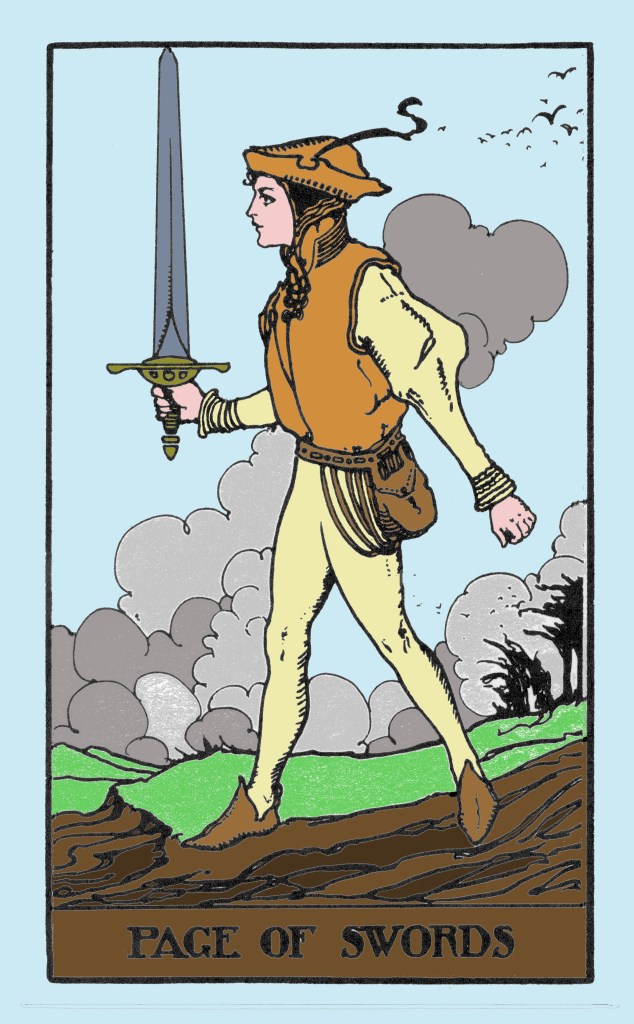
The Page of Swords from the BOTA (Builders of the Adytum) Tarot deck

Paul Foster Case (and Ann Davies)

The time period is from the beginning of Libra to the end of Sagittarius, September 23 to December 21. Meanings: a young person of either sex. Artistic, active, generous. Capable of weighing evidence, somewhat interested in occultism, philosophy or religion. Naturally aspiring, graceful.
If Ill-Dignified: frivolous, cunning and prodigal
Light brown hair and blue eyes
(From the Oracle of Tarot course)

A. E. Waite

A lithe, active figure holds a sword upright in both hands, while in the act of swift walking. He is passing over rugged land, and about his way the clouds are collocated wildly. He is alert and lithe, looking this way and that, as if an expected enemy might appear at any moment. Divinatory Meanings: Authority, overseeing, secret service, vigilance, spying, examination, and the qualities thereto belonging. Reversed: More evil side of these qualities; what is unforeseen, unprepared state; sickness is also intimated.
(From The Pictorial Key to the Tarot)

Aleister Crowley

The Princess of Swords represents the earthy part of Air, the fixation of the volatile. She brings about the materialization of Idea. She represents the influence of Heaven upon Earth. She partakes of the characteristics of Minerva and Artemis, and there is some suggestion of the Valkyrie. She represents to some extent the anger of the Gods, and she appears helmed, with serpent-haired Medusa for her crest. She stands in front of a barren altar as if to avenge its profanation, and she stabs downward with her sword. The heaven and the clouds, which are her home, seem angry.

The character of the Princess is stern and revengeful. Her logic is destructive. She is firm and aggressive, with great practical wisdom and subtlety in material things. She shews great cleverness and dexterity in the management of practical affairs, especially where they are of a controversial nature. She is very adroit in the settlement of controversies.

If ill-dignified, all these qualities are dispersed; she becomes incoherent, and all her gifts tend to combine to form a species of low cunning whose object is unworthy of the means.

In the Yi King, the earthy part of Air is represented by the 18th hexagram, Ku. This means “troubles”; it is, for all practical and material matters. The most unhappy symbol in the book. All the fine qualities of Air are weighed down, suppressed, suffocated.

People thus characterized are slow mentally, the prey of constant anxiety, crushed by every kind of responsibility, but especially in family affairs. One of both of the parents will usually be found in the aetiology.

It is hard to understand line 6, which “shows us one who does not serve either king or feudal lord, but in a lofty spirit prefers to follow his own bent”. The explanation is that a Princess as such, being “the throne of Spirit”, may always have the option of throwing everything overboard, “blowing everything sky high”. Such action would account for the characteristics above given for the card when well dignified. Such people are exceedingly rare; and, naturally enough, they appear often as “Children of misfortune”. Nevertheless, they have chosen aright, and in due season gain their reward.
(From the Book of Thoth)

Golden Dawn’s Book T

AN AMAZON figure with waving hair, slighter than the Rose of the Palace of Fire. Her attire is similar. The Feet seem springy, giving the idea of swiftness. Weight changing from one foot to another and body swinging around. She is a mixture of Minerva and Diana: her mantle resembles the AEgis of Minerva. She wears as a crest the head of the Medusa with serpent hair. She holds a sword in one hand; and the other rests upon a small silver altar with grey smoke (no fire) ascending from it. Beneath her feet are white clouds. Wisdom, strength, acuteness; subtlety in material things: grace and dexterity.
If ill dignified, she is frivolous and cunning.
She rules a quadrant of the heavens around Kether.
Earth of Air

Etteilla

Observer
Upright. This card, as far as the medicine of the spirit is concerned, means, in its natural position: Spy, Curious, Observer, Scrutinizer, Collector, Overseer, Intending. – Examination, Note, Observation, Annotation, Speculation, Account, Calculation, Conjecture. – Scientist, Artist.
Reversed. Unexpected, Suddenly, Suddenly, Suddenly. – Stunning, Astonishing, Inopinently. – Improvise, Acting and speaking without preparation, Composing and acting sitting down.

MQS

On Death (Example Reading)

Of the many subjects that have been banished to the realm of shadows in contemporary divination, none have become more unspeakable than death. Under no circumstances should we be reminded of our mortality and finitude, largely because these are all things that fly in the face of the “you can be whatever you want” ideology that many diviners now espouse. Divination proves that no, we can’t be whatever we want. Certain patterns of our life are laid out for us and there is precious little we can do about them except, maybe, work on our ability to accept them.

Obviously, as diviners we wield a certain degree of power over our querents, and as such we ought not to abuse it to terrorize them. I don’t usually talk about death unless the question is specifically about it or unless the context somehow allows for such a discussion. But I am also no moralist lecturing the querent on what they should be asking. In this case I was asked by a woman about her father’s wellbeing after being diagnosed with a serious illness. I told her I would not diagnose anything, but I would merely look at the general flow of his life.

2♥ – Q♥ – Q♠ – K♠
10♠ – K♣ – 9♠
8♠ – Q♦
10♥

I said it largely to comfort her, but the cards have their own language that cannot be overruled by any consideration. The pyramid can largely be summarized in one word: “funeral“. There isn’t much to discuss or interpret. Look at that group of people cards: these are not specific individuals. They are just meant to indicate many people together.

Then we have the Nine of Spades, Eight of Spades and Ten of Speads interspersed. These show great evil, tears, darkness. You get the picture. In the context of this question, many people together for something tear-related is called a funeral. So there is going to be a funeral: the father won’t survive.

Due to the Two of Hearts, I thought this was going to be within two weeks (not the funeral, but the death). It ended up being almost a month (timing is always tricky). In general, I think the cards meant “soon”.

But what about the Ten of Hearts at the end? Shouldn’t it nullify the evil meaning of the other cards? Usually it does, but the Ten of Hearts also represents Heaven or paradise. In the context of readings about this sort of issues it indicates that death comes as a release from the sufferings of life. As such, as weird and unfathomable as this sounds to us in the realm of the living, the spread is positive: it ended well because it ended in death. As a matter of fact, I have been told that the father was serene and peaceful till the end.

Why Predict Death? Philosophical and Practical Implications

I hope I haven’t put off anyone with this post, but the fact is that death is possibly the most salient event in life, so it makes sense that divination should be able to address it. The readings I do about this sort of issues are very rare, and I generally warn the person that I am fallible and have been and will be wrong again.

Other readers may choose to avoid such questions altogether. This is a legitimate choice, as no one should be forced to read about topics they feel uncomfortable about. However, it is also important to recognize that such questions are legitimate and that there is nothing inherently dark about them. It all depends about the context and about the attitude of the diviner (and of the querent, of course).

One may ask what the point is of divining about death and other such topics, since the querent cannot do much about it. In reality, there is plenty of non-morbid reasons to want to know about it: one may wish to set their affairs in order, or simply get a head start in getting closure. In pre-modern Western astrology, as well as in Chinese astrology, the prediction of the native’s death, or at least of whether they had enough life force in them to lead a relatively long life, was one of the first things the astrologer looked for. This is obvious: you can’t predict fame to someone for next year if they’ll be gone tomorrow.

Most importantly, a sober and serviceable approach to such topics has the ability to make us appreciate life from the point of view of the eternal, from the recognition that many things escape our control and we are truly actors in a cosmic play.

MQS