Category Archives: Cartomancy

The Ethical Limits of Prediction, Between Girly-Pops and Caring For Others

I had a quick but interesting exchange of emails with a reader of this blog, and they asked me my perspective on the ethical side of prediction. One of the questions was if I share the belief that we shouldn’t answer questions that don’t directly relate to the querent and their actions, especially if they involve reading other people’s mind (e.g., “Is he thinking about his ex?”)

The Three Types of Diviners

First off we must recognize that, nowadays, there are many diviners who do not even think that prediction is possible. Then there’s those who think it’s possible but not desirable. And then there’s those who think it’s both possible and perfectly legitimate. If you know me, you can guess which camp I belong to.

The one thing almost all diviners of almost all strands can agree on is that divination should leave the querent with more information than before the reading took place. It is the nature of the information that is controversial. Many (most, perhaps) contemporary diviners believe the information should be of a mystical/ethical nature and should guide the querent’s action rather than foretelling future events or things the querent has no control over, such as other people’s thoughts beliefs, which is seen as prying. The idea is that to do otherwise is to disempower the querent by putting the center of power outside of them.

To which I say: We are not discrete atoms living each in its own self-made, self-referential reality, no matter what the manifesting girly-pops on Tiktok say. The center of power is not within us, at least not in the sense that most people think.1 We exist enmeshed in an infinitely complex chain of actions and reactions, and our degree of control over them is objectively limited.

We seek to steer our life through the chaos of existence by levereging the information we have, including our knowledge of what (we think) other people’s beliefs and motivations are. In so far as divination gives us information and knowledge, it helps us increase the degree of control we have on our life (though this control can never be absolute). As such, it is perfectly legitimate to want to know what other people think.

The idea that we can only tell the querent what to do as a discrete, atomized individual is faulty for a variety of reasons. As said, the first reason is that we are not atoms. Only first world people with first world problems can seriously believe such postmodern crap (try to go to a starving child in a war zone and tell him he just needs to manifest harder). In reality, how other people think and act has very much to do with how the querent will or can behave, and so the querent’s expectation of being told such information is understandable.

The Two Should’s

The second important reason is that the idea itself that there is an objective cosmic measure of how we should act which the diviner must relay to the querent is silly. How people should act is between them and their god, and diviners are well advised to stay out of it instead of trying to play the role of ruler-wielding metaphysical pep-talkers (whenever you find someone who acts like this, run! Those who can live their life, do. Those who can’t, become life coaches.)

The word “should” has two different meanings: technical (“you should take the bus now if you want to get there on time”) and moral (“you should think about those less fortunate than you”). In the first sense, divination has some use, but only in the sense that the diviner, after assessing the situation as it emerges from the cards or chart, and taking what the querent hopes to achieve into consideration, gives them advice (I’ve talked about this here). In this sense, knowing what someone else thinks can be valuable (“he is not thinking about you and he won’t for the foreseeable future. Maybe you should start thinking about putting yourself back on the market”).

From a moral standpoint, divination’s use is very limited and it can become a dangerous tool of delusion or deceit. Example: “Should I have an abortion?” there is absolutely no way of answering that question. Some quick research online will show that there are all kinds of stances on abortion, ranging from believing it should never be had even if it means the woman will lose her life to believing it’s a moral duty of every woman to have one to stick it to the system, with a variety of more moderate solutions in between.

Since there is no consensus, such question essentially translates to “what is your stance on abortion?” Why you should regulate your life based on the personal moral beliefs of someone shuffling pretty cards on the internet is a question the answer to which is probably found somewhere in California.

“But isn’t divination a form of communion with the divine? Shouldn’t the divine know what’s right?”

Divination is most definitely a form of communion with the divine, but the idea that God has any kind of moral preference is, as far as I am concerned, questionable. People tend to patch their idea of God together from their moral and political prejudices. Somehow the God of the reactionary is always a hillbilly and the God of the revolutionary is always a hippy.

Divination lets us partake of a small share knowledge that one would usually get only if he were God, but this knowledge is very practical and is a tight condensation of that which happens, has happened or will happen in real life: Dante, in describing God, imagines it almost as a compressed version of all that happens in the created world, apprehended in the single blink of an eye.

The above doesn’t mean that it is always wise to answer any question the querent puts to us. “Is he thinking about someone else?” can be two very different questions depending on whether it is being asked by a person looking for closure or by a crazed monomaniac bombarding the diviner with the same query over and over. That divination tends to attract a less conservative clientele is not an earth-shattering revelation, so we do need to exert caution in choosing the questions we are comfortable answering.

Caring For Others

My one guiding principle is that divination implies care for another human being. But what does ‘care’ mean here? Does it mean caring for their ‘evolution’?

Well, no. First off, I think it is very questionable that the concept of evolution should be applied to spirituality. It is generally brought up to make pseudospiritual gibberish sound scientific–it’s a trend that dates back to the XIX century–yet those who use it end up employing a concept of evolution that is more Lamarckian (the giraffe stretches its neck to reach the leaf, thus evolving) than Darwinian (the giraffe born with the shorter neck simply starves, thus ridding the gene pool of its inadequacy, and can do nothing about it), and therefore completely unscientific.

Secondly, again, who am I to tell the querent what the next step in their evolution is supposed to be, especially since there is no consensus on objective standards? Divination can point out shortcomings in the querent’s behavior, but not in a moralistic sense. The cards, for instance, can say, “he left you because you tend to spread your legs more than a ballet dancer” but that’s a mere explanation of the causality behind an objective situation: Y derives from X. The cards are no bead-clutching confessor and I don’t aspire to be one either.

For me caring for another human being means seeing them in their struggle to reach their goals and offering them a bit of additional information that they are at liberty of using or leaving. The main question I ask myself when asked to do a spread is: am I offering information? In the example above of “Is he thinking about someone else?” the person looking for closure is asking for information, while the monomaniac isn’t. It is that simple.

I will certainly talk more about the issue in the future, but I think so far the main point is that divination is a tool for intelligence-gathering. As long as it offers intelligence it is a form of communion with the divine. If it doesn’t, it reinforces destructive trends and is best avoided, but this depends less on the question and more on the querent’s attitude.

MQS
  1. From a philosophical standpoint I can accept the idea that the ultimate reality resides wholly within me, but if we accept this, then it is present just as much inside everything else, including in the people and situations that make my life miserable. ↩︎
Tarot Encyclopedia – The Three of Wands

(Note: this is a collection of the meanings attributed to the cards by some occultists in the past centuries. It does not reflect my own study or opinion of the cards. It is only meant as a quick comparative reference as I develop my own take.)

The Three of Wands from the Builders of the Adytum (BOTA) tarot deck

Paul Foster Case (and Ann Davies)

In Tarot divination the key ideas related to the Three of Wands are: mental energy, leadership, ambition, determination. It is a card related to the realization of hopes and of success after struggle.
Well-Dignified: it stands for courage, persistence, pride and nobility.
Ill-Dignified: it represents conceit, arrogance, insolence.
Keyword: Established strength.
(From the Oracle of Tarot course)

A. E. Waite

A calm, stately personage, with his back turned, looking from a cliff’s edge at ships passing over the sea. Three staves are planted in the ground, and he leans slightly on one of them. Divinatory Meanings: He symbolizes established strength, enterprise, effort, trade, commerce, discovery; those are his ships, bearing his merchandise, which are sailing over the sea. The card also signifies able co-operation in business, as if the successful merchant prince were looking from his side towards yours with a view to help you. Reversed: The end of troubles, suspension or cessation of adversity, toil and disappointment.
(From The Pictorial Key to the Tarot)

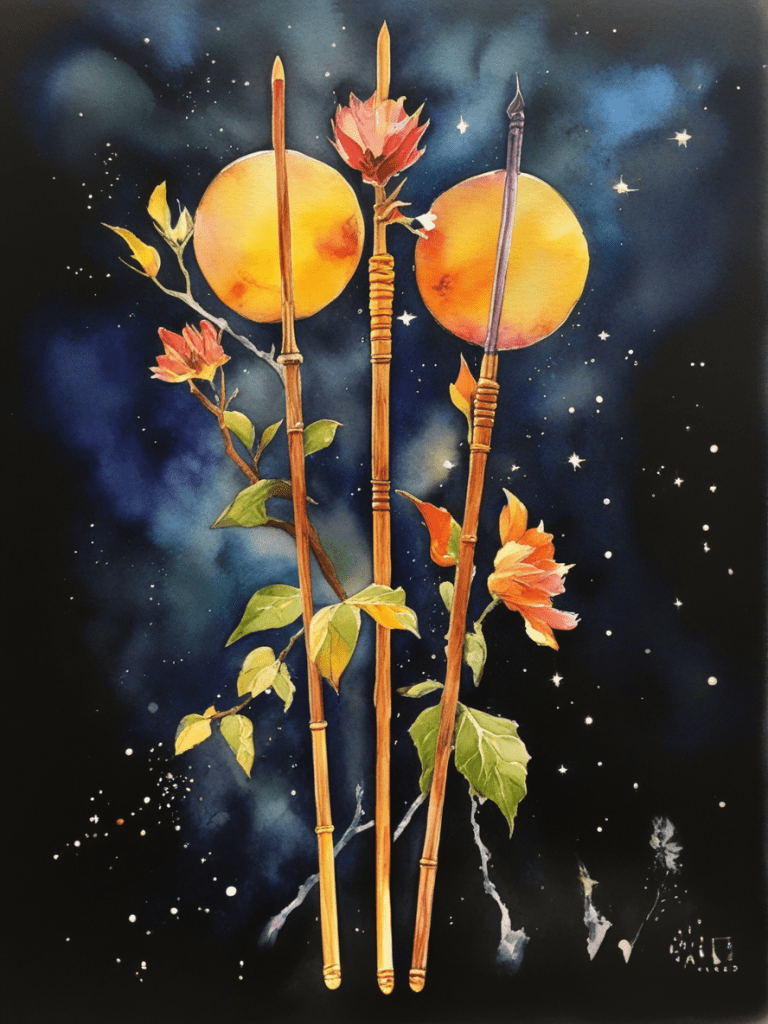
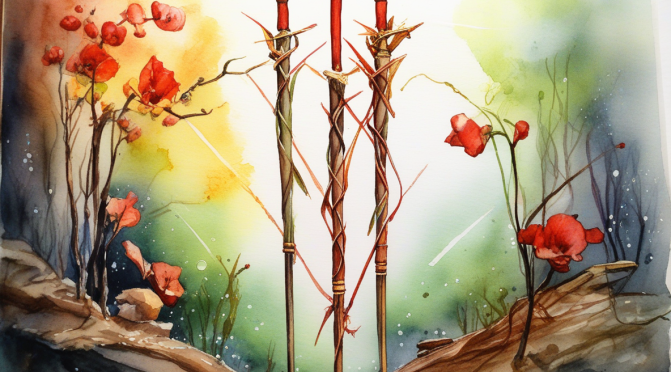
A beautifully essential AI-generated illustration for the Three of Wands

Aleister Crowley

The Three of Wands is […] the Lord of Virtue. The idea of will and dominion has become interpreted in Character.

[…]

This card refers to Binah in the suit of Fire, and so represents the establishment of primeval Energy. The Will has been transmitted to the Mother, who conceives, prepares, and gives birth to, its manifestation.

It refers to the Sun in Aries, the Sign in which he is exalted.

The meaning is harmonious, for this is the beginning of Spring. For this reason one sees the wand taking the form of the Lotus in blossom. The Sun has enkindled the Great Mother.

In the Yi King, Sol in Aries is represented by the 11th hexagram, Thai; its meaning is identical with the above description.
(From The Book of Thoth)

Golden Dawn’s Book T

A WHITE Radiating Angelic Hand, as before, issuing from clouds and grasping three wands in the centre (two crossed, the third upright). Flames issue from the point of junction. Above and below are the symbols Sun and Aries.
Established force, strength, realization of hope. Completion of labour. Success after struggle. Pride, nobility, wealth, power, conceit. Rude self-assumption and insolence. Generosity, obstinacy, etc.
Binah of HB:Y (Pride, arrogance, self-assertion).
Herein rule the Angels HB:HHShYH and HB:a’aMMYH.

Etteilla

Enterprise
Upright. This card, as far as the medicine of the spirit is concerned, means, in its natural position: Enterprise, Undertake, Begin. – Usurp, Seize. – Boldness, Temerity, Fierceness. – Imprudence, Undertaking, Bold, – Committed, Embarrassed. Bewildered. – Paralyzed, Effort, Experiment, Attempt.
Reversed. Interruption of misfortune, torment, sorrow or toil. – End, Cessation, Interruption, Pause, Rest, Influence, Intermediary, Intermittence.

MQS

A collection of meanings for the Three of Wands

Vera Sibilla Cards That Indicate Stability

We’ve already talked about the cards in the Vera Sibilla deck that indicate change. Now let’s see which indicate stability. As usual, do not take this as an attempt at exhausting the meanings of the cards. We are just comparing some similarities.

Two of Hearts – The House

Your house is, of course, pretty much the most stable thing in your life, considering its imposing structure. The Two of Hearts therefore represents stability, especially in love readings: it shows serious intents, the desire to start a family and a constructive attitude. It represents those couples that stay together and work out their problems together. It is, therefore, a positive stability.

Nine of Hearts – Faithfulness

Unlike the Love card, the Nine of Hearts show stable success, especially in love, and it represents deep attachment to someone or even something (this is the card of patriotism, attachment to ideology, etc.) On a less positive note, when surrounded by difficult cards, it can show those difficult situations remaining faithful to us, while in fact we’d much rather they cheated on us.

Ten of Hearts – Perseverance

This is THE card of stability. When surrounded by positive cards, it shows that those positive situations will persevere, but unfortunately the same applies to negative cards. Either way, the Ten of Hearts indicates a situation that perseveres. It also shows constancy of character.

Two of Clubs – The Peacock

Due to its symbolism of completeness and totality, which is similar to that of the World card, the Peacock represents situations that reach their peak, their complete perfection, and if it is not followed by negative cards it says that the situation will stay that way for the forseeable future.

Seven of Clubs – Realization

A card of strong material realization, the Seven of Clubs is responsible for the concretization of our aspirations, allowing them to take root in our life. In general, when surrounded by bad cards, it indicates the lack of this kind of stability rather than the stabilization of the negative things (such as was the case with the Ten of Hearts).

Ten of Diamonds Reversed – The Thief

When reversed, the Thief card represents, in the main, insurmountable problems. It therefore indicates situations that remains blocked, possibly forever depending on the other cards. Therefore, the stability brought by this card is always negative, as it shows situations that are unlikely to ever improve.

Four of Spades Upright/Reversed – The Sickness

When upright, the Four of Spades signifies sickness, but also a situation that is structurally compromised and is therefore unable to flourish or to offer positive solutions. When reversed, it is a card of long blockages and delays, among other things, so it indicates being stalled, isolated, unable to change a situation.

Nine of Spades – The Prison

The Prison card indicates something binding us, restricting us, whether physically, mentally or emotionally. It represents tight bonds (sometimes, when surrounded by positive cards, even positive bonds). More generally, it shows obstacles that last a long time, and therefore situations that stagnate. Similarly to the reversed Four of Spades, it can show isolation.

MQS

Folklore of Italian Cartomancy

Cartomancy has a rich tradition in Italy. It was believed until some years ago that cartomancy had been brought to Italy by Napoleon, but then some cartomantic meanings dating back to before the Napoleonic period were discovered, as well as even some scattered early modern literary references to tarot as a tool for fortune-telling in Italy.

Cartomancy (i.e., divination by cards) has always been a Folk tradition, as opposed to Astrology, which required an advanced knowledge of math. Therefore, the practice of cartomancy was always mingled with odd traditions, beliefs and superstitions. Here I gather a couple of folk anecdotes that were passed down to me and that I later discovered to be widespread. I don’t share these as rules (they aren’t) but only as interesting bits of trivia.

The Cards Must Have Been Used to Play Games

The cards were always originally used as game counters (including tarot). No esoteric woowoo. When I first started learning to read playing cards, my teacher told me to get a deck that was “giocato e bestemmiato“. This literally means, a deck that has been played with (giocato) and that players have used swearwords and profanities over while playing (bestemmiato).

This may sound curious, but it is a widespread belief among Italian fortune-tellers. I don’t have a definitive explanation for why this is so, but I do have a theory: the Church has always condemned card games as tools of the devil, because they caused people to gamble away their money (which they ought to give to the Church) and it tarnished their soul because it caused them to use swearwords and profanities.

When fortune-telling evolved out of card games, it was of course equally condemned as witchcraft and devil-worship, as it was believed that the devil moved the cards to form the messages. Therefore, some card readers must have believed that the cards that some people had used to play while using profanities had already acquired some kind of demonic connection with hell that made them work better (note that profanities are an important part of some strands of Italian witchcraft).

A more angelic variation of this belief is that the cards must have been used either by a virgin or by children, due to their purity.

Although I don’t think the cards have anything to do with demons, I must confess I always use used decks, simply because they feel better when I touch them.

The Little Spirit In The Cards

There is a widespread belief among old-time fortune-tellers that the cards work because they are inhabited by a little spirit or sprite that moves them through the reader’s hand (traditional folk beliefs in Italy, as well as around the world, tend to have animistic undertones.) Not only this, but it is believed that, in each deck, one particular card is home to the little spirit. For instance, in some Italian playing decks the spirit is said to inhabit the Ace of Swords, where a little angel is depicted.

In the regular playing deck, it is said that the spirit inhabits either the Ace of Hearts or the Ace of Clubs, depending on the tradition. My teacher also seemed to believe that, in the Sibilla deck, the spirit resides in the Peacock card, probably due to its esoteric connection.

Needless to say, it is widely believed that if the card inhabited by the spirit is lost or destroyed this is a portent of bad luck.

Passing Down The Meanings

In many Italian traditions it is said that the meanings of the cards must be passed down excusively either on Christmas Eve or in the week preceding Easter. The same holds true for many magic formulas. But don’t worry, the cards work regardless of when you learned to use them.

Knocking On The Deck

Possibly a consequence of the belief in the little spirit in the cards, many fortune-tellers have the habit of knocking on the deck before dealing out the spread as a way to respectfully ask the cards to speak the truth. I have preserved this habit from my teacher: I always knock three times (some even say seven) before dealing out the cards. It’s not that I think the cards wouldn’t answer anyway. It is just a tip of the hat to my tradition.

Paying For Consultations

There are, as usual, two contradictory schools. One says that readings must absolutely be free. The other, more common, is that readings must absolutely be paid to avoid incurring bad luck. This latter belief probably comes from the fact that cartomancy was a popular way for women to make some money, especially in the countryside, and this often led them to become both respected and feared.

Honestly, it was much more common for the old cartomancers to be paid not with money but in different ways: a chicken, a jar of preserve, a pie, some free repairwork. Cartomancers of old became integrated members of the community by offering their advice in exchange for other people’s goods and services.

Clearly, doing free readings is not really problematic from an esoteric standpoint. I’ve been giving free readings my whole life and I’m still alive. I’ll probably soon start offering paid reading from this site and I don’t think this will interfere much with my fate.

The Ace of Hearts

As in many systems of cartomancy with playing cards, in Italian cartomancy the Ace of Hearts is the house. There are many traditions connected to it. One of these traditions is that some fortune-tellers will have the Ace of Hearts blessed by a priest (if the priest is against such practices, then the Ace of Hearts is simply slipped under something else that the priest will bless) and then put somewhere in the home for protection. Usually this somewhere is next to the entrance door.

Leg-crossing

This isn’t exclusively Italian, but still interesting. Some fortune-tellers believe the querent should never cross their legs during the reading. While I don’t really believe this, the interesting thing is that in some countries, during the Middle Ages, judges were encouraged to cross their legs when ruling so as to avoid external interference. Fortune-tellers clearly want the querent to be energetically open, and so encourage the opposite.

MQS

What Do I Need to Hear Right Now? Example Reading

Occasionally, people throw questions at you that clearly they’ve been trained to ask by other readers. One of these questions is “what do I need to hear right now?”

The question is tricky, because, strictly speaking, we never ‘need’ to hear anything. To suggest otherwise is to imply that the universe is some kind of paternalistic (or maternalistic) minister of welfare with a moral compass that somehow overlaps with that of modern coastal elites.

However, this is not to say that the question is unanswerable. The cards describe situations, and we can, using common sense, derive healthy tips for our querents from them. We can also make the following assumptions about the querent, when we hear something like this:

  1. The querent is not necessarily looking for a prediction.
  2. They are more or less lost and in need of some guidance.
  3. Even if they aren’t lost, they are missing something or something isn’t clicking into place in their life.
  4. (more rarely, they are missing nothing, but they still want to invite an element of supernatural guidance into their life. This still implies a level of dissatisfaction.)
  5. The answer they prefer is probably formulated in terms of ‘oracular advice’ similar to the one heroes get by the Gandalf figure of their story (for instance, in the theory of the monomyth)

Assumptions can be deadly, but we need to start somewhere. So here’s the spread I got when I got asked the “What do I need to hear right now?” question by a querent:

What do I need to know right now? Cartomancy with playing cards

To refresh people’s memory, the meaning of the positions is:

  1. Up: What’s on his/her mind
  2. Down: what the querent treads on (they don’t like, causes trouble)
  3. Left: leaving behind
  4. Right: going toward
  5. Center: in his/her heart
  6. To the side: for him/her

Since we have nothing to start our analysis from given the vague question, let’s take a quick note of something obvious: except the cards the querent is leaving behind, all other packs end with a Spade, signifying trouble (the cards she treads on end with a Heart, but the position itself is one of trouble).

The fact that the querent is leaving behind the only good thing in her life is not encouraging. These cards speak of a happy family. Clearly this is no longer the case, at least for her. And look at what’s on her mind! Double Spade! She is not in a good place mentally at the moment. She feels isolated and impeded at every turn.

There’s desire in her heart (the Nine of Hearts) but she cannot express it (Spade on the Four of Clubs, the card of words).

The two little fans regarding the future talk about various problems, both economic and marital, but we need not delve too deeply into them. As far as the cards below her are concerned, it turned out during the reading that her dad has lost much of his mobility and is in need of assistance.

Clearly, this is the spread of a frustrated, borderline depressed woman. it could be a very good jumping-off point for more spreads, each one analyzing the various situations going on in her life. But that is not the point. The querent doesn’t want to know about each of them separately (notice how the cards seem to talk about various themes in a very cursory manner). She wants to know what she needs to know at the moment.

So, what do we tell her? First, we remind her that life is made of ups and downs, and that she doesn’t need to despair; Second, in times of hardship she must not let go of the few things that she derives (or derived) joy from; Third, there is no shame in asking for help, including professional help, and she must not exaggerate with the self-abnegation, or she’ll run herself into the ground; Fourth, she must try to make space in her life for what she desires (hobbies, passions, etc.) no matter how little time she can dedicate to it, because it will keep her sane, and when the situation improves, she’ll be glad she has planted those seeds.

MQS

Tarot Encyclopedia – The Two of Pentacles or Coins

(Note: this is a collection of the meanings attributed to the cards by some occultists in the past centuries. It does not reflect my own study or opinion of the cards. It is only meant as a quick comparative reference as I develop my own take.)

The Two of Pentacles / Coins from the Builders of the Adytum (BOTA) tarot deck

Paul Foster Case (and Ann Davies)

The time period is the first decanate of Capricorn, December 22 to December 31, under the rulership of Saturn. Meanings:
Well-Dignified: harmony in the midst of change; alternation of gain and loss; change of occupation; travel in quest of wealth; ups and downs of fortune; a visit to friends.
Ill-Dignified: intimates discontent; foolishness in the management of resources; restricted condition of material affairs due to bad management; the Querent is probably too talkative and too suspicious. He is kind, but inconsistent, and should avoid arguments.
Keyword: Fluctuation
(From the Oracle of Tarot course)

A. E. Waite

A young man, in the act of dancing, has a pentacle in either hand, and they are joined by that endless cord which is like the number 8 reversed. Divinatory Meanings: On the one hand it is represented as a card of gaiety, recreation and its connexions, which is the subject of the design; but it is read also as news and messages in writing, as obstacles, agitation, trouble, embroilment. Reversed: Enforced gaiety, simulated enjoyment, literal sense, handwriting, composition, letters of exchange.
(From The Pictorial Key to the Tarot)

Aleister Crowley

The Two of Pentacles was of old time called the Lord of Harmonious Change. Now, more simply, Change; and here the doctrine must be stated a little more clearly. This suit being of Earth, there is a connection with the Princesses, and therefore with the final Heh of Tetragrammaton. Earth is the throne of Spirit; having got to the bottom, one immediately comes out again at the top. Hence, the card manifests the symbolism of the serpent of the endless band.

[…]

The number Two, Chokmah, here rules in the suit pertaining to Earth. It shows the type of Energy appropriate to Two, in its most fixed form. According to the doctrine that Change is the support of stability, the card is called Change.

Its celestial rulers are Jupiter and Capricornus; and these symbols are most inharmonious, so that in practical matters the good fortune of Jupiter is very limited. Their influence on the card is not great. Yet, Jupiter being himself the Wheel (Atu X), he emphasizes that idea.

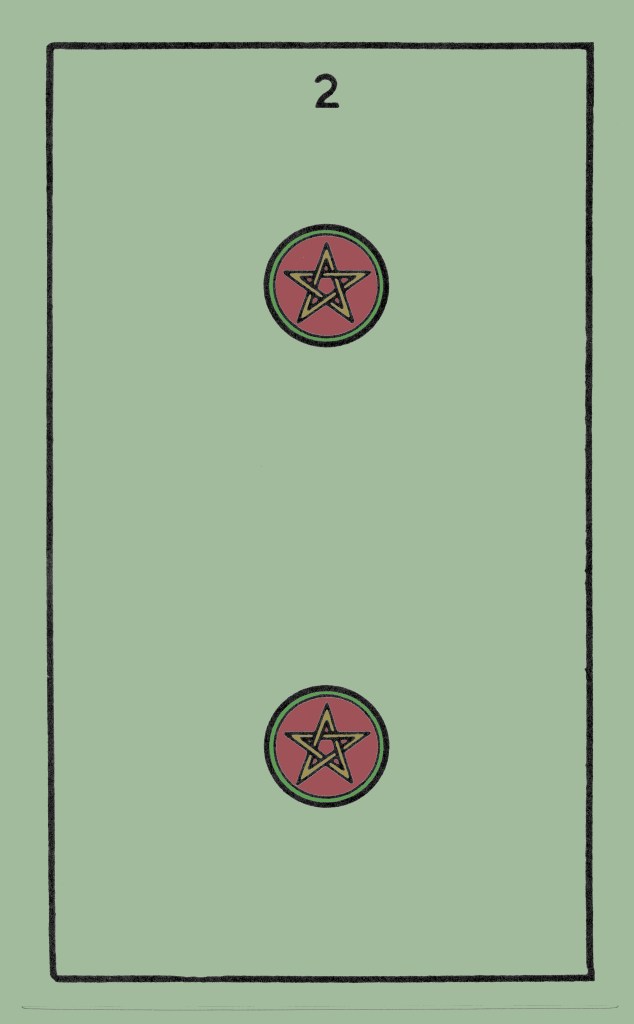
The card represents two Pantacles, one above the other; they are the Chinese symbols of the Yang and Yin duplicated as in the Hsiang. One wheel is dextro- and the other laevo-rotatory. They thus represent the harmonious interplay of the Four Elements in constant movement. One may in fact consider the card as the picture of the complete manifested Universe, in respect of its dynamics.

About them is entwined a green Serpent (see Liber 65, chapter iii, verses 17-20). His tail is in his mouth. He forms the figure Eight, the symbol of the Infinite, the equation 0=2.
(From The Book of Thoth)

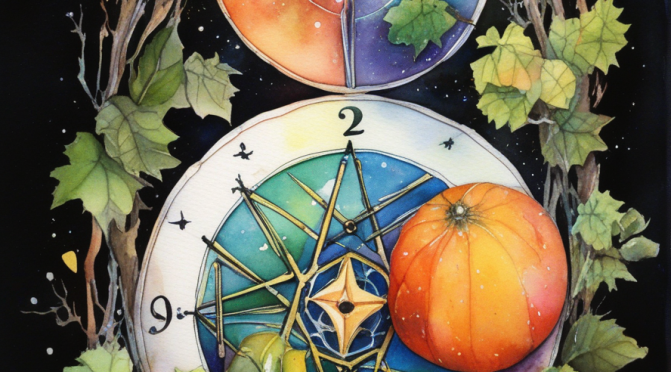
Nice AI-generated illustration for the Two of Pentacles or Coins

Golden Dawn’s Book T

TWO wheels, disks or pentacles, similar to that of the Ace. They are united by a green-and-gold serpent, bound about them like a figure of 8. It holds its tail in its mouth. A White Radiant Angelic Hand holds the centre of the whole. No roses enter into this card. Above and below are the symbols of Jupiter and Capricorn. It is a revolving symbol.

The harmony of change, alternation of gain and loss; weakness and strength; everchanging occupation; wandering, discontented with any fixed condition of things; now elated, then melancholy; industrious, yet unreliable; fortunate through prudence of management, yet sometimes unaccountably foolish; alternatively talkative and suspicious. Kind, yet wavering and inconsistent. Fortunate in journeying. Argumentative.
Chokmah of HB:H (Pleasant change, visit to friends).
Herein the Angels HB:LKBAL and HB:VShRYH have rule.

Etteilla

Embarrassment
Upright. This card, as far as the medicine of the spirit is concerned, means, in its natural position: Awkwardness, Obstacle, Commitment, Obstruction, Setback. – Disturbance, Bother, Emotion, Mess, Confusion, Difficulty, Impediment, Tangle, Obscurity. – Agitation, Restlessness, Perplexity, Concern.
Reversed. Ticket, Piece of Writing, Writing, Text, Literature, Doctrine, Erudition, Work, Book, Production, Composition. – Dispatch, Epistle, Missive. – Written character. – Literal Meaning. – Alphabet, Elements, Principles. – Promissory note.

MQS

Fantasy in Divination: A Double-Edged Sword

I’m currently still doing readings in exchange for recommendations for when I  decide to start offering readings from this site. After a short reading with a querent we began chatting about the process of divination, and he asked me if fantasy is required to interpret the cards. I thought this was a really great question. I’m taking fantasy as a synonym with imagination, that is, the ability to conjure up images in one’s mind.

First off, we need to distinguish fantasy/imagination from (true) intuition. True intuition is relatively rare and it does not originate from the limited structure of the personality. It is, for all intents and purposes, otherworldly. Before being appropriated by boss babes on TikTok, intuition was rightfully considered a gift of the gods. It is hard to obtain and even harder to train, although the practice of divination, as it leads to the divine, does allow for the development of intuition.

Fantasy or imagination is mostly the product of neurons bouncing together, and it is at least in good part under our control (though whether imagination is also merely a personal power is up for debate. Many occultists think it isn’t, and I agree.)

Imagination plays a large role in modern magic, and, it could be argued, in the magic of all times (though with different implications and within different frameworks), but I’ll leave this discussion for another time. The point is that imagination is one among the many legitimate sources of understanding that we have at our disposal, including in the occult world.

Ordinarily, if someone asked me what’s the one thing that is required in order to become a diviner, I would answer that they need to understand the vocabulary, grammar and syntax of what is essentially a divine language.

Yet, in philosophy of language, and even more in philosophy of science, there is a concept called underdetermination. In its most frequent use, the principle of underdetermination states that, given a number of facts, there exist more than one theory that can explain those facts and account for them. How we then choose the most appropriate theory has sparked a debate that largely goes on to this day between scientists, philosophers, psychologists and anthropologists.

Something similar happens with divination: given a spread of cards, or a chart, it is often the case that more than one explanation might appear plausible at first. True, the more cards we string together, the fewer the possible interpretations are, just as a single word out of context might mean many things, but the more words there are, the more we understand the sentence.

But take a sentence like “we saw her duck“. Was she avoiding a bullet or does she live on a farm? This is a form of underdetermination, because the possible mental images evoked by the sentence cannot be reduced to the sentence itself.

Probably if we had a perfect understanding of the language of divination we would get unambiguous results, but we don’t. We must therefore use logic and context to weed out the less likely predictions, yet even so we might be left with more than one possible image of the future in mind. The word image here is key.

Can we predict a future we cannot imagine? That is, can we predict a future (or reveal a past) that we cannot put in the form of a picture or series of pictures? If one asks me: would you be able to understand a sentence you’ve never heard before? The answer is: if I know the language, yes. We hear sentences we’ve never heard before everyday and we rarely have problems. But going back to “we saw her duck”, if I didn’t know that duck can also be a verb, I would interpret the sentence univocally, as I wouldn’t be able to create a mental image corresponding to the interpretation of “duck” as verb instead of noun.

In real world languages the ambiguity is often removed by clear context. But in divination context is not always clear, meaning it is harder to exclude possible interpretations, and we need to be capable of creating mental images of all the most likely interpretations of an oracle before choosing which one is the most likely.

We need to be able to extrapolate the many possible meanings a spread can have before submitting them to inquiry. The ability to construct mental images or scenes from the divination tool we are using is consequently incredibly important. In other words, yes, imagination is key in divination.

But the imagination I am talking about is not the unbridled imagination that so many mistake for intuition, and which usually leads either to error or to unverifiable predictions. Imagination is the ability to create possible images derived from our (limited) understanding of the medium we are using, so that we can then see which one is more likely to be accurate by finding testimonies in the spread or by asking the querent.

Like all other occult arts, divination therefore requires the cooperation of both sides of the brain (to which we may add the importance of bodily grounding, but that’s a matter for another post).

MQS

Tarot Encyclopedia – The Two of Swords

(Note: this is a collection of the meanings attributed to the cards by some occultists in the past centuries. It does not reflect my own study or opinion of the cards. It is only meant as a quick comparative reference as I develop my own take.)

The Two of Swords from the Builders of the Adytum (BOTA) tarot deck

Paul Foster Case (and Ann Davies)

The time period is the first decanate of Libra from September 23 to October 2, under the rulership of Venus.
Well-Dignified: contradictory characteristics in the same nature; strength through suffering; pleasure after pain; delay in the realization of objectives. This card sometimes indicates a period of uncertainty, during which the Querent, though he has a sense of adequate power, does not know just what to do with it. It also indicates justice, unselfishness and the restoration of peace.
Ill-Dignified: falsehood; sorrow; injury from another who really means well to the Querent, or injury by the Querent to another whom he wishes to help; always a symbol of tension, of want of tact, and suggests force held in abeyance, awaiting some announcement or revelation that will make decision possible.
Keyword: Indecision.
(From the Oracle of Tarot course)

A. E. Waite

A hoodwinked female figure balances two swords upon her shoulders. Divinatory Meanings: Conformity and the equipoise which it suggests, courage, friendship, concord in a state of arms; another reading gives tenderness, affection, intimacy. The suggestion of harmony and other favourable readings must be considered in a qualified manner, as Swords generally are not symbolical of beneficent forces in human affairs. Reversed: Imposture, falsehood, duplicity, disloyalty.
(From The Pictorial Key to the Tarot)

Aleister Crowley

The Two of Swords was formerly called the Lord of Peace Restored; but this word “restored” is incorrect, because there has been no disturbance. The Lord of Peace is therefore a better title: but it needs thinking hard to work this out, since the Sword is so intensely active. It may be helpful to study the Essay on Silence (p. 120) for a parallel: the Negative Form of the Positive Idea. See also the Essay on Chastity (Little Essays toward Truth, pp. 70-74) which concludes: Sir Knights, be vigilant: watch by your arms and renew your oath; for that day is of sinister augury and deadly charged with danger which ye fill not to overflowing with gay deeds and bold of masterful, of manful Chastity.

Witness also Catullus: domi maneas paresque nobis Novem continuas futationes. Nor does he misunderstand the gesture of Harpocrates; Silence and Chastity are isomers.
It is all one case of the general proposition that the sum of the infinite Energy of the Universe is Zero.

[…]

This card is ruled by Chokmah in the Element of Air. This suit, governing all intellectual manifestations, is always complicated and disordered. It is subject to change as is no other suit. It represents a general shaking-up, resulting from the conflict of Fire and Water in their marriage; and proceeds, when Earth appears, to crystallization. But the purity and exaltation of Chokmah are such that this card manifests the very best idea possible to the suit. The energy abides above the onslaught of disruption. This comparative calm is emphasized by the celestial attribution: the Moon in Libra.

The Moon is change, but Nature is peaceful; moreover, Libra represents balance; between them, they regulate the energy of the Swords.

In the card appear two swords crossed; they are united by a blue rose with five petals. This rose represents the influence of the Mother, whose harmonizing influence compounds the latent antagonism native to the suit. The Rose emits white rays, producing a geometrical pattern that emphasizes the equilibrium of the symbol.
(From The Book of Thoth)

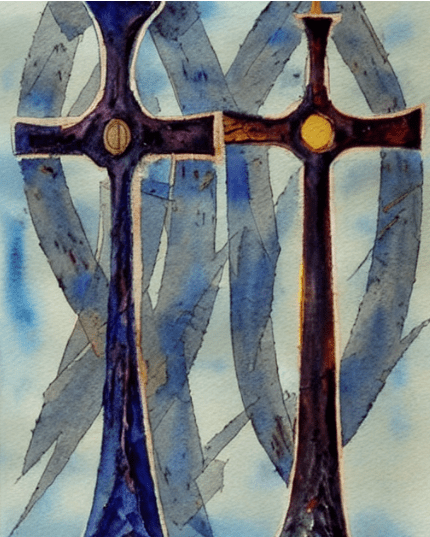
An ominous AI-generated illustration for the Two of Swords

Golden Dawn’s Book T

Two crossed swords, like the air dagger of a Zelator Adeptus Minor, each held by a White Radiant Angelic Hand. Upon the point where the two cross is a rose of five petals, emitting white rays. At the top and bottom of the card are two small daggers, supporting respectively the symbol {Crescent moon with horns upward} thus, and Libra representing the Decanate.
Contradictory characters in the same nature, strength through suffering; pleasure after pain. Sacrifice and trouble, yet strength arising therefrom, symbolized by the position of the rose, as though the pain itself had brought forth beauty. Arrangement, peace restored; truce; truth and untruth; sorrow and sympathy. Aid to the weak; arrangement; justice, unselfishness; also a tendency to repetition of affronts on being pardoned; injury when meaning well; given to petitions; also a want of tact, and asking question of little moment; talkative.
Chokmah of Vau. Quarrel made up, yet still some tension in relations: actions, sometimes selfish, sometimes unselfish.
Herein rule the Great Angels HB:YZLAL and HB:MNHAL.

Etteilla

Friendship
Upright. This card, as far as the medicine of the spirit is concerned, means, in its natural position: Friendship, Attachment, Affection, Tenderness, Benevolence, Relationship, Identity, Intimacy, Convenience, Correspondence, Interest, Conformity, Sympathy, Affinity, Attraction.
Reversed. Falsehood, Falsehood, Lying, Imposture, Duplicity, Bad faith, Overbearingness, Dissimulation, Cunning, Deceit, Superficial, Superficiality, Surface.

MQS

The Ghost That Came Back (Example Reading)

Certain topics are exceedingly rare, and they should remain so, because people otherwise tend to see the supernatural at play everywhere. Traditional divination takes these topics very seriously, which is why it rarely discusses them. In most systems, a vocabulary is given to describe most situations in life, including encounters with ghosts. We are, of course, free to disbelieve, but the cards can still talk about it.

A querent asked me if there was a ghost in her (very old) apartment complex. As I said when talking about curses and hexes, the answer is almost invariably no (although, to be fair, ghosts and other entities are far more common than competent witches). Here’s the spread (it started as a three card spread, I kept adding cards until I was satisfied).

A♠️ – Q♠️ – 2♠️ – K♥️ – 2♣️ – 4♣️ – 9♥️ – 5♠️ – 10♥️

I asked the querent an open question (to avoid influencing her), that is, I asked her to describe the ghost she thought she saw. She said she thought it was the spirit of an ugly, angry woman moving in the hallways of the building. This fits very well with the Queen of Spades and Two of Spades. The Ace of Spades, aside from indicating death, is also a card of great evil.

What about the rest of the spread? Usually the Heart court cards indicate either positive spirits (God, etc.) or religious people. I asked the querent if she was planning on contacting a priest, shaman or other such figure. She said she wasn’t really thinking about it, but another tenant was.

I said that it was a good idea. Look at the King’s action: he is taking steps (Two of Clubs) by uttering words (Four of Clubs) which are positive (Nine and Ten of Hearts). But what about the Five of Spades? My sense is that the presence will not be eradicated or banished for good, since the Five of Spades is a card of imprisonment, but it will be contained in some form (the two Hearts hemming in the Spade).

The interesting thing was that, according to the querent, the other tenant (who had been living in the building for much longer than the querent) told her that many years ago they had had a problem with the same presence and had managed to somehow exorcise it.

My view is that even this time the situation will not be remedied completely, but the situation should improve by calling in someone to perform a religious ritual.

MQS

A Reading Gone Wrong

Getting things wrong hurts, but is part of the human condition. In fact, I would argue that if a reader says they are infallible, that’s a good time to put as much distance between you and them as possible. An infallible reader is either so delusional that they block out all negative feedback from their reality or so dishonest that they’ll constantly be looking for the right bridge to sell you. Either way, they are best kept at a distance.

Still, there’s no denying that getting a reading wrong is disheartening because, as much as we should keep the ego out of the equation, the ego always seeps into it. I think it’s fair to share our failures as well as our triumphs. Here is a reading I got wrong relatively recently.

The querent was asking about her recent pregnancy.

Q♣️ – 7♣️ – J♥️ – 3♠️ – 2♥️

Accepting the question was my first mistake, as such issues are way too delicate. There is no situation where “you will miscarry” is an acceptable thing to say, and if we can’t be honest there is no point in giving a reading. Even if I had interpreted the cards correctly I would never have told the querent.

Thing is, though, that I wanted to give her good news, albeit subconsciously, and so I ended up interpreting a clearly negative spread positively. The querent falls first in the spread, and there is a card of obstacles between her and the child (the Jack of Hearts). The Three of Spades in questions of pregnancy often leads to loss, but I interpreted the Two of Hearts as the solution of the problems, while in fact it was merely saying that the loss would happen soon (it was knocking at the door). In hindsight, I probably should have added some cards.

I told the querent the pregnancy would go fine, though with minor problems which would be solved, but that she should always listen to the doctor. In reality, the cards point to a situation that not even doctors would be able to salvage (the doctors don’t show up in the spread).

Two things can be learned: first, never accept questions you are not really comfortable answering; second, always keep your desire to give a skewed answer in check. It is human nature to want other people to be happy (or sad, if we don’t like them) but this gets in the way of our objectivity.

MQS