Category Archives: Cartomancy

Vera Sibilla Cards That Indicate People

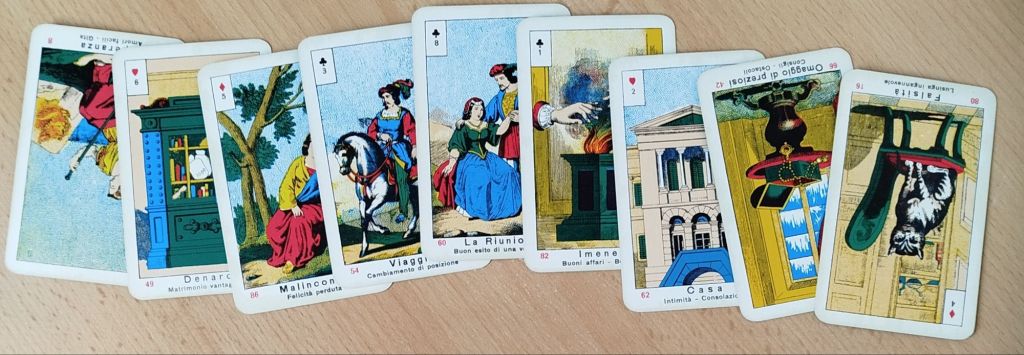
There are plenty of cards, in the Vera Sibilla, that can indicate individuals (see here for groups). Here are the most common (keeping in mind that most of the cards have other associations as well, and may indicate concepts or situations):

Seven of Hearts – The Scholar
The Scholar can represent the figure of a lawyer, a notary, or more in general a professional. Traditionally he is said to be in his 40s or early 50s, but we need to be flexible with age. He can also be a member of the family or even a partner.

Eight of Hearts – Hope
There are two schools of thought concerning the Hope card. According to some it doesn’t represent a woman, while according to others it can (traditionally, a younger or blonde woman). I have found that it is rare for this to be the case, but it could happen.

Nine of Hearts – Faithfulness
The Faithfulness card can represent support, and occasionally it will show up alone indicating a concrete someone, i.e., a friend, who shows us support.

Jack of Hearts – The Boyfriend
It is common for this card to indicate an actual person, often the unmarried male querent or a male who is in love, or positive, or belonging to the family.

Queen of Hearts – The Girlfriend
Same as with the Jack, only applying to women.

King of Hearts – The Gentleman
The King of Hearts is traditionally the figure of a protector or benefactor, someone who aids us. He is typically in a good position to do so. He can be a father or loving husband (when upright), but can also represent the married male querent or a boyfriend who is older or has a position in society.

Four of Clubs – The Friend
The Friend card can represent friendship as a concept, as well as partnerships and other situations where people come together for a common goal. However, it can often indicate a female friend or relative.

Jack of Clubs – The Servant
The Jack often represents a younger man, one up to 30 years of age, or unmarried. However, it can also represent a colleague or friend, regardless of age. It can also indicate a son, if relevant. Usually he is already known to the querent (the Italian word ‘domestico’ can mean servant but it also implies familiarity with the house).

Queen of Clubs – The Maiden
The Maidan can be the female counterpart of the Servant, showing a younger unmarried woman, sometimes a daughter.

King of Clubs – The Doctor
The Doctor card often indicates health issues or the need to take care of something. However, it can also represent a man with a certain social position or with a degree (if next to a female card, then he turns into a woman with those characteristics). It can show the figure of a professional whose advice or help will be required, or a boss.

Seven of Diamonds – The Child
Often it is a metaphorical child, but sometimes the Seven of Diamonds can represent a literal one, usually very young (toddler). It can combine with other cards (the Servant or Maiden, for instance) to indicate a teenager. It is the card of pets as well.

Eight of Diamonds – The Handmaid
A card strongly connected with the coming and going of money and with work, the Handmaid can also be the figure of a female colleague or a female servant (like a cleaning lady). Traditionally she is from a different town, but this is not always the case. She can also be a stranger or a foreigner.

Ten of Diamonds – The Thief
Rarely a literal person, but in connection with negative cards it can show someone who steals, either literally or metaphorically.

Jack of Diamonds – The Messenger
Rarely a person card, the Messenger often heralds the arrival of news and the knowledge of facts. However, it can occasionally represent a young man, traditionally dark-haired.

Queen of Diamonds – The Wife
A card that often represents what it says on the tin, the wife shows a woman who is married and may have children. It can indicate a woman who has achieved some level of success (could be a colleague or boss).

King of Diamonds – The Merchant
Usually this card signifies the querent’s work life. However, it occasionally signifies a literal merchant or someone who a transactional view of life and relationships.

Two of Spades – The Old Lady
Often one of the most complex cards in the deck, the Old Lady has a whole host of metaphorical meanings. The literal meaning, though, is that of representing an older woman, a grandmother, a widow, someone close to retirement, a woman of 60+, and so on. The card can also stand for an ex (your old woman).

Three of Spades – The Widower
As with the Old Lady, so with the Widower, but for men. It can represent an older man, a grandfather, an ex, a widower or divorced man. It is somewhat rarer for the Widower to be a literal person, compared to the Old Lady.

Ten of Spades – The Soldier
Another often cryptic card to interpret, the Soldier can also indicate a young man, in his 30s or early 40s (again, taking it with a pinch of salt), who is muscular or sexy or who wears a uniform. It can also indicate a stranger or a foreigner.

Jack of Spades – The Enemy (male)
The male enemy card can stand for a literal enemy, or for someone who is against the querent for some reason, either as a rule or in a particular situation (your uncle whose car you crashed into a tree can be your enemy too, when he finds out). It can also represent a place where people are inimical to the querent.

Queen of Spades – The Enemy (female)
Same as with the Jack, but for women.

King of Spades – The Priest
The King of Spades often indicates an institution, the government, a judge, etc. It can also sometimes represent an older man who is not inimical to the querent, but who is somewhat cold toward him or her, but is still fair (unless the card is reversed).

MQS

Psychological Hang-Ups of Diviners and Querents

When a person sits in front of a diviner, a number of preconceptions have often already been set off in their mind, and sometimes even in the mind of the diviner.

We must always remember that, nowadays, many people don’t visit an astrologer or card reader by chance, nor (usually) as their first go-to choice. Often, they have made a deliberate choice to step outside of the norm, for better or for worse, meaning that they have found the norm to be lacking in its ability to provide certainty. For many, therefore, the underlying presupposition seems to be: “I accept to take part in something that operates outside of consensus reality as long as it gives me the certainty I can’t find any other way.”

As diviners, we instinctively know it, and we may feel pressured to play into this presupposition or swim directly against it, thus falling into the opposite error.

Some diviners may feel they need to provide the querent with the unreasonable all-knowledge that only God can gift them with, only to end up providing uncertain information with unreasonable confidence. Others may push in the direction of vague self-help: We may not know if Mr. Right is behind the corner for our love-starved querent, but her divine feminine or other buzzword can still derive important lessons and “aha moments” from reflecting on the whole situation.

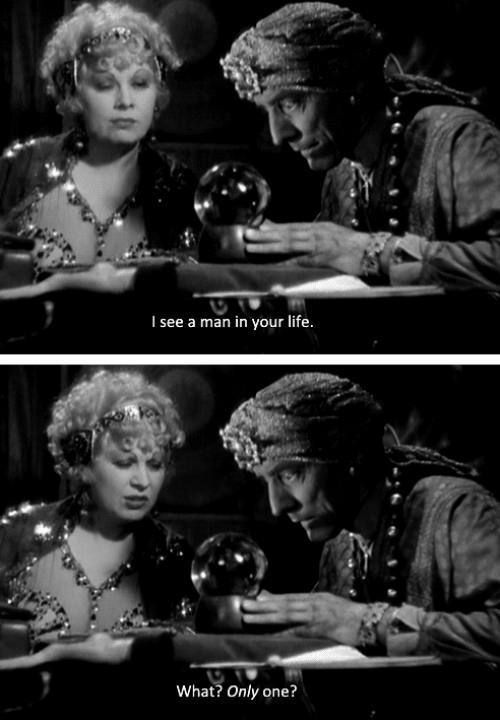
Mae West said it best. Picture by Sophie Charlotte on Pinterest

There are many dimensions to divination, some of which are indeed very deep. However, as far as our relationship with querents is concerned, we are simply an added means of intelligence-gathering, which, like all tools at our disposal, may fail for a variety of reasons, not the least of which is the diviner’s limited knowledge (our knowledge is always limited).

“But I came here to have undebiable, clearcut answers,” one might argue. To which I anwer: Tough titties! If you want undeniable clearcut answers shake a magic eightball. Divination is, quite literally, a divine language, and is not always so cleacut, either in itself or due to our limitations, or sometimes simply because the situation isn’t clearcut in itself. This is especially the case for issues involving human emotions.

As a rule, honesty is the best policy. I believe in voicing my procress to the querent, and the querent has a right to as clear an answer as I am capable of giving them, but we should never feel pressured to give them more certainty than we can truly see in the oracle.

It is perfectly acceptable to talk to the querent about our doubts or about the possible interpretations we are seeing in the oracle. For instance, it is ok to say “it seems like x, but y is also a possibility, while z seems less likely and w is out of the question.” It is also acceptable to say “these cards seem to point to such and such being the case, but I’m uncertain, as this other interpretation might also be right”. More often than not, the querent will say that both interpretations apply, and when this is not the case they can help us disambiguate the oracle.

Ultimately, the fact that divination has no legitimate place in our society implies as a consequence that, because our society believes itself to be held together by reasonable rules and processes, then divination must be either complete poppycock for delusional idiots or it must be capable of unreasonable fits of prowess in other to justify its existence in spite of its current ostracism.

This in turn creates expectations and hang-ups on both ends of the divination process that need to be analyzed and clarified to avoid them subconsciously ruling our practice. Doing so can make divination much more valuable and much more enjoyable.

MQS

Recovery From Surgery (Example Reading)

Plenty of readings this time of year, and an above average number on health issues. An acquaintance of ours, an elderly man whom we know from theater, had to go under the knife for major surgery, my husband and I decided to see how the situation would evolve. I used the 45-card Bologna tarot system and the 13 card spread.

Recovery from Surgery. Spread with the Bologna

I am immediately reassured by the lack of dramatic sequences. However, the first row is interesting: Death can indicate a major turning point, the Chariot is the bed card in this tradition, and the Tower is a place of suffering, such as a hospital. Death and Tower can be a tragedy or painful situation. Technically you’d need the Knight of Swords together with the Chariot and Tower to predict surgery, but considering I didn’t even need to predict it (I knew it already) the cards are being remarkably specific.

We also find that his thoughts (the Knight of Wands) are not at ease (the Fool and Justice, that is, irrgularities on his idea of what is right). It could simply indicate bewilderment at the question of how he is going to move on from this. Note that the Tower weighs his thoughts down.

In the following row we see that there is love and care around him (Seven of Cups and Love) and that this care is going to have to last quite a while (Temperance). The recovery is going to take its time. Finally, the cards reassure us that the people and doctors taking care of him mean well and know what they are doing (the Queen of Coins is the truth, wisdom and knowledge).

All in all it could certainly have been worse.

MQS

Tarot Encyclopedia – The Six of Cups

(Note: this is a collection of the meanings attributed to the cards by some occultists in the past centuries. It does not reflect my own study or opinion of the cards. It is only meant as a quick comparative reference as I develop my own take.)

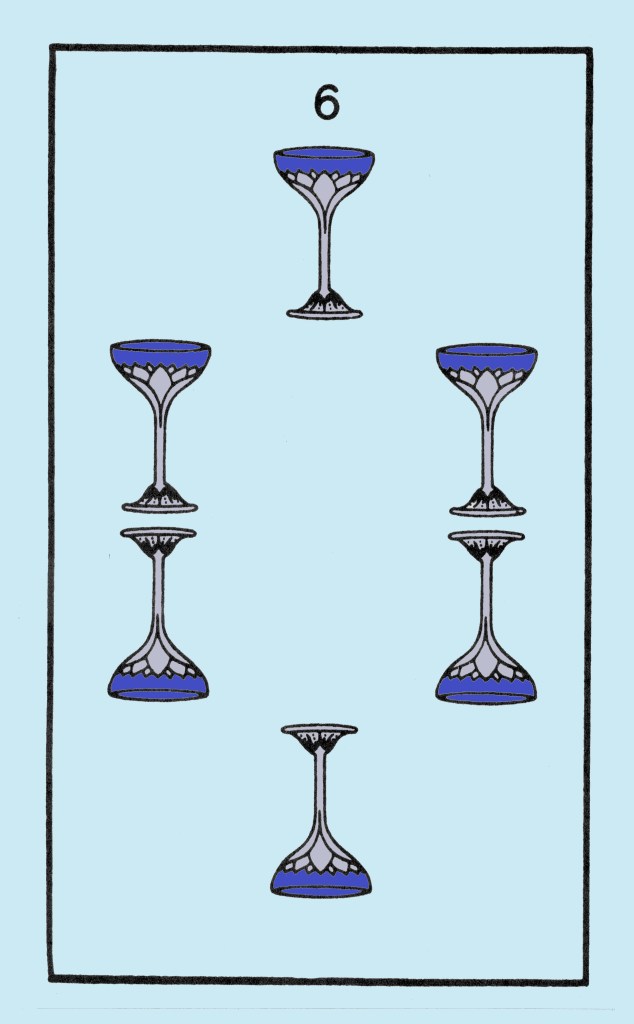
The Six of Cups from the Builders of the Adytum (BOTA) tarot deck

Paul Foster Case (and Ann Davies)

Time period is the second decanate of Scorpio, from November 1 to November 10 under the combined influences of Jupiter and Neptune.
Well-Dignified: the meanings in specific divinations are based on the influence of Neptune and Jupiter in Scorpio combined with its natural 8th house; deep emotions, ardor, enthusiasm, generosity; money through marriage or business partner, or by inheritance; the beginning of steady gain in business or pleasure, but beginning only; peculiar circumstances.
lll-Dignified: deceit in reference to partner’s money; loss of inheritance through some sort of swindle; danger of death on water, or through poisons or anesthetics; some reversal of fortune.
Keyword: Betterment
(From the Oracle of Tarot course)

A. E. Waite

Children in an old garden, their cups filled with flowers. Divinatory Meanings: A card of the past and of memories, looking back, as–for example–on childhood; happiness, enjoyment, but coming rather from the past; things that have vanished. Another reading reverses this, giving new relations, new knowledge, new environment, and then the children are disporting in an unfamiliar precinct. Reversed: The future, renewal, that which will come to pass presently.
(From The Pictorial Key to the Tarot)

Aleister Crowley

The Six of Cups is called Pleasure. This pleasure is a kind of pleasure which is completely harmonized. The zodiacal sign governing the card being Scorpio, pleasure is here rooted in its most convenient soil. This is pre-eminently a fertile card; it is one of the best in the pack.

[…]

This card shows the influence of the number Six, Tiphareth, in the suit of Water. This influence is fortified by that of the Sun, who also represents the Six. The whole image is that of the influence of the Sun on Water. His fierce, but balanced power operates that type of putrefaction-he is in the Sign of Scorpio-which is the basis of all fertility, all life.

The lotus stems are grouped in an elaborate dancing movement. From their blossoms water gushes into the Cups, but they are not yet full to overflowing, as they are in the corresponding card below; the Nine.

Pleasure, in the title of this card, must be understood in its highest sense: it implies well-being, harmony of natural forces without effort or strain, ease, satisfaction. Foreign to the idea of the card is the gratification of natural or artificial desires. Yet it does represent emphatically the fulfilment of the sexual Will, as shown by the ruling Sephira, planet, element, and sign.

In the Yi King, Sol in Scorpio is represented by the 20th Hexagram, Kwan, which is also “Big Earth”, being the Earth Trigram with doubled lines. Kwan means “manifesting”, but also “contemplating”. The Kwan refers directly to an High Priest, ceremonially purified, about to present his offerings. The idea of Pleasure-Putrefaction as a Sacrament is therefore implicit in this Hexagram as in this card; while the comments on the separate lines by the Duke of Chau indicate the analytical value of this Eucharist. It is one of the master-keys to the Gate of Initiation. To realize and to enjoy this fully it is necessary to know, to understand, and to experience, the Secret of the Ninth Degree of the O.T.O.
(From The Book of Thoth)

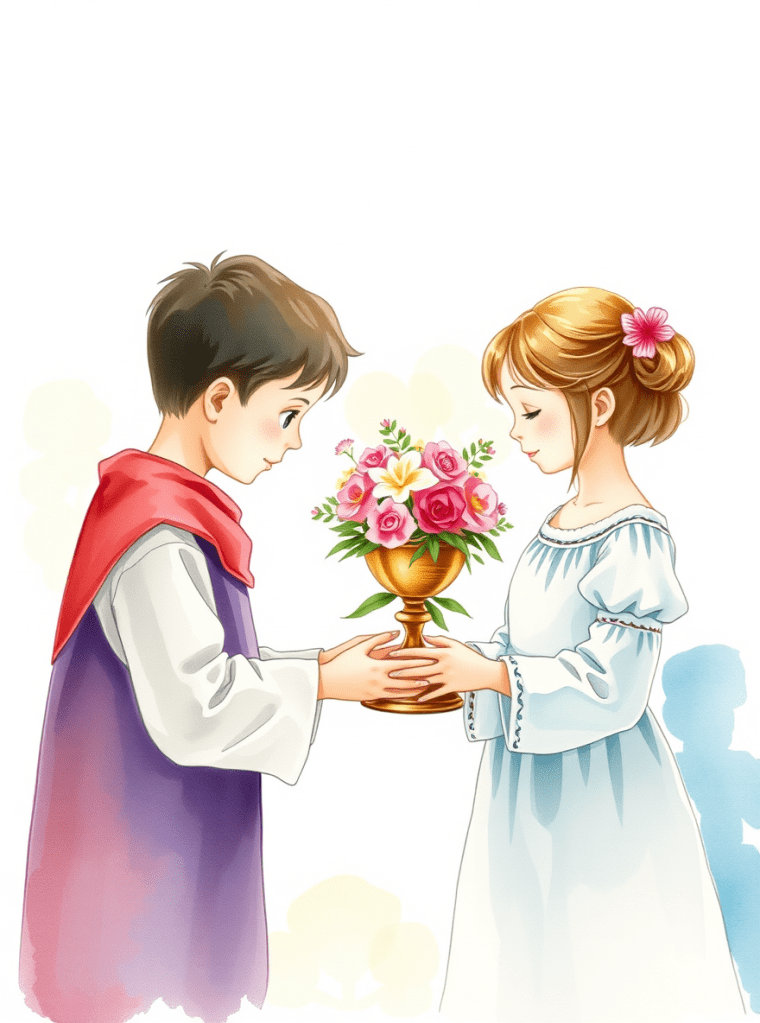
A fairytale-like AI-generated illustration for the Six of Cups

Golden Dawn’s Book T

AN Angelic Hand, as before, holds a group of stems of water-lilies or lotuses, from which six flowers bend, one over each cup. From these flowers a white glistening water flows into the cups as from a fountain, but they are not yet full.
Above and below are Sun and Scorpio referring to the Decan.

Commencement of steady increase, gain and pleasure; but commencement only.
Also affront, detection, knowledge, and in some instances contention and strife arising from unwarranted self-assertion and vanity. Sometimes thankless and presumptuous; sometimes amiable and patient. According to dignity as usual.
Tiphareth of HB:H (Beginning of wish, happiness, success, or enjoyment).
Therein rule HB:NLKAL and HB:YYYAL

Etteilla

Past.
Upright. This card, as far as the medicine of the spirit is concerned, means, in its natural position: the Past, Formerly, Withered, Formerly. – Formerly, Anteriorly, Of Yore, Once. – Old age, Decrepitude, Antiquity.
Reversed. Upcoming, Future. – What comes next, Afterwards, Posteriorly, Further. – Regeneration, Resurrection. – Reproduction, Renewal, Reiteration.

MQS

The Hothead (Example Reading)

If you ever happen to receive a comment from someone whom the cards describe in the following way:

2♠️ – 6♦️ – 2♣️

you can safely flag all their future comments as spam. Their actions (Two of Clubs) presuppose (behind) a volatile and unstable temper (Two of Spades – Six of Diamonds). It is someone who is simply looking for a target to live out their idiosyncrasies depending on the fixation of the moment.

MQS

The Great Spreads With the Bologna Tarot – The Significator Spread

This is the last full-deck spread I am aware of that can be performed with the Bolognese Tarot. It doesn’t have an Italian name. The person who taught it to me, together with the 45-card method, just calls it “la stesa”, “the spread”. For her, this is THE spread, while all other systems, whether large or small, are in a separate category, as it were. My other teacher, who taught me the 50-card spread, is also aware of such a way of laying out the cards, but doesn’t have a name for it either.

To distinguish it from the other spreads I call it the Significator Spread, because it requires you to lay out a significator for the querent on the table, as opposed to the bed sheet spread and the staircase spread, where the significator remains in the deck.

In most regular readings, you are going to select either the King of Wands, for a man, or the Queen of Wands for a woman, though someone might ask to lay out the cards for someone else (e.g., a father would be the King of Cups, a daughter the Page of Cups, etc.) You may also choose to ‘christen’ the significator to connect it with the querent. Once this is done, you shuffle the deck, cut it, and then lay out the cards in the following manner:

141516Sign.272829
171819123303132
202122456333435
232425789363738
2610111239
13
4041424344

You may notice some similarities between this spread and the thirteen card spread, which also belongs to the same cartomancy tradition. Here is an example:

The Significator Spread using the Bologna tarot

In this case, the cards 1 to 13, that is, those underneath the significator, indicate either the past or the present of the querent, or sometimes the immediate future, if you’ve already discussed the querent’s past using other spreads. The cards 14 to 26 indicate what comes after (usually the nearer future), while the cards 27 to 39 show the further developments. Finally, the cards 40 to 44 can either give something upcoming and noteworthy or, according to others, simply be omitted from the spread. It is your choice. If you use the 50-card deck, you can add another row of five cards underneath.

As with the regular thirteen card spread, the central column of each thirteen-card cluster is more important, while the cards on the side either give details or may be ignored depending on the situation (after all, not all the cards in the deck are going to be read, otherwise everything would happen to everyone). Finally, remember that not every information you glean is going to be about the same topic, since this is a broad spread to tell a general future, before using shorter spreads to talk about individual topics.

MQS

The Past Is In The Past (Example Reading)

Sometimes we spend a lot of time stuck in one phase of our life, only to be surprised by fate when we’d given up hope. This is a career reading for a man in his 40s:

Vera Sibilla – A career reading

I started with three cards and then kept adding. The first three cards are Hope reversed, Money and Melancholy. It is true that the Six of Hearts, Money, generally has to do, well… With money. However, it is also the card of the past. The Five of Diamonds, Melancholy, also broadly describes the past, especially when occurring this early in the spread. However, it describes the past in a more negative light, as having somehow scarred us and left us dissatisfied or wounded.

Two cards talking about the past reinforce the idea of past. What has wounded the querent in the past? A reversal of his hopes (Eight of Hearts reversed) concerning his career!

Then we find the Three of Clubs, the Journey. The Journey can be literally about travelling, but it can also herald a transition from one phase to another. The Melancholy card itself, when not followed by evil cards, shows that the melancholy won’t last forever, but is just a phase. Once again: two cards talking about a transitory phase reinforce the idea of transitory phase!

What does the Journey bring? A meeting concerning a business or firm! The Ace of Clubs, Marriage, with the Two of Hearts, the House, can represent a relationship where we live together with the partner, but also a business or firm. Since we are talking about career, it must be the latter.

Finally, two reversed cards seal the spread in a positive way. Reversed cards have a bad reputation, but in this case they are life-savers: the reversed Gift card shows solution of problems, the reversed Falsehood card shows relief and supports the idea of a positive solution.

MQS

“Christening” The Significator – In Folk Cartomancy and “High” Divination

There is a tradition in Italian cartomancy (and possibly in other forms of folk cartomancy as well) that concerns the so-called christening of the querent’s significator. This is possibly done in order to have the divination be more certainly about the querent who comes for a reading.

Some systems, like my system for reading playing cards, have a fixed significator for the querent (the Queen or King of Clubs),1 while others (like the Vera Sibilla) do not. Either way, once the significator is known, a small magical operation takes place to connect the cards to the querent. This is what is called ‘battesimo’ or baptism/christening of the card.

There are many traditional ways of doing so. One is called ‘getting the card drunk‘ and it consists in taking the card that represents the querent and rotating it seven times (some say three times) while repeating the querent’s name each time. Another one I’ve seen used looks more similar to an actual christening, and it consists in again taking the querent’s significator and drawing a small cross symbol on the figure’s head with one’s thumb while saying “You are *name of the querent*”. There may be other systems I’m not aware of.

The practice of using a significator has largely fallen out of favor in modern tarot practice, mostly because reality has fallen out of favor with too many tarot readers, who no longer aim at describing it. This is not to say that a good tarot reader necessarily uses significators (I know some who are really good and don’t use them), but significators are a reminder that the tarot pack is a microcosm of reality, and reality contains actual people. Interestingly, many people recently became aware of the concept of significators because of traditional fortune-telling is experiencing a small resurgence.

However, it is noteworthy that the Golden Dawn and its offshoots and representatives, who greatly influenced modern tarot, did use significators. For instance, Waite recommended to select a significator even for the Celtic Cross in his Pictorial Key to the Tarot. The traditional Golden Dawn spread, The Opening of the Key, hinges on selecting a significator and counting and pairing the cards from it.

The Opening of the Key instruction recommends a brief ritual that serves to make the divination valid. This is not exactly the same as the christening I talked about, because it usually involves targeting the whole pack rather than just a card. However, I have seen GD diviners who take some time to connect the significator to the querent.

This is especially interesting to me because it shows a correspondence between folk magic and high magic (which is a distinction I don’t believe in, since ‘high’ magic is usually high only in the sense that it is practiced by people who are often high, and not just on their own farts). In part, this is because the GD, in his attempt at preserving and consolidating the whole Western tradition, often took folk traditions very seriously. In part, however, I believe that there must necessarily be such a correspondence, in as much as many streams often come from a single original spring.

MQS

  1. Same goes for the Bologna Tarot, where the Queen and King of Wands are the significators ↩︎

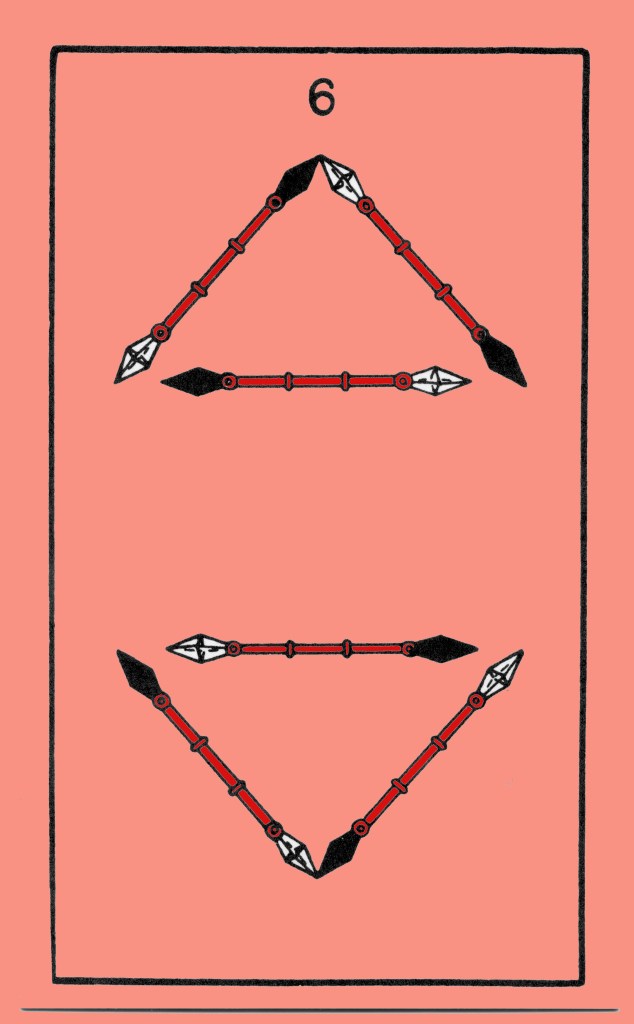
Tarot Encyclopedia – The Six of Wands

(Note: this is a collection of the meanings attributed to the cards by some occultists in the past centuries. It does not reflect my own study or opinion of the cards. It is only meant as a quick comparative reference as I develop my own take.)

The Six of Wands from the Builders of the Adytum (BOTA) Tarot deck

Paul Foster Case (and Ann Davies)

The second decanate of Leo, related to this Key, is the time period of August 2 to August 12, ruled by Jupiter. In Tarot divination, the Six of Wands partakes of a meaning similar to the conjunction of the Sun and Jupiter, combined with the influence of Leo and its natural fifth house.
Well-Dignified: success, happiness, gain; gain through love affairs or by the opposite sex; pleasure in labor; gain after a period of uncertainty and competition.
lll-Dignified: loss through the same things; waste in pleasure; trouble through pride of riches or through insolence based on success.
Keyword: Victory
(From the Oracle of Tarot course)

A. E. Waite

A laurelled horseman bears one staff adorned with a laurel crown; footmen with staves are at his side. Divinatory Meanings: The card has been so designed that it can cover several significations; on the surface, it is a victor triumphing, but it is also great news, such as might be carried in state by the King’s courier; it is expectation crowned with its own desire, the crown of hope, and so forth. Reversed: Apprehension, fear, as of a victorious enemy at the gate; treachery, disloyalty, as of gates being opened to the enemy; also indefinite delay.
(From The Pictorial Key to the Tarot)

Aleister Crowley

The Six of Wands is called Victory. The outburst of energy in the Five of Wands, which was so sudden and violent that it even gave the idea of strife, has now completely won success. The rule, or lordship, in the suit of Wands is not quite as stable as it might have been if there had been less energy displayed. So, from this point, as soon as the current leaves the middle pillar, the inherent weakness in the element of Fire (which is this: that, for all its purity, it is not completely balanced) leads to very undesirable developments.

[…]

This card represents Tiphareth of the suit of Fire. This shows Energy in completely balanced manifestation. The Five has broken up the closed forces of the Four with revolutionary ardour, but a marriage has taken place between them; and the result is the Son, and the Sun.

The reference is also to Jupiter and Leo, which seems to imply a benediction on the harmony and beauty of this arrangement. It Will be seen that the Three Wands of the Three Adepts are now orderly arranged; and the flames themselves, instead of shooting out in all directions, burn steadily as in lamps. They are nine in number, in reference to Yesod and the Moon. This shows the stabilization of the Energy, and its reception and reflection by the Feminine.

There is no circle to enclose the system. It is self-supporting, like the Sun.
(From The Book of Thoth)

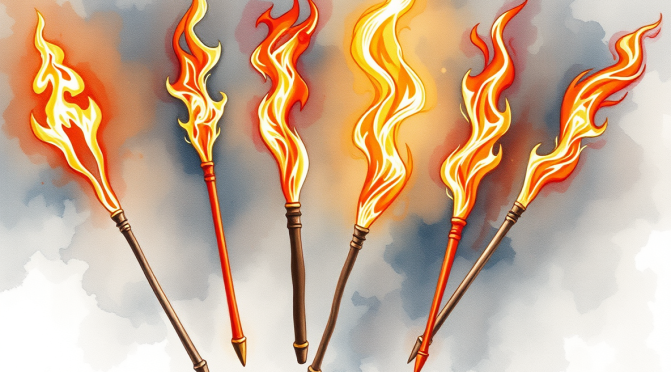
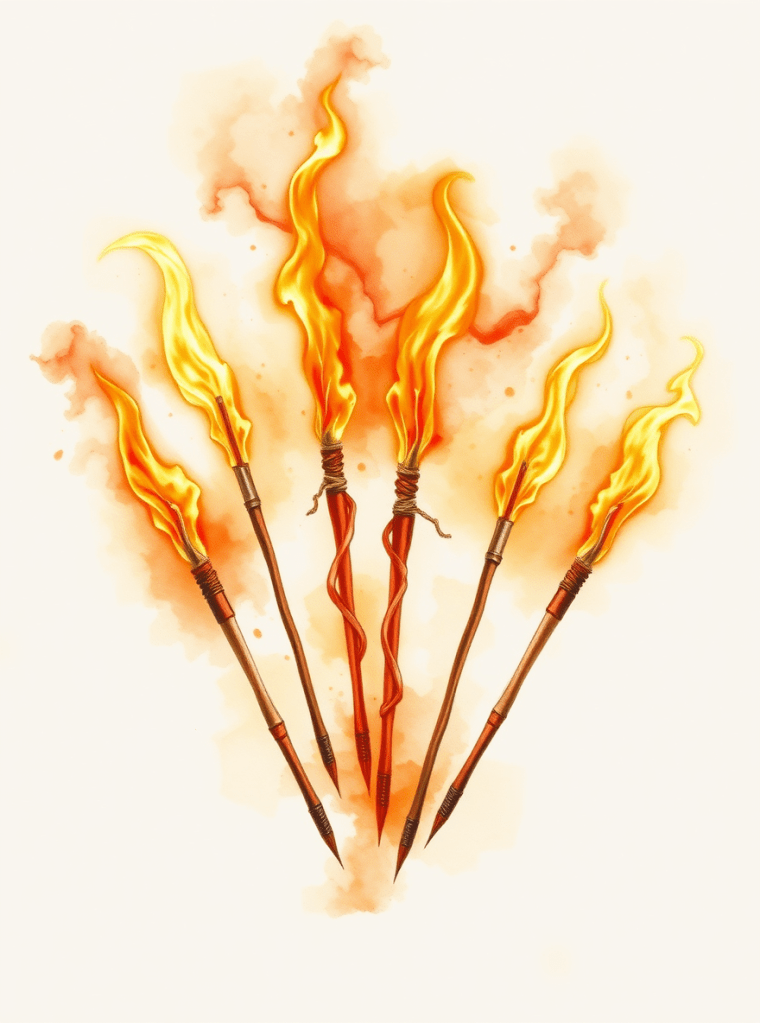
Rather prosaic AI-generated illustration for the Six of Wands

Golden Dawn’s Book T

TWO hands in grip as the last, holding six wands crossed three and three. Flames issue from the point of junction. Above and below are short wands with flames issuing, surmounted respectively by the symbols of Jupiter and Leo, representing the Decan.

Victory after strife: Love: pleasure gained by labour: carefulness, sociability and avoiding of strife, yet victory therein: also insolence, and pride of riches and success, etc. The whole dependent on the dignity.

Tiphareth of HB:Y (Gain).

Hereunto are allotted the great Angels HB:SYTAL and HB:a’aLMYH of the Schemhamphorash.

Etteilla

Servant
Upright. This card, as far as the medicine of the spirit is concerned, means, in its natural position: Housekeeper, Servant, Valet, Lackey, Slave, Mercenary, Inferior. – Courier, Commissary, Factor. – Interior of the house, Ménage, Family, Complex of the servants of the house.
Reversed. Expectation, Expectation, Hope, Relying on, Grounding, Trusting, Promise. – Confidence, Foresight. – Fear, Apprehension.

MQS

The Great Spreads with the Bologna Tarot – The Staircase

Following up on my previous post about the “bed sheet” spread with the Bologna tarot, I wanted to cover another full-deck spread: la scala, i.e., the staircase spread. You could also call it a pyramid spread, but I’ve never heard it being referred to as ‘pyramid’, possibly because pyramids were quite outside of the daily experience of the old ladies of Bologna. Here is the layout:

The staircase spread (la scala) with the Bologna Tarot

Note that this spread is intended for a 45-card deck. If you use a 50-card deck you’ll have five cards left over that you can put to the side as describing something imminent or something that is outside of the querent’s life (your choice).

The principles for interpreting this spread are the same as with the previous one: we look at the angles, then we locate the significator (Queen of Wands for a woman, King of Wands for a man). Generally speaking, anything above or before the significator shows the past, and anything after or under it shows the future, but we need to be flexible: sometimes we can just read the full column or row of the significator as a single sentence.

Furthermore, while the angles are important, we must not forcefully insert them into the reading: if they seem meaningful we can look at them, if they don’t, we can ignore them. Sometimes their significance becomes clear as the reading progresses.

Finally, we can look at the cards forming the outer diagonal side of the triangle as giving us one or more predictions concerning the future. In this case, the cards are read from the bottom to the top, walking up the stairs as it were.

In this case, let us suppose we are reading for a man. The angles of the spread are formed by Temperance, the Moor and the World. The cards are not especially clear. Let us move on for now. The King of Wands is found in the fourth column and third row. The row is quite negative: Justice is in the dark (Moon) causing suffering (Eight of Swords) at home (Ace of Cups) and confusion (Fool) that requires an expert (King of Coins). This could relate to something legal or bureaucratic.

In his column we find that there are messages and talks (Page of Swords, Page of Coins) with a woman who is close to him (Queen of Cups) and these communications are sad (Seven of Coins) but will be required to clarify some things (Queen of Coins).

Note that not everything we read in this spread must necessarily be connected to everything else, since this spread is supposed to be general. However, in this case we find that the querent’s card is close to the house card and the conversations happen with a family woman, so we can guess that the two things are related. Looking back at the angles, they cound indicate that this situation is requiring unexpected journeys.

Now let us look at the diagonal: the World and the Juggler could indicate a small trip or, considering the Ace of Wands is next to the Juggler, it might refer to hearing about a pregnancy. The Love card would confirm the joyful occasion. If we connect these cards, together with the Queen of Coins and the Strength card, to the issues we’ve seen relating the family, it could show the solution coming after a bit of uncertainty.

Considering the final cards on the stair, namely the King of Coins and the Chariot with the Moor, it could indicate an unexpected need to see a doctor (Chariot = sick bed, King of Coins = important man).

MQS