Category Archives: Card Reading

Free Will and Real Estate (Tarot Reading Example)

In the previous article I started talking about free will and prediction. There I talked about some factors that influence our freedom of decision.

Another incredibly important aspect is information. We orient ourselves by interpreting available information. If our free will were absolute, our knowledge of how the world works and how we move in it would not matter, because we’d be able to reach any result regardless of the initial conditions.

This is patently absurd, yet it is maintained by some diviners (appropriately, those who are incapable of deriving specific information from the divination process). It kind of reminds me of one of the definitions of God in the Book of the 24 Philosophers, where it says that God is that whose will is equivalent to his power and knowledge (or wisdom).

This was a fancy way of saying that God’s every action is always exactly the right one at the right moment because the fact that he wants it is the same with the fact that it can be done and also the fact that it is the right thing to do. This may be very true of God, and if we conceive (as I do) that the divine is immanent in the world, it is also true of humans, but only in so far as they understand themselves as limited fractions of this whole process. In so far as we crave things and don’t know how to get them, this view of the world is fairly deceiving, especially if you plan on charging people who expect to be given reliable information.

From a more mundane and practical standpoint, we have limited knowledge (or wisdom) and this always changes from moment to moment. As our information changes, so do our decisions. This has nothing to do with “destiny”: if we did not adjust our behavior to match our knowledge we’d already have died out. It is about survival.

The First Spread

Here’s an example. As I mentioned in my journal section, my husband and I are looking for a bigger home. We had eyed an apartment some weeks ago that seemed perfect, and upon visiting it, we were even more convinced to buy it. Some days ago I asked the tarot if we would be able to buy it.

“Will we be able to buy the apartment?”
Tarocchi di Layla, design by Elisa Scerrato

As can be seen from the cut (Strength and Justice) we were very determined (Strength) to buy (Justice).

The opening of the spread repeats the statement by showing that we are gung-ho about buying the apartment (Stars and Chariot) but that we are not considering everything (Moon) as we head toward the handshake (Lovers)

The second line shows the clarifying (Sun) intervention of a woman (Empress) who will bring certain less than pleasant aspects to light (Devil). The result is that my husband (Pope) will lose all interest in buying (Hanged Man)

This is exactly what happened. Two days after I did this spread, my husband came home and told me that one of his friends from an Enneagram group he is in has some experience with real estate and could help us decide. We set up a Zoom meeting with her, where she went through the apartment’s documents with us and raised some serious red flags we had completely missed that would have turned buying that apartment into a financial and bureaucratic nightmare. Needless to say, my husband (and I) lost all interest after that.

As you can probably guess, nobody forced us NOT to buy. Nor did destiny force our hand. In fact, we probably could have gone on with the deal, and fairly quickly (Strength + Justice in the cut of the first spread can signify a signed contract). But we would have been idiots.

And note how skewed my question was: we were completely besotted with the place, so I asked if we would be able to buy it, not if it was a good idea to buy it. The tarot clearly overrode my question and told me that certain unknown facts would surface that would influence our decision. Note also that the tarot did not say that we should not buy (my experience is that divination reflects reality, not what reality should be). The tarot said that we would change our mind.

The question is: were we destined to change our mind? Well, it is complicated, and the complication arises from the fact that the moment of divination is a very special moment, where spirit reflects on itself through the diviner. I will need to come back on this issue in more detail in some future articles.

The thing is, though, that we were not forced to change our mind: we simply realized it was the smart thing to do. Sure, you may say, if we had been more gullible, or if the apartment had completely blinded us out of our wits, we would have gone on with the deal anyway and regretted it later.

But being gullible or not is neither a choice nor an imposition: it is part of one’s being, at least to an extent, even if it is originally a learned behavior. The tarot simply computed the available information, both that which we could change and that which we had no control over, added the information about who we are at our core, and came to the conclusion that someone like my husband and I, in such a situation, would probably change their mind upon receiving better data.

The tarot predicted our behavior in the same way your mom who knows you are obsessed with chocolate icecream can predict you had chocolate icecream for dessert after dinner with your friends: it is a prediction based on knowledge of your nature and of the available information. The difference between your mom and the tarot is that the tarot (like all oracular forms) has a wider and deeper view of reality. The Tarot is, in a way, like a cosmic botanist who knows a red rose bush will sprout from this or that seed, even though this knowledge does not force the rose to be red. It is simply part of its nature.

The Second Spread

By the way, today before writing this article, I did a second spread just for kicks (the tarot is very tolerant of my shenanigans) to ask if that apartment was seriously off the table, as I am still a bit in love with it. Here’s the result

“Is the apartment really off the table?”
Tarocchi di Layla, design by Elisa Scerrato

In the cut we have Death and the Wheel: definitive change (the Death card can never be undone, just like real death). The spread itself is even more blunt. The Devil and the Moon show hidden dangers, and the contract, signified by Justice, is blocked (Hanged Man) thanks to a woman (Popess / High Priestess). Note how much more concise and harsh the spread is compared to the first one: it’s as if the cards were saying “Dude, really, knock it off already…”

Side note: I don’t know exactly why my husband’s friend came up as Empress in the first spread and as Popess in the second one. My best guess is that the tarot didn’t want me to get confused in the first one: if she had come up as the Popess, I would have linked her to the Pope, and would not have interpreted him as my husband, but since in the new spread neither I nor my husband show up, the cards were free to use a more natural significator for her.

MQS

General Cross Spread / Cartomancy with Playing Cards

In the Sibilla section of this site I posted some spreads that may also be used with playing cards. One type of spreads is generally used for broad readings without a specific focus. I must confess I don’t often use these spreads myself when reading for others (especially the 21 card spread which I will cover in another post), although I have found them invaluable for a quick glance into my own future.

A typical general spread is the cross spread. The disposition of the cards, after shuffling and having the deck cut by the querent, is as follows:

4 – 9 – 14
2 – 7 – 121 – 6 – 113 – 8 – 13
5 – 10 – 15
Cross spread for cartomancy with playing cards

The center of the spread (cards 1, 6, 11) indicates the querent’s present situation, or something that is happening that is very important to them. To the querent’s left (2, 7, 12) is his or her recent past. To the querent’s right (3, 8, 13) is his or her future in the next month or so. Above the querent (4, 9, 14) are his or her thoughts or something they are aware of, while underneath (5, 10, 15) shows something the querent doesn’t like or doesn’t know.

This spread is general, but I am sure it can be adapted to answer broad questions (“Tell me about my career”). It can also be used to investigate a person the querent is interest in knowing about (“My friend’s been behaving strangely lately…”)

One variation of this spread consist in shuffling the remaining cards again and dealing out an additional three cards for the further future or for the “answer”.

Here’s an example. I asked a friend of mine if we could do a spread for her as a demonstration and she graciously accepted. Here’s what came out.

3♣ – 3♥ – 9♣
J♥ – A♦ – 4♠8♥ – 6♠ – 8♠K♠ – 6♦ – A♥
7♠ – J♠ – 7♦
Example of a general cross spread with playing cards

It is never a good idea to start talking immediately, especially when the spread is general. It is always better to simply let your eyes absorb the cards as a whole.

Still, it is quite evident that the central heap is rather problematic, as it shows illness. This is not the querent’s own illness, but that of a relative (Eight of Hearts). This is confirmed by the future cards, where there is worry in the house, with the King of Spades in this case as the doctor. The querent’s grandma needs some minor surgery, it turns out, but given her age, her family is understandably concerned. Fortunately there is no indication of great difficulties, let alone bereavement.

The querent’s thoughts, however, are occupied by the desire for a lasting love union (upper fan), which however she doesn’t have, considering the past fan (blocked news concerning romance).

The bottom fan is difficult to interpret, as it doesn’t appear to link up with the others. It is very possible that, in her life in general, the querent doesn’t feel seen or appreciated (the Seven of Diamonds is money, but also rewards, broadly construed) and she feels unlucky.

This spread, as can be seen, is short and quick, and should ideally only be used as an “opener” to break the ice, before moving on to specific spreads.

MQS

Describing Court Cards, Part 3 / Cartomancy with Playing Cards

We’ve been talking a little bit about identifying court cards in cartomancy. Another possible key for identifying them, of course, is combinations. There is no need to memorize endless lists of combinations, as they are generally self-explanatory.

The difficulty comes when a reading contains many Court Cards, or even just court cards. Usually, this indicates a situation that involves many people, often a reunion of some kind. Note that when a bunch of Court Cards are together, Jacks usually count as people, that is, they strengthen the meaning of “many people together” even if they don’t indicate any specific person. However, if many Jacks show up, this can indicate that there will be children.

I know that some readers panic when a string of cards consists only or mostly of Court Cards, but I have learned to see this possibility as one of the easiest to deal with. This is because readers coming from a tarot background (especially in America) want to drown questioners in saccarine or self-helpy words, and Court Cards are hard to use in this respect.

But if we learn to see cartomancy (with the tarot or with playing cards, or any other means) as a way of decoding simple sentences, then Court Cards become very easy to interpret, even if a lot of them shows up. Usually there isn’t much to say, only that there has been or will be shortly a reunion of some kind. Here’s a recent example. I was visiting a friend and she asked me to do a reading about her job prospects. Here are the cards that came up:

8♥ – Q♣ – K♥ – J♥ – Q♥ – K♠ – Q♦

I asked her if there was a family reunion of some kind coming up, and she said that she was invited as a photographer to the christening of a friend’s child. She would get paid and, of course, she would also be there as a guest. Since this is something she already knew, we tried asking again, this time with five cards. Here’s what came up:

Q♣ – J♥ – K♠ – K♥ – Q♦

Clearly, the cards still wanted to talk about the christening, so we decided to let it go for now and I told my friend we would do another reading after the event. A couple of weeks later she told me that at the party she had been introduced to one of her friend’s relatives (probably the Queen of Diamonds here) who put her in contact with a photographer she knows personally, and who has a studio and hired her for some gigs.

I found it fascinating that the cards managed to talk about something partly unrelated to the question, but yet so pertinent to my friend’s job situation.

MQS

People have the Power | Cartomancy with Playing Cards

Court cards are scary, because they don’t seem to have a logical meaning, or at least not a prominent one. Instead, they represent people, and this can be inconvenient, because people exist in the real world and need to be described more or less accurately for the reading to be useful. This can be very difficult.

Queens and Kings are more likely to represent people and less likely to represent concepts, although on occasion they might. The K♣ and Q♣ are the two querent cards, and only in the rarest occasion do they stand for anything other than that.

A general rule of cartomancy (not just with playing cards) is that action happens in the spread. Who is not in the spread does not act. This can take on a variety of meanings, but most commonly what it means is that, for instance, if the querent doesn’t show up, they are relatively passive, and it is going to be harder for them to change the situation.

A natural corollary to this is the fact that if a person does show up in the spread, they influence the situation directly. Example: a female querent once asked me if she would find a job. The cards were:

10♠ – Q♥ – 7♥

The querent is not represented in the spread. This doesn’t mean that she wasn’t actively looking for a job (she was). It just means that her looking for one won’t solve the problem. Instead, out of nowhere (10♠) a woman will provide the solution in an unexpected way. What happened was that an aunt who lived far from home and didn’t even know the niece was looking for a job phoned and she happened to mention that there was an opening in the company she worked at that she needed to fill. Once she discovered the niece was looking for a job she helped her get the job.

Another example. A friend of mine once asked if the relationship that had just ended would resume (he had been left)

K♣ – 5♣ – A♦

An accumulation of Clubs is not good when asking about reconciliations. Here, the querent’s significator is shown acting (Five of Clubs) to start something new (Ace of Diamonds.) A week later he met a new girl and he (successfully) went after her. Here, despite the question, it is clear that the previous girl is completely out of the picture and cannot influence the events, so much so that later on she tried to reconnect with him (obviously, when she noticed that he was taken) but the spread showed that he was the one wielding power within the situation and was committed to the new.

MQS

Reading the Colors and Suits – Cartomancy with Playing Cards

In playing card divination, a lot of emphasis is given to the two colors and the four suits. The two aspects must not be separated from one another as they give us valuable information. However, since the two colors are a binary distinction without much refinement, they tend to describe general trends that can be easily overruled by other considerations. It’s best to leave them out unless they strike you.

In general, red cards indicate life and movement, but an excess of red can show instability. On the other hand, black cards show inertia and slowness, but when there’s too many of them they create obstruction. A good mix of red and black shows a balanced situation. This is especially true if we are describing a situation rather than predicting an outcome. For instance, I remember once doing a reading for a friend on the beach. She had just met a new guy. The spread was:

2♥ – 7♥ – 8♥ – J♥ – 3♥

Obviously, this spread consists only of Hearts and it is only red. This is consistent with the newness of the relationship, but it also shows us that there is nothing except some infatuation going on. The cards don’t predict a breakup, but they show that the relationship won’t last after the initial excitement has gone. We would need some black cards to anchor the red ones. We don’t even need to interpret the single cards, although we could. This is a fun summertime romance. Let’s leave it at that. Result: they broke up in winter.

Here is another example. A woman was asking if there would be reconciliation with her husband.

3♣ – 2♠ – 4♣ – 6♣ – 5♣

The Three of Clubs is the marriage and the Two of Spades is the argument. My question to the querent was how long ago the breakup had happened. She said it had been less than a week. The cards are obviously predominantly Clubs and all black. Therefore, they show that inertia will prevail. They don’t show reconciliation proper. They simply show that the breakup wasn’t really a break so much as an argument. The situation is unsatisfactory, and there is no love, but the cards show that it will go on.

Now, suppose that the same question had been asked by the same person and that she had gotten the same cards, but this time the breakup had happened three months ago. There is no reconciliation in the cards, and a new status quo has set in, which will tend to preserve itself (black color)

Red and black

Let us now analyze the suits. Suits tend to reinforce their particular meaning: Spades bring sorrow and blockage, Hearts feelings and joy, Clubs work and toil, Diamonds money and energy. In the first example, we only have Hearts, which shows feelings. It would be helpful to get Clubs, because Clubs show effort, and we all know that true love is a full time job. In fact, in a larger spread, it would even be nice to see some Spades in the past position, together with positive cards showing that the couple has gone through a lot and now has reached a point of stability.

In the second example, however, we have mostly Clubs. Here there is no fun left, and the situation goes on simply because it has been going on for a while, but it remains just drudgery.

Another important thing to take notice of is when a card that symbolizes either a person or a significator for a specific question shows up surrounded by cards of the same suit, or at least by cards that give us a coherent picture.

Here’s an example. A man asked about his relationship.

4♠ – Q♣ – 5♠ – 3♣ – K♦

The woman shows up as the Queen of Clubs, surrounded by two Spades. We don’t care about which Spades. The point is that she cannot move. She is impeded in some way. The reason is given by the Three of Clubs and the King of Diamonds: she is married.

Here is another example: a man asked if his new business venture would flourish.

K♣ – J♥ – 5♣ – 8♦ – 6♣

We don’t need to spend much time fiddle-farting with card meanings. The Eight of Diamonds, the card of business, is hemmed in by Clubs. No, the business will not flourish. It won’t go belly up, but at least for a very long time it will be just toil with little rewards. Yes, we could add that that Jack of Hearts shows he’s naive, but let’s not complicate things, for now. Sometimes the prediction is just obvious.

Basics of Card Interpretation – Cartomancy with Playing Cards

As I did for the Sibilla, I shall now write a series of articles on the concrete interpretation of playing cards in divination. Some of what I said for the Sibilla applies here, so make sure to check that article.

Keep in mind that you cannot learn card reading in theory. I am among those who believe that, without some grounding in theory, practice tends to be shallow. I’ve met plenty of “intuitive readers” who basically spend their querents’ time saying “how powerful this reading is” without actually saying anything of consequence except some pseudo-empowering truisms (“It’s time for you to get out of your own way”). There is nothing wrong with empowering the querent, but the advice needs to be taylored to their specific situation, and reading the querent’s specific situation requires some study of the theory.

That being said, there is also such thing as too much theory. If you want to be a card reader, read cards. Do it for friends, acquaintances, relatives. Sooner than you think you are going to amass a wealth of practical insight into the nature of the cards which is going to be more valuable than anything anyone may write.

Playing Cards are usually read one after the other in a linear fashion. If you feel called by positional spreads (“This is his heart, this is his past, this is his wish, etc.”) by all means go ahead. However, playing cards are great at creating broad pictures by combining with one another.

The first thing to remember is that Hearts tend to be positive and Spades negative, with Diamonds and Clubs fluctuating somewhere in between. Unlike in the Sibilla, where red cards tend to be weak and black cards strong and assertive, in playing cards Hearts are just as strong as Spades. This means that much of the interpretation depends on which card falls first and which last.

For instance, let’s say you have the 2♥ followed by the 2♠. In this case, an argument or some kind of vexation is coming up next. The Two of Hearts is a rather broad card in terms of meaning, often just showing that something is about to knock at the door. However, if it were 2♠ followed by 2♥, then whatever negative thing the Two of Spades signifies is likey to be overcome by harmony (the Two of Hearts indicate a distance being bridged).

Diamonds and Clubs are broadly neutral, although Diamonds tend slightly toward the positive and Clubs slightly toward the negative. This means that they are strongly influenced by the Hearts and Spades in the spread. For instance, one of the main associations of Diamonds is with money, but in itself we do not really know if it’s money gained or money lost. This depends on how the card falls in the spread, and whether with Hearts or with Spades. Clubs, on the other hand, indicate effort, so a Heart can make the effort pleasurable or positive, while Spades can make it in vain. In general, accumulations of Clubs indicate difficulties.

Note that although Clubs are neutral and Hearts are positive, which prevails still depends on which card falls first. For instance, 6♥ + 7♣ shows that there are difficulties in overcoming a separation or in healing from sickness. In itself, this combination is slightly positive because the Seven of Clubs is not a Spade, so it leaves the door open, but it is not satisfactory. If we had 7♣ + 6♥, then a problem would be overcome rather easily.

In general, a Spade falling last indicates failure. However, you need to be careful. If you are only pulling three cards, this may very well be so. However, the more cards make up the row of cards you are interpreting, the less a Spade falling last can overcome very positive card, especially if it’s not a hugely negative Spade. Suppose you have five or seven cards in a row that show that the querent will get his wish, but then a Spade falls last. In this case we would interpret the spread as “you will get what you want, but then a problem will arise.” What kind of problem will be shown by the cards themselves. In case, do another spread.

These are just some preliminaries. Playing cards tend to be rather straightforward, so you will soon find yourself understanding the cards in context better than I could ever describe them in an article.

When Questions Are Deceptive Even if Querents Are Honest (Example Reading)

Sometimes people ask me, “What happens if I ask you a deceptive question?” to which the honest answer is, “I’ll be more likely to get the answer wrong” The underlying assumption is that I either pull answers out of my ass or I get them through some infallible magical process, so that either my getting the answer wrong is proof that divination is bogus or a querent’s deceptive behavior should have no bearing on my ability to answer.

Neither of these assumptions is true. Divination is a process of symbol-reading that equates the combinations of a given comprehensive set of symbols with certain states of being in the past, present or future.

A symbol is not some arbitrary squiggle. Keep in mind that symbolic means “that throws together”. It’s the opposite of diabolic, which means “that throws apart”. Our whole perception is symbolic, as we equate X with Y at every turn, linking various states of being together (“we throw them together”) in our perception. Car approaching means danger of becoming crayon smears on the asphalt. If our mind didn’t work symbolically it wouldn’t be able to link facts together, and we’d already be dead.

As I said somewhere else, if you show up at the doctor’s insisting your leg hurts even if it doesn’t, sooner or later you are going to get a diagnosis and a prescription. If the doctor touches you where it hurts but you say it doesn’t hurt, that also changes the diagnosis. The doctor is reading you and your behavior as symbols that he “throws together”, i.e., connects with certain predictions about the past, present or future. An honest and cooperative querent is as valuable as an honest and cooperative patient, except that patients understand this, querents sometimes don’t.

Detecting a querent’s lies is not impossible, just as it’s not impossible for a perceptive doctor to call a patient’s bluff, but it’s damn hard. It is especially hard with divination, because unlike a doctor visit, a divination will always give an outcome, that is, its symbols will always come up in a certain order. If a married querent asks you “will I get married?”, you are still going to have a spread of cards or a chart or some other set of symbols in front of you saying something.

In my (fortunately limited) experience with deceptive querents, the divination always contains the truth of the matter. In the example of the married querent, there should be indications of an existing marriage. Unfortunately, it is extremely easy to misread the symbols as meaning something else on the backdrop of what the querent said.

But a question is not deceptive just when the querent is maliciously trying to call you out as a fraud. Well-meaning querents can inadvertently frame their questions deceptively. Here’s an example.

Case Study

I’m currently gathering recommendations as a reader, in case I decide to offer paid readings from the blog in the future. I was reading for a young woman in her late thirties in exchange for her recommendation a couple of days ago. She asked me about her love life, but asked nothing specific.

We’ve talked about querents’ assumptions, but readers have assumptions, too. One of the typical assumptions of many readers is that if someone is getting a reading, the person must be a mess in need of major help, so readers tend to give a less favorable reading of any outcome. In this case, this assumption would have led me to make a mistake.

Here’s the spread that came out in response to the question (I know I haven’t talked about tarot on this blog yet, but I’ll explain my approach another time. Note that the querent has given me permission to talk about the reading)

A tarot reading about the querent’s love life
Tarocchi di Layla, design by Elisa Scerrato

The cards of the cut were the Empress (the querent) and the Moon. The Moon can have a huge variety of meanings, from deception to silence to maternity to influence on people to many, many more. Mostly it is a bit of a red flag when it falls next to a significator. But the rest of the cards were wonderful.


Mqs: “You’re in a relationship, right?”
Querent: “yes”
Mqs: “it’s a longstanding one, though. Marriage?” (Hermit at the beginning showing slowness/long time, plus Sun and Justice showing a union of love)
Querent: “yes!”
Mqs: “It’s a good marriage. It has settled into its rhythms (Justice and Wheel) but there is still a great deal of love (Sun)”
Querent: “yes, we love each other.”
Mqs: “there is a clean, pure (Stars) energy (Devil) around this union (Justice above). You have different characters (Justice and Devil) but it doesn’t seem to matter, and any obstacle (Devil) is overcome (Chariot).”
Querent: “it’s true”
Mqs: “Is he older than you? (He’s represented by the Pope)
Querent: ” Quite a bit”
Mqs: “But he’s very dynamic (Juggler next to Pope)”
Querent: “Definitely. He does a lot of sport.”

At this point I was a bit startled. The cards were wonderful. There didn’t seem to be any issue. This is relatively common when the querent doesn’t ask a very specific question (she only told me the topic). Still that Moon next to her bothered me. Why was it there? The cards didn’t point to any cheating or issue.

Mqs: “Are you somewhat taciturn?”
Querent: “Yes, I tend to keep to myself.”

That was an explanation, but it still wasn’t satisfying. It was an odd thing for the cards to point out in the cut.

Mqs: “Are you dissatified?” (The Moon can mean sadness)
Querent: “A bit”
Mqs: “But not with your marriage”
Querent: “No, I’m happy with my husband”
Mqs: (looking at the Juggler next to the husband, which is the significator card for work) “Does he work?”
Querent: “yes”
Mqs: “do you work?”
Querent: “I don’t”
Mqs: “Are you dissatisfied that your husband works but you don’t?”
Querent: “yes! I think that’s how I feel”
Mqs: (laughing) “So the question is about work, not love”

Her face lit up with understanding, as if she hadn’t thought about it. “That’s right!” she said enthusiastically, “I wanna know about work!”

I think this interaction shows very well how, even if not meaning to, querents can veil one issue by wrapping a different topic around it. The querent in this case wasn’t trying to deceive me. Her subconscious mind simply used the topic of her love life to lead me to her real issue. This, by the way, is why it’s important to be able to have a frank conversation with querents.

MQS

Vera Sibilla Reading – Will He Get a Job?

Occasionally I get to do a reading that is worth discussing. This reading was done last November. A friend of ours, a mature woman, was worried that her son, 21, wasn’t going to find a job. The cards were:

“Will my son find a job?” Vera sibilla reading

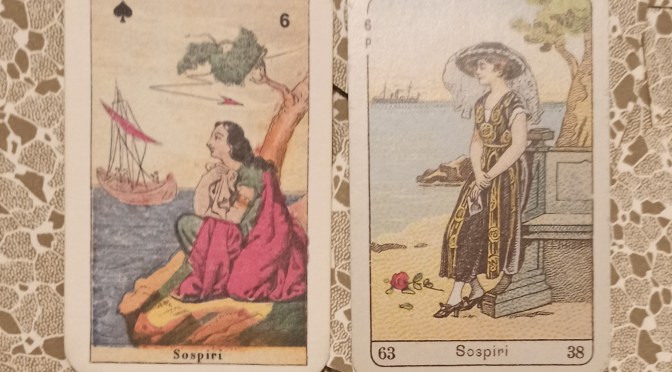
The first card, the Merchant, is the theme card for the son’s work. It is reversed, showing the difficult moment. Immediately after comes the Fortune card, which technically should be a stroke of luck in the person’s destiny. Following is the Sighs card, which represents delay and waiting, in its main meanings. It also shows that the card the young woman is looking at is something the querent is worried about or is expecting. The Maiden, the Queen of Clubs, is usually a significator for a young woman. However, it also has the peculiar function of showing where the problem lies: it’s the card she is facing away from and pointing her finger at. Finally, there’s the Death card. Usually it’s not good to end a reading with the Death card, but in this case the reading was clear enough.

The young man will not find a job. The stroke of luck (Fortune) is not real, but merely something he is waiting for (Sighs). To paraphrase, he’s not looking for a job. This is the problem (Maiden) that leads to a dead end (Death). For several months, therefore, the boy won’t find a job, simply because he is passively hoping it will drop in his lap. In July of 2023 I got confirmation that he hasn’t yet found one. Of course, the cards are time-bound. At this point it would be good to do another reading. We shall see.

Vera Sibilla | Twenty Five Card Spread

A last spread I wanted to cover with you, another one that can be used for general readings, is the twenty five card spread. This is similar to the twenty one card spread, but instead of seven packs of three, you use five packs of five cards.

Pack 1: The Querent
Pack 2: The Home
Pack 3: Work
Pack 4: Love
Pack 5: What you don’t expect

This method also has a short time frame, rarely beyond three months. As usual, lay out the cards and see what your interpretations are before reading mine.

Example with the twenty-five card method

This was a general fortune for a friend, more than two years ago.

Pack 1: 2♥R + 5♦ + 6♦ + 3♠ + 3♣
Pack 2: Q♦R + 4♥ + 4♠ + K♥R + A♣R
Pack 3: 3♥ + 4♣R + 9♥ + 6♣ + 6♥
Pack 4: 9♠ + 10♥ + A♠R + 2♦ + 10♣R
Pack 5: K♠R + Q♠R + 5♥R + 4♦R + 2♣

Pack one tells of a difficult situation at home, which makes the querent sad and makes her want to leave. Since the 3♣ is a card of movement, it is probably going to happen (it did)

Pack two tells of tensions in the family between two married relatives (turned out it was the aunt and uncle who lived on the second floor of the querent’s home). Their love is sick and the situation will likely lead to a divorce (A♣R)

Pack three shows that there is an upcoming recommendation or help. The querent’s interests will be fostered on the job and her finances will improve.

Pack four shows a long period of solitude. The A♠ is reversed, which makes it mildly negative together with the 9♠, as they sandwich the 10♥. However, in reference to the following cards, which are positive, the A♠R shows the end of sorrow. Probably thanks to meeting someone online. This doesn’t tell us about their story, only that she will start dating.

Pack five shows the unmasking of a negative relative, a woman who will give the querent’s family much grief and be unjust. All will be well though in the end. It turned out that a distant cousin was trying to claim the will of a common relative for herself. I don’t know the details, but she was stopped.

Vera Sibilla | Twenty One Card Spread

This spread can be used to tell a general fortune, but it is somewhat vague, meaning you will need to follow up with other spreads. It also tends not to go beyond one or two months.
You simply shuffle and cut the cards and then deal them out into seven packs of three cards each. Each small pack has a correspondence.
Pack 1: the querent (usually, but not invariably, the present moment)
Pack 2: the house
Pack 3: external influences
Pack 4: work and money
Pack 5: love life
Pack 6: potential for trouble
Pack 7: something unexpected

If a pack is not clear, shuffle the remaining cards and add two more

If you look up online, you will see that there are many different variations of this spread. This is how it was taught to me, but feel free to adopt the one that you find resonates better with you. I should also point out this is not a spread I use very often with other people, mostly I do it for myself every month or so to see what’s ahead. There are exceptions, or course.

Remember to lay out the cards as in the example and try to come up with your interpretation before reading mine

Example of 21 card spread
Pack 1: 5♦ + 9♠ + 3♣R
Pack 2: 9♣ + 8♣ + 3♦
Pack 3: J♦ + 8♦R + K♠R
Pack 4: 10♥ + 4♠ + 7♣
Pack 5: 5♥ + A♥ + 2♥
Pack 6: 9♦ + 5♣R + 2♣
Pack 7: 10♣ + 2♦ + 10

This is an old spread from some year backs. The first pack shows that I was coming out of a bout of depression. The 3♣R breaks negative cycles.
Pack 2 shows a family gathering with the exchange of gifts. A couple of weeks later was my nephew’s first birthday.
Pack 3 shows the arrival of negative communications from the authorities, possibly something to be paid or some money not granted. I hadn’t asked for money though. Around a month later I received communication that I needed to pay for the public broadcast network (even though I never watch it. Yay for unwanted public services)
Pack 4 shows that a long spell of unemployment was coming to an end. I did find a job soon after.
Pack 5 shows harmony in the relationship I’m in and talks about consolidating it. It was around the time we had started considering marriage.
Pack 6 shows that althouth there may be difficulties, all will sort itself out, albeit with a delay
Pack 7 shows the loss of correspondence. I actually ended up losing my phone (which can be signified by the Letter, considering that the Gift card was already in play). A tourist found it and I got it back (remember Pack 6)