Category Archives: Card Meanings

Tarot Encyclopedia – The Four of Swords

(Note: this is a collection of the meanings attributed to the cards by some occultists in the past centuries. It does not reflect my own study or opinion of the cards. It is only meant as a quick comparative reference as I develop my own take.)

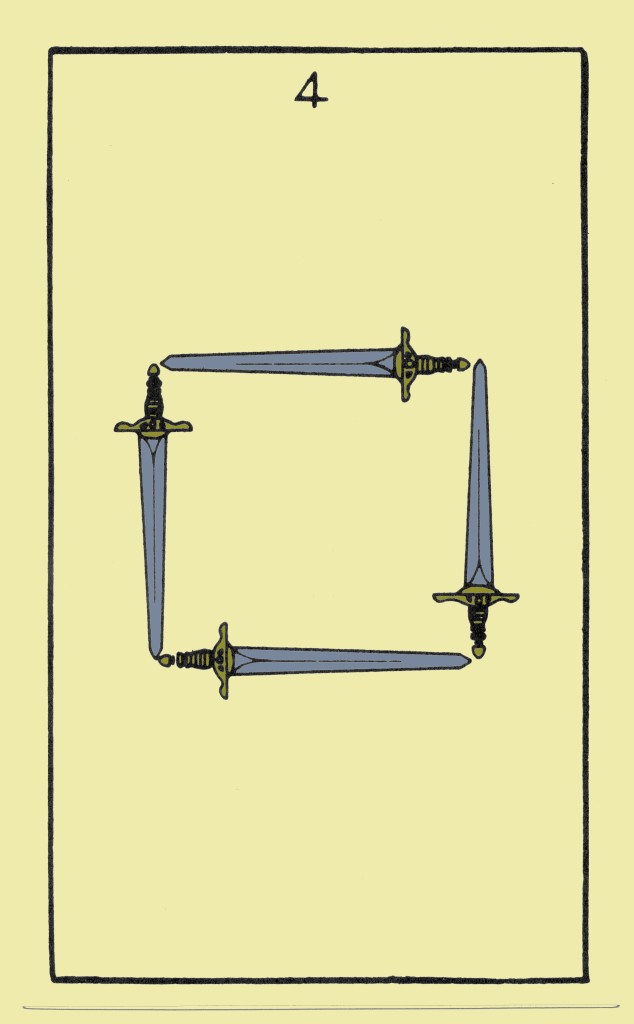
The Four of Swords from the Builders of the Adytum (BOTA) tarot deck

Paul Foster Case (and Ann Davies)

The time period is the last decanate of Libra, October 13 to October 23, under the rulership of Mercury.
Well-Dignified: rest from sorrow, yet after and through it; relief from anxiety; rest after illness; quietness; change for the better; success in legal affairs; association with others in Mercurial pursuits; strong mental attraction to a person of the opposite sex; activity in writing or short journeys.
Ill-Dignified: inharmony with partners; unsettled conditions in legal
affairs; disorder and loss through ill-considered writings or needless
short journeys; vexations through petty strife and sarcastic speech.
Keyword: Rest.
(From the Oracle of Tarot Course)

A. E. Waite

The effigy of a knight in the attitude of prayer, at full length upon his tomb. Divinatory Meanings: Vigilance, retreat, solitude, hermit’s repose, exile, tomb and coffin. It is these last that have suggested the design. Reversed: Wise administration, circumspection, economy, avarice, precaution, testament.
(From The Pictorial Key to the Tarot)

Aleister Crowley

The Four of Swords is called Truce. This seems rather on the lines of “the strong man armed, keeping his house in peace”. The masculine nature of air makes it dominant. The card is almost a picture of the formation of the military clan system of society.

[…]

The number Four, Chesed, is here manifested in the realm of the Intellect. Chesed refers to Jupiter who rules in Libra in this decanate. The sum of these symbols is therefore without opposition; hence the card proclaims the idea of authority in the intellectual world. It is the establishment of dogma, and law concerning it. It represents a refuge from mental chaos, chosen in an arbitrary manner. It argues for convention.

The hilts of the four Swords are at the corner of a St. Andrew’s cross. Their shape suggests fixation and rigidity. Their points are sheathed—in a rather large rose of forty-nine petals representing social harmony. Here, too, is compromise.

Minds too indolent or too cowardly to think out their own problems hail joyfully this policy of appeasement. As always, the Four is the term; as in this case there is no true justification for repose, its disturbance by the Five holds no promise of advance; its static shams go pell-mell into the melting-pot; the issue is mere mess, usually signalized by foetid stench. But it has to be done!
(From The Book of Thoth)

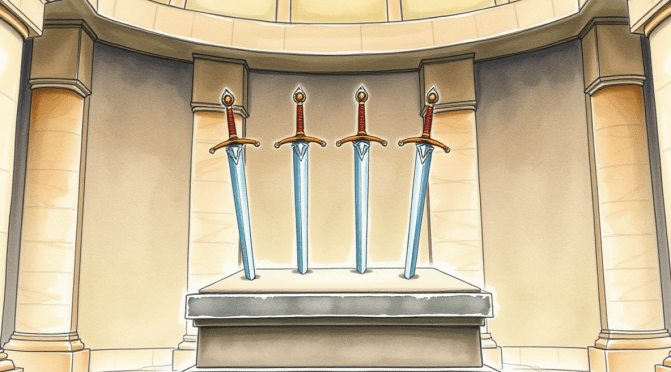
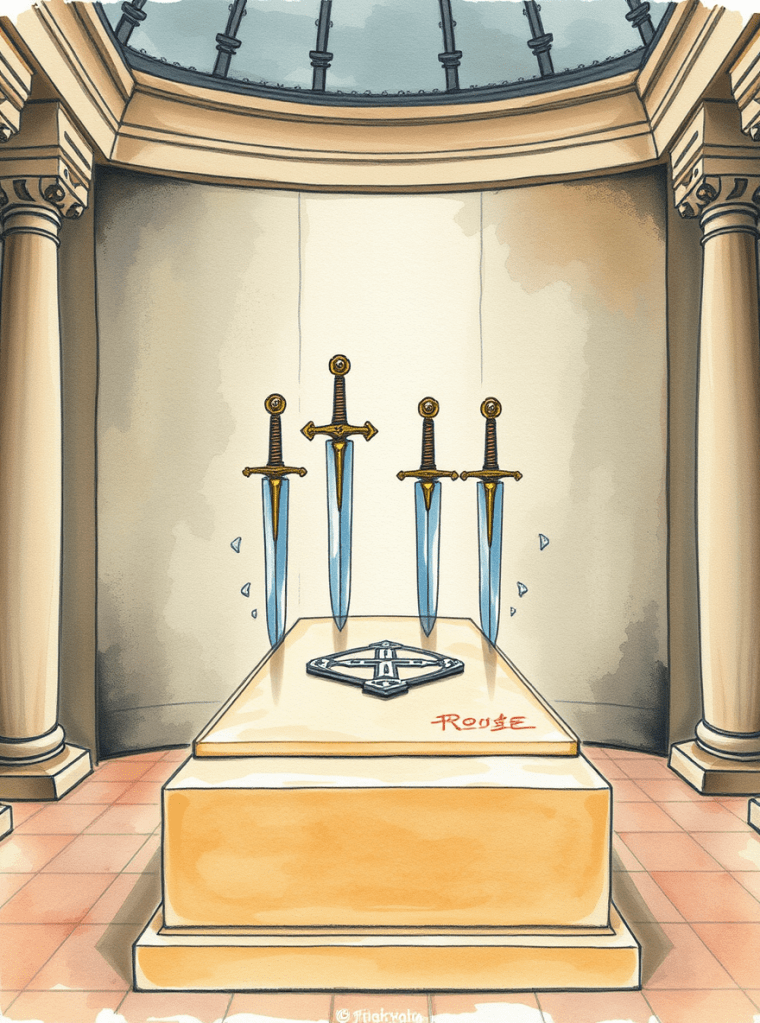
AI-generated illustration for the Four of Swords

Golden Dawn’s Book T

TWO White Radiating Angelic Hands, each holding two swords; which four cross in the centre. The rose of five petals with white radiations is reinstated on the point of their intersection. Above and below, on the points of two small daggers, are Jupiter and Libra, representing the Decanate.

Rest from sorrow; yet after and through it. Peace from and after war. Relaxation of anxiety. Quietness, rest, ease and plenty, yet after struggle. Goods of this life; abundance; modified by dignity as is usual.
Chesed of HB:V (Convalescence, recovery from sickness; change for the better).
Herein do HB:LAVYH and HB:KLYAL bear rule.

Etteilla

Solitude
Upright. This card means, as far as the medicine of the spirit is concerned and in its natural position: Solitude, Desert, Retired place, Hermitage. – Exile, Banishment, Proscription. – Uninhabited, Isolated, Abandoned, Neglected. – Tomb, Burial Ground, Coffin.
Reversed. Economy, Wise Conduct, Wise Administration. – Welfare, Management, Household management, Savings, Avarice. – Order, Arrangement, Relationship, Convenience, Concordance, Agreement, Harmony, Music, Disposition. – Will. – Reservation, Restriction, Exception. – Circumspection, Circumscription, Retention, Wisdom, Sympathy, Regard, Precaution.

MQS

Bolognese Tarot – Introduction to an Old Fortune-Telling Tradition (Part I)

As I’ve mentioned on this blog, I’ve been studying the divination tradition of the Bolognese Tarot (Tarocchino Bolognese, literally the Small Tarot of Bologna) for some months now. I’ve been doing it under the direction of a traditional practitioner of this art, whom I’ve befriended and with whom a wonderful exchange of ideas has started.

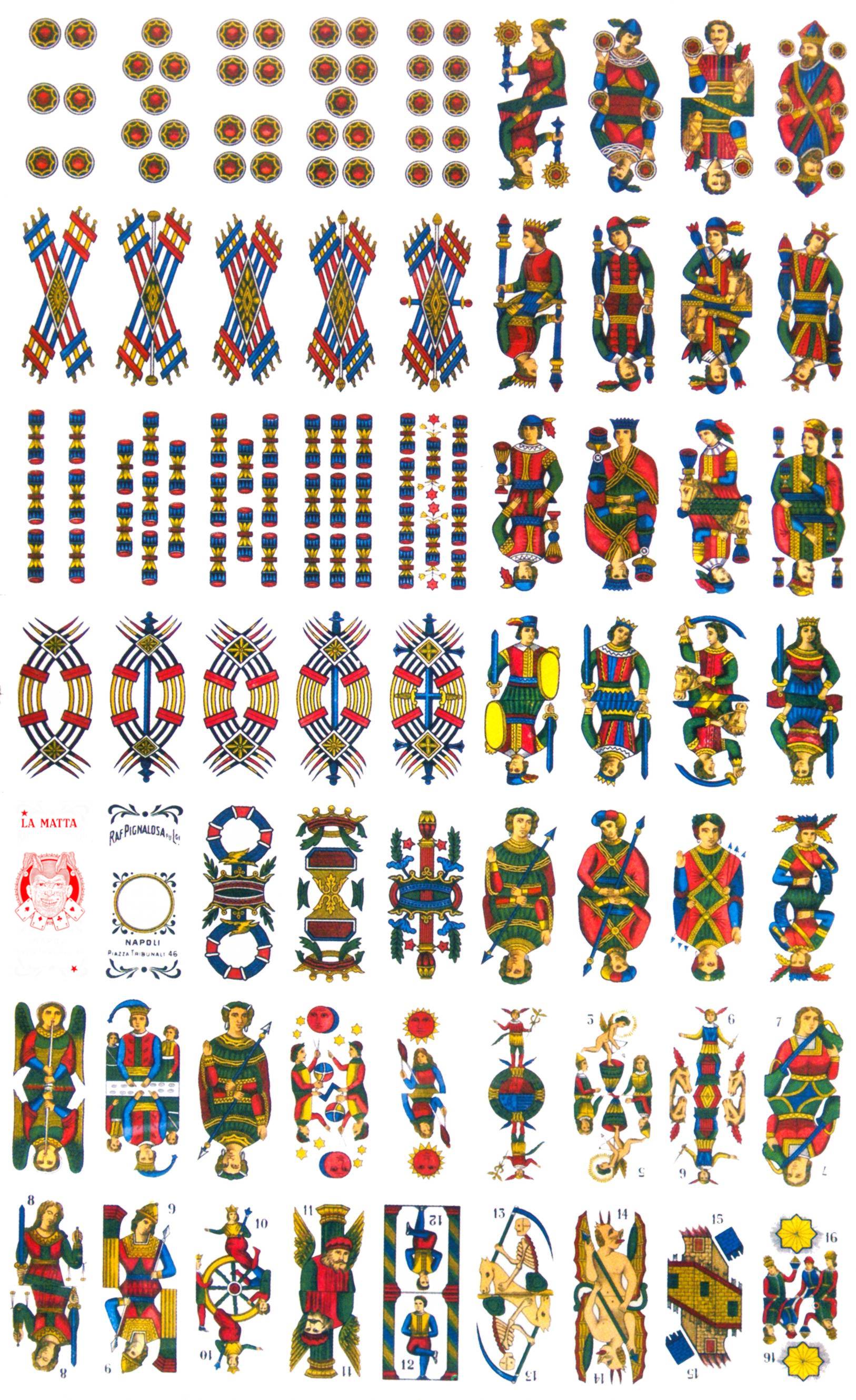
The full deck. Image from the website Labirinto Ermetico

I plan on introducing this form of divination in its main lines for a couple of reasons: 1) it is little known outside of Italy and it deserves some love 2) Its reading techniques are markedly different from the current approach and allow for a very concrete, down-to-earth approach 3) I want to discuss some spreads done with it in the future, and I can’t do it without introducing it first 4) it is the oldest tarot-related divination tradition that we know of, and it is therefore cool from a historical standpoint.1

The Ugly Duckling and Its Quirks

Like the almost totality of very old decks, with a couple of exceptions (the Visconti deck is one) the Bolognese tarot is distinctively unappealing from an esthetic standpoint, largely because, like other popular pre-RWS decks, it was meant to be used by poor people as a playing deck at the local inn.

A selection of cards from the Bolognese Tarot. As may be noted, they are symmetrical, like playing cards, though the earliest packs had full images.

The reason it is called ‘tarocchino’ (small tarot) has to do with its reduced size, probably to enhance its handlability. However, it is not just the size of the cards that is reduced, but also the number of the cards that comprise the deck: all pip cards from Two to Five are removed, leaving only the Ace of each suit plus the cards from Six to Ten and the court cards.

Furthermore, the Pope (Hierophant), Popess (High Priestess) Empress and Emperor are absent from the deck for political reasons, as Bologna was directly under the control of the Church. Instead, the deck includes four ‘Moors‘ (the Moors were Muslim colonizers that had conquered parts of Italy.)

Three of the ‘Moors’. The Fourth one is a copy of the third on the right.

Finally, the Bolognese Tarot has another peculiarity, in that the Major Trumps are out of order compared to our regular system. This may sound surprising to some, but our current ordering of the trumps is a relatively recent development and has nothing mystical about it (the oldest preserved document with the order of the trumps gives a rather different sequence).

An Old Tradition

The Bolognese Tarot tradition was almost entirely confined to the city of Bologna and the surrounding areas, and was at risk of dying out, until both the card game and the divination tradition were transmitted to a larger public thanks to the power of the Internet.

Interestingly, to this tradition is connected the most ancient set of meanings handed down by old sources. The following list dates back to the pre-Napoleonic period and gives the meanings of a reduced pack of thirty five cards. I’m copying it here for its historical interest, but it does not correspond to the system I have been taught:

  1. The Juggler (Magician): Married Man
  2. The Lovers: Love
  3. The Chariot: Journey
  4. Temperance: Time
  5. Strength: Violence
  6. The Hermit: Old (Person)
  7. The Hanged Man: Treason
  8. Death (called ‘Thirteen’): Death
  9. The Devil: Wrath
  10. The Star: A Gift
  11. The Moon: Night
  12. The Sun: Day
  13. The Angel (Judgement): Marriage or Agreement
  14. The World: Long travel
  15. The Fool: Madness
  16. King of Wands: A Bachelor
  17. Queen of Wands: A Prostitute
  18. Knight of Wands: Something Knocking at the Door
  19. Page of Wands: Thoughts of the Female Querent
  20. Ace of Wands: Sexual Escapades
  21. King of Cups: An Old Man
  22. Queen of Cups: Married Woman
  23. Knight of Cups: Reconciliation
  24. Page of Cups: The Female Querent
  25. Ten of Cups: The Roof of the House
  26. Ace of Cups: The House
  27. King of Swords: An Evil Tongue
  28. Ten of Swords: Tears
  29. Ace of Swords: A Letter
  30. King of Coins: The Male Querent
  31. Queen of Coins: The Truth
  32. Knight of Coins: Thoughts of the Male Querent
  33. Page of Coins: Unmarried Woman
  34. Ten of Coins: Money
  35. Ace of Coins: The Table

As I said, this is not the system that I’ve been taught, and it is very likely that even back then more than one system existed (usually, significant differences are found from quarter to quarter in Bologna and from small village to small village in the surrounding areas). Since this cartomantic tradition predates Etteilla’s by at least a quarter of a century, and probably more, and since Etteilla says he learned to read the tarot from an Italian card reader (though he pretends it was Alexis of Piedmont to add to the mystery), it is not to be excluded that the Bolognese tarot had some influence on him.

But this is speculation. What is clear is that tarot divination, whenever it was born, was brought into the world as a way of addressing concrete issues. This series of articles is dedicated to bringing the tarot back to these roots.

MQS

  1. If you want to read more, you can start with the Wikipedia page. More Information is contained on the webside of the Associazione Le Tarot ↩︎

The Car Keys (Example Reading)

I’m currently visiting my parents in Italy, so I’m going to keep this short and sweet. I lost my  keys. As I probably already mentioned, I hate lost object readings because they are incredibly difficult to decipher, but I figured it wouldn’t hurt to try. The cool thing about playing cards is that most people have them at home. This is the reading that came up:

7♠️ – 8♥️ – 10♠️ – 2♦️ – J♦️

If I had to tell you I understood this reading I’d be lying. The one thing that seemed clear to me is that it was in a place made for people (Eight of Hearts), so the living room was an option, though it seemed strange, since I always keep my keys in my old bedroom. There were also those two diamonds indicating messages, which I didn’t understand.

Well, it turned out I suddely lost (Seven of Spades) the keys the previous evening (Ten of Spades) during a dinner (Eight of Hearts), and I was contacted by the owners through a friend of mine who knows them.

MQS

Vera Sibilla Cards That Indicate Negative Feelings

I already made a post about positive feelings. This is a follow-up on the other side of the coin. As usual, this isn’t meant to be exhaustive. Note that many cards indicating difficult feelings are just reversed cards whose upright meaning is positive.

Three of Hearts Reversed – The Balcony

When upright, the Three of Hearts relates to the sense of sight, both literally and figuratively. Reversed, it can represent someone who is blinded by emotion, especially such emotions as rage or lust (the “red” emotions). It can indicate the inability to control oneself as a result of such emotions.

Four of Hearts Reversed – Love

Aside from being an indication of depravity, the reversed Love card can, and in fact is more commonly found to relate to unrequited feelings, emotional dryness and deep emotional scars from disappointment, usually in love.

Seven of Hearts Reversed – The Scholar

Upright, the Scholar card represents the mind in its best aspects of intelligence, creativity and having a solid grip on reality and on one’s problems. When it is reversed, it represents either someone who is cold and calculating (the lower octave of the mind) or someone who feels impotent and easily overwhelmed by problems.

Eight of Hearts Reversed – Hope

When reversed, the Eight of Hearts is a harbinger of sorrow, disappointment and unfulfilled hopes and wishes. Being a card that is strongly connected with one’s inner optimism, the reversed Hope card becomes one of pessimism or even of mild depression (by itself).

Nine of Hearts Reversed – Faithfulness

Upright, the Dog card of the Sibilla indicates friendship and loyalty, as well as deep and strong attachment to someone, something or an idea. Reversed, it is an indicator of rebellion, unreliability and biting the hand that feeds you, from thankless teens to political activists depending on the context.

Ten of Hearts Reversed – Perseverance

Upright, the Ten of Hearts can indicate solid, reliable people, lasting feelings and certainty. When it falls reversed in a reading, the Ten of Hearts become an indication of turmoil and of not being able to control oneself, one’s instinct and one’s rage.

Two of Clubs Reversed – The Peacock

When it comes up reversed, the Peacock card embodies the negative side of the symbolism of the animal, namely pride, haughtiness, an inflated ego that is easily slighted and self-centeredness. Depending on the surrounding cards this can go from a mild drama-queen complex to serious pathological deviancy.

Seven of Clubs Reversed – Realization

The Upright Seven of Clubs represents our realization in the world, our ambitions and our sense of accomplishment. When it comes up reversed, it shows insecurity, dissatisfaction with one’s existence, and fear, especially understood as feeling under attack in one’s life projects.

Eight of Clubs Reversed – The Reunion

Reversed, the Reunion card has many difficult meanings relating to groups and one’s social contacts. However, it is also a card of disillusion, sadness and depression. It represents someone who has lost momentum and is prey to inner turmoil, self-doubt and similar feelings.

Nine of Clubs Reversed – Merriment

Coming up reversed in a reading, the Nine of Clubs reverses the hakuna matata feeling of its upright counterpart. It becomes a card of joylessness, and it can also represent feeling isolated from others, sometimes even as a consequence of other people taking shots at us.

Four of Diamonds – Falsehood

The Falsehood of this card must be understood broadly as a feeling of “wrongness” and negativity. In this sense it is the opposite of the Dog card. It represents being ill-disposed or displeased with something, and negative feelings brewing right below the surface.

Five of Diamonds – Melancholy

The title speaks for itself. Upright, the card can be an indicator of disappointment, sadness, pining, melancholy and dissatisfaction. By itself it is not a tragic card, but it does slow you down. Reversed, the card becomes much more impactful and its effects long-lasting.

Seven of Diamonds Reversed – The Child

When it falls reversed, the Child card embodies the negative side of children: childishness, in the main, but also a general sense of inexperience and that the world is too complex for us to understand and tackle.

Nine of Diamonds – The Fools

The Fools indicate feelings of unwarranted exaltation and self-confidence, mistaken conceptions, as well as easily aroused feelings of aggression. They depict a volatile atmosphere where things can go seriously south.

Ten of Diamonds – The Thief

The Thief is a card of betrayal, whether literal or metaphorical. It represents ill-will toward someone or something, and the desire to do wrong things. This needn’t be tragic, as there are many situations where the sneakiness of the Thief borders on amorality rather than immorality. Still, this card is always a warning.

Ace of Spades – Sorrow

The Sorrow card is the card of tears, of the broken heart and of the sense of being cut off from one’s source of happiness. In itself it is a very difficult card to go through, but when not piled on by other problematic cards it can show just a sense of discouragement that the person can muscle through with some mental discipline.

Three of Spades – The Widower

Another difficult card, the Widower represents isolation, loneliness and serious interpersonal issues. Being the card that signifies “oneness” and the single individual, sometimes it can show things done alone, with no negative connotation, but more often than not it foretells difficulties in one’s loneliness. When reversed, it becomes a rather tragic card.

Four of Spades – Sickness

Although this is the card that indicates literal sickness, it can also be interpreted metaphorically on occasion. It often signifies feeling sick, disturbed or down, but it can also be the card of sick and morbid feelings which cannot find a healthy expression.

Six of Spades – Sighs

Among the less difficult Spades in the deck, the Six of Spades represents everything we desperately long for and await, hoping it will come to us. It is a less serene version of the Eight of Hearts, as it contrasts its composure with a sense of uncertainty and fear of losing what one wishes to get.

Seven of Spades – Tragedy

Another card of “red” feelings, this one indicates anger and wrath. It shows explosive energy disrupting one’s life, which, from an emotional standpoint, usually signifies that we are feeling slighted or wronged or somehow unable to restrain our ire.

Eight of Spades – Desperation and Jealousy

In the main, the Eight of Spades is a card of literal jealousy and envy, but it can represent all those situations where we look at others with toxic feelings in our heart. It can also signify desperation and tears, and a sense of being trapped in a corner with no way out.

MQS

The Mystery of the Six of Pentacles

Following up on my article about the Seven of Swords, I want to take a look at another ambiguous card in Waite’s deck: the Six of Pentacles.

As usual, there is a folk intepretation of this card and there is what Waite meant. My comment is not meant to be disparaging of anyone’s interpretation: it is just philological in nature.

Generally, most people see the Six of Pentacles as a card of generosity, philanthropy and giving to others. This is rather odd at first, since for the meaning of the minor cards Waite follows the Golden Dawn system almost religiously (which is proof that he didn’t care much about the minors in the first place, see my article about his disdain for the minor arcana).

In the Golden Dawn system of tarot, all sixes represent the best expression of the suit and are assigned to the sephira Tiphareth, which is indicative of perfect harmony and equilibrium within the element. The harmony represents a balance between the closed stability of the Four and the chaos of the Five, with a direct influx from the Ace coming from above -shown, as it were, by the fact that the Six is directly in contact with the first Sephirah, Kether the Crown:

The Tree of Life as used within the BOTA and Golden Dawn tradition (and OTO as well, with minor changes). Number Six is right in the center

In the Golden Dawn system, the Six of Pentacles is called Material Success. The description of the meanings says (taken from Book T):

Success and gain in material undertakings. Power, influence, rank, nobility, rule over the people. Fortunate, successful, liberal and just.

If ill dignified, may be purse-proud, insolent from excess, or prodigal.
Tiphareth of HB:H (Success in material things, prosperity in business).

Clearly, Waite meant the Six of Pentacles to represent material success and influence/rank in that the merchant in the depiction has material success and has influence over the needy underneath him. The other important source of inspiration for Waite is Etteilla, who calls the Six of Coins the card of the “Present” understood as present time, now, immediately. This is in contrast to the Six of Cups, which Etteilla calls the card of the past (when upright) and of the future (when reversed).

With that in mind, let’s see what Waite has to say about this card (taken from The Pictorial Key to the Tarot):

A person in the guise of a merchant weighs money in a pair of scales and distributes it to the needy and distressed. It is a testimony to his own success in life, as well as to his goodness of heart. Divinatory Meanings: Presents, gifts, gratification another account says attention, vigilance now is the accepted time, present prosperity, etc. Reversed: Desire, cupidity, envy, jealousy, illusion.

Note how Waite stresses that the act of giving is “a testimony to his success in life”. Then he adds the divinatory meanings, and he says “presents, gifts”. Why? One may be tempted to say that he is taking this hint from the keywords “liberal and just” from Book T. In reality, Waite may have mistaken the word “present” in Etteilla, taking it as meaning “gift” rather than “now”.

Mistaken is probably an excessive word. Waite knew his French quite well, so it is unlikely he got the translation from Etteilla wrong. What he is trying to do is “drawing a harmony of meanings”, as he often says, between the various sources. This is why he adds the strange meaning “present prosperity”, which mixes the material success of the GD Six of Pentacles and the present time of Etteilla’s Six of Coins.

Note, furthermore, that Waite is not the first to add the keyword “presents, gifts” to the Six of Pentacles: MacGregor Mathers had already done so in his exoteric booklet on the tarot, a book Waite definitely used as a source. Of the two, if anyone was more likely to have misread the French it was probably Mathers, and Waite simply ran with it.

What is interesting about Waite’s interpretation of the card is that it is certainly colored by his Christian mysticism. He says that the merchant depicted in the card has success and “goodness of heart”, which mediates between the stable but unfruitful Earthly Power of the Four and the destitution and Material Trouble of the Five.

What results is a rather dynamic card which ends up representing material success not as something in itself, but as a means to help others, which is the most beautiful (Tiphareth) expression of the suit of Pentacles. This is in contrast to the Ten of Pentacles, which, in GD decks, is often described as “material wealth but nothing beyond”.

MQS

Pangs of Conscience (Example Reading)

Sometimes the Sibilla’s chattiness is exasperating: there you are, trying to get a straight answer about whether he loves you or not, and she just wastes your time telling you about what his aunt thinks about the whole thing. At other times, though, the Sibilla is a drama queen in the type of language she uses. Here’s a simple example of the latter behavior.

It’s an old reading from at least ten years ago, when a friend and I were relatively fresh out of college. She had been desperately looking for work for some time but without success, and, like most desperate people, she’d started looking in unconventional places. She’d answered an ad that would require her to move to Poland or the Czech Republic (can’t remember) for a stage followed by a part-time offer if all went well.

The first contact was by phone, yet she had some suspicions. She didn’t seem to be able to get a straight answer out of the guy interviewing her. So she asked me to pull some cards on the dude, and here’s what came up:

Can I trust him? Vera Sibilla Reading

I don’t think we need much interpretation to see that there’s something fishy at best about the offer, and at worst it’s a total swindle. The Thief and the Enemy can obviously show anything from an actual thief to a mobster to an assassin, depending on the other cards. Here we have no hint of violence, so we’ll stop at swindle.

The most interesting card here, though, is the reversed Six of Spades. When it is upright, the Six of Spades represents someone who sighs after someone or something, whether because he or she longs for it or because they have pangs of conscience about it.

When it is reversed, the Six of Spades can be a good card if surrounded by positive cards: it can indicate letting go of an addiction, for instance, or of an unrequited love. Broadly speaking, it indicates not sighing anymore.

In this case, though, the reversed Sighs card is surrounded by terrible cards, cards that indicate someone who would hurt others, at least financially, for his own profit. Therefore, the Six of Spades reversed simply shows he has no pangs of conscience about it, which in turn makes him even more dangerous.

Well, my friend did some snooping around and she soon came into contact with other people who had answered the ad. By piecing together the information they had, it turned out that it was a swindle. I am not sure what would have happened, had they gone to the “stage”. Probably they would have been duped out of some money. Anyway, I’m sure glad she didn’t go.

MQS

The Mystery of the Seven of Swords

Waite the Juggler

The Rider Waite’s minor arcana (which I already talked about here) are based on the Golden Dawn’s correspondences and titles found in Mathers’ and Felkin’s Book T. Yet Waite, who was very fond of showing off his erudition, made it a point to look for as many similarities as possible between the Book T system and other lists of meanings such as Etteilla’s, Christian’s and others.

This is reflected in the accompanying book to his deck, The Pictorial Key to the Tarot, where he tries to find similarities between various sources for each minor card. He never mentions the Golden Dawn material, despite the fact that knowing the GD’s card names would clarify most of the designs.

The 1 to 1 correspondence between GD meanings and Waite’s minor arcana is self-evident, and once it is noted it cannot be unseen. Yet in his book he makes it a point to just rely on non-esoteric sources, or at least on non-GD sources.

Note that the Golden Dawn did something similar, despite the claim that the card titles were revealed to them. Take the Four of Cups, for instance, which technically should be ascribed to the rulership of the Moon in the third decan of Cancer and to the sephira Chesed (mercy). All these things sound very promising. Yet the card is called Blended Pleasure and it is less positive than the previous two, largely (I believe) in an attempt to accomodate Etteilla’s relatively negative interpretation of the Four of Cups as a card of boredom, annoyance, etc.

Similarly, the Golden Dawn retained certain meanings found in traditional fortune-telling, such as ‘travel by water’ for the Six of Swords. This can be seen as part of the GD’s attempt at summarizing the whole of the Western magical tradition in a new synthesis.

Going back to Waite, it is clear that in his book he is also trying to balance various sources, but if in doubt about which one to follow, he will stick (without saying so explicitly) to the GD tradition. An example I already discussed is the Five of Pentacles, which Etteilla calls the card of the lovers, but the Golden Dawn called it ‘Material Trouble’.

Another example is the Two of Wands, which Etteilla calls a card of sorrow, but for the GD it is a card of Dominion, so Waite goes with the GD but tries to stretch the interpretation in his text by saying that it could be the sorrow of a great leader, like Alexander the Great, at the height of his power.

But What About the Seven of Swords?

With that in mind, what the hell is going on with the Seven of Swords? Let me explain: most people who pick up a Rider Waite tarot deck, even today, have no idea about the esoteric stuff behind it, so they base their interpretation on the design (which, incidentally, Waite thought very little of). This is how, for instance, the Two of Pentacles, the Lord of Harmonious Change according to GD, became the card of juggling, or how the Seven of Cups, the Lord of Illusionary Success, became the card of options.

In this new folk approach to the Waite deck, the Seven of Swords became known as the thief card due to the design.

Yet Waite does not even mention thieves in his description. He says:

A man in the act of carrying away five swords rapidly; the two others of the card remain stuck in the ground. A camp is close at hand. Divinatory Meanings: Design, attempt, wish, hope, confidence; also quarrelling, a plan that may fail, annoyance. The design is uncertain in its import, because the significations are widely at variance with each other. Reversed: Good advice, counsel, instruction, slander, babbling.

The meanings he gives are from Etteilla, where the Seven of Swords is one of the few non negative Sword cards. The description of the card, however, is far more consonant with what we find in Book T, which is:

The Lord of Unstable Effort […]Partial success. Yielding when victory is within grasp, as if the last reserves of strength were used up. Inclination to lose when on the point of gaining, through not continuing the effort. Love of abundance, fascinated by display, given to compliments, affronts and insolences, and to spy upon others. Inclined to betray confidences, not always intentionally. Rather vacillatory and unreliable.
Netzach of HB:V (Journey by land: in character untrustworthy)

This thing with the yielding when victory is within grasp is clearly depicted in the card, where the thief takes away most of the enemy’s swords, but not all, as Waite clearly states.

But why did Waite (and, maybe, Smith) decide to depict a thief in the Seven of Swords despite it being so thematically different from Waite’s actual inspiration (Book T) and even his cover-up inspiration (Etteilla)?

The only hints we find in Book T that seem to point in this direction are “to spy upon others” and “in character untrustworthy”. In an attempt to accomodate Etteilla, Waite probably saw the man looking longingly at the swords he left on the ground as a symbol of hope, which is Etteilla’s meaning for the card.

One possible explanation is that Waite and/or Smith probably thought the type of action that is best suited to the Suit of Swords is the kind of sneaky, underhanded action depicted in the final design of the card. Be it as it may, this is one of the cards that always stood out to me when studying the history of this deck, because it takes a very non-obvious approach to its theme.

MQS

It Was Me All Along (Reading Example + Update)

Sometimes it is hard to predict your own future even while interpreting the cards correctly. In the past month, whenever I drew cards for my general future or to answer personal questions, I kept receiving this combination:

A♥ – K♠ – 6♠

The order of the cards changed, but they were always present, and if you’ve had a look at the meanings I use, it is quite clear that they refer to a health-related issue in the home.

This is where making assumptions is deadly: I know that my dad, being old, suffers from quite a vast array of issues, so I assumed the cards were talking about him.

Nope: it was me. Yesterday my wisdom teeth started screaming bloody murder in my mouth, so much so that I haven’t slept a bit. At 8 in the morning I dragged myself to the dentist, where I was given an appointment for tomorrow, likely to get those teeth pulled. This is probably going to be the longest 24 hours of my life.

Interestingly, the cards do not put my significator next to the combination of the doctor, so all I could say was that there would be a health issue at home, and I am, of course, part of my home.

NOTE: it is also fascinating that the teeth started aching exactly on the day before I was going to start a particular ritual work. This is not seldom the case: as soon as one approaches magic the whole of existence plots revenge.

MQS

Tarot Encyclopedia – The Three of Pentacles or Coins

(Note: this is a collection of the meanings attributed to the cards by some occultists in the past centuries. It does not reflect my own study or opinion of the cards. It is only meant as a quick comparative reference as I develop my own take.)

The Three of Pentacles from the Builders of the Adytum (BOTA) deck

Paul Foster Case (and Ann Davies)

The time period is the second decanate of Capricorn, under the rulership of Venus, from January 1 to January 9.
Well-Dignified: construction; increase, growth; financial gain; the building up of favorable conditions; gain in commercial transactions; rank or prestige in vocation or business; beginning of matters to be perfected later.
Ill-Dignified: selfishness; cleverness in business, but lack of scruples;
narrowness and prejudice; too much ambition.
Keyword: Constructiveness.
(From the Oracle of Tarot course)

A. E. Waite

A sculptor at his work in a monastery. Compare the design which illustrates the Eight of Pentacles. The apprentice or amateur therein has received his reward and is now at work in earnest. Divinatory MeaningsMétier, trade, skilled labour; usually, however, regarded as a card of nobility, aristocracy, renown, glory. Reversed: Mediocrity, in work and otherwise, puerility, pettiness, weakness.
(From The Pictorial Key to the Tarot)

Aleister Crowley

The Three of Pentacles, in a similar manner, exhibits the result of the idea of Earth, of the crystallization of forces; and so the Three of Pentacles is called the Lord of Work. Something has definitely been done.

[…]

The influence of Binah in the sphere of Earth shows the material establishment of the idea of the Universe, the determination of its basic form. It is ruled by Mars in Capricornus; he is exalted in that Sign, and therefore at his best. His energy is constructive, like that of the builder or engineer. The card represents a pyramid viewed from above the apex. The base is formed by three wheels-Mercury, Sulphur, and Salt; Sattvas, Rajas, and Tamas in the Hindu system; Aleph, Shin, and Mem-Air, Fire, and Water-the three Mother letters of the Hebrew alphabet.

This pyramid is situated in the great Sea of Binah in the Night of Time, but the sea is solidified; hence the colours of the back-ground are mottled, a cold thin dark grey with a pattern of indigo and green. The sides of the pyramid have a strong reddish tint, showing the influence of Mars.
(From The Book of Thoth)

AI-generated illustration for the Three of Pentacles or Coins

Golden Dawn’s Book T

A WHITE-WINGED Angelic Hand, as before, holding a branch of a rose tree, of which two white rosebuds touch and surmount the topmost Pentacle. The Pentacles are arranged in an equilateral triangle. Above and below the symbols Mars and Capricorn.
Working and constructive force, building up, creation, erection; realization and increase of material things; gain in commercial transactions, rank; increase of substance, influence, cleverness in business, selfishness. Commencement of matters to be established later. Narrow and prejudiced. Keen in matters of gain; sometimes given to seeking after impossibilities.
Binah of HB:H (Business, paid employment, commercial transaction).
Herein are HB:YChVYH and HB:LHChYH Angelic Rulers.

Etteilla

Important
Upright. This card, as far as the medicine of the spirit is concerned, means, in its natural position: Noble, Considerable, Famous, Important, Great, Major, Extended, Vast, Sublime, Renowned, Famous, Powerful, Elevated, Illustrious. – Excellence, Consideration, Greatness of mind, Nobility of conduct, Generous deeds, Magnificently, Splendidly.
Reversed. Puerility, Childhood, Infantilism, Frivolity. – Weakening, Lowering, Diminishing, Education, Modicity, Mediocrity, Minuity, Inezia, Frivolity, Lowness, Vileness, Poltrony, Rampant, Small, Puerile, Petty, Low, Servile, Vile, Abject, Humble. – Abjection, Humility, Humiliation.

MQS

A World of Odd Coincidences

Yesterday I was cleaning in my office. I took my playing card deck (the one I use for divination) and was about to put it on the windowsill to dust my desktop, when it fell to the floor and the cards went flying in all directions.

So I gathered the cards without thinking anything of it and went on with my day. Later on I realized that one of the cards was the wrong way around: the Six of Spades, the sickness card.

Around an hour later my husband was on the phone with my mother-in-law, when she suddenly started slurring her words and being unable to move one side of her face. Fearing a stroke, we immediately called an ambulance and they were there a few minutes later.

We are still not sure what it was, but it was thankfully gone. She seems to be doing fine now, but the paramedics told her to remain in contact in case the situation presents itself again.

It is a good thing that we were on the phone with her when it happened, and I find the way the cards forewarned me endlessly fascinating, though I didn’t put two and two together until after the fact.

MQS