(Note: this is a collection of the meanings attributed to the cards by some occultists in the past centuries. It does not reflect my own study or opinion of the cards. It is only meant as a quick comparative reference as I develop my own take.)
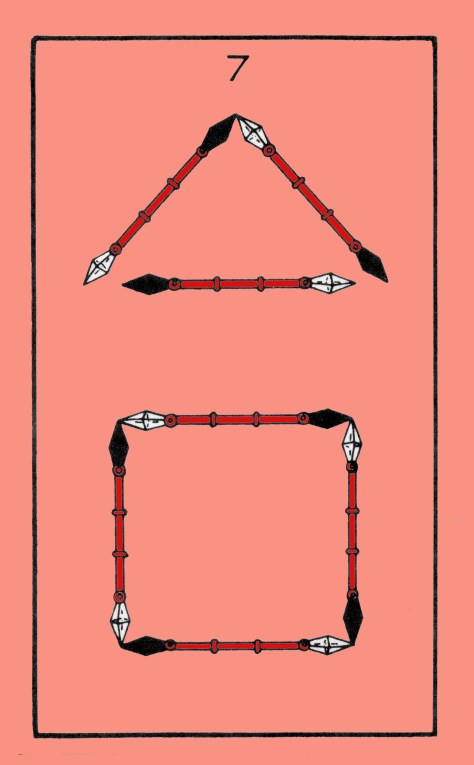
The Seven of Wands from the Builders of the Adytum (BOTA) tarot deck
Paul Foster Case (and Ann Davies)
Astrologically, the Seven of Wands, because it corresponds to the third decanate of Leo, is the time period from August 13 to August 22. In divination, the Seven of Wands combines the activities of the Keys listed in the Tableau [Empress, Sun, Tower, Strength, Emperor] together with ideas of pleasure and love connected with the fifth house in Astrology, the natural house of Leo. Well Dignified: denotes pleasure in strenuous action; some danger through love affairs or self indulgence; also strength and magnanimity; adventure; courage in the face of difficulties; influence over subordinates. lll Dignified: indicates ignorance, pretense, vain-glory, quarrels and wrangling, threats and very determined opposition, especially from subordinates and open enemies. Keyword: Valor (From the Oracle of Tarot course)
A. E. Waite
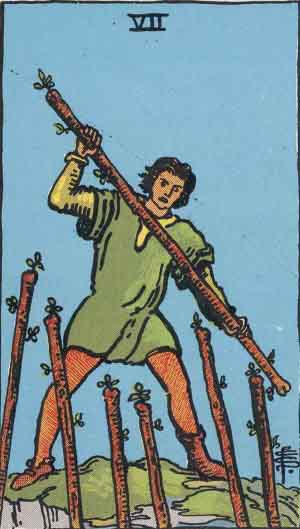
A young man on a craggy eminence brandishing a staff; six other staves are raised towards him from below. Divinatory Meanings: It is a card of valour, for, on the surface, six are attacking one, who has, however, the vantage position. On the intellectual plane, it signifies discussion, wordy strife; in business–negotiations, war of trade, barter, competition. It is further a card of success, for the combatant is on the top and his enemies may be unable to reach him. Reversed: Perplexity, embarrassments, anxiety. It is also a caution against indecision. (From The Pictorial Key to the Tarot)
The Seven of Wands from the Rider Waite Smith tarot deck
Aleister Crowley
The Seven of Wands is called Valour. Energy feels itself at its last gasp; it struggles desperately, and may be overcome. This card brings out the defect inherent in the idea of Mars. Patriotism, so to speak, is not enough.
[…]
This card derives from Netzach (Victory) in the suit of Fire. But the Seven is a weak, earthy, feminine number as regards the Tree of Life, and represents a departure from the balance so low down on the Tree that this implies a loss of confidence.
Fortunately, the card is also attributed to Mars in Leo. Leo is still the Sun in his full strength, but the marks of decadence are already to be seen. It is as if the wavering fire summoned the brutal energy of Mars to its support. But this is not enough to counter-act fully the degeneration of the initial energy, and the departure from equilibrium.
The army has been thrown into disorder; if victory is to be won, it will be by dint of individual valour-a “soldiers’ battle”. The pictorial representation shows the fixed and balanced wands of the last card relegated to the background, diminished, and become commonplace.
In front is a large crude uneven club, the first weapon to hand; evidently unsatisfactory in ordered combat. The flames are dispersed, and seem to attack in all directions without systematic purpose. (From The Book of Thoth)
The Seven of Wands from the Thoth Tarot deck
Golden Dawn’s Book T
TWO hands holding by grip six wands, three crossed. A third hand issuing from a cloud at the lower part of the card, holding an upright wand which passes between the others. Flames leap from the point of junction. Above and below the central wand are the symbols of Mars and Leo, representing the Decan.
Possible victory, depending on the energy and courage exercised; valour; opposition, obstacles and difficulties, yet courage to meet them; quarrelling, ignorance, pretence, and wrangling, and threatening; also victory in small and unimportant things: and influence upon subordinates.
Netzach of HB:Y (Opposition, yet courage). Therein rule the two great Angels HB:MHShYH and HB:LLHAL of the Schemhamphorash.
Etteilla
Talking Upright. This blade, as far as the medicine of the spirit is concerned, means, in its natural position: Talking, Negotiation, Conference, Colloquy, Conversation, Dissertation, Deliberation, Discussion. – Word, Pronunciation, Language, Idiom, Dialect, Negotiation, Market, Exchange, Measure, Trade, Traffic, Correspondence. – Talking, Saying, Proferring, Conferring, Discussing, Chatting, Dividing, Chattering, Gossiping. Reversed. Indecision, Irresolution, Uncertainty, Perplexity, Inconstancy, Lightness, Variation, Diversity, Hesitating, Hesitating. – Temptation, Vacillation, Versatility.
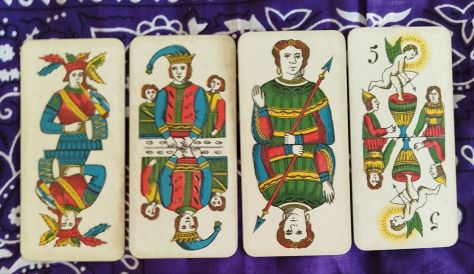
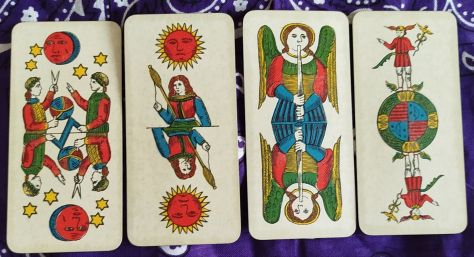
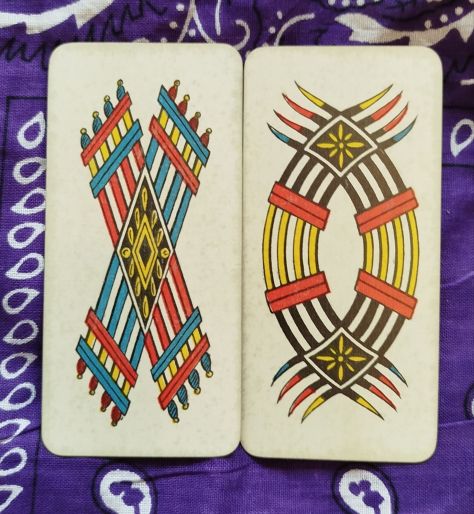
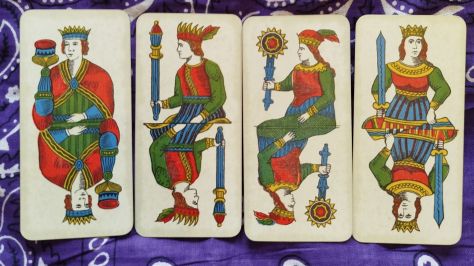
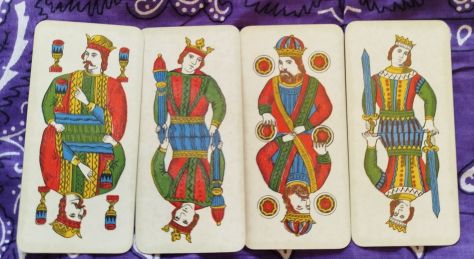
While the number of Minor Arcana differs from system to system, being usually comprised of the aces, court cards and a variable number of pips, the Major Arcana of Bolognese Tarot the are always the same: eighteen classically recognizable trumps (the regular ones, minus the Emperor, Empress, Pope/Hierophant and Popess/High Priestess), plus any number of Moors (from zero to all four, depending on the school of thought). For more information on the peculiarities of this deck read here. NOTE: when I was kindly taught the 45-card system, the person who taught it to me considered the Moor card to be part of the suit of swords, possibly due to the spear. I include it in the Major Arcana simply because the four Moors are replacements for the four missing trumps. NOTE 2: The Bolognese major arcana sequence is older than the one we are used to, and quite different. I stick to the sequence we know just to avoid confusion. It has no divinatory implications either way.
The Fool, The Juggler, The Moor, Love in the Bolognese Tarot
The Fool A neutral card, with both positive and negative implications. It represents oddity and strangeness, but also carefreeness and thoughtlessness, and possibly confusion, uncertainty, mental trouble, lack of restraint, etc. Its meaning is very sensible to how the cards surrounding it modify it. It is always a bit of a question mark in many spreads, so much so that a teacher and friend said that there is a tradition, when the cards are unclear and the Fool is among them, to put the deck back together and knock on it, asking the Fool to be more clear. It is also a card of creativity and inspiration, if it makes sense within the context. For instance, it can show a line of work where one needs to follow their own sensibility, vision or intuition.
The Juggler Again a neutral card that heavily depends on the others. It is mainly the significator of children. For this reason, it is important when we talk about pregnancies or the family, or when we explore someone’s childhood. It also has the implication of childishness or of things that are small and of little literal or moral value, or something that hasn’t found its footing or stability. For this reason, depending on the combinations, it can represent someone who is not to be trusted. It can also signify situations where we are like children, that is, powerless or passive. According to others it can also sometimes depict a beginning. According to most, it is also the card of pets.
The Moor or The Stranger In the 45-card system I know, only one of these cards is used, namely the one with the earring and the spear. It represents a stranger, and therefore things that disrupt regular life, hence the ideas of surprise, unexpected events or meetings, hiccups along the way, etc. The other cards will tell us if the unexpected situation is good or bad. In itself it can be mildly annoying, as we tend not to like disruptions to our routine. It is also traditionally associated with a priest (oddly enough) and therefore with all kinds of ceremonies.1
Love It means mostly what it says on the tin: love. It is possibly the single most important card in the single most requested type of consultation, i.e., about relationships. Whether the love is strong or weak, childish or mature, increasing or declining depends on the cards surrounding this one. It also represents one’s emotional world, emotions in general, and it is a card of good heart and good feelings. When not talking about love, it can show something that involves your heart (you are emotionally invested for good or ill), or something you love. In itself it is positive, signifying joy.
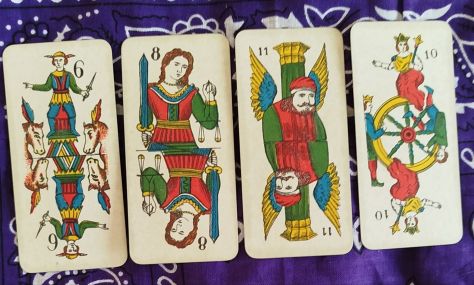
The Chariot, Justice, The Hermit and the Wheel of Fortune in the Bolognese Tarot
Chariot or The Bed This is where the Bolognese Tarot is at its oddest. In the card’s design, the Chariot appears to be still, with the horses resting on each side, and the man looks unhappy. For this reason, the Chariot has been called the Bed card. This led to interpreting it exactly the opposite way as most would: instead of movement, stasis. In itself it is a negative card of tribulation, illness, static situations, tiredness, exhaustion. It can also signify nooky time with other cards (like the Ace of Wands). Mostly, though, it signifies illness, either literal or figurative (e.g., an unhealthy love, an unhealthy way of expressing anger, etc.) Still, some card readers retain the traditional idea of moving toward a goal quickly, and attribute it to the card when surrounded by good cards.2
Justice Mainly this is the card of everything legal and justice-related. When talking about wills, fines, trials, bureaucracy and similar things, Justice is an important card, as the cards surrounding it can tell us if the situation is going to go well or not. It is also the card of fairness or of things that are just or ok, or equilibrated. It represents control, controlling, testing, etc. (including in a medical or academic sense). Justice next to a person can mean a just person, the person’s sense of justice, or someone wearing a uniform.
The Hermit The Bolognese variant of this card has none of the introspective undertones that it has been attributed in other traditions. This is a bad card: it is called blockage (in italian Blocco or Incaglio, the latter word indicating a ship that has run aground). It shows big obstacles that delay a situation, whether indefinitely or momentarily depends on the rest of the spread. It is also the card of small ailments, either seasonal (cold, flu), obnoxious but not life-threatening (like toothache) or age-related. Obviously it can also indicate a character that is reserved or tending to isolation, as the blockage can be inner as well as outer.
The Wheel This is the only card in the Bolognese tarot whose reversal is discernible and is read accordingly. Look to the left: if the crowned figure is ascending, the card is upright. If the young boy is ascending, it is reversed. According to some, when upright the Wheel represents good luck, when reversed bad luck. According to others, the Wheel represents movement and evolution of circumstances in general, but when upright it brings stability (stable good luck, decisive chances, etc) while when reversed it shows instability (unstable luck, with ups and downs, requiring effort). I have been taught according to the second school. Much also depends on the surrounding cards. Still, unstable luck is always more likely to turn into bad luck when surrounded by bad cards.
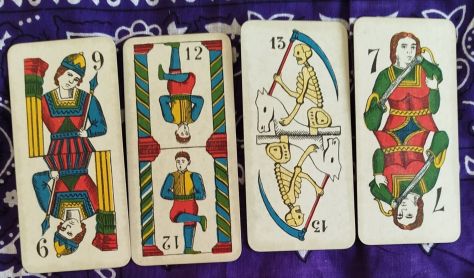
Strength, the Hanged Man, Death and Temperance in the Bolognese Tarot
Strength or Fortitude Considered a very good card, Strength brings energy, decisiveness, steadfastness, focus in meeting obstacles and taking action. The cards following it, however, can block it or diminish it, so it is important to pay attention to them as well. In itself, when coming up at the end of a sequence or with positive cards, it shows a situation that is reliable (“strong”) or a person (if next to a court card) who is strong in a positive sense, usually to help us. When following negative cards it can indicate the ability to pick yourselfup or stand your ground. It always indicates an active stance in the matter.
The Hanged Man or The Traitor Here we enter the realm of history. In spite of the many mystical interpretations of the Hanged Man that started popping up during the occult revival, traditionally the card was inserted in the oldest packs to represent how traitors were punished in the Middle Ages (namely, by being hanged by a foot), and thus served as a cautionary tale to those playing tarot games never to betray the church or the government: “Know your place and stay there. Don’t try to overreach, or we’ll hang you upside down, so instead of moving upward in life, you’ll be going downward to hell.” That’s the message. The Bolognese tarot retains this old tradition, as the Hanged Man is mainly the card of treason. The treason can be literal (cheating, betrayal, etc.) or it can be metaphorical (a situation that betrays you, stabs you in the back when you are heading for the finish line, that makes you feel cheated on or sorely disappoints you). It is one of the worst cards in the pack, and it can show situations that end badly (like traitors in the past), or that are being upended. Even when no one is betraying anyone in particular, it can still symbolize life kicking you in the nuts, so you feel betrayed by it, as if you’ve ended up in a bad place or situation. Sometimes, in my experience, the upending can be good, but only when the querent’s expectations are negative and the cards following the Hanged Man are positive. In this case, the negative expectations are betrayed. In itself, though, the upending tends to be of the negative kind.
Death or Thirteen This card is never actually called by its name, but by its number (tredici, i.e., thirteen). Different schools of thought interpret it slightly differently. It largely depends on the context though. Its first meaning is that of physical death, but this is rare and never by itself. In itself it shows the end of something. It can also indicate an inner sense of loss or death (“mortificazione”, which has the same root as the Italian “morte”, death, but indicates inner devastation and mortification). When, however, Death cannot be interpreted as ending, it can act as confirmation: “tredici conferma”, “the thirteenth card confirms”, or, if you will, “as sure as the fact we all die”. For instance, when it is surrounded by positive cards, it acts as a highlighter, confirming them. Same with negative cards: it makes them stronger and more important in the querent’s destiny. It can also indicate a situation that changes radically. Suppose, for instance, the cards preceding it are bad and those following it good: in this case it shows the end of the bad situation.
Temperance The old diviners must have taken a look at this card and thought it looked like an hourglass, because the main meaning is that of time, the passage or flow of time. It is usually a slow card, which slows down the reading. It is connected with such concepts as waiting, patience, stagnation, but also of things that last a long time, take a long time or happen after a lot of time has passed. For instance, if it is followed by cards that show falling in love, it might mean that we will fall in love after a long time, while if it is preceded by cards of love it indicates that the love will last a long time. Use your commonsense. I have also found that, when it falls in the first few lines of a spread, the cards surrounding it, and especially those preceding it, tend to either talk about the past (a long time ago) or have started a long time ago and still drag on. Finally, some card readers connect it with the flow of water, and therefore water in general. I haven’t verified this connection but it does make sense.
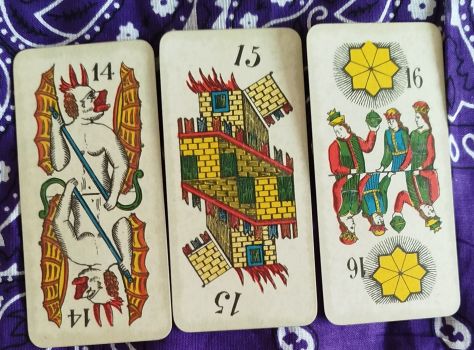
The Devil, The Tower, The Star in the Bolognese Tarot
The Devil In Italian “Diavolerie”, i.e., things that bedevil you. It is a deeply negative card, but with some redeeming qualities. In the main it is connected, traditionally, with anger, which depending on the context can range from annoyance to rage, due to things, people or circumstances bedeviling you. In general, though, it can indicate all passions that seize us and we fail to control. When falling with a person card, it is usually a sign the person is negative for us (depending on the context it can show jealousy or envy as well). When it describes a situation, it is bad for us. It is a card of excess all around, but it can indicate sexy energy, when with cards that talk about it, and it can also represent a strong energy when surrounded by very positive cards. Finally, it is one of the cards connected with magic.
The Tower The image shows a burning building, and the main meaning is consequently that of places we’d rather not find ourselves in, mostly prison or hospital (or, if next to the Ace of Cups, our home). However, it can also signify a metaphorical prison, that is, a situation that is strongly limiting for us and prevents us from fleeing or moving freely, where we must sacrifice our hopes and aspirationsor resources at least in part (“sacrificio” is one of the main Italian keywords for this card). Whether this card can indicate neutral or positive places is up for debate, as it depends on the school of thought. I guess in the appropriate context and with the appropriate cards it might, but generally, in my experience, it mostly shows negative places or negative situations. It can, however, show neutral places of authority (like a city hall, where there is an authority above us) or very large or foreboding buildings.
The Star Another peculiar card. The main keyword is “roba”, i.e., stuff, especially referred to one’s objects, belongings and possessions. This is because the image shows three people holding some unspecified object. Some say they are the three Wise Men bringing gifts to Jesus, others say they are merchants. Either way, the emphasis is on objects and materiality. This is the card of business, belongings, objects, work (either one’s work life or working on something). It can represent study (which is the student’s work). In health readings it shows the objects used in medicine, that is, meds (and therefore therapy in general). This card can represent gifts when coupled with other specific cards. To summarize: business, work, stuff (material/practical life), study, gifts.
The Moon, The Sun, The Angel / Judgement and the World in the Bolognese Tarot
The Moon and the Sun The reason I talk about these two cards together is that they complement each other. They are also called “le due rosse”, “the two red (cards)”. Their main meaning is temporal: the Moon shows things happening by night or in the evening, the Sun shows things happening by day. But they are also two polar opposites. The Sun indicates positivity, life, energy, clarity, success, happiness, vitality. When coupled with other cards it slants them positively. The Moon indicates negativity, death, lethargy, secrets, falsity, dissatisfaction, sadness. When coupled with other cards, it slants them negatively.
The Angel or Judgement The best card in the deck, the Angel is the card of goodness, peace, friendship, protection. It brings solutions to difficult situations. However, if followed by cards indicating obstacles or impossibility, it can show the solution is delayed or impossible. When coupled with a person card, it can signify the person is an angel for us, helping and protecting us, or that they are good. It is also the main card connected with spirituality.
The World “Around the world“, “the world outside“. It is the card of travel and journeys, as well as of distance. It signifies movement, whether literal or metaphorical. Often it shows actual journeys, relocations and removals. The journey doesn’t have to be very long, however traditionally, when falling next to a court card it can show a person we don’t yet know (the person comes from the outer world, i.e., is not part of our daily life), although, depending on the context, it can also show someone who travels or someone who lives distant from us. It can indicate a stranger, though again, how much of a stranger depends on the context. It shows situations that are open, in motion, and it gives the sense of something big or large or important (as opposed to the Juggler, which is something small). It can be symbolic of life (the great journey). Finally, some attach the idea of something recurring to it (like recurring thoughts, etc.)
MQS
In other reading systems with more cards, where more Moors are used, the priest is often associated with the Moor with the hat, who is also the doctor. ↩︎
How positive or negative (or neutral) the card is depends on the system as well. In systems with more cards, where there is a specific illness card (the Moor with the hat) the Chariot is more neutral. In the 45-card system, it is more negative. ↩︎
It wouldn’t make sense, at this point, to talk about each single card individually, but I think the cards do warrant a bit more discussion. I am referring to the 45-card system, even though most considerations will apply to the other systems as well.
The Aces
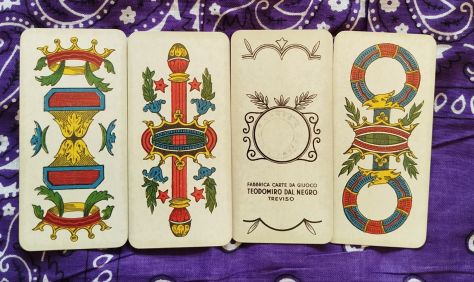
The four Aces in the Bolognese Tarot
Ace of Cups. This is the card of the home environment and of the family, as in many fortune-telling and divination traditions. Its presence usually indicates that the issue somehow relates to the family or the house. However, the card can also occasionally function as a sort of adjective, in that it can indicate a situation or environment is like family. Broadly speaking, the cards surrounding it generally show us whether the family is positive or negative, or is going through a rough patch, etc. I have found that sometimes, when the home or familiar situations simply cannot be part of the interpretation, the Ace of Cups can hint at the intimate life of a person, their inner side, or the intimate relationship between two people.
Ace of Wands. This is a somewhat more complex card. In the main it is a card of sex and sexual interest (or interest in general). However, it represents anything done by two people together, especially marriage (or a strong relationship) or partnership. It portends great vigor, energy, creativity. Another important meaning of this card is that of achievement, personal triumph or personal success, i.e., the ability to reach one’s aims and fulfill one’s aspirations. It is a powerful, active card.
Ace of Coins. In the most ancient set of meanings, this is the card of the table, and it therefore represents sitting together for whatever reason. This meaning has been retained, as well as its metaphorical extensions (conviviality, etc.) It represents daylight. Its most frequent meaning, however, is that of representing finances. Compared to the other money card, i.e., the Ten of Coins, the Ace represents a bigger amount. Whether the amount is coming or going depends on the question and cards surrounding it. Metaphorically it can sometimes portend great satisfaction or a prize.
Ace of Swords. The most common meaning found attached to this card is that of symbolizing the door knockers (see design). The image of the door knockers is widespread in Italian cartomancy and is found in many traditional Italian card reading systems. It symbolizes something about to happen, because it is knocking at the door. However, the card symbolism has also been interpreted as representing two wedding bands being exchanged or a pair of handcuffs. Broadly speaking, therefore, it can show a commitment or a binding situation for better or worse, from marriage to prison, from a contract to an obligation, from an oath to an addiction. The emphasis here is on the binding aspect of it, which limits us, whereas in the Ace of Wands the emphasis is more on doing or achieving something together with someone else.
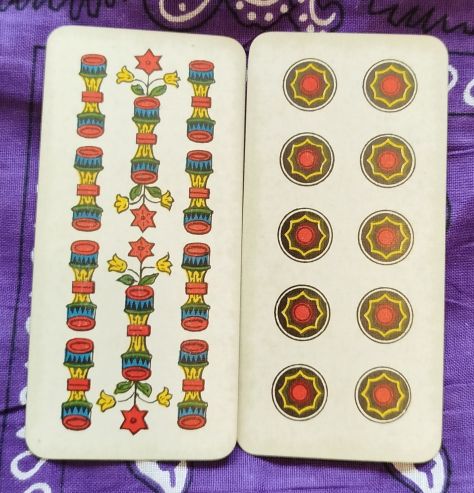
The Sevens
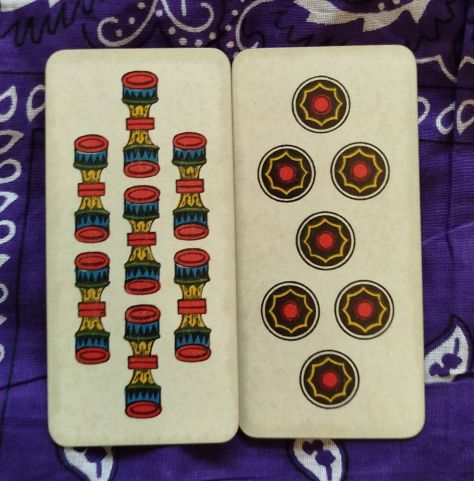
The two Sevens in the Bolognese Tarot
Seven of Cups. Called the card of the roof or the rooftops. Like all cups, it is strongly connected to the home environment. It is still a card of familiarity and closeness, but in a more extended sense than the Ace of Cups. Therefore, it also symbolizes the city or homeland (depending on the scope of the question). Due to its connection to the roof, it carries a certain connotation of protection with it. It is also another card that can show a quick timeframe.
Seven of Coins. The Seven of Coins is the card of tears. It shows melancholy, sadness, dissatisfaction. In itself it is not a tragic card, but it does indicate loss of heart, feeling down or blue, etc. When it falls together with other difficult cards, though, it compounds their effect, making it worse and showing that it affects the querent emotionally. On rare occasion, when with very positive cards (like the Sun and the Angel) it can show tears or joy, emotional relief in general. This is rare though. Note: some diviners use the Six of Coins instead of the Seven to symbolize tears.
The Eights
The two Eights in the Bolognese Tarot
Eight of Wands. The Eight of Wands is the card of the road or path. The road can be literal, representing a short journey (as opposed to the World), even just going out to meet or visit someone, or it can be metaphorical, indicating something that is moving or requires movement or evolution (e.g., a professional path, a study course, the trajectory of a relationship, etc.) In itself, the card tends to be positive, indicating a situation that is ‘open‘ (like a road) and still developing, but with negative cards it can show the opposite. It can also represent something that is on the way, and therefore, like the Ace of Swords, is about to happen. Note that some diviners use the Six of Wands instead of the Eight.
Eight of Swords. This card is traditionally called ‘passione’, i.e., passion, but more in the sense of the passion of the Christ. It represents torment, suffering and similar fun concepts. It is connected to pain in all its manifestations, whether physical, mental, psychophysical or of different kind. It is also connected with addictions, again literal or metaphorical (as when you make yourself dependent on what your ex thinks or does). Some diviners use the Six of Swords instead of the Eight.
The Tens
The two Tens in the Bolognese Tarot
Ten of Cups. As the image suggests, this is the card of all things that bloom and flourish. It shows rebirth and increase in all fields of life, and situations that metaphorically sprout, bringing mirth. It is the card of fun, of jollity, of parties and of drinking, so with cards showing excess it can indicate alcoholism. It is also the card of blood, so if the other cards seem to point to a stay at the hospital, it doesn’t mean the querent is having the time of his life, only that he is being cut open and blood is coming out.
Ten of Coins. This is again a money card, but its amount is smaller than the Ace. Still, by itself it is a positive card, showing satisfaction and well-being. It represents a positive flow of things, a situation that is calm, tranquil, without major ups and downs (unless the surrounding cards are negative, in which case the calmness is denied, as it were.) With negative cards it can show the querent has little money or little satisfaction.
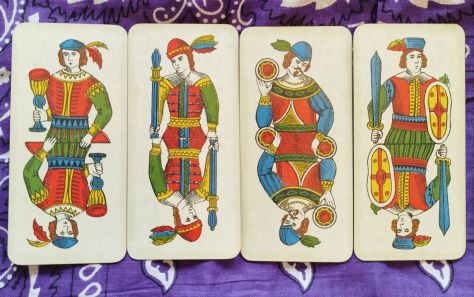
The Pages
The four Pages in the Bolognese Tarot
Page of Cups. The Page of Cups has the traditional name of ‘coppina‘, i.e., little/young female cup-bearer. It signifies a young, younger or youthful woman, usually belonging to the family or to the querent’s everyday life. With negative cards confirming it, it can represent a rival in love (the fresh young thing snatching hubby from you) or an immature woman. When exploring a woman’s past, it can show “when she was young”. This is one of the hardest cards for me to read, as sometimes it shows up seemingly for no reason, even though there is no young woman involved. I have figured that in these situations she is still a small cup-bearer, cups being joyful, so it can represent the arriving or giving of small joys or satisfactions.
Page of Wands. In the Tarocchino Bolognese, we have not only cards for the male and female querents, but also for their thoughts. The Page of Wands represents the female querent’s thoughts, beliefs, plans, memories, character and inner side.
Page of Coins. This is the card of words, talks, conversations, dialogues. It heralds the arrival of meetings where situations are talked over, agreed on, clarified, etc. Cards surrounding the Page will show either the nature of the words (angry, loving, etc.) their content (work, love, money) or their outcome (agreement, disagreement and so on).
Page of Swords. Traditionally the letter card. Like the Page of Coins, it is a card of communication, but usually written or, nowadays, in the form of messages. It can symbolize documents and things made of paper. It also embodies the broader notion of contacts, developing contacts, coming into contact with others. This is especially relavant when we are not talking about a single specific letter or message.
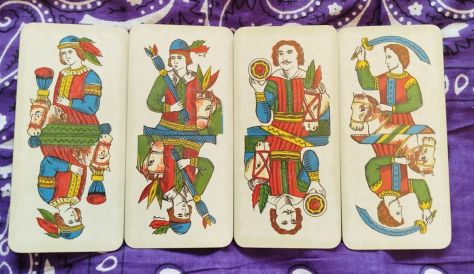
The Knights
The four Knights in the Bolognese Tarot
Knight of Cups. In Italian, ‘accomodamento’, literally adjustment, compromise, agreement or even repair. This card’s main meaning is simple, but its applications are many: it shows situations that bring conciliation (or reconciliation), healing and the solution of trouble, or at least a way of dealing with it positively. It heralds harmonious interpersonal relationships, smooth sailing ahead, the ironing out of disagreements or difficulties, positive developments.
Knight of Wands. This is the male counterpart to the Page of Wands: the Knight represents the thoughts of the male querent or of a male figure that is involved in the situation. It is the thoughts, beliefs, character, memories and inner side of this male figure. Note, however, that sometimes, when it doesn’t make sense for this (and the Page) to represent thoughts, it can be taken as a secondary significator for the querent: if I show up not as a physical person (King) but as my thoughts (Knight) I am still there, the spread still talks about me.
Knight of Coins. This is the card of the ambassador, as it brings news, developments and similar things connected with the situation we are exploring. It can indicate knowledge of facts from third parties or other sources, but in general it is the card of news. In itself the news is implied to be good news (one of its traditional names is ‘cavallo di buona nuova’, ‘the horse(man) of good news’), because it brings a coin, and coins were considered good in traditionally poor Italian society. However, if the cards surrounding it are bad, the news may be less than positive, or the good news may be blocked or delayed. Sometimes this card can be ‘christened‘ as a young man, if you’ve run out of court cards.
Knight of Swords. The Knight of Swords is the opposite of the Knight of Cups. Where the Knight of Cups adjusts and irons out, the Knight of Swords complicates, twists, brings trouble, difficult situations that are not linear nor smooth (note the curved sword). Where the Knight of Cups conciliates, the Knight of Swords attacks. In interpersonal relationships it brings disagreements, misunderstandings and hurtful words (one of its names is ‘malalingua’, literally evil tongue). If the Knight of Cups brings healing and goodness, the Knight of Swords brings suffering and evil. One of its main symbolic connections is with cuts, either literal (cutting yourself, getting hurt, being cut open by a surgeon, wounds, breaking something) or figurative (cutting words, situations that hurt, etc.)
The Queens
The four Queens in the Bolognese Tarot
Queen of Cups. A mother or a woman in your family, usually. If not in your family, then a friend or someone who acts in your interest. Or should. Always look at the cards surrounding her, as she can be a bad mother or friend if they confirm it, but one who is emotionally invested in you somehow. Mostly, though, it represents the figure of someone who holds you (look how she holds the cup) and has your back. Traditionally she is dark-haired or of dark complexion. Others say she is of medium complexion. Either way, we obviously need to be very careful with descriptions. The Queen of Cups can indicate femininity.
Queen of Wands. If the querent is female, then the Queen of Wands is going to represent her, and the Page of Wands her thoughts. If the querent is male, the Queen can be his partner, or it can be a woman who is somehow important in the situation. Note that when we are talking about triangles, the Queen of Wands is the person who is in the male querent’s heart, regardless of whether she is the official partner.
Queen of Coins. Traditionally ‘the truth‘. This is rarely a physical person. More often than not, it represents truth, reality, authenticity, wisdom, knowledge, education, exactitude, clarity, understanding and the like. It can also say that a situation is as it seems. Or isn’t, if it is surrounded by cards of deceit, indicating the truth is hidden. According to some, it can also sometimes stand for a blonde woman or a wise woman. A traditional phrase attached to this card is ‘di verità conferma’, meaning ‘confirming the truth’ or ‘and that’s the truth’: sometimes this card comes up at the end of a spread or of a group of cards, and acts like a sort of period, as if saying “and that’s exactly it.”
Queen of Swords. Its traditional name is ‘affliction.’ When this card doesn’t represent a woman, it indicates a situation that brings affliction, either physical or psychological. More often than not, though, it does indicate a woman. Tradition says she is gray-haired or a redhead. Others say she is dark. Again, I would advise caution. The Queen of Swords isn’t necessarily evil: she is another woman, usually less accomodating than the Queen of Cups, but not bad. She can be rigid, or she can be a competent but stern professional. With bad cards then she is a rival, the other woman, or a woman who is out to get you.
The Kings
The four Kings in the Bolognese Tarot
King of Cups. The King of Cups is the male counterpart to the Queen of the same suit. He is typically the father or a man in your family. If not in your family, a friend, a wise male influence, someone who has a good word for you, who will help you (like the Queen, he can be a good boss or coworker). It can embody masculinity in general.
King of Wands. As with the Queen so with the King. This is the male querent, or the female querent’s partner, or another man that is important in the question at hand. The Knight of Wands indicates his thoughts. Again, in a triangle this is the man in the querent’s heart, regardless of whether he is the official partner.
King of Coins. It has several titles in the tradition: ‘uomo/vecchio da soldi’ (man/old man bringing money), doctor, important person, a good lord etc. More than a particular person, it represents a role: that of a professional, of someone who has an important job and/or money. Traditionally it shows someone with a degree, from back when degrees were something special. Being called the doctor, it indicates situations that bring healing and care for the querent’s needs. It can indicate a boss or superior. It can also indicate a situation, whether a job or a relationship or something else, which is helpful or nourishing or ‘important’. Traditionally the King is a man for obvious socio-historical reasons, but nowadays it can indicate a woman as well, especially if next to a female court card.
King of Swords. The male counterpart to the Queen, his traditional name is ‘spadino’, i.e., little/young sword-bearer. It can represent a man who is young and/or immature, like the Page of Cups, such as a son or nephew. When exploring a man’s past, it can indicate ‘when he was younger’. It can show a new entry in the querent’s love life, someone who hasn’t yet been promoted to King of Wands. He can be a rival or a problematic man, if with negative cards, or a problematic or immature situation in general. More often than not, it is a literal male figure. Whether positive or negative, it is shown by the other cards. In some traditions it can show a military man, a soldier, a policeman or similar. Look at the other cards for confirmation.
(Note: this is a collection of the meanings attributed to the cards by some occultists in the past centuries. It does not reflect my own study or opinion of the cards. It is only meant as a quick comparative reference as I develop my own take.)
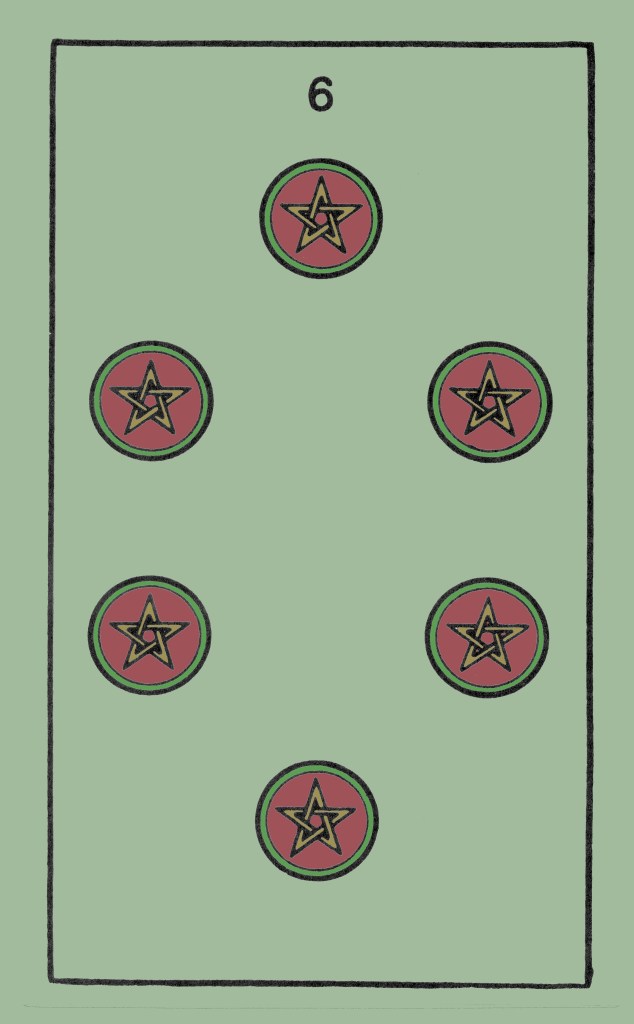
The Six of Pentacles from the Builders of the Adytum (BOTA) tarot deck
Paul Foster Case (and Ann Davies)
The time period is the second decanate of Taurus, under the rulership of Mercury, from April 30 to May 10. Meanings: Well-Dignified: practicality and determination; discretion and diplomacy; gain by letters, writing, travel, speaking, teaching, commissions and through advertising, study, books and all things ruled b Mercury. Ill-Dignified: Loss through the same things. Keyword: Prosperity. (From the Oracle of Tarot course)
A. E. Waite
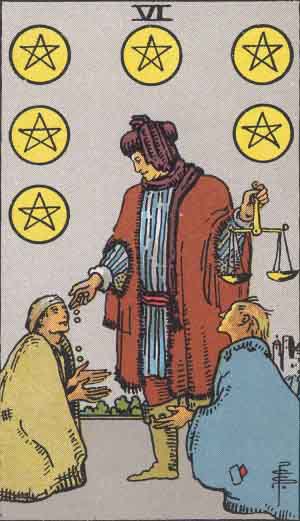
A person in the guise of a merchant weighs money in a pair of scales and distributes it to the needy and distressed. It is a testimony to his own success in life, as well as to his goodness of heart. Divinatory Meanings: Presents, gifts, gratification another account says attention, vigilance now is the accepted time, present prosperity, etc. Reversed: Desire, cupidity, envy, jealousy, illusion. (From The Pictorial Key to the Tarot)
The Six of Pentacles from the Rider Waite Smith Deck
Aleister Crowley
The Six of Disks is called Success; the ruler is the Moon. This is a card of settling down; it is very heavy, wholly lacking in imagination, yet somewhat dreamy. Change is soon coming upon it; the weight of earth will ultimately drag the current down to a mere eventuation of material things. Yet the Moon, being in Taurus, the sign of her exaltation, the best of the Lunar qualities are inherent. Moreover, being a Six, the solar Energy has fertilized her, creating a balanced system for the time being. The card is worthy of the name Success. Remember only that all success is temporary; how brief a halt upon the Path of Labour.
[…]
The Number Six, Tiphareth, as before, represents the full harmonious establishment of the Energy of the Element. The Moon in Taurus rules the card; and this, while increasing the approach to perfection (for the Moon is exalted in Taurus and therefore in her highest form) marks that the condition is transient.
The disks are arranged in the form of the Hexagram, which is shown in skeleton. In the centre blushes and glows the light rose-madder of dawn, and without are three concentric circles, golden yellow, salmon-pink, and amber. These colours show Tiphareth fully realized on Earth; it reaffirms in form what was mathematically set forth in describing the Ace.
The planets are arranged in accordance with their usual attribution; but they are only shown as disks irradiated by the Sun in their centre. This Sun is idolized as the Rose and Cross; the Rose has forty-nine petals, the interplay of the Seven with the Seven. (From The Book of Thoth)
The Six of Disks from the Thoth Tarot deck
Golden Dawn’s Book T
A WHITE Radiant Angelic Hand holding a rose branch with white roses and buds, each of which touches a Pentacle. Pentacles are arranged in two columns of three each:
* * * * * * Above and below are the symbols Taurus and Moon of the Decan. Success and gain in material undertakings. Power, influence, rank, nobility, rule over the people. Fortunate, successful, liberal and just. If ill dignified, may be purse-proud, insolent from excess, or prodigal.
Tiphareth of HB:H (Success in material things, prosperity in business). Herein rule the Angels HB:NMMYH and HB:YYLAL.
Etteilla
The present Upright. This card, as far as the medicine of the spirit is concerned, means, in its natural position: Present, Presently, Now, Immediately, At the instant, At this time, Today, Attending, Witnessing, Contemporary. – Attentive, Careful, Vigilant. Reversed. Desire, Vow, Ardor, Haste, Passion, Searches, Cupidity, Want, Jealousy, Illusion.
(Note: this is a collection of the meanings attributed to the cards by some occultists in the past centuries. It does not reflect my own study or opinion of the cards. It is only meant as a quick comparative reference as I develop my own take.)
The Six of Swords from the Builders of the Adytum (BOTA) tarot deck
Paul Foster Case (and Ann Davies)
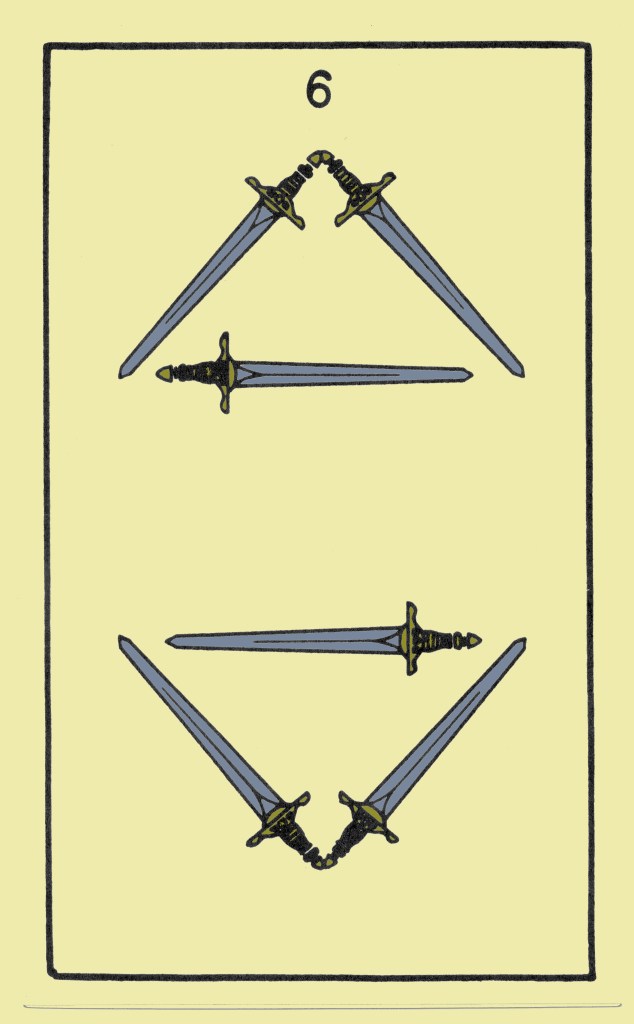
The Six of Swords corresponds to the second decanate of Aquarius under the rulership of Mercury, January 30 to February 8. Well-Dignified: success after a period of trouble or anxiety; difficulties overcome; change of scene, possibly a journey by water; something mysterious effects a change o f circumstances for the better; success earned by the Querent’s laborious efforts. Ill-Dignified: sudden changes; circumstances dominate the Querent; he is in danger of being over-confident or conceited; too much effort expended for small results. Keyword: Patience (From the Oracle of Tarot course)
A.E. Waite
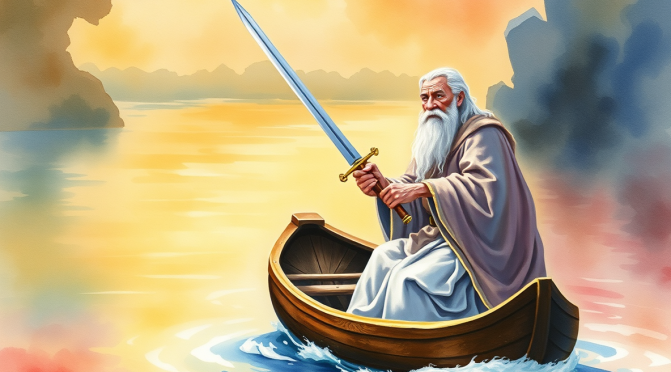
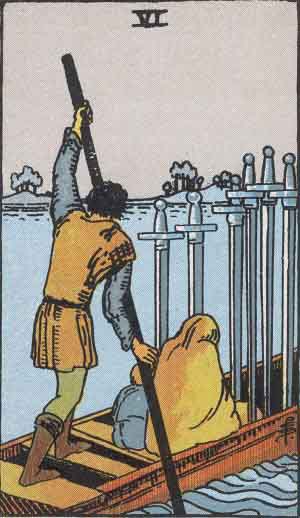
A ferryman carrying passengers in his punt to the further shore. The course is smooth, and seeing that the freight is light, it may be noted that the work is not beyond his strength. Divinatory Meanings: journey by water, route, way, envoy, commissionary, expedient. Reversed: Declaration, confession, publicity; one account says that it is a proposal of love. (From The Pictorial Key to the Tarot)
The Six of Swords from the Rider Waite Smith tarot
Aleister Crowley
The Six of Swords is called Science. Its ruler is Mercury, so that the element of success turns away from the idea of division and quarrel; it is intelligence which has won to the goal.
[…]
Tiphareth shows the full establishment and balance of the idea of the suit. This is particularly the case with this card, as the intellect itself is also referred to the number Six. Mercury, in Aquarius, represents the celestial Energy influencing the Kerub of the Man, thus showing intelligence and humanity.
But there is much more than this in the symbol. The perfect balance of all mental and moral faculties, hardly won, and almost impossible to hold in an ever-changing world, declares the idea of Science in its fullest interpretation.
The hilts of the Swords, which are very ornamental, are in the form of the hexagram. Their points touch the outer petals of a red rose upon a golden cross of six squares, thus showing the Rosy Cross as the central secret of scientific truth. (From The Book of Thoth)
The Six of Swords from the Thoth Tarot deck
Golden Dawn’s Book T
TWO hands, as before, each holding two swords which cross in the centre. Rose re-established thereon. Mercury and Aquarius above and below, supported on the points of two short daggers or swords.
Success after anxiety and trouble; self-esteem, beauty, conceit, but sometimes modesty therewith; dominance, patience, labour, etc.
Tiphareth of HB:V (Labour, work, journey by water). Ruled by the Great Angels HB:RHa’aAL and HB:YYVHL.
Etteilla
Road Upright. This card, as far as the medicine of the spirit is concerned, means, in its natural position: Road, Avenue, Walk, Course, Passage, Path, Way. – Path, Tract, Gait, Origin, Conduct, Means, Manner, Way, Expedient, Run, Career, Walk, Pattern to be followed, Track, Footprint, Sending, Commissary [= Deliveryman]. Reversed. Declaration, Declaratory act, Development, Explanation, Interpretation. – Charter, Constitution, Diploma, Manifest law, Ordinance. – Publication, Proclamation, Ostensibility, Manifesto, Publicity, Authenticity, Notoriety. – Denunciation, Census. – Enumeration. – Knowledge, Discovery, Unveiling, Vision, Revelation, Apparition, Appearance, Admission, Confession, Protest, Approval, Authorization.
There are plenty of cards, in the Vera Sibilla, that can indicate individuals (see here for groups). Here are the most common (keeping in mind that most of the cards have other associations as well, and may indicate concepts or situations):
Seven of Hearts – The Scholar The Scholar can represent the figure of a lawyer, a notary, or more in general a professional. Traditionally he is said to be in his 40s or early 50s, but we need to be flexible with age. He can also be a member of the family or even a partner.
Eight of Hearts – Hope There are two schools of thought concerning the Hope card. According to some it doesn’t represent a woman, while according to others it can (traditionally, a younger or blonde woman). I have found that it is rare for this to be the case, but it could happen.
Nine of Hearts – Faithfulness The Faithfulness card can represent support, and occasionally it will show up alone indicating a concrete someone, i.e., a friend, who shows us support.
Jack of Hearts – The Boyfriend It is common for this card to indicate an actual person, often the unmarried male querent or a male who is in love, or positive, or belonging to the family.
Queen of Hearts – The Girlfriend Same as with the Jack, only applying to women.
King of Hearts – The Gentleman The King of Hearts is traditionally the figure of a protector or benefactor, someone who aids us. He is typically in a good position to do so. He can be a father or loving husband (when upright), but can also represent the married male querent or a boyfriend who is older or has a position in society.
Four of Clubs – The Friend The Friend card can represent friendship as a concept, as well as partnerships and other situations where people come together for a common goal. However, it can often indicate a female friend or relative.
Jack of Clubs – The Servant The Jack often represents a younger man, one up to 30 years of age, or unmarried. However, it can also represent a colleague or friend, regardless of age. It can also indicate a son, if relevant. Usually he is already known to the querent (the Italian word ‘domestico’ can mean servant but it also implies familiarity with the house).
Queen of Clubs – The Maiden The Maidan can be the female counterpart of the Servant, showing a younger unmarried woman, sometimes a daughter.
King of Clubs – The Doctor The Doctor card often indicates health issues or the need to take care of something. However, it can also represent a man with a certain social position or with a degree (if next to a female card, then he turns into a woman with those characteristics). It can show the figure of a professional whose advice or help will be required, or a boss.
Seven of Diamonds – The Child Often it is a metaphorical child, but sometimes the Seven of Diamonds can represent a literal one, usually very young (toddler). It can combine with other cards (the Servant or Maiden, for instance) to indicate a teenager. It is the card of pets as well.
Eight of Diamonds – The Handmaid A card strongly connected with the coming and going of money and with work, the Handmaid can also be the figure of a female colleague or a female servant (like a cleaning lady). Traditionally she is from a different town, but this is not always the case. She can also be a stranger or a foreigner.
Ten of Diamonds – The Thief Rarely a literal person, but in connection with negative cards it can show someone who steals, either literally or metaphorically.
Jack of Diamonds – The Messenger Rarely a person card, the Messenger often heralds the arrival of news and the knowledge of facts. However, it can occasionally represent a young man, traditionally dark-haired.
Queen of Diamonds – The Wife A card that often represents what it says on the tin, the wife shows a woman who is married and may have children. It can indicate a woman who has achieved some level of success (could be a colleague or boss).
King of Diamonds – The Merchant Usually this card signifies the querent’s work life. However, it occasionally signifies a literal merchant or someone who a transactional view of life and relationships.
Two of Spades – The Old Lady Often one of the most complex cards in the deck, the Old Lady has a whole host of metaphorical meanings. The literal meaning, though, is that of representing an older woman, a grandmother, a widow, someone close to retirement, a woman of 60+, and so on. The card can also stand for an ex (your old woman).
Three of Spades – The Widower As with the Old Lady, so with the Widower, but for men. It can represent an older man, a grandfather, an ex, a widower or divorced man. It is somewhat rarer for the Widower to be a literal person, compared to the Old Lady.
Ten of Spades – The Soldier Another often cryptic card to interpret, the Soldier can also indicate a young man, in his 30s or early 40s (again, taking it with a pinch of salt), who is muscular or sexy or who wears a uniform. It can also indicate a stranger or a foreigner.
Jack of Spades – The Enemy (male) The male enemy card can stand for a literal enemy, or for someone who is against the querent for some reason, either as a rule or in a particular situation (your uncle whose car you crashed into a tree can be your enemy too, when he finds out). It can also represent a place where people are inimical to the querent.
Queen of Spades – The Enemy (female) Same as with the Jack, but for women.
King of Spades – The Priest The King of Spades often indicates an institution, the government, a judge, etc. It can also sometimes represent an older man who is not inimical to the querent, but who is somewhat cold toward him or her, but is still fair (unless the card is reversed).
(Note: this is a collection of the meanings attributed to the cards by some occultists in the past centuries. It does not reflect my own study or opinion of the cards. It is only meant as a quick comparative reference as I develop my own take.)
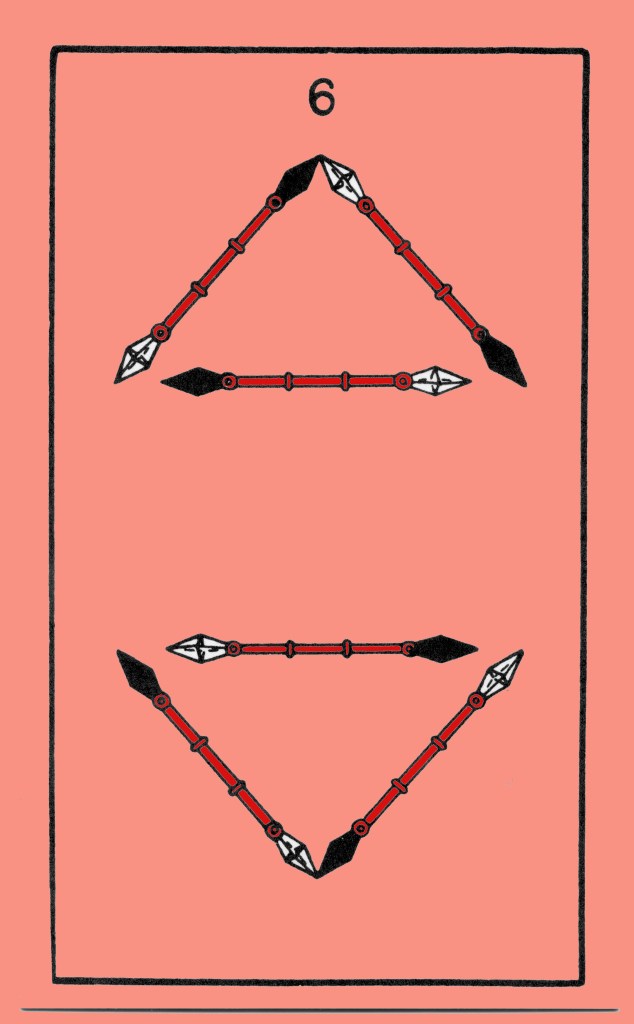
The Six of Wands from the Builders of the Adytum (BOTA) Tarot deck
Paul Foster Case (and Ann Davies)
The second decanate of Leo, related to this Key, is the time period of August 2 to August 12, ruled by Jupiter. In Tarot divination, the Six of Wands partakes of a meaning similar to the conjunction of the Sun and Jupiter, combined with the influence of Leo and its natural fifth house. Well-Dignified: success, happiness, gain; gain through love affairs or by the opposite sex; pleasure in labor; gain after a period of uncertainty and competition. lll-Dignified: loss through the same things; waste in pleasure; trouble through pride of riches or through insolence based on success. Keyword: Victory (From the Oracle of Tarot course)
A. E. Waite
A laurelled horseman bears one staff adorned with a laurel crown; footmen with staves are at his side. Divinatory Meanings: The card has been so designed that it can cover several significations; on the surface, it is a victor triumphing, but it is also great news, such as might be carried in state by the King’s courier; it is expectation crowned with its own desire, the crown of hope, and so forth. Reversed: Apprehension, fear, as of a victorious enemy at the gate; treachery, disloyalty, as of gates being opened to the enemy; also indefinite delay. (From The Pictorial Key to the Tarot)
Aleister Crowley
The Six of Wands is called Victory. The outburst of energy in the Five of Wands, which was so sudden and violent that it even gave the idea of strife, has now completely won success. The rule, or lordship, in the suit of Wands is not quite as stable as it might have been if there had been less energy displayed. So, from this point, as soon as the current leaves the middle pillar, the inherent weakness in the element of Fire (which is this: that, for all its purity, it is not completely balanced) leads to very undesirable developments.
[…]
This card represents Tiphareth of the suit of Fire. This shows Energy in completely balanced manifestation. The Five has broken up the closed forces of the Four with revolutionary ardour, but a marriage has taken place between them; and the result is the Son, and the Sun.
The reference is also to Jupiter and Leo, which seems to imply a benediction on the harmony and beauty of this arrangement. It Will be seen that the Three Wands of the Three Adepts are now orderly arranged; and the flames themselves, instead of shooting out in all directions, burn steadily as in lamps. They are nine in number, in reference to Yesod and the Moon. This shows the stabilization of the Energy, and its reception and reflection by the Feminine.
There is no circle to enclose the system. It is self-supporting, like the Sun. (From The Book of Thoth)
Rather prosaic AI-generated illustration for the Six of Wands
Golden Dawn’s Book T
TWO hands in grip as the last, holding six wands crossed three and three. Flames issue from the point of junction. Above and below are short wands with flames issuing, surmounted respectively by the symbols of Jupiter and Leo, representing the Decan.
Victory after strife: Love: pleasure gained by labour: carefulness, sociability and avoiding of strife, yet victory therein: also insolence, and pride of riches and success, etc. The whole dependent on the dignity.
Tiphareth of HB:Y (Gain).
Hereunto are allotted the great Angels HB:SYTAL and HB:a’aLMYH of the Schemhamphorash.
Etteilla
Servant Upright. This card, as far as the medicine of the spirit is concerned, means, in its natural position: Housekeeper, Servant, Valet, Lackey, Slave, Mercenary, Inferior. – Courier, Commissary, Factor. – Interior of the house, Ménage, Family, Complex of the servants of the house. Reversed. Expectation, Expectation, Hope, Relying on, Grounding, Trusting, Promise. – Confidence, Foresight. – Fear, Apprehension.
I’ve recently talked about understanding the order of the cards when using the Vera Sibilla and playing cards. The Bolognese tarot, being a traditional fortune-telling system, follows similar rules, and as such it is important to understand whether the cards add their meanings together or contradict each other. Example:
Page of Coins + Queen of Coins
The Page indicates words, while the Queen represents the truth. Therefore, in this case, we get “true words”, “trustworthy words”, and similar combinations.
Queen of Coins + Moon
The Queen of Coins is the truth, but it is followed by the Moon, which indicates negativity, falseness, secrets. Therefore the combination talks about hidden truths, and thus of potential lies to cover the truth.
Moon + Sun
In the Bolognese tarot, the Moon is the card of negativity, while the Sun is the card of positivity. Traditionally, the Sun and Moon together are called “the two red cards” (due to the color of the two celestial bodies in the card) or the sorrow combination. Since here the Moon comes first and is followed by the Sun, the sorrow is passing, the problem will be solved.
Sun + Moon
In this case, the Moon more decisively blocks the Sun, so the sorrow doesn’t stop, or at least will last longer.
Tower + Justice
The tower can represent a large building one would rather avoid. Justice represents the law. Together, the two cards can represent a courthouse (but they can also indicate that justice or fairness is impeded, if the reading is not about a trial).
Justice + Sun
The Sun affirms the positivity of something. Together with Justice, it shows justice, fairness, equilibrium, etc
Justice + Moon
This is the opposite. The Moon negates justice.
Justice + King of Coins
The King of Coins is an important person, usually one with a degree. With Justice, he becomes an attorney, a notary, someone who is competent in some area of law or bureaucracy.
Love + Hanged Man
The Love card indicates, of course, love. In the Bolognese Tarot, the Hanged Man represents betrayal (being hanged upside down was the punishment for traitors). Together, they can indicate some kind of dishonesty connected to love (with the figure of a third party, it would become a triangle).
Love + Ten of Cups
The Ten of Cups brings feasting and jollity, so this combination would describe a happy-go-lucky love that is blooming, and if we add the Fool, that’s obviously a very fun love with not much commitment.
Love + King of Coins + Justice + Tower
We’ve seen that the King of Coins with Justice indicates a lawyer, and Justice and the Tower indicate a court of law. Connected with Love, this combination could show a divorce.
World + Eight of Wands
The World card means “around the world” or journey. The Eight of Wands indicates a road or path. Clearly, the two cards together strengthen the idea of a literal journey.
World + Page of Cups
The Page of Cups can indicate a younger woman, while the World shows “from afar” or “from around the world”. So this young woman probably isn’t part of the querent’ life: she’s a stranger.
All in all, combining the cards of the Bolognese tarot is a relatively intuitive process, although there are some traditional combinations that we’ll need to talk about in a future post.
One thing that I often receive messages about is how to understand the order in which the cards fall. Whether it’s the Vera Sibilla or playing card, there is one fundamental rule that applies in the majority of cases: later cards modify those that fall before.
Keep in mind that divination with cards is like the reading of a book, so the cards build the equivalent of sentences with their own grammatical structure. This is why I prefer to read the cards together rather than in isolation, as would happen in many contemporary positional spreads, where to each position corresponds one card.
In the tradition I come from, there can be positions, but there are always at least three cards, and sometimes five, covering one position. When we have two or more cards together, it becomes possible to “agglutinate” their meanings.
“Boy” and “run” becomes “the boy is running.” “Boy” and “friend” becomes “the boy is with a friend” or “the boy is a friend.” “Boy” and “Australian” becomes “the boy is Australian.”
Similarly, if we put two playing cards together such as the Three of Clubs (Union, marriage) and the Ten of Hearts (Happiness) they say: the marriage is happy. In the Sibilla, if we put the Ace of Club (Marriage) and the Four of Hearts (Love) together, it becomes “a loving marriage” or “a marriage of love.”
These are the first steps only. There are many more nunaces. However, the basic thing we must ask ourselves when interpreting two or more cards together is whether they add to each other or they contradict each other.
When they add to each other, the sequence in which they fall doesn’t matter that much (though it may add shades of meaning). “A beautiful girl” is roughly the same as “A girl who is beautiful.” But if we have “War” and “Peace”, saying “Peace and then war” is very different from saying “War and then peace”.
In the Sibilla, Fortune + Death is the end of fortune (literally, “the fortune meets its end”), whereas Death + Fortune is an end that brings fortune. Generally speaking, the cards falling after have the power to modify those that fall before.
That being said, divination is an art more than a science: we should never apply our rules so rigidly that we stop thinking about what the cards are saying. In most cases, in the Sibilla, Thief + Marriage has a similar meaning as Marriage + Thief: someone or something is interfering with the marriage.
Ultimately, each spread is a world in itself and the specific key to it must be found by following the clues that the cards leave behind.
(Note: this is a collection of the meanings attributed to the cards by some occultists in the past centuries. It does not reflect my own study or opinion of the cards. It is only meant as a quick comparative reference as I develop my own take.)
The Five of Pentacles from the Builders of the Adytum (BOTA) tarot deck
Paul Foster Case (and Ann Davies)
The time period is the first decanate of Taurus, under the rulership of Venus, April 20 to 29. Meanings: Well-Dignified: labor, toil, the cultivation of the land; building, and plans concerning it; some anxiety over money. lll-Dignified: toil unrewarded; loss of money; poverty; trouble for the Querent through lack of imagination and foresight. Keyword: Uncertainty; material trouble. (From the Oracle of Tarot course)
A. E. Waite
Two mendicants in a snow-storm pass a lighted casement. Divinatory Meanings: The card foretells material trouble above all, whether in the form illustrated–that is, destitution–or otherwise. For some cartomancists, it is a card of love and lovers-wife, husband, friend, mistress; also concordance, affinities. These alternatives cannot be harmonized. Reversed: Disorder, chaos, ruin, discord, profligacy. (From The Pictorial Key to the Tarot)
Aleister Crowley
The Five of Disks is in equally evil case. The soft quiet of the Four has been completely overthrown; the card is called Worry. [See Skeat, Etymological Dictionary. The idea is of strangling, as dogs worry sheep. Note the identity with Sphinx.] The economic system has broken down; there is no more balance between the social orders. Disks being as they are, stolid and obstinate, as compared with the other weapons, for their revolution serves t9 stabilize them, there is no action, at least not in its own ambit, that can affect the issue.
[…]
The Number Five, Geburah, in the suit of Earth, shows the disruption of the Elements, just as in the other suits. This is emphasized by the rule of Mercury in Taurus, types of energy which are opposed. It needs a very powerful Mercury to upset Taurus; so the natural meaning is Intelligence applied to Labour.
The symbol represents five disks in the form of the inverted Pentagram, instability in the very foundations of Matter. The effect is that of an earthquake. They are, however, representative of the five Tatvas; these hold together, on a very low plane, an organism which would otherwise disrupt completely. The background is an angry, ugly red with yellow markings. The general effect is one of intense strain; yet the symbol implies long-continued inaction. (From The Book of Thoth)
A peasantly mystical AI-generated illustration for the Five of Pentacles
Golden Dawn’s Book T
A WHITE Radiant Angelic Hand issuing from clouds, and holding a branch of the white rose tree, but from which the roses are falling, and leaving no buds behind. Five Pentacles similar to the Ace. Above and below are Mercury and Taurus.
Loss of money or position. Trouble about material things. Labour, toil, land cultivation; building, knowledge and acuteness of earthly things, poverty, carefulness, kindness; sometimes money regained after severe toil and labour. Unimaginative, harsh, stern, determined, obstinate. Geburah of HB:H (Loss of profession, loss of money, monetary anxiety). Herein the angels HB:MBHYH and HB:PNYAL rule.
Etteilla
Lover Upright. This card, as far as the medicine of the spirit is concerned, means, in its natural position: Lover [man], Lover [woman], In love, Gallant man, Gallant woman, Husband, Wife, Groom, Bride, Friend, Friend. – Lover. – Loving, Lovingly, Adoring. – Harmony, Agreement, Convenience, Concordance, Good manners. Reversed. Disorderly, Contrary to order. – Debauchery, Disorder, Turmoil, Confusion, Chaos. – Damage, Devastation, Ruin. – Dissipation, Consumption. – Unruliness, Libertinism. – Discord, Disharmony, Discordance.