Category Archives: Card Combinations

Playing Card Multiples

I believe that in the development of divination techniques, the creation of meanings for multiples of cards of the same number must have probably come pretty early. When I was taught to read playing cards, the person who gave me the meanings passed also the signification of card multiples to me, with the caveat that she’d never found them to be very reliable, contrary to the rest of the method. I must confess that I almost never use them, except when the meaning can be derived from the meanings of the cards, which is why I never talked about them before. However, since someone asked me, I’ll retrieved them from my notes so that you can experiment with them.

Note that it does not matter which cards we are talking about as long as they have the appropriate number of pips. However, the presence of Spades in the combination is supposed to worsen the meaning, especially if the Spade card comes last.

Aces
2 = Surprise
3 = Positive Chance
4 = when together, death or great danger, when apart, glory or success

Twos
2 = Exchange
3 = Agreement
4 = Slowness, Boredom

Threes
2 = Tricks
3 = Increase or Progress
4 = Quick Communications

Fours
2 = Worry, Insomnia
3 = Situations speeding up, Unblocking
4 = Travel

Fives
2 = Small losses, Small torments
3 = Resolution
4 = Law

Sixes
2 = Nervousness
3 = Anger
4 = Violence

Sevens
2 = Development
3 = Sickness
4 = Dissatisfaction

Eights
2 = New acquaintances or learning something new
3 = Wedding bells
4 = Infamy

Nines
2 = Help from friends
3 = Triumph
4 = Glory

Tens
2 = Change of place
3 = Change of life
4 = Birth or rebirth

Jacks
2 = Fighting
3 = Litigation
4 = Danger

Queens
2 = Talks
3 = Gossip
4 = Slander

Kings
2 = Help
3 = Commerce
4 = Great Honor

MQS
Exploring Curses with Playing Cards

Most systems of divination can also be used to explore esoteric topics. For instance, I have answered the question “have I been hexed?” way more than I would like. The answer is no 95% of the times. Only two times in my life have I sent someone straight to see a priest because something supernatural was objectively at play. Most of the times, people use dark magic as a scapegoat to rationalize natural periods of bad luck.

Of the the two times I did detect a curse I can only find records of one (my notes tend to be rather messy). The girl in question asked me if she’d received the evil eye (malocchio). This was the spread:

10♠ – 5♠ – 5♥ – J♠ – Q♠

I added two cards to the queen, and I got the Q♦ and the 2♥. The reading is quite obvious: a woman cursed her (the Queen of Spades with the Jack) on behalf of a relative (the Queen of Diamonds and Two of Hearts) though probably not a blood relative. The Ten and Five of Spades, when read together with the other spades, indicate the use of negative occult powers, probably at night.

The Five of Hearts in the center of the spread probably showed the sector of the querent’s life that was impacted by the curse: the ‘abundance’ sector. The young woman had lost a ton of weight in a short timeframe, she looked wasted, had started losing her hair and her beauty, had started developing money problems (in that she couldn’t retain any money she made). Her significator is absent, meaning she was completely passive to the hex.

It seems her mother-in-law had gone to see a country witch to try to harm her. This is far more troublesome than the evil eye, which sometimes can even be cast inadvertently without a ritual. The hex was broken by a priest, or rather, thanks to a priest who put her in contact with a monk specializing in this kind of stuff.

I’m bringing up the topic because I was recently asked the same question by a friend of mine who is going through a rough patch (lost her job, broke up with her boyfriend, argued with her sister, etc), which she believed was due to some ‘bad vibes’ or the malocchio. The spread was:

3♠ – 6♣ – Q♣ – 7♠ – 5♦

This time we have the querent in the middle of the spread. This, coupled with the fact that there are no combinations of curse, is encouraging: the querent has not been displaced from the center stage of her life.

The cards are negative, but they don’t reference supernatural phenomena: the Three of Spades could indicate curses or evil eye in combinations, but here there is no such combo, so it just indicates problems, things that don’t go smoothly. The querent is surrounded by the Six of Clubs and the Seven of Spades, the latter showing unfortunate events, the former reiterating the idea of difficulties. The Seven of Spades connects to the Five of Diamonds to indicate a period of misfortune, that is, of natural bad luck, which will pass (there will be change, it won’t stay that way forever).

MQS

Vera Sibilla Reading Example – Don’t Fixate on Combinations

The Vera Sibilla tradition is steeped in combinations that are handed down in specific order. These combinations are important, but to understand them, you need to keep in mind that, in the olden days, at least in Italy, you would simply sit in front of the fortune teller and he or she would tell you your general future, sometimes covering your whole life. In this context, the traditional combinations are highly effective. Divination is not about numbers, but if I had to put a number to it, I would say that, in a questionless reading, classic combos are around 70 – 80% accurate.

Combinations are also an extremely valid learning tool, as you let your brain wrap itself around the deck and its language, just as it’s useful when you are very little and your parents teach you specific turns of phrases that tend to have always the same meaning. Over the years, however, you learn to create variations on the theme and you develop a more plastic language that is also more adaptable to all circumstances.

Let’s take this recent reading example. A friend of ours told his parents that he won’t be able to visit for Christmas (they live in Scheswig-Holstein, in Northern Germany, while we live in Rheinland-Pfalz, in the South-West). His mother sounded cheerful on the telephone, but he asked how she had taken the news. These cards came up:

Vera Sibilla Oracle Card Reading Example

If you were to interpret these cards according to traditional combinations, you would say something to the effect of: you need to stay away from your mother (Person card reversed next to the Three of Hearts reversed) because she is a scheming bitch (Seven of Hearts reversed)

But let us take a deeper look at the cards. The Balcony card, when upright, represents the arrival of someone or something. When reversed, often it shows waiting in vain. This implies that the mother was expecting her son to visit.

Next to the mother we have the Scholar reversed. In addition to plotting and scheming, this card also shows plans that don’t come to fruition, so we can say she was planning the Christmas together. But there is more. It is also the card of illusion and a sense of futility and sterility. To choose the appropriate meaning, let us look at the central card, the Queen of Hearts reversed.

The mother could have safely come up as the Queen of Diamonds, the Wife or Married Woman. It is crucial to understand, though, that the Queen of Diamonds is essentially attached to her roles in life, rather than to feelings. This doesn’t mean she is evil or a bad mother, only that she fulfills her role primarily because it’s her role.

The Queen of Hearts, the Girlfriend, on the other hand, is essentially a loving person, one who follows her heart and who has love to give. Coming up reversed, she finds herself frustrated in this aspect.

Knowing this, let us go back to the Scholar. In this case, it must represent futility as well all the other stuff. She feels sterile and futile as a mother.

We also need to consider that we have three out of three Heart cards, all three reversed. This shows that clearly she longs for a connection she doesn’t have. Probably not the most stable person, emotionally speaking, but not the dangerous, scheming woman that you would see in the cards according to usual combinations.

MQS

Describing Court Cards, Part 1 / Cartomancy with Playing Cards

In many card reading systems, the appearance of a court cart is enough to make the reader panic. This is partly because there is no fudging with real people: they are there in flesh and blood, so if you botch the interpretation, it’s gonna show.

It’s hard to place people cards in the querent’s life. But there are some tricks that can help us. These are rules of thumb, and need to be applied flexibley. Be sensible and reasonable. If something doesn’t make sense for whatever reason, don’t say it: if it doesn’t make sense in divination it doesn’t make sense in real life, and vice versa. Leave space for some intuition as well.

In general, we know that the Club court cards represent the two querents. In general, the Club court card of the opposite sex represents the significant other for straight querents (for gay querents it’s the Heart court card of the same sex, while the other Club card becomes an important figure who is close to the querent or will have an important role)

Often, Heart cards represent people the querent already knows as they have a close bond with them, shown by the Heart suit. However, if the cards surrounding them show newsness or being unknown, then the Heart suit represents that they are good to the querent.

Diamond and Spade figures may or may not be known. If they are surrounded by Hearts, they are more likely to have a close relationship with the querent, although Spades surrounded by Hearts still show a problematic relationship. Surrounding Clubs suggest a more distant relationship, while Diamonds and Spades suggest the relationship is purely transactional or even hostile (in the case of Spades.)

When two court cards show up next to each other, they are related in some way. Related doesn’t necessarily mean that they are relatives, but that they know each other and have already interacted in the past. When the two cards come up with some other cards between them, we need to pay attention to the cards that separate them. If these separating cards describe a type of relationship, they simply describe their interaction. if they describe happenings, then it may be that the two people don’t know each other yet.

A court card next to the Ace of Hearts is usually a member of the household. A court card next to the Two of Hearts is usually a relative, but usually not a sibling or parent. Obviously, a court card next to the Eight of Clubs is a colleague, and so on.

Here’s an example. The acquaintance of a friend asked me once if she would find a new boyfriend. I knew nothing about her.

K♣ – 6♣ – Q♣ – 5♠ – 10♠ – 2♦ – J♥

It is patently clear that this person is already in a committed relationship: the King of Clubs shows up at the beginning. He and the Queen do not interact directly, because their court cards don’t touch. However, the card that separates them, the Six of Clubs, represents the type of relationship they have: a tired one. This makes the Queen feel confined and unwell (Five of Spades) which leads her to sending secret flirty messages (Ten of Spades, Two of Diamonds, Jack of Hearts) probably over the internet. This spread does not show new relationships, it just shows that the querent is already in a relationship.

People have the Power | Cartomancy with Playing Cards

Court cards are scary, because they don’t seem to have a logical meaning, or at least not a prominent one. Instead, they represent people, and this can be inconvenient, because people exist in the real world and need to be described more or less accurately for the reading to be useful. This can be very difficult.

Queens and Kings are more likely to represent people and less likely to represent concepts, although on occasion they might. The K♣ and Q♣ are the two querent cards, and only in the rarest occasion do they stand for anything other than that.

A general rule of cartomancy (not just with playing cards) is that action happens in the spread. Who is not in the spread does not act. This can take on a variety of meanings, but most commonly what it means is that, for instance, if the querent doesn’t show up, they are relatively passive, and it is going to be harder for them to change the situation.

A natural corollary to this is the fact that if a person does show up in the spread, they influence the situation directly. Example: a female querent once asked me if she would find a job. The cards were:

10♠ – Q♥ – 7♥

The querent is not represented in the spread. This doesn’t mean that she wasn’t actively looking for a job (she was). It just means that her looking for one won’t solve the problem. Instead, out of nowhere (10♠) a woman will provide the solution in an unexpected way. What happened was that an aunt who lived far from home and didn’t even know the niece was looking for a job phoned and she happened to mention that there was an opening in the company she worked at that she needed to fill. Once she discovered the niece was looking for a job she helped her get the job.

Another example. A friend of mine once asked if the relationship that had just ended would resume (he had been left)

K♣ – 5♣ – A♦

An accumulation of Clubs is not good when asking about reconciliations. Here, the querent’s significator is shown acting (Five of Clubs) to start something new (Ace of Diamonds.) A week later he met a new girl and he (successfully) went after her. Here, despite the question, it is clear that the previous girl is completely out of the picture and cannot influence the events, so much so that later on she tried to reconnect with him (obviously, when she noticed that he was taken) but the spread showed that he was the one wielding power within the situation and was committed to the new.

MQS

Basics of Card Interpretation – Cartomancy with Playing Cards

As I did for the Sibilla, I shall now write a series of articles on the concrete interpretation of playing cards in divination. Some of what I said for the Sibilla applies here, so make sure to check that article.

Keep in mind that you cannot learn card reading in theory. I am among those who believe that, without some grounding in theory, practice tends to be shallow. I’ve met plenty of “intuitive readers” who basically spend their querents’ time saying “how powerful this reading is” without actually saying anything of consequence except some pseudo-empowering truisms (“It’s time for you to get out of your own way”). There is nothing wrong with empowering the querent, but the advice needs to be taylored to their specific situation, and reading the querent’s specific situation requires some study of the theory.

That being said, there is also such thing as too much theory. If you want to be a card reader, read cards. Do it for friends, acquaintances, relatives. Sooner than you think you are going to amass a wealth of practical insight into the nature of the cards which is going to be more valuable than anything anyone may write.

Playing Cards are usually read one after the other in a linear fashion. If you feel called by positional spreads (“This is his heart, this is his past, this is his wish, etc.”) by all means go ahead. However, playing cards are great at creating broad pictures by combining with one another.

The first thing to remember is that Hearts tend to be positive and Spades negative, with Diamonds and Clubs fluctuating somewhere in between. Unlike in the Sibilla, where red cards tend to be weak and black cards strong and assertive, in playing cards Hearts are just as strong as Spades. This means that much of the interpretation depends on which card falls first and which last.

For instance, let’s say you have the 2♥ followed by the 2♠. In this case, an argument or some kind of vexation is coming up next. The Two of Hearts is a rather broad card in terms of meaning, often just showing that something is about to knock at the door. However, if it were 2♠ followed by 2♥, then whatever negative thing the Two of Spades signifies is likey to be overcome by harmony (the Two of Hearts indicate a distance being bridged).

Diamonds and Clubs are broadly neutral, although Diamonds tend slightly toward the positive and Clubs slightly toward the negative. This means that they are strongly influenced by the Hearts and Spades in the spread. For instance, one of the main associations of Diamonds is with money, but in itself we do not really know if it’s money gained or money lost. This depends on how the card falls in the spread, and whether with Hearts or with Spades. Clubs, on the other hand, indicate effort, so a Heart can make the effort pleasurable or positive, while Spades can make it in vain. In general, accumulations of Clubs indicate difficulties.

Note that although Clubs are neutral and Hearts are positive, which prevails still depends on which card falls first. For instance, 6♥ + 7♣ shows that there are difficulties in overcoming a separation or in healing from sickness. In itself, this combination is slightly positive because the Seven of Clubs is not a Spade, so it leaves the door open, but it is not satisfactory. If we had 7♣ + 6♥, then a problem would be overcome rather easily.

In general, a Spade falling last indicates failure. However, you need to be careful. If you are only pulling three cards, this may very well be so. However, the more cards make up the row of cards you are interpreting, the less a Spade falling last can overcome very positive card, especially if it’s not a hugely negative Spade. Suppose you have five or seven cards in a row that show that the querent will get his wish, but then a Spade falls last. In this case we would interpret the spread as “you will get what you want, but then a problem will arise.” What kind of problem will be shown by the cards themselves. In case, do another spread.

These are just some preliminaries. Playing cards tend to be rather straightforward, so you will soon find yourself understanding the cards in context better than I could ever describe them in an article.

Cartomancy with Playing Cards | Jack of Clubs

In cartomancy with playing cards, the Jack of Clubs (J♣) is the card of friendship and help. Rarely, it can represent an actual person, usually very young, such as a child or teen. When it does, the person is usually helpful, good, constructive.

In love readings, when coupled with Hearts, the Jack of Clubs is a wonderful card of mutual support, indicating that two partners have each other’s back, and that their love finds practical “application” in daily acts of kindness and support for one another. However, if in a more negative context, the Jack of Clubs can show that the situation is more akin to friendship. Note that, if followed by cards that negate its meaning, the Jack of Clubs can indicate lack of help or support, and so it can point to an unsupportive partner.

In work-related questions, the Jack of Clubs is a card of many meanings. When it indicates a type of job, it shows service and help, in whatever context it may be (look at the other cards). Unless assisted by cards of wealth, in itself this card does not promise great realization, as it is more indicative of someone in a helping or secondary position. It is also the card of friends and, by extension, co-workers. Especially with Spades, it can highlight a situation of mobbing, or, failing that, a bad work environment or an underpaid job. Help can also indicate help in health matters, and so with certain cards it can indicate a nurse.

In money issues, the Jack of Clubs does not have a specific meaning, however, with money cards, it can show financial help and support. When quantifying a sum of money, the card tends to restrict it somewhat.

Psychologically, this card indicates a practical, constructive, helpful attitude. Again, look out for negative cards after it, as the meaning may totally opposite. Spiritually, the Jack of Clubs indicates much the same, however in esoteric readings it can indicate a positive familiar spirit or elemental, but not an angel.

Combinations

Face card + J♣ = A friend or colleague (friend can mean someone who will lend a hand)
J♣ + 8♦  + 3♣ = A business partnership (instead of the 3♣, a money card could be present)
J♣ + 5♠ = it can mean helplessness or lack of friends (the 3♠ would indicate loss of support)
4♣ + J♣ = counseling or, more broadly, words that help
Q♣ + 4♠ + K♣ + J♣ = the relationship is stale, it’s turned into more of a friendship

Cartomancy with Playing Cards | Jack of Hearts

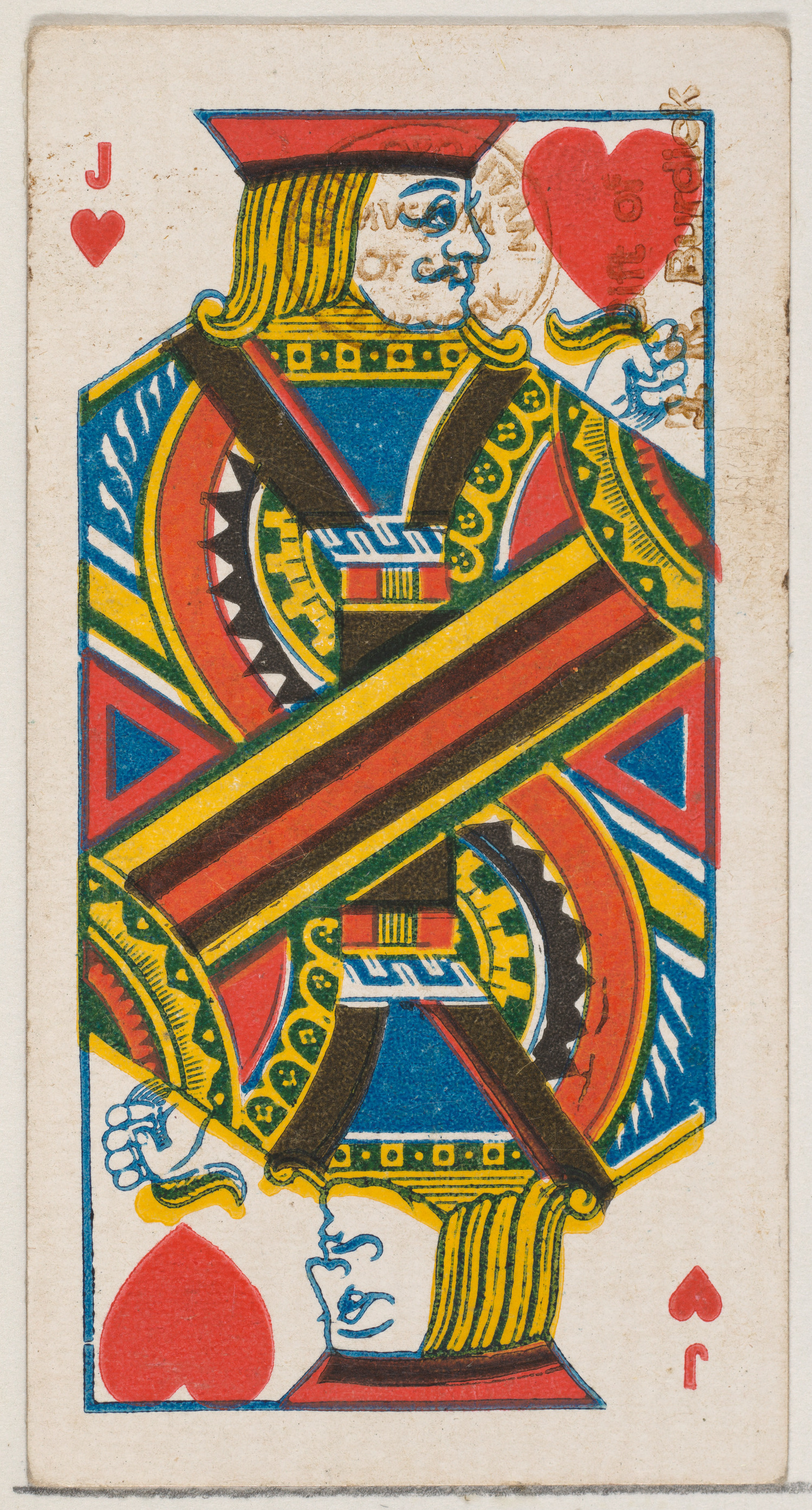
In cartomancy with playing cards, the Jack of Hearts (J♥) is generally the Child card.

All the Jacks can represent children, but the Jack of Hearts is the one that is most likely to. When it does, it is a neutral significator card. You will read the child’s characteristics and “fate” from the surrounding cards. Needless to say, this is an important card in issues surrounding pregnancy.

When it does not represent a literal child, the Jack of Hearts takes on the symbolic attributes of children: playfulness, purity, freshness, gullibility, immaturity, inexperience. It is slightly positive, but can easily become negative when in a negative context.

In love readings, the card broadly speaks of something that has begun or will begin, and that therefore is in its initial stages. This is when a relationship is at its most fun and people get to know each other, but it also means that the couple doesn’t have deep roots (yet). It is a fun, flirtatious, adventurous card, and if not spoiled by negative cards it holds the promise of a long and stable future, because children have their whole life in front of them.

When the Jack of Hearts comes up for a couple that has been together a long time (say, at least three or four years), it can mean they have a child or that they still have a fresh and playful attitutude. With negative cards, though, it indicates shallowness and lack of true commitment, and can point to potential cheating. Only potential, though. You need confirmation from other cards. Broadly, the Jack of Hearts indicates flirting.

In a work reading, the Jack of Hearts indicates a new job or a job connected with children. It is also a card of inexperience, so if other cards indicate trouble, this can be due to not knowing what you’re doing. It can also indicate new arrivals and new colleagues. In itself, it shows that the querent is well-liked in a new work environment (or any environment), just like generally people will sympathize with children and pamper them.

In money matters, the card is a bit ambiguous, as, unless it indicates new ventures, it often shows a chronic inability to hold on to your money. However, it can also signify that you are unprejudiced and will pursue new avenues, so it can speak of brilliant financial abilities.

The above also applies to a person’s character. Depending on where it falls, the Jack of Hearts will highlight positive or negative traits. From a spiritual standpoint, the card is among those connected to prayers and positive thoughts in general, as well as to angels.

Combinations

J♥ – J♠ = can be a misbehaving or problematic child
J♥ – 7♦ or 3♦ – 3♠ = financial loss due to carelessness
10♣ – 4♥ – J♥ – A♥ = a trip to your childhood home (and therefore your family home)
5♥ – J♥ – 9♥ or 10♥ = One of the combinations that indicate a pregnancy (a wanted one)
J♥ – 8♦ – 6♣ = a new business that drains a lot of energy (the querent is tired). Implicitly, this means that the venture is not going very well

Cartomancy with the Skat / Piquet Deck of 32 Cards – Card Meanings

This is the list of meanings I have received for the German Skat deck. If you need a background, click here for part I.

Hearts – Hearts (also called “Rot”, red)

Ace – The home, The Family
Seven – Intimacy, Someone or something close, Something imminent
Eight – Fun, Entertainment, Festivity
Nine – Friendship, Joy, Love
Ten – Marriage, Union, Connection, Bond
Jack / Unter – A Child, Naive, Inexperienced, Positive, Immature
Queen / Ober – The female querent
King – The male querent

Spades – Leaves (called “Grün”, green)*

Ace – A letter, Document, A book, Study
Seven – Visit, Meetings, Hopes, A short trip (even just going out on foot)
Eight – Society, People meeting, Groups, Talks, Also a short trip, but a bit longer than the Seven
Nine – Worry, Uncertainty, Preoccupation
Ten – Long road, Travel, A long time, Abroad
Jack / Unter – Message, News, also relatives
Queen / Ober – An older woman, A dark-haired woman, A friend or relative
King – The male counterpart to the Queen

Diamonds – Bells (“Schellen”)

Ace – Success, Great fortune, Gift, Good for career and business
Seven – Small money, Something small, Objects, little by little, of small account
Eight – Job, Occupation, also Praise
Nine – Success, Growth, Increase, Recognition, Satisfaction, Improvement
Ten – Money, Success
Jack / Unter – Good luck, Fortunate occurrence
Queen / Ober – A blond woman, A younger woman
King – The male counterpart to the Queen

Clubs – Acorns (note that Clubs are called “Kreuzkarten”, Crosses)

Ace – Sorrow, Suffering, Spirituality, Loss, Shock, A large building
Seven – Tears, can rarely be tears of happiness
Eight – Anger, Arguments, Clashes
Nine – Loss, Lack of success, Also jealousy
Ten – Illness, Situations that are sick
Jack / Unter – Disruption, Bad luck, Falseness, also wearing a uniform
Queen / Ober – An elderly woman, An ex, A negative woman, Lonely, lying, A female doctor or a woman in a position of authority
King – The male counterpart to the queen

Combinations

A♣ – 10♣ – K♣ = hospital, sickness
K♣ – 10♥ – 8♥ = marriage
7♥ – 7♠ – J♥ = pregnancy
8♦ – A♠ = a new job
8♦ – 9♦ – A♦ = career advancement
8♦ – 7♦ = part-time job
8♦ – 10♦ = full-time job
10♦ – K♦ – A♦ = successful businessman
8♠ – 8♥ = meeting people, a party
A♥ – 7♣ – 9♣ – A♣ = loss in the family
10♥ – K♣ – 8♣ = divorce
K♣ – J♣ – A♣ = problems with the law, prison (if another bad card instead of the Ace, problems with the law)
10♠ – 7♠ = someone visiting from far away
8♥ – J♦ – A♦ – 10♦ = winning money
J♦ – J♣ = bad luck, lost opportunity
J♣ – J♦ = good luck
7♥ – 7♦ = flirt, just sex, small money coming in
7♠ – 8♥ = going out with friends
10♠ – 8♥ = a pleasant trip
10♠ – 10♣ = problems with the car
10♠ – 8♣ – A♣ = an accident
7♦ – A♥ – 9♦ = house renovations
A♠ – 10♦ – A♥ – A♦ = buying a house
K♥ or Q♥ – 9♠ – 9♣ = person is jealous
7♦ – 7♣ = money problems

* as I said in part I, in the German tradition Spades are good and Clubs bad. If that seems weird to you, feel free to swap them.

Vera Sibilla | Split Combinations

To sum up what we’ve seen so far in terms of card interactions: 1) cards behaving neutrally are influenced positively or negatively by the cards following them 2) cards with the same polarity tend to strengthen each other for good or ill 3) cards of a similar polarity tend not to rely on their placement to create meanings 4) but when cards have the opposite polarity, the one falling last tends to influence the previous one more than vice versa 5) similarly, if cards have opposite meanings the one falling last tends to influence the previous one more and indicate the direction of the reading 6) and, generally, black cards tend to be stronger than red cards, which tend to be influenced more than they influence. These rules of thumb can and often do conflict with one another, which is where the art of reading comes in.

Another phenomenon that it is well to keep in mind is the one which might be termed that of split combinations. This phenomenon happens when two or more cards forming a unit of meaning are split up to include a third card. This is especially common with cards bearing the same suit or the same number or having similar meanings. It can also happen in more elaborate combinations where all or most cards point to a single concept.

The 3♠ and 3♣ have the notion of movement in common: the Journey card is movement and the Widower is a removal. Together they form a combination that signifies a journey away from someone or something. It is very common for a card to fall between then, such as a face card. But the cards must still be read together as a unit, and the card falling between them is the thing or person the querent gets away from (K♥ their husband, 2♥ their house, K♦ their job, 10♥ their town) in other words, you do not read the combination 3♠ + 2♥ + 3♣ as: there will be loss, then the querent will move into a home. You read them as: the querent will abandon their house (or another place).

The 9♠ and 9♦ form a combination signifying a vicious cycle or an addiction (the same is true substituting either one with the 9♣R). If the 10♣R falls between them, you do not read: there is a blockage, then an opportunity which however will be squandered. You read the combination as: the querent has a problem with slot machines (the 10♣R is associated with gambling).

The 5♠ and the 7♠ often fall together to signify a definite and rather traumatic ending. If the 4♥ falls between them, you do not read the cards as: the querent will go through a sharp change, then he will find love but it won’t last. You read it as: the querent will break up with someone.

Of course, we are only taking three cards into account, which is very limiting. When you find yourself with five or ten or more cards in front of you, deciding what kinds of geometry the cards are following can become more a matter of judgement. All I can say is that you need to develop an eye for what the cards are saying.

Suppose we have the following combination: 5♠ + 5♥ + 7♥ + 2♦. The placement of the cards is relatively indifferent. Four times out of five, this combination will signal the reading of a will. If the 2♠ falls  in the middle, you do not let the card interfere with the combination and break it up. You incorporate the card into the combination, applying the combination’s meaning to the card: the reading of an old lady’s will.

Another example. Suppose we have the following combination: 4♦ + 8♠ + 10♦. This combination signals, generally speaking, a swindle. If the 6♥ falls somewhere inside the combination, you do not read that there will be a swindle, then money will be gained and then lost. You read it simply as:a swindle concerning money.