Category Archives: Card Combinations

Bolognese Tarot – How to Tackle Combinations

Life is a recipe, and the art of living consists in large part in detecting the ingredients to know if and how to mix them differently. Divination is a mirror of life, and oracular systems usually have some kind of vocabulary to create descriptions of life.

In traditional divination by cards, each card carries small bits of meaning that must be mixed together to form coherent pictures. If divination mirrors life, then it stands to reason that the recipe for something in real life should be mirrored by a recipe for that same thing in the divinatory language. This is how all card reading systems I know work, and that’s how the Bolognese tarot works, with the exception of a couple of universal combinations with odd meanings (Angel + Devil = Good news or satisfaction; Sun + Moon = sorrow; Angel + Death = yes, confirmed).

Let us make an example. What are the ingredients of an inheritance in real life? I would say the ingredients are: death (no inheritance without someone croaking); family ties (usually we inherit from someone whom we are related to, though not always); the law (inheritances are generally regulated by the law and require a bureaucratic mechanism to be set in motion); material possessions (the things we inherit).

In the language of the Bolognese tarot, these ingredients correspond to the following cards: Death: Death; Family ties: Ace of Cups and/or Seven of Cups; The Law: Justice and/or King of Coins; Material Possessions: The Star and/or a money card.

Do we need all the cards to be present? It much depends on the context. If the question is directly about an inheritance, then we could do without many of these cards, while if it is a general reading then the more cards, the clearer the message. But we might also find other cards to flavor the basic recipe: the Moon is also connected with death (the realm of shadows); tears may sometimes be expected, so the Seven of Coins could come up; the court card of the deceased person could show up, etc.

Let us make another example. Let’s take surgery. What’s the recipe for surgery in real life? I would say: a hospital, a bed, a doctor, a cutting instrument. In the Bolognese tarot these same ingredients are: Hospital: The Tower; Bed: The Chariot; Doctor: King of Coins; Cutting instrument: Knight of Swords.

Again, there can be additions and variations. The doctor or the bed might be absent, while the Ten of Cups (blood) or the Moon (unpleasantness) or the Eight of Swords (suffering) might be present. A King or Queen of Swords may take the doctor’s place to show someone holding the knife. Just like my lasagne recipe might differ from yours, but it would still be recognized as lasagne, so the way the deck mixes the ingredients might vary slightly from time to time, but the broad picture remains the same.

One last example. Let’s take marriage. In many situations, a marriage requires the following ingredients: a commitment; love (let’s assume the best intentions in this case); a celebrant. The same ingredients are, in the language of the Bolognese tarot: Love: Love; Commitment: Ace of Wands or Ace of Swords; Celebrant: The Stranger. This is the basic recipe. But we might also expect the main significators to show up. A marriage is a celebration, so the Ten of Cups (fun) might be expected; the family life is certainly impacted, so some Cup cards could be there.

Once we start recognizing that life is made up of ingredients mixed together, it becomes easy (or at least easier) to see how the tarot might mix its own ingredients, the cards, to match the recipe. In many cases, while it is useful to reason out the combinations handed down by tradition, it is much easier to understand the basic principles and be flexible in our observations.

Ultimately, divination starts with logic, not with psychic powers, even though psychic abilities may occasionally be of help. The more we immerse ourselves in the logic of divination, the easier it becomes to decode its messages.

MQS

Bolognese Tarot – Some Examples of Combinations

This is a short selection from a much longer list. Although there are a couple of traditional combinations that are not easy to read unless studied beforehand (like Sun + Moon or Angel + Devil), most of the times the combinations of cards are logical. For this reason I have omitted many obvious combos: Page of Coins (words) and Love is sweet talk or words about love. Thank you very much. The following list is just an example: I will talk more about combining cards in the future. Plus, always remember that much depends on the context of the question and of the other cards. Be flexible. The comments in brackets are my own.

Ace of Cups + Ace of Wands = 1. married life 2. a business (the interpretation depends on the question or on the surrounding cards. For instance, + Love, married life; + Star, business)

Ace of Cups + Seven of Cups = things related to the family, or strong family or family-like relationship

Seven of Cups + Sun or Angel = protection, either from the family/friends or whoever is specified in the spread

Seven of Cups + Juggler = small city or your hometown (where you grew up)

Seven of Cups + World = large city or foreign city (not necessarily in another country though)

Ten of Cups + Love = falling in love, usually being at the stage where love is more fun than hard work (if also + Juggler or + Fool, fun but immature love)

Ten of Cups + Moon = there is no happiness (the Moon covers it)

Ten of Cups + Hermit = traditionally for women it shows their period being blocked, and if the Juggler appears it can show a pregnancy

Ten of Cups + Knight of Swords = 1. Hurting yourself and bleeding (with cards showing hospitalization, an operation) 2. More metaphorically, the fun or joy is cut short

Page of Cups + Ace of Wands = prostitute, according to tradition (it can still be like this nowadays, but look at the context of the question and the other cards. Also, prostitute can sometimes simply indicate a slutty individual, especially if no money card is involved)

Page of Cups + Juggler = son and daughter or a young girl

Knight of Cups + Angel = peace, agreement, reconciliation

Knight of Cups + Person card = the person is gentle, kind or agreeable

Ace of Wands + Love = a love relationship

Ace of Wands + Star = success at work or in business, can be the signing of a contract

Ace of Wands + Fool = “baronate” in Italian/Bolognese dialect, meaning fun sex without much thought

Eight of Wands + World = travel, removal

Eight of Wands + Hanged Man = 1. danger on the road 2. A road or path that ends abruptly

Eight of Wands + Juggler = A trip, but can have other interpretations in context

Ace of Coins + Tower + Hermit = serious money trouble and the need for making sacrifices (I guess instead of the Hermit any other troublesome card would suffice)

Ace of Coins + Ten of Coins = finances (in itself good finances, material well-being)

Ace of Coins + Ten of Cups = 1. prosperous finances 2. Can be a festive table

Ace of Coins + King of Coins = a banker or someone commanding lots of money

Seven of Coins + Fool + Moon = the blues

Seven of Coins + Ten of Coins = having little money

Ten of Coins + Ace of Cups = spending a little money on the family or home (I guess depending on the context it can also be a little money coming from the family or home)

Page of Coins + Queen of Coins = clarification or explanation (words that give you the truth)

Page of Coins + Juggler + Hermit = stuttering (probably mataphorical as well)

Knight of Coins + Page of Swords = 1. Post 2. Good news by message

Knight of Coins + Ace of Coins = good financial developments, money coming easily

Queen of Coins + Moon = hiding the truth, lack of clarity

Queen of Coins + King of Coins = expert

King of Coins + Justice = legal or bureaucratic matters (in itself can be a lawyer, notary, red tape, etc.)

King of Coins + Chariot = a doctor

King of Coins + Angel = 1. powerful protector (the one you’d ask to pull some strings, for instance) 2. A positive entity

Ace of Swords + Page of Swords = letter coming soon

Ace of Swords + Justice + Tower = prison (here the Ace of Swords is the handcuffs)

Eight of Swords + Ace of Swords + Devil = addiction (A bond to the devil for something that torments you. But it can mean being dependent from someone or something in a negative way)

Eight of Swords + Love + Devil = strong jealousy (probably pathological)

Page of Swords + World = message from afar (nowadays also probably messaging with people around the world)

Page of Swords + Moon = 1. secret correspondence 2. Letter whose content displeases us

Queen of Swords + Seven of Coins = affliction (obviously it can also mean a sad woman or a woman who causes sadness, depending on the context)

Queen of Swords + Devil = witch (or, more probably, a negative woman)

King of Swords + Juggler = an immature man or a young boy, or two sons

King of Swords + Justice = law enforcement

Fool + Juggler = bewilderment, disorientation

Fool + Ten of Cups = creativity or levity (in a medical context, since the Fool is the head and the Ten of Cups is blood, if there are negative cards it can indicate blood clots, brain strokes, etc.)

Fool + Hanged Man = estrangement from reality (+ Moon and/or + Seven of Coins, serious mental suffering)

Fool + Devil = excesses (either excessive character or using funky stuff. It can probably also indicate a negative situation that confuses us)

Juggler + Ace of Wands = conception or inception

Juggler + Moon + Devil = untrustworthy character, dangerous individual

Juggler + Page of Cups + King of Swords = children or young people

Juggler + Wheel = gambling (but it can mean other things in context)

Stranger + Fool = overturned expectations (I have experimented this combination as overturning the status quo as well)

Stranger + Moon = disappointment (unexpected bad things)

Stranger + Star = can mean a gift (unexpected object)

Love + Ace of Swords + Stranger = Marriage (the Stranger here is a priest or celebrant, the Ace are the rings. I think the Ace of Wands might be there instead of that of Swords. Without the Stranger it can still show a relationship or, if you’re single, love about to knock at the door)

Stranger + Devil + Moon + Ace of Swords = black magic (here the Stranger is the person celebrating the ritual, the Ace of Swords is the creation of magic bonds. I’m wondering if the Angel and Sun came up instead of the Devil and the Moon if it would indicate white magic)

Love + Hanged Man + Queen of Swords or King of Swords = cheating

Love + Temperance = lasting love

Chariot + Ace of Wands = sex

Chariot + Death = deathbed (but unless the question is specific or there are other cards it probably means something else)

Chariot + Moon = sickness

Justice + Ace of Wands = marriage, partnership or important contract

Justice + Moon = injustice (can probably be interpreted in various ways, such as something being wrong or unfair or mistaken)

Hermit + Person = person is indisposed (or blocked within the context)

Hermit + Temperance = lasting blockage

Hermit + Page of Wands or Knight of Wands = person is shy or solitary (has inner blockage)

Wheel + Stranger = chance meeting (probably with a person card next to it, otherwise maybe also unexpected chance)

Strength + Hermit + Moon = exhaustion, weakness, ill-health

Strength + Ace of Wands = person is very willful (I’ve noticed that the Ace of Wands next to a person card also makes them very willful)

Strength + Devil + Knight of Swords = fights

Hanged Man + Death = paralysis (literal or metaphorical)

Hanged Man + Tower = ending

Death + Wheel = what’s been set in motion cannot be stopped (probably also a change for the better, if the Wheel is upright and/or followed by positive cards)

Death + Tower = 1. Tragedy 2. Disruption

Death + Justice + Ace of Cups + Star = inheritance (the Star here refers to material possessions. I think a money card could be there instead as well.)

Temperance + Hanged Man = end of something (that lasted a while)

Temperance + Ace of Swords = short (short-ish) timeframe (here the Ace of Swords reduces the slowness of Temperance. It can probably also indicate a lasting bond.)

Ace of Coins + Temperance + Ten of Cups = finances slowly flourishing

Page of Coins + Devil = angry words, fights

Devil + Angel = great satisfaction or good news (regardless of the order of the cards)

Devil + Ace of Wands = great passion (primarily sexual but to be adapted to the context)

Tower + Chariot + King of Coins = hospital (other cards like the Moon, the Seven of Coins etc. may be present)

Tower + Chariot + Knight of Swords = surgery (I’ve already experimented this combination. The Queen of Swords was present indicating the female surgeon. Otherwise a King of Swords would be probably a man or the King of Coins would generically indicate the doctor)

Tower + Ace of Coins = financial sacrifice, financial limitations, bankruptcy with other bad cards

Tower + Fool + Moon = mental breakdown

Star + Ace of Coins = a well-paid job

Star + Temperance = stable job (if followed by cards of ending like the Hanged Man, temporary job)

Star + Queen of Coins = intellectual job (but I think it depends on the context)

Chariot + King of Coins + Star = therapy, prescription (here the Star indicates meds)

Moon + Person card = traditionally a dead person (someone who is no longer visible to us. But it needs to make sense in the context. It can probably also mean someone who is sad or is hiding something)

Moon + Eight of Wands + Hanged Man + King of Swords = danger on the road at night (probably due to a man)

Sun + Moon = Sorrow (if the cards are swapped around, with the Sun last, it is still sorrow but it is lessened or it goes away more quickly)

Sun + King of Coins = the doctor’s cure works (probably to be extended to any kind of professional help)

Sun + Devil or Ace of Wands = strong vitality or energy

Angel + Queen of Coins = faith

Angel + Page of Coins = prayer (probably also good/positive words)

Angel + Juggler + World = pregnancy (the World is the belly)

Angel + Death = yes, for sure (either to a question or to the cards preceding them)

World + Person card = person is not yet known or comes from far away (keep in mind that once upon a time even the next town was far away) or travels

World + Star + Ace or Ten of Coins = commerce (but it can probably mean other things too)

Three Aces together = “Tre assi son tralasci”, three aces equal abandonment. Radical change, leaving the old for the new.

Four Aces together = “Quattro assi fan fracassi”, four aces make a lot of noise. Destabilizing situations, chaos, pandemonium

Three Kings together = Success

Four Kings together = Triumph

Three Queens together = Problem*

Four Queens together = Failure*

Three Knights together = Good news, Speed

Four Knights together = Speedy good news, great speed

Three Pages together = gossip, talking

Four Pages together = slander, bad people

*Some (including one of my teachers) see the Queens less unfavourably, as delays (Queens, in this case, are probably seen as taking a long time to deliver the heir/result)


Bolognese Tarot – Introduction to Combinations

The Tarocco Bolognese is famous in Italy for relying heavily on combinations of cards. Rather than each card being a full picture, the cards are like small tiles in a mosaic, and need to be interpreted as a whole. No individual card can tell us much of anything. Let’s take the most favorable card in the deck, the Angel. In itself a wonderful card of protection and solution. Yet, alone, the Angel merely says “protection” or “solution” or “friendship” or any other keyword. We still don’t know if this protection exists, is longed for, is missing, is crumbling, or what effects it will have.

In this, the Bolognese tarot is much closer to the Sibilla or Playing Cards or other traditional oracles than to how tarot is often read nowadays (but regular tarot did use to be read in a combinatory manner in the past, before the Waite deck became popular and people started focusing on illustrations).

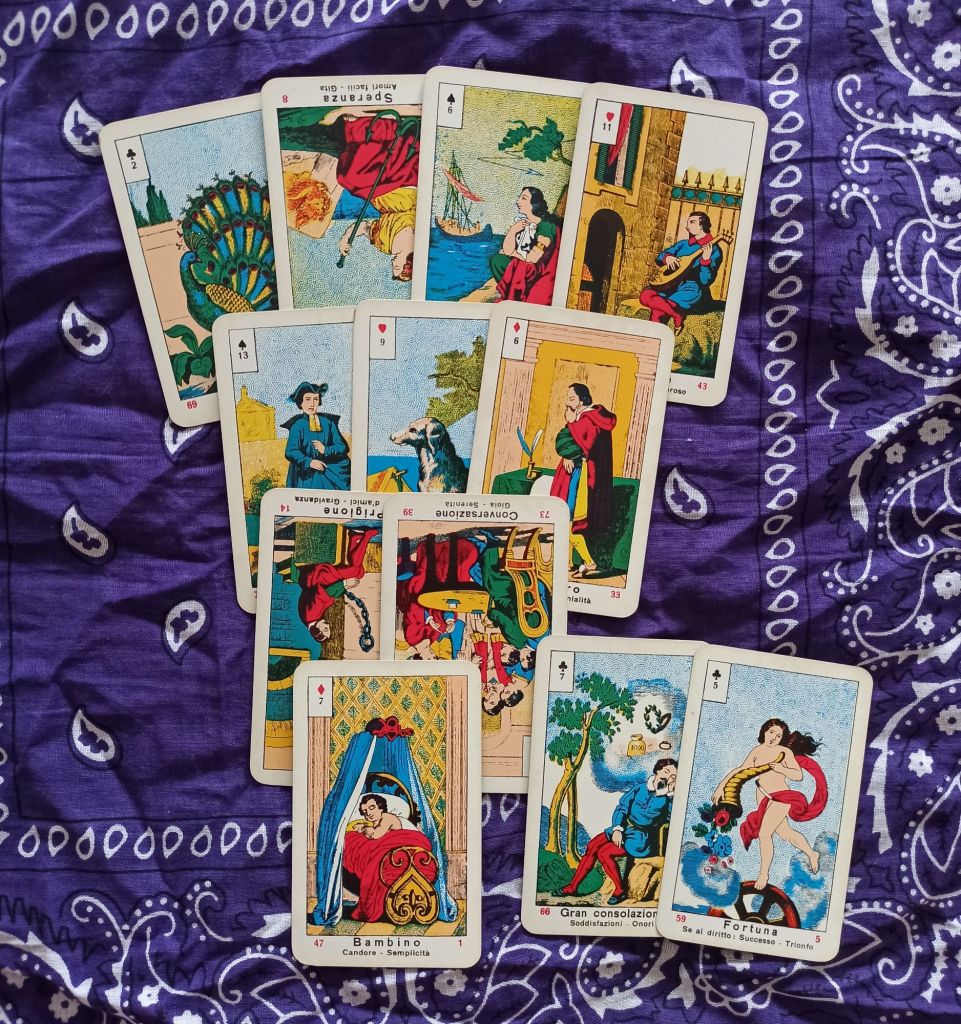
Since each individual card doesn’t say much by itself, the spreads tend to rely on a larger number of cards. The smallest traditional spread done with the Bolognese tarot is the thirteen card spread, which I have already shown, and which I will cover again. This is a small tableau of three columns of four cards (or four rows of three cards) plus one at the end. In this small tableau, the cards are interpreted in their interaction with one another.

Often, therefore, it is necessary to be able to see the big picture when interpreting the Bolognese Tarot. Occasionally, all cards are important and need to be considered. At other times, one or two cards come up in the spread that we don’t know how to interpret and don’t make sense to us, and there is no point in banging our head against them, trying to fit them into the interpretation at all costs: we should be able to see where the answer to our question lies, where the cards that are clearly forming a message are clustering, and go from there.

Look at the spread as if it were a bunch of people in central square. Some are there to meet other people and discuss something important or go somewhere interesting together. Others are simply sitting there because their wife kicked them out so she can finish waxing the floor in peace, so they just sit alone. They don’t have much to add. They are just there. Or, if you prefer the image of the mosaic I used earlier, some tiles go together to show the cool angel warding off the horde of demons, while other tiles are just vaguely blue and form the sky in the background.

This sounds complicated but it isn’t necessarily, once we have developed an eye for which cards tend to go together. Don’t fixate on rigid 1+ 1 + 1 + 1 +1 = 5 kind of combinations. In cartomancy, 1 + 1 +1 + 1 +1 often equals a bunch of crap if you are not careful. Who says that it’s 1 + 1 +1 +1 +1, and not 1 + 1 on one hand and then 1 +1 +1 on the other? Or 1 + 1 + 1 + 1 and then one left over? Who says the cards add up, instead of detracting from each other? The Angel is good, but followed by the Hermit and the Tower it is diminished. Strength makes you strong, but Strength followed by the Moon? Not so much.

Look at the flow and apply logic to it. See how the small meanings of the cards cluster together to form one coherent bit of mosaic. That coherent bit of mosaic may be next to another bit that is coherent in itself, without the two going together: in one corner you may have the scene with the angel warding off the demons, but right next to it you could have God creating Adam and Eve. Mix them the wrong way and you’ll have the angel warding off God, while the demons create Adam and Eve. Not good on the angel’s resume.

Also, don’t fixate rigidly on methods like “the first card is the noun and the second is the adjective” that were popular some time ago in the Lenormand community. I don’t use Lenormand, don’t know if that’s how they work, but it certainly doesn’t help with the Bolognese tarot. Again, the big picture is essential. Once we have that down, we can carefully add the details.

Finally, go for concrete life. The cards can talk about many things, from the most mundane to the most deep, including spirituality, psychology and so on. Do keep in mind, though, that the card readers of yore didn’t ponder too many questions we (often deludedly) consider deep. Not because they were dumb (they weren’t) but because they had other priorities: they were too occupied seeing if they could put away enough food for the winter or if the doctor would be able to come in time from two towns over on his rickety buggy to see what was wrong with little Guido.

Ordinary life is our starting point. It is in it that more spiritual or introspective topics are nestled. Without real life, spirituality falls into the void, failing to manifest, and it therefore remains an abstract collection of feel-good statements. But just because we start from real life doesn’t mean the tarot can’t talk about it in sometimes strikingly deep or metaphorical ways.

The tarot is highly metaphorical. Never forget that the old card readers had entire poems, folk songs, stories and even Bible books committed to memory. They were often capable of seing meaning in things we consider bland. Again, they were practical, not dumb. Life is highly metaphorical and symbolic if you know how to look at it, and the tarot is a good lens. Of course Truth (Queen of Coins) and Love can mean a true love, but what does it mean that your job is true? Think about it.

MQS

The Main Problem (Cross Spread Example Reading)

Those who read my Sibilla and Playing Cards sections are probably familiar with the cross spread I use with those decks. Turns out, the same spread can be used with the Bolognese tarot.

This querent is the same I read for here and had a crush on a colleague. The cross spread I present here is a prequel to that spread.

A general cross spread

The cross spread may be used to look at a person’s life in general or to answer general questions (“tell me about my career”). In this case it was general. I’ll keep it short:

  1. Above the head position (what the querent would like or is thinking about): King of Cups, Juggler/Magician, Ace of Cups. This screams “pucture perfect family” with a husband (King), children (Juggler) and a hearth (Ace of Cups)
  2. Under her feet (what she doesn’t want or what she has trouble with): Love, Ace of Wands and Eight of Wands. Love and Ace of Wands together represent a relationship, and the Eight of Wands is a road or path, so it could indicate a love life. Note that this position could indicate that she doesn’t want a relationship, but considering what the cards on her head are saying, it is more plausible that she wants a relationship but has trouble obtaining it.
  3. To her left (past or present): Star, King of Coins, Death. This position talks about work. After checking with her, I discovered she had lost her job in the months prior to the reading and had found a new one.
  4. To her right (near future): Page of Swords, Fool, Seven of Cups. This speaks generically about confusing messages concerning the home.
  5. Center (in her heart): Angel/Judgement, Devil and King of Wands. Well, Angel and Devil together represent, traditionally, great satisfaction, connected to a man. This seems to be the cards’ polite way of saying she’s turned on by him.
  6. To the side (for her): Ace of Swords, Knight of Coins, Ace of Coins. Speedy positive news about money. Probably connected to the near future position, but we didn’t look further into it.

And the reason we didn’t look further into it is that the most important cards (those comprising the central column, i.e., above, heart and below) are all connected with love. This is how the spread about the colleague was born. Note, however, that this spread, when done in general, can give us brief messages about the most disparate fields of life, and it is up to us then to expand on them by either adding cards or doing other spreads.

MQS

Bolognese Tarot – Connecting the Cards

I’ve recently talked about understanding the order of the cards when using the Vera Sibilla and playing cards. The Bolognese tarot, being a traditional fortune-telling system, follows similar rules, and as such it is important to understand whether the cards add their meanings together or contradict each other. Example:

Page of Coins + Queen of Coins

The Page indicates words, while the Queen represents the truth. Therefore, in this case, we get “true words”, “trustworthy words”, and similar combinations.

Queen of Coins + Moon

The Queen of Coins is the truth, but it is followed by the Moon, which indicates negativity, falseness, secrets. Therefore the combination talks about hidden truths, and thus of potential lies to cover the truth.

Moon + Sun

In the Bolognese tarot, the Moon is the card of negativity, while the Sun is the card of positivity. Traditionally, the Sun and Moon together are called “the two red cards” (due to the color of the two celestial bodies in the card) or the sorrow combination. Since here the Moon comes first and is followed by the Sun, the sorrow is passing, the problem will be solved.

Sun + Moon

In this case, the Moon more decisively blocks the Sun, so the sorrow doesn’t stop, or at least will last longer.

Tower + Justice

The tower can represent a large building one would rather avoid. Justice represents the law. Together, the two cards can represent a courthouse (but they can also indicate that justice or fairness is impeded, if the reading is not about a trial).

Justice + Sun

The Sun affirms the positivity of something. Together with Justice, it shows justice, fairness, equilibrium, etc

Justice + Moon

This is the opposite. The Moon negates justice.

Justice + King of Coins

The King of Coins is an important person, usually one with a degree. With Justice, he becomes an attorney, a notary, someone who is competent in some area of law or bureaucracy.

Love + Hanged Man

The Love card indicates, of course, love. In the Bolognese Tarot, the Hanged Man represents betrayal (being hanged upside down was the punishment for traitors). Together, they can indicate some kind of dishonesty connected to love (with the figure of a third party, it would become a triangle).

Love + Ten of Cups

The Ten of Cups brings feasting and jollity, so this combination would describe a happy-go-lucky love that is blooming, and if we add the Fool, that’s obviously a very fun love with not much commitment.

Love + King of Coins + Justice + Tower

We’ve seen that the King of Coins with Justice indicates a lawyer, and Justice and the Tower indicate a court of law. Connected with Love, this combination could show a divorce.

World + Eight of Wands

The World card means “around the world” or journey. The Eight of Wands indicates a road or path. Clearly, the two cards together strengthen the idea of a literal journey.

World + Page of Cups

The Page of Cups can indicate a younger woman, while the World shows “from afar” or “from around the world”. So this young woman probably isn’t part of the querent’ life: she’s a stranger.

All in all, combining the cards of the Bolognese tarot is a relatively intuitive process, although there are some traditional combinations that we’ll need to talk about in a future post.

MQS

Understanding the Order of the Cards

One thing that I often receive messages about is how to understand the order in which the cards fall. Whether it’s the Vera Sibilla or playing card, there is one fundamental rule that applies in the majority of cases: later cards modify those that fall before.

Keep in mind that divination with cards is like the reading of a book, so the cards build the equivalent of sentences with their own grammatical structure. This is why I prefer to read the cards together rather than in isolation, as would happen in many contemporary positional spreads, where to each position corresponds one card.

In the tradition I come from, there can be positions, but there are always at least three cards, and sometimes five, covering one position. When we have two or more cards together, it becomes possible to “agglutinate” their meanings.

“Boy” and “run” becomes “the boy is running.” “Boy” and “friend” becomes “the boy is with a friend” or “the boy is a friend.” “Boy” and “Australian” becomes “the boy is Australian.”

Similarly, if we put two playing cards together such as the Three of Clubs (Union, marriage) and the Ten of Hearts (Happiness) they say: the marriage is happy. In the Sibilla, if we put the Ace of Club (Marriage) and the Four of Hearts (Love) together, it becomes “a loving marriage” or “a marriage of love.”

These are the first steps only. There are many more nunaces. However, the basic thing we must ask ourselves when interpreting two or more cards together is whether they add to each other or they contradict each other.

When they add to each other, the sequence in which they fall doesn’t matter that much (though it may add shades of meaning). “A beautiful girl” is roughly the same as “A girl who is beautiful.” But if we have “War” and “Peace”, saying “Peace and then war” is very different from saying “War and then peace”.

In the Sibilla, Fortune + Death is the end of fortune (literally, “the fortune meets its end”), whereas Death + Fortune is an end that brings fortune. Generally speaking, the cards falling after have the power to modify those that fall before.

That being said, divination is an art more than a science: we should never apply our rules so rigidly that we stop thinking about what the cards are saying. In most cases, in the Sibilla, Thief + Marriage has a similar meaning as Marriage + Thief: someone or something is interfering with the marriage.

Ultimately, each spread is a world in itself and the specific key to it must be found by following the clues that the cards leave behind.

MQS

Three Court Cards! (Example Reading)

They are the bane of many a reader: Court Cards are seen as difficult to read, in part because they clearly represent people, and so refuse to be banished into the realm of woolly platitudes inhabited by way too many readers, in part because locating them within the querent’s life can be objectively difficult.

In cartomancy with playing cards, however, the inherent signification of the cards can help us: The Queen and King of Clubs are almost always the main protagonists (the querent and his/her significant other), though there may be exceptions. I know of cartomancy systems where the querents are represented by the Heart suit, but this is just semantics.

Then we have the Heart court cards, of which the Jack is a child, a pet or something fresh and immature and small and the Queen and King represent people close to the querent’s heart. This is actually a modern interpretation: traditionally, they would be people sharing the querent’s bloodline, but modern times require modern solutions. I have found that the Heart courts can simply indicate very dear friends. For gay people, usually the significant other is a Heart card of the same sex, although occasionally the cards simply use the Club cards. We need to stay open. The Jack of Clubs can indicate friendship, help, cooperation.

The Diamond suit represents people usually unrelated to the querent, though they can indicate relatives by marriage. More usually, they show colleagues, acquaintances, bosses, rich people or people who have a more neutral or even cold perspective of the querent compared to the Hearts. The Jack of Diamonds usually represents a message.

Finally, Spades show people who are downright inimical to the querent, or who wield power over the querent’s well-being and enforce an objective set of rules, such as the police, doctors, judges, etc. This is especially the case for the King. The Jack can represent enmity, scheming, etc.

All Jacks can indicate children or very young people, though in practice this is more likely with the Jack of Hearts.

Usually, one court card within a reading is already more than we can tolerate, but sometimes we find that there are ONLY court cards. This is an example of a reading a did yesterday for a man who asked about his relationship:

A marriage-related three-card spread

When more than one court card shows up, it is important to look at the cards between them, as they show the nature of their relationship, or what’s between them.

It is easy to jump to conclusions here: there’s a woman between you two! You have a lover! This could very well be the case, actually, but it is always important to keep in mind that, with so few cards on the table, more than one interpretation is possible. Here are some possibilities:

  1. There could actually be a woman between them. He may have a lover (or, more rarely, she may have a female lover)
  2. It might be a threesome
  3. There could be a woman who interferes but who is not a lover: it could be her mother, her friend, any other person.
  4. There might be a person mediating between them in a positive way
  5. He might know her from work or from a business context, since sometimes, two queens or two kings together can represent a single person, merging the qualities of two suits.

So, how do we know which interpretation applies? Well, first off, we ought never to play Nostradamus: in doubt, we ask. This may sound unimpressive, but our aim is not to impress, but to give accurate information. Still, with experience, we may rule out a couple of possibilities as being less likely:

  1. This is a simple three-card spread. If the querent were in some kind of odd polyamorous arrangement, the cards would not lead off with three court cards, but by telling us the querent is weird. This may sound politically incorrect, but the cards are keyed to a rather traditional view of the world. This doesn’t mean they are a compass of morality: it’s just their language. They highlight the strange and untypical in rather clear ways. Three court cards together aren’t strange enough.
  2. This is a simple three-card reading. If the querent had a hidden lover they would tell us the relationship is in danger, or at least they would highlight the lover by assigning her to the Queen of Spades rather than Diamonds (The Queen of Diamonds can be a lover, but it requires more hints from the surrounding cards). Even the Queen of Spades wouldn’t necessarily be a lover, but at least we’d know she’s trouble.
  3. This is a simple three-card spread. If there were a positive influence mediating between them, the cards would have given her to the suit of Hearts, or they would have omitted the information altogether and told us the querent and his significant other are in a positive phase (the mediator isn’t that important, and a three-card spread only has space for what’s important).

With that in mind, I asked the querent if he knew his girlfriend from work or from a business context, and he denied this. I asked him then if there was a woman causing some issues between them. He smirked and said: “A friend of hers doesn’t like me, she’s trying to break us up.”

Obviously, this spread doesn’t tell us how it’s going to end. It just describes the situation rather than how it will evolve, and more cards should be drawn.

MQS

A Long Long Time (Reading Example)

Sometimes in readings it’s not immediately clear whether the cards start by describing the past, present or future. There are times when they jump immediately into the future, while at other times they only talk about past and present situations and we need to keep adding cards to find out what happens next. More often, though, the cards start with the past/present and then move on to the prediction, or at least this is my experience.

In this case I was asked by a querent if she would find a job. Note that I started with five cards and then added more to get more details, but I here want to concentrate on the first five:

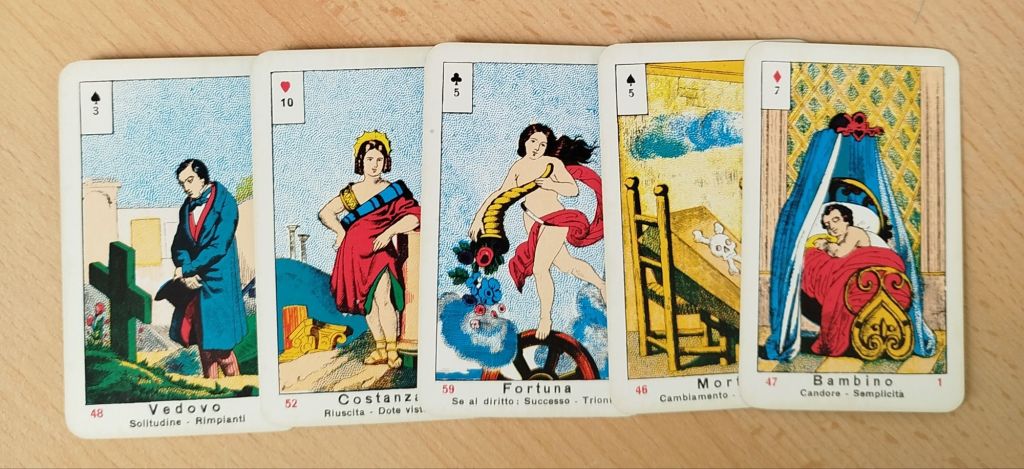
Job Prospects. A Vera Sibilla Reading

The first four cards (Widower, Perseverance, Fortune and Death) deserve special attention. The Widower is the card of “being without”. It also has some affinity with the past, especially when it falls toward the beginning of the spread. The Perseverance card can sometimes indicate that something goes on for a long time (it perseveres). Usually this happens when the cards surrounding it have the same polarity or talk about the same thing.

In this case, the Fortune card is not the same polarity as the Widower, since the former is positive and the latter negative. However, Fortune is followed by Death, showing misfortune or lost chances. In this case, it’s as if Fortune + Death formed a single (negative) card, which is of the same polarity as the Widower.

Therefore the Perseverance card highlights the fact that the querent is without (work) and has been for quite a while, and has repeatedly lost chances or opportunities, or has had repeated misfortunes connected to her career. She confirmed to me that she hadn’t found a job since giving birth to her daughter a few years ago. Actually, she hadn’t looked that much for a job, but whenever she had she had been passed over in favor of someone else.

The Child card is a card of beginning, and in a way it shows the start of a new phase. This fact is highlighted by the Death card being at the end of a negative sequence, so that while it is a negative card in itself (because it follows the Fortune card) it also ends the negative period thanks to being followed by the Child.

The cards following the first five simply described the work environment and the various ups and downs she will face, but they are less interesting.

MQS

The Lost Coins (Example Reading)

Readings about lost objects are hard. I am very much less than infallible in finding them. The reason is quite simple: most questions have a limited number of likely answers and an even more limited number of unlikely ones, so it is usually easier to make sense of the cards. “Yes he’ll marry you”, “No, he hates you”, “There doesn’t seem to be much tenderness left in the relationship, but with some effort you can keep it going a while.” There is, of course, some skill for finding nuances involved, and a good reader will add some details, but in general, the possible answers are relatively limited.

But a lost object can be anywhere, and we can either be very right or very wrong, with little space for “yes, but…” and “no, although…” Especially if we’ve never seen the place where the object was lost, it becomes hard to read the symbolism of the cards without reading our own fantasy into them. As far as I am concerned, much depends on how clear the cards decide to be with me. Since I have nothing to prove, I have no problem throwing my hands up and saying “Dunno” if that is my honest answer.

As we are moving all our stuff from the old house into the new one, plenty of things have gone momentarily missing, in the sense that I don’t know which of the dozens of boxes we’ve brought along they are in, and frankly I’m not too eager to start searching.

Except that I started itching to do some I Ching readings, and I couldn’t find my I Ching coins anymore. I did remember putting them somewhere where “I know I will find them”. The problem is that I have done the same with so many of my things in the last couple of months that the trick doesn’t work anymore. So I asked the cards for a pointer:

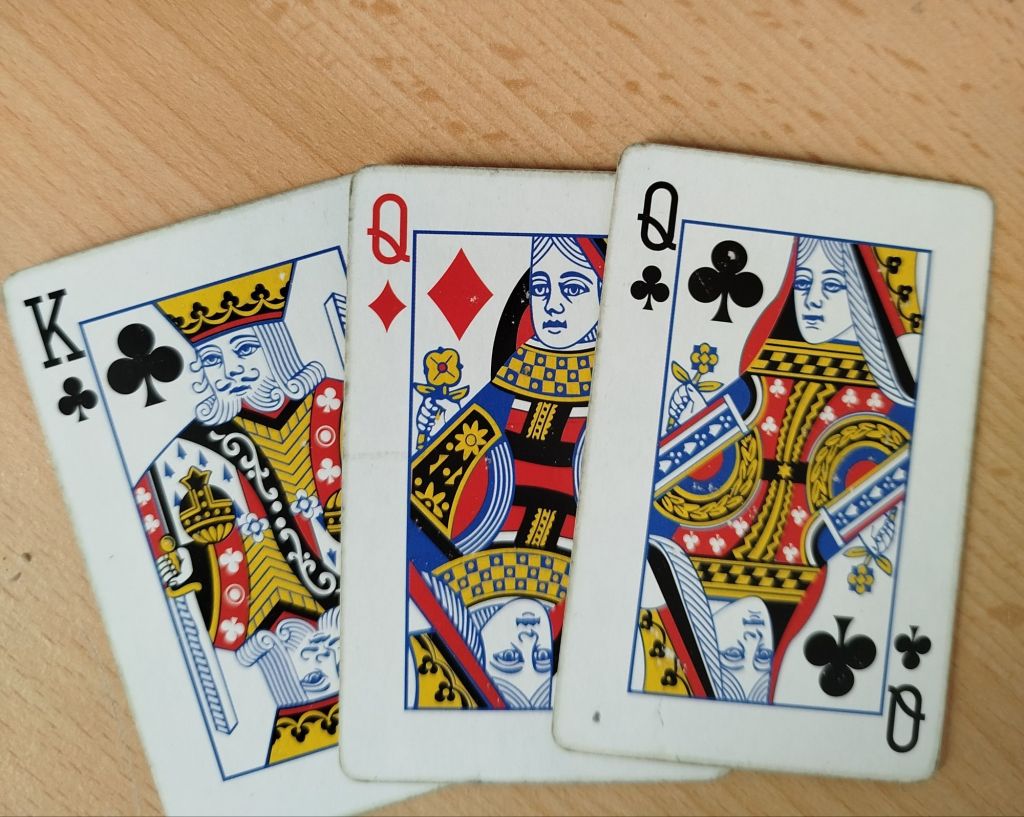
K♣ – 2♥ – 5♣

In general, what makes this reading relatively easy, compared to other lost item readings, is that it does not describe the place where the coins are, but rather their relationship to me. The King of Clubs is my significator. It is followed by a card, the Two of Hearts, which indicates ‘close to home’, but also ‘close’ in general. I know I cannot have left the coins in the neighborhood, which is naturally signified by the Two of Hearts, so I take it to mean ‘close’.

That Five of Clubs is interesting. In general it represents effort, but it is connected also with the body in general, understood as moving, acting ‘machine’, and also the hands. Close at hand, maybe? Or close to my body?

Either reading would have been correct. I found the coins in an internal pocket of my jacket where I usually don’t keep anything and don’t bother looking.

MQS

Spirituality and the Sibilla (Example Reading)

As promised in a previous post, I’m discussing a (rather old) reading on spiritual issues. It is common to believe that the Tarot is better suited to talk about spiritual issues and oracles such as the Sibilla or Lenormand are more useful for practical, everyday events. This is not true. The Tarot can be just as practical, and the Sibilla (and, I assume, other oracles) can be just as clear about spiritual issues. The thing that makes people think otherwise is that they are used to that kind of tarot reading where the psychic spends the whole time pulling pseudodeep psychobabble out of their butt by looking at the pictures on the cards. That’s not a tarot reading, that’s a therapy session (for the reader, not for the querent).

Spirituality is part of real life, and as such all oracles can talk about it, but always in real-life terms. Here the querent was a man and had asked me generically about his spiritual life.

A spiritual reading with the Vera Sibilla cards

The first thing I was able to detect was the presence of the Priest in the second row. The Priest is usually not a real priest, and rather indicates a figure of authority. We also have, it seems, the significator card for the querent, represented by the Boyfriend, or Jack of Hearts, in the first line. The Priest is accompanied by the Dog/Faithfulness. This is a very good card, even outside of a love reading. It shows that, whoever the Priest is, he (or she) is good, trustworthy and has the querent’s best interest at heart. Furthermore, they are true believers.

The Thought card perplexed me a little, so I skipped over it (though you can see that the Thought card is just under the querent, so it turned out that it was the querent’s thinking process setting into motion). However, I did ask the querent if he was in contact with some kind of spiritual authority and he confirmed it, though he said it wasn’t a traditional priest or minister. This doesn’t matter: all kind of spiritual authorities can be signified by the Priest card.

The querent’s line, the first, has the card of God in it. This is the Peacock (when reversed, it represents the Devil and demons, as well as pride and haughtiness). The Peacock indicates totality, wholeness, miracles, etc. when upright. But it is followed by the Hope card reversed. Hope is the card of faith, but it is reversed, thus showing unbelief.

Yet it is not a clear atheism. Look at the Six of Spades, the Sighs card, right between the querent and the combination of lack of faith in God: the querent is sighing about his lack of faith. He is uncertain and tormented. I remember judging that he was probably a wobbly agnostic, and upon asking he confirmed that he had doubts (I didn’t ask him “are you a wobbly agnostic?” of course. We need to be kind to the querent).

It turned out, the querent had long banished spirituality from his life, had gone for an engineering degree, had been active in the skeptic community online, etc. However, some personal experiences had made him doubt his position.

Look at the last three cards of the pyramid. The Prison reversed shows unburdening, unshackling, freedom, etc. (when not followed by negative cards). Then we have the Conversation card. When reversed, it shows change. Finally, the Child, which shows a new beginning. I don’t know about you, but liberation + change + new beginning sounds like a spiritual conversion.

Furthermore, look at the angles of the pyramid plus the center: the Peacock (God), the querent, the new beginning (Child) and the Faithfulness card. This is a very positive indication.

Still, just to make sure, I asked the querent to draw two cards, and these were the Gratification and Fortune, confirming the good outcome.

As far as I know, the querent has since chosen his spiritual path.

MQS