One pro of using more than one system of divination is that sometimes they clarify each other: sometimes one reading is somewhat obscure in one system but clear in the other, and we can use the clear one to navigate the one that has us scratching our heads. Granted, obscurity is in the eye of the beholder, being always a consequence of our own limitations, but it is still an occasion to learn.
I was at the airport yesterday, trying to catch a flight to get back home. Suddenly, and to my horror, I noticed that plenty of flights were being cancelled due to the heavy mist, including one flight on the same route I needed. My first instinct was to cast a Horary chart, asking if I’d be able to get back home.
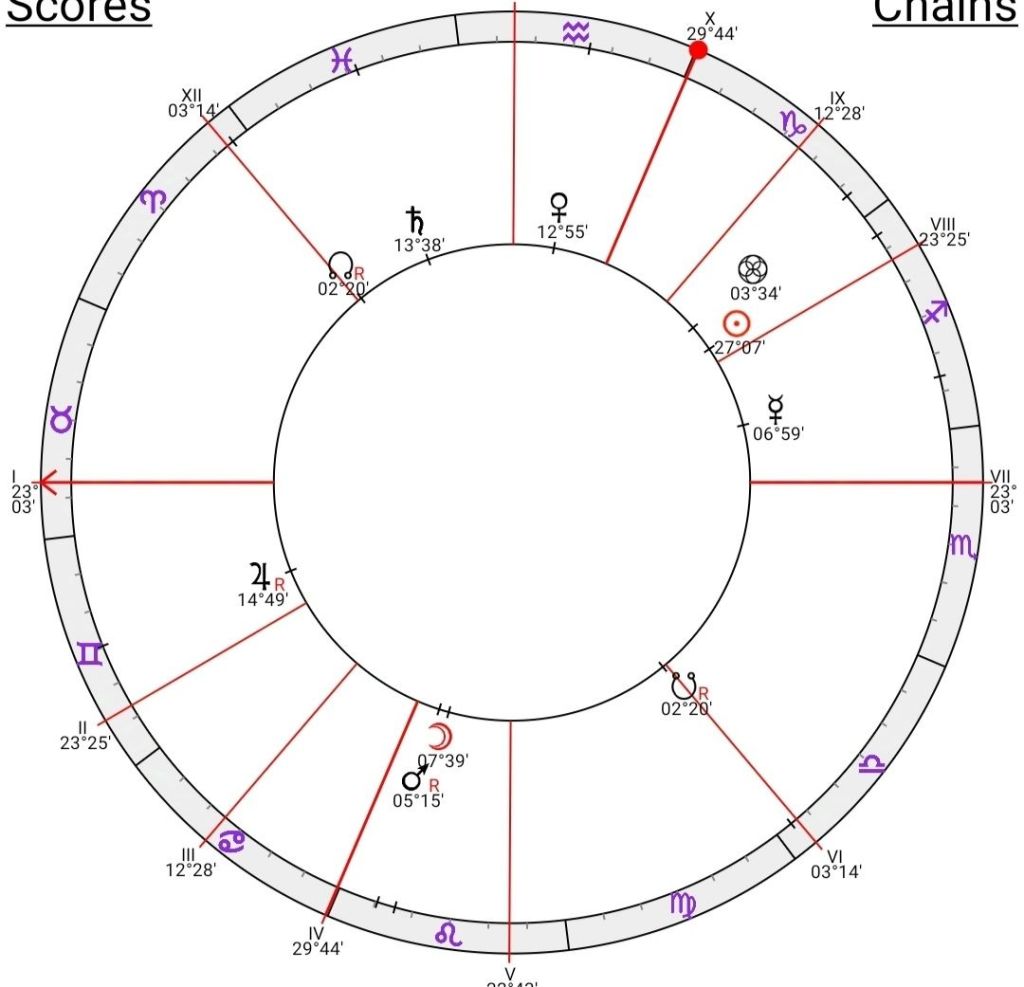
Will my flight go as planned or will it be cancelled? Horary Astrology
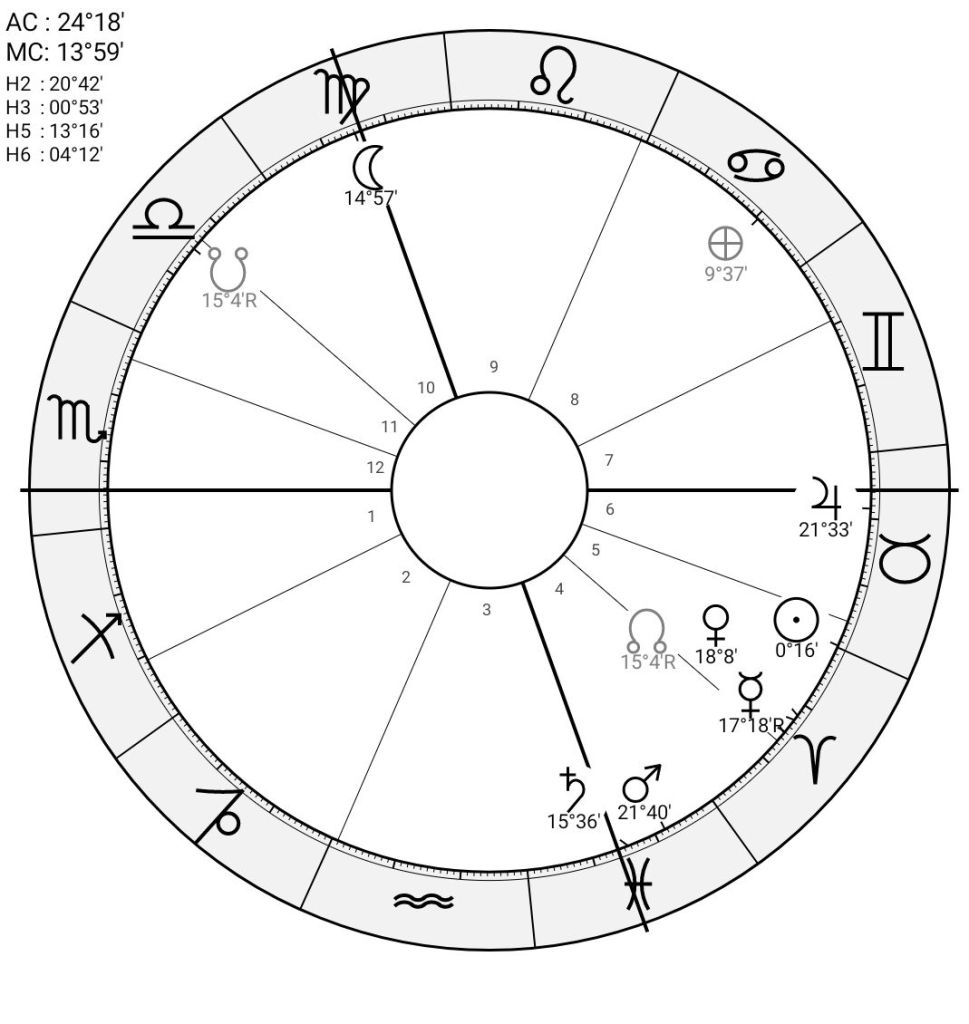
This was my first interpretation. I am represented by Venus, ruler of the ascendant. The place I want to get is my home, which is ruled by the Fourth House and therefore by the Moon (Cancer is on the cusp). The Moon is approaching an opposition of Venus. Bam! The flight will be cancelled.
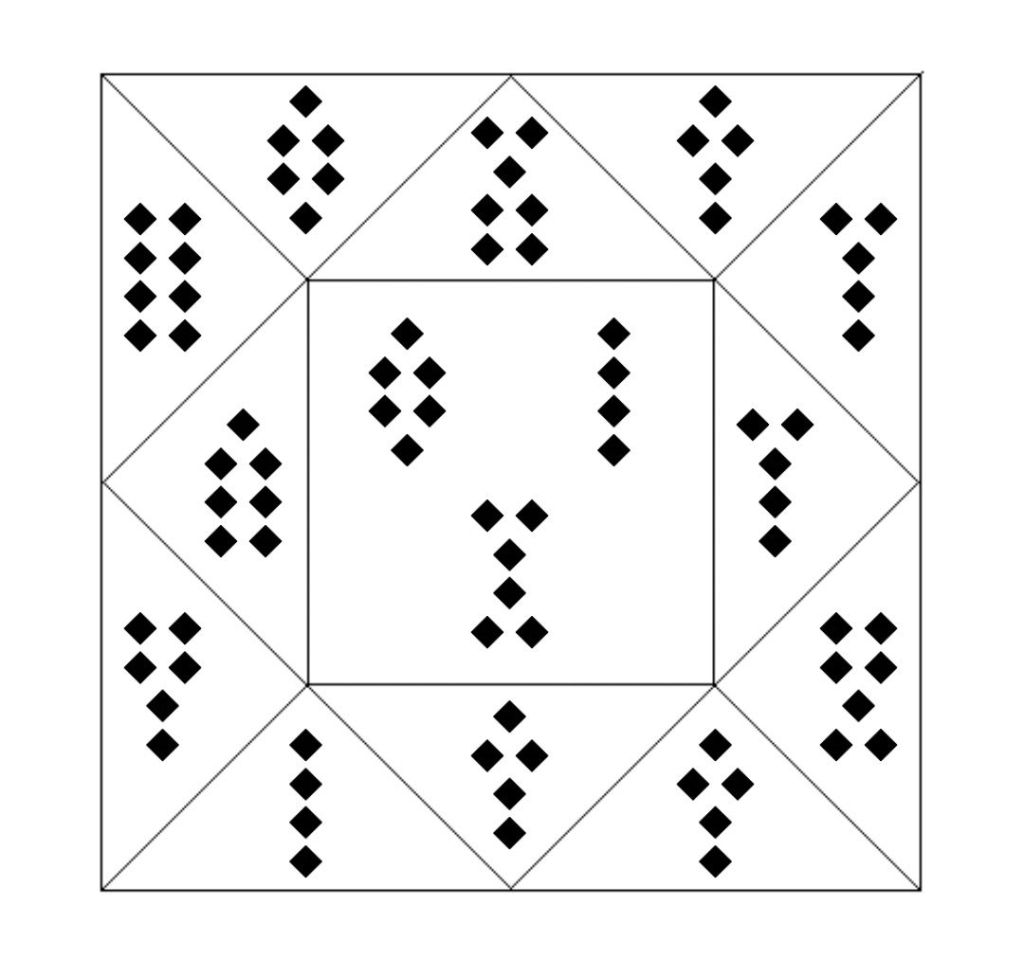
After a while, as I was waiting for information, I did a Geomancy reading on the same question. Here is the chart:
Will the flight go as planned or will it be cancelled? App used: Simple Geomancy
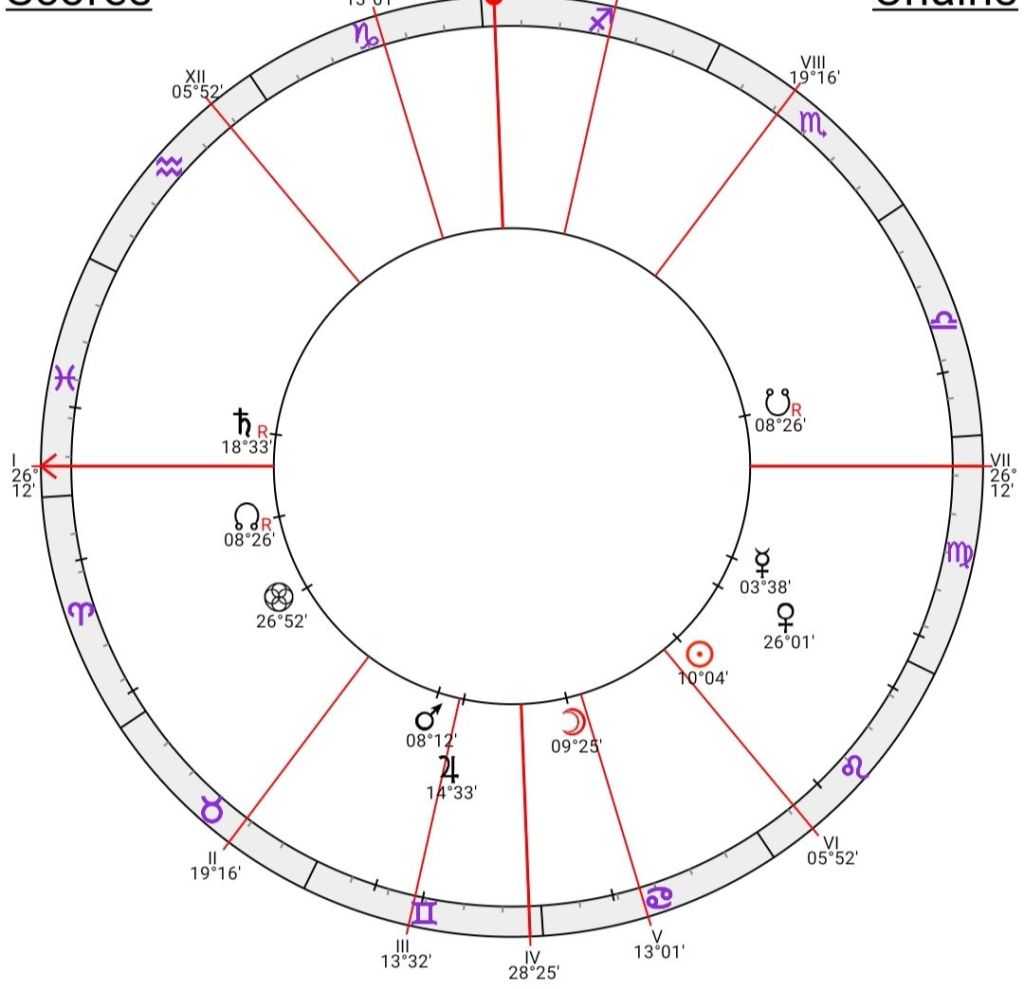
The first thing the struck me is the generally positive Judge, Conjunctio, which arises from Carcer and Via. It argues mobility more than stasis, and obstacles that are removed. The second important point is the figure that represents me: Laetitia in the first. Laetitia represents upward motion. It is an exiting figure, meaning movement. What a wonderful symbol for a plane taking off!
Even if we want to involve the Fourth house, we see that it is occupied by Puella, a mildly benefic figure, which is also connected to the ninth house of journeys (it occupies it). So the journey (Ninth) connects with the home (Fourth).
Obviously,two systems of divination cannot give contradictory answers if correctly interpreted, and the Geomancy seemed rather obviously positive. So I went back to the Horary Chart (again below)
Will my flight go as planned or will it be cancelled? Horary Astrology
I meditated on this chart quite a while (I had plenty of time, after all). Then it hit me. I am represented by Venus. Venus is in the Midheaven (up in the sky) in Aquarius, an *air* sign. Not only, but Aquarius is fixed: it doesn’t change. My being in the sky is fixed. So there will be a flight: I will be up in the sky as planned.
But what about that opposition by the Moon? Well, there was significant delay, so the Moon could show the flow of events causing trouble to my being up in the air.
Ultimately, the Fourth House didn’t need to get involved. The point of the question was not whether I would get home (I would have gotten home anyway at some point) but what would happen to me/my flight.
No matter what kind of divination we practice: if it’s worth its salt and is not just some feelgood angel therapy oracle, it has the potential to deliver bad news. How we handle bad news is a mark of how helpful we are capable of being as diviners.
People can come to us for a variety of reason. They may need reassurance, hope, advice or just a quick look ahead. They may even come to us for fun or curiosity, and as long as they are not disrespectful, there is nothing wrong in indulging them.
The principle of respect for our querent stems from seeing them as a whole person rather than a sack of meat endowed with more than its fair share of doubts. We, as diviners and as handlers of odd devices (decks, charts, counters of various kinds) hold a degree of power over them. It is symbolic power, for sure, but reality itself is symbolic (that’s how magic works), therefore symbolic power is real power, and must not be misused.
Finding the right balance between informing the querent and respecting them can be difficult. It’s all well and good as long as the cards talk about pleasant trips and job interviews. But occasionally we recognize messages that we know are going to deeply upset our querent.
Causing unnecessary anguish is a no-no, and there are things that cannot be said without causing unnecessary anguish (“You’ll die soon”, “You’ll lose the baby). Even less serious topics (at least, less serious than death), such as marital infidelity must be treated with caution. We cannot just destroy whole families willy-nilly simply because our cards seem to hint at untoward dealings.
We must also distinguish whether a querent directly asks for something or something unpleasant simply shows up in the cards. Usually, if the querent asks for something, we can be more forthcoming, if we can speak with tact. If they ask “Will I get the job?”, they need to be able to accept “I’m not infallible, but it seems they appear more inclined to go with someone else.”
If they ask “Is my spouse faithful?” and the cards show clear signs of interference, an answer like “Remember that I could be wrong, but there does seem to be someone who’s trying whisk them away from you. Maybe it’s time to have an honest talk and try to solve the issue.”
Incredibly enough, even some taboo topics may occasionally be addressed in this guise. For instance, there are plenty of non-morbid reasons querents might want to know about death: “Do you think my elderly father going to survive long? I want to be able to visit him one last time but the situation at home is just crazy.”
While we must not delude the querent, we have no right to rob them of all hope. Aside from the mantra “Remember I’m a fallible human being”, and even aside from potential advice we might sometime give the querent to soften the blows of bad luck, there are occasionally ways of preparing the querent for a difficult situation without hurting them.
“Is the pregnancy going to go alright?” This is a question I am become more and more skeptical of answering as time goes by, because there is no way of saying anything other than “yes” and still be able to look at myself in the mirror. If we do find ourselves somehow coerced into answering it and the cards are less than positive, the only thing we may say is something to the effect of “Yes, but remember to take it easy, and the cards are saying you should pay extra attention to the doctor’s orders.”
Where all else fails, human empathy is our last line of defense. Helping the querent even for just some minutes by sharing their burden is part of what we may have to sign up for when we choose the path of divination.
I’ve already written a couple of articles on unanswerable questions. Some of them are unanswerable for logical reasons, others because they ask about something on which no objective standard of measurement exists. Some are also unanswerable for ethical reasons (“Tell me when is the best time to rob the bank.”)
But occasionally someone comes along who asks a question that we instinctively feel is unanswerable, yet we can’t put our finger on why. It’s happened a couple of times to me that someone would ask me something to the effect of “Will I ever be happy?“
Obviously no one whose life is coming up roses would seek out a diviner of all people to ask such a question. These queries are put to the cards or the skies in a moment of weakness. My experience in these situations is that the cards behave in one of three ways. They:
Show the cause of the person’s unhappiness rather objectively, and whether the problem is likely to be overcome over the next few months (usually not)
Are generically very negative, without a specific sense to them
Are generically very positive, without a specific sense to them
In the first instance, the cards usually show the problem not getting resolved, not necessarily because it never will be, but because the person is still knee-deep in it. The fact that they chose to frame their question in such tragic terms tells us that, whatever the nature of their problem, it goes beyond its specific objective nature and it has wounded the person in their soul.
Extreme care is advised in dealing with people in such a state of difficulty. They come to us broken and they should, at the very least, not leave even more broken. Furthermore, it is not unlikely that they have started consulting many diviners, obsessively asking the same question in hopes of getting a magical solution to their issue dropped in their lap. It would be good to advise them to stay away from divination for a while, unless we are capable of pointing out a solution they haven’t thought about, which unfortunately is rare.
When the cards are generically positive or generically negative, they are merely reflecting the person’s state of confusion: the bleakness of their outlook or the irrational hope for unexpected redemption. I don’t think there is much that we can do in such situations, except telling them that their upset shows in the cards and that, life being a succession of phases, even this one will pass. Sometimes, in such situations, talking to them in our quality of human beings is better than talking to them in our quality of diviners. In extreme cases, having a hotline number handy may be helpful.
Really there isn’t much sense in asking this question except to torture ourselves. We as diviners should know this when asking our own questions, but many people don’t, so it’s best to be prepared.
Not every question is fit for divination, and as diviners who get approached by people, discernment and, if necessary, gate-keeping is among our rights and duties. I say this not because I want to feel part of a superior caste of priests, but because our practice should be informed by two great principles: the well-being of our querents and the honor of our art.
It is perfectly fine to ask questions out of mere curiosity or for fun, but the ultimate decision on whether a question shall be put to the cards rests with us. I, for one, have dodged more questions about controversial politicians in the last couple of weeks than in the last couple of years altogether, largely because the question, when boiled down to its essential meaning, was “Is it true this politician I hate is a spawn of Satan?”
Such questions are unanswerable not merely because they are idle, but because they are ultimately unverifiable: unless you are that politician’s cleaning lady you have few ways of verifying my answer. Furthermore, consider this: if my answer is anything except “yes, you’re absolutely justified in your hatred,” the person is going to be inclined to dismiss my answer as superstitious nonsense. Why, then, whould a positive answer be of any value?
But unanswerable questions are not just those that belong to the “is it true that my particular preferences are absolutely valid and I don’t ever need to question them?” category. Some are more tragic. Recently I got asked something heart-breaking: “Is my life still worth living?”
No matter how we slice it, THIS is an unanswerable question, which doesn’t make it a meaningless string of sounds. On the contrary, it is a clearly formulated cry for help. As someone who has been struggling with depression since my teen years and has gone dangerously close to the edge on more than one occasion, I resonate strongly with it. But the fact remains that divination is not the tool to solve this issue.
I refused to open the cards on this question, obviously, but suppose I had, and suppose that, predictably, the cards had shown me the absolute mess that is this person’s life: does this make their life less worth living?
There is no answer. In this case, not because we cannot verify the details (I could easily point at the cards and say “your career is in shambles and your family life is a museum of red flags”) but because the reality of the situation has no bearing on the answer. Worth is subjective. The exact same set of circumstances that might drive someone to walk into a lake with stones in their pockets would be taken by someone else as life throwing a little challenge their way.
Therefore, in this case the question would translate as “What is your personal opinion on what makes life worth living and do you think I still meet those criteria?” I don’t think anyone would be foolish enough to even consider taking such a responsibility for themselves.1 It is much wiser to talk to the person, encourage them to open up and direct them to an appropriate source of (medical) help.
Again, though, the fact that the question cannot be answered does not imply that there isn’t a deep, real, visceral experience behind it. It is just that divination is not the way to go. It is like asking a pair of scales to measure whether you are pretty.
MQS
Furthermore, people in a seriously distressed state are especially prone to esoteric influences, and would to better to avoid them, even if it’s just a simple card reading ↩︎
A couple of weeks ago I received a message about the question of whether we, as readers, risk causing self-fulfilling prophecies with our predictions. For instance, if I tell a querent that the relationship she is in is going to end, I may end up causing the break-up. What follows is a slight elaboration on my response.
First off, we need to recognize that some things we can change or at least improve, others we can’t and they will happen regardless of what we do and what a reader tells us. Most people who go about their life with their brain switched on can recognize this. It is only when we get into delulu territory and body-mind-spirit-section pseudomysticism that we encounter people who deny the existence of unavoidable happenings.
On the other hand, sheer fatalism is also a gross misunderstanding. Consider simply this fact: if two people X and Y are exactly the same and go exactly through the same life experience, except that X also uses divination or consults a diviner, this is enough to tell them apart.
The fact that X knows about what is going to happen in advance is enough to make him a different individual, which in turn is enough to change the nature of his fate, because our ability to change a situation is contingent on our knowledge of what the situation truly is. Even if X cannot change a certain fact in any meaningful way, but knows about it enough in advance that he can make his peace with it, the same event Z won’t be the same if X’s attitude toward it changes, because X is part of the event that takes place in his life, and so if X change, the event changes. Even if X cannot bring himself to accept Z, his knowledge of Z is enough to change Z, because X with knowledge of Z is not equal to X without knowledge of Z.
Fate patterns are a difficult topic to tackle without a previous sound philosophical and occult discussion, and I plan on starting that discussion at some point, once I’ve organized my notes. For now, it suffices to say that we, as readers, can play a rather important role in the querent’s life if we are consulted at the right moment.
Yet, this doesn’t mean that we are capable of empowering querents to always turn their life around, and I don’t even think empowering is our mission: our mission is to provide information. On a number of occasions, especially when I was less experienced, I gave querents the wrong prediction on purpose because I didn’t want to disappoint them, even though the cards were clearly negative: Yes, you’ll get the job, yes the relationship is going to last and be wonderful. But it didn’t happen.
On some of those occasions you may even think that because I didn’t bring up the negative aspects, the querent wasn’t prepared to tackle them, so my not bringing them up may have been just as bad as another diviner handing out negative predictions willy-nilly. That’s because I wasn’t able to give accurate information.
It is nice that some things can be changed even if some things can’t, but unfortunately we don’t always know which is which. Therefore, we must also recognize that we have a degree of power over our querent just by virtue of using odd, mysterious counters to give our predictions, and we must not abuse this power.
Whenever possible, we should either frame our predictions as potentials and/or accompany them with positive suggestions. These suggestions, though, must ALWAYS be based on what the oracle describes, never on vague self-help platitudes. Sometimes (many times) it is best to highlight critical points so that the querent can become conscious of them (e.g., “you know, this relationship is headed down a pumpy road. You should address x, y and z if you want to try to make it work”) while avoiding drastic predictions unless necessary.
Furthermore, we must never frame our predictions in such way as to take away all hope. It is not our right to do so. Deluding and disillusioning are the two capital sins that we must avoid, even though striking the right balance is sometimes hard. There is plenty of space between being a pushover to our querent’s wishes and being an insufferable sassy tough-love prick.
If there are positive aspects to a situation, we should emphasize those and try to put them at the center of the querent’s life so that they can address the negative points more positively.
Finally, we ought to always remind our querent that diviners are people and are therefore fallible. In a world where doctors, lawyers, judges, scientists and bakers can get things wrong it would be absurd to expect diviners to always be right. Always encourage the querent to take your predictions as an additional input.
I had a conversation with a reader of this website, and he told me that the main obstacle in learning how to read the cards is that he can’t put the meanings of the cards together to form a clear picture of the situation. The example he used was that it may be hard to tell a querent that they are at risk of getting fired, when in fact the cards may be predicting a fight with a coworker or a demotion, or some other work-related problem, but not a firing.
Divination is an art in itself, and it does require practice and patience. For the first couple of years after being taught cartomancy, I couldn’t put two card meanings together to save my life, even if it was obvious. I still remember my teacher’s dismayed expression when I couldn’t tell her that “talking” and “work” meant, quite obviously, “talking at work or talking about work”. Yes, it is obvious, just like it’s obvious that you first put one leg forward and then the other in order to walk, yet it takes us time to learn.
There are plenty of reasons why divination is hard, and lack of talent is only rarely an issue. Most of the times, we are simply experiencing the same hardships we would face when learning a new language, and most people can learn a second language if they put their mind to it.
Furthermore, I find that we often feel the need to overperform in order to convince the querent we are not frauds, and we do so by wanting to give them an absolutely accurate, unambiguous and immediately recognizable picture of the future. Of course, it would be nice if every divination session was as clear, but we are limited beings and we must be grateful for what we can do with the hand we are dealt (quite literally).
What do you do if you want to say ‘apple’ in a foreign language but you just can’t remember the name? You get creative and go back to the language’s building blocks: you describe the apple. “A round, red thing to eat.” This may sound weird and it is a bit vague, as there are other round red things we can eat, but it does help you narrow down the thing you want.
The same happens with divination. Sometimes we just can’t put the building blocks together into a single unambiguous picture (“you are at risk of getting fired”). But we can always describe what the cards are telling us: “I see some potentially upsetting circumstances surrounding your career.”
This is very vague, but it’s a start. Once we have narrowed down the topic, we can look for cards and combinations that give us additional clues: “These upsetting circumstances seem to involve a man, possibly a boss, who causes you trouble, and as a result I see the potential for some money problems.”
This is still not unambiguous: there are plenty of events that fit the description, e.g., being fired, being demoted, being assigned to an unrewarding task, a boss being replaced by another one that is so terrible the querent chooses to quit, etc.
Yet in spite of only describing the outline of a situation instead of naming it specifically, this is already very helpful to our querent, because we are giving them rather specific information they can use in preparing for difficult times ahead in their career.
We can also come up with a number of likely scenarios that fit the description as examples for our querent, and often they will help us fill the blanks (“Oh right, there’s that new project coming up no one wants to take on” or “Oh right, my boss has been talking about relocating for some time now”)
Note, also, that it is perfectly acceptable to voice our insecurity to the querent: “It is something between X1 and X10, and it seems to me like X1 to X3 are more problable, but I could be wrong”.
Once the prediction has come to pass, it is always possible to go back and see if perhaps we couldn’t have been more specific. This is a very important part of learning: there’s always something we miss, some turn of phrase of the cards we have misread or some meanings we have misapplied or even forgotten.
Still, the aim of divination is to provide help to people, not to impress them, and we are of service in the measure that we can point them in the right direction. If we can’t give them precise indications on the path ahead, “Between North and West, but more West than North” is good enough.
As I already talked about ad nauseam, some months ago hubby and I bought an apartment. During that period I kept track of the situation using various divination tools, including Horary. This is a reading that I didn’t cover, since I didn’t have any feedback for it yet.
My question was simply if we would be happy in the new home. Here is the chart.
Will we be happy in the new home? Horary question. App used: Aquarius2go
We are represented by the First house and the planet ruling it, Mars (ruler of the rising sign Scorpio). As for which house represents the new place, I believe there are two schools of thought: either the Seventh House (that place there, as opposed to this place here, which is the First house), or the Fourth House of real estate and umoveable property.
The chart seems to guide us to the Fourth House. Plus, usually the Seventh house is reserved for hypothetical “there” places, whereas we had already bought the new place (therefore it was our property) and I was not interested in a comparison between the old apartment and the new, but only in the new place (I already hated the old one).
The Fourth House thus represents the apartment. Jupiter, ruler of Pisces, is the house. And look! Mars, our significator, is right inside the Fourth House, which is good and a symbol of liking the place. It has no major dignity in it (no house rulership or exaltation) but it is dignified by triplicity, term and face. So while it is not the ultimate castle of our dreams, it is very comfortable indeed.
The place’s significator, Jupiter, is conjunct the Seventh cusp and thus angular, and sextiles our significator. A sextile is a positive aspect of ‘friendship’. All in all the picture that emerges is not perfect, but it is quite satisfying.
However, look at the Moon! The Moon is about to oppose Saturn, which is right inside the Fourth cusp, afflicting it. There is some kind of problem ahead. Pinpointing it is not very easy, but considering that Saturn is inside the house representing the place itself and that Saturn rules the Third house, my first instinct was that there might be issues concerning the neighbors (the other people who live in the building). These issues would not be major, as the picture remains generally favorable, but they would be serious enough to be worth mentioning.
Fortunately, a couple of months passed and we saw that the neighbors are generally well-adjusted people. Furthermore, the apartment is, in fact, very comfortable.
What did turn out to be the problem was that the neighbors started some major fuss about the manager of the building as, according to them, he is incompetent and charges way too much for his services and even skims off on the money required for taking care of the building. The thing escalated so far as to almost end up in court, and finding a new manager is costing us quite a lot of time spent traveling and talking to new candidates.
A recent comment by a visitor of this website has inspired me to write an article about what makes divination go south, whether it’s card reading or something else. I have already shared one or two readings I got wrong, but in the future I would like to share more of my hardships as well as my successes, for two reasons: 1. it gives a fairer representation of how divination works and 2. it doesn’t discourage those who are studying the material I provide (I often get messages from people despairing they will ever be good diviners)
The reality is that divination is a human activity, and like all human activities it can go wrong. In a world where lawyers, scientists and doctors can be wrong (and not seldom), it’s unclear why we would expect fortune-tellers to be infallible.
There can be a variety of factors that make a reading go south. Here’s a bunch, in no particular order.
The querent is too emotionally volatile
Usually, the querent’s attitude doesn’t matter that much. However, it has been my experience that when a querent is in a state of utter and extreme desperation or emotional volatility, they will skew the reading in one direction or the other. This is rare, but it does happen on occasion. Once a friend who was looking for a job and was absolutely desperate asked for a reading and he pulled ALL spades. He still got a job around a month later. The cards were just reflecting his emotional turmoil.
Emotional involvement is also usually not good when reading the cards for ourselves. My personal experience is that if I read for myself about a topic I don’t care too much about, the reading will be largely accurate, while if I read about something I care very much about, the cards will show me either what I hope or what I fear.
Note though that there are divination tools that work better when the querent is very emotionally involved. This is the case, for instance, for Horary Astrology, where there are no counters to manipulate and therefore a relatively strong emotional push is required for question and answer to align.
The reader isn’t grounded enough
This is more common. Divination is not an assembly line type of occupation. We are dealing with a world that is, in a very real sense, divine and that eschews the mechanic and repetitive.
The diviner needs to be relatively at peace with themselves before performing a divination. I say ‘relatively’ because we don’t need to always be at our best (otherwise we’d never be able to divine). Certainly we need to be capable of detaching at least momentarily from our deepest worries and hopes. Fits of ecstasy and cheap mysticism are also to be avoided, as the best attitude is one of sober helpfulness toward the other.
There are some partial exceptions for ‘inspired divination’, such as mediumistic spiritism, but I don’t cover these topics on this website as I avoid these practices like the plague (I had a distant relative who was an excellent natural psychic and ruined her life in her attempt at constantly staying in the required state of passive receptivity).
The reader simply doesn’t always interpret the medium right
This is obvious, and I’ve talked about it at length, but it bears repeating. Divination is a language with no native speakers. We must learn it as if it were a foreign language. or, if you are romantic about the universe and think divination is our original language, then we must relearn it, but the end result doesn’t change. Like with all secondary languages, we are bound to make mistakes.
The best we can do about it is strive to correct our mistakes and be upfront with our querents that we are not offering miracles but just help in widening their view of their own life, of where it’s coming and where it’s directed.
Drawing wrong conclusions from right premises
This is another important pitfall, and it is a particular variety of ‘not reading the medium right’. As diviners we must understand that certain things can be changed and certain things can’t. Most divination tools are very upfront about it. If they say the thing you want cannot be achieved, then it cannot be achieved (unless we are interpreting the medium wrong, see above). If it says the thing you want will fall in your lap, then it will fall in your lap. Period. But if the medium says what you want is hard, it doesn’t mean it’s impossible, just as when it says it’s easy it doesn’t mean you’ll achieve it.
As diviners, sometimes, we feel we must give our querents more certainty than we are entitled to give them based on our divination tools. If the querent wants to become a writer and the cards show that writing comes easy to them, it doesn’t mean they will become a writer if they don’t put in the effort. Usually, in such cases, the lack of effort does come up in the cards as a warning, so that the prediction will sound like: you are very talented, but unless you actually spend time honing your craft, you won’t amount to much. This, too, is a valid prediciton.
All in all, we must be careful to distinguish what the medium says from what we want to tell the querent.
I had a quick but interesting exchange of emails with a reader of this blog, and they asked me my perspective on the ethical side of prediction. One of the questions was if I share the belief that we shouldn’t answer questions that don’t directly relate to the querent and their actions, especially if they involve reading other people’s mind (e.g., “Is he thinking about his ex?”)
The Three Types of Diviners
First off we must recognize that, nowadays, there are many diviners who do not even think that prediction is possible. Then there’s those who think it’s possible but not desirable. And then there’s those who think it’s both possible and perfectly legitimate. If you know me, you can guess which camp I belong to.
The one thing almost all diviners of almost all strands can agree on is that divination should leave the querent with more information than before the reading took place. It is the nature of the information that is controversial. Many (most, perhaps) contemporary diviners believe the information should be of a mystical/ethical nature and should guide the querent’s action rather than foretelling future events or things the querent has no control over, such as other people’s thoughts beliefs, which is seen as prying. The idea is that to do otherwise is to disempower the querent by putting the center of power outside of them.
To which I say: We are not discrete atoms living each in its own self-made, self-referential reality, no matter what the manifesting girly-pops on Tiktok say. The center of power is not within us, at least not in the sense that most people think.1We exist enmeshed in an infinitely complex chain of actions and reactions, and our degree of control over them is objectively limited.
We seek to steer our life through the chaos of existence by levereging the information we have, including our knowledge of what (we think) other people’s beliefs and motivations are. In so far as divination gives us information and knowledge, it helps us increase the degree of control we have on our life (though this control can never be absolute). As such, it is perfectly legitimate to want to know what other people think.
The idea that we can only tell the querent what to do as a discrete, atomized individual is faulty for a variety of reasons. As said, the first reason is that we are not atoms. Only first world people with first world problems can seriously believe such postmodern crap (try to go to a starving child in a war zone and tell him he just needs to manifest harder). In reality, how other people think and act has very much to do with how the querent will or can behave, and so the querent’s expectation of being told such information is understandable.
The Two Should’s
The second important reason is that the idea itself that there is an objective cosmic measure of how we should act which the diviner must relay to the querent is silly. How people should act is between them and their god, and diviners are well advised to stay out of it instead of trying to play the role of ruler-wielding metaphysical pep-talkers (whenever you find someone who acts like this, run! Those who can live their life, do. Those who can’t, become life coaches.)
The word “should” has two different meanings: technical (“you should take the bus now if you want to get there on time”) and moral (“you should think about those less fortunate than you”). In the first sense, divination has some use, but only in the sense that the diviner, after assessing the situation as it emerges from the cards or chart, and taking what the querent hopes to achieve into consideration, gives them advice (I’ve talked about this here). In this sense, knowing what someone else thinks can be valuable (“he is not thinking about you and he won’t for the foreseeable future. Maybe you should start thinking about putting yourself back on the market”).
From a moral standpoint, divination’s use is very limited and it can become a dangerous tool of delusion or deceit. Example: “Should I have an abortion?” there is absolutely no way of answering that question. Some quick research online will show that there are all kinds of stances on abortion, ranging from believing it should never be had even if it means the woman will lose her life to believing it’s a moral duty of every woman to have one to stick it to the system, with a variety of more moderate solutions in between.
Since there is no consensus, such question essentially translates to “what is your stance on abortion?” Why you should regulate your life based on the personal moral beliefs of someone shuffling pretty cards on the internet is a question the answer to which is probably found somewhere in California.
“But isn’t divination a form of communion with the divine? Shouldn’t the divine know what’s right?”
Divination is most definitely a form of communion with the divine, but the idea that God has any kind of moral preference is, as far as I am concerned, questionable. People tend to patch their idea of God together from their moral and political prejudices. Somehow the God of the reactionary is always a hillbilly and the God of the revolutionary is always a hippy.
Divination lets us partake of a small share knowledge that one would usually get only if he were God, but this knowledge is very practical and is a tight condensation of that which happens, has happened or will happen in real life: Dante, in describing God, imagines it almost as a compressed version of all that happens in the created world, apprehended in the single blink of an eye.
The above doesn’t mean that it is always wise to answer any question the querent puts to us. “Is he thinking about someone else?” can be two very different questions depending on whether it is being asked by a person looking for closure or by a crazed monomaniac bombarding the diviner with the same query over and over. That divination tends to attract a less conservative clientele is not an earth-shattering revelation, so we do need to exert caution in choosing the questions we are comfortable answering.
Caring For Others
My one guiding principle is that divination implies care for another human being. But what does ‘care’ mean here? Does it mean caring for their ‘evolution’?
Well, no. First off, I think it is very questionable that the concept of evolution should be applied to spirituality. It is generally brought up to make pseudospiritual gibberish sound scientific–it’s a trend that dates back to the XIX century–yet those who use it end up employing a concept of evolution that is more Lamarckian (the giraffe stretches its neck to reach the leaf, thus evolving) than Darwinian (the giraffe born with the shorter neck simply starves, thus ridding the gene pool of its inadequacy, and can do nothing about it), and therefore completely unscientific.
Secondly, again, who am I to tell the querent what the next step in their evolution is supposed to be, especially since there is no consensus on objective standards? Divination can point out shortcomings in the querent’s behavior, but not in a moralistic sense. The cards, for instance, can say, “he left you because you tend to spread your legs more than a ballet dancer” but that’s a mere explanation of the causality behind an objective situation: Y derives from X. The cards are no bead-clutching confessor and I don’t aspire to be one either.
For me caring for another human being means seeing them in their struggle to reach their goals and offering them a bit of additional information that they are at liberty of using or leaving. The main question I ask myself when asked to do a spread is: am I offering information? In the example above of “Is he thinking about someone else?” the person looking for closure is asking for information, while the monomaniac isn’t. It is that simple.
I will certainly talk more about the issue in the future, but I think so far the main point is that divination is a tool for intelligence-gathering. As long as it offers intelligence it is a form of communion with the divine. If it doesn’t, it reinforces destructive trends and is best avoided, but this depends less on the question and more on the querent’s attitude.
MQS
From a philosophical standpoint I can accept the idea that the ultimate reality resides wholly within me, but if we accept this, then it is present just as much inside everything else, including in the people and situations that make my life miserable. ↩︎
Traditional astrology is full of interesting techniques. One of these, which is especially useful in Horary Astrology, is translation of light.
The most generally accepted definition of translation of light is when a planet that has conjuncted or aspected one significator goes on to conjunct or aspect the other significator, thus perfecting the matter. In other words, since Horary heavily depends on the contact between significators, which shows interaction, translation of light shows this interaction happening usually thanks to third parties.
The most common culprit when it comes to translating light is the Moon, because she is the quickest of the traditional planets, as well as having the metaphysical role of spreader of influences, whereas Saturn can never translate light under normal circumstances, being the slowest of the seven planets (Saturn cannot apply to an aspect to another planet, and it can only be applied to by others).
In general, in order for translation to be effective, it must happen by a positive aspect (trine or sextile) or at least with reception. Some old authorities even consider reception to be a requisite. This is probably on the theory that the translator must “receive” the significator’s light that it then translates to the other significator. As the example below shows, this is being way too precious.
When Will The Package Arrive?
I had bought a book from the US and wanted to know if and when it would arrive. I’ve always had little luck with stuff from America, as it often ended up stuck at customs and I always had to pay extra.
When will the parcel arrive? Horary astrology example. App used: Astro Charts
I am signified by Jupiter, ruler of the Ascendant sign Pisces. The seller is the Seventh house ruler Mercury, but I am not interested in the seller, but rather in his stuff, which is represented by the second house from the Seventh, i.e., the radical Eighth house. Therefore, the book is signified by Mars, ruler of Scorpio.
Jupiter is in detriment and in a cadent house, but that is no big deal: it merely shows I can do very little to change the situation (I can’t just teleport to America, take the book and teleport back to Germany.)
Mars is also in Gemini, and will conjunct Jupiter eventually. However, before that, Jupiter is sextiled by the Sun. What is the Sun? The Sun is the ruler of the Sixth house, which it also occupies. The Sixth house is the house of servants, including couriers, since they perform work for us.
The Sun’s previous aspect is to Mars, the book, and its next aspect is to Jupiter, me. This is a very good example of translation: the courier getting the book and taking it to me. This seems like a plausible cosmic representation of the situation.
Timing
The Sun perfects its sextile with Jupiter in around five degrees, corresponding to five units of time. The prediction was made on August 1. With the Amazon order page saying the package would arrive on August 11, the more likely unit of measure is five days. This meant the book would arrive around August 6 or 7. It arrived yesterday, on August 6.
A note on reception
Note that there is no major reception at play here, so clearly the positive aspect suffices. The Sun is received by Jupiter by face and triplicity, which undoubtedly helps things, but this only shows my receiving the package. Mars has no reception with the Sun, yet the Sun still collected Mars’ light to take it to my significator.