Category Archives: astrology

Robert Fludd’s Geomancy – Book II Pt. 7

Previous / Back to Index / Next

Fludd discusses the signification of a figure springing from one house to another.

Of the signification of the 16 figures, when they duplicate in a question, that is, when similar figures are found in different houses, such as two Via, two Populus, etc.1

The figure in the first house means, when it is duplicated in the following houses:
In the Second, especially if it fortunate and fixed, and so the opposite, which is valid for all other houses.2
In the Third, good situation between relatives, brothers, sisters or neighbors.
In the Fourth, it is a bad mutation3 but not excessively so, unless the figure is Cauda Draconis.
In the Fifth, mirth, vivacious and gluttonous companions, new clothes, music, melodies, antique things, good according to the mind’s opinion,4 so that one couldn’t wish things to be better, unless the figure is Cauda Draconis.
In the Sixth, sickness, tribulations, fears.
In the Seventh, fearful things due armies or evil women; good [signification], unless Cauda or Via are there, which denote all evil in this house, unless a question has been made for a gathering, or for marriages and enemies, for otherwise they show danger.
In the Eighth, evil, great wrath or death or injury, loss, hurtful words, evil tribulations, but if the figure is good, it signifies the acquisition of the inheritances of the dead.
In the Ninth, something good, a firm and stable change to acquire some thing for another,5 and to negotiate some religious business or of the Church, or with ecclesiastical men or people, or with messengers or those who return from a journey, unless Cauda and Rubeus come up in a question made for a journey.
In the Tenth, all good, so that the thing cannot be better, and especially for the acquisition of honor and dignity, unless Cauda or Rubeus are there.
In the Eleventh, good, so that it is not better in the question propounded; for it signifies hope, a good friend, especially if it is Major, Via or Acquisitio.
In the Twelfth, the querent will fall into some tribulation, or a serious illness, or the loss of some thing, or defiance from enemies; nor can the thing be worse if the figure is Cauda.

The figure in the second house means, when it is duplicated in the following houses:
in the Third, gain from parents, brothers, sisters or neighbors, if the figures are good, but if bad, the opposite.
In the Fourth, what the querent thinks of gaining from his father, or from some great lord [he will get], if the figure is good; if bad, [he won’t get them].
In the Fifth, what the querent thinks of gaining from food, or clothes, or news that will come to him with letters, or loss by fire.6
In the Sixth, future illness of the family, or some loss, or fear, or great tribulation, or disease, or some evil thing.
In the Seventh, marriage, loss from a woman, great enmity for the querent, or robbery, or the thoughts of women about lust, or quarrels, threatening words, change from place to place.
In the Eighth, the return of an absent person, or of some other member of the family.
In the Ninth, gain for the querent, religious or ecclesiastical, or a priest, or some other similar thing.
In the Tenth, the Necromantic arts,7 or that the querent will win the love of some woman, or Lord, or great Majesty, or sciences according to the good or evil of the figures.
In the Eleventh, fortune in that house, or in the family, or through the family, or through gain, or friends, or merchandise; for this is the force and power of the whole question.
In the Twelfth, the imprisonment of some member of the family, or a serious illness, a serious molestation, or the destruction of someone from the family, of what you have gained, great accidents, or future tribulation and anguish.

The figure in the third house means, when it is duplicated in the following houses:
In the Fourth, brothers, sisters, companions, neighbors, messengers [arriving ] to the questioner, profit or loss according to the nature of the figures.
In the Fifth, joy, gladness, speedy news from friends, letters and messengers.
In the Sixth, tribulation, diseases, some fear, loss through a servant, or machination, or evil enemies.
In the Seventh, quarrels, change of place, there will be hatred and discord between brother and sister, anger against the questioner, marriage, etc.
In the Eighth, death or danger from the past, thoughts about a woman, or about one’s enemies, or fear, and future profit from evil thoughts.
In the Ninth, an occasion for the Clergy, great journeys to be made,8 benefits of the Church, some great prelate or honor.
In the Tenth, brothers and sisters will attain to some arts,9 or great marriages, or great dominion, or they will become great prelates, or be exalted to honor.
In the Eleventh, fortune or good favor from someone.
In the Twelfth, imprisonment, long illness, occupation, or entering into [a period of] tribulation, from which there will be no easy way out.

The figure in the fourth house means, when it is duplicated in the following houses:
In the Fifth, the father will rejoice with his children, or an uncle, or a relative, or some friend, or the father will make a profit through his children.
In the Sixth, the father will soon fall ill, or he will be forced into great labor in his house, or in the town where he lives.
In the Seventh, marriage or enemies, or lascivousness, or a change of state, or a change of land.
In the Eighth, mortality will enter the land10 and inheritance of the questioner, or some tribulation, or, if he is outside his country, a return.
In the Ninth, the death of priests or their loss in the Church.
In the Tenth, the questioner’s honor, gain, riches.
In the Eleventh, the questioner will be fortunate in some profitable matter, so that he will suddenly make a profit in it, and indeed through some of his friends, or some of the querent’s friends will give letters to those living in his house, which will bring the questioner much profit.
In the Twelfth, long anguish and sadness, illness, envy, betrayal of the land of some lord, or of someone of his blood, but if the figure is good, it will not do much harm.

The figure in the fifth house means, when it is duplicated in the following houses:
In the Sixth, disease by contusion or corrosion, or in other such ways, or news of children, the capture of some small beasts.
In the Seventh, a gathering for a wedding or for trade, the joy of friends, fortune for women and children.
In the Eighth, mortality, and the danger of some evil to come, the return of an absentee, and letters of joy, profit or news.
In the Ninth, the son of the querent will be a cleric or a priest of the Church or a religious person, or he will make a great and long journey, or will have great joy through the honor of the Church, that is, through a man of the Church.
In the Tenth, the son will have dominion, and the mother and sister will rejoice or find joy, or some assistance from [those in a position of] honor, or profit from the lord, or a prelature, or he [the son] will be a judge or teacher.
In the Eleventh, the son will have dominion or fortune over his enemies, or in trade or in a similar matter or in news, or his friends will rejoice over his children.
In the Twelfth, illness, imprisonment, great enemies for children, or some loss for the querent, or strangers will rejoice.11

The figure in the sixth house means, when it is duplicated in the following houses:
In the Seventh, disease, or the servant or the woman of the querent, or his companion, will suddenly become angry or will end up among enemies, or the querent and his woman will fall into the hands of robbers, or disgrace, which they will nevertheless escape from as much as possible.
In the Eighth, the servants or the beasts of the querent will fall into danger or tribulation, pain or sadness, and he will be beaten, or he will lose some object, and he will be absent and in the company of enemies of his house, or the woman of the querent will be familiar with someone else.12
In the Ninth, the servant or the animals of the querent will make a fortunate path, diseases will befall a cleric, or will hinder his exaltation, or the servants will have the company of the clergy, and especially with good and fortunate figures, such as Acquisitio and Major.
In the Tenth, those who will remain in the place about which the question was made will be sick or oppressed by some Lord.13
In the Eleventh, fortune, and your enemies will envy you.
In the Twelfth, a disease among one’s animals, or the querent himself will fall ill or be imprisoned and suffer loss either through useless beasts or through a long journey.

The figure in the seventh house means, when it is duplicated in the following houses:
In the Eighth, the death of one’s woman, iniquities and all those things which pertain to the seventh house, namely lost merchandise, etc.
In the Ninth, the companion of the querent will return to his country, and the clergy will be enemies to the querent, or his wife will enter religious life or go on a long journey.
In the Tenth, honors to those who are represented in the seventh house, or the servant of the querent will be a familiar of his wife, or of his enemies.
In the Eleventh, a friend will immediately become an enemy, or someone will immediately become a friend to the querent,14 or he will gain in some matter, or will suffer some loss from his friends.
In the Twelfth, occupation of large animals, or the querent will fall into a serious and long illness, or imprisonment, or a long journey, or poverty, or that some letters will bring him loss in a short time, which should be kept secret as proof.15

The figure in the eighth house means, when it is duplicated in the following houses:
In the Ninth, a judge of the enemies or of the woman or of the friend of the querent will attain great exaltation in the church, or he will be absent on a journey, or death threatens someone.16
In the Tenth, loss for the querent, or the death of the lord, or a defect in good will, or an impediment in some thing, or the absence of some lord.
In the Eleventh, the death of the querent, or he will acquire some thing, or the inheritance of a dead man, or that while absent he will acquire friends, or that friends will restrain the hatred of the querent.
In the Twelfth, secret enemies of the querent, who labor mightily to oppress him, or while absent he will be imprisoned or sick, or while imprisoned he will die.

The figure in the ninth house means, when it is duplicated in the following houses:
In the Tenth, being friends with priests or clerics, or the querent will suddenly marry a wife, or messengers will come from some place, or from the querent’s mother.
In the Eleventh, the journey of women, or a cleric will be your friend, or your fortune will be in the church, or you will have possessions in the church.
In the Twelfth, sadness during a the journey for the querent, or he will have trouble with his horse, or a cleric will be imprisoned. This is a bad place for the querent.

The figure in the tenth house means, when it is duplicated in the following houses:
In the Eleventh, the house or place of some lord, the completion of his fortune and hope, or that he will be a friend to some great lord, through whom he will be fortunate.
In the Twelfth, that the questioner will be shortly in great tribulation or illness, or will be imprisoned, or his enemy will be made a priest, and that the petitioner will have great loss from beasts.

A figure existing in the eleventh house signifies, when it doubles itself in the twelfth house, imprisonment, hatred of enemies, a similar thing.

MQS
Footnotes
  1. That is, if the same figure is found in two different houses. This, as we shall see, is generally interpreted as the two houses being linked together. Some of Fludd’s interpretations are straightforward, others rather obscure. Similar chapters are often found in other handbooks of geomancy as well. Their value consists not so much in their offering interpretations that need to be memorized, but rather in the kind of mental exercise that they allow the reader to engage in. ↩︎
  2. This sentence doesn’t mean much. Fludd is simply asserting that the signification of the link between the two houses is colored by the positive or negative meaning of the geomantic figure. ↩︎
  3. Mutation in the sense that the figure in the First house moves to the Fourth. ↩︎
  4. Somewhat obscure. I think Fludd means that this connection between First and Fifth houses is good concerning whatever the querent is thinking about. ↩︎
  5. Possibly referring to a business-related journey ↩︎
  6. Unclear what fire has to do with this house. ↩︎
  7. The connection of the Tenth house with necromancy is unclear. ↩︎
  8. Probably due to the connection of Third and Ninth houses, which both pertain to journeys. ↩︎
  9. The Tenth house is the house of art in the older Aristotelean sense of poiesis, i.e., practical science, which is what allows people to gain money. In short, it is one’s learned trade. ↩︎
  10. The land is a Fourth house matter. ↩︎
  11. Joy is here brought into the equation by the Fifth house. ↩︎
  12. That is, intimate. Older astrological texts are filled with lists of testimonies to look for to establish whether the querent’s wife is faithful, or even if he is exploring herself. I suggest we leave these things in the past. Still, from a purely didactical standpoint, Fludd’s paragraph makes sense. ↩︎
  13. I have no idea what Fludd meant. ↩︎
  14. Here we see how ambiguous this type of interpretation can become if we don’t keep the question in mind: it could go either way, namely that a friend (Eleventh) becomes an enemy (Seventh) or that someone else (Seventh) becomes a friend (Eleventh). ↩︎
  15. Not very clear. ↩︎
  16. The involvement of a judge here is unclear and seemingly random. ↩︎
A Brush With Death (Example Reading)

At the beginning of the year I did a reading for myself using the Bolognese tarot to have a look at my 2025. I am 99% sure I took a picture of it, but unfortunately can’t find it. One of the predictions was that an older female member of the family would probably need an operation around the middle of the year. There was no death in the cards (that I could see), but I remember that particular column looking a bit difficult. I assumed the cards were possibly talking about my mother. But I was wrong.

Last month my mother-in-law came to visit. She spent a week with us, although I couldn’t enjoy her company very much due to being in and out of a clinic in the past eight weeks (my bipolar depression flared up big time this summer).

At the end of our week together, she put off going back home for a day due to feeling sick, and on the following day hubby drove her home personally. Then she went completely off radar, to the point that we were all worried she might have had some serious health issue. We called the paramedics on her after she sent a somewhat incoherent message (we thought she might have had a stroke or something similar).

She was rushed to the hospital, and we all braced for the worst. As there was a real possibility of her dying, I asked if she would survive, and how the situation would evolve. To be fair, my question was a bit confused: I don’t know exactly what I asked, only that my concern was her survival.

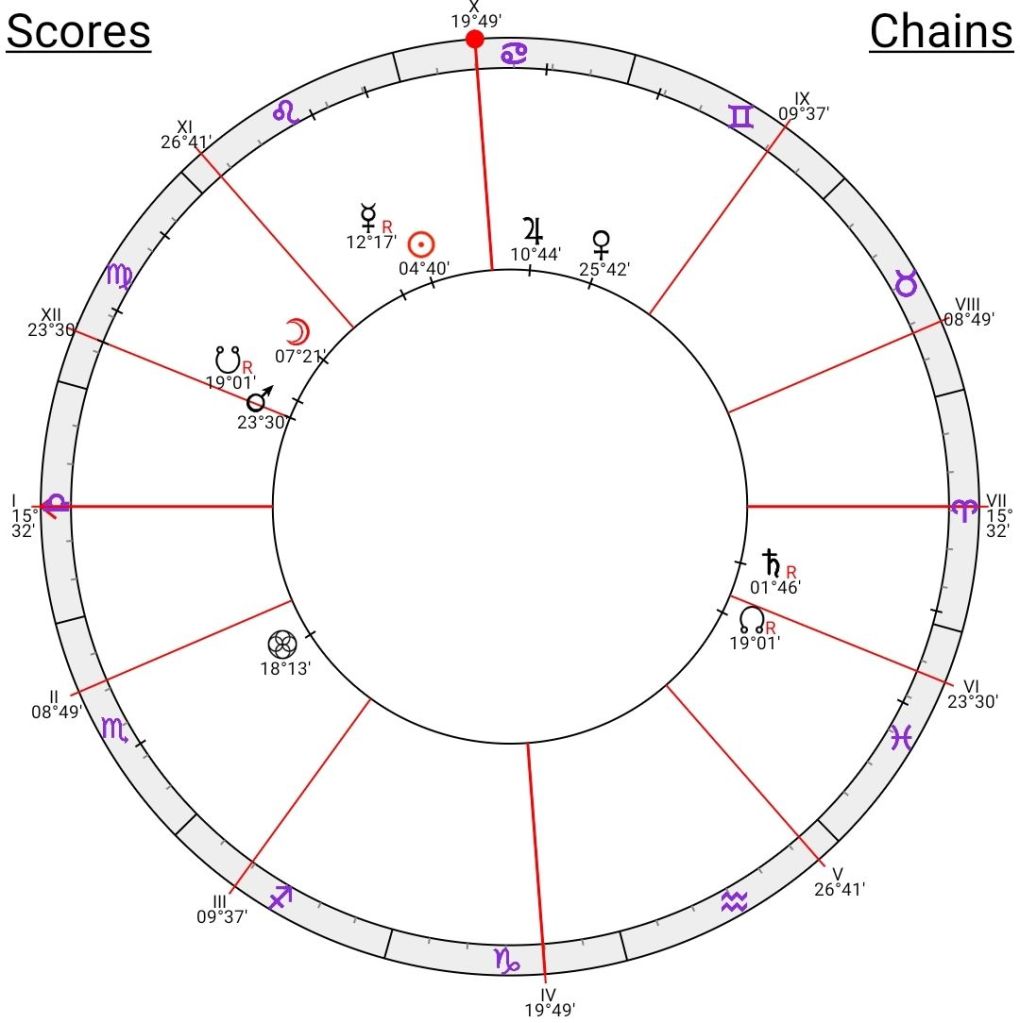
My mother-in-law is my husband’s (seventh house) mother (tenth house), so she should be represented by the radical fourth house and its ruler, Saturn. How is Saturn’s condition? Dreadful! It is in Aries, and therefore in fall, retrograde and tucked into the radical sixth house of illness. As I was concerned about her survival, I looked at the eighth house of death. Both the radical and the derived eighth house are in play, represented by Venus (radical) and the Sun (derived, radical eleventh).

Venus makes no aspect to Saturn in her current sign. The Sun is separating from a trine with reception from Saturn: there was a brush with death, but that was as close as they will come to each other in a while.

The Moon applies to a sextile of exalted Jupiter with reception. Things will improve. Saturn is about to come out of its fall by retrograding into Pisces, so while the situation remains difficult, she will survive.

It turned out she hadn’t had a stroke, but there was a serious bacterial infection in her bloodstream that caused her to have an alarmingly high fever (hence the confused message). She was treated with antibiotics. A couple of days later I asked a more relaxed: how will the matter evolve?

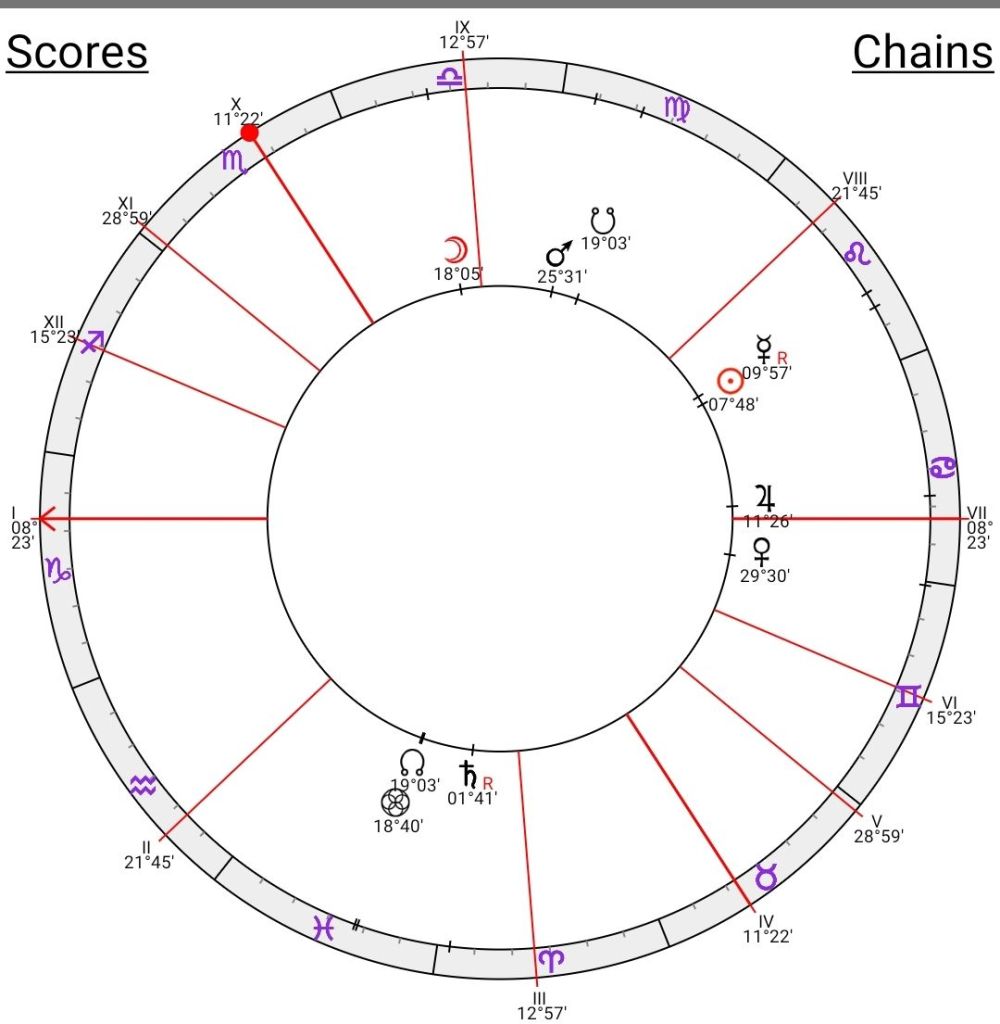
This time she Is represented by Venus as lady of the fourth house. Venus is peregrine in the sixth house of sickness, but she is about to change sign, whereupon she will enter her triplicity and decan: not out of the woods, but better. Once again there is no contact with death (once again the lord of the derived eighth house, Mars, separates from her planet).

But upon changing sign, Venus will bump into a difficult square with a very nasty Saturn. The situation will improve, but there is still something very unpleasant in her near future, though I could not tell what it was at the time.

Turns out that the infection, though cured in her blood, had reached her heart, and she needed an operation to change a valve, as well as additional antibiotics. The operation went fortunately really well and she is already improving a lot. I will edit the post if something changes.

MQS

The Cards Won’t Tell You What’s Right

Morality is a complex thing, though this fact is lost in an age in which debates are reduced to exchanges of snarky remarks on social media. Morality is complex because it deals not in what is but in what ought to be, and what ought to be is invisible to the eyes. How ideas about what ought to be came to exist has kept philosophers and scientists occupied for thousands of years.

And this may account for a good deal of the blind desperation with which people seek something or someone who will tell them how to act. For those of a speculative mindset, reaching definitive conclusions is less a priority than exploring possibilities.

But most people feel the urgent need of external guidance. So some give themselves over to group leaders, others adhere rigidly to an ideology or religion. And those with a more woo woo view of life turn to oracles.

But divination is not a good judge of what’s morally right. If you want proof, when was the last time you laid out a spread that gave you advice that was based on moral principles completely incompatible with your own?

Having the stamp of approval of whatever projection we may make onto pretty bits of cardboards is not that good of an idea. It is a surefire way to delude ourselves and it can rob us of our agency and of our responsibility to think for ourselves.

Divination is good at telling us what is, or was, or has a good chance of being in the future. What ought to be is for us to make up our mind about.

MQS

Get Out And Read!

When it comes to divination, theory can only get you so far. The best way to improve your reading skills is to learn the basics of a *valid* system and then start reading.

For most of us, we are our own first querents, and that is a problem. I don’t have a 100% accuracy record when reading for others, but I barely reach 60% when reading for myself, especially if I’m invested in the topic. It is not just a matter of wrong interpretation, which can and does happen. I am more and more convinced that sometimes, when we read for ourselves and we are not perfectly at peace, we tend to get readings that reflect what we think rather than what is happening or will happen.

Furthermore, the tendency that many people have to start obsessively putting questions to the cards just to see if they say something vaguely understandable (which doesn’t mean true) is dangerous, and can get us in a warped frame of mind.

I know that for many, especially coming from certain societal backgrounds, reading for others can be a big step into the unknown, but I would advise anyone to start reading for some sympathetic friends or relatives (and when I say for them I mean in front of them, not asking questions about them) and then to graduate as soon as possible to readings for people we don’t know or know little about.

I don’t have too many friends, but they do a good job of talking about me to their friends and to their friends’ friends, which is how I get my supply of test anim-ehm, querents. If you start reading for your friends and ask them to spread the word the same will happen to you.

The cool thing about reading for people we don’t know is that it is so much easier than you might think. Divination DOES work! And divining for someone when there is no chance of you knowing the information in advance is very impressive for them and very satisfying for us as diviners. It will build your confidence much more quickly than torturing the cards about your own mental dramas. Plus, the oracles always seem to be much clearer and much more crisp when I divine for strangers.

One thing I would advise is to be as scientific as possible: record the question, the reading, your interpretation and the results. Don’t think you cannot build your vocabulary because the only right answer is the one offered to you by your intuition. 99% of intuitive readers are terrible, and what they call intuition is not actual intuition: it’s their stupidity echoing in the empty chambers of their mind. Be systematic and slowly you will gain experience.

MQS

A Note On The Ten Of Cups

I always maintain that the Golden Dawn were not great astrologers, largely because the XIX century astrology they had access to was not very good. Still, for the purposes of deriving symbolism for magical operations, their take was acceptable.

One thing that has always fascinated me about the Golden Dawn’s take on astrology was how they tried to synthesize it into their tarot system. Aside from the attributions of Zodiac signs and planets to the Hebrew letters and of the Hebrew letters to the major trumps, they also assigned the thirty-six decans to the thirty-six minor cards two through ten and, in different ways, to the aces and court cards as well.

This way of allocating the symbolism was not unique to them, but (as someone who doesn’t like to mix cartomancy and astrology) I must say that it probably produced the most coherent system.

Crowley generally doesn’t stray too far from the GD interpretation of the minors, but there are a couple of exceptions, the most obvious of which is the Ten of Cups.

For the GD, the Ten of Cups is an excellent card (which is what inspired Waite’s take on it). Crowley, however, disagrees on account of the decan assigned to the card, which is the third decan of Pisces, ruled by Mars. This leads Crowley to argue that this is a card ruled by two disarmonious symbols (Pisces and Mars) and so it produces bad results.

The problem with Crowley’s take is that he constantly, throughout the book, mistakes decan rulership with the influence of a planet in a sign. This is wrong. Rulerships represent affinities of a planet with a sign or subdivision of the sign.

For instance, Aries is ruled by Mars, which means there is an affinity and so when Mars is in Aries it is said to be well-dignified, at least according to the astrological practice that developed in the middle ages. The Sun is also exalted in Aries, which means there is also an affinity. Then we have the three decans: the first ten degrees ruled my Mars, the second ten by the Sun and the last ten by Venus.

Now, Venus is in detriment in Aries, which means there is disharmony between Venus and Aries, so Venus is ill-dignified in it. She is like a dainty ballerina stranded in a war-torn country. It’s not her place. However, in the last ten degrees of Aries, Venus has subrulership by decanate. This means that, even though she is the anti-venusian environment of Aries, she has a small room where she is a bit more comfortable, though not by much: it’s as if our dainty ballerina had been hired to entertain the troops in the barracks. She’s still in the wrong place, but in a less uncomfortable subplace.

Therefore, when Crowley says that Mars is not compatible with Pisces he is saying something that is irrelevant: by definition, the fact that Mars rules the third decan of Pisces means that Mars is at least a bit comfortable in the last ten degrees of the sign. This is because the last decan of Pisces has some kind of Mars-like quality to it: it is the part of Pisces that expresses through Mars.

This is not to say that his system is more right or wrong than the GD (one can stretch symbolism in almost any direction by abusing it long enough), but his misunderstanding runs through the whole minor arcana section, and I thought it would be interesting to bring it up.

MQS

How to Work With Wrong Readings

I had a nice exchange with a visitor, who asked how we can work with the readings we get wrong, so that we can improve our skill.

The first thing to take into account is that this is not always possible. We may say that we are accurate because 80-90% of our assertions end up being true, but that is calculated on those assertions for which we get feedback, and we don’t always get feedback.

Here, too, there is a lesson, I think: all we can do is be as good as we can be at the particular moment in which the reading takes place. If we think an interpretation is viable, there is no point in withholding it out of fear that we might get it wrong (unless the topic is sensitive and we choose to stretch the truth to avoid hurting the querent) because we might not get another chance to say it.

What happens after the reading is that some querents simply forget about it. Too many querents think that a reading needs to come true within a couple of weeks, when in fact it often takes months, so after the initial excitement (or dread) they simply move on, and they may only be reminded of it when it comes to pass, if at all.

Other readings are correct, but the querent thinks that’s just regular business, so they don’t bother to tell us, while other readings are wrong, and the querent either rubs that in our face as publicly as possible or they don’t talk about that anymore, thinking we are beneath them.

Then there’s the readings for which we do have feedback, which can be very positive (“everything was spot on, and you’re also kinda cute”), very negative (“it ended up being the exact opposite of what you said”), or mixed (“this and that came to pass, but this other thing not yet”).

Even the feedback we get needs to be taken with a grain of salt. Positive feedback can sometimes be a mix of wishful thinking and the desire to please, while negative feedback can sometimes be a mix of delusion (you said he wouldn’t call and he didn’t, but I know he loves me, so you’re wrong) and desire to hurt.

So, what do we do with the feedback we are given, if it is negative? The reasonable thing to do, in my opinion, is to check the spread (I usually take pictures and/or notes) and see where we might have screwed up.

Was there a point in the spread where the cards were a bit ambiguous and we forced the reading in the wrong direction? Was there a huge, smacking-your-forehead blunder? You simply cannot see what went wrong? Take notes on the reading. If you don’t think you can formulate a definitive theory on what went south, don’t. Leave things hanging. Add ‘maybe’ and ‘possibly’, and see if there are other readings you did on similar issues that can help you.

Even when going back to an older spread, we should never force it to say what the feedback said, if we just don’t see it: firstly, because, as I said, even feedback that exists must be treated with caution; secondly, because there is a tendency to want to read details into the reading that we would never have been able to guess beforehand, and that’s not divination.

Broadly speaking, the feedback we get, positive, negative or mixed, should be treated as raw data that needs to be studied carefully. That’s where a lot of growth can take place. Be especially thankful for mixed feedback, as usually it is the most honest kind: we rarely get 100% of the things right, either in our description of the past/present or in our predictions. As fallible humans, getting many things right many times should be enough to satisfy us, especially since we are doing something most people consider impossible.

MQS

Which House Is Next To Which?

In astrology, the contiguity of the houses is obvious, since the houses are usually arranged either in a square or in a circle, but always forming a loop. Thus, we have that the Ascendant is always squished between the second house and the twelfth; that it always opposes the seventh, and, if we go by whole sign houses, that it has fixed relationships with all the others (inconjunct, sextile, square or trine).

This is not the case in Geomancy, where the relationship between houses is controversial, at least nowadays. First off, it is not pacific that the houses of the Shield represent astrological houses, unless we operate an equivalence with astrology, as was done at least since Geomancy reached Europe.

Those coming to Geomancy through Michael Greer, as I did, are probably used seeing the geomantic houses as equivalent to astrological houses: once the Shield is turned into a square chart, the houses follow the same astrological pattern as in an astrological chart. Those coming to Geomancy through the Golden Dawn, though using a different way of assigning the mothers to the houses (the one popularized by Agrippa), still end up dealing with a 1:1 replica of an astrological chart.

However, the idea that the Shield chart and the astrological chart are separate ways of doing Geomancy seems to be relatively new. In most old books, only the Shield is shown, and even when the astrological format is followed, this is done more to show some of the similarities with astrology.

Secondly, which house is next to which is not always clear, and sometimes varies by author. In some sources it seems that only houses that are in company are considered to be next to each other: first and second, third and fourth (but not second and third), fifth and sixth (but not fourth and fifth) and so on pair by pair. This seems to follow the order in which the Shield chart is generated.

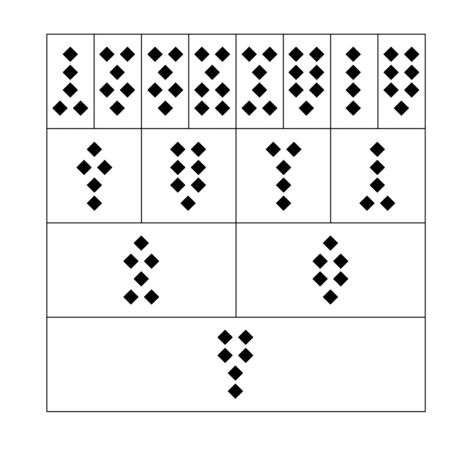
An example shield chart. App used: Simple Geomancy

In the example above, Tristitia in the first is next to Via in the second, and Tristitia in the third is next to Conjunctio in the fourth, but not to Via in the second. This is possibly because the first and second combine to form the ninth and the third and fourth combine to form the tenth, but the second and third never combine. This approach obviously restricts the possibilities of perfecting the chart, since most houses end up losing a possible spot next to them for other figures to move to.

Another approach is the one I found while translating Abano’s work. Here Abano started by saying (or rather, implying) that the twelfth house is not next to the first. Initially, I thought this was because he was following the arrangement for the company of houses I just discussed. Yet he gives other examples where he does not follow it, for instance by implying that the eighth and ninth house are next to each other, which would contradict the company of houses (the eighth is with the seventh, the ninth with the tenth).

Then, in another one of his examples, he implies that a figure in the tenth house is next to a figure in the third. This does not make sense from an astrological standpoint, but from a sheer geomantic standpoint it does: the third house DOES border with the tenth, since it co-generates it with the fourth. This would also explain why he doesn’t consider the twelfth house to be next to the first: not because they are not in company, but because they are not close on the Shield (they are, in fact, on opposite ends of the shield).

This approach of considering the houses close on the Shield as being next to each other is certainly different from anything I’ve seen, especially in contemporary geomancy, and if it weren’t for the fact that enough readings I’ve done confirmed to me that the twelfth house CAN perfect with the first, I would find Abano’s approach extremely appealing. Unfortunately, one of my rules when dealing with divination is that practice trumps theory.

Abano goes even further, implying that the Witnesses (and possibly even the Judge) are to be treated as regular houses. This, in itself, is not unique to him, but what I find unique is that he considers the Witnesses capable of perfecting the reading, for instance if the first figure moves to the tenth and the quesited’s figure moves to the right Witness, where, by Abano’s theory, the two figures touch.

Another consequence of Abano’s approach is that not all houses are created equal: the first house, for instance, only touches with the second and the ninth, while the tenth house must be considered to be next to the ninth, eleventh, third, fourth and to the right Witness.

A possible argument, at this point, could be that this approach makes certain readings too easy (like those involving the tenth house, as I just showed). Still, we should keep in mind 1. that divination reflects reality, so a no is a no, regardless of the system 2. secondly, that Abano doesn’t always consider merely the querent and quesited. Often he considers the whole chart, and sometimes he resolves certain questions by dividing the shield into two sides (the left and the right side) and seeing which side is stronger. This is a method he has from traditional astrology, where questions of contest or war are often decided in such manner.

Ultimately, which approach we choose depends on what works, which means that the only way is to try, record and compare with what actually ends up happening.

MQS

The Home – A Deep Dive Into Cartomancy

Following my deep dive into the symbols of the door knockers and the road in divination by cards, I want to tackle the symbol of the home. This, too, like the road, is a widespread symbol that is almost never absent from any divination system of a practical nature (I am aware of systems for playing card divination based on Rider Waite symbolism, but they have very little practical use).

The popularity of the symbol of the home is simply a consequence of its importance in people’s lives. The home or house card is, in most systems, a ‘topic’ or significator card indicating the querent’s or someone else’s house, and the cards surrounding it show us the atmosphere or happenings of the household. Its practical value, therefore, is immense.

In the earliest recorded system for reading the tarot, which is Pratesi’s guide for the Bolognese tarot, the house card is the Ace of Cups. This meaning is retained in the more modern variants of the method. This is also an almost universal constant in cartomancy, since the Ace of Cups or Hearts is almost always taken as a symbol of the home.

Whether this association originates with the Bolognese tarot I don’t know. It is possible that the symbolism is simply suggested by the shape of the Ace of Cups. In the Visconti tarot, the Ace of Cups is a water spring similar to a baptismal font, but in many old decks it can look similar to a walled structure. If we add to this the fact that the function of the cup is to contain, it may be that this could have suggested the idea of the house to old cartomancers, since a house is a large (the ace is large) containment structure.

Similarly, in almost all card reading systems using Italian regional cards, the Ace of Cups is the home, although I am aware of a couple where the meaning is attributed to the Four of Cups, possibly due to the squarish form suggested by the arrangement of the pips. The Ace of Cups is also the house card in the Sibilla regionale, which is the second-most widespread sibilla deck in Italy.

Why the same idea of home as the Ace was suggested by people using regular playing card suits is unclear, since the Ace of Hearts does not look like anything but a heart. Still, if the system I was taught is anything to go by, the main idea is that hearts deal with one’s emotional life and nourishment, and the home is the origin and source (ace) of our emotional life, the place where our first (ace) needs are met. As a matter of fact, the person who taught me cartomancy with playing cards often insisted that the Ace of Hearts is not just any house (though it can be, in practice) but especially one’s home, where we come from (the ‘spring’ we come from, in the Visconti sense), which is why an extended meaning of the house card is often one’s family.

The same attribution of the Ace of Hearts to the home is found in most systems I am aware of, including German cartomancy and most English and French methods. As far as tarot is concerned, we find that, in some earlier tarot documents, the Tower is simply called ‘casa’ (house), before being called House of God or House of the Devil in some other decks (the title ‘Tower’ is actually a rather late innovation).

Etteilla assigned the house to the Ten of Coins, which Waite retains in his illustration of the Ten of Pentacles, while Paul Case generally matched the house with the Two of Cups, among other things. However, this was more of an accidental consequence of the Golden Dawn attribution of the first cards of the suit of Cups to the zodiac sign of Cancer and, according to the sign/house equivalence theory, to the fourth house, which is the house of the father and therefore of one’s fathers and one’s family/house.

The Sibilla is a partial exception to the rule of the ace as the home, as the House card is given to the Two of Hearts. The meaning of origin (which metaphorically, depending on the reading, can also indicate the origin of a problem) is retained. Still, the Ace of Hearts is also given to the family and to people living together, among other meanings.

The Sibilla, like the Kipper cards, distinguishes between a House card and a Room card. This is probably because both decks seem to have been consolidated from earlier German or Austrian decks which also had similar cards, although the makers of the Sibilla also took playing cards into consideration.

I cannot speak to the Kipper cards (nor to Lenormand, where there is a House card, attributed to the King of Hearts), but in the Sibilla, the Room can represent a small(er) apartment, as well as a place in general, but it doesn’t usually have a connection with the emotional side of life, like the House, although it can represent intimacy, since it is connected with rooms in general, but with the bedroom specifically.

MQS

Flexibility in Divination (and Other Occult Branches)

In my latest reading, an interesting phenomenon happened: I had to partly go beyond the basic rules of the oracle (in this case the tarot) in order to interpret its message.  Specifically, I had to get past the rule that only the Wand figures represent the querents and accept the Queen of Cups as an alternative version of the subject in question.

There is always a reason why something happens, and in this case I believe the possible reasons were 1) that I was asking about my mother, so the cards described her not only as the protagonist of the reading (Wand) but also as mother of the person asking the question (Cup) 2) the reading was, in part, about her still viewing herself as wife, even though she is widowed, so not only is she the protagonist (Wand) but also a wife (Cup).

I am pretty sure this sort of things (that is, the need to apply the ground rules with discretion) can happen in different respects with any deck. In fact, I think it can happen with any oracle. The late Robert Zoller often showed that good astrologers need to be guided by what the chart is saying, which often requires one to start from recorded knowledge and then stretch that knowledge to cover each individual case. William Lilly, possibly the most important horary astrologer in history, often repeated that one must “mix discretion with art”, that is, understand the rules and then apply them intelligently.

The thing is, divination is not an assembly line type of work: it’s a Hermetic art (where the word ‘Hermetic’ is understood in its classical sense, not the Kybalion-style crap). If even the rules of biology need to be interpreted smartly by doctors in order to cure the human body, then how much more flexible do we need to be to interpret a device whose permutations can give us the blueprint for anything that could happen?

Anything goes vs informed pragmatism

My understanding of divination is a never-ending journey. The way I currently see the rules of divination is as posts along the way in a thick snowstorm. If a post has been put somewhere, that means someone was there before and has figured out something. We do not discard such knowledge lightly, unless the contingent reality of our current situation makes us prefer another route.

This approach is very different from the ‘anything goes’ non-method used by so many, which is almost expected and even bragged about, largely due to the widespread rejection of rationality in our milieu. Too many people who dabble into esoteric subjects today seem to believe that throwing overboard logic is the first step on the journey. In part this is due to mistaken orientalist fantasies, in part to a post-modern Zeitgeist that sees all structures as dispensable, reactionary dead weight only good for restraining us– who wants to be restrained?

The way I currently see rules in the esoteric arts is neither reactionary nor revolutionary. It is an attempt at appraising reality through lenses as simple as possible and as complex as they need to be, a kind of pragmatism that is informed by the past but future-oriented in looking for concrete solutions to concrete issues.

As far as divination is concerned, it is a language, but it is a language with no native speakers, and for which no Rosetta stone exists, except the tentative hypotheses of those who have grappled with the language before. We don’t need to vest them with our superstitious awe, but we do owe them a serious, dispassionate look at the conclusions they have reached before either accepting them as they are, discarding them or expanding them with discretion.

MQS

Intuition – Do You Need The Gift of Prophecy?

I received a really sweet message from a fledgling occultist who wants to pick up some form of divination, but has been put off so far because they have been convinced that they don’t have “the gift”, as they put it, by which I think they meant intuition.

It is a fact of life that a certain predisposition can give you a head start. My high school chemistry teacher could explain to me every single step of how to balance a formula, and I would sort of understand it, but then, left to my own devices, I would still get it wrong. I certainly didn’t have the gift for it. But that doesn’t make chemistry hoplessly outside of my reach. If I had persevered instead of throwing my hands up and saying “oh well, at least I can read Plato in Greek” I would have definitely made some progress. It’s just that in life you’ve got to pick your battles, and I knew I wasn’t the next Marie Curie, and I did like Plato, so Plato it was.

The same holds true for the various esoteric disciplines. The kind of gift that is required to practice them is not different from the predisposition toward high school subjects. Yet there is this widespread belief something more is needed. Well, it isn’t needed.

Oracles, i.e., the various forms of divinations, are languages, and like all languages they require study and practice. The idea that all it takes is intuition is a result of the loss of understanding for occult practices that resulted from the scientific revolution, which confined anything that wasn’t understandable in terms of the rising empiricism to the realm of irrational superstition.

This new designation was either consciously or unconsciously accepted by those practicing divination, so divination became something irrational that requires non-rational tools to be practiced. This, in spite of the fact that, wherever you look around the world, and even in the West before the Enlightenment, divination is considered to be primarily made of rules to be studied and applied with intelligence.

True divination, like all parts of magic, is hopelessly technical. It has nothing to do with following your heart, much less your intuition. Speaking of which, actual intuition is a much more sacred thing than the “I can’t prove it but I know it’s true” that many make it out to be. “I just feel this is how it is” is how cults get started, which is probably why so many people who describe themselves as intuitive are so up their own asses and so full of unconscious prejudices.

That is not intuition: it is personal bias subtracting itself from scrutiny. Actual intuition is the prerogative of the great saints, and only to a lesser extent of people who are on a spiritual/esoteric path. It is rare and cannot be commanded. It is the result of brief moments of perfect union with the source of all, and for that reason it comes from outside the limitations of the individual vessel. What many call intuition are simply personal hunches that they cannot trace back to any line of reasoning.

And mind you: hunches ARE a thing. They can work, and sometimes they can help. They can also fail. Many people seem to believe that ‘intuition’ is never wrong. And fair enough, the intuition I talked about is in fact never wrong. But personal hunches CAN indeed be wrong, in the same way that a logical inference can be wrong: hunches, like reason, the senses and all other channels humans use to gather information, are fallible. The fact that many think their hunches are never wrong is simply the result of confirmation bias: if they concentrated on how often their hunches let them down on a daily basis they’d be crushed.

Another use of the term intuition is simply a cooler way of describing the facility that comes from experience. The experienced doctor comes in, eyeballs you, listens to a couple of your complaints and knows with a high degree of probability what is wrong with you. The experienced mechanic listens to the purr of your car and knows immediately it will break down in two weeks if you don’t do something about it.

That’s also not intuition, although it is far more valuable than what average psychics do. It is simply the result of having gone through the same process so often that you can skip some of the steps, at least consciously. It is the intellectual version of muscle memory.

So, can anyone become a diviner? Let me answer with a question: can anyone become a chemist? Well, no. If we all could, the human race would go extinct. But the only thing keeping you from studying chemistry is your decision and perseverance. So is with divination.

MQS