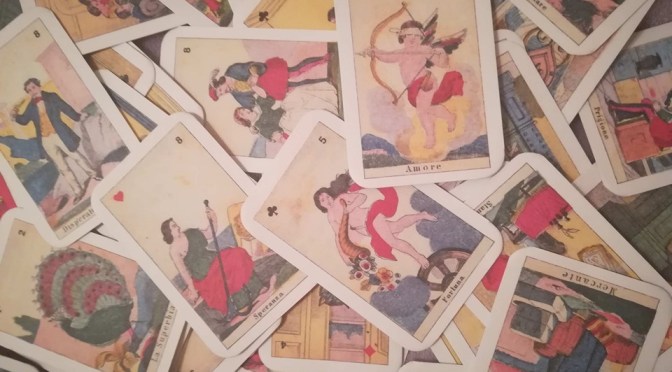
I was pleasantly surprised to discover the legendary Il Meneghello had come out with a new edition of their lovely Vera Sibilla deck. The Vera Sibilla is a traditional Italian divination deck. In its land of origin, the Sibilla is second in popularity only to Tarot cards, so much so that it is cheaply available at any of the numerous tobacco shops scattered in every town and city. It also seems to be slowly making its way to the rest of the world.
Sibilla cards are also affectionately called “chiacchierine”, which means something along the lines of “little chatty (cards)”. The word conjures up the image of a couple of saggy old grannies sitting outside late in the afternoon in a picturesque cobblestone alley, away from the noise of the main street, shelling beans while exchanging the latest news about the neighbor’s affair with the school teacher’s dog trainer, and what the florist’s daughter thinks about all this, being the prude that she is.
They are, in a word, nosy little f*ckers, these cards. Their astounding love for details is only equaled by their complete inability to keep their mouth shut. It is often wise to keep them on a short leash to avoid being overwhelmed. In my personal experience, a short-ish spread done with the Sibilla often gives the same amount of detail as a Kipperkarten or Lenormand Grand Tableau. This doesn’t mean that other decks are more limited. It is purely a question of “character”, and each deck has its own character. The Sibilla simply happens to be the hyperactive cousin with no grasp of boundaries, political correctness and social acceptability.
Il Meneghello is renowned for its hand-made limited editions of historical decks. Master Menegazzi, the heart and soul behind IM, has been producing and reproducing decks for years now, and has become some kind of a legend amongst collectors and card readers. The products they publish are always guaranteed to be of high quality. This reproduction of the 1850s Vera Sibilla is no exception.
What’s inside
As usual for Il Meneghello, the deck comes packaged in a lovely reinforced cardboard box (see picture). I keep my other Sibilla decks in their original box, as I’m a practical dude and I can’t be bothered with finding a more “appropriate” accommodation for what is, at the end of the day, just a deck of cards. In this case, however, I wouldn’t be able to think of a better solution even if I wanted to. Not only is the box beautifully decorated (with a reproduction of the iconic Love card glued on the front), but it is also made to last.
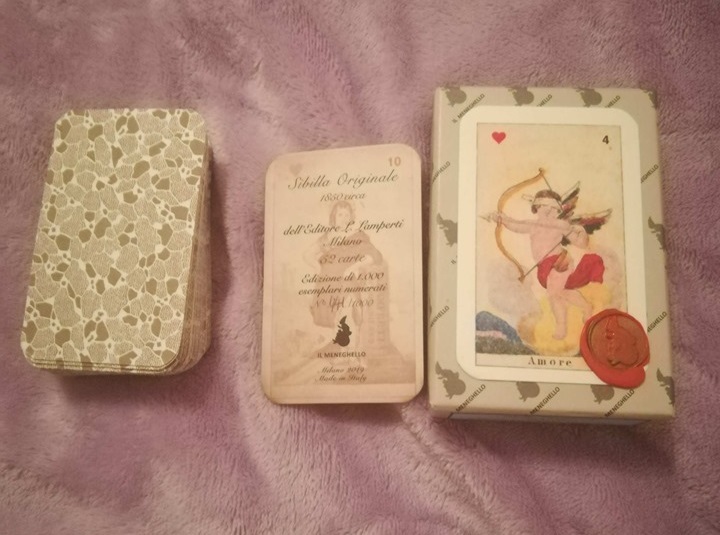
Inside the box you’ll find the deck itself, an extra card, a Little White Book and a note. The note simply warns you that, since the product is hand-made, some imperfections are to be expected. Cool. The Little White Book is, like all Little White Books, pretty useless. You won’t find the meanings of the cards in it, although a simple five card positional spread is suggested.
Frankly, the Sibilla works at its best when read in rows or other geometrically inspired shapes (e.g. box, square, pyramid, tableau etc.) which are made up of multiple rows. This allows the cards to come together and form combinations and clusters. Using positions, and even worse, using one card per position is extremely limiting. Other than that, the LWB keeps its promise of being “little”, and it only adds some historical remarks in Italian and English. The extra card, which you can see in the picture, is a reproduction of the Ten of Hearts with some information about the edition.
All that’s left to talk about are the cards themselves. If you don’t know how a Vera Sibilla deck is structured, it is basically like a playing card deck, with four suits (Hearts, Clubs, Diamonds and Spades), but each card is assigned an image. According to Sibilla expert Etienne Valancourt, the Vera Sibilla deck has been created by taking the Italian system of reading playing cards and adapting it to the images of the famous Gypsy Cards which were popular in Germany and Austria back then.
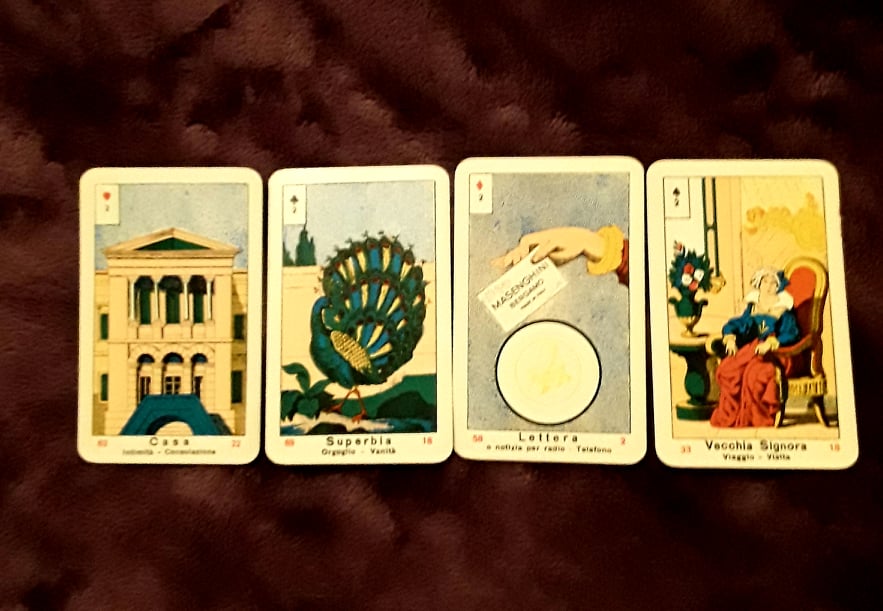
Indeed, many images and names are very similar. However, since the Gypsy cards are 36, while the Sibilla has 52 cards, some images had to be split among various cards (for instance, the card of the Visit, where you can see a handmaid visiting an old lady, became the two cards of the Old Lady and of the Handmaid), while other images were added to the mix to fit the Italian system. Let’s look at the cards in this particular edition.
Pros
The cards themselves are a treat for the eye and, if I may, for the hand as well. Il Meneghello has chosen to sell this new edition of their Sibilla deck with the corners already rounded off. I believe this is a winning move: the cards come across as much gentler and “approachable” to the eye. They are just pretty, I wanna merry them. According to Kapherus of Art of Cartomancy, who owns a copy of the previous IM Sibilla reproduction, the square corners of that edition tended to peel off a bit too easily. I have been mistreating (really!) this deck for a couple of weeks now and it seems to be in perfect shape. If in doubt, choose this newer edition.

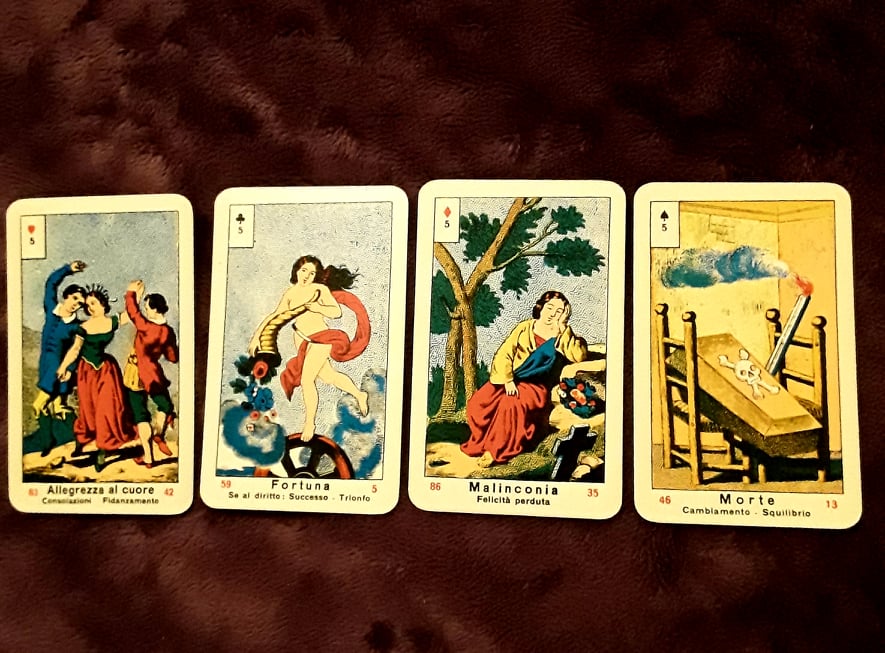
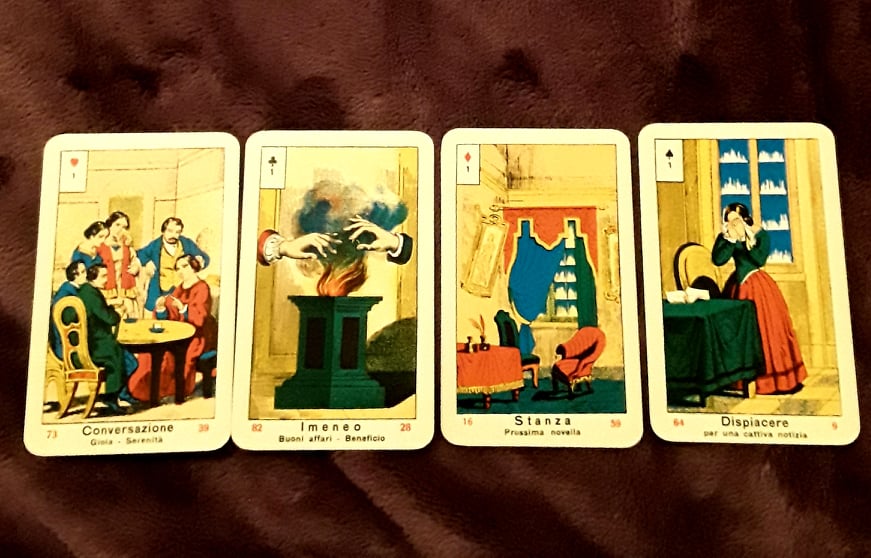
There’s something extremely authentic and genuine in the experience of holding this deck in my hands. Although the size is the same as the popular Masenghini edition (see image), the deck as a whole takes up more space, simply because it is made of relatively irregular pieces of actual cardboard rather than of 52 identical pieces of plastic. Whenever I shuffle the deck, I feel immediately transported to a tearoom of old, where a funny-looking lady shuffles her self-made deck for her numerous clients.
Speaking of hand-made stuff, this deck is completely matte. I don’t have the previous Il Meneghello edition of the 1890 Sibilla, but I have been told by a Facebook friend that that edition is at least lightly coated. Not so with this 1850 edition. This certainly contributes to the feeling of authenticity of the deck.
Another important pro, in my opinion, is that this deck, like the previous edition (and like the original edition), has no annoying keywords on it as the Masenghini edition does. Bear in mind that the Masenghini edition came out only in the late 1970s and it was probably some rich old manager who’d never used the cards for divination and simply wanted to make them more appealing to bored teenagers that slapped the keywords on the cards.
Granted, I have learnt to disregard them, especially since they are very reductive, and many of them are extremely misleading, telling you the Jack of Clubs is an evil dude, even though he is actually traditionally the prototype of the good friend, son, student, coworker, and only becomes negative when reversed. Still, it feels liberating, and the font used for the title is also much prettier.
Some of the names of the cards, being the original ones, are slightly different from the Masenghini edition (e.g. Present of Precious Stones instead of Present of Jewels, Consumed with Jealousy instead of just Jealousy, etc.). Also, the Present and the Handmaid are swapped back to their original place. Finally, you can see that the colors in this edition are a bit more muted compared to the newer ones. I find them lovely, less fake. Note: this is not meant as a bashing of the Masenghini edition, which I adore and use. It’s just a comparison.

Cons
Is this a wonderful deck to have if you are a Sibilla Reader? Absolutely! I don’t know how you could miss out on it.
Is this a great deck to have if you like traditional oracle decks in general? Yep, go ahead, buy it!
Is this a good addition to your collection if you are a collector? Hurry up, it’s limited!
Should this be the only Sibilla deck you own? Probably not.
Granted, it does seem sturdy enough to last me a lifetime. This doesn’t change the fact that it’s not meant to be as resistant as a mass-produced, heavily coated plastic deck, especially considering it’s a limited edition and it’s not necessarily cheap. If I ever chose to go pro, this wouldn’t be the deck I use with my clients, although I could probably keep it for my personal readings.
Since these are actual pieces of uncoated cardboard, you need to be careful around liquids, as I guess they will stain quite easily. Also, you need to get used to shuffling this deck, which wasn’t easy for me at the beginning. It’s not impossible, and with a little practice it is actually extremely pleasant, but don’t expect it to be the same as with the newer, plastic-y editions.
Final Thought: absolutely recommended!
Pros:
+ The Vera Sibilla Oracle at its best. If I had to choose my favorite edition, this would be it
+ Pleasantly matte pieces of cardboard in your hands
+ Rounded corners!
+ Seems very resistant
+ No keywords on the cards
+ It’s like gazing into images from a dream
Cons:
– You might need to be careful around liquids
– Initially difficult to shuffle, but you just need to get used to it
– It’s lovingly hand-made in a limited edition, so I don’t know if it would be suitable as a “power horse deck”. Perhaps if you are careful
Price: When I bought it, it cost 40€ plus shipping.
How to order it: It is not currently available on the website. However, you can order it by emailing Il Meneghello. Their customer service is quick and efficient.