All posts by MQS

Living at the intersection of occultism, fiction and philosophy, I travel the planes at a moderately quick pace. I read, I do magic, I cook for hubby. Confused by the number of things I talk about? Good, confusion is a nice thing ;)

The Three Social Stances (Enneagram Plain and Simple)

We’ve seen so far that the Enneagram tracks the development of our personality based on the central issue it revolves around. If we imagine reality to be a solar system with planets naturally revolving around the Sun, personality is the equivalent of a bit of one planet breaking off and revolving around said planet instead of around the Sun, like the Moon with the Earth.

Our personality colors our perception and our priorities and needs, as well as the strategies we develop to meet them. It also colors our stance toward other people. As most things in the Enneagram come in threes, we recognize three stances: assertive, withdrawing and conciliating or compliant. Each triad (Body, Heart, Head) has one assertive type, one withdrawing type and one compliant type.

This distinction ought not to be confused with the one discussed in the previous article on how each type relates to the energy of the center it belongs to. For instance, Type Two asserts the Heart energy, but in terms of social stance it is a conciliating type, not an assertive one. The expression of a center’s energy is the inherent motor of one’s personality, while the resulting social stance is more of a consequence, though an important one.

Assertive Types: Seven, Eight, Three

The three assertive types of the Enneagram: Three, Seven, Eight

In the Enneagram, assertive types tend to move toward the Other in a more or less bold fashion. They are usually daring and have a practical streak. They go get what they want or need, and do not let other people stand in the way. However, what they need is dictated by the center they belong to.

Type Three is a Heart type, meaning it is concerned with themes of recognition and attention. Three is definitely the show-off of the Enneagram. It asserts itself to emerge as worthy of validation within the system it finds itself in, whether it be school, work, family, etc.

Type Seven is a Head type, which means it desires security and safety, fearing pain and negative states of being. In fleeing from the inner potential for fear and pain, Seven asserts itself on the world around, looking for distractions and diversions, making plans for a thousand projects that keep it from the muted inner sense that all is not well.

Type Eight is a Body type, which means it wants autonomy. Eights are renowned for their ability to assert themselves on others and on reality in general. Even physically they have a certain presence (regardless of their body type) as they present themselves as the fixed point that can deviate the course of reality. Among the Enneagram types, Eight is the least reactive and most naturally active: an Eight doesn’t deal with you, you must deal with them.

In general, assertive types get into trouble with others by generating conflict (whether willingly or not) or by being excessive in their actions and sometimes deaf to other people’s reasons and perspectives.

Withdrawing Types: Nine, Four, Five
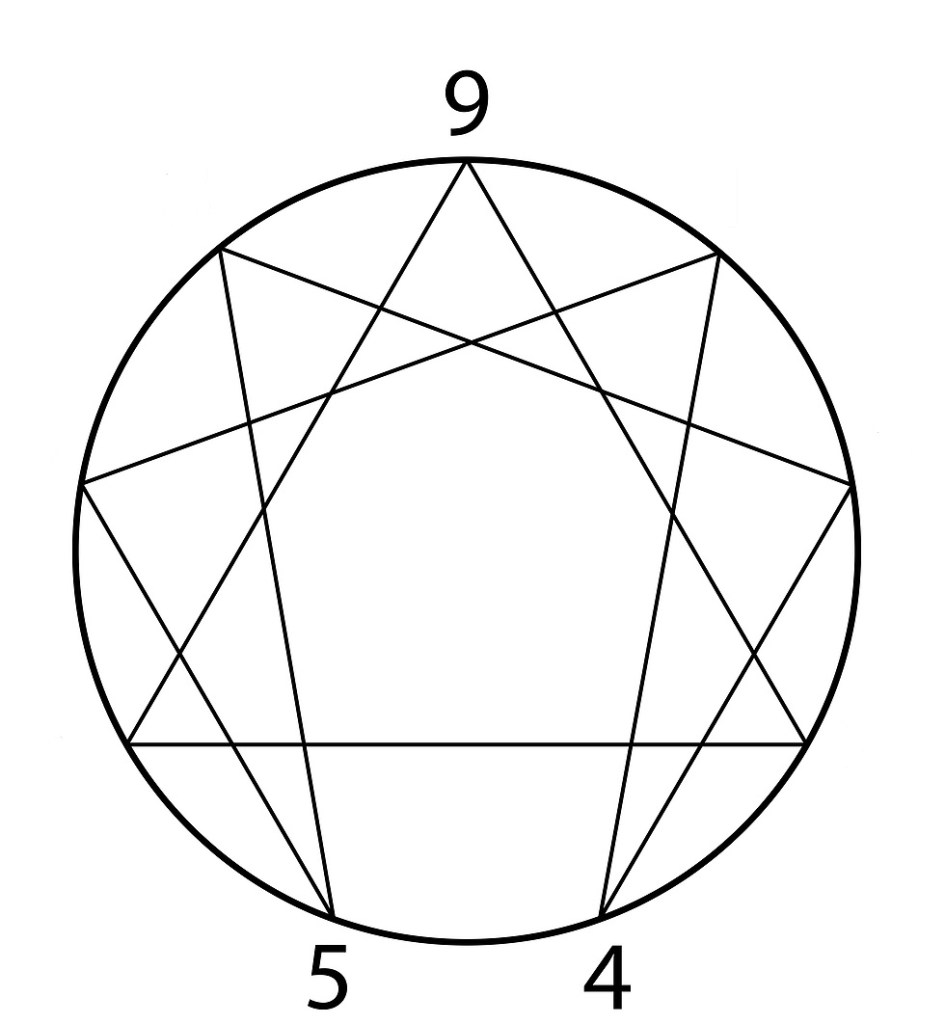
The three withdrawing types of the Enneagram: Nine, Four, Five

Withdrawing types do the opposite of assertive types: in order to get their needs met, they retreat from the Other. This is not to be confused with introversion, especially in a Jungian sense, as the Enneagram does not measure this. Any type can be introverted.

Type Nine is a withdrawing Body type. Its need for autonomy is met by not getting into situations of conflict or confrontation that might threaten its autonomous existence. The idea is, if I create a general mood of harmony, don’t demand anything and don’t go against the flow of other people, I will get what I want and won’t create problems for myself. This is the very opposite of what Eights do.

Type Four is a withdrawing Heart type. Fours withdraw into their fantasy, where they cultivate a rich world of images, moods and emotions, hoping that someone will notice them and whisk them away from a dreary, disappointing reality that doesn’t match their wishes. Instead of sucking the air out of a room like a Three, you’ll likely find Fours sulking in a corner, hoping to be asked what’s wrong.

Type Five is a withdrawing Head type. It retreats from the uncertain flow of the world into its mind, a universe filled with concepts, abstractions and logical reasoning. The idea is that, since the truth is the truth is the truth, the more a Five renounces its material and social existence to identify with impersonal, objectively valid thoughts, the less it will suffer from the uncertainty of reality. Dealing with concepts is easier than dealing with people. This is exactly what a Seven would never do.

In general, withdrawing types tend to get into trouble with other people by not being available to them or by being unclear and ungraspable, which can become a rather frustrating experience.

Compliant Types: Six, One, Two

The three compliant types of the Enneagram: One, Two and Six

Compliant types adopt rather complex strategies to fulfill their needs. They do not assert themselves like assertive types, nor do they retreat away from others like withdrawing types. Instead, they seek, as it were, to merit their needs being met, and as such their stance is markedly interpersonal (though not necessarily social.)

Type Six is a compliant Head type. Its core issues are related to security, and to the type’s inability to be the source of its own security. The solution is to find an authority to submit to by deserving their protection. This authority can be, but is not necessarily a person: it can also be an institution, an ideology, etc. Protection is deserved by being a good friend, partner, employee, believer, political activist, etc. As such, Six neither asserts itself like a Seven nor retreats like a Five.

Type One is a compliant Body type, whose need for autonomy is met by earning it. Ones don’t assert themselves unconditionally like Eights, nor do they shy away from conflict like Nines. Instead, they assert themselves on behalf of a higher goal or reason or idea. Being in the right gives Ones the credentials they need to demand other people’s obedience or respect.

Type Two is a compliant Heart type, concerned with recognition and attention. The way Twos seek to meet this need for recognition is by taking care of other people and meeting their (perceived) needs so as to gain a right to have their needs fulfilled. In this way, they neither withdraw for attention nor assert themselves, like Fours and Threes respectively, but instead seek to become indispensable for the other.

In general, compliant types tend to get into trouble with others by stipulating unspoken pacts with them and becoming angry, offended, hurt or scared when the other doesn’t meet their end of this unspoken bargain.

Energy CenterEnergy DynamicSocial StanceType
BodyAssertionAssertive8
BodySuppressionWithdrawing9
BodyTransformationCompliant1
HeartAssertionCompliant2
HeartSuppressionAssertive3
HeartTransformationWithdrawing4
HeadAssertionWithdrawing5
HeadSuppressionCompliant6
HeadTransformationAssertive7
The nine Enneagram Types with their social stance.

From the Three Centers to Nine Types (Enneagram Plain and Simple)

Everyone’s personality, regardless of their type, is founded on sustaining a separate existence from the whole. You cannot be your regular, daily self without being able to point at something that is not you. There is nothing wrong with separation and duality, in spite of what mystics may say, because it is through separation that unity blooms, pouring forth a thousand forms. More specifically to personality, it is through our consciousness of the universe that the universe perceives itself, and this, as I said, is only possible if the universe adopts our limited perspective through which it can explore itself, and without which it would remain blind.

This limitation takes place as we develop our character or personality, which involves us gravitating toward one of three centers of energy expression: Body, Heart or Head. Each center, as I discussed in the previous article, has its hub in one of the Enneatypes of the inner triangle: Nine (Body, Instinct), Three (Heart, Feelings), Six (Head, Intellect).

These three original types represent their respective center in a rather odd way: they don’t express the corresponding energy. Instead, they suppress it or filter it out. Type Nine, sometimes called the Mediator or Peacemaker, is a rather inconspicuous, self-effacing type, which is the opposite of the choleric drive behind our bodily urge for independence. Type Three, often called the Doer or the Achiever, seems at first anything but a feeling-oriented personality, concerned as it is with status, competition and practical plans. This seems to go against the Heart center’s urge for mending the bond between Self and Other. Type Six, normally referred to as the Skeptic or the Doubter, appears to be anything but oriented by a clear mind, caught up as it is in constantly catastrophizing and poking holes in its own certainties until all that is left is for it to blindly follow a trusted leader’s instruction. This seems contrary to the intellectual urge.

The full Enneagram, with its inner triangle (9, 3, 6) and the seven derived types.

In reality, though, we need to understand that the Enneagram does not really tell us who we are, but rather what we have a problem with at our core. Type 9 has a problem with its bodily presence, and therefore seems unable to assert itself; Type 3 has a problem with its true feelings, and therefore concentrates on achieving rather than being; Type 6 has a problem with its mind, being unable to trust itself and its own thinking, so it ends up being rather irrational or unreasonable.

But what we deny we imply. I cannot say “there is no flower here” without implying the notion of flower, and therefore the possibility for a flower to be here. So, in each Enneagram center, we also find a personality type that asserts the center’s energy. These are the types that come right before the ones that suppress the energy: Type 8 (coming before 9) asserts the instinctual energy of the Body; Type 2 (coming before 3) asserts the emotional energy of the Heart center; and Type 5 (coming before 6) asserts the intellectual energy of the Head center. In short, 8, 2 and 5 are the types that you spend five minutes with and you know immediately what they are about.

Type Eight, sometimes called the Boss, is assertive, powerful and has no problem going out and taking what its instincts tell it belongs to it. Through Eight, the Body center finds the kind of unobstructed expression that it seems to lack in type Nine. The Other is often either acknowledged as weaker and therefore in need of Eight’s protection, or as a target to direct attacks toward.

Type Two, sometimes called Helper, is relational, caring, interpersonal and motherly, often denying itself to please or help. Through Two, the Heart center expresses itself in a way that is not possible through Three. The Other becomes the object of the person’s attention, in hopes that, by creating a bond with them, Two’s identity and needs may be validated.

Type Five, often known as the Observer, is rational, unsentimental, objective, detached, always willing to follow a line of reasoning to its ultimate conclusions, regardless of how subjectively unpleasant it may be. Here the energy of the Head center asserts itself as it could never do at Six. The objectivity of the thought-process becomes a refuge from the uncertainty of life and the fear it engenders.

As in every dialectical model, where there is assertion and negation there is also a mediation between the two, and this happens in the types following the hub of each center. In all three cases the energy of the center is neither asserted nor negated, but transformed, and redirected, in one way or another, toward oneself. In Type 1 (coming after 9) the instinctive energy of the Body center finds a mediated expression; in Type 4 (coming after 3) the same happens in the Heart center; likewise, in the Head center Type 7 (coming after 6) mediates between affirming and negating intellectual energy.

Type One, usually called the Perfectionist, is strict, precise, law-abiding, just, disciplined. It represents a mediation between the unbridled assertion of instinctual energy of Type Eight and the suppresion of it in Type Nine. In Type One, the idea is: I can assert myself as long as I do it in the right way, or rather, as long as I assert the right thing. In doing so, however, One submits itself to this pervasive idea of right, becoming its own harshest critic.

Type Four, often called the Individualist or the Romantic, is self-involved, introspective, reserved, self-conscious. It mediates between Type Two and Type Three, introjecting the energy of the Heart center to sustain its own moods and cultivate a self-image with which it seeks to flee inward and away from a reality it perceives as tragic, or at least as unkind and unable to recognize it as it truly is.

Type Seven, known as the Joker or the Epicurean, is fun-loving, energetic, excited, unfocused. It represents a mediation between the assertion of mind energy of Type Five and its suppression in Type Six. Type Seven is concerned mainly with self-gratification, and it uses the Head energy to come up with endless ways of feeling entertained, positive and energized, which leads to fleeint out into the world in search of pleasure so as not to acknowledge inner fear.

TypeCenterEnergy DynamicDescription
8BodyAssertionAsserts itself physically and attacks obstacles
9BodySuppressionSuppresses its own individual energy
1BodyTransformationSubmits to rules that justify its own assertion
2HeartAssertionCares for the other to gain validation
3HeartSuppressionPerforms and achieves to emerge as worthy of recognition
4HeartTransformationCares for itself to cope with tragic reality that doesn’t “see” it
5HeadAssertionAbides by own mental skills to avoid uncertainty
6HeadSuppressionSeeks external support to avoid relying on own mental skills
7HeadTransformationPlans own gratification to avoid thinking about the negative side
The Nine Enneagram Types and their main energy dynamics

Toward the Geomancy Shield – The Four Mothers

Geomancy has changed a bit since Medieval times, but one thing that remains constant is how a Geomantic figure or Geomantic Shield is formed. This is done in order to answer a question.

As I said in the previous article, we don’t draw the whole figure in the same way. We can divide the process in two parts: the creation of the four Mothers on one side; and the deriving of the rest of the figure from the four Mothers on the other side. The first is the “divinely inspired” part, i.e., the part where you allow chance into your life, while the second part is automatic and fixed and will follow with mathematical rigor from the first.

So, how do we get a set of four Mothers? In reality, Geomancy is a rather flexible oracle, as any method is technically valid. Once you are well versed in the main operations required to draw a Geomantic figure, you can pretty much use any method that suits you in order to obtain the four mothers.

Still, some methods are more traditional than others. It seems that the Arab Magi used a stick to poke points in the sands of the desert, a method that is still perfectly valid and has even been accepted and adapted by the Golden Dawn. By the time Geomancy reached Europe in the Middle Ages, it was customary to use a stylus or pen and a tablet or piece of paper or parchment. Dice were also used, and one could, and can use dried beans or pebbles or playing cards. Anything that can give you odd and even numbers will do.

Needless to say, some have devised software that calculate everything automatically. I don’t particularly trust this method, and yes, partly it’s because technology is still so new that my mind doesn’t accept it as a valid substitute for things that are more dependent on my direct manipulation–it may very well be that in five hundred years occultists will use geomantic software without thinking twice about it, but we’ll cross that bridge when we get to it.

The Pen and Paper Method

My personal favorite method remains pen and paper. I almost always use it, and I find it has an odd beauty, even power to it. It also reminds me of a playful oracle that we used to use as kids in middle school and high school in Italy to answer yes or no questions. Usually, some love-stricken teen would ask the fateful question, “does he love me?” and would start drawing random numbers of points on a piece of paper. Then she would pair up the points until either one point was left (yes) or none at all (no). I have no idea how this oracle originated, but I remember it being very much in vogue when I was a kid.

A set of geomantic Mothers is obtained in a similar, albeit more complex, manner. First off, it pays to write down the question. This has the incredible advantage that it forces you to think about it seriously, and it also makes it more real and objective.

Then, after concentrating on the question, you should ask for divine help. I’m not saying this to be preachy. Consult any Medieval handbook of Geomancy and you will find the same instruction: it’s the “Unmoved Mover” that sends his “vertue” down from the skies to answer your question. At the very least, you should take a moment to relax.

Once you feel ready, start drawing sixteen consecutive rows of points. Try to be orderly, but don’t worry too much: as long as the rows don’t cross or merge you are fine. Also, I have found that it is better to draw I’s instead of points, for the simple reason that it makes it easier to recognize the marks instead of leaving you wondering “is it a point or a random inkblot?”

Do not count the points or I’s you are making, and do not bother counting the rows as you make them. Do not engage in any kind of mathematical or rational thinking. In fact, I have found it pays to write down numbers from 1 to 16 before starting the operation, so as to be free from the worry of drawing too many or too few rows of points. Still, in the traditional instruction, you are normally told not to bother if you end up with an extra row of two–just go overboard and then discount the extra ones. Either way you will end up with something like this:

  • 1) IIIIIIIIII
  • 2) IIIIIIIIIIIII
  • 3) IIIII
  • 4) IIIIIIIIIIIIIIIIIIII
  • 5) IIIIIIII
  • 6) IIIIIIIIIIIIIIIIII
  • 7) IIII
  • 8) IIIIIIIIIIIII
  • 9) IIIIIIIIIIIII
  • 10) IIIIIIIIIIIIIII
  • 11) IIIIIIIIIIII
  • 13) IIIIIII
  • 14) IIIIIIIIIIIIIIIIIIIII
  • 15) IIIIIIIII
  • 16) IIIIIIIIIIIIIII

Once this operation is over, you have your four Mothers, but only in a raw form. Each Mother figure is made up of four rows (4×4 = 16). Now you need to pair up the I’s in each row until either one is left over or two. Let’s make the example of the first Mother, which is made up of rows 1 through 4:

  • 1) I-I I-I I-I I-I I I = O O
  • 2) I-I I-I I-I I-I I-I I-I I = O
  • 3) I-I I-I I = O
  • 4) I-I I-I I-I I-I I-I I-I I-I I-I I-I I I = O O

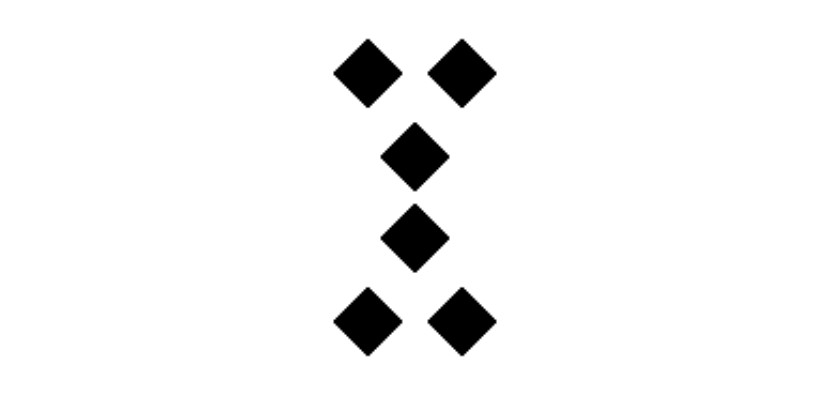
The figure we have received as first Mother is comprised by a sequence of two points on top, then one point, then one point, then two points. The same process of pairing up must be done for all sixteen rows to obtain the four Mothers (the second Mother being made up of rows 5 through 8, etc.) The first Mother we have obtained is called Conjunctio.

The Geomantic figure Conjunctio. From the App ‘Simple Geomancy’

Once this operation is over, you will be left with four figures, each made up of four rows of either one or two points. From these figures you will need to derive the rest of the chart, which I will go over in the next post.

The Enneagram Plain and Simple – The Three Centers (Body, Heart and Head)

In my previous post I discussed the difference between reality and personality. The long and short of it is that an individual’s personality exists essentially by blocking out or filtering out a part of the whole. You cannot be yourself as a single, individuated person and take in everything all at once. Individuation and manifestation (what some occultists call life below the abyss) imply a limitation of perspective.

How we get from the One to the Two, from unity to duality, that is, from the Whole to Self versus Other, is an interesting question, one that cannot be answered satisfactorily in a few words. Saying that duality is an illusion is too simplistic, because even an illusion must be something that exists apart from the real, it must *be* something illusory that is not the real thing, so really this explanation doesn’t explain anything. I will tackle the issue if and when I decide to start talking about philosophy. For my part, all I can say at the moment is that we cannot really understand the One and the Two without taking into account the Zero.

Three Urges, Three Passions

Let us take for granted, though, that Two comes from the One. Individuals come into being as centers of awareness that are separate from the rest of the universe. This can only happen by taking some parts of the whole not to be part of oneself, that is, by filtering them out (“I am this, not that.”) This, according to Enneagram theory, can happen in three ways, depending on what it is that is being blocked out.

Conventionally, we recognize people as being made up of three things: Body, Heart and Head. The Body is sometimes called the Guts, the Heart is sometimes called the Soul, the Mind is sometimes called the Head or even Spirit. I shall stick with Body, Heart and Head.

The three centers: Body, Heart, Head

These three aspects of the human complexion are representative of three urges: autonomy, recognition and security.

Even the meekest individual seeks to maintain their autonomy, some degree of space for themselves, which requires that they assert themselves as organisms against the world surrounding them. This is Self versus Other in its purest form, where the self seeks to neutralize otherness and bring it under its command. Even in our painfully egualitarian times he who doesn’t want to starve will seek to conquer the world.

Recognition is a much misunderstood concept. It speaks to the junction between our personal and our social existence, and to our desire to match the image of ourselves that we think exists in other people’s perception, or, which is the same, the desire for them to have the image of us that we have of ourselves. This, however, implies that we maintain a self-image, that is, that we can point at certain definite characteristics we either display or wish to display and say, “This is me.” Only, we cannot really know why this is the case: our self-image hangs in the air somewhat, and feels arbitrary. Why are you only yourself when you are X, but not when you are Y? So, in order to validate it and make it real, we seek to reproduce it in other people’s perception to render it stable. Everyone needs recognition to an extent, and this includes hipsters.

The need for security is the need to know that one’s existence is preserved against imponderable forces that we see as alien to our being. If life consists of Self and Other, of Me and the World, there is no way of knowing whether tomorrow something will happen that will favor me against the world or the world against me. The urge for security is the urge to maximize my chances. It is, in a way, similar to the urge for autonomy in that it sees the Self against the Other, but in this struggle it concentrates more on regimenting and strengthening the Self than on conquering the Other.

These three urges come bundled with their negative side or passion. You cannot conquer the world to maintain your autonomy without anger, seen not necessarily as rage, but as a certain choleric disposition to treat that thing outside of you as a potential enemy or obstacle to be overcome. You cannot have recognition without attaching a great deal of value on the small segment of the universe that you call “me” and that you spruce up with wishes and exaggerations which you want other people to validate. This need for recognition creates the potential for lack of recognition and therefore for shame. Finally, you cannot be looking for security without experiencing fear, by which I do not mean any ordinary fear, but rather the sense of your being teetering on the brink of annihilation.

CenterUrgeDesired OutcomePassion
BodyAutonomySubduing the OtherAnger
HeartRecognitionConnecting Self and OtherShame
HeadSecurityPreserving the SelfFear
The Three Centers of the Enneagram

The Three Centers in the Enneagram: Types Nine, Three and Six

The three centers, i.e., the Body center, the Heart center and the Head center, work in a circle. You establish yourself as an individual body as opposed to the others, you sustain a self-image which you look to accredit in the eyes of your fellows so as to validate your existence, but you suddenly realize that your condition as a separate entity is precarious, so you use your mind to create survival strategies that lead to you being able to preserve yourself as an individual, and so on.

Of course, this cycle is the basis for everyone’s self-sustained existence as individuals, regardless of their particular proclivities. In a way, this is the minimum needed for you to be you, and not another person, or a bunch of moss gathering on a rock. However, this is also how the Enneagram comes into being as a system of nine types.

Types Nine, Three and Six, the hubs of the three centers

The circle represents the whole, the unbridled and undivided universe, as it were. The triangle indicates the three points in the Enneagram where the three centers have their hub: 9 is the hub of the Body center, 3 is the hub of the Heart center and 6 is the hub of the Head center. Energy flows uninterrupted from 9 to 3 to 6 to 9 (we will see in the next article how the other six types come into existence.)

I have described personality as a filtering system which blocks out certain aspects of reality to privilege others. Interestingly, the three Enneagram types which represent the hubs of the respective centers are qualified exactly by the fact that they block out, or suppress, the energy of their center.

In other words, Type 9, the hub of the Body center, suppresses its own bodily energy; Type 3, the hub of the Heart center, suppresses its own emotional energy; Type 6, the hub of the Mind center, suppresses its own intellectual energy. This has the interesting consequence that, unless you know the Enneagram, you would never guess that Nines are body types, since they seem soo airy and diffuse, nor would you recognize the willful and competitive Threes as heart-driven, nor the insecure Sixes, who never trust their judgment and are always looking for someone trustworthy to make decisions for them as head-driven.

Yet it is so. We will see in the next article that this is part of a dialectical or triadic movement that leads to the emergence of the other types.

The Enneagram Plain and Simple – Personality versus Reality

The Pale Horse is one of my favorite books by Agatha Christie. I find myself rereading it every couple of years, and I consider it one of the great stories in the mystery genre. Part of it is because it deals (on the surface) with occultism, which is something I am obviously into, considering this website. But mostly it’s because it manages to infuse the reader with an impalpable, ancestral dread that stems from Christie’s almost intuitive understanding of how a human psyche is capable of spiralling into a vortex of mystery, fear and confusion (no wonder she is usually typed as an Enneagram 5 or 6.) Nothing about the plot feels forced: we are led almost seamlessly down the narrow, unlit hallway at the back of our minds into a basement we didn’t know was there at all.

One of the (many) intelligent remarks on human psychology that Christie makes in passing is the following:

“One of the oddest things in life, as we all know, is the way that when you have heard a thing mentioned, within twenty-four hours you nearly always come across it again.”

This is a great example of how our character works, at least the way Enneagram theory understands it. The thing you hear mentioned and then pops up again almost serendipitously has obviously nothing to do with odd and mysterious synchronicities, as much as it’s a consequence of the fact that, if we are sufficiently struck by the thing in the first place, we will begin to scan reality for instances and confirmations of it. It is not just a matter of being struck, though, but also of need.

We have all made the experience of reality changing in front of us depending on our needs. Think of the last time you received a parcel and couldn’t just tear it open with your hands. You probably started scanning your environment, and immediately all the objects around you that weren’t sharp enough to be useful in opening the package were blended out of your perception, at least to a degree, and those that were sharp or pointy were more or less intuitively sorted by how useful they might be in helping you achieve your aim.

Now imagine if you did the same thing while at dinner with your significant other and there is no package to open. They are talking about how good the wine is or how classy the music is; all the while you are still categorizing your surrounding by how sharp things are and how useful they might be in cutting open a package (and hopefully not your sweetheart.)

In both cases, what you see isn’t necessarily false or wrong. Even in the second case (i.e., dinner with your partner,) it’s true that a handkerchief is less sharp than the edge of a table, which is less sharp than a knife, etc. What *is* false is the belief that the filtering system you use allows you to always see the whole of reality as it is, instead of just one side, and to capture what is important at that moment. In the first instance the filter is useful, while in the second it’s… well, it’s kind of creepy.

Personality is, essentially, a filtering system. We can’t take reality in all at once, so we concentrate on what we believe is important for us, what will foster our wellbeing, get us through trouble, etc. The difference between personality and the example I have just given is that personality tends to be relatively more stable, while the example of the knife is somewhat contingent. The principle, however, is the same.

There is a great debate among Enneagram theorists on when personality forms and we get our “number”, with some–usually those of a more mystical bent–believing it’s inborn, while others think it develops over time as we learn to cope with the challenges of our early life and deploy more and more fixed strategies that we end up overindentifying with to the detriment of others. Either way, the strategies we pick helped us, to a degree, in surviving, but we end up using them to a fault and tend to rely on them even when it doesn’t make sense or even when they might make things worse. Slowly, our personality is at risk of becoming an echo chamber that constantly reinforces old prejudices about ourselves and others instead of allowing us to change, adapt and react to the present moment rather than to some past problem, wound or fear.

Frankly, it is rather pointless for me to pick a side in this nature/nurture debate, especially because it wouldn’t add anything of consequence: the Ennagram is only useful as a tool once one has lived long enough, made enough blunders and achieved enough successes to develop some sense of self-reflection. Usually this doesn’t happen to the necessary degree until well after puberty has finished pummeling us to the ground (though there are exceptions, of course.)

The Enneagram as a typology system captures the nine basic patterns that people tend to fall into depending on how they structure their personal “filtering system.” The point of knowing it is not to free ourselves of it. This can’t be done, no more than one can step into a bucket and try to lift himself up by pulling at the handle. You are not going to get rid of your personality until you kick that bucket. Nor is personality a disease, as much as some in our vapid spiritual milieau tend to consider separate existence as evil and individuals as walking knots of traumas and darkness waiting to be unraveled by the uttering of the appropriate New Age platitudes.

Personality is a damn fine thing. Through it we can look at the world and see something instead of a confused blur of everything all at once. Think about it. We are capable of consciousness, which means that, through us, the universe experiences itself. Without us, no self-awareness for the Universe, or God, or Spirit, or the Anima Mundi, or Existence, or whatever you wish to call it. This experience, though, is only possible by blending out a part of the whole, so that something can come into focus. And this is glorious.

The problem arises when we fail to understand that our perception is limited, so that we can, at least to a small extent, improve it. Our personality is like a dress. We can wear it loosely and graciously, or it can become a straitjacket. The kind of self-cultivation that the Enneagram renders possible to us is the art of loosening the garment, not casting it off.

Patience is required, and kindness to oneself and to others. The hardest thing for some is learning to suspend judgment and just watch as they deploy their usual mechanism. The point is learning to appreciate the various facets of our response to reality until we can, as it were, catch ourselves in the act of “doing it again.” With practice, it becomes even possible to stop ourselves in the act and choose a better option. Sometimes we will surprise ourselves and the people around us by doing something that is partly out of character, because we have learned to accept other modes of being, thinking and acting as viable options.

This practice of self-reflection is also the process that leads to the development of what has been called the “inner observer.” At a deeper level, I may say that the inner observer is not really developed so much as it is discovered, because, at an even deeper level, we do not so much observe as we are observed into being. But this is neither here nor there at the moment. The point is that this inner observer can look dispassionately at what is going on, and although we may only get glimpses of this clarity, it’s through these glimpses that we are started on our quest of loosening the straitjacket of our personal mechanism and achieve greater balance.

A Step by Step Deconstruction of a Geomancy Reading

In all Medieval handbooks of Geomancy, this method of divination is called something like “a brief science”, meaning an art that can be mastered with little effort. It was often sold as some kind of quick, “portable” oracle. This, I presume, is in comparison with Astrology, which back then required no small amount of mathematical knowledge, astrological software still being a couple of years away.

By comparison, anyone who can memorize a couple of meanings and rules and is capable of producing a Geomantic Shield (i.e., the chart) can obtain a quick answer.

The more I delve into Geomancy’s Medieval practice, the more I realize that all modern attempts at reviving it hinge on some kind of rationalization or optimization of what was, essentially, a rather chaotic (though not random) method. It is typical of the pre-modern approach to rely on older authority and compile as many observations and rules as possible from previous sources, even when contradictory with each other, so as to have an endless array of techniques to throw at the chart in hopes of teasing out the wanted response. This is not unlike what modern astrologers do when they interpret birth charts, though I must say, unlike contemporary astrology, traditional geomancy does work.

Producing a Geomantic Shield, Step by Step

If rationalization it must be, then it makes sense first to understand what it is that a geomancy reading does, that is, what it accomplishes from a structural standpoint. This is a Geomancy Shield.

Example of Geomantic Shield

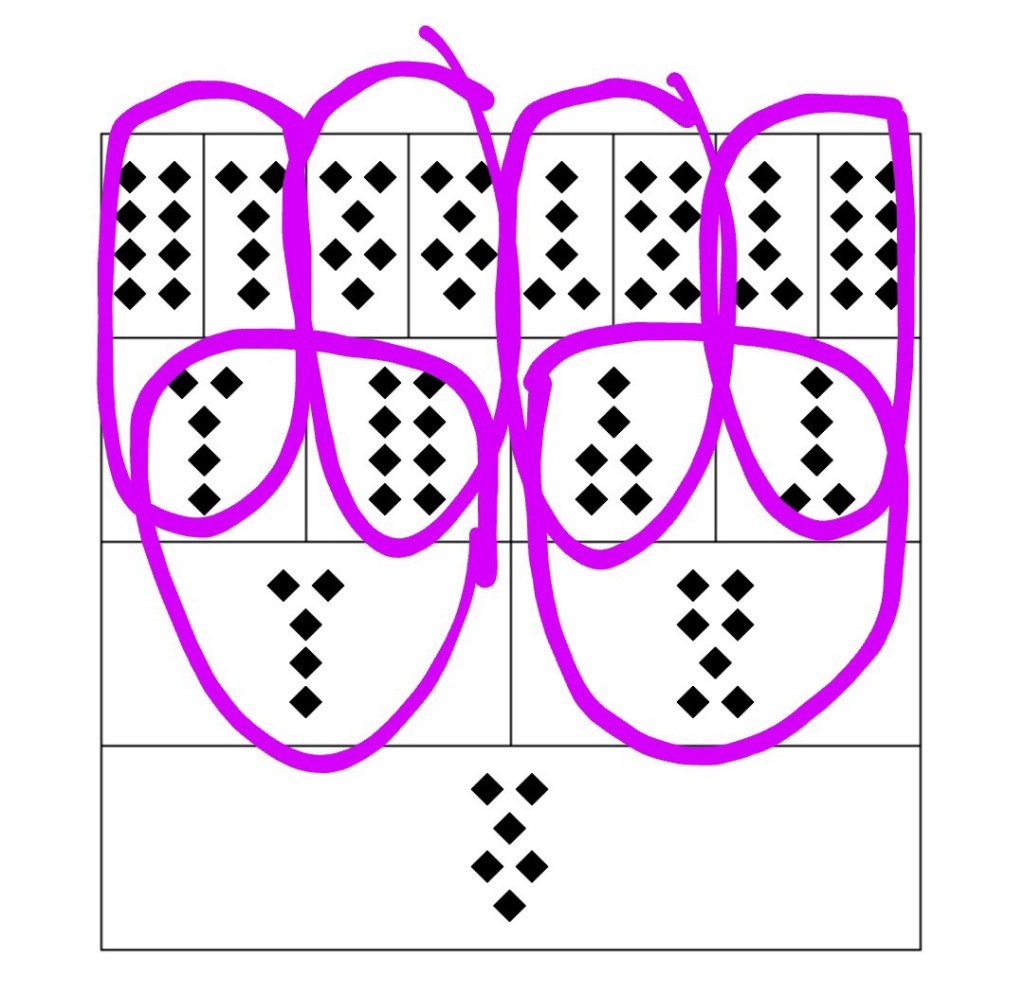
In this shield, not all the figures are generated by the querent/diviner. In fact, only the figures circled in red are actively produced by the person interested in the reading. These are made from right to left, following the numbered order.

The Four Mothers produced by the querent are in red, the Four Daughters in blue

Once the four main geomantic figures (called the “four Mothers“) are produced, every other passage is automatic and relies on certain geomantic operations to fill out the Shield. One such operation is very particular, in that it only occurs once throughout the reading, while the other one is repeated many times. I’m talking about the operation that produces the “four Daughters.” This consists in taking the first line from every one of the first four figures (the mothers) to produce the fifth figure or first daughter; then taking the second line from each of the four mothers to produce the sixth figure or second daughter, and so on, until we have four mothers and four daughters (the daughters are circled in blue.)

As you can see, for instance, if you take the first line from each of the four mothers, you get a first line of two points, a second line of one point, then a third line of two points and a last, fourth line of one point, which now occupies the fifth house.

Once this operation is over, it is never repeated again, and it leaves us with a double set of four figures each. These two sets are not unrelated (hence the names of mothers and daughters.) They must of necessity be comprised of the same number of points, albeit differently shuffled around. Still, as much as they are related, they represent a split of some type, a doubling of reality from one into two related but separate sides.

Now it is a matter of producing the rest of the chart. This is done by taking the figures two by two and “adding” them line by line. We pair the first and second mother together, then the third and fourth, then the fist and second daughter together, and then the third and fourth. Adding here means taking the points that comprise each line in the two figures, adding them and seeing if you get an odd or even number: if you get an odd number, the resulting line will have one point; if you get an even number, the resulting figure line will have two points. This produces the “four Nieces” which occupy the second row in the Shield. Take careful notice that, at this point, Mothers and Daughters have not interacted with each other yet.

The Four Nieces in Geomancy

Once we have the Mothers, the Daughters and the Nieces, we repeat the second operation once more by pairing up the Nieces, the first with the second and the third with the fourth. As you can appreciate, once more, Mothers and Daughters haven’t come into contact: the split hasn’t been mended.

The Two Witnesses coming out of the Four Nieces

The two figures resulting from the addition of the four Nieces are the two Witnesses, which are the first two members of the “Geomantic Court.” The Right Witness is the ultimate consequence of the four Mothers, while the Left Witness is the ultimate consequence of the four Daughters. We can’t produce any more figures without finally bridging the gap between the right side of the Shield and the left side. This is done by producing the fifteenth figure, the last one, called the Judge. This brings the operation to a close.

The Geomantic Court complete with the Judge is in blue

So, What are we doing in Geomancy?

Anyone familiar with Hegel’s dialectics cannot but look in admiration at what I have just described. We begin the operation with a set of four symbols (the four Mothers) which represent the querent’s active involvement, in the hope of knowing something. A querent that doesn’t want to know anything does not consult an oracle: he is not a querent, ‘querent’ meaning ‘asker’. Therefore, the four Mothers represent the question itself, not in a divinatory sense, but in a structural one: if someone doesn’t want to know something, the Four Mothers don’t appear.

Once this happens, reality splits into two, the Right side representing the querent, the Left side the quesited. This culminates in the reading of the Geomantic Court, in which the Right Witnesses pleads for the querent and the Left one for the quesited, among other possible interpretations. Other variants are: Right side good, Left side bad, Right side past, Left side future, Right side helpful, Left side hindering. These are all variations on the same theme.

The point is that from a Geomantic standpoint, duality comes into being as a result of someone either desiring something they don’t have or fearing they might lose something they have. Objective reality comes into being by “lapsing away” as it were from the Subject, creating a would of sort that requires a series of steps in order to be healed again (‘heal’ literally meaning ‘to make whole’). Try to think of a situation where you don’t need anything: you don’t need food, clothes, air, light, aspirations. You’d be very godly or very dead.

What I just said, therefore, is not a disparaging of dualism: without duality, unity cannot manifest, and remains a sterile, barren field. Without the split, the querent wouldn’t be able to know, or, indeed, to get. By pronouncing his sentence, the Judge makes the situation whole again, which is signified by the fact that only the eight figures with an even number of points can become Judge. Either the querent gets his wish or he doesn’t. But the making whole again presupposes the split, just as in dialectics the synthetic moment cannot be understood and appreciated but through the process of opposition that led to it.

What I just described is, as far as I know, never mentioned in Medieval or Renaissance works on Geomancy–one obvious reason being that dialectics in the Hegelian sense hadn’t been invented yet. Platonic dialectics (that is, conceptual dialectics) comes close, but again, all this seems implicit in the operations of Geomancy and never articulated. I harbor no delusion therefore of having discovered the secret meaning of the art. I am conscious, in fact, that I am merely organizing it according to a model that is familiar to me. But I must say Geomancy wears this model beautifully. It contains a whole philosophy of what it means to ask a question and to get an answer.

The Enneagram Plain and Simple – Some Guidelines

The Enneagram is a great tool for self-reflection, whatever your path in life. It’s a system of personality types consisting of nine main categories based on nine core “sins” or “passions”: Anger, Pride, Falsehood, Envy, Stinginess, Fear, Gluttony, Lust, Sloth. As on this site I share my musings on all things connected with occultism, divination, hermeticism and spirituality, the Enneagram is something I think is useful to present for those interested in internal alchemy work. In this article I discuss a few guidelines I will follow.

I was first introduced to the Enneagram almost ten years ago by my now husband. We had a long distance relationship going on at that time, which meant that every time we actually met we found each other to have turned into an almost unrecognizable person. It is very easy to grow out of sync when you don’t spend much time together. He bought an introductory book on the Enneagram and then lent it to me. It was an incredibly useful tool for keeping track of ourselves and finding a common level of understanding. It made me realize how much of what people do is not due to them wanting to disrespect or hurt other people as much as it is because they are caught up in their unconscious mechanisms. It was a great lesson.

Where did it come from? How does it work? Dunno!

The Enneagram has been popular for some time, but never has it been as popular as now. And of course, nothing ruins something more than popularity, especially in the age of social media. Here I strive to present it in as simple and essential a manner as possible, as way too often people add useless frills to it in an attempt at branding it. At its core, the Enneagram is simple, and I personally love meaningful, essential things.

I’m not going to waste anyone’s time with bogus theories on the Enneagram’s origins, and, to be clear: no claim as to the Enneagram’s antiquity is valid, at least not in today’s form as a psychological typology tool. Nor is it clear why it seems to work. After all, you don’t get your Enneagram type back with your blood work. Some say it’s because its types are transcendental from a Kantian or at least biological standpoint. Maybe, but you’d have to stretch the notion of transcendental and suspend disbelief–to what purpose?

It is much easier to accept that the Enneagram is a human construct to make sense of ourselves, and, because it draws from such archetypal notions as the seven sins or passions (extended to nine), it gives us a good representation of our core motivation in acting the way we do when our default mindset takes over. This doesn’t mean it’s the one true way or the one true model. It is just a (good) model.

It’s not the Tree of Life

There is also a tendency to compile endless lists of correspondences for the Enneagram, such as with astrology or other occult matters (and even with car types). As an astrology and an occult student and practitioner myself, I can honestly say that all these additions are useless. They give one the illusion of having learned something while adding nothing meaningful at all.

Attributing this Type or that Type to Scorpio or to Saturn or to Venus in Taurus sextile Mars in Pisces is purely a way to scratch a pseudointellectual itch for order at all costs, just so one may complacently pat himself on the shoulder and reassure himself that everything is for the best in the best of all possible worlds. It also usually betrays a very poor understanding of these subjects, one usually acquired through fifteen minutes spent in the Mind Body Spirit section of the local bookstore. Those of us who have had the Tree of Life drilled into our heads know what I’m talking about, so I shall leave it at that. Again, the Enneagram is simple and it stands on its own two (or rather nine) feet. You CAN use the Enneagram as a substitute for the Tree of Life, but that’s not the Enneagram we are interested in here. Therefore I am going to avoid correspondences.

I’m also going to try to avoid two extremes. One one side we have those equating types with a couple of extremely shallow generalizations (“fours are artsy”, “sevens never finish what they start”) some of which are plain silly (“fives wear glasses”). These things have nothing to do with the type, even when they happen to be true, because they do not capture the essence of each type. So you are a four and you are artsy. What about that artsy eight over there? Clearly there cannot be any link of causality between these traits. This crap is rather popular on social media, especially on sites that favor short-form content, and that therefore tend to attract users that barely have basic object permanence, but are eager to have another checkbox ticked in their bio, because that’s their idea of having an identity.

Let’s Keep it Simple

At the other extreme, we have those who bury the poor reader or listener under an endless barrage of pseudodeep psychobabble. Don’t get me wrong, we could spend hours talking about each type, but the psychobabble I’m referring to is usually accomplished by adding useless complications to a simple system, such as tri-types or even wings. This stems from two common issues: on one hand, as more people discover the Enneagram, more and more people try to come up with their own version of it to sell books and courses; on the other hand there is a fundamental misunderstanding of what the Enneagram does. Let me give you an example.

If you believe in Sun sign astrology (I don’t) I’m an Aries. People who dabble in astrology constantly tell me “but you don’t strike me as an Aries”, only to go on to learnedly discuss how my Cancer ascendant modifies my character. For some people it gets even more complicated–they drag the Moon into consideration, and Saturn, and the asteroids, and, and, and. In their quest to create ever smaller boxes that cater to their shallow and inauthentic need for uniqueness (despite the fact that they are often all pretty much the same) people keep making up new stuff, disregarding the fact that even if we had one thousand factors at play, we would still end up with a system that considers way too many people to be exactly as way too many other people.

The same happens with the Enneagram. Nine types don’t seem enough. How can you keep harping on how pleasantly peculiar you are if roughly one ninth of the population is like you? And so people came up with wings, and tri-types, and, and, and. Once again, though, no matter how many factors we add, we keep finding that too many people end up in the same category, and so ever newer, more meaningless factors are dragged into the equation.

But here there is a fundamental misunderstanding of the nature of the Enneagram (just as modern astrology comes from a fundamental understanding of astrology as a divination tool rather than a mirror for narcissistic self-admiration). The Enneagram is not meant to capture every feeling, thought, action and fleeting whim. it is meant to describe the core mechanism and motivation that keeps surfacing through most of what you do, and to make you aware of it. This leaves plenty of space for individuals to be themselves, just as saying that something is a plant because it can effect photosynthesis leaves plenty of space for millions of individual plant species to be discovered.

In terms of the Enneagram, therefore, nine types are more than enough. Everything else is a distraction. Take the concept of wing, which has been popularized mostly by Riso and Hudson and has then gotten out of hand, to the point where wings are often considered to be as important as the type itself. They aren’t. Wings can have some descriptive role in categorizing some of your behavior, I’ll grant you that. But this is not what the Enneagram is for. If you are a Type 8, your core is given by your Lust, and it doesn’t matter whether you are an 8 with a 9 wing or an 8 with a 7 wing. You are an 8.

Sometimes, the concept of wing (and that of tri-type too, but let’s keep it simple) is often used by people to pretend to be a type they aren’t, just because they consider it cool. Example: almost no one on Tumblr or Twitter is a Type 4, yet there is an overabundance of people on Tumblr and Twitter who fake being 4s because they think it makes them deep and creative. But when you ask them how they live out their Envy (which is Four’s core passion) they all resolutely deny ever feeling it. This may be because they are unaware of it or in denial. Or, more often than not, they pick whichever type on the two sides of Type 4 they can pass themselves off as and then say that they are a 4w5 or 4w3 or 3w4 or 5w4. “Yea, I have nothing in common with Fours, but if I frame it in this or that way I can kind of fake it and live my fantasy,” is their reasoning. What they fail to realize is that, no matter how many shallow fourish character traits they may have, if Envy is not there, they ain’t Fours.

I’m a Sinner Just for Kicks Now

This leads us neatly to my next point: each Type can be essentially boiled down to its “sin”, or passion, if you are easily triggered by words. There are also other important considerations (e.g., Four’s melancholy) but the passion HAS to be there, and while it doesn’t need to be interpreted religiously and can (and often must) be seen allegorically, THAT’s the type. Yet, if you look around on the internet, you often see anything mentioned in type descriptions except the very foundation of the type. Why? I would say because in their ceaseless quest to the perfect rose-tinted mirror, people mill endless amounts of fluff that amount to little more than “look how endearing I am, with my quirks and all!”

Here are some other pointers along the way to conclude. The Enneagram is not meant for you to tell yourself who you think you are. “Yup, the Enneagram confirms it, I am THAT smart/funny/unique.” That’s the (not-so-)grown-up version of “My mom thinks I’m special”. The Enneagram should ideally lead you out of your bubble, at least in your most lucid moments.

The Enneagram is not meant to excuse crappy behavior. “I’m a 2, so I can’t help being manipulative” is the “no wonder I’m a bitch, I have Mars in Scorpio” for people who think themselves too smart for astrology. If anything, once you know your Enneatype, you pretty much run out of excuses for being crappy.

Similarly, the Enneagram is not meant for us to pigeonhole people into it and use it against them. If we find that we no longer meet people on the street, but types, that’s a sign it’s best to take a break. It is also not meant to disparage them or their gifts. “You are Three, you should stop trying to have so much success”, “You are a Five, you must give up intellectual occupations”. Each Enneagram type has its gifts. The point of the Enneagram is not to relinquish them, but avoiding them turning into impediments when we are fixated on them to the exclusion of other things. But they remain gifts.

Finally, the Enneagram is not meant as a normative tool. Often–again, especially on social media–you will see people acting out their (supposed) type, adhering to it as if it were a description of what they ought to do. “I’m a One, so I MUST lecture people,” “I’m a Six, so I MUST pick up a cause to work myself up mindlessly about,” “I’m a Four, so I MUST be whiny.” Sometimes this is done by people who, for whatever reason, have decided that they want to be a certain type and so seek to mimic the first traits that come to mind. This is silly though, and it turns the Enneagram from a simple and effective tool for self-discovery into a sex toy for your psychic masturbation. And there’s already altogether too much of it around.

Enneagram | Master Post

Here you’ll find links to all my blog posts on the Enneagram. You will notice that I try to go back to the basics of the Enneagram. This is not a call to purity (which I don’t give a rat’s tutu about) but a call to simplicity.

The Enneagram Plain and Simple

Introductory Articles
1. Some Guidelines to Keep it Simple
2. Personality vs Reality
3. The Three Centers: Body, Heart, Head
4. From Three Centers to Nine Types
5. The Three Social Stances
6. The Nine Passions
7. Focus, Fear and Conditional Self-Acceptance
8. The Meaning of the Arrows: Integration and Disintegration
9. Tips on Discovering Your Type
10. Don’t Think Too Much About It!

Enneagram Type Descriptions
Type One | Basics | Growth and Stress
Type Two | Basics | Growth and Stress
Type Three | Basics | Growth and Stress
Type Four | Basics | Growth and Stress
Type Five | Basics | Growth and Stress
Type Six | Basics | Growth and Stress
Type Seven | Basics | Growth and Stress
Type Eight | Basics | Growth and Stress
Type Nine | Basics | Growth and Stress

Comparisons
Type One and TypeTwoThree FourFiveSixSevenEightNine
Type Two and TypeOneThreeFourFiveSixSevenEight Nine
Type Three and TypeOneTwoFourFiveSixSevenEightNine
Type Four and TypeOneTwoThreeFiveSixSevenEightNine
Type Five and TypeOneTwoThreeFourSixSevenEightNine
Type Six and TypeOneTwoThreeFourFiveSevenEightNine
Type Seven and TypeOneTwoThreeFourFiveSixEightNine
Type Eight and TypeOneTwoThreeFourFiveSixSevenNine
Type Nine and TypeOneTwoThreeFourFiveSixSevenEight

My Articles on the Enneagram

Something went wrong. Please refresh the page and/or try again.

Geomancy | Master Post

Here I gather all my articles on (mostly European) Geomancy.

Geomancy has been an ongoing interest of mine. It is an ancient divination system that is being rediscovered after a couple of centuries spent in obscurity. It exists in various flavors, the most commonly recognized in the West being the one practiced by Medieval and early Modern magi. It derives in its main lines from Arabic Geomancy, and is only distantly related to African practices that use similar figures.

Of course, at the time when Geomancy was introduced to the West, Astrology was all the rage, which means that European Geomancy has a marked astrological bent. In most of its variations, Geomancers obtain a response by generating a random number of points which are then organized according to a fixed series of rules. Note that geomancy has nothing to do with Feng Shui and related practices (Flying Stars, Qi Men Dun Jia, Ba Gua Sectors, etc.)

Translations of Old Books
Peter of Abano’s Geomancy Handbook
Robert Fludd’s Geomancy Handbook (from the Fasciculus Geomanticus)

General
A step by step Deconstruction of a Geomantic Reading
Obtaining the Four Mothers
From the Four Mothers to the Geomantic Shield
Anatomy of a Geomantic Figure
Meanings of the Houses
Which House is Next to Which?

The Figures
Via
Populus
Fortuna Major
Fortuna Minor
Puer
Albus
Puella
Rubeus
Acquisitio
Amissio
Laetitia
Tristitia
Conjunctio
Carcer
Caput Draconis
Cauda Draconis

Interpretation
Geomantic Perfection: how things come to pass
Interpreting the Judge and Witnesses
Reconciling the Judge with the Chart
The Via Puncti or Way of the Points
The Company of Houses
Astrological Aspects in Geomancy

Readings
A question about Study
Friend or Acquaintance?

My Articles on Geomancy

Something went wrong. Please refresh the page and/or try again.

Geomancy Reading – Study-related question

I’m currently translating an old manuscript on Geomancy from Italian into English and I wanted to seize the opportunity to give someone a reading. My husband proved to be the guinea pig I needed. He was about to enroll in a course at the local VHS (Volkshochschule, a network of continuing education institutes in Germany) and wanted to know if he would be happy with the course.

Will I be happy with the course I’m about to start?

The lord of the first is Conjunctio, which indicates mental flexibility and the ability to learn. The quesited is the lord of the ninth house, Fortuna Minor, which is outside help. It often indicates good opportunities that need to be seized.

Fortuna Minor moves to the twelfth house, perfecting the chart. This is a very good indication, as it shows contact between querent and quesited, in this case the transfering of knowledge/skill. The perfection happens by the ninth figure moving, showing that the course organizer(s) will do their best.

However, F. Minor also moves to the seventh house, from which it opposes the querent. Furthermore, Minor plus Conjunctio gives Amissio, Loss, which shows either waste of money or the inability/impossibility to learn everything.

Carcer is the Judge, which indicates that overall it’s a wash, especially since the Right Witness is Laetitia but the Left Witness is Tristitia, indicating a downward or negative trend. The Judge of the Judge (Judge + Lord of the First) is Via, which in general can be seen as something of little consequence, something that is there and then is gone.

The Way of the Points leads back to Amissio in the second house, it’s an investment that is not wholly justified.

Outcome: my husband was somewhat happy with the course, but his interest waned with every class, especially because he found that he disagreed with some of what the teacher was saying (that opposition) although the teacher was generally enthusiastic and helpful. He didn’t get buyer’s remorse. He was still happy he had done it, but he had hoped for way more, especially considering the price.

MQS