Living at the intersection of occultism, fiction and philosophy, I travel the planes at a moderately quick pace. I read, I do magic, I cook for hubby. Confused by the number of things I talk about? Good, confusion is a nice thing ;)
Riddle me this. I’ll try to present my case as succinctly as possible, and you will be the judge.
You graduate top of your class. You win study grants. You travel the world. You lecture in crowded halls. Everyone praises you for your special vision and your daring challenge of academic conventions. You have something no one else has, they say, and they encourage you.
Then, finally, you land in the space program. They are sure you will discover something unbelievable. And I did.
Why then, If I may ask, am I the one wasting away in a padded room?
We’ve been talking a little bit about identifying court cards in cartomancy. Another possible key for identifying them, of course, is combinations. There is no need to memorize endless lists of combinations, as they are generally self-explanatory.
The difficulty comes when a reading contains many Court Cards, or even just court cards. Usually, this indicates a situation that involves many people, often a reunion of some kind. Note that when a bunch of Court Cards are together, Jacks usually count as people, that is, they strengthen the meaning of “many people together” even if they don’t indicate any specific person. However, if many Jacks show up, this can indicate that there will be children.
I know that some readers panic when a string of cards consists only or mostly of Court Cards, but I have learned to see this possibility as one of the easiest to deal with. This is because readers coming from a tarot background (especially in America) want to drown questioners in saccarine or self-helpy words, and Court Cards are hard to use in this respect.
But if we learn to see cartomancy (with the tarot or with playing cards, or any other means) as a way of decoding simple sentences, then Court Cards become very easy to interpret, even if a lot of them shows up. Usually there isn’t much to say, only that there has been or will be shortly a reunion of some kind. Here’s a recent example. I was visiting a friend and she asked me to do a reading about her job prospects. Here are the cards that came up:
8♥ – Q♣ – K♥ – J♥ – Q♥ – K♠ – Q♦
I asked her if there was a family reunion of some kind coming up, and she said that she was invited as a photographer to the christening of a friend’s child. She would get paid and, of course, she would also be there as a guest. Since this is something she already knew, we tried asking again, this time with five cards. Here’s what came up:
Q♣ – J♥ – K♠ – K♥ – Q♦
Clearly, the cards still wanted to talk about the christening, so we decided to let it go for now and I told my friend we would do another reading after the event. A couple of weeks later she told me that at the party she had been introduced to one of her friend’s relatives (probably the Queen of Diamonds here) who put her in contact with a photographer she knows personally, and who has a studio and hired her for some gigs.
I found it fascinating that the cards managed to talk about something partly unrelated to the question, but yet so pertinent to my friend’s job situation.
Name of the Figure: Carcer (Prison) Element: Earth Planet: Saturn (direct) Sign: Pisces Quality: Common Fortune: Bad
Carcer is a figure of Saturn direct. Its symbol is said to represent an enclosure, pen or prison of some kind. If we choose to look at the single dots as active elements, then Carcer is the opposite of Conjunctio, in that its active elements have in common the quality of dryness, which indicates difficulty in integrating and mixing together. Furthermore, the two elements are spread apart (one at the top, one at the bottom) and the figure can also be seen as two arrows pointing in opposite directions.
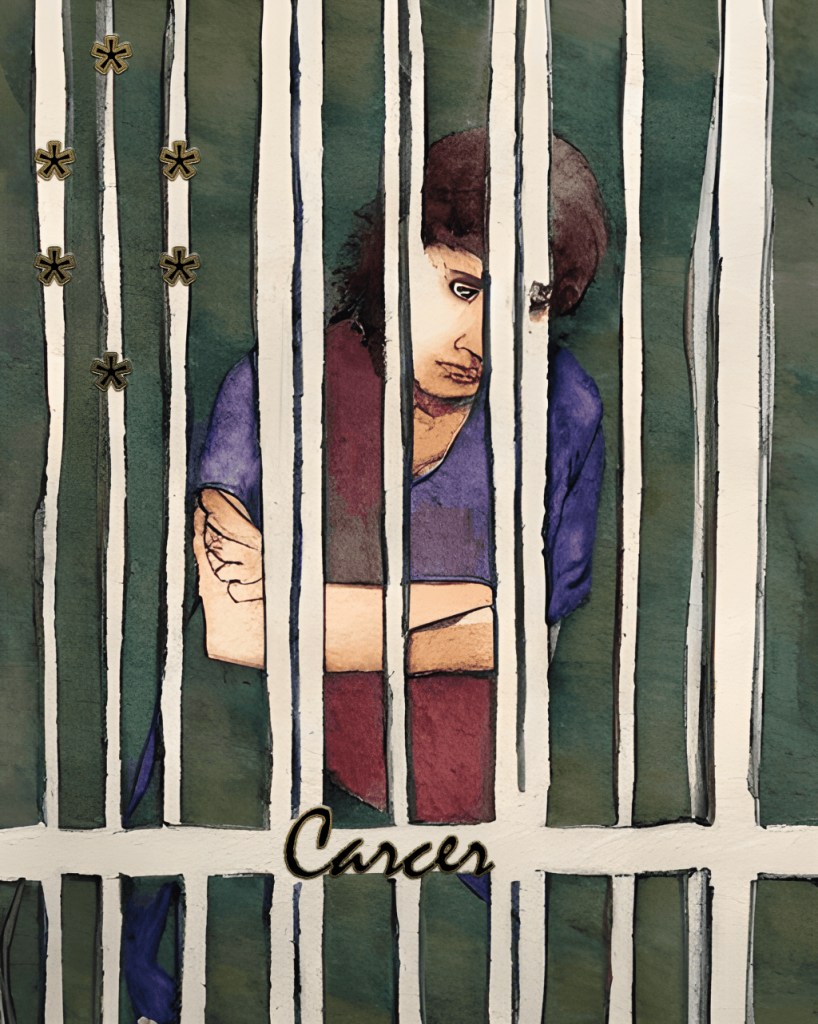
Illustration for the geomantic figure Carcer, prison
Carcer’s association with Saturn is very telling, as it embodies many of its qualities. It indicates loneliness, and in personal relationships it is broadly bad in its import. Although with positive indications it can show long-term commitment, it is more likely to show feelings cooling off, if not outright separation, or more simply it can speak of not finding anyone to be with. Lack of communication and personal contact all belong to the figure’s array of meanings.
Carcer can show prison and negative sentences in general, but the symbol of a prison or enclosed place can be interpreted metaphorically as obstacles, blockages and restriction. It indicates situations where we are in difficulty and it is difficult for us to act. However, on a brighter note, the symbol of the enclosed space can be interpreted as a womb, and Carcer is said in some sources to be good for pregnancy.
Another field where Carcer is generally positive is for building and laying the foundations of buildings (or maybe, metaphorically, for laying the foundations of something) and for keeping things secrets and solo endeavors such as meditation, study, etc. In most mundane questions, though, Carcer is one of the worst figures you can obtain, especially since it can become Judge, unlike other negative figures.
Common Keywords: Loneliness, sadness, blockage, obstacles, stoppage, building, laying foundations, separation, obligations, debts, poverty, pregnancy, secrets, deep knowledge
Carcer in the Geomantic Houses (these are only examples. Use context to guide your interpretation)
House
Possible Meanings
First
Lonely person, blocked, in difficulties, Stingy, Difficult to relate to
Second
Poverty, Lack of means, Hardships, Debt, Financial obligations
Third
Lack of communication, Isolation from the community, Only child, Lack of relationship with the siblings
Fourth
Castle, Large building, Constructing, Building, City, City walls, Tombstones, Loss of the father
Fifth
Depression, lack of fun or excitement, restraint, pregnancy
Sixth
long convalescence, difficult illness, lack of mobility, animal pens, death of animals
Seventh
loneliness, interpersonal difficulties, person is already committed, lack of relationships, separation
Eighth
Cemetery, death, fear, lack of progress, lack of money from the partner
Ninth
serious study, hidden knowledge, atheism, a priest or hermit,
Tenth
unemployment, lack of upward mobility, dead end
Eleventh
loneliness, lack of help or friends
Twelfth
prison, black magic
Thirteenth
past loneliness or hardships, person is serious, solid
Fourteenth
future difficulties, person needs to face serious challenges
Fifteenth
lack of success except in building and keeping secrets or pregnancy
Possible meanings of Carcer in the various Geomantic Houses. Note that this is not meant to be exhaustive, and it only serves to jog your interpretive muscles
On that planet, it seems, technology had reached such a degree of perfection that no problem had been left unsolved. To this day, in all corners of the galaxy, whispers are whispered of their wondrous inventions.
But those visiting the planet today report of the immense silence that envelops everything. A depthless emptiness is over all, unchallenged. Nor are there first-hand accounts of this alien folk.
Some of their fascinating trinkets have reached us, but not a single one of their myths or tales, not one of their beliefs. As if, together with problems, they had run out of ideas.
Often Known As: Doubter, Skeptic, Loyalist, Underdog (note that names are as limiting as they are revealing.) Sin/Passion: Fear Focus: on security Fear: of not finding any stable protection Energy Center: Head (energy is suppressed) Social Stance: Compliant Key Positive Traits (embodied at their best): Dependable, Friendly, Supportive, Dutiful, Mild, Reasonable, Gregarious, Courageous, Cooperative, Group-conscious, Good partner, A buddy, With good hunches, Encouraging, Loyal, Funny, Hardy, Good at foreseeing problems Key Negative Traits (embodied at their worst): Fearful, Critical, Cynical, Cowardly, Mindless, Ideological, Catastrophizing, Alternating between following blindly and rebelling blindly, between conformism and mutiny, A deer in the headlights, Given to unwarranted fight or flight behavior Growth and Stress Directions: to Nine and Three respectively
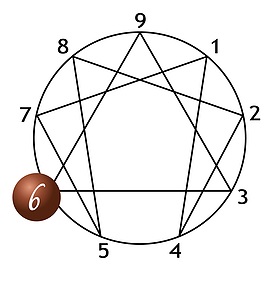
Enneagram chart with Type Six highlighted.
Introduction
In a way, Type Six represents Joe Citizen. Supportive, generally friendly, Sixes are usually mild-mannered and dependable with others. They tend to form strong and stable bonds and they are normally there for the people they have bonded with. Often capable of a great spirit of sacrifice in the name of fairness and friendship, they are always willing to fight for the underdog and try to be good neighbors with their fellow humans.
They often have incredible hunches that almost invariably turn out to be true. This is nothing supernatural. It is the consequence of a life spent trying to anticipate and prevent uncertainties and dangers. When a Six tells you that something is off about someone or something, they are probably right.
Sixes value loyalty–loyalty to ideas and to people. It is rare for them to question the motives of people they trust, and they usually go well out of their way to justify friends and associates. There is little they dislike more than untrustworthy people and traitors. They also occasionally display an obdurate unwillingless to trust others and have trouble with authority figures (unless they blindly trust them).
Sixes often have a good sense of humor, but also a cynical streak. Occasionally they make skeptical remarks that feel unwarranted or exaggerated, and they are seldom satisfied with the level of proof required by others in order to feel confident in a situation: Sixes need more.
The defenseless lamb, a good symbol for Enneagram Type Six
Core Mechanism
It is incredibly hard to pin down Type Six in a single description. In a way, it is the most complex type. Sixes can and often do showcase opposite tendencies at different times, or even at the same time, and sometimes it is hard to see what links them to other Sixes. From a behavioral standpoint, Sixes are probably the most heterogeneous Enneagram type.
Sixes often swing between extremes of obedience and rebellion, mindless acceptance and rejection, aggression and passivity, fight and flight, faith and skepticism. The reason is that they lack any inner sense of certainty about life.
In the introduction I said that Sixes are always willing to fight for the underdog. This is because Sixes often feel like they are underdogs. Their worldview is one of great uncertainty. In a way, Sixes feel like they have been cast into the world with no protection–a world full of wolves that are waiting to attack.
Sixes are a Head type, but unlike the major head type, Fives, who trust only their own mind and relish in endless doubt and uncertainty, Sixes don’t trust themselves to have something figured out for good, but they do want to figure it out for good. Their mental processes are forever undermining their choices and their sense of certainty: “What if this happens? What if that happens? What is the worst that could happen?”
To compensate for their lack of inner guidance, Sixes seek a source of guidance outside of themselves (something Fives would never do). Once this source of guidance (which may be a person, a political ideology, a religion, an institution, etc.) is selected, the Six is unlikely to question them, and will become a brave little soldier fighting for the cause. Sixes also tend to find strength in number and in networking with other people they deem dependable, often on the assumption that they are all potential victims of this uncertain world and so they can help each other.
As soon as the cracks start showing in whatever source of certainty the Six has selected (after all, nothing and no one is perfect one hundred percent of the times) Sixes may try to overlook them by becoming more mindless, but if the cracks become impossible to ignore, Sixes turn on their “protectors” becoming the stereotype of the torch-bearing villagers. Once the rebellion is over, Sixes look for another anchor, and the cycle starts over.
Passion
The passion of Enneagram Type Six is Fear. To understand this we must take a step back and recognize that fear is, in a way, the foundation of every form of life. As soon as an organism exists, it seeks to perpetuate itself and to avoid what damages it, which it fears.
Sixes embody this idea in a visceral and almost archetypal way. Their primary concern is with their safety (and that of the people they care about, of course). Their fear stems from the fact that they cannot find anything around them that they can one hundred percent rely upon.
This leads them to their famous trait of catastrophizing about everything under the sun. Paradoxically, Sixes do this because it calms them, as it allows them to come up with endless Plans B (and C, and D) in case something goes south.
Unfortunately, their fear interferes with this focus on certainties, as eventually they’ll manage to poke a hole even in their fifth, sixth and seventh wheel, leading to a breakdown of their view of reality as it is, and not in a positive sense.
Fear is the constant companion of a Six’s life. It manifests as an ocean of variables when they don’t know what or whom to trust; when they have found this solid rock, fear manifests as a mute, nagging sensation that all is not well, that something is escaping them and will bite them in the ass one day.
In relation to the passion of fear, we distinguish two possible reactions on the Six’s part: the phobic reaction, which consists in running away from fear, and the contraphobic reaction, which consists in ramming through fear (if you’ve seen a herbivore attack a predator in a fearful frenzy, you’ve seen a contraphobic Six). Most Sixes fall somewhere between the two extremes, but some crystallize on one end or the other of the spectrum.
Fear, the passion of Enneagram Type Six
Misconceptions
A common misconception about Sixes is that, because they tend to undermine people’s credibility when they do not fully trust them, they are personally out to get them. Although it can be difficult to deal with a Six in these circumstances, their cynicism and snide remarks are not to be taken personally (which does not make them acceptable, of course).
Sixes are constantly looking for an anchor, something in the world that they can rely on, something that won’t change or be found faulty. As is often the case with psychological mechanisms, other people are simply casualities in our war with ourselves. Knowing this can help you in defusing difficult situations.
Another common misconception is that, because Hitler was supposedly a contraphobic Six, then every contraphobic Six is Hitler or a potential serial killer. I’ve heard this from a number of supposed authorities on the Enneagram. In an age where all it takes to be called Hitler is to mildly disagree with someone with funny hair, it should perhaps be pointed out that, since most Sixes have contraphobic tendencies buried more or less deep within them, and since Six is probably the most common type, it would be silly to say that more than one ninth of the population is made up of deranged dictators, but maybe this is a conversation for a more sane age.
Under normal circumstances, a contraphobic Six is simply someone who has a tendency to react to fear by moving toward and against it (it’s the “fight” part of “fight or flight”). This is not in itself a negative thing. It is just yet another survival strategy.
Wings
6w5: Sixes with a Five wing have definite intellectual, even scientific bent. They are very systematic in their survey of all possibilities, variables and factors, and they are likewise very systematic in their attempt at finding the solution to all of them. They often come up with ponderous defenses of the ideas that give them certainty, which tend to be somewhat more conventional than the ideas a pure Type Five might be interested in, but less than what a pure Six would find comforting.
6w7: Sixes with a Seven wing are very friendly and very entertaining. They often have a sharp sense of humor and a tendency to like and to be liked by others. The Six’s strategy to make friends with everyone so as not to end up eaten by wolves finds application, in part, through the Seven-ish drive toward enjoying time with others and networking. Less intellectual and more practical in their orientation, they fare well in social contexts, especially in group efforts.
(note that wings can have some minor descriptive power in terms of superficial behavior, but they are irrelevant in terms of what motivates the person. Many people have no noticeable wing, while few show signs of both.)
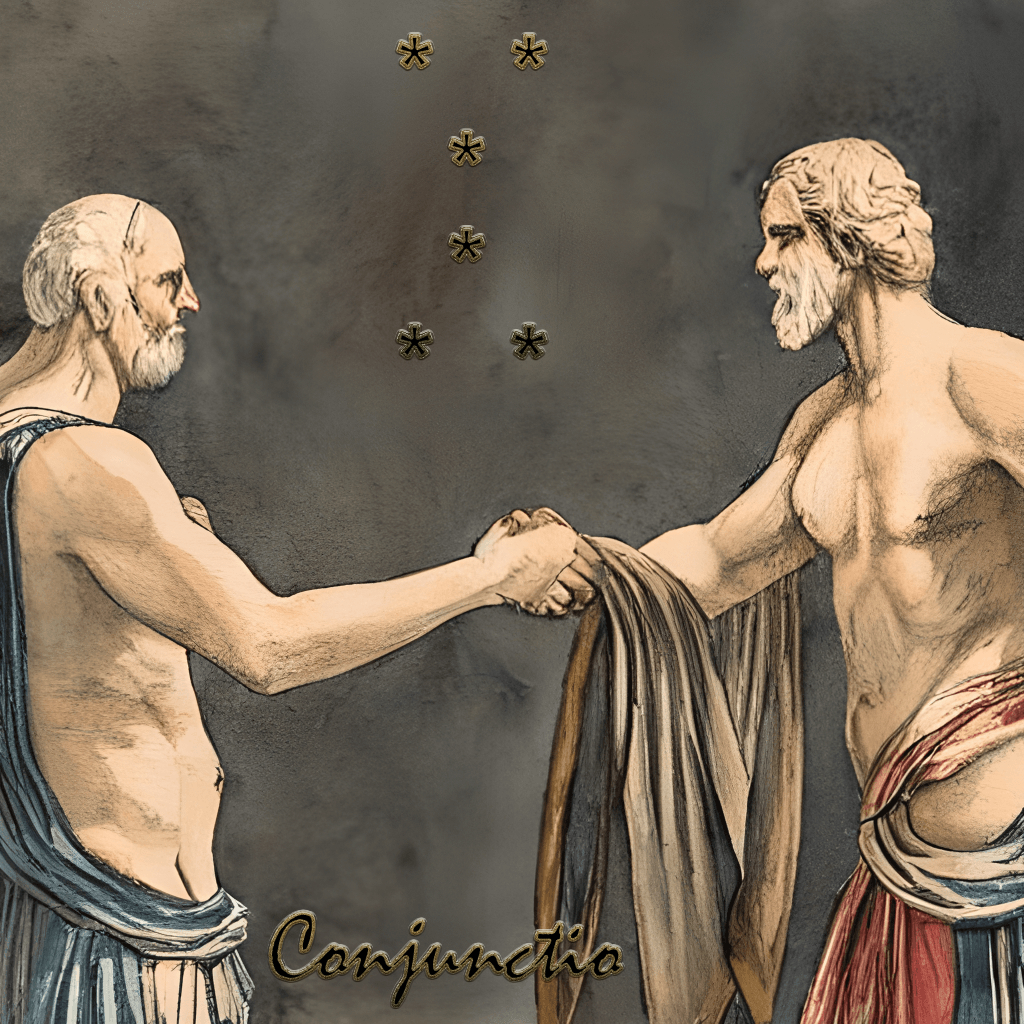
Name of the Figure: Conjunctio (Union) Element: Air Planet: Mercury (retrograde) Sign: Virgo Quality: Common Fortune: Mixed
Conjunctio is a figure of Mercury retrograde. I always found it an interesting figure, as its array of possible meanings is actually quite ample. Its glyph seems to show two arrows converging in the middle. Interestingly, if we believe that a single dot represents an active element, then Conjunctio shows that only the two moist elements (Air and Water) are active. Moisture is associated with pliability and receptivity (remember that Thales, the canonical first philosopher, said that everything comes from Water, and aside from any biological observation, philosophically this means that water can take on any shape.)
Illustration for the geomantic figure Conjunctio, union
Conjunctio represents this mercurial lack of rigidity and convergence toward a middle point. As such, Conjunctio represents all situations that link two things or people together. It is a figure of communication, talking and being good at talking. It is not a figure that favors loneliness and solo endeavors. Togetherness is hinted at.
Because it highlights the two middling elements, Conjunctio is associated with compromise and agreements. It is a very good figure for commerce, employment and for getting out of an impasse, as it indicates moderation and finding commonalities. It is also a portent of marriage. Symbolically, it represents the marriage of various elements, thus showing admixture, mixing things, and all things that are made of various parts.
As it is a symbol of fluidity, it also speaks of exchange of fluids, also known as sex (the word ‘conjunctio’ itself can hint at it). After all, it does indicate unions of all kind. It is one of the double figures, so when asking about pregnancy, if supported by other factors, it can show twins.
On a slightly less positive note, Conjunctio does not promise astonishing results, especially when it is Judge and the question is not about contracts or retrieving lost objects. It is good, it is just not THAT good.
Common Keyword: Communication, convergence, agreement, compromise, contract, document, contact, convene, congratation, sex, exchange of fluids, moderation, temperance, middling outcome, mediocrity, retrieval, discovery, coming into contact with someone or something, mixing, admixture, multiplicity
Conjunctio in the Geomantic Houses (these are only examples. Use context to guide your interpretation)
House
Possible Meanings
First
Flexible, able to compromise, intelligent, communicative, moderate
Second
documents, money-related paperwork, business contracts, retrieval of objects, buying and selling
Third
news, documents, social contacts in the neighborhood, contact with one’s siblings
Fourth
real estate contract, discovery of hidden treasure, talking to one’s father
Fifth
Writing, moderation in pleasure, sex, conception, twins
Sixth
catching an illness, taking meds, buying animals, agreement with servants
Seventh
Marriage, business contract, social contacts, acquaintances, theft
Eighth
money through marriage or business
Ninth
learning, studying, books, talking with spiritual people
Tenth
Job contract, agreement with one’s superiors, moderate leader, talking with one’s mother
Eleventh
Talking with friends, new frends, help
Twelfth
buying large animals, middling prison sentence, unable to let go of self-harming behavior
Thirteenth
able to compromise, good at talking, sociable, past middling results
Fourteenth
indecisive, without moral compass, future compromise, future middling results
Fifteenth
Middling results, obtaining something, union
Possible meanings of Conjunctio in the various Geomantic Houses. Note that this is not meant to be exhaustive, and it only serves to jog your interpretive muscles
Name of the Figure: Tristitia (Sadness) Element: Earth Planet: Saturn (retrograde) Sign: Scorpio Quality: Entering Fortune: Bad
Tristitia is a figure of Saturn retrograde. As Saturn is the great malefic of traditional astrology, connected with restriction, gloominess and such other alluring concepts, its figures cannot be particularly pleasant. Tristitia’s symbol is said to represent a fallen tower or a stake driven into the ground. If we believe the theory that a single dot indicates an active element, then Tristitia only has the Earth element active.
Illustration of the geomantic figure Tristitia, sadness
This seems to be in harmony with the general meanings of Tristitia. For one, it represents melancholy, which is mostly associated with the element of Earth. It indicates all negative emotional reactions to the slings and arrows of life. Dejection, depression, being down are all meanings of the figure. It is also associated with anything that has a downward movement: “Will the stocks go up?” no, they will go down.
Furthermore, Tristitia’s earthiness shows up in the other important concept embodied by the figure, i.e., its quality of “stuckness”. Tristitia indicates all situations that are stuck, for good or ill. As a matter of fact, it is a good figure whenever you wish for things not to proceed or to have a solid foundation. This is especially true in questions about building and cultivating the land.
Finally, as the opposite of Laetitia, Tristitia indicates secrets, another meaning of Saturn. It shows everything that is done under cover of darkness or in secret. Whether this is good or bad will depend on what the querent asked: “Will my wife find out about my affair?” Tristitia says no.
Tristitia in the Geomantic Houses (these are only examples. Use context to guide your interpretation)
House
Possible Meanings
First
Person is sad, Depressed, discouraged, Saturnine
Second
Loss of money, economic decline, Loss of items
Third
Sad news, problematic neighborhood, false rumors, secret messages
Fourth
Burying, Digging, Building, Working the earth, Loss of the father, need for renovations
Fifth
lack of enjoyment, A Debbie Downer, Loss of pregnancy
Sixth
Long illness, Problems through servants and helpers, sick pets
Seventh
Bad public relations, Bad image, Stuck in a marriage, Loneliness
Eighth
Mourning, Death, Bereavement, Lack of income from the spouse
Ninth
Sad journey, occult philosophy, atheism
Tenth
rain, precipitation, loss of employment, demotion, difficulties with the mothers
Eleventh
Lack of friends, loneliness, loss of hope, loss of support
Twelfth
Long sentence, Black magic, loss through large cattle, self-undoing
Thirteenth
Sad past, depression, loss, ability to make efforts
Fourteenth
there will be complications, it won’t be worth it, there will be toil and effort, decrease
Fifteenth
Tristitia cannot be Judge
Possible meanings of Tristitia in the various Geomantic Houses. Note that this is not meant to be exhaustive, and it only serves to jog your interpretive muscles
The psychonauts’s capsule plunged into the collective psychic pool. The mysterious song no one had been able to identify slithered between their minds like the wind, guiding them away from the surface.
Lyrics evaporated one word into the other, notes became colors and colors became suns, and queen bees nested in them.
There it was, lodged between a memory and a desire for more, the cosmic song whose origin they’d been commissioned to investigate. They managed to unstick it.
Excited, they made for the surface. But they’d strayed too far. The mystery they’d entered was dissolving, fog-like, sweeping them along.
Locating the court cards within the querent’s life is probably one of the hardest tasks of a card reader. The Suit of the court card in question can help, of course. A Heart shows someone with a close connection, a Club is an official partner, a Diamond has a more distant connection or is unknown, a Spade tends to either be unknown, a stranger or an enemy.
However, far more revealing than the suit of the card are the suits surrounding it. Let us start simple. Suppose you have a Heart figure (Queen or King) surrounded by Spades. Hearts are usually positive, but IF the question is about a family member, the fact that it shows up as a Heart does not matter much: Hearts simply show consanguinity. However, if the question is about a friend, then their showing up as a Heart is in itself positive, as it shows core positive feelings. The fact that the figure is surrounded by Spades can indicate obstacles or a fight with the person.
As a very vague and general rule of thumb, the suit of the person shows their core, while the cards surrounding them show either their role or their current (or immediate future) way of relating to us. If the friend had shown up as a Diamond, it would have been worse, as then there would be no good feelings left and any fight might cause the end of the friendship.
In general, being surrounded by Hearts indicates good feelings, Clubs show either a solid relationship or a static one (it depends on the cards and the context), Diamonds show a transactional attitude for better or worse or, more rarely, one based on intellectual pursuits, while Spades show enmity. It is easy to predict, for instance, that a Heart figure surrounded by Diamonds shows the positive side of transactions (they may help us financially, for instance), while a Spade card surrounded by Diamonds may show the person will damage us financially.
Here is an example. A person asked if they could trust someone as a business partner:
5♥ – K♠ – 4♥
Regardless of the specific meanings of the cards, we have a Spade court card surrounded by Hearts. The Hearts show that the person is not trying to scam the querent. However, the fact that the person shows up as a Spade indicates that he is at his core a difficult person to get along with and this may cause difficulties along the way. Let us suppose that there had been Diamonds instead of Hearts. In this case the warning would have been more substantial: he may not be a scammer, but he is rather cutthroat and will only look after his profit. If there had been Clubs, the partnership would have probably ended up stranded due to differences of opinion, while Spades would have shown a dangerous individual.