All posts by MQS

Living at the intersection of occultism, fiction and philosophy, I travel the planes at a moderately quick pace. I read, I do magic, I cook for hubby. Confused by the number of things I talk about? Good, confusion is a nice thing ;)

Free Will and Real Estate (Tarot Reading Example)

In the previous article I started talking about free will and prediction. There I talked about some factors that influence our freedom of decision.

Another incredibly important aspect is information. We orient ourselves by interpreting available information. If our free will were absolute, our knowledge of how the world works and how we move in it would not matter, because we’d be able to reach any result regardless of the initial conditions.

This is patently absurd, yet it is maintained by some diviners (appropriately, those who are incapable of deriving specific information from the divination process). It kind of reminds me of one of the definitions of God in the Book of the 24 Philosophers, where it says that God is that whose will is equivalent to his power and knowledge (or wisdom).

This was a fancy way of saying that God’s every action is always exactly the right one at the right moment because the fact that he wants it is the same with the fact that it can be done and also the fact that it is the right thing to do. This may be very true of God, and if we conceive (as I do) that the divine is immanent in the world, it is also true of humans, but only in so far as they understand themselves as limited fractions of this whole process. In so far as we crave things and don’t know how to get them, this view of the world is fairly deceiving, especially if you plan on charging people who expect to be given reliable information.

From a more mundane and practical standpoint, we have limited knowledge (or wisdom) and this always changes from moment to moment. As our information changes, so do our decisions. This has nothing to do with “destiny”: if we did not adjust our behavior to match our knowledge we’d already have died out. It is about survival.

The First Spread

Here’s an example. As I mentioned in my journal section, my husband and I are looking for a bigger home. We had eyed an apartment some weeks ago that seemed perfect, and upon visiting it, we were even more convinced to buy it. Some days ago I asked the tarot if we would be able to buy it.

“Will we be able to buy the apartment?”
Tarocchi di Layla, design by Elisa Scerrato

As can be seen from the cut (Strength and Justice) we were very determined (Strength) to buy (Justice).

The opening of the spread repeats the statement by showing that we are gung-ho about buying the apartment (Stars and Chariot) but that we are not considering everything (Moon) as we head toward the handshake (Lovers)

The second line shows the clarifying (Sun) intervention of a woman (Empress) who will bring certain less than pleasant aspects to light (Devil). The result is that my husband (Pope) will lose all interest in buying (Hanged Man)

This is exactly what happened. Two days after I did this spread, my husband came home and told me that one of his friends from an Enneagram group he is in has some experience with real estate and could help us decide. We set up a Zoom meeting with her, where she went through the apartment’s documents with us and raised some serious red flags we had completely missed that would have turned buying that apartment into a financial and bureaucratic nightmare. Needless to say, my husband (and I) lost all interest after that.

As you can probably guess, nobody forced us NOT to buy. Nor did destiny force our hand. In fact, we probably could have gone on with the deal, and fairly quickly (Strength + Justice in the cut of the first spread can signify a signed contract). But we would have been idiots.

And note how skewed my question was: we were completely besotted with the place, so I asked if we would be able to buy it, not if it was a good idea to buy it. The tarot clearly overrode my question and told me that certain unknown facts would surface that would influence our decision. Note also that the tarot did not say that we should not buy (my experience is that divination reflects reality, not what reality should be). The tarot said that we would change our mind.

The question is: were we destined to change our mind? Well, it is complicated, and the complication arises from the fact that the moment of divination is a very special moment, where spirit reflects on itself through the diviner. I will need to come back on this issue in more detail in some future articles.

The thing is, though, that we were not forced to change our mind: we simply realized it was the smart thing to do. Sure, you may say, if we had been more gullible, or if the apartment had completely blinded us out of our wits, we would have gone on with the deal anyway and regretted it later.

But being gullible or not is neither a choice nor an imposition: it is part of one’s being, at least to an extent, even if it is originally a learned behavior. The tarot simply computed the available information, both that which we could change and that which we had no control over, added the information about who we are at our core, and came to the conclusion that someone like my husband and I, in such a situation, would probably change their mind upon receiving better data.

The tarot predicted our behavior in the same way your mom who knows you are obsessed with chocolate icecream can predict you had chocolate icecream for dessert after dinner with your friends: it is a prediction based on knowledge of your nature and of the available information. The difference between your mom and the tarot is that the tarot (like all oracular forms) has a wider and deeper view of reality. The Tarot is, in a way, like a cosmic botanist who knows a red rose bush will sprout from this or that seed, even though this knowledge does not force the rose to be red. It is simply part of its nature.

The Second Spread

By the way, today before writing this article, I did a second spread just for kicks (the tarot is very tolerant of my shenanigans) to ask if that apartment was seriously off the table, as I am still a bit in love with it. Here’s the result

“Is the apartment really off the table?”
Tarocchi di Layla, design by Elisa Scerrato

In the cut we have Death and the Wheel: definitive change (the Death card can never be undone, just like real death). The spread itself is even more blunt. The Devil and the Moon show hidden dangers, and the contract, signified by Justice, is blocked (Hanged Man) thanks to a woman (Popess / High Priestess). Note how much more concise and harsh the spread is compared to the first one: it’s as if the cards were saying “Dude, really, knock it off already…”

Side note: I don’t know exactly why my husband’s friend came up as Empress in the first spread and as Popess in the second one. My best guess is that the tarot didn’t want me to get confused in the first one: if she had come up as the Popess, I would have linked her to the Pope, and would not have interpreted him as my husband, but since in the new spread neither I nor my husband show up, the cards were free to use a more natural significator for her.

MQS
Enneagram Type Nine – A Quick Introduction

Often Known As: Diplomat, Mediator, Peacemaker (note that names are as limiting as they are revealing.)
Sin/Passion: Sloth
Focus: on harmony
Fear: of rocking the boat and creating conflict
Energy Center: Body (energy is suppressed)
Social Stance: Withdrawing
Key Positive Traits (embodied at their best): Peaceful, Conciliatory, Friendly, Irenic, Serene, Placid, Flexible, Welcoming, Easy-going, Tolerant, Undemanding, Able to hold space for others, Facilitating others’ self-expression, Defusing, Deescalating, Kind, Tactful, Unbothered, Always capable of finding common ground
Key Negative Traits (embodied at their worst): Inert, Self-forgetting, Self-suppressing, Diffuse, Vapid, Platitudinous, Bland, Soporific, Flavorless, Vanilla, Immovable, Complacent, Oversimplifying, Both self-sabotaging and passively sabotaging others, Passive-aggressive, Unable to assert themselves clearly, A secondary character in their own life
Directions of Growth and Stress: to Three and Six respectively

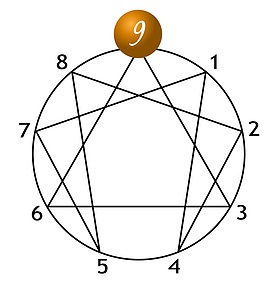
Enneagram chart with Type Nine highlighted.

Introduction

Nines are generally easygoing, accepting, positive and agreeable. They are placid, hardy and normally unbothered by the difficulties of life, as though they wore a waterproof jacket. It is often easy for people to open up to them, and Nines usually like creating connections and cultivating harmonious relationships. In fact, harmony is probably the one word that best describes Enneagram Type Nine.

Within a group of friends, Nines are the ones that will always seem happy no matter what the others decide, and others may find that Nines are very easy to get along with, since they rarely pose challenges or raise serious problems, so much so that, on occasion, they may even stop thinking or worrying about them. This often leads to Nines slipping under the radar and not getting the recognition and attention they deserve, which may make them feel overlooked.

Whenever problems do arise, Nines often prioritize harmony and stability, so they will usually seek to solve conflicts as quickly as possible, sometimes by giving in on others’ demands or giving up their own preferences. Even in their own private life, regardless of other people, Nines normally prefer to entertain positive and uplifting thoughts rather than dwell on the negative side of things.

Nines usually give importance to togetherness and unity with others, and often have a marked mystical bent, where they seek to blur the line between themselves and the divine (or nature, if they prefer) just as they often seek to blur the line between themselves and others in a social context. They usually prefer activities that stress and strengthen cohesion and group work.

Deep inside, Nines may struggle to find a definite identity, as they perceive themselves as showcasing the traits of other people (often, their standard reaction to hearing about the Enneagram is that they see a bit of every type in themselves.) This lack of a strong profile contributes to their being taken for granted by others, which in turn feeds their insecurity.

The sleepy koala, a good symbol for Enneagram Type Nine

Core Mechanism

Peace is a very important thing for Nines. They value peace with others and peace of mind within themselves. This is obviously not a bad thing. However, the quest for peace can become inauthentic and even dangerous if it stifles conflicts and oversimplifies problems without looking them in the face. This is exactly what average to unhealthy Nines tend to do.

Nines belong to the Body triad of the Enneagram, which means that they are concerned with issues of autonomy and instinctual bodily energy. Nines usually seek to maintain their autonomy not, like Eights, by becoming confrontational toward others, but by going along with them and avoiding rocking the boat. More or less unconsciously, Nines believe that if they cause problems, they will sever their connection to other people, and this could lead to problems snowballing.

To avoid this feared outcome, Nines suppress their bodily energy, their urges, their preferences and their claims to autonomy by becoming accepting of other people’s agendas and aims. Their hope is that this will make them more valuable to others. Unfortunately, this behavior often leads to others actually undervaluing or disregarding Nines, and being disregarded is often a painful feeling for Nines (as it usually is for most people).

When they feel trampled over by people with a more decisive attitude, Nines often retaliate by exerting a kind of peaceful passive resistance, where they do not outright tell people that they feel hurt (or, if they do, they still minimize it) but this of course makes it even harder for others to understand the Nine’s boundaries and preferences.

Passion

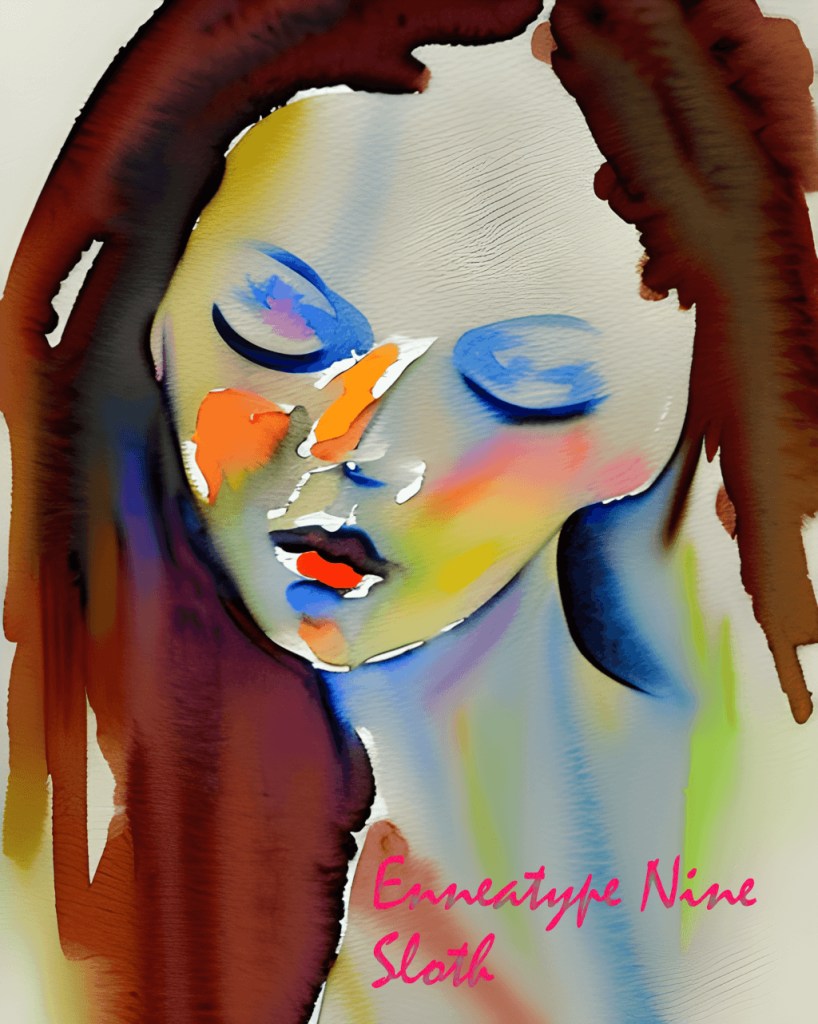
Nine’s passion is Sloth. Sloth does *not* mean laziness. Nines may actually lead quite active lives, full of activities and diversions. Sloth must be rather understood as a spiritual ‘falling asleep’ toward oneself and one’s nature.

Note how point Nine is at the top of the Enneagram symbol. This is because, in a way, Enneagram Type Nine represents the blueprint for all other types. Regardless of who we are, the basic premise of the Enneagram is that we have fallen asleep toward the whole of reality, becoming blind to a section of it to emphasize another section (for instance, Ones, the perfectionists, fall asleep to perfection, overemphasizing faults and errors, which they learn to see everywhere.)

Nines fall asleep to reality in a slightly different manner from other types, as they fall asleep to their own falling asleep. This explains why it is not uncommon for Nines to believe they are very advanced spiritual seekers, when in fact they haven’t even started the real work.

Part of our spiritual work consists in reconnecting with the unity of all things. Nines are very good at emphasizing unity and oneness, and often feel fundamentally connected to everyone and everything. But their condition is like that of a seed that hasn’t sprouted yet but believes itself to be the flower.

Nines’ connection to everything is not that of the experienced seeker who finally returns to the great source of everything after experiencing the ups and downs of life: it is the connection of the baby in the mother’s womb before birth.

Duality is an oft-reviled concept in spiritual circles, but in reality duality is just as fundamental to existence as unity itself. In fact, the two terms are coessential: unity cannot express but through duality, and duality cannot do anything except giving voice to unity. Unity without duality is a barren white light without change and without life; duality without unity is an explosion of incoherence without stability. As such, emphasis on one to the exclusion of the other is always a form of delusion.

Nines’ sloth consists in their tendency to run away from all forms of separation, conflict and dualism, retreating into a sort of dreamy oneness, be it with God, their friends, their community, their spouse or their fantasy. Everything that threatens to tear them away from this vapid, hazy unity is ignored or downplayed.

Their slothfulness is their unconscious refusal to go through the pains of being born as separate individuals and experience both sides of life, happiness and sorrow, joy and despair, doubt and certainty, pain and pleasure. Deprived of the journey, the end result that Nines cling to can only engender shallow insights and a kind of cheap mysticism that works more as a psychological crouch than as a stimulus to growth.

Sloth, the passion of Enneagram Type Nine

Misconceptions

A rather common misconception about Type Nine is that they are the pushovers of the Enneagram. Although unhealthy to average Nines do have a hard time asserting themselves and are often accomodating to a fault, this doesn’t mean that they will just allow anyone to disrupt their flow and sweep them along.

Anyone who tries to force a Nines to do something that they don’t want to do usually experiences that everything suddenly takes five times as much energy to accomplish. Nines are excellent saboteurs of all plans that they don’t want to go along with. And they do it often without so much as lifting a finger. Going to war against a Nine is like going to war against a fog bank: you usually just end up getting lost and giving up.

It is also not true that Nines don’t have their own aims, though they may not voice them (sometimes not even to themselves). If we imagine each person as a different current in the sea, a Nine is the leaf on the surface that rides each current as long as it is needed to get where they want to be (at least, this is ideally how Nines get things done).

This doesn’t necessarily mean that Nines “use” people, at least, not more than anyone else. Nines merely seek to reconcile their own presence in the world with the presence of everyone else, and they often feel that the only way for them to do it is going along with other people as long as they need to, kind of like cosmic itch-hikers: they don’t impose their route to others, they only borrow their momentum.

The problem is that Nines can become resentful of their “drivers” when it becomes clear that they have their own aims and do not show the same tact that the Nine has displayed. Once this resentfulness builds up, Nines start their sabotaging, trying to sweep everything under a blanket of stillness where nothing gets done.

Wings

9w8: Nines with an Eight wing are an interesting combination, as Nines often have a hard time connecting to their bodily energy, while Eights definitely don’t have such issues. This subtype usually has a somewhat more forceful and practical demeanor and a slightly stronger presence. They are often very instinctual and tend to have stronger likes and dislikes. Often they mediate between people and solve conflicts by taking a more active approach, and it is not rare for them to become beacons for the community or for those that know them.

9w1: Nines with a One wing are doubly idealist. To be fair, Nine’s ideal is closer to La La Land than the well-ordered and precisely regulated world Ones aspire toward, but combined, the two tendencies give rise to a person with a strong desire for a peaceful and quiet world. There is a strong tendency to value high ideals, but without being very precise in how they would work in reality. This subtype often yearns for a world of kindness and general ‘nicety’ and they usually have an eye for when people and situations don’t live up to this idea.

(note that wings can have some minor descriptive power in terms of superficial behavior, but they are irrelevant in terms of what motivates the person. Many people have no noticeable wing, while few show signs of both.)

MQS

General Cross Spread / Cartomancy with Playing Cards

In the Sibilla section of this site I posted some spreads that may also be used with playing cards. One type of spreads is generally used for broad readings without a specific focus. I must confess I don’t often use these spreads myself when reading for others (especially the 21 card spread which I will cover in another post), although I have found them invaluable for a quick glance into my own future.

A typical general spread is the cross spread. The disposition of the cards, after shuffling and having the deck cut by the querent, is as follows:

4 – 9 – 14
2 – 7 – 121 – 6 – 113 – 8 – 13
5 – 10 – 15
Cross spread for cartomancy with playing cards

The center of the spread (cards 1, 6, 11) indicates the querent’s present situation, or something that is happening that is very important to them. To the querent’s left (2, 7, 12) is his or her recent past. To the querent’s right (3, 8, 13) is his or her future in the next month or so. Above the querent (4, 9, 14) are his or her thoughts or something they are aware of, while underneath (5, 10, 15) shows something the querent doesn’t like or doesn’t know.

This spread is general, but I am sure it can be adapted to answer broad questions (“Tell me about my career”). It can also be used to investigate a person the querent is interest in knowing about (“My friend’s been behaving strangely lately…”)

One variation of this spread consist in shuffling the remaining cards again and dealing out an additional three cards for the further future or for the “answer”.

Here’s an example. I asked a friend of mine if we could do a spread for her as a demonstration and she graciously accepted. Here’s what came out.

3♣ – 3♥ – 9♣
J♥ – A♦ – 4♠8♥ – 6♠ – 8♠K♠ – 6♦ – A♥
7♠ – J♠ – 7♦
Example of a general cross spread with playing cards

It is never a good idea to start talking immediately, especially when the spread is general. It is always better to simply let your eyes absorb the cards as a whole.

Still, it is quite evident that the central heap is rather problematic, as it shows illness. This is not the querent’s own illness, but that of a relative (Eight of Hearts). This is confirmed by the future cards, where there is worry in the house, with the King of Spades in this case as the doctor. The querent’s grandma needs some minor surgery, it turns out, but given her age, her family is understandably concerned. Fortunately there is no indication of great difficulties, let alone bereavement.

The querent’s thoughts, however, are occupied by the desire for a lasting love union (upper fan), which however she doesn’t have, considering the past fan (blocked news concerning romance).

The bottom fan is difficult to interpret, as it doesn’t appear to link up with the others. It is very possible that, in her life in general, the querent doesn’t feel seen or appreciated (the Seven of Diamonds is money, but also rewards, broadly construed) and she feels unlucky.

This spread, as can be seen, is short and quick, and should ideally only be used as an “opener” to break the ice, before moving on to specific spreads.

MQS

Artificially Generated Predictions Concerning the Most Likely Behavior of OneNet’s Netizens by RealValues, Inc.

Previous / Back to Index / Next

From the Microcosmicon, 11:

“At 12, problematic user IIX-P0-1287719 will make a controversial statement on a culturally sensitive topic.
At 13, users whose ID divides by three will gather to work themselves into fits of outrage over it.
At 14.45, even-numbered IDs will organize a parallel demonstration in favor of it.
Users whose ID fits both profiles will stay home and comment sarcastically, unless their ID divides by five as well, in which case they will engage in other social activities.
Likely topic: the wages of Xandal’uc workers (Probability: 78%)
Shall I start the production of merchandise for both sides?”
RealValues’ manager smiled.
“Ok.”

An AI predicts the future for RealValue, Inc.

MQS

Enneagram Type Eight – A Quick Introduction

Often Known As: Boss, Warrior, Challenger
Sin/Passion: Lust
Focus: on the power and strength needed to preserve their independence
Fear: of weakness and being submitted
Energy Center: Body (energy is asserted)
Social Stance: Assertive
Key Positive Traits (embodied at their best): Assertive, Strong, Powerful, Willful, Protective, Fatherly, No-nonsense, Decisive, Honest, Truthful, Magnanimous, Big-hearted, Inexhaustible, Fierce, Courageous, Heroic, Able to fight for what’s right, Has a good bullshittometer, Endlessly patient with friends and proteges
Key Negative Traits (embodied at their worst): Cruel with enemies, Unforgiving, Aggressive, Overbearing, Vicious, Lustful, Unable to resist own urges, Uncompromising, Intimidating, Impulsive, Foolhardy, Hooked up on intense experiences, An elephant in a china shop, Obtuse, Unwilling to make subtle distinctions even when needed, Unable to unclench
Directions of Growth and Stress: to Two and Five respectively

Enneagram chart with Type Eight highlighted

Introduction

An Enneagram Type Eight is usually hard to miss. Not seldom they are physically imposing–not necessarily because they are big or tall (the Enneagram has nothing to do with body type) but because of the kind of energy they emanate.

Eights enter a room and most people in there feel that they need to deal with them, one way or another. They exude power, they know they exude power, and they know you know they exude power. And they like it. Eights are not necessarily arrogant, but they are unwilling to let anyone trample over them, and will often take the opportunity to make it known at the merest slight they receive (sometimes even if no slight was intended).

Being on a Type Eight’s good side not only makes things easier, but it’s also a wonderful experience. They shower the people they like with all kinds of attention. It is like living between a cushion and a very, very soft place. Eights love pampering their friends, family and protégés just as much as they hate anyone that threatens them (either in reality or in the Eight’s imagination).

In fact, they have particularly developed protective instincts toward their loved ones, and average to healthy Eights often take the initiative whenever they feel anyone is being treated unfairly, especially if the Eight believes the person is too weak to defend themselves.

Fairness, truthfulness and honesty are the values that Eights usually cherish the most. They don’t have a cerebral definition of these qualities, but rather an instinctive understanding of it. Eights often feel that they had to toughen up early in life to avoid being treated unfairly or dishonestly, and their sense of justice will often come from their experience rather than from abstract principles.

In a way, they believe that they must still protect the tender side of their personality (figuratively, the small Eight child that still lives inside of them) and this they accomplish by making it known that they are a force to be reckoned with and that they are the one who are in control. This, of course, is where many problems start.

The powerful bear, a good symbol for Enneagram Type Eight

Core Mechanism

Eights belong to the Body triad, and they are the type that most directly and emphatically expresses their bodily energy. Out of all the nine types, Eights are the one with the most willpower, stamina and endurance.

In general, an Eight’s more or less subconscious drive is for independence, like all Body types. Eights achieve independence by either submitting others and being in control of the situation or by preventing others from submitting them. They have a strong sense of who is in charge of any situation, and they often look for ways to make those people know that they (the Eight) are not to be messed with.

An Eight’s greatest fear is of appearing weak, either in front of themselves or, even worse, in front of others. They have a sneaking suspicion that there is a weak point in them that they need to protect, often coming from some childhood event that left a mark. To compensate, they often act overconfident and cocky, and it is not unheard of that they will actively look for a fight, either physical or psychological.

Well-adjusted Eights are capable of using their endless drive in productive and fair ways, and their general sense of justice makes them often heroic. Less well-adjusted Eights can just as easily turn into overbearing villains that force their ways onto others.

Underneath it all, Eights are keenly aware of their vulnerability and deficiencies, and much of their subsequent behavior depends on how they deal with it. If they accept it as a core part of themselves, they can grow and allow others to grow with them, while if they deny it or hide it, it often leads them toward misery for themselves and others.

Passion

Type Eight’s passion is Lust. Lust must not be confined to sexual needs, although Eights may indeed have a strong sex drive. The word “lust” derives from a Proto-Indo-European root which means “to be wanton, unruly“. This is a good description for the Enneagram conception of lust.

Lust is a powerful inclination toward someone or something. The accent here is on “powerful”. Eights have a strong bodily energy, and crave using it to establish themselves and their dominion over anything or anyone outside of themselves. In a way, Eights love the idea of meeting resistance, and they actually respect those that are capable of offering it. By meeting resistance, Eights can overcome it to assert themselves.

When left unbridled, lust can become a source of problems for Eights, as it is a magnet for confrontations, but also because it tends to give them the idea that they simply need to reach for whatever they want and it will be theirs, regardless of what others think and do. This leads to the typical problem of Eights being wanton and having no self-restraint.

The lack of self-restraint of an Eight is different from that of, say, a Seven, as the latter seeks variety and fears confinement, while Eights seek intensity, even if just in one or two fields.

Unfortunately, the lustful attitude of an unhealthy to average Eight can lead to people becoming extremely resentful of them for behaving like the villains of a martial arts movie. As Eights already feel the need to protect themselves by being assertive, when they pick up on people’s less than friendly attitude they can be led to ramping up their aggression, which is obviously a recipe for disaster.

Lust, the passion of Enneagram Type Eight

Misconceptions

It is not uncommon for people to describe Type Eight as the “bad” type. Even when explicit value judgments are absent, Type Eight descriptions tend to be less than flattering. Not that I think the Enneagram should flatter anyone, but we should certainly acknowledge that there is a place for every type.

The reality is that the aggressive mediocrity that rules our spayed and neutered world today is quite allergic to the kind of warrior-like values that Eights tend to embody. Eights are not inoffensive, they are not conciliatory and they don’t give a flying fig about not hurting other people’s emotions. They are, in the best sense of the word, predators, and predators go for the jugular.

This is not to say that Eights must be protected from criticism, either. First of all, they don’t need protection, and second of all, like every type they can become entangled in their own mechanism, with negative consequences for themselves and others.

What is true is that being in front of an average Eight *is* confronting, for two reasons: because Eights’ way of asserting themselves is of confronting others directly, and because people are generally used to exactly the kind of tea-and-cookies social niceties that Eights rarely provide. As with any type, there is plenty of room for others to learn something from Eights.

Wings

8w7: Eights with a Seven wing are generally hard to miss when you come across them. The in-your-face quality of Type Eight is magnified. They tend to be extremely quick-witted, though they are also generally pachydermic in their way of dealing with subtle issues. They rarely complain about anything and are possessed of incredible endurance and willpower.

8w9: Eights with a Nine wing are the archetype of the lioness protecting her cubs. There is a more conciliatory aspect to this subtype, and a tendency to use their power to hold together and protect the important bonds in the Eight’s life (this can be for better or worse). Usually, this subtype is more tranquil and laid back, although it still cultivates its sense of condifence that, in case of need, it can break a bone or two.

(note that wings can have some minor descriptive power in terms of superficial behavior, but they are irrelevant in terms of what motivates the person. Many people have no noticeable wing, while few show signs of both.)

MQS

Cauda Draconis / Dragon’s Tail (Geomancy Figures)

Name of the Figure: Cauda Draconis (Dragon’s Tail); sometimes called Outward Threshold
Element: Fire
Planet: None, Moon’s South Node (some say also the malefics, Mars and Saturn)
Sign: Sagittarius
Quality: Exiting
Fortune: Bad

Cauda Draconis is the less lovable sibling of Caput Draconis. Like its counterpart, Cauda is not traditionally associated with any planet, although some classics say it belongs to the malefics of astrology, namely Mars and Saturn. However, in itself, Cauda is connected with the Moon’s South Node. Technically every planet has nodes, that is, points where they cross the Sun’s ecliptic. However, in traditional astrology, only the Moon’s nodes are considered, as the Moon’s connection with the journey of life is said to begin with the North and end with the South Node. Visually, the symbol of Cauda is said to show a series of steps leading away from a threshold, symbolizing the sense of ending.

Illustration of the geomantic figure Cauda Draconis, Dragon’s Tail

And ending is indeed one of the main meanings of Cauda. Ending is not necessarily bad. When you want to get rid of an illness, or really anything, Cauda can be positive, if not easy. It also shows quick, sharp change, so it can bring stagnant situations to an end.

Still, Cauda is mostly unwelcome in most readings. It can indicate the end of a relationship (or that a relationship won’t start). It can show unemployment and loss of money. It can announce difficult interpersonal relationships all around.

Due to its connection with the bad side of life, Cauda is one of the figures that, traditionally, prompted geomancers to break their figure and abandon divination if it shows up in the first house. Don’t do it. Just because Cauda is in the first house doesn’t mean your querent is a psychopath. Cauda is a challenging figure. It can simply mean the person is going through challenging times, that their life is changing dramatically and they have lost the plot.

Common Keywords: Ending, Loss, Abandonment, Evil, Quarrel, Evil intentions, Disruption, Letting go

Cauda Draconis in the Geomantic Houses (these are only examples. Use context to guide your interpretation)

HousePossible Meanings
FirstDangerous person, Person in danger, Person who is going through hell, Person who is ending something
SecondLoss of money or items
ThirdQuarrels among neighbors or siblings, Bad news, False rumors
FourthEnd of lineage, Death of father, Eviction, Loss of home
FifthDanger though excess, Loss of pregnancy, Questionable pastimes
SixthEnd of sickness (but if the chart is bad, it could end with death), stay way from your servants
SeventhDivorce, Quarrel, Theft, Untrustworthy individuals, Fraud
EighthDeath, Danger, Loss of money
NinthEvil religion or way, Inability to learn, Atheism, Materialism, Loss of faith
TenthBeing fired, Loss of employment, Revolution, Coup d’etat, Death of mother
EleventhEnd of a friendship, Fights, Quarrels, End of hope
TwelfthEscape, Freedom, Death of large animals
ThirteenthThere was upheaval, ending, disaster, the querent is capable of letting go
FourteenthThere will be upheaval, ending, disaster, the querent is unable to let go
FifteenthCauda cannot be Judge
Possible meanings of Cauda Draconis in the various Geomantic Houses. Note that this is not meant to be exhaustive, and it only serves to jog your interpretive muscles

MQS

Free Will and Prediction (Notes on Divination)

This post is part of my Notes on Divination series. This gets somewhat philosophical and is rough and not organized, so bear with me.

I have been playing with the idea of writing a book on the philosophy of divination. In fact, I have been playing with ideas for a lot of books on occultism, but I need to start somewhere. This is the first in a series of articles on such topics. Don’t take the following as an organized treatise–it is more like a random gathering of thoughts.

It’s impossible to be self-aware diviners without sooner or later stumbling upon the question of free will, the two most simplistic options being that we have complete free will and therefore divination is not about the future or that we have no free will at all and everything is predestined. I will argue in another article that both options actually prevent meaningful prediction.

Often people talk about “compatibilism” that is, the idea that prediction and free will can be seen as compatible. This is all very well, but it means nothing unless one explains how. Inevitably, explaining it requires one to clearly define the space alloted to both. Here I talk about all things that limit our choice, while in a future article I will talk about the limits of prediction.

Firstly, we need to acknowledge that when it comes to divination, it is not at all clear that we talk about prediction. After decades of New Age nonsense, divination has largely been relegated to the uttering of ‘inspired wisdom’, wisdom apparently being the consolation prize for those that can’t look at reality for what it is.

People who usually manage to compose their faces in a mask of sanity abandon all commonsense as soon as they pick up a tarot deck: you create your own destiny, you can do whatever you want. Well, you don’t. This is provably so. We cannot treat people as if they were bundles of free will floating in empty space. People come from specific backgrounds and have specific problems, idiosyncrasies and preferences that dictate their course.

You may be free, for instance, to choose between vanilla and chocolate, but if you hate chocolate you’ll probably pick vanilla. This is often seen as part of people’s free choice, but if we think about it for a second, it is actually a limit to personal freedom: an inner disgust toward something leads you toward something else without you being able to control it.

Free Will and Destiny

In other words, your choice, which is theoretically open to everything, is already limited by a number of psychological hangups that push you around like a sock puppet. That is a limit to free will in my book. Divination may very well be used to delve into these issues and to widen your options. In fact, it is a very good use of divination. But we cannot use divination to do so if we don’t first acknowledge that our options are limited, sometimes severely so.

But preferences are just one kind of limit. Another one comes in the form of ( the much reviled in spiritual circles) objective reality. If you are in a blind alley, know no martial arts, have no means of self-defense and an armed thug is walking toward you, that’s a pickle you can’t meditate or visualize your way out of.

This is not to say that you’ll inevitably lose. Maybe the dude is drunk and collapses to the ground as soon as he stumbles on that banana peel; maybe you are very good at talking and you persuade him to let you go by striking the right note; maybe a falling bit of debris from a ramshackle building takes care of him.

All this (and more) is possible. But the objective fact that you are in the blind alley in a less-than-desirable situation instead of sucking on a Capri Sun on your way to Hawaii imposes certain limits (just as this latter scenario imposes other limits)

The example above is situational, but our whole life is a series of determining factors that limit our trajectory. Look back on your personal history and you’ll probably be able to see traces of many, many past situations that still accompany you to this day, for better or worse. Even past choices become hard, unchangeable facts once enough time passes. You cannot, for instance, ungraduate from that useless gender studies degree in order to pursue a STEM subject. Although you can divorce, you cannot unmarry the person you married. Although you can abandon your child, you cannot unbirth it.

We could go on, but this point is clear enough: at any given moment in time we find ourselves shaped by a series of objective, subjective and intersubjective factors that limit us and our possible trajectory.

The delusional New Age view that we are the product of our current decisions does happen to stumble upon a little bit of truth, though it mischaracterizes it. It is true that, in so far as we abstract from ourselves and we move toward the universal, we peel backs layers of individual conditioning and we move toward the unconditional, however you may choose to call it (God, Being, One, Reality, Ensoph, etc.)

But there is a catch: moving toward the unconditional means not just letting go of our limits, but also of the aims that would lead us to want to overcome those limits as, however we may understand the unconditional, it is not conditioned by this or that choice. The fact of the matter is that free will may very well be the substance of reality, but in so far as it is the substance of reality it is not the substance of my limited whims.

In practice, therefore, the idea of unconditional free will is untenable from the standpoint of a diviner, as abiding by it renders the divination process futile, however we may understand it. This is not to say that complete determinism fares much better, as I shall show in the next article.

MQS

Caput Draconis / Dragon’s Head (Geomancy Figures)

Name of the Figure: Caput Draconis (Dragon’s Head), sometimes called Inner Threshold
Element: Earth
Planet: None; North Node (some say also the benefics, Venus and Juputer)
Sign: Virgo
Quality: Entering
Fortune: Good

Caput Draconis, like its counterpart Cauda, is a special figure in the geomantic family. These are the only two that are not canonically assigned to any traditional planet. Instead, they are given to the nodes of the Moon, i.e. the points where the Moon intersects the Sun’s ecliptic. These were held in exceptionally high regard in traditional astrology, at least from Arab astrology moving forward (but apparently also in Hellenistic astrology, though their function there is debated.) Caput Draconis, the North Node, is usually said to be expansive and broadly positive, or at least augmenting. The symbol of the geomantic figure is usually likened to a series of steps leading toward a threshold.

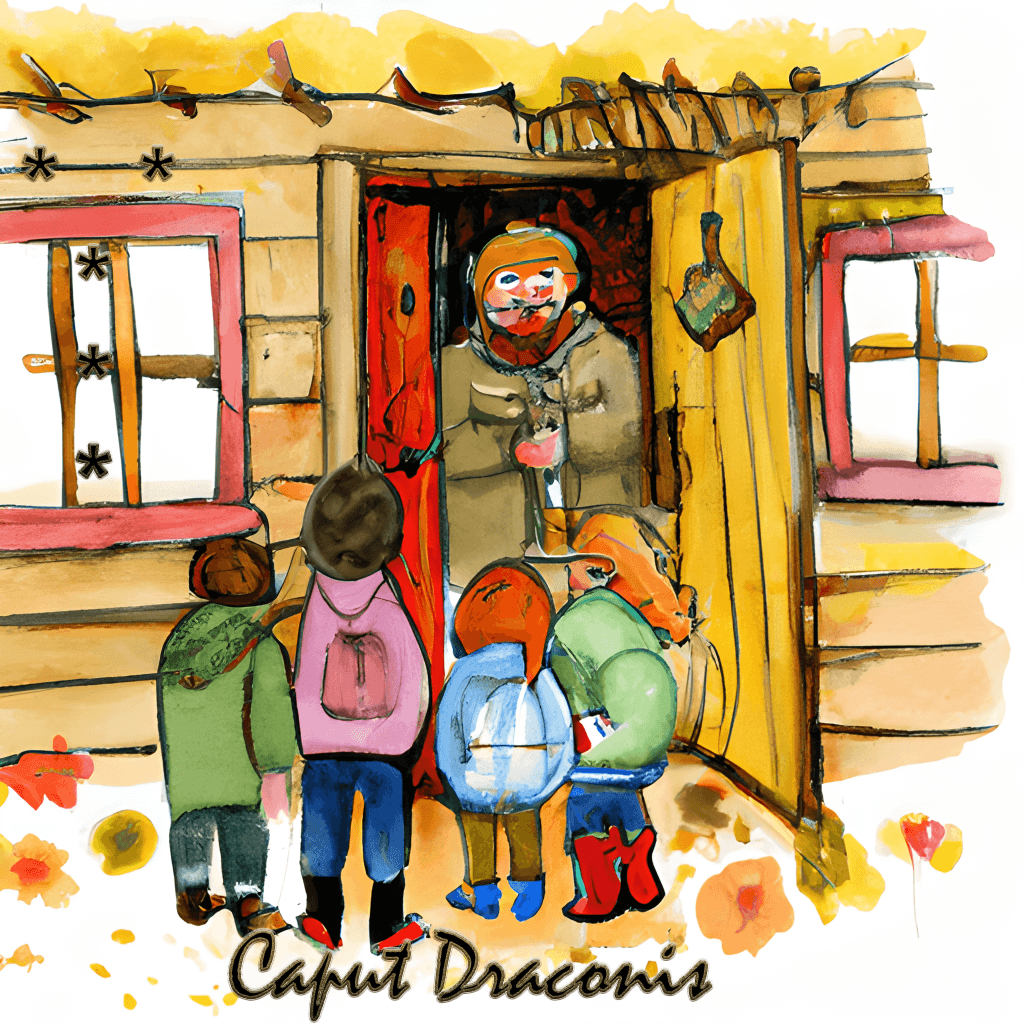
Illustration for the geomantic figure Caput Draconis, the Dragon’s Head

Some say that Caput is associated with the two benefics of traditional astrology, Venus and Jupiter. More specifically, though, Caput is not automatically a good figure. It often represents an onrush of new energy, indicating everything new or everything that starts afresh.

More generally, it is associated with everything that develops, grows, becomes more stable and certain. This, of course, is a double-edged sword, as not everything that is stable is good for us. Often, Caput shows the impossibility to get rid of something, even if it is bad for us. It shows long illnesses, for instance.

Often, however, Caput is in fact a positive figure. It represents things coming to us, and as most questions get a positive answer when something comes to us, Caput is mostly a welcome figure.

Common Keywords: Arrival of new situations, beginning, fresh air, new enterprises, dynamic energy, development, deepening, stabilizing, long-lasting

Caput Draconis in the Geomantic Houses (these are only examples. Use context to guide your interpretation)

HousePossible Meanings
FirstPositive, taking initiative, going, doing, starting something, good luck
SecondIncome, new income stream
ThirdNews, important information, help from siblings
FourthBuying real estate, help from the father
FifthFun, pregnancy, conception
SixthLong illness, good servants
SeventhNew relationship, lasting bond
EighthBeing shielded from danger, gain from other people
NinthConversion, signing up for a course, good at learning, spiritual evolution
TenthNew job, lasting stability in one’s career
EleventhNew friends, realization of hopes
TwelfthLong prison sentence, safety from occult enemies
ThirteenthQuerent has initiative, something has already started
FourteenthQuerent lacks initiative or needs to exert it more, there will be a new beginning
FifteenthCaput cannot be Judge
Possible meanings of Caput Draconis in the various Geomantic Houses. Note that this is not meant to be exhaustive, and it only serves to jog your interpretive muscles

MQS

Longing and Presence

One thing I’ve noticed as hubby and I have finally started actively looking for a new place is how incredibly tiring the mere mere act of longing for the future is. It is like the opening of a black hole at the top of one’s mind, from where all energy is drained away.

Longing is really like booze in one way: you are suddenly unaware of what goes on right in front of you, everything feels less real, and yet in the back of your mind there is a muted awareness that you are willingly deluding yourself.

I’ve noticed it especially during the morning meditation, when my awareness is sharpest and most aligned with the present, only to be yanked away a few minutes later as the day starts. All I can do is observe myself with curiosity, like one being amused by the antics of a pet.

Enneagram Type Seven – A Quick Introduction

Often Known As: Epicurean, Enthusiast, Entertainer, Joker (note that names are as limiting as they are revealing.)
Sin/Passion: Gluttony
Focus: on options to experience pleasure
Fear: of suffering and being left without options
Energy Center: Head (energy is transformed)
Social Stance: Assertive
Key Positive Traits (embodied at their best): Positive, Fun, Friendly, Active, Good planner, Anticipating, Excited and exciting, Energetic, Colorful, Playful, Spontaneous, Casting a wide net, Smart (and often street-smart), Multifaceted, Practical, Quick-witted, An enjoyer of life, Entertaining, A magnet for people and for odd, whimsical adventures
Key Negative Traits (embodied at their worst): Shallow, Manic, Falling for every silly novelty, Excusing away own lack of restraint, Scattered, Wasteful, Materialistic, Impatient, Delusional in assessing own abilities, Hyperactive, Making rash decisions that come back to bite them, Sense that if they stop one second something “wrong” or “bad” may surface within them
Growth and Stress Directions: to Five and One respectively

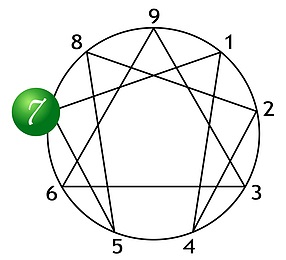
Enneagram chart with Type Seven highlighted

Introduction

Everyone has someone in their life who always seems to be in the right place for something odd, fun or remarkable to happen to them. Even when they relate their experience as if it were a nuisance, these people manage to put a funny spin on it, turning it into the subject of a story that everyone can laugh at. These people may be Sevens on the Enneagram.

Sevens are always seemingly upbeat and positive. Possessing an endless reservoir of energy and as wide an array of interests toward which to funnel this energy, they appear to go through life in search of the next exciting thing.

Sevens don’t necessarily look for the spotlight, but still they often shine in group settings, where they grab people’s attention with their colorful personality and their ability to connect over their many interests. In fact, Sevens tend to cultivate a variety of hobbies and personal interests, often achieving more than other people in a shorter period of time.

A Seven is not someone who “one day” would like to go see that concert. A Seven is the person who’s already scouring the internet for tickets and accomodation solutions, even if they’ve promised themselves they would wait a couple of months before spending that much money again.

Sevens love making new experiences and hate feeling held back or limited in their options. They live for the thrill and they are often found planning the next one. When the experience is over, they may be a little sad, but low moods rarely last very long with Sevens. They always find a way to cheer up and move on to the next thing. This may sometimes cause trouble as it leaves negative feelings unelaborated and may end up in rash decisions.

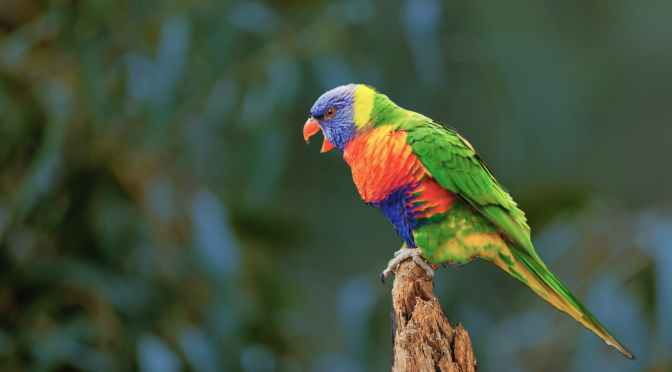
The colorful parrot, a good symbol for Enneagram Type Seven

Core Mechanism

On the Enneagram, Sevens belong to the Head triad. This may seem strange, as they do not give off intellectual vibes (note that ‘intellectual’ does not necessarily mean ‘intelligent’). Sevens appear very much to be doers. And yet, Sevens are also great planners. Just as Fives seek to anticipate the world as a whole and Sixes seek to anticipate what might cause them pain or fear, Sevens seek to anticipate pleasure. This is how they use their head.

In Sevens, the urge for safety that characterizes all Head types is transformed into an active quest for enjoyment. Sevens fear pain and sorrow. Thus, they fill their lives with what philosopher and mathematician Blaise Pascal called ‘divertissements’, that is, distractions. Although Sevens appear hardy and resilient, they actually have a low tolerance for inner pain or existential dread. Therefore, their lust for adventure is actually a flight from these conditions.

This is behind Sevens’ tendency to “skim” through life, fueled by their fear of missing out and being stuck with the present. Not that the present is inherently bad for them. They can appreciate it. But they appreciate it in so far as it is one of the many things they can and will enjoy. When it becomes the sole thing, then Sevens’ attention, being confined within the narrow space of existing conditions, turns toward the more negative side of their life, which is what they want to avoid.

And yet, the more they force variety and diversity into their life, the more this variety becomes shallow. Since Sevens are often anything but stupid, they perceive this, and they are prompted to flee even further into more meaningless variety.

Passion

Gluttony is the passion of Enneagram Type Seven. As with all types, we must read the term ‘gluttony’ figuratively. The gluttony of Type Seven manifests in their general tendency to seek variety and always new experiences to ‘consume’, and always being afraid of remaning stuck with the thing you have and missing out on the world out there.

Sevens want to fill their life with experiences. The idea of staying put is very much alien to them, because as soon as their life begins feeling stale or samey, a sense of wrongness begins to surface, and the negative feelings that they seek distraction from become loud.

Interestingly, Sevens usually fear being in a situation of lack, want or dearth. They tend to have a sensual, materialistic streak. However, their gluttony can jeopardize their sense of security if left unbridled, as the person may end up overspending, overeating, overdoing, developing addictions, etc.

Healthy Sevens are generally capable of exerting some self-restraint when needed, but unhealthy ones feel that lack of variety and change makes the world close in on them. This can cause them to drop the toy they are playing with as soon as they eye the next shiny trinket. It is not uncommon, for instance, for Sevens to try to initially compromise with themselves: “I’ll get the new thing I want when the paycheck comes” only to be unable to help themselves and just going in the red. This is just an example, of course, but it paints an accurate picture.

Gluttony, the passion of Enneagram Type Seven

Misconceptions

A common misconception about Sevens is that they cannot make commitments and are unreliable friends. This is not true. Though Sevens may have a number of acquaintances and fair-weather friends with whom they do not care to take things very far, they are extremely loyal to the people they consider important in their life.

As with people, so with activities. It is true that Sevens may often be unwilling to persevere in things (some hobbies, for instance) once the rush wears off unless they have managed to organize their life around it, but there is almost always a handful of activities to which a Seven devotes themselves wholeheartedly.

Another typical misconception is that Sevens are always extroverted. Extroversion is not something that the Enneagram can measure. Although there may be a statistical correlation between introversion with certain types and extroversion with certain other types, there is never a causal connection.

Sevens move toward people not necessarily because they are extroverted (though they may be) but because their behavior leads to them interacting with people, even when it is not the main goal.

Finally, I’ve come across descriptions, especially on socials, that state that Sevens are never depressed. As depression is a mental condition, it can develop in anyone with a mind, and has no connection with one’s Enneagram type.

Wings

7w6: Sevens with a Six wing often have a more noticeable anxious note. Excellent planners, their quest for entertainment often ends up involving other people, as this subtype tends to be in high demand among potential friends and acquaintances. Friendly and upbeat, they often appear approachable. Compared to the other wing, 7w6 may sometimes be held back by fear from going after what they want, though often they end up going after it anyway and worry later.

7w8: Sevens with an Eight wing have a stronger presence, and can have the eightish air of someone you don’t want to mess with. Compared to the other wing, they are more likely to jump eagerly into situations without forethought, and will often quickly go get what they want. These Sevens often have a decidedly sensual bent, and want to surround themselves with all the means of satisfying their desires.

(note that wings can have some minor descriptive power in terms of superficial behavior, but they are irrelevant in terms of what motivates the person. Many people have no noticeable wing, while few show signs of both.)

MQS