Living at the intersection of occultism, fiction and philosophy, I travel the planes at a moderately quick pace. I read, I do magic, I cook for hubby. Confused by the number of things I talk about? Good, confusion is a nice thing ;)
Morality is a complex thing, though this fact is lost in an age in which debates are reduced to exchanges of snarky remarks on social media. Morality is complex because it deals not in what is but in what ought to be, and what ought to be is invisible to the eyes. How ideas about what ought to be came to exist has kept philosophers and scientists occupied for thousands of years.
And this may account for a good deal of the blind desperation with which people seek something or someone who will tell them how to act. For those of a speculative mindset, reaching definitive conclusions is less a priority than exploring possibilities.
But most people feel the urgent need of external guidance. So some give themselves over to group leaders, others adhere rigidly to an ideology or religion. And those with a more woo woo view of life turn to oracles.
But divination is not a good judge of what’s morally right. If you want proof, when was the last time you laid out a spread that gave you advice that was based on moral principles completely incompatible with your own?
Having the stamp of approval of whatever projection we may make onto pretty bits of cardboards is not that good of an idea. It is a surefire way to delude ourselves and it can rob us of our agency and of our responsibility to think for ourselves.
Divination is good at telling us what is, or was, or has a good chance of being in the future. What ought to be is for us to make up our mind about.
April, the month I was born is, is quite like me: mercurial and moody. But this June is giving April a run for its money, and this little fella was seeking shelter from the rain under our roof.
I love bees and bumblebees almost as much as I’m terrified by wasps and hornets. Look how chonky and squeeshy he is.
There are couples who stay together a lifetime, couples who break up at the first sign of hardship, and then couples that seem to follow some kind of fated path made of pushing and pulling. This is one example.
8♥️ 6♣️ 7♣️ 4♠️
Q♣️ J♦️ K♣️
9♣️ 3♣️
6♥️
Note the absolude predominance of Clubs. Clubs are a heavy suit that causes difficulties and slowness. There is no card of great love, but the Eight of Hearts is a card of fun and good times.
Followed by two problematic Club cards, the Six and the Seven, which end up in break-up (Four of Spades) it is clear that the two didn’t break up from one day to the other never to see each other again, but have been on a constant path of ups and downs ending up in separation.
At the time of the reading the two were broken up, so when I told the (female) querent what I was seeing she confirmed that they’ve been on again off again for quite some time.
Look the second line! We have the two significators united by the messenger card (Jack of Diamonds). So the two have broken up but are still in contact. The querent told me it’s not so much that they send each other messages as they communicate and cause misunderstandings with one another through mutual friends (the Jack of Diamonds can show a go-between). Clearly not a very healthy situation!
The final cards, the Three of Clubs and Six of Hearts, show a reconciliation in the union, but the Nine of Clubs before them implies this is going to be a long-term goal rather than a matter of days or weeks. So the unsatisfactory situation is likely to persist for a while.
As far as giving the querent some advice based on this spread is concerned, I would personally be wary of that Jack of Diamonds between them. It is much better to clear up misunderstandings directly instead of playing up the drama by involving friends as if the two were still high-schoolers (they are in their 40s).
All in all, this spread gives off bad vibes for a relationship. It seems the two are attached more to the drama than to each other. To each their own.
You know the old adage that people who sell solutions need the problem to remain unsolved. I’m not talking about odd conspiratorial crap, like “the government is hiding the secret of immortality”. I’m talking about observable facts.
When influencers started becoming a thing, it was simply a bunch of kids in their rooms talking about stuff they were passionate about. Corporations then smelled the opportunity and ruined everything, as they usually do, by turning them into advertisers.
There is, obviously, absolutely nothing wrong in wanting to make money on the Internet. My mom, who was a journalist, used to say to people criticizing that she made money off of reporting tragedies, that it’s possible to do her job well with professionalism and strong ethics. A look at the Internet today shows me that most people are not my mom.
Whenever you end up in a rabbit hole on a particular topic on social media or youtube, your feed is going to fill to the brim with people trying to part you from your money. Even if they don’t want to part you from your money, they still want to part you from your attention, and your attention is one of the most precious things you have, so you should administer it well.
I’ve already talked about the pros I experienced from reducing Internet consumption, learning again to stay with myself. I’m not some kind of Luddite or Amish. I don’t dislike technical progress. I just think it should serve me rather than the other way around.
I generally try to spend less than an hour a day on the Internet (which, for a Millennial, is quite the achievement) not counting the time I spend working on the blog or yt channel. I’ve found that most days I can safely stay under 30 minutes.
What I’ve noticed in my journey toward reclaiming my own attention is that it is especially easy to spot someone trying to sell you something on the Internet. Again, I’m not saying it is wrong to sell goods and services, and in a way all is fair in love and marketing, but the point is that my aim of keeping my attention to myself and deploying it only for worthwhile pursuits is at odds with most people’s need to make a couple of bucks off of me.
You can immediately spot a youtuber (and probably tiktoker) who is out to get your attention and/or money because they have a distinctive (and very effective) way of serializing even the most minute unit of crappy information they are going to give you. For instance, if you watch a video about fitness, you’ll be swamped with videos all telling you how you are missing out on every possible secret hack.
You will always notice that their way of pushing out ‘content’ is to make it seem as though that video is always going to be exactly the one thing you need in whatever niche you’re exploring, and without which you will utterly fail or be lied to by invisible entities who won’t tell you the truth about it.
That is, until the next video, which will drop 24 hours later, and which will also be exactly the one thing you need and are missing and are being lied to by others and without which you’ll fail. Once you start spotting these trends it becomes almost amusing to see how much sludge can be manufactured with so little actual material.
(Note: this is a collection of the meanings attributed to the cards by some occultists in the past centuries. It does not reflect my own study or opinion of the cards. It is only meant as a quick comparative reference as I develop my own take.)
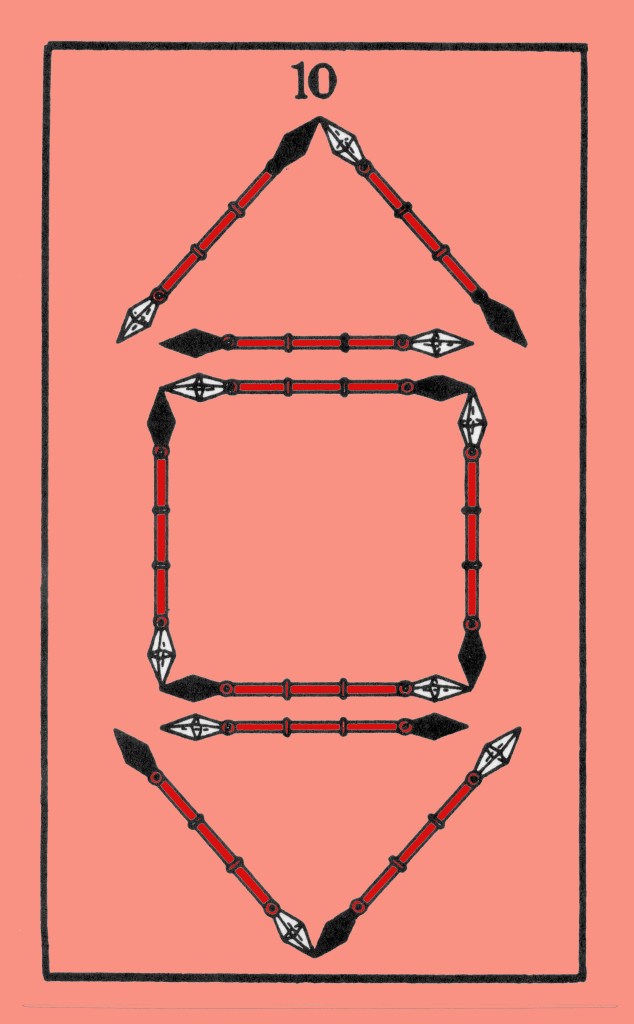
The Ten of Wands from the Builders of the Adytum (BOTA) tarot deck
Paul Foster Case (and Ann Davies)
The third decanate of Sagittarius is the time period from December 12 to December 21. In divination its meanings are those of the Tenth Sephirah combined with the planetary forces of the Sun and Jupiter, the zodiacal sign of Sagittarius together with its natural Ninth house of the Higher Mind. Well-Dignified: generosity; success and honor in connection with the law, religion or philosophy; possibility of post of responsibility; gain through travel. Ill-Dignified: ostentation; dogmatism; overbearing pride. Note :- this card often carries the significance of a burden of responsibility of ‘too many irons in the fire’, or the need for a rearrangement of the Querent’s affairs or activities so as to get them in better order. Keyword: Fullness of power. (From The Oracle of Tarot course)
A. E. Waite
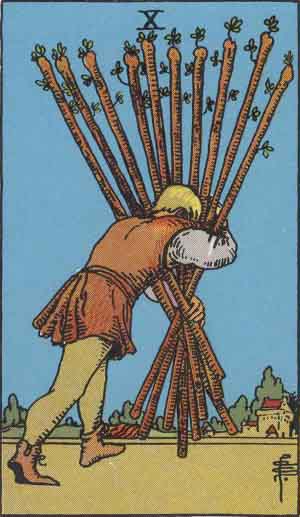
A man oppressed by the weight of the ten staves which he is carrying. Divinatory Meanings: A card of many significances, and some of the readings cannot be harmonized. I set aside that which connects it with honour and good faith. The chief meaning is oppression simply, but it is also fortune, gain, any kind of success, and then it is the oppression of these things. It is also a card of false-seeming, disguise, perfidy. The place which the figure is approaching may suffer from the rods that he carries. Success is stultified if the Nine of Swords follows, and if it is a question of a lawsuit, there will be certain loss. Reversed: Contrarieties, difficulties, intrigues, and their analogies. (From The Pictorial Key to the Tarot)
The Ten of Wands from the Rider Waite Smith tarot
Aleister Crowley
The Ten of Wands is called Oppression. This is what happens when one uses force, force, and nothing else but force all the time. Here looms the dull and heavy planet Saturn weighing down the fiery, ethereal side of Sagittarius; it brings out all the worst in Sagittarius. See the Archer, not shooting forth benign rays, but dealing the sharp rain of death! The Wand has conquered; it has done its work; it has done its work too well; it did not know when to stop; Government has become Tyranny. One thinks of the Hydra when one reflects that King Charles was beheaded in White hall!
[…]
The number Ten refers to Malkuth, which depends from the other nine Sephiroth, but is not directly in communication with them. It shows the Force detached from its spiritual sources. It is become a blind Force; so, the most violent form of that particular energy, without any modifying influences. The flames in the background of the card have run wild. It is Fire in its most destructive aspect.
The card also refers to the influence of Saturn in Sagittarius. Here is the greatest antipathy. Sagittarius is spiritual, swift, light, elusive, and luminous; Saturn is material, slow, heavy, obstinate, and obscure.
The eight Wands are still crossed, showing the enormous power of the completed energies of Fire; but they have lost their patents of nobility. Their ends seem more like claws; they lack the authority and intelligence shown in the earlier cards; and in front are the two formidable Dorjes of the Two of Wands, but lengthened to bars.
The whole picture suggests Oppression and repression. It is a stupid and obstinate cruelty from which there is no escape. It is a Will which has not understood anything beyond its dull purpose, its “lust of result”, and will devour itself in the conflagrations it has evoked. (From The Book of Thoth)
The Ten of Wands from the Thoth tarot deck
Golden Dawn’s Book T
FOUR hands holding eight wands crossed as before. A fifth hand holding two wands upright, which traverses the junction of the others. Flames issuant. Saturn and Sagittarius.
Cruel and overbearing force and energy, but applied only to material and selfish ends. Sometimes shows failure in a matter, and the opposition too strong to be controlled; arising from the person’s too great selfishness at the beginning. Illwill, levity, lying, malice, slander, envy, obstinacy; swiftness in evil and deceit, if ill dignified. Also generosity, disinterestedness and self-sacrifice, when well dignified. Malkuth of HB:V (Cruelty, malice, revenge, injustice). Therein rule HB:RYYAL and HB:AVMAL.
As I may have mentioned in the past, I have been in therapy a long time. I almost took for granted that I knew all there was to know about the various phases of my life.
Yet recently I was talking to my new therapist about my late teens to early twenties, and I casually mentioned how I had lost a ton of weight in that period. I hadn’t been chubby before, just regular size, but somehow I had convinced myself there was too much of me.
As I explained to her my behavior with food (won’t go into details), she furrowed her brow and said “well, that’s called anorexia.”
It really hit me like a ton of bricks. I knew of course that men can suffer from anorexia too, but in my mind the term had been subconsciously filed away under ‘eating disorders for insecure teen girls’, so it never truly came into question as a meaningful description for whatever the hell I was doing in that period.
While I still feel weirded out by the idea, another part of me is glad that there are still things I need to discover about myself.
In every deck there are what we might call topic cards, that is, cards that represent a specific field of life: family, work, money, health, love, the law, etc.
All or most of these cards also have general meanings that apply to various contexts. For instance, the Ace of Cups in the Bolognese Tarot is the home card (just like the Ace of Hearts in playing cards or the Two of Hearts in the Vera Sibilla), so it is the topic card for everything relating to family and house questions. But it can also indicate that someone belongs to the family, e.g., when it comes up next to a court card. It can also indicate the inner side of one’s experience of life, one’s inmost, intimate world, etc. So it can also show that something is close to us and touches us.
We need to distinguish between a card acting as a stand-in for a specific topic and the same card acting out a particular meaning. To keep with the Ace of Cups example, when it comes up in a question about work, it might show that the querent’s work life interferes with their family life or vice versa, or that they work from home, or that their work environment is family-like. In all these cases, the house card qualifies the other cards by adding details of its own.
But when the House card is simply a stand-in for the topic ‘home and family life’, the card says nothing about the topic itself. It doesn’t qualify the reading. It simply tells us, “this is the topic.” It is then the role of the other cards to describe the situation, qualifying it in a positive or negative way.
When we are doing a general reading with no question, or with all the cards down on the table, this is all well and good: we see if the person’s significator is next to any of the topic cards, showing that that topic is important, and then we read the cards surrounding the topic card relating them to the topic.
When the question has been specified, though, extra care must be taken trying to figure out if the topic cards that appear are qualifying the topic of the question or if they are coming up to ignore the question and talk about something else. This is not always easy.
Let’s say you asked about work, but the house card comes up. Why? Is it because the home is involved? Or is it because the cards have decided to bypass your question and discuss something else? Or is it both? (It CAN be both). One way to solve this issue is to see if there are topic cards relating to the question, or if at least the cards seem to be predominantly of a nature that seems more akin to the question asked (e.g., lots of Diamonds and Clubs in a work-related question).
The other way is to see if the cards next to the rogue topic card coalesce with it to form a coherent statement that has nothing to do with work, or if instead the topic card allows itself to be absorbed into the querent’s question.
The third way is simply to work with the querent. This is always a good idea. After all, our aim is to interpret the oracle correctly, not to impress people.
Cards that have the potential to be topic cards are always quite strong in a reading, so it is always good to observe them first. Often they form focal points in the interpretation of the spread. Sometimes some cards in some readings can even be ignored, but topic cards always seem to have something to say. We ignore them at our peril.
When it comes to divination, theory can only get you so far. The best way to improve your reading skills is to learn the basics of a *valid* system and then start reading.
For most of us, we are our own first querents, and that is a problem. I don’t have a 100% accuracy record when reading for others, but I barely reach 60% when reading for myself, especially if I’m invested in the topic. It is not just a matter of wrong interpretation, which can and does happen. I am more and more convinced that sometimes, when we read for ourselves and we are not perfectly at peace, we tend to get readings that reflect what we think rather than what is happening or will happen.
Furthermore, the tendency that many people have to start obsessively putting questions to the cards just to see if they say something vaguely understandable (which doesn’t mean true) is dangerous, and can get us in a warped frame of mind.
I know that for many, especially coming from certain societal backgrounds, reading for others can be a big step into the unknown, but I would advise anyone to start reading for some sympathetic friends or relatives (and when I say for them I mean in front of them, not asking questions about them) and then to graduate as soon as possible to readings for people we don’t know or know little about.
I don’t have too many friends, but they do a good job of talking about me to their friends and to their friends’ friends, which is how I get my supply of test anim-ehm, querents. If you start reading for your friends and ask them to spread the word the same will happen to you.
The cool thing about reading for people we don’t know is that it is so much easier than you might think. Divination DOES work! And divining for someone when there is no chance of you knowing the information in advance is very impressive for them and very satisfying for us as diviners. It will build your confidence much more quickly than torturing the cards about your own mental dramas. Plus, the oracles always seem to be much clearer and much more crisp when I divine for strangers.
One thing I would advise is to be as scientific as possible: record the question, the reading, your interpretation and the results. Don’t think you cannot build your vocabulary because the only right answer is the one offered to you by your intuition. 99% of intuitive readers are terrible, and what they call intuition is not actual intuition: it’s their stupidity echoing in the empty chambers of their mind. Be systematic and slowly you will gain experience.
I always maintain that the Golden Dawn were not great astrologers, largely because the XIX century astrology they had access to was not very good. Still, for the purposes of deriving symbolism for magical operations, their take was acceptable.
One thing that has always fascinated me about the Golden Dawn’s take on astrology was how they tried to synthesize it into their tarot system. Aside from the attributions of Zodiac signs and planets to the Hebrew letters and of the Hebrew letters to the major trumps, they also assigned the thirty-six decans to the thirty-six minor cards two through ten and, in different ways, to the aces and court cards as well.
This way of allocating the symbolism was not unique to them, but (as someone who doesn’t like to mix cartomancy and astrology) I must say that it probably produced the most coherent system.
Crowley generally doesn’t stray too far from the GD interpretation of the minors, but there are a couple of exceptions, the most obvious of which is the Ten of Cups.
For the GD, the Ten of Cups is an excellent card (which is what inspired Waite’s take on it). Crowley, however, disagrees on account of the decan assigned to the card, which is the third decan of Pisces, ruled by Mars. This leads Crowley to argue that this is a card ruled by two disarmonious symbols (Pisces and Mars) and so it produces bad results.
The problem with Crowley’s take is that he constantly, throughout the book, mistakes decan rulership with the influence of a planet in a sign. This is wrong. Rulerships represent affinities of a planet with a sign or subdivision of the sign.
For instance, Aries is ruled by Mars, which means there is an affinity and so when Mars is in Aries it is said to be well-dignified, at least according to the astrological practice that developed in the middle ages. The Sun is also exalted in Aries, which means there is also an affinity. Then we have the three decans: the first ten degrees ruled my Mars, the second ten by the Sun and the last ten by Venus.
Now, Venus is in detriment in Aries, which means there is disharmony between Venus and Aries, so Venus is ill-dignified in it. She is like a dainty ballerina stranded in a war-torn country. It’s not her place. However, in the last ten degrees of Aries, Venus has subrulership by decanate. This means that, even though she is the anti-venusian environment of Aries, she has a small room where she is a bit more comfortable, though not by much: it’s as if our dainty ballerina had been hired to entertain the troops in the barracks. She’s still in the wrong place, but in a less uncomfortable subplace.
Therefore, when Crowley says that Mars is not compatible with Pisces he is saying something that is irrelevant: by definition, the fact that Mars rules the third decan of Pisces means that Mars is at least a bit comfortable in the last ten degrees of the sign. This is because the last decan of Pisces has some kind of Mars-like quality to it: it is the part of Pisces that expresses through Mars.
This is not to say that his system is more right or wrong than the GD (one can stretch symbolism in almost any direction by abusing it long enough), but his misunderstanding runs through the whole minor arcana section, and I thought it would be interesting to bring it up.