Living at the intersection of occultism, fiction and philosophy, I travel the planes at a moderately quick pace. I read, I do magic, I cook for hubby. Confused by the number of things I talk about? Good, confusion is a nice thing ;)
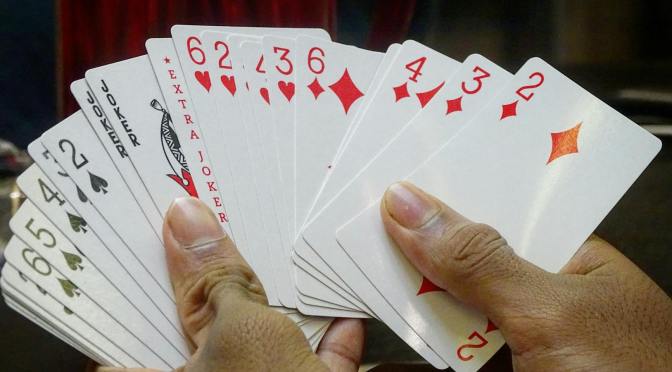
I believe that in the development of divination techniques, the creation of meanings for multiples of cards of the same number must have probably come pretty early. When I was taught to read playing cards, the person who gave me the meanings passed also the signification of card multiples to me, with the caveat that she’d never found them to be very reliable, contrary to the rest of the method. I must confess that I almost never use them, except when the meaning can be derived from the meanings of the cards, which is why I never talked about them before. However, since someone asked me, I’ll retrieved them from my notes so that you can experiment with them.
Note that it does not matter which cards we are talking about as long as they have the appropriate number of pips. However, the presence of Spades in the combination is supposed to worsen the meaning, especially if the Spade card comes last.
Aces 2 = Surprise 3 = Positive Chance 4 = when together, death or great danger, when apart, glory or success
Enneagram Type Three and Enneagram Type Eight share a number of traits that can make them similar in some contexts. Threes are a Heart type and focus on obtaining recognition for their talents. Eights are a Body type and concentrate on establishing and defending their own independence. Both types are action-oriented, energetic and highly driven, but there are also some key differences.
Both Threes and Eights want to tower over others and emerge, and therefore develop a strong character and sharp and even ruthless strategies. Furthermore, both enjoy admiration. However, Threes want to emerge above others in order to comply with some kind of ideal image of themselves as perfect or excellent, and this image is usually dictated by social, or at least familial, standards. In this sense, Threes are social comformists and fear public rejection greatly.
Eights, by contrast, care little about the court of public opinion and are more maverick-like in their demeanor. While they do like being admired, they can content themselves fearful awe they need to. Their focus is on forcing their own particular energy onto the world, leading it on a leash so as to neutralize its power on them.
leadership
Compared to average Threes, average Eights are less refined and tend to have a “me use club against you” mentality, whereas Threes are sharper and can be more underhanded. Note that this has nothing to do with intelligence (which is independent of type) but with how one’s energy is directed. Eights’ energy bursts vehemently and directly outward, and as long as it knocks down the adversary, all is well, while Threes are more strategic because, ultimately, their source of energy is outside of them, locked inside the social expectations they seek to fulfill.
Another great difference stems from the fact that Eights have a visceral connection to ideas such as justice and truth. Similarly to some other types, Eights feel they are authentic and true and immediately just and fair, while Threes often panic at the idea of being unmasked as fraudsters peddling a scam, even when there is no apparent cause. Neither of these worldviews is necessarily true, but Eights embody their chosen role immediately, while Threes often feel they are wearing a mask and are generally unable to say what’s underneath it, so they hope to sell it well to others.
Both Eights and Threes can be very good leaders. Of the two, Eights tend to more authentically look out for their proteges’ interests, often going out of their way and to great pains to make life easier or better for them. Threes tend to give the good example, and relish in being seen as role models. Although they are of course capable of caring deeply for others, average Threes are less likely to be willing to do something for them if it means stepping out of the limelight. On the other hand, they are more image conscious than Eights, and can teach this awareness to others.
or “Summa Scientiae Nihil Scire” in Latin. This motto is very useful in practical fortune-telling. One of the greatest risks we run is of assuming. “She’s 85, how is she gonna find love?” “He’s a 23-year-old jock, he’s probably not a priest.” “She looks so prim and proper, she’s unlikely to have seven lovers.”
All these preconceptions and more cloud our mind as we try to read the oracle’s answer, regardless of the oracle, whether it be the Tarot, playing cards, astrology, the I Ching, etc. All these preconceptions are poison to the art of divination. They are not of service to us, nor to our querent. Let’s delve into why.
Let us start from the fact that bias is a natural and necessary phenomenon, as politically incorrect as this may sound. Bias comes to us from our experience, but also from the experience of others, especially family members, friends, teachers and people we trust. Bias orients our life, and this cannot be otherwise. The attempt to forcibly eliminate bias from people’s minds only causes suffering, and is its own kind of irrational crusade.
You know who is NOT biased? God. You know what God does? Everything. But you can’t do everything. You can only do something. And in order to do something, you must be biased against something else. That’s life.
This is not to say that all bias is good. For instance, I may have accepted some preconceptions from my parents, who got them from their grandparents, who got them from the priest, who got them from a crazy lady next door, etc. This kind of bias is the worst because it can needlessly limit our options and create likewise needless suffering in those around us. The best kind of bias is the critically examined one that you accept based on your actual life experience and keep open to revision.
Yet even this kind of “good” bias is harmful to divination. When someone comes to us for a reading, or when we read for ourselves, what we are doing is trying to look at reality from the point of view of a symbolic system that reflects life from an objective, or at least less subjective standpoint.
Divination is a language with no native speakers, except maybe the guy upstairs, which means that our understanding of it is always going to be imperfect and faulty. But this is a technical kind of difficulty, and in its own way it’s excusable. What is less excusable is the additional confusion we create by reading our biases into the divination. This is not just about politics, philosophy, morality or religion. It’s everything.
“A 85-year-old is not going to find love again” is one sort of bias. “An attractive young guy is probably not a priest” is another. The aim of divination is to read the truth, not ourselves.That’s why the height of science is to know nothing. If we start with a clean slate we can receive much more information from the tool we are using, simply because we are not randomly blocking out information we consciously or subconsciously deem unlikely.
The unlikely happens everyday. Think about it. Almost everyday something unlikely happens in the world. That’s not to say we must feel the urge to make our predictions as unlikely as possible in order to impress the querent. Most of the time, what’s likely is what ends up happening. Still the unlikely is not the impossible.
I am big on comparing divination with language, as those reading this blog know. And as you know, I am not a native speaker. Around fifteen years ago, I was trying to improve my English by watching youtube videos. Yet this was very hard, because the language people use on youtube is very inconsistent, erratic at times, filled as it is with memes, asides, jokes, ancdotes, interruptions… I was trying to project the artificial English I had learned in school onto this truer, more lived English.
“Surely he can’t have said what he has just said. It doesn’t make any sense,” I constantly thought. It was when I stopped projecting my presuppositions and started just taking in what was objectively being said that my English truly improved. That’s the same with divination. The height of science is to know nothing. Only if we know nothing we can take in what is being said.
In one of my recent posts I discussed how playing cards can detect curses (of course, it’s not just playing cards that can do it). Today I wanted to add to this subject by discussing the esoteric use of Playing Cards to check if a spell (in this case, a talisman) is a good idea or has been successfully created and is working.
I should perhaps first explain that there is a modicum of belief in magic involved in all this. The modern worldview tends to react to the idea of magic in two ways: the skeptical way (“it’s not really true”) and the new age way (“it’s not really true, but I would really love for it to be true, so I’ll play make belief and tailor everything to my preconceptions”)
Either way, magic is reduced to the acceptable role of cathartic theater or psychological tool (unfortunately, even great minds within the occult scene, like William Gray, have partly fallen for this approach, or at least considered it viable). From here it has even found its way even into the corporate sphere (a friend of mine working for Google told me she was forced to attend a “magical” day with a psychic who talked to them about tarot and Wicca). You know something is crap when pandering megacorporations appropriate it.
At least since Aleister Crowley (but there are predecessors) magic has been understood as the way of the will. Granted, Crowley’s understanding of the word “Will” is not the same as how we understand it in our everyday life, which would rather be “whim“. His view resembles more closely Nietzsche’s view of the will, so it does have some nobility.
But this doesn’t detract from the fact that most people whose view of magic has been colored by Crowley’s (and that’s almost everyone today, whether they know it or not) don’t REALLY believe in magic. Instead, they tend to see it as, again, little more than a placebo. It’s true if you believe in it. It’s true if you want it to be true.
Still, it’s my experience that belief in magic is not really required for magic to work. In fact, one would be hard pressed to find any trace of the concept of the magician’s will in the traditional Western approach to magic (or in the Eastern approach, for that matter).
Because just believing in it was usually not considered a prerequisite for success, the use of divination to check the efficacy of magical workings has been advocated a long time. Besides, if belief is not enough, other, more objective factors must be checked. *
The Arab mages of old, for instance, invited people to do a horary reading to see if the use of planetary magic was warranted. Agrippa probably used geomancy for the same purpose. We don’t know about Abano, but it is not a stretch to think he would have consulted a geomantic shield to check how his spellwork was doing.
In general, all forms of divination take the reality of magic for granted within the worldview that informs their language. After all, why would divination work, but not magic? ** This is true for playing cards as well. Here is an example.
Last year while the Sun was in Leo I was working on a Sun talisman. I’m not going to disclose the aim of the talisman. It was nothing untoward, but I’d rather keep it to myself. After the creation of the talisman I set out to consecrate it. The number of days varies.
On the first day, after the first consecration, I got the following spread:
A♠ – 6♣ – 5♠
Definitely a bad start. And I wouldn’t have expected anything less. The majority is Spades, which is bad for anything but black magic.
6♣ – 8♣ – 10♣
Second day of consecration. A mash of clubs is not positive. It shows difficulties and toil without success. Still, Spades have abandoned the spread, which is a positive.
6♣ – A♦ – 3♠
This is the third day. Close but no banana. It is still a negative spread. It has the Six of Clubs in common with the previous spread, and it closes with an unpromising Three of Spades, which bring Spades and large obstacles back into the equation. Note that this is the third day in a row I get the Six of Clubs. But the Ace of Diamonds has appeared, which indicates success, talismans and even the Sun.
A♦ – 9♦ – 10♦
Fourth day. This is the sign I was waiting for. The Ace of Diamonds is back. This time it is well-placed. The Nine of Diamonds and Ten of Diamonds together just mean “it works”, whether we are talking about an object, a business plan or a spell.
MQS
* This is not to say that the old magi wanted you to do your homeworks half-heartedly. Marsilio Ficino talks about the importance putting your heart in your spellwork.
** this would lead us off into an interesting discussion of all those that practice divination without believing it to actually work (“it’s just a brainstorming method” being the most common rationalization)
They approached the thing stretched out mutely on the table. Its nervous system unfolded like a web out of its brain, suspended on hooks. This was their forbidden gateway to the fullness of life.
“Lock the door,” one of them said apprehensively. The other obeyed. Then each of them took a connector, forced one extremity of it inside the thing and the other into their temple socket.
Finally, one pushed a button, and the life latent in the thing unfurled. Their perception collapsed, absorbed into that of the thing.
Kids playing, dogs barking, the smell of meatloaf. “I’m home, honey!”
Horary astrology is a centuries old form of divination. The word ‘horary’ means ‘of the hour’, because unlike natal astrology, which predicts from someone’s natal chart, Horary looks at a chart for the time and place a meaningful question is asked.
The fascinating thing about Horary is the way it works: it doesn’t require you to shuffle a deck or cast dice. There’s nothing for you to manipulate. Once someone asks a (relatively) serious question to someone else who can cast a chart, the answer is there. In a way, it presupposes a view of the universe as an unraveling system of self-answering questions or self-solving problems.
As I strive to create a coherent philosophy of divination, Horary is definitely one of my most important sources of inspiration. I will probably start offering cheap email horary readings in the near future in exchange for feedback, in order to gain experience. In the meantime, here’s an example from yesterday.
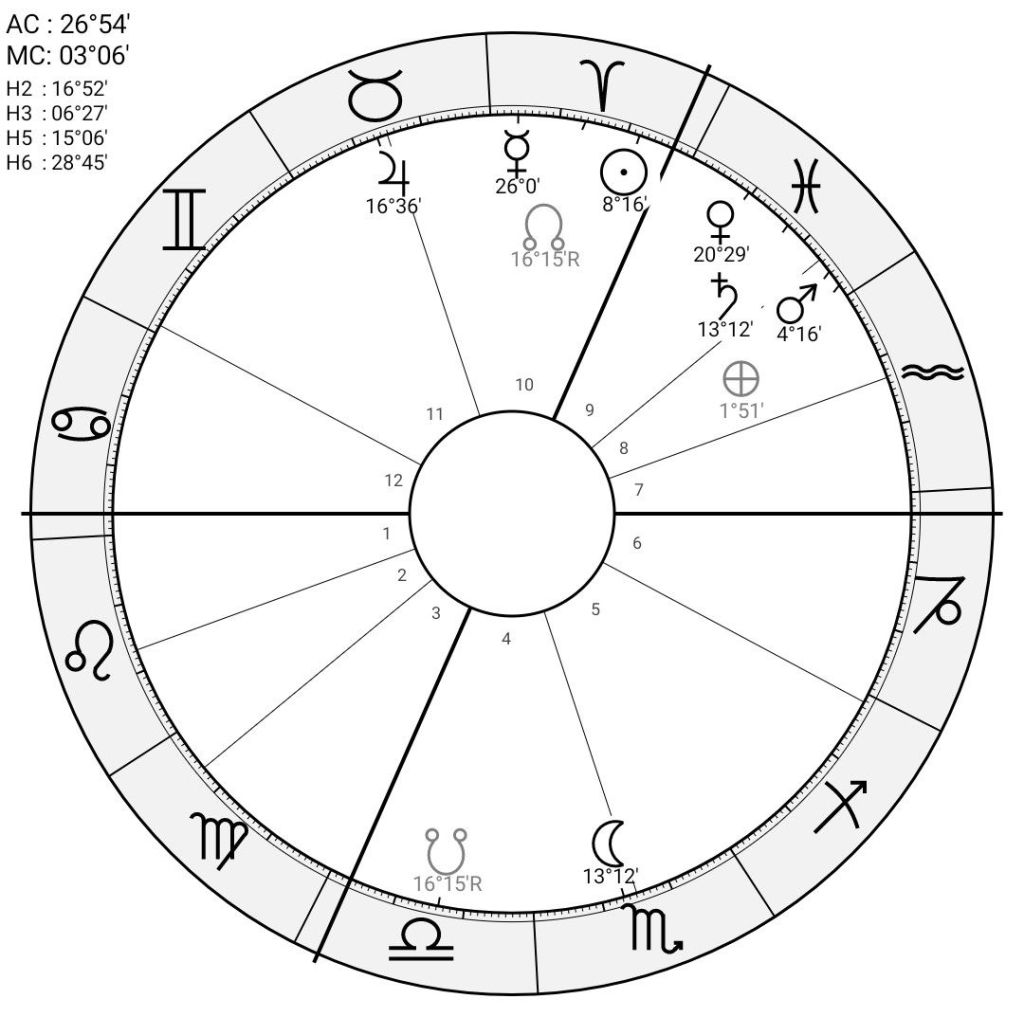
Is she alright? Horary question answered with the App Aquarius2Go
Background: A woman my husband is involved with for some projects had disappeared for a couple weeks after the death of her father. She didn’t answer any message my husband or the other people involved sent her, so naturally they were all worried that she might have fallen into depression and done something silly. So the question he asked me, knowing I’ve started dabbling in Horary, was “Is she alright?”
My husband is signified by the Moon, lady of the Ascendant. The woman is not really his friend (Eleventh house) but rather his colleague, so she is signified by the Seventh house and its ruler, Saturn. This is appropriate, as Saturn rules solitude.
Since the question is about this person’s wellbeing, we are looking at potential afflictions that Saturn may be suffering from. It’s peregrine, that is, it is in no dignity. Peregrination is a minor affliction. It also describes her very well: “peregrine” means “wanderer”, and she has disappeared. Saturn is also in a cadent house, the ninth, which however is not especially malefic. On the other hand, Saturn is Sextiled by Jupiter. This is a positive aspect, and Jupiter is a protective planet. My idea was that she wasn’t especially fine, but she wasn’t in any great danger either.
My husband (and probably the other people involved) is the Moon. The Moon is in her fall and inside the Via Combusta, i.e., the stretch of Zodiac that goes from 15 Libra to 15 Scorpio, which is bad for the Moon, as it is said to indicate turmoil. This is a good description of their apprehension. Mercury is slow in motion and squaring the Ascendant: communication is a problem.
The Moon is in exact Trine (to the minute) with Saturn. Trines are aspects of amity, so obviously they want to know that Saturn (aka the woman) is fine, and are worried (Fall, Via Combusta) about her.
Since Saturn doesn’t seem to be in any grave peril, it stands to reason that the woman will be back in contact (we would need strong testimonies to show the contrary). The fact that the Trine aspect is exact doesn’t allow us to say whether it is still applying or separating, but considering all the chart, it seems to be an indication that she will soon resurface. This is also shown by the fact that the Moon is near the end of the Via Combusta, so I judged that she would write my husband soon. Another possible indication is that the First House Cusp is nearing the end of Cancer, so the situation is in its late phase and is about to change. But I’m on the fence about this testimony.
Result: yesterday (day of the question) after weeks of not hearing from her, my husband got a message from her three or four hours after this chart was cast. The woman was of course not in top shape, but she was relatively fine.
Enneagram Type Three and Enneagram Type Seven can on occasion be lookalikes, so distinguishing them may be treaky. Threes are a Heart type, and seek recognition for their (real or perceived) merits and for their excellence. Sevens are a Head type, concerned with achieving security by filling their life with distractions and exciting projects.
Let us never forget that the quest for recognition is part of our human makeup: it is how we work as social beings, regardless of our Enneagram Type. The same can be said for security and for looking out for exciting new things. Everyone needs security.
Threes, though, are essentially social in their psychological framework, even when they are introverted, simply because their usual way of acting is aimed at meeting criteria that have been set up for them by society or family. Thus, their actions and plans always imply the presence of other people, even when those people are not there. Sevens, on the other hand, may very well attract colorful and interesting people due to how they behave and may enjoy their praises, but they are ultimately interested in filling their lives with novelty and excitement to avoid looking at what they fear or causes them pain.
Threes are status-seekers, Sevens are pleasure-seekers.Sevens tend to have a strong materialistic streak and find comfort in owning stuff. Of course, they often want the cool new stuff, and coolness is generally a socially defined concept, but the comfort this stuff gives them is that they can use it to fill their lives with thrills and stimulations. Threes, on the other hand, want to be praised more than anything else. Of course, in our society, praise is often linked to the ability to have material possessions (prizes, wealth, etc.) but for Threes stuff matters mostly for what it means for their status.
Action
Both Threes and Sevens can be very hard and efficient workers. Sevens usually need more clearly to be in a line of work that stimulates them, but lacking this, they can put up with a job they don’t like that will allow them to fuel their extravance. Ultimately, their fear is of finding themselves in a situation of scarcity and being left without options, alone with their pain and a sneaking sense of void, meaninglessness and gloom. Threes tend to pursue paths that they deem themselves good at. Of course, if they like the path, all the better, but Threes can go down career paths they despise as long as they can stand out and gain approval. Their fear is mainly that of failure.
Both Threes and Sevens can have a grandiose sense of self. In Sevens, this is due to their disconnection (momentary or permanent) from the negative side of life, which often lauches them into phases of mania where they can become dangerously foolhardy and have unrealistic feelings of invincibility. Average Threes are grandiose about their sense of self, which is almost the sole reason, together with social or familial conditioning, why they get into careers or other life paths even if they don’t particularly like them, simply because they are looking for something that will give them a recognition they deem adequate to their view of themselves.
Ultimately, the grandiosity of an average Three does not blind them to reality, but merely fuels their plans, while the grandiosity of a Seven tends pravail in particularly unbalanced phases of their life and can cause them to make grave blunders (again, it is like a mania).
Most systems of divination can also be used to explore esoteric topics. For instance, I have answered the question “have I been hexed?” way more than I would like. The answer is no 95% of the times. Only two times in my life have I sent someone straight to see a priest because something supernatural was objectively at play. Most of the times, people use dark magic as a scapegoat to rationalize natural periods of bad luck.
Of the the two times I did detect a curse I can only find records of one (my notes tend to be rather messy). The girl in question asked me if she’d received the evil eye (malocchio). This was the spread:
10♠ – 5♠ – 5♥ – J♠ – Q♠
I added two cards to the queen, and I got the Q♦ and the 2♥. The reading is quite obvious: a woman cursed her (the Queen of Spades with the Jack) on behalf of a relative (the Queen of Diamonds and Two of Hearts) though probably not a blood relative. The Ten and Five of Spades, when read together with the other spades, indicate the use of negative occult powers, probably at night.
The Five of Hearts in the center of the spread probably showed the sector of the querent’s life that was impacted by the curse: the ‘abundance’ sector. The young woman had lost a ton of weight in a short timeframe, she looked wasted, had started losing her hair and her beauty, had started developing money problems (in that she couldn’t retain any money she made). Her significator is absent, meaning she was completely passive to the hex.
It seems her mother-in-law had gone to see a country witch to try to harm her. This is far more troublesome than the evil eye, which sometimes can even be cast inadvertently without a ritual. The hex was broken by a priest, or rather, thanks to a priest who put her in contact with a monk specializing in this kind of stuff.
I’m bringing up the topic because I was recently asked the same question by a friend of mine who is going through a rough patch (lost her job, broke up with her boyfriend, argued with her sister, etc), which she believed was due to some ‘bad vibes’ or the malocchio. The spread was:
3♠ – 6♣ – Q♣ – 7♠ – 5♦
This time we have the querent in the middle of the spread. This, coupled with the fact that there are no combinations of curse, is encouraging: the querent has not been displaced from the center stage of her life.
The cards are negative, but they don’t reference supernatural phenomena: the Three of Spades could indicate curses or evil eye in combinations, but here there is no such combo, so it just indicates problems, things that don’t go smoothly. The querent is surrounded by the Six of Clubs and the Seven of Spades, the latter showing unfortunate events, the former reiterating the idea of difficulties. The Seven of Spades connects to the Five of Diamonds to indicate a period of misfortune, that is, of natural bad luck, which will pass (there will be change, it won’t stay that way forever).
In Medieval and early modern times, Astrology was everything. Being a natural consequence of the philosophical worldview tolerated by the church (that is, Aristoteleanism), Astrology was not seen, strictly speaking, as a Bible-prohibited practice, but merely as an extension of the science of the day. Though it always had its detractors, it was generally accepted. Therefore it was normal to try to astrologize everything.
We’ve already discussed geomantic perfection. This takes place thanks to something resembling aspects. But some old books go a step further and seek to introduce the actual astrological aspects of the time into geomantic practice.
In Astrology, an aspect happens when two planets occupy the same degree in different signs: a sextile happens to planets that are 60 degrees apart (e.g., Venus at 10 Aries and Jupiter at 10 Gemini); a square is between planets that are 90 degrees apart (e.g. Venus at 10 Aries and Jupiter at 10 Cancer); a trine is between planets that are 120 degrees apart (e.g., Venus at 10 Aries and Jupiter at 10 Leo); an opposition is between planets that are 180 degrees apart (e.g., Venus at 10 Aries and Jupiter at 10 Libra)
Aspects are key to astrological perfection. They show the things signified by the planets coming together, with sextile and trine indicating good contact on one hand and square and opposition showing bad or difficult contact. For instance, if in a love question my significator aspects my love interest’s significator, it shows us coming together. If by trine, we get along, if by square we argue.
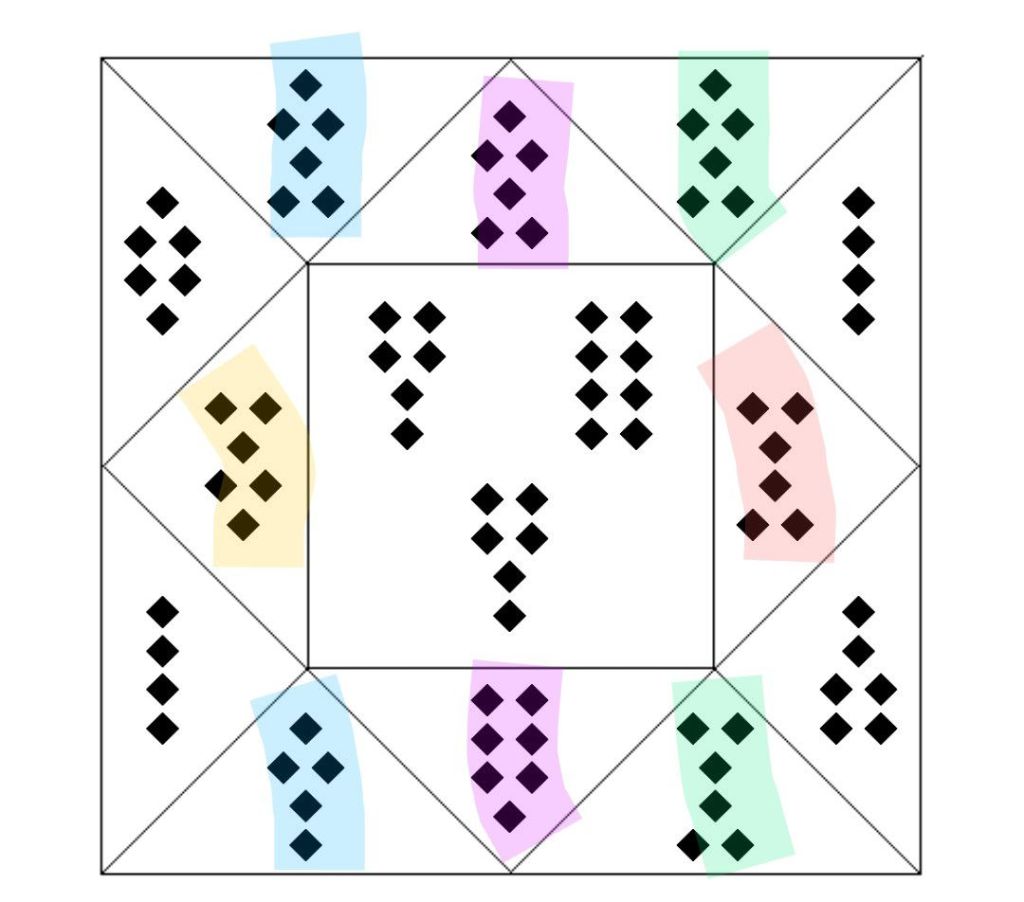
In geomancy, astrological aspects have been adapted to the chart as follows:
Astrological aspects in Geomancy (App used: Simple Geomancy)
If we take the figure in the first house (marked in yellow) as a reference point, then the figures in blue sextile it, because they are separated from it by a single sign; the figures in purple square it, because they are separated from it by two houses; the figures in green trine it because they are separated from it by three houses, and the figure in red opposes it, since it occupies the houses directly opposite.
This is supposed to shed some light on the relationship between the figures: two figures that fall into a square pattern have a difficult relationship, two figures in a trine a good one, etc.
The problem with using astrological aspects in Geomancy is that aspects work in a fundamentally different way: in Astrology, an aspect requires a planet to move in order to apply to another planet. After perfection, then, the aspect separates and its effect wanes.
Geomancy, though, is a static system with no real movement. Sure, we can say a figure moves from one house to another, but in reality that figure is already present in both houses. The only way to conceptualize movement in a geomantic chart is when we take a significator’s house to be the original position of the figure in it, and every other instance of that figure as a successive movement (e.g., in a career reading, if Laetitia is in the tenth house and in the seventh, we take it to move from the tenth to the seventh and not vice versa).
I am honestly not convinced that astrological aspects can find a meaningful place in geomancy. They certainly cannot bring matters to perfection, otherwise everyone would always be separating from their partner since the figure in the seventh house always opposes the figure in the first. Similarly, everyone would always get along with their siblings since the third house always sextiles the first.
One possibility which has been suggested is that of applying aspects only to figures that move. In a love reading, for instance, if the seventh figure moves to the tenth, it moves to square the querent, since the tenth house squares the first.
I personally find this application also problematic, because the tenth house represents the job, among other things, so that would mean that everytime the querent’s job is involved in their love life it causes trouble, which is a false assumption.
At most, I would take an aspect into consideration only if BOTH significators move. In the hypothetical love reading, for instance, if the first figure (querent) moves to the fourth house and the seventh (significant other) moves to the tenth, then they are in opposition to one another. Maybe they will argue. Or, if the first moves to the fourth and the seventh to the second, they sextile each other, which is good.
Even in a situation like this I am generally cautious about applying this theory. There are certain aspects of Astrology (pun intended) that simply don’t translate well to other systems of divination. You are of course welcome to try this theory on for size, but personally I believe Geomancy already has its particular version of aspects, and throwing other stuff into the mix feels more like an attempt at complicating this “brief and simple science” to find something more to tell the querent.
I’m currently studying horary astrology under Chris Warnock’s supervision. He puts a great deal of emphasis on studying old sources, which is perfect for a guy like me who breaks out in hives when occultism is boiled down to “just wear a deep knowing expression, drink herbal tea and let the ascended masters guide your intuition.”
Geomancy is similar to horary astrology in that it allows you to answer questions, though it is less dependent on the time the question is asked. It is also similar in that you need to go back to really old books in order to study it seriously.
When reading premodern sources we always run a couple of risks:
Unless they’ve been edited and discussed by a modern, they are probably written in a language that is not our own, or, even if it is, it’s an old version of it. This makes room for misunderstanding.
More subtly, the world in which the author lived and wrote is not our world: it has different cultural, political and spiritual reference points.
The source is written by someone who is just as fallible as we moderns (or rather postmoderns) are.
If one thing that grinds my gears is when people just turn occultism into their little escape from reality (“I wanna believe the world is magical but I’m too special for Christianity”), the other thing that equally grinds my gears is when people desperately seek a doctrine to follow blindly just because it happens to run against the Zeitgeist.
An occultist (and divination is a branch of occultism, though we often forget it) must be capable of being equally distant from intellectual lassitude and fanaticism, from scientism and religion. It takes a particular temperament that most people don’t possess, and I say this in a neutral sense: most people simply don’t have the temperament for most things, which is why only few people in any generation do any one thing.
Point three on the list is what I’m referring to here. The few on the occult path who have what it takes to move beyond the sanitized, advertiser-friendly version of occultism that gets tarot readers invited to corporate meetings often run the contrary risk: that of believing “if something says the opposite of what we hear everyday in our decadent world, it must be true and I must worship at its altar.”
When reading old sources (and I’m talking about geomancy, but it could refer to any other branch) this can turn us into fanatics if we don’t constantly remind ourselves that a book, even in the old days, could be written for a variety of reasons:
to pass on important knowledge (but still from the author’s limited perspective)
to record your experience
to help others
as a publicity stunt
to impress others
to confuse others
a mix of all the above
Furthermore, old authors are just as capable as modern ones of believing crap. As such, while it is vital to question our own worldview, it is also just as vital to question all others. The moment you are asked (or you feel like you ought) to stop questioning is exactly the point where prejudice has crystallized, be it yours or someone else’s. It is also the point where you can break new ground if you proceed cautiously and with intelligence.
All this is to say, old books are treasure troves of information that we can study, learn from, adapt sensibly to our current needs, and much more. But if you are looking for a new Bible, you’re better off sticking to the old one.