Living at the intersection of occultism, fiction and philosophy, I travel the planes at a moderately quick pace. I read, I do magic, I cook for hubby. Confused by the number of things I talk about? Good, confusion is a nice thing ;)
There is a number of cards in the Vera Sibilla that can indicate groups or at least hint at them. Each card stresses a different aspect of the experience of groups, and must be read within the context of the whole spread. As usual, this list is not meant to be exhaustive. Context is key.
Ace of Hearts (Conversation)
The Conversation card represents the act of talking, and therefore (except the querent is a lunatic) it implies someone else. It can broadly refer to the ability to express one’s thoughts or even one’s qualities with others, and is a deeply interpersonal card. It also refers to a usually tight-knit group of people, often people living together or family members,
Two of Hearts (House)
The House card does not directly refer to people, but it does refer to a close environment where people either live (a literal house) or are found (any kind of building). For instance, next to negative cards, or if reversed, it can show that the querent isn’t happy in their house, usually due to interpersonal conflict with family members or other people who spend time in that place.
Five of Hearts (Happiness)
The Happiness card can refer to relatives and blood relations or, in general, one’s “clan”. It can be another significator for the querent’s family, but it refers to relatives in a usually broader sense. However, it can also indicate groups of people held together by common interests, a clan of sorts, such as a political party. This is quite rare though. When reversed, it shows trouble with relatives.
Ten of Hearts (Perseverance)
Traditionally this card can refer to the querent’s town or motherland. Occasionally it can show how they are seen or if they are talked about in their town. This is somewhat rare.
Ace of Clubs (Marriage)
The Ace of Clubs represents all official acts binding two or more people together. It is the card of pacts, agreements, marriage, contract, partnerships. It can represent a business where people cooperate in the creation of something (a product).
Four of Clubs (Friend)
The Friend card can refer to a literal (female) friend or relative, but it can also represent a circle of friends, and the idea of a supportive environment where the querent is taken care of in a spirit of friendship or cooperation.
Eight of Clubs (Reunion)
Traditionally this is the card of reconciliation, of meetings, etc. However, it represents also a coming together, and this coming together doesn’t need to involve only two people. It can also more generally represent the querent’s interpersonal skills. When reversed, these skills are not present or are put to the test by difficult people. This is also the “more than one” card of the Sibilla (e.g., more than one job, more than one child, etc.)
Nine of Clubs (Cheerfulness)
This card can indicate one’s wider circle of acquaintances, but in general also friends or groups of people, often not tied by very deep bonds of affections. When reversed, or when near negative cards, it can refer to bullying by other people or serious problems in a particular environment due to being hated. Traditionally it also represented people from the countryside, but this is an older reading.
Ace of Diamonds (Room)
Like the House card, the Room doesn’t refer to people directly, but it can represent them indirectly by pointing to the environment they spend time in, usually an office, a shop or similar.
Nine of Diamonds (The Fools)
This card is the opposite of the Cheerfulness card, and is the only (upright) card that directly points to interpersonal problems, problematic groups, enmity and instability in a group setting and similar situations. It can represent hooligans, gangs, rioters or, more simply, a disunited family.
Three of Spades Reversed (Widower)
In general, the Widower reversed is the card of trauma, of serious loss and of bad behavior. However, it can also point to ritual settings that involve more than one person. The ritual setting needn’t be negative (it can be a christening, for instance). However, with negative cards it can signify dangerous groups, especially sects.
(Note: this is a collection of the meanings attributed to the cards by some occultists in the past centuries. It does not reflect my own study or opinion of the cards. It is only meant as a quick comparative reference as I develop my own take.)
The Ace of Cups from the Builders of the Adytum (BOTA) tarot deck
Paul Foster Case (and Ann Davies)
Well Dignified: fertility, productiveness, development, multiplication, happiness, pleasure, gratification, fruition of desires; cheerfulness, geniality, gaiety. lll Dignified: too much emphasis on pleasure; over-intensity of the desire nature; trouble in love. Keyword: Desire force (From the Oracle of Tarot course)
A. E. Waite
The waters are beneath, and thereon are water-lilies; the hand issues from the cloud, holding in its palm the cup, from which four streams are pouring; a dove, bearing in its bill a cross-marked Host, descends to place the Wafer in the Cup; the dew of water is falling on all sides. It is an intimation of that which may lie behind the Lesser Arcana. Divinatory Meanings: House of the true heart, joy, content, abode, nourishment, abundance, fertility; Holy Table, felicity hereof. Reversed: House of the false heart, mutation, instability, revolution. (From The Pictorial Key to the Tarot)
Aleister Crowley
This card represents the element of Water in its most secret and original form. It is the feminine complement of the Ace of Wands, and is derived from the Yoni and the Moon exactly as that is from the Lingam and the Sun. The third in the Hierarchy. This accordingly represents the essential form of the Holy Grail. Upon the dark sea of Binah, the Great Mother, are Lotuses, two in one, which fill the cup with the Life-fluid, symbolically represented either as Water, as Blood, or as Wine, according to the selected purpose of the symbolism. This being a primordial card, the liquid is shown as water; it can be transformed into Wine or Blood as may be required.
Above the Cup, descending upon it, is the Dove of the Holy Ghost, thus consecrating the element.
At the base of the Cup is the Moon, for it is the virtue of this card to conceive and to produce the second form of its Nature. (From The Book of Thoth)
AI-generated illustration for the Ace of Cups
Golden Dawn’s Book T
A WHITE Radiant Angelic Hand, issuing from clouds, and supporting on the palm thereof a cup, resembling that of the Stolistes. From it rises a fountain of clear and glistening water: and sprays falling on all sides into clear calm water below, in which grow Lotuses and Water-lilies. The great Letter of the Supernal Mother is traced in the spray of the Fountain. It symbolizes Fertility — productiveness, beauty, pleasure, happiness, etc.
Etteilla
Table Upright. This card, as far as the medicine of the spirit is concerned, means, in its natural position: Table, Meal, Feast, Gala, Banquet, Nourishment, Food, Nutrition. – Guests, Services. – Invitation, Prayer, Supplication, Convocation. – Guest, Hotel, Inn, Tavern. – Abundance, Fertility, Production, Soundness, Stability, Steadfastness, Constancy, Perseverance, Continuance, Duration, Follow-through, Assiduity, Persistence, Steadfastness, Courage. – Picture, Painting, Image, Hieroglyphic, Description. – Tablet, Portfolio, Office, Secretary. – Natural tablet, Bronze tablet, Marble tablet, Law. – Catalog, Index of subjects. – Harmonic table, Garden table, Holy table. Reversed. Mutation, Permutation, Transmutation, Alteration, Vicissitude, Variety, Variation, Inconstancy, Lightness. – Exchange, Barter, Purchase, Sale, Market, Treaty, Convention. – Metamorphosis, Diversity, Versatility, Reversal, Reversal, Revolution, Reversal. – Version, Translation, Interpretation.
Here Abano discusses matters relating to the Seventh House and Eighth House.
Seventh House
Of marriage The first and second house are for the man, the seventh and eighth for the woman.1 The first signifies the person, the second his wealth, the eighth the wife’s dowry. If these figures are good they show a positive outcome. If the third figure is conform to the first and seventh, the marriage is mediated by messenger [intermediary],2 especially if the eleventh is conform to the third. If the fourth is conform to the first and seventh, it means the marriage is arranged by one’s relatives, especially if the fifteenth figure confirms it. If the second house is bad it means the husband’s (lack of) wealth is a problem, and so judge for the wife if the eighth is unfortunate. Similarly, if the first or seventh are bad, either the husband or the wife cause problems, and if the third, the mediator, and if the fourth, the family. If the first or seventh are unfortunate and move to the sixth, it shows that the marriage won’t happen due to sickness or because one of the two has a physical defect.3
If the spouse shall be chaste and honest4 Look at the first and sixth, seventh, eighth, fourth and twelfth. If you find good figures, it shows the spouse to be chaste and honest, especially if the figures move to other houses. But if the figures are evil, it shows the contrary, especially if they move to other houses, especially if Populus is born from those houses. If Puer is in the sixth and seventh, it shows the wife to be cheating with a young(er) man, and if it is in the seventh and eighth, it means it’s common knowledge.5 If in these places you find Rubeus, and if it moved as we have said above, it means the same, and similarly if in those houses you find Rubeus and Tristitia or Puer and Laetitia. And again, the more you find Populus in the whole figure, all the more dishonest the spouse is shown to be. But if the you find that the figures add up to Carcer, it shows honesty and reserve, and if the above mentioned figures cause Tristitia in the twelfth it means dishonesty with a family member or with a vile person, or with an almost beast-like man. And if Puer or Rubeus were formed in the twelfth, it means dishonesty with young men or with strangers, especially if they are conform to the thirteenth, fourteenth and fifteenth.
If the querent shall have (the love of) the lover or girlfriend If the first and seventh are fortunate and entering, benign and conform one to the other, it shows obtaining what he wants. If the first moves to the eighth or sixth, it means he will need to insist a little, but if the seventh moves to the second she will insist with him, but the mutation still shows a positive answer.6
Of partnerships and similar affairs If the first, second, fifth, seventh and eleventh figures are good, fortunate, fixed, it shows the partnership is good, especially if the second and seventh are the same figure. If the figures are fixed and fortunate it will last, but if not it shows they won’t. If you want to know who will cause problems, look at which side of the chart hosts more signs of instability and ill will, and judge in the same way as with marriage.
If one’s enemy will cause one offense If the seventh is fortunate and positive it means the enmity is of small moment, unless the enemy is a woman, because it still means ill will toward the enemy.7 But if the seventh is unfortunagte and strong and malicious, it means a great and powerful enmity, especially if the twelfth is equally evil. Look also at the fifteenth, and which planets are more fortunate, whether in the first or seventh, and in the other angles, whom they conform to. And if the first and seventh are good, fortunate, entering and the seventh conjuncts the first, or vice versa, it shows reconciliation and peace. If the figure that conjunct the other also moves to another place, it means that the reconciliation will happen through the persons signified by those houses. Always consider the fifteenth and the Witnesses. If there is no conjunction and no translation, but only conformity of the first and seventh, look at the Judge, whether it is also found in another house (of the first twelve), and the more you find it, the more the two parties shall make peace.
Whether there will be war or peace Assign the first house to one side and the seventh to the other, and look on whose side there are more fortunate figures, and look whether the figures that signify war are in the seventh or the first, or if the figures are fortunate, entering and good. If the figures are good, there is no war, but if they are malicious and fortunate in war, they mean war from the side where they are, and it will be as bad as the figures are, and the side will win that holds the more fortunate figures. Rubeus, Tristitia, Puer, Conjunctio are fortunate in war. Carcer, Amissio, Laetitia are unfortunate in war. If Popoulus or Conjunctio are in the sixth, seventh, eighth or twelfth it means death and great loss of blood, and fleeing, and great cruelty.8 If in those places you find Rubeus and Carcer is in the eighth it means death, prison, fires and flames, and if in the seventh and eighth you find Puer it shows great victory, but always look at the tenth, fifteenth and first, whether they move.
Of litigations The first is the querent, the seventh is the other party. The figure that is stronger and more fortunate wins, and if Amissio is found in either, that party shall lose. Laetitia and Puella signify concord, while Tristitia and Rubeus are very evil. And if the first moves to the sixth, eighth or twelfth, the person shall lose, but if the seventh moves in the same way, the other party shall lose. And if the whole figure is occupied by figures of more or less positive import, there will be agreement.
Of fled servants, prison and lost items If the first, seventh, eighth figures are conform and are entering and fortunate, it shows retrieval, and vice versa if they aren’t. If the first is in the sixth, the servant has not fled, but has hidden, and if the figure is Carcer, he hasn’t changed place, if not very little, especially if the first, fourth and the Judge are entering and fortunate. Acquisitio and Fortuna Major signify retrieval, but the opposite figures show the opposite.
Whether the absent party shall come back, and how soon If the first house is fortunate and well-meaning, and similarly the seventh and ninth, it shows the absent party is well and in good state,9 and vice versa if the figures are bad, especially if the sixth is unfortunate. Also look at the fifteenth and tenth. If the first is unfortunate and moves to the eighth it means death, especially if in conjunction with Carcer, Rubeus or Conjunctio.
If the sixth is unfortunate and moves to the first or in conjunction with it, it means a deadly infirmity, and similarly when the first and seventh are unfortunate are united somewhere in the figure. But if the sixth is unfortunate (but doesn’t move) it shows an illness that shall pass, especially if the eighth is good. And if you want to know whether the absent party shall come back soon, look at the first and ninth, and if they are Cauda, Acquisitio or Laetitia he shall come back soon. If Populus or Via, very soon. If the eighth is good and is in the first, he will come back in a month, if in the second, in two, and so on. And if the said figure is in the second and in the eighth, entering, he shall come in a month.10
Eighth House
Whether one shall die within the year If the first figure is the same as the eighth, or if it is conjunct to it, it is an indication of death, especially if it is also in the thirteenth or fifteenth house. If you want to see what kind of death one shall suffer, look at the nature and quality of the figure, and judge as follows: if it’s Rubeus, it indicates fire or steel (that is, being wounded by an arm,) if it is Puella, being beaten to death, if it is Carcer due to a long sickness, phlegm, melancholy or various health issues; and similarly judge of every other figure depending on its virtue and meaning and quality.
On who shall die first between two people Consider the eighth and see if it is in the house of the person you are inquiring about, or if it in conjunction to it, or if it is in the first house, and judge accordingly who shall die first.
If one shall have the money back If the eighth and the first are entering and fortunate it shows getting the money back without difficulty or problems, vice versa if they aren’t. And this is especially true if the thirteenth and the fifteenth agree, but when they don’t, and if on the side of the first house you find weak figures, it means getting back the money with great trouble. If the eighth is in the third it means one’s siblings will help, and if in the fourth, the relatives, and if in the fifth, one’s children, etc.
If the bad thing you fear shall come to pass Consider the first, second, eighth and twelfth.11 If they are lucky it shows the thing won’t come to pass, but if some of them are unfortunate, it shows it shall partly come to pass, and if they are evil, it shall come to pass, and the bad thing will be identified by the type of figure. If the first figure is in conjunction with the eighth or the eighth with the first, it means harm to the person. If the second is in the seventh or ninth, it means harm to one’s wealth. And so judge all the other things with respect to the eighth house according to the meaning of the house and the thing inquired about. Always keep in mind the Witnesses and the Judge.
MQS
Footnotes
This statement is interesting for a number of reasons. I will only mention one. Abano does not say that the First is for the querent and the Seventh for the spouse, but that the First is for the man and the Seventh for the woman. It would be easy, especially in the current cultural climate, to attribute this to Medieval sexism. I am not saying that it doesn’t play a part, but there could be more. In many Medieval astrological texts the Seventh house, as noted before, is assigned to women, and when delineating marriage from the birth chart different procedures seem to have been used to predict a man’s marriage as opposed to a woman’s, the method for the man involving the seventh house, the one for the woman being more weighed toward other considerations. ↩︎
It would be easy to update this interpretation to show the influence of social media in bringing two partners together nowadays. ↩︎
The modern doctrine would dictate that the marriage happens if the first figure springs to the Sixth House. ↩︎
The Italian title is “if she will be chaste and honest”, again presupposing a female Seventh House. ↩︎
This passage is exceedingly complex. It is not clear if Puer in the Sixth indicates a younger man because it is Puer or because it is in the Sixth (which is below the Seventh). The thing being common knowledge when it happens in the Eighth is possibly due to the fact that the Eighth house is above the horizon. ↩︎
Of interest here is that the querent can obtain the lover by moving to the Eighth or Sixth House, but the Seventh can only spring to the Second, not the Twelfth. ↩︎
This passage is not clear. It seems to imply that a good figure in the Seventh House still bodes ill if the enemy is a woman. ↩︎
These attributes seem ill-fitting for Conjunctio. ↩︎
Older astrology handbooks are filled with indications on delineating the Eleventh House in a horary question to know whether what one hopes will come to pass. Abano here applies the same method to the Eighth house to delineate one’s fears. ↩︎
As promised in a previous post, I’m discussing a (rather old) reading on spiritual issues. It is common to believe that the Tarot is better suited to talk about spiritual issues and oracles such as the Sibilla or Lenormand are more useful for practical, everyday events. This is not true. The Tarot can be just as practical, and the Sibilla (and, I assume, other oracles) can be just as clear about spiritual issues. The thing that makes people think otherwise is that they are used to that kind of tarot reading where the psychic spends the whole time pulling pseudodeep psychobabble out of their butt by looking at the pictures on the cards. That’s not a tarot reading, that’s a therapy session (for the reader, not for the querent).
Spirituality is part of real life, and as such all oracles can talk about it, but always in real-life terms. Here the querent was a man and had asked me generically about his spiritual life.
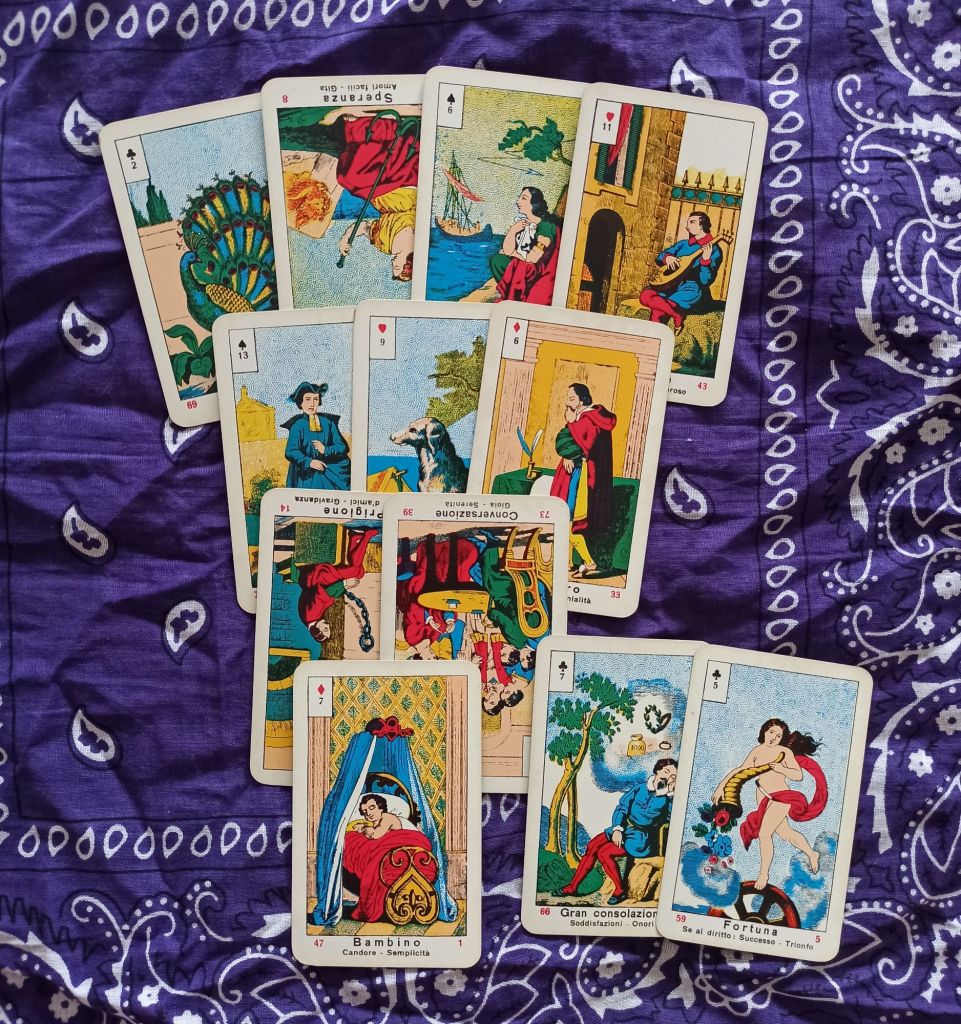
A spiritual reading with the Vera Sibilla cards
The first thing I was able to detect was the presence of the Priest in the second row. The Priest is usually not a real priest, and rather indicates a figure of authority. We also have, it seems, the significator card for the querent, represented by the Boyfriend, or Jack of Hearts, in the first line. The Priest is accompanied by the Dog/Faithfulness. This is a very good card, even outside of a love reading. It shows that, whoever the Priest is, he (or she) is good, trustworthy and has the querent’s best interest at heart. Furthermore, they are true believers.
The Thought card perplexed me a little, so I skipped over it (though you can see that the Thought card is just under the querent, so it turned out that it was the querent’s thinking process setting into motion). However, I did ask the querent if he was in contact with some kind of spiritual authority and he confirmed it, though he said it wasn’t a traditional priest or minister. This doesn’t matter: all kind of spiritual authorities can be signified by the Priest card.
The querent’s line, the first, has the card of God in it. This is the Peacock (when reversed, it represents the Devil and demons, as well as pride and haughtiness). The Peacock indicates totality, wholeness, miracles, etc. when upright. But it is followed by the Hope card reversed. Hope is the card of faith, but it is reversed, thus showing unbelief.
Yet it is not a clear atheism. Look at the Six of Spades, the Sighs card, right between the querent and the combination of lack of faith in God: the querent is sighing about his lack of faith. He is uncertain and tormented. I remember judging that he was probably a wobbly agnostic, and upon asking he confirmed that he had doubts (I didn’t ask him “are you a wobbly agnostic?” of course. We need to be kind to the querent).
It turned out, the querent had long banished spirituality from his life, had gone for an engineering degree, had been active in the skeptic community online, etc. However, some personal experiences had made him doubt his position.
Look at the last three cards of the pyramid. The Prison reversed shows unburdening, unshackling, freedom, etc. (when not followed by negative cards). Then we have the Conversation card. When reversed, it shows change. Finally, the Child, which shows a new beginning. I don’t know about you, but liberation + change + new beginning sounds like a spiritual conversion.
Furthermore, look at the angles of the pyramid plus the center: the Peacock (God), the querent, the new beginning (Child) and the Faithfulness card. This is a very positive indication.
Still, just to make sure, I asked the querent to draw two cards, and these were the Gratification and Fortune, confirming the good outcome.
As far as I know, the querent has since chosen his spiritual path.
Enneagram Type Five and Enneagram Type Six belong both to the Head triad, yet they give off markedly different energies. Fives actively employ their Head energy, using it to make sense of the world from a distance. Sixes often suppress their Head energy, don’t trust their own judgment and seek someone or something that will explain reality to them.
Being both Head types, both Fives and Sixes deal at their core with fear of the world around them.Fives thus retreat from the world into the safe realm of their own intellect, from which they observe life without being touched by it. It is often held that Fives are taking time off from real life in order to look for something, an idea or strategy, with which they may join the others and be useful or have a fighting chance, but while some great Fives really do come up with revolutionary ideas that changed the world, most Fives become lost and almost hooked on their own thinking power.
Sixes deal with fear differently. They don’t trust their own mind, so they seek structures outside of them, whether social, political, religious or other kind. For them, life is a sea of difficult choices, risks and dangers, a place where nothing seems certain. They therefore become engaged in an endless quest for the person, idea, group or thing that will give them clear answers that they don’t need to question anymore. Once they have found (or if they find) something that stands up to their scrutiny, they espouse it with militant fervor.
Fives tend to be philosophical and rational (though not always reasonable). Their approach to ideas and concepts is seldom practical, and they tend build up mental constructs not to employ them but to sharpen their overactive mind’s claws on them. Their attitude toward ideas is often playful and nihilistic. Sixes on the other hand are more practically oriented because their sense of fear is less rarefied and is almost palpable, as if they needed to actually survive from moment to moment. Their attempt at tearing down ideas and concepts is not playful at all: they keep poking holes in everything in hopes of finding the one thing where holes cannot be poked.
From a social standpoint, the difference between Fives and Sixes is often marked. Fives are withdrawn, remote, aloof. Even at average levels they are often socially inept, nor do they care to work on this aspect of their life, as they consider it inessential. Sixes, on the other hand, while often questioning people’s motivations, put on a friendly and even cheerful facade, because they are aware of how important networking is in dealing with the uncertainties of the world.
In reality, both Fives and Sixes are mistrustful of people. However, as far as Fives are concerned, rather than mistrusting people’s motives, like Sixes do, they tend to mistrust other people’s ability to understand reality better than them. On the other hand, a Six’s skepticism is generally oriented at people’s loyalties and competence in providing answers the Six can rely on. For instance, in an educational context, a Six pupil may not believe the teacher is good and is, in a way, faking it, while a Five pupil will often think they are better.
Here Abano discusses matters relating to the Fifth House and Sixth House.
Fifth House
If one shall have children. If the question is about having children, look at the first, fifth and seventh figures.1 If they are entering and fortunate and the fifth is united or conjunct to the first or seventh house, the querent shall have children, especially if if the figures are Albus, Populus, Conjunctio or Laetitia. And depending on how many figures are on the side of the first figure,2 it means this is thanks to the husband’s inclination, and if the on the side of the seventh, of the wife’s, and if in said places you find exiting and unfortunate figures, it means the opposite, and if the fifth moves to the eighth or twelfth it means miscarriage and death of one’s children.3
If a woman is pregnant, and if the child is a boy or a girl. And if you want to know if a woman is pregnant and whether she will give birth to a boy or a girl, look at the aforementioned figures, to wit, the first, fifth and seventh, and also the fourth. If they are entering and fortunate, and if the fifth joins the seventh, then the woman is pregnant, especially if the figure is Major, Caput or Carcer. And this is especially true if the same is found in the fifteenth house. But if in those houses you find Puella, Cauda or Amissio, she is not pregnant. If the majority of the figures in those places, but also in the rest of the chart (and especially the angles and the fifteenth) are masculine, she will give birth to a boy, and if they are mostly feminine to a girl. If you find Populus or Conjunctio, she will give birth to twins. And if there are still doubts, form a figure from the fourth and seventh, and if the resulting figure is more consonant to the fourth the baby is a boy, if to the seventh, a girl.4
If the children shall be good or evil. If one wishes to know whether his children will be good or evil, look at the first, fourth, fifth and seventh and also the sixth figure, and if all these figures are good, entering, fortunate, then the children shall be good, and vice versa. And if the picture is mixed, you ought to form a figure from the fourth and fifth figure, and judge by the goodness or malice of the result. But you should never neglect to keep in mind the tenth and fifteenth figure.5
Sixth House
If one shall fall ill. If you want to know whether you shall fall ill during the year, look at the first and sixth figures, whether the first figure is good and the sixth shows good health, and judge accordingly. And especially if the first is unfortunate and it moves to the sixth, or if the first is bad and the sixth moves to the seventh, or if the sixth should come into contact with the first by falling in the second house, and if the fifteenth figure is unfortunate, and if you want to know the quality of the illness look at the sixth, of what nature and complexion, and whether it is malicious or unfortunate.
If they are earthy and unfortunate it means a grave illness, long and melancholic, and if they are fiery and unfortunate, it means a choleric illness, sudden and strong and acute; and if they are airy and more unfortunate than fortunate, it means a light illness, but bothersome and long, and maybe accompanied by another illness; and if they are watery and more unfortunate than fortunate, it means the illness is troublesome, whether long or short depending ont he nature and property of the figure.6
And if you are afraid of dying of said illness, if the sixth is in the eighth or in the ninth, judge the illness very serious. Similarly, if the sixth shows an illness and the first, being unfortunate, moves to the eighth it shows death. Always judge with diligence and in everything consider the nature and condition of the planets, and judge the great secrets and admirable things always keeping into account the angles and the fifteenth.7
Whether the sick person shall die. Look at the first, sixth, eighth, tenth and fifteenth figures. If you find Caput, Puella, Major, Acquisitio or Laetitia, it shows liberation from illness. If it is Albus, Tristitia, Cauda, Rubeus, Populus, Conjunctio or Pure, it shows a deadly illness and especially if the first, being one of these figures, goes to the eighth or ninth, and similarly if the sixth goes to the seventh or fifteenth. And if this figure is Carcer, by as much as it multiplies itself in these places, so much the more it shows the illness to be deadly, and if Tristitia moves to the eleventh figure it indicates healing and then relapsing and dying, especially if you find it in the thirteenth or fourteenth or fifteenth.8 And if it’s Rubeus in the first and it agrees with the sixth, it shows long infirmity.
Whether the doctor will help the patient. The seventh is attributed to the doctor. If the first, sixth and seventh are good, fortunate and in agreement with each other, it means the doctor shall heal the sick person, and vice versa. If the first, sixth and eleventh are good and fortunate, it shows a quick recovery because the eleventh indicates goodness and the perfection of one’s nature and complexion.9
Of a lost or stolen item The first figure is the querent, the sixth the thief, the second, the tenth, the eleventh and seventh are the thing inquired about. If the tenth is in the second, third or fourth, the thing lost or stolen is in the house of the querent or nearby. If it is in the seventh it shows it to be in the house of the thief, if in the ninth, eleventh or twelfth it means it is far from home, and according to the fortune or malice of the figure, judge whether it shall be gotten back or not, and the condition and identity of the thief, and where.
Whether the servant is good or bad. If the sixth is good, fortunate and in agreement with the first it means a good servant, and similarly if it is in conjunction with the first, especially if it is fixed and fortunate. Look also at the angles and the ninth figure.10
If it is good to buy a small animal. Look at the first, sixth, ninth and tenth.11 If they are good, entering and fortunate, it means it is good to buy, and vice versa if they aren’t. If the first, sixth and tenth are bad but the Witnesses and Judge good, it means it is good to buy, but not at the time you thought was ideal, and you must delay by as many days as are the points in the first figure.12 If you want to know what kind of animal it is good to buy, look at the figure in the sixth and thirteenth and fourteenth, and if you find Rubeus it means pigs, Albus sheep, Minor and Major horses, Tristitia and Laetitia oxen. If you find Caput, Acquisitio or Cauda, other small animals. Look also if the second house is fortunate.
I believe Abano means the two sides of the Geomantic Shield. Abano says “how many figures”, but in reality, of course, the number of figures is always the same. What he means is how good they are. ↩︎
Note that the Eighth house, aside from indicating death, is also conjunct the Seventh, so it seems Abano is giving us contradictory indications. However, the chart must be read as a whole. A bad figure in the Fifth house springing to the Eighth is a bad omen. ↩︎
We are accustomed to calling the Seventh the house of the spouse, but in many older texts it is called the house of women, and it is not at all clear that this is just due to the old bias against women. There may be something to it. Similarly, the Fourth house is generally considered a house mostly of men. ↩︎
The rationale behind the choice of house is not always clear, but I believe the First House is to show the child’s attitude toward the querent, the Seventh to judge their attitude toward the spouse, the Fourth is the end of the matter, the Sixth is in Company with the Fifth, the Tenth has to do with one’s actions. Furthermore, the angles are always important, regardless of their meaning. ↩︎
This paragraph offers insight into the old theory of humors as applied to matters of health. Though this theory is thoroughly alien to us now, Abano’s description is eminently practical and worth exploring. ↩︎
Abano is not the poetic kind of writer, but here he is clearly intimating that there is more to judging and treating illnesses than merely interpreting an oracle. ↩︎
Many of these indications are somewhat obscure. Furthermore, Tristitia cannot be the judge. ↩︎
The Eleventh House was known as the “Good demon” of the person. It is also connected with the Guardian Angel. ↩︎
I don’t understand why the Ninth ought to be involved into this kind of judgment. ↩︎
Again, it is not clear why the Ninth and Tenth ought to be involved. However, they are the first two Nieces, and are on the querent’s side of the chart. This might be the connection. ↩︎
This timing technique is especially interesting. I do not believe I have seen it anywhere else. ↩︎
(Note: this is a collection of the meanings attributed to the cards by some occultists in the past centuries. It does not reflect my own study or opinion of the cards. It is only meant as a quick comparative reference as I develop my own take.)
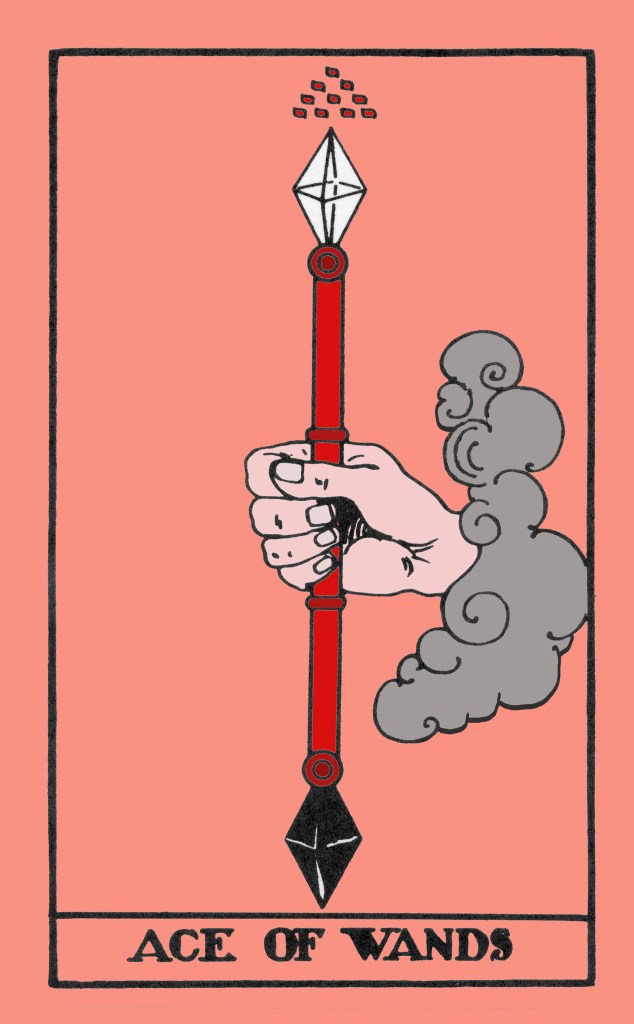
The Ace of Wands from the Builders of the Adytum (BOTA) Tarot deck
Paul Foster Case (and Ann Davies)
In Tarot Divination the Ace of Wands has these key meanings: natural as opposed to invoked force; strength; force; vigor; vitality; particularly the force of concentrated will; the principle of beginning; initiation or inception of any enterprise or activity; concentration of power; involution of force. Keyword: Initiative (From the Oracle of Tarot course)
A. E. Waite
A hand issuing from a cloud grasps a stout wand or club. Divinatory Meanings: Creation, invention, enterprise, the powers which result in these; principle, beginning, source; birth, family, origin, and in a sense the virility which is behind them; the starting point of enterprises; according to another account, money, fortune, inheritance. Reversed: Fall, decadence, ruin, perdition, to perish also a certain clouded joy. (From The Pictorial Key to the Tarot)
Aleister Crowley
This card represents the essence of the element of Fire in its inception. It is a solar-phallic outburst of flame from which spring lightnings in every direction. These flames are Yods, arranged in the form of the Tree of Life. (For Yod, see Atu IX supra.) It is the primordial Energy of the Divine manifesting in Matter, at so early a stage that it is not yet definitely formulated as Will.
Important: although these “small cards” are sympathetic with their Sephirotic origin, they are not identical; nor are they Divine Persons. These (and the Court Cards also) are primarily sub-Elements, parts of the “Blind Forces” under the Demiourgos, Tetragrammaton. Their rulers are the Intelligences, in the Yetziratic world, who go to form the Schemhamphorasch. Nor is even this Name, “Lord of the Universe” though it be, truly Divine, as are the Lords of the Atu in the Element of Spirit. Each Atu possesses its own private, personal and particular Universe, with Demiourgos (and all the rest) complete, just as every man and every woman does.
For example II’s or VI’s Three of Disks might represent the establishment of such an oracle as that of Delphi, or VIII’s might be the first formula of a Code such as Manu gave to Hindustan; V’s, a cathedral, XVI’s, a standing army; and so on. The great point is that all the Elemental Forces, however sublime, powerful, or intelligent, are Blind Forces and no more. (From The Book of Thoth)
Golden Dawn’s Book T
A WHITE Radiating Angelic Hand, issuing from clouds, and grasping a heavy club, which has three branches in the colours, and with the sigils, of the scales. The Right-and Left-hand branches end respectively in three Flames, and the Centre one in four Flames: thus yielding Ten: the Number of the Sephiroth. Twoand-twenty leaping Flames, or Yodh, surround it, answering to the Paths; of these, three fall below the Right branch for Aleph, Men, and Shin, seven above the Central branch for the double letters; and between it and that of the Right twelve: six above and six below about the Left-hand branch. The whole is a great and flaming Torch. It symbolizes Force — strength, rush, vigour, energy, and it governs, according to its nature, various works and questions. It implies Natural, as opposed to Invoked, Force.
Etteilla
Birth Upright. This card means, in its natural position, as far as the medicine of the spirit is concerned: Birth, Beginning. – Nativity, Origin, Creation. – Source, Beginning, Primacy. – Extraction, Race, Family, Condition, House, Lineage, Posterity, Occasion, Cause, Reason, First, First fruits. Reversed. Fall, Decadence, Decay, Decline, Decay, Decay, Dissipation, Failure, Bankruptcy, Ruin, Destruction, Demolition, Damage, Devastation. – Guilt, Error, Contempt, Abatement, Depression, Discouragement. – Perdition, Abyss, Chasm, Precipice. – Dying, Falling, Decay, Derogation. – Depth.
I’m pretty sure at this point that everyone believes their country to be the least functioning of all. I grew up in Italy where everyone scoffs at the idea of things ever going well or functioning properly. I’ve then lived in a couple of countries that Italians tend to look at as paradises only to realize that the attitude of people there is actually the same (hell, I’ve even heard the occasional praise for Italy when something was in the news. “Those Italians know how to get things done.” I laughed)
I have the same experience now in Germany. People have the impression of living in the most broken country in the world. And honestly, I must say that I never thought I would get to experience a worse bureaucracy than Italy’s. But here we are.
I think the chief difference is that Italians know their bureaucracy doesn’t work and so ‘reinterpret’ the rules, while the Germans tend to bang their heads against broken rules until they pass out.
Here Abano discusses matters relating to the Third House and Fourth House.
Third House
Of whether a messenger brings good news. If you want to know about a messenger or letter you’ve sent out, and about what effect they will have, and whether the messenger will come back with good news, then the first house is the querent, the third is the messenger or letter. When the first figure is good and the third one is exiting, or at least if it is entering or mixed but good, this is positive.
This is especially the case if the fourth house is conform to the first, and the third to the ninth. If the first or second figure1 moves to the house of the quesited, that is, of the person you send the message or messenger to, this augments the positivity of the message you get in return. The same is true if the first or second figure are conjunct to the house of the quesited or the person. Whether the message comes soon or late is known by whether the figures are mobile and exiting or fixed and entering, and also by the fifteenth and fourth figures.
The figures representing letters or messengers are Albus and Conjunctio. If Rubeus or Puer are in the second, it means airy words2 and talking inappropriately, and rumors or gossip, and discord, unless the message is about war. And if it’s Tristitia or Carcer, it means obstacles and lateness in what you inquire about. The other positive figures have a good meaning.
Which among one’s siblings or relatives will die sooner. 3 The first house is the querent . If it moves to the eighth, or if the eighth moves to the second, it means the querent will die before his siblings, and all the sooner if the figure moves to the angles.4 On the other hand, if the second figure5 were in the eighth or the ninth, and if the eighth were unfortunate, it means the sibling or relative will die sooner, especially if it is also found in the fourteenth or fifteenth. The death is good or bad depending on whether the figure is positive or negative.
If one is loved by their relatives. Look at the first house, whether it is good or bad, and similarly the third, and if they are conform or not, and in this way you judge whether they love each other. If they are not conform, but if the third is in the second, or the first in the fourth,6 and if the third figure is good, similarly they are friends and love each other. If the first figure is unfortunate and malicious and the third good, the querent doesn’t love the relative, but the relative loves them, and vice versa.
Fourth House
Paternal Inheritance. If you want to know about paternal inheritance, or from an older relative, or father-in-law, look at the fourth figure, if it moves to the second and if it is fortunate and entering, of fixed, judge that the querent will have what he wishes for, but if it is unfortunate and exiting, it means not obtaining it. Similarly, if the fourth does not move to the second, and if the first does not move to the fifth or eleventh.7 If the first and fourth were contrary to one another, it means not obtaining it, and similarly if the first is unfortunate and the second is contrary to the fourth. If the fourth moves to the seventh or ninth or tenth or twelfth, it means the inheritance goes toward other people, and this according to the properties of the figures, as explained before.
If one is loved by the father or uncle or partner.8 Look if the fourth figure is good and entering and if it is conjunct to the first, that is in the second, or if the first is in the fifth.9 If the first is good and is united to the fourth in the second, it means that affection is reciprocal, and all the more if the fifth or eleventh are conform to the first or the fourth. And if the first or fourth are in the fifth, it means the same, especially if the eleventh is conform to the aforesaid figures. When the first is good and the fourth bad, even if the fourth moves to the fifth, it means that the father or uncle doesn’t love the querent, although the querent loves him. On the other hand, if the fourth is in the second and is good, but the first is bad, it means the querent is well-liked, but the querent doesn’t like him. And even if the two figures are contrary to one another and there is no conjunction between them and there is no mutation of place it has a similar [negative] effect, as it shows lack of affection, and whichever of the figures is more unfortunate shows who is more at fault, and if the first and fourth are both evil, it means one is bad and the other worse.
Whether it’s good to build If you want to erect a building, look whether the fourth is good, entering and fixed, which means it’s good to build, especially if the tenth figure is conform to the fourth, and the first is good and fortunate. If the fourth is good but not fixed, the building is good but won’t last. If the fourth is mobile and exiting, and the seventh is contrary to it and unfortunate, it means the building will be ruined by an enemy, especially if the twelfth is unfortunate and contrary. And if the tenth is contrary to the fourth, it means ruin through one’s lord. If the fifth is contrary to the fourth, it will be ruined soon. However, note that if the fourth is exiting and the three other angles are fixed, the building will still last, especially if the fifteenth figure is fixed or entering and fortunate.
Whether there will be abundance or a famine. If the fourth figure is entering and fixed and fortunate, it means the year is abundant and the soil fertile, especially if the figure is earthy, and similarly if the angles are so, and also the fifteenth figure. But if the figure is unfortunate and exiting it means dearth, especially if the figure is fiery, and if the angles and the fifteenth are similar. Furthermore, add up the fourth and fifth,10 and judge if the result is good or bad or mediocre.
If a besieged fortress will be taken. The first and second figures are attributed to the fortress and those inside, the fourth means the fortress, the seventh and tenth the enemies. If the first and second houses are good, fortunate, entering and better than the seventh and tenth, it means those in the fortress will win. So also if the fourth is fixed and fortunate and earthy, and vice versa if the seventh and tenth are better. Similarly, if the fourth figure goes to the tenth or if it is conjunct to it, it means the enemies will come inside.
And if both are good and benign, they will conquer it peacefully, and if the fourth and tenth are are evil, but the first and second are strong and entering, there will be a battle, and the fortress will be taken by force, especially if the tenth figure is fortunate and powerful in virtue, and if the seventh and tenth are weak and the first and second are fortunate and entering, those in the fortress will win.
And if the third and fourth are fixed and fortunate and entering or earthy, those in the fortress will also win, and vice versa. When the first and the second are evil and unfortunate, and the seventh and tenth are likewise evil, and the fourth is fixed, it means the fortress will be conquered through betrayal.11 And if only the second is exiting and unfortunate and the first and fourth are good and fixed, money will be used [illeggibile] those of the third.
Of buried treasures and hidden things The fourth means the buried treasure and the hidden thing. If the figure is entering and fixed and fortunate, it means the question is valid, and if the first and fifteenth are conform it means the querent will get the treasure, especially if the fourth is in the second, or any other positive, entering figure is in the second, and vice versa if the figure is exiting and unfortunate and evil, and the first and fifteenth are unfortunate. And if the treasure or hidden thing is in a house it is shown by the figure in the fourth being fiery,12 and if it is airy it means in the attic, and if it is watery it is below, and if earthy it is buried.
What end the question shall have. If you want to know what effect any question will have, consider the fourth, if it is good and fixed, or exiting according to the querent’s wish, whether it is good or bad, or unfortunte, and if it is conjunct to the first or to its opposite, and if it is good according to the querent’s intention, and fortunate, it means a good end, especially if the tenth and fifteenth are conform to the querent’s intention, and similarly look at the other angles and see [if the majority of them is good]. If you want to know the cause or means of reaching this end, look at the angles and the second, fifth, eighth and eleventh,13 and the one that is best or worst will cause the greatest good or evil.
MQS
Footnotes
It is not clear why Abano refers to the second figure instead of the third in this passage. If it is not an oversight, then it could be a reference to the Company of Houses. ↩︎
This may sound a rather grim topic to ask about, but it was by no means uncommon in Abano’s times. Death was much more frequent and much more in the nose of people than it is today, and therefore something to prepare adequately for. I had a woman once ask me who would die first between her, her sister and her brother. ↩︎
The Angles (First, Tenth, Seventh and Fourth House) were generally considered quick. ↩︎
This reference to the Second House instead of the Third is difficult to explain. ↩︎
Notice, once again, that Abano refers to the First and Second Houses as pertaining to the querent (but not the Twelfth) and the Third and Fourth to the sibling or relative (but not the Second). ↩︎
The Fifth house is the second from the Fourth and thus represents the father’s wealth. The Eleventh house is harder to justify, except that it is considered a lucky house and, on the Geomantic Shield, it falls right underneath the Fifth. ↩︎
“Compagno”. I don’t know what this should imply here, in reference to the Fourth House. ↩︎
Interestingly, Abano refers to the Fifth house here in connection to the father’s or uncle’s love, but not to the third. This cannot be a reference to the Company of Houses, since by that doctrine the Fourth is in company with the Third, not with the Fifth. The Fifth house aspects the First by trine, so maybe that is an explanation. ↩︎
the Fifth house represents wealth derived from the Fourth, including the fruits of the earth. ↩︎
Possibly this is because the Fourth house, being strong, wouldn’t have been conquered without help from the First and Second. ↩︎
Traditionally, in some old Astrology handbooks, fiery signs were symbolic of the walls of a house, because bricks were made with fire. ↩︎
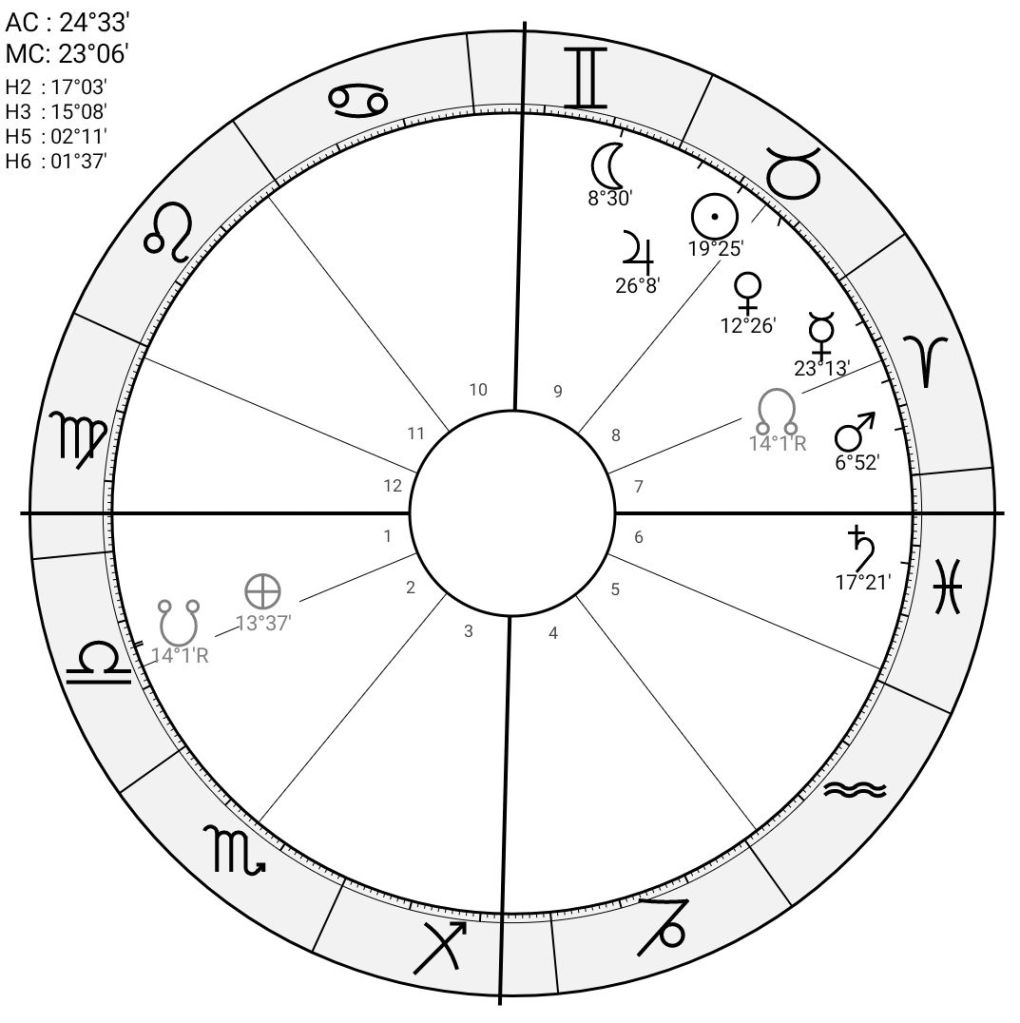
This is a quick one. My husband comes from a particular family background, and as a consequence of it is often afraid of not being left with enough money despite his hard work (and he is a hard worker). As I said elsewhere, we are moving, and so expenses are popping up left and right, and I’ve noticed a certain anxiety in his eyes. Consequently, I asked the Heavens a bank statement.
My husband’s finances, Horary Astrology reading
Since I didn’t tell my husband I was doing a reading, I am the querent, and he is my husband, and therefore Seventh House ruler, Jupiter. His money is represented by the second house from the Seventh, therefore the radical Eighth House, ruled by Mars.
Jupiter is peregrine in Taurus, and conjunct Caput Algol, a malefic star that, some say, is connected metaphorically to losing one’s head. Furthermore, Jupiter is combust and approaching the Sun. Therefore, my husband is under great stress.
How are his finances? Well, Mars is its sign and face, angular and inside the Seventh House, which represents my husband. So his finances are good, and they remain in his possession. This may sound silly. After all, if they are his money, of course they are his possession. Still, it is comforting to see his money in his house: he retains control over it.
I believe this wonderful Mars testimony shows that, as it were, the fundamentals of his finances are solid, i.e., there is no risk of dejection, poverty, major adversity, etc.
That being said, this does nothing to alleviate his stress. The Moon is cadent, possibly indicating that the economy is going to be slow for a while, and it separates from a positive sextile of Mars, showing a positive financial recent past, and applies to a square of Saturn. Saturn shows restriction. In other words, while there is nothing to fundamentally worry about, the next period isn’t going to be the most prosperous.
I already have a partial outcome for this reading, which was done some weeks ago. As soon as we entered the house, after a couple of days, some household utensils gave up the ghost, including the fridge, and we had to buy new ones. Since Saturn rules the Fifth house, the house’s possessions, I’m wondering if that was what it was referring to, though this is stretching it quite a bit (they are our possessions, not the house’s). Alternatively, Capricorn is the second sign on the Fourth cusp, so Saturn would generally show the house.