All posts by MQS

Living at the intersection of occultism, fiction and philosophy, I travel the planes at a moderately quick pace. I read, I do magic, I cook for hubby. Confused by the number of things I talk about? Good, confusion is a nice thing ;)

Enneagram Comparisons – Type Five and Type Nine

Enneagram Type Five and Enneagram Type Nine can share some similarities, though they remain vastly different. Nines are a Body type, who seeks to maintain a sense of harmony within themselves and their surrounding by avoiding conflicts that would undermine their sense of autonomy. Fives are a Head type, who withdraw from the world to observe it from a distance and to gain skills that will ideally allow them to succeed.

Both Fives and Nines withdraw from others, but in different ways. Average Nines withdraw their energy and suppress their agenda to avoid it clashing with that of other people. Average Fives withdraw themselves, often physically, or at least emotionally, from social situations.

Nines, however, generally remain friendly and often go with other people’s flow, as long as it doesn’t threaten their inner sense of calm. Fives, on the other hand, have a strong sense of self as opposed to all other, refuse to be swept along in their flow and tend to have a supercilious and combative demeanor that most Nines would never display.

Withdrawing

Internally, Nines usually pacify themselves with happy or comforting thoughts and a positive, if vague, attitude. They tend to think in terms of generalities, which makes them very good at finding common grounds with all humanity at an almost archetypal level. Fives are internally high-strung and constantly mulling over some thought or theory, they disdain generalities and are as laser-focused on details as they are preoccupied with finding their universal significance. Furthermore, in general Nines will stop themselves from trespassing into “scary thought territory”, while Fives will usually willingly go there.

The decisive difference between Nines and Fives is in what drives the two types. Fives are driven by knowledge. At their best they are as wise as they are knowledgeable, at their worst they are obnoxious collectors of obscure trivia. Nines are motivated by peace. At their best they are deeply embracing of themselves and others, at their worst they are dollar-store mystics detached from reality.

MQS

Italy vs Switzerland (Reading Example)

To be clear, I have the same interest in soccer that a koala has in space exploration. Two days ago I didn’t even know that Italy was playing Switzerland, and I would have kept not knowing it if I hadn’t been at a friend’s birthday party, where I met a fellow Italian, one who does care about soccer. Since she knows of my interest in occultism and divination, she asked if Italy would win. I used horary astrology to answer.

Note that the match had already started when she asked me the question, though I knew nothing of how it was going and I asked her not to tell me to avoid influencing my judgment. Furthermore, I forgot to screenshot the chart, so this is a recreation that I believe to be close to the original.

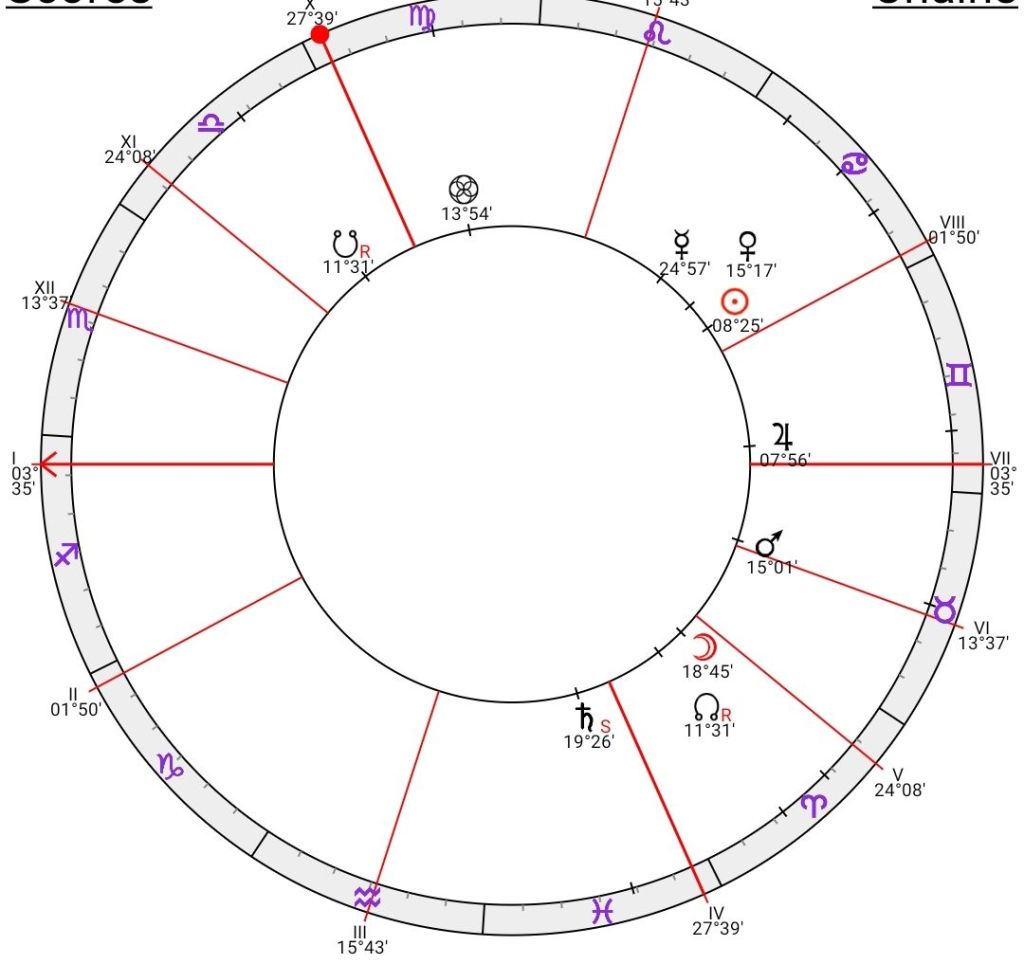
Will Italy win? App used: Astro Charts

Since the querent is Italian and wants Italy to win, Italy takes the First house. Switzerland is given the seventh house of the enemy. The first, and decisive, clue is given by the position of Jupiter, significator of the First house. It is stuck inside the Seventh house, in the grips of the opposing team.

Once we see this, pretty much nothing else matters. The opposing team, signified by Mercury, is in the Eighth house, which is not great, but by antiscion it is right inside the Seventh, which is bad for Jupiter but again good for Mercury. The Moon is moving to square Mercury with reception. Bonatti says that a square with reception is like a sextile without reception, so it is generally smooth. At any rate, Switzerland should win. And indeed they won 2 to 0.

Important note: Horary astrology requires the querent to have some kind of emotional involvement in the question. Since I couldn’t care less about soccer, despite being Italian, if I had asked the question I would have regarded the chart with some suspicion. It is only because the querent is a soccer fan that the chart was accurate.

MQS

Playing Cards That Indicate Loss

After discussing the playing cards that indicate gain, let’s take a look at the ones that represent loss. Keep in mind that loss can be indicated by any card of gain that is poorly placed in the spread, i.e., when surrounded by difficult cards. For instance, the 7♦, normally a card of money, followed by most Spades or even some Clubs, would represent either loss of money or a sum of money being withheld.

Six of Clubs

The Six of Clubs is a card of difficulties, toil and fatigue. It is not inherently a card of monetary loss. However, it represents a stagnand situation which, applied to money, can imply either loss or lack of gain, and especially lack of compensation for one’s toil.

Seven of Clubs

The Seven of Clubs is, again, not directly connected to loss, but it does show problems in all levels, and as such it can indicate loss or lack of gain when together with Diamonds or when summoned for a money reading. Keep in mind, though, that Clubs are not tremendously nefarious, so while they can create unsatisfactory situations, that are unlikely to cause dramatic loss.

Six of Diamonds

The Six of Diamonds is a card of worry and preoccupation, usually over money matters (but not necessarily). In general it shows situations of all kinds that stand on a shaky foundation, living paycheck to paycheck, businesses that don’t take off, etc. Again, it is not a dramatic card, but it can signify money problems or even, in general, not gaining something.

Ace of Spades and Nine of Spades

All Spades can signal loss. However, the way each of them causes loss is different. I will just highlight some of the differences. The Ace of Spades is a seriously bad card, which is often involved of configurations indicating bankruptcy, poverty and failure all around. The Nine of Spades is equally bad, and when they come up together they often prevent success in accumulating money for very long periods of time.

Two of Spades and Three of Spades

Less dramatic than most Spades, the Two of Spades indicates small losses, situations that cause headaches from a financial standpoint. The Three can also indicate small losses, and can also be found in sequences indicating scams.

Four of Spades, Five of Spades and Six of Spades

Much more dramatic, the Four and Five of Spades indicate serious loss, projects going awry and being abandoned. They can often represent difficult circumstances, but with the appropriate cards they can point to the querent being at fault (missteps, etc). The Six of Spades represents financial situations characterized as ‘sick’, that is, unhealthy, structurally unsound and therefore destined to failure.

Seven of Spades and Eight of Spades

These cards, especially the Seven, can indicate accidental loss, that is, loss not due to negligence (however, always remember to take the context into account).

MQS

The Geomancy of Peter of Abano – Book III Pt. 1

Previous / Back to Index / Next

In a relatively straightforward passage, Abano gives the reader examples of what it may mean when a figure moves from one house to another.

To truly understand mutation and the variety of the figures, you need to consider the property of the figure, whether it be fortunate or not, entering or exiting, fixed or mobile, and judge according to its meaning the effect of the mutation, always keeping in mind the question, the quesited and the querent.
Another mutation1 to be kept in mind with its meaning in order understand better what has been said so far, is the one that happens to every figure as it changes from one house to another.

If the first figure changes to the second, and is good, fortunate, entering, it means gain, good luck for oneself, and when it is evil it means ill; if it moves to the third it bodes well for neighbors, relatives, traveling; when to the fourth, it means small losses, except if it is Cauda or if the question is about older relatives, friends and things fixed and immobile, endings, buildings and possessions; if to the fifth it’s excellent, except if it is Cauda; if to the sixth, it is very bad, except if it is Via or Cauda, or if the question is about sixth house matters; if to the seventh it has a very bad meaning, unless it is for seventh house matters, as said above, or unless it is Via or Cauda; if to the eighth it means ill luck, accident, loss, death, fear, except if you are asking about your enemy’s wealth or of the wealth of another person; if to the ninth it is good, unless it is Cauda or Rubeus, and if the question is about travel it won’t be made as scheduled; if to the tenth, it is very good, except if it is Via or Cauda; if to the eleventh it is also excellent; if to the twelfth, it is the worst of all, unless it is Cauda and in twelfth house questions.2

If the second figure moves to the third house, it means good luck and gain through siblings and relatives, or due to them, but if the figure is bad it shows the opposite; if it moves to the fourth it shows good outcomes in stable things, and through one’s older relatives; if to the fifth, it means well through messengers, letters, etc; when to the sixth it means infirmity, even of the family, and loss in moble things, and of servants. If it moves to the seventh, if it is good it means well, but if it is bad it shows loss through enemies or women, or games of chance,3 or thieves; if it moves to the eighth it shows that the absent party comes back with good news, and maybe the death of some relative, or loss depending on the angles of the chart; when it moves to the ninth it shows gain or loss from the church or through travel; if to the tenth it means gain from the profession or from one’s lords and good luck; if to the eleventh it shows good luck and good friends, and good luck from the community; if to the twelfth, it means one of his relatives will fall ill or be imprisoned, or shall lose wealth, but if the figure is good it shows buying animals, and things unthought of.

The third figure, when it moves to the fourth, shows gain or loss through relatives; when to the fifth, it shows happiness and new things, and messengers, clothes, etc. When to the sixth, it shows sickness, servitude, toil, small animals; to the seventh, it means copulation,4 change of place, fights, separation; when to the eighth it means gain or loss, death, fear; when to the ninth it means long travel, churches, religious people; when to the tenth it shows the army, profession, dominion, lordship, honor; when to the eleventh it means good luck, noble servants; when to the twelfth, prison, long sickness, retrieving lost animals or buying them.

When the fourth figure goes to the fifth it shows goods from one’s relatives or children, clothes, food, and other things of the home; when to the sixth, it means sickness in the family or animals, relatives, servants; when to the seventh it means getting married, a bandit coming back for you,5 the home becomes inimical; when to the eighth it shows inheritance, the absent party comes back; dying in one’s home country or home; to the ninth, it means death of a religious person, acquisition of church things; when to the tenth, honor of the house, lordship, honors, etc; when to the eleveth, it shows good luck in one’s home, family, congregation of friends, etc.; when to the twelfth, if good, it shows good things, but when bad it means sickness, long prison sentences, toil, difficulties in one’s home or country, or through one’s relatives.

When the fifth figure goes to the sixth house, it means sickness through being hexed6 or food, or issues with children, or messengers, or animals; when to the seventh, it means marrying off one’s child, merchandise, fights, enemies rejoicing, problems with children or a woman giving birth; to the eighth, problems and death of one’s child, or [acquiring] other people’s wealth, and the absent party is doing well; when to the ninth, a child entering the clergy, long travel, happiness and gain, a churchman having a child, gain from things of the church; to the tenth, it means a happy mother, lordship or [happiness] of one’s lord; when to the eleventh it means good news for the child, and a messenger resolving all kinds of issues, and friends are happy for or with the querent; to the twelfth it means sickness or imprisonment for the child, large animals and a prisoner or wayfarer who is doing well.

When the sixth moves to the seventh house, it means sickness, wrath, problems through small animals, servants or one’s wife or other people; when to the eighth, it means death of animals or servants, loss of wealth, sickness of the absent party, and servants helping one’s enemies; when to the ninth, it means a journey full of issues, and sickness during the journey, or a sick churchman, occupation, problems with the church; when to the tenth, it means sickness and problems, but also having good and faithful [servants?], obtaining a lordship; when to the eleventh it means sickness of self or of a friend, or contrarieties with friends; when to the twelfth it means sickness of great animals, loss through them, prison, pilgrimage.

When the seventh goes to the eighth house, if it is good, it means good things for the absent party, but if bad, death, loss and issues for those represented by the seventh; when to the ninth, it means the absent party will come back, the bandit goes away, the querent gets married, the enemy makes peace, long travel, religious people, or a churchman becomes your enemy; to the tenth, the lord gets married or becomes inimical, lordship, honors; when to the eleventh it means a friend becomes an enemy, and what’s good for him is bad for you, the partner won’t keep his promise, the thief is a false friend, the marriage or partnership is changeable; when to the twelfth loss of animals through enemies, or due to sickness of animals, and prison, and the prisoner gets married, problems during a pilgrimage, long pilgrimage, betrayal from hidden enemies.

The eighth figure, when it goes to the ninth house, means wealth, help from the church, death of a priest, travel full of fear and problems, the absent party is traveling; when to the tenth, it means death, occupation of stable things, the absent party comes back to the country; to the eleventh, it means death of a friend, gain through a dowry, inheritance, misfortune, loss through friends, good luck of the absent party if the figure is good; when to the twelfth, it means the prisoner or sick person is seriously sick, death of the same, and of the wayfarer, and being imprisoned due to enemies.

When the ninth goes to the tenth, it means ecclesiastical dignity, increase of church things, an honorable journey or for religious purposes; when to the eleventh it means good luck in travel, good company or partnership, luck with friends and things of the church, recognition within the church; when to the twelfth it means issues while traveling, danger through horses, being imprisoned, the prisoner may be released, the wayfarer comes back, the horse is found, and this causes more or less trouble to the querent depending on how good or bad the figure is.

When the tenth figure goes to the eleventh it means good in all things, and one’s lord or master is good and friendly, the year abundant; when to the twelfth it means prison, sickness, one’s enemies are not seen in a good light, and are hated by your friends and by your masters.

When the eleventh goes to the twelfth it means sickness, prison, adversities, problems, and one’s hidden enemies are lucky, and all is good for the querent.

MQS

Footnotes
  1. It is rather typical, in premodern occultism, to use the same word to signify different things depending on the context. ↩︎
  2. The general principle in judging the mutation of one figure to another house is whether it bodes well for the question at hand and whether the figure accords with the question and is fortunate. As such, in Abano’s example, a figure moving from the first to the seventh is unfortunate because it oppses itself, but the same movement is positive if the question is about Seventh House matters (marriage, alliances, etc.) ↩︎
  3. Gambling is often seen as a Fifth house matter, but in this case the relationship with the Seventh House is through the fact that we are playing against ‘other people’. ↩︎
  4. it is not clear why the conjunction of Third House and Seventh House matters should produce sex. ↩︎
  5. ‘Ritorna il bandito’. Bandito is an ambiguous word in Italian, as it can mean both bandit and banished. In this case it is probably the latter meaning which is relevant: someone who has been banished will come back. ↩︎
  6. ‘per fature’, similar to the current Italian word ‘fattura’, which in this context would mean a hex. It is possible the word has another meaning which escapes me. ↩︎

The Great Watcher

Previous / Back to Index / Next

From the Microcosmicon, 27:

The psychonauts’ submarine plunged into the Inmost Ocean, the depths of the collective unconscious where the whirlpool roared. A wound throbbed at the bottom of it, through which meaning bled out of reality, leaving the world stunned under a pall of grayness.

“There’s something,” one of them shouted, as the sub spiraled down toward the abyss.
“Don’t be silly, there can’t be anything beyond reality,” another responded.

“Wake up!” Dr. Ferguson’s voice broke in, saving them just as they were approaching the point of no return.
Their vision disappeared from the screen as they awoke.

“What did you see?”
“An eye.”

MQS

The Great Watcher

Tarot Encyclopedia – The Two of Wands

(Note: this is a collection of the meanings attributed to the cards by some occultists in the past centuries. It does not reflect my own study or opinion of the cards. It is only meant as a quick comparative reference as I develop my own take.)

The Two of Wands from the Builders of the Adytum (BOTA) Tarot deck

Paul Foster Case (and Ann Davies)

In Tarot divination the Two of Wands has these key meanings:
Well Dignified: it shows force, enterprise, boldness, resolution, some
combativeness, much originality.
lll Dignified: it signifies restlessness, fierceness, shamelessness, inordinate ambition, turbulence, obstinancy, revenge. A card of enthusiasm, but of strong self-interest.
Keyword: Dominion
(From the Oracle of Tarot course)

A. E. Waite

A tall man looks from a battlemented roof over sea and shore; he holds a globe in his right hand, while a staff in his left rests on the battlement; another is fixed in a ring. The Rose and Cross and Lily should be noticed on the left side. Divinatory Meanings: Between the alternative readings there is no marriage possible; on the one hand, riches, fortune, magnificence; on the other, physical suffering, disease, chagrin, sadness, mortification. The design gives one suggestion; here is a lord overlooking his dominion and alternately contemplating a globe; it looks like the malady, the mortification, the sadness of Alexander amidst the grandeur of this world’s wealth. Reversed: Surprise, wonder, enchantment, emotion, trouble, fear.
(From The Pictorial Key to the Tarot)

Aleister Crowley

The Two of Wands is called the Lord of Dominion, and represents the energy of fire; fire in its best and highest form.

[…]

This card, pertaining to Chokmah in the suit of Fire, represents the Will in its most exalted form. It is an ideal Will, independent of any given object.

“For pure will, unassuaged of purpose, delivered from the lust of result, is every way perfect.” AL. 1. 44.

The background of this card shows the power of the planet Mars in his own sign Aries, the first of the Signs. It there represents Energy initiating a Current of Force.

The pictorial representation is two Dorjes crossed. The Dorje is the Tibetan symbol of the thunderbolt, the emblem of celestial Power, but more in its destructive than its creative form.

More, that is, in its earlier rather than its later form. For destruction may be regarded as the first step in the creative process. The virgin ovum must be broken in order to fertilize it. Fear and repulsion are therefore the primary reaction to the assault. Then, with understanding of the complete plan, willing surrender rejoices to co-operate. Six flames issue from the centre. This indicates the influence of the Sun, who is exalted in Aries. This is the creative Will.

Mars in Aries is the attribution of the Geomantic Figure Puer. The meaning of these figures is to be studied in the Handbook of that science: “The Equinox” Vol. I, No.2. Remember that the Geomantic Intelligences (see Liber 777 Cols. XLIX and CLXXVIII) are all primarily Gnomes.
(From the Book of Thoth)

Weirdly religious AI-generated illustration of the Two of Wands

Golden Dawn’s Book T

A WHITE Radiating Angelic hand, issuing from clouds, and grasping two crossed wands. Flames issue from the point of junction. On two small wands above and below, with flames of five issuing therefrom, are the symbols of Mars and Aries for the Decan.
Strength, domination, harmony of rule and of justice. Boldness, courage,
fierceness, shamelessness, revenge, resolution, generous, proud, sensitive, ambitious, refined, restless, turbulent, sagacious withal, yet unforgiving and obstinate.
Chokmah of HB:Y (Influence over others, authority, power, dominion).
Therein the Angels HB:VHVAL and HB:DNYAL bear rule.

Etteilla

Sadness
Upright. This card, as far as the medicine of the spirit is concerned, signifies, in its natural position: Sadness, Misery, Melancholy, Affliction, Sorrow, Desolation, Mortification, Mood, Discontent, Vapors, Gloomy Ideas. – Bitterness, Anger, Spite.
Reversed. Surprise, Enchantment, Shock, Upset, Unexpected event, Unexpected fact, Excitement, Fear, Fright, Terror. – Consternation, Stunning, Domination, Abduction, Alarm. – Marvel, Phenomenon, Miracle.

MQS

Vera Sibilla Cards That Indicate Positive Feelings

In the Vera Sibilla, every card can indicate some type of feelings. I have singled out some of those that indicate positive feelings. As usual, the list is not meant to be exclusive.

Ace of Hearts (A♥️) – Conversation

This card is broadly connected with words and self-expression. However, when discussing someone’s feelings, they indicate someone who is capable of expressing their feelings to someone else and reaching some kind of communion with them. In general, it shows an attitude of openness toward others.

Two of Hearts (2♥️) – The House

Usually the Two is the card of the house and of places in general. However it is also connected with harmony between two people, and it shows a constructive attitude, especially, though not exclusively, in a love reading.

Four of Hearts (4♥️) – Love

The Love card is, wouldn’t you know, the card of love, but also of strong feelings of affection in all personal relationship. It is connected with the motions of our heart, and as such it shows emotions above and beyond reason. The caveat here is that this card is not stable, and it requires other more grounded cards to promise lasting happiness.

Five of Hearts (5♥️) – Happiness

The Happiness card indicates everything connected with joy and good intentions. Being the card of the bethrodal, it also shows a certain degree of commitment to someone, and is therefore also a symbol of fidelity.

Seven of Hearts (7♥️) – The Scholar

The Scholar is a rational card, one of planning and long term prospects. When not damaged by the presence of difficult cards it shows the desire to create something lasting, as well as a helpful attitude.

Eight of Hearts (8♥️) – Hope

Hope is the positive feeling par exccellence. It represents optimism, honesty, someone who takes the high road, is elevated, spiritual, reliable. The exception is when the Hope card is not supported by stronger cards, as in this case it tends to show flirts, due to its connection with ease and lack of trouble.

Nine of Hearts (9♥️) – Faithfulness

Contrary to popular belief, the Nine of Hearts (not the Four) is the best card when it comes to feelings. Not only does it show love, but unlike the Love card, it also represent a strong bond and commitment that goes beyond those feelings and is pursued systematically. It is the card of the diehard supporter, of the best friend, of the lifelong love commitment.

The Heart Court Cards

Court cards tend to be neutral. However, the Heart court cards, when upright, indicate a person who is in love or who has a positive attitude toward the question or the querent.

Four of Clubs (4♣️) – The Friend

Similar to the Nine of Hearts, the Friend can indicate friendship (when it doesn’t show a literal -female- friend). The difference is that the concept of friendship of the Four of Clubs is not as strong and it is often connected with practical matters. When reversed, the Friend card can indicate a helpful attitude that takes the form of tips, recommendations, etc.

Six of Clubs (6♣️) – The Surprise

The Surprise card is connected broadly with things that come to us easily. As such, it indicates people who are similar, have similar interests and find it easy to grow together and pursue similar activities. Relationships tend to flourish with this card.

Seven of Clubs (7♣️) – The Realization

In general, this card speaks of ambitions in a positive sense, so it can show people having common goals and projects.

Eight of Clubs(8♣️)  – The Reunion

The reconciliation card of the deck, the Eight of Clubs is indicative of a willingness to compromise and to find common ground. Furthermore, it shows someone who is social and moves toward others with positive intents in mind.

Nine of Clubs (9♣️) – Merriment

In keeping with the energy of the suit, the Nine of Clubs indicate positive bonds, though not necessarily deep. It is a card of fun and of playing, drinking and having a good time together.

Ace of Diamonds (A♦️) – The Room

The Room has, among its meanings, that of intimacy. As such it represents someone who seeks closeness and contact. However it is not a card of love, as it is in the suit of Diamonds, not that of Hearts.

Seven of Diamonds (7♦️) – The Child

As the card of children, the Seven of Diamonds shows someone to be open, good-hearted and inoffensive, unless with cards that bring out the worst qualities of children (immaturity, etc.). It represents also someone who wants to start new things and is unprejudiced and innocent.

Eight of Diamonds (8♦️) – The Handmaid

This is the card of someone who is serviceable, dependable and hardworking. It is also a card of politeness and the desire of peace. It can show someone of a noble character who is helpful, friendly and improving himself to be better with others.

Two of Spades (2♠️) – The Old Lady

As pretty much the only card of this suit that is not outright negative, the Old Lady can indicate feelings of affection toward others, though these feelings tend to be tenuous and not very dynamic. It can also indicate someone who uses the wisdom and experience they gained in life to be of service to others in a detached, serene way

MQS

Enneagram Comparisons – Type Five and Type Eight

Enneagram Type Five and Enneagram Type Eight are apparently very different, so much so that they are each other’s arrow on the Enneagram symbol: Five is Eight’s stress point, Eight is Five’s growth point. Fives are a Head type, concerned with security, and tend to find it by removing themselves from the world and observing it from a distance. Eights are a Body type, whose drive for independence leads them to asserting themselves in most situations, even and especially when there is resistance against them.

Interestingly, both Fives and Eights assert the energy of their center: Fives assert the intellectual urge of the Head center, Eights the instinctual urge of the Body center. In this, they both tend to break down opposition on the plane on which they operate: Eights break down physical opposition, often by asserting themselves on others more or less fiercely; Fives assert their mind’s right to be the judge of the truth of this or that idea by breaking it down, rarely accepting it as a given. Both Eights and Fives can be confrontational when unhealthy: Eights physically, Fives intellectually.

Assertion

Both types are strongly concerned with truth. Fives seek to develop a true appraisal of reality beyond social or even academic conventions. Eights usually have a very instinctual conception of the truth (their famous bullshittometer). Fives’ danger is of getting lost in the hair-splitting byzantinisms of their mental process; Eights’ danger is of failing to realize that sometimes their instincts do fail them and not everything is as simple and black-and-white as their guts tell them. Eights usually tend to simplify, Fives to complexify. Both excesses are best curbed.

Socially, both Eights and Fives have an individualistic, maverick-like streak, and both can be socially awkward and be somewhat timid. Yes, this also applies to Eights: as soon as they feel they are out of their depth Eights tend to become withdrawn and insecure, like regular Fives, often out of fear of being called out for being stupid or incompetent (this is Five’s fear, which is Eight’s stress point). Usually, though, Eights, while not necessarily social, tend to be imposing and even demanding. Fives, on the other hand, are almost always distant and even remove themselves physically from contact with others. Fives who have consciously worked on their social skills may, however, develop some of Eight’s bodily confidence.

When Mothers Smother (Reading example)

When we read for people and they only give us a broad question, I think it’s important to remain open to the twists of fate the cards are showing us, as well as to have an open dialogue with the querent  Sometimes querents lie, but more often they are either confused or fail to focus on the ‘real’ question. In the following case, the querent’s question wasn’t wrong, but it hid more than it showed. The querent is a woman of around 25. She asked me about her career without specifying anything.

A career reading using the Vera Sibilla

The querent is anagraphically covered by the Queen of Clubs, the young maiden, so we can initially assign this card to her. She is reversed, showing trouble.

The first line of the pyramid indicates the influence of a (probably older) woman. She is surrounded by the House and Love, but on the same line we find the Seven of Spades reversed. This is one of the worst cards in the deck, so whenever we see it we must tread carefully.

I asked the querent if an older female relative, possibly her mother, is involved in the issue, and at this point the querent tells me she works with her parents in the family business.

The Seven of Spades reversed represents tyranny and oppression, so I ask her if her mother is somewhat authoritarian, and she confirms. Note though that the mother is surrounded by two positive cards, hence the ‘somewhat’ in the statement. Furtermore, look at the angles of the spread: Good feelings, oppression, but not too much (Butterfly). I am aware that smothering mothers are how some serial killers get started, but this mother, while not positive, could be worse. She smothers the querent out of (real) love. She is oppressive, but not a sociopath.

Be it as it may, the querent clearly suffers from this situation (she is reversed) and therefore hopes to move away (Hope + Journey), as the Hope card can indicate the hopes of the querent or of the person preceding it, which in this case is again the querent. Probably the querent wants to find her sense of self and freedom. This would be understandable even under normal circumstances, let alone in this case. I asked her if she wanted to leave and again she confirmed.

But, woe and alas, look how the spread ends! Money is tight (Money + Sickness) so whatever job she is looking for is going to probably make her start at the very bottom. Thus we end with the Ten of Clubs, the Butterfly. This card indicates all those things that are fleeting and not rooted in the querent’s destiny. Thus her hopes are just fleeting, at least in the foreseeable future, due to the rotten (Sickness) money situation.

MQS

The Geomancy of Peter of Abano – Book II Pt. 8

Previous / Back to Index / Next

In this chapter, Abano discusses what happens when a figure changes from one house to another, and also geomantic perfection.

It is very necessary that you know how figures change from one place to another, as shown above,1 for it is of great signification. We have three species of mutation: Mutation, Translation, Occupation and Conjunction. Mutation is when the first figure of the querent is found in other houses such as the third or ninth or other places, whether near to or far from the house that signifies the quesited.2 Similarly, Mutation is when the quesited does the same with the querent.

For instance, let there be a question about a sick person, who wants to know whether he shall heal. In this case the first is the querent and the sixth his being sick, and the eighth is death, and the tenth is the house of well-being and the twelfth the house of the graveyard. If the first goes to the third and also to the tenth or eleventh, this is a mutation of place; and similarly if the sixth goes to the ninth or eleventh house, this is also a mutation.

And Mutation has a double meaning, because depending on where it happens it changes its signification and virtue for good or ill depending on the house. If the said figures are in the tenth, which means well-being, or the eleventh which is next to the tenth, it means healing, especially if it is both in the tenth and the eleventh; but if the first or sixth goes to the eighth it means dying, or if to the twelfth also, because it means the graveyard, especially if the figures are earthy and unfortunate.

Another example. Let there be a question about whether one shall have the woman he desires. The first is the querent and the seventh the quesited. If the first, being fortunate, moves to the fourth and the seventh, similarly fortunate, moves to the third, he shall have her, because both figures are fortunate and they are next to each other: they have mutated place. However, this shows that he shall not have her at his place or even at hers, but it will happen in the house of a neighbor or relative of his, and this because both figures are found in the first four houses, which represent the querent. If it had been on her side of the chart, i.e., in the following four figures, it would have happened in the house of someone she knows. And if it were in the ninth, tenth and eleventh, in a distant place. But if the figures are unfortunate, it shows contrarieties, partly due to him and partly due to the persons signified by the houses involved. But if the figure is fortunate but it changes to the twelfth, it means he shall not have her due to hidden enemies.

Translation is when the first figure or the second, which is associated to it, moves to the house of the quesited or next to it, or vice versa. And if the figures are good and accompanied by good figures,3 it shows a happy end, but if it is a mixed bag, the greater part wins4. However, it is better when the translation is made by the first figure and not by the second.5 It is also a translation when the figure of the quesited is found in the house next to the querent, that is, the second. It is also a translation when the first or second are not only in the house before the the quesited, but also in the house afterward.

Example. If the question is about marriage, whether it will happen or not, and through what means, and the first figure is Acquisitio and the second Laetitia, which are both good (and the first is better), and the seventh is Albus and the eighth Laetitia, which is better than Albus, this all shows that the marriage will happen easily and will happen through one’s relatives, especially if the fourth and tenth are close to one another and to the second, which is airy, and to the querent and the first figure is found in the Witnesses. For instance:

Example of Geomantic Shield by Peter of Abano

Occupation can happen in two ways: the first is when the figure of the querent occupies the house of the quesited. For instance, if the question is about a (contested) inheritance and whether one shall have it or will need to get it from an enemy, and if the first figure is Albus and the same figure is found in the fourth house, which indicates houses, fields, possessions, inheritance and stable goods, this is called Occupation, because the first figure occupies the fourth house, i.e., that of the quesited. It indicates obtaining what you wish, especially because Albus is a good figure. No geomantic configuration is better than occupation, but only, again, if the figure is good.

Example of Geomantic Shield by Peter of Abano, 2


Even more does it indicate obtaining the quesited because Acquisitio is in the second house, which means gain, and the ninth and tenth are fortunate, being houses assigned to the querent.
Another way of occupation is when the house of the quesited is found to hold the opposite figure of that of the querent. So, for instance, if with Albus in the first, one should find Rubeus in the fourth. This is also a form of occupation, but this is a worse kind, especially if the figure of the quesited thus obtained is unfortunate.6

Conjunction is also of two kinds. The first is when the first moves next to the house of the quesited, or vice versa when the quesited moves next to the house of the querent, that is, in the second house. The second type of conjunction is when not only one finds the two figures together as just said above, but one finds them together also far away, that is, in the ninth, tenth or eleventh.

Example. The question is if one shall get back a lost or stolen item or a fugitive servant. The first figure is Major, which moves to the fifth house next to the sixth of the lost thing or the runaway servant. Major is a good, entering figure. Furthermore the sixth figure is found in the second house next to the querent. The judgment is therefore that one shall get back the lost item. Furthermore, the figure of the quesited is conjunct to the first in the second, which shows the querent’s gain, and things are further facilitated by the fact that the sixth house has Populus in it, which means the waxing Moon. Finally, it is even more fortunate because Populus is found in the tenth and Major in the ninth and eleventh, and even more so because the first is found in the Witnesses, and the sixth as the Judge.

Example of Geomantic Shield by Peter of Abano, 3

All these configurations are called conjunction, whereby the ninth figure is said to be conjunct the first and the second because it is born from them,7 and the tenth is conjunct the third and fourth because it is born from them, and the eleventh is conjunct the fifth and the sixth because it is born from them, and the twelfth is cojunct the seventh and eighth, because it is born from them. And furthermore the Right Witness is conjunct to the ninth and tenth because it is born from them, and the Left Witness is conjunct to the eleventh and twelfth, because it is born from them.8

Let’s make the example of one asking about a lost item, and the first figure is Major, which however does not move to the house of the lost item, nor does it conjunct it, but moves to the third house, and similarly the sixth figure, which is Acquisitio, does not conjunct the first immediately, but moves to the tenth house, wherefore one shall judge that he shall soon get the lost item back, because the figure of the querent is found in the third house and Conjunctio is in the fourth, and the sixth figure is Acquisitio and is found in the tenth, which is born from Major in the third and Conjunctio in the fourth.9 Therefore, querent and quesited are said to be in Conjunction, especially when they are fixed and fortunate and entering, and the Witnesses are the Judge are exiting, and this means a change of place of the quesited to the place where the figure is found.

Example of Geomantic Shield by Peter of Abano, 4


The reason for all these methods of Mutation or Translation and Occupation and Conjunction is that every time a figure moves from its original house, it is always found in the place wherein it moves, and not in its original place, because no change happens without cause and without meaning something. Nevertheless, always it maintains the meaning of the person or thing inquired about in their original place, only changing its fortune or misfortune and its time-frame (past or future) in the way we have discussed above.

However it is not always the case that a good figure diminishes its good fortune or a bad figure its bad fortune; in fact, sometimes it increases them, depending that it is found in a better Mutation or Conjunction, so that if the first moves by Translation or Conjunction in another place, or if it occupies it, the figure still indicates the person of the querent, but it shows greater virtue of said figure in the question inquired about, and it means a more particular effect than if it were found only in the first house.

The same is to be observed if the second figure goes next to the house of the quesited or moves to its exact house, or next to the figure of said house, if they are good, and vice versa if they are bad the misfortune is greater [than if the figure hadn’t moved], always keeping in mind the limits of the question and of the figures it requires, and of the places and houses of the quesited. So that if the first goes to the seventh, which is a bad place, contrary to that which the querent seeks, being the house of the enemy, and it means fighting, anger, discord, then it means contrarieties surrounding the obtaining of what one wishes, unless if the question is about marriage, love, friendship, business, travel, lack of peace, and similar things, in which case finding the first in the seventh is excellent, if the figure is positive and fortunate.10

In other questions, if the first moves to the twelfth or sixth or seventh, if it is a good figure, it diminishes its goodness, but if it is a bad figure it augments its evil, except if the first figure is accompanied by a good figure in the second or ninth or eleventh.

And when the second, ninth and eleventh are fortunate and good and the questions are about an absent messenger, good news, money coming from afar and other similar things, and if you find in these houses the fifth or sixth figure or the seventh, twelfth, eleventh or thirteenth, it means good news, good messenger, a messenger coming from afar, money approaching. If the second or ninth and third or also the thirteenth move or translate to the seventh, eighth or twelfth it means good things from afar, especially if the Judge agrees.

If the seventh or eighth moves to the fourth they show good news and durable situations, if the figure is good, and the opposite if they are unfortunate.
The best houses are the first, fifth, tenth and eleventh.
The second, third, fourth and ninth houses follow.
The worst are the sixth, seventh, eighth and twelfth.

Every good figure that you find in a good place increases its virtue due to being in a good place, but if you find it in a bad place it diminishes it. Every bad figure you find in a bad place increases its malice, but if you find it in a good place it diminishes it, except in the first house, where it always keeps its own properties and meaning. And every figure you find accompanied or conjunct by others diminishes or increases its goodness or malice depending on the figure it is accompanied by.

Therefore, if the first is good and fortunate and the second good, and the ninth also good,11 it does not increase the goodness of the first, but if it is bad it decreases the goodness of the first or second, keeping also in mind the question and the querent’s desire and the houses involved in it and the meaning of the house of the querent. The same is valid for the tenth house with respect to the third and fourth house, of the eleventh with respect to the fifth and sixth, of the twelfth with respect to the seventh and eighth, of the Right Witness with respect to the ninth and tenth, of the Left Witness with respect to the eleventh and twelfth, as said above.

MQS

Footnotes
  1. Book II, Part 7 ↩︎
  2. In other words, mutation implies change of house, regardless of whether it brings the querent near the quesited, although in this case we have, of course, perfection. Note that usually we consider a Mutation to happen when two figures move to places that are next to each other, but Abano, as many other Medieval authorities, doesn’t seem to fixated on precise language. ↩︎
  3. “Accomagnate cun bone”. It is unclear if this refers to the company of houses. ↩︎
  4. That is, if the figures are mostly good, it is positive, and vice versa ↩︎
  5. This seems to imply that translation happens even if the querent’s figure causes it. This is in contrast with modern practice. ↩︎
  6. This technique has not survived in modern practice. However, it would be interesting to test it out. ↩︎
  7. This assertion made by Abano is of incredible interest for those trying to make more of the Geomantic Shield. Apparently, we do not consider figures to be next to each other just in the order of the Astrological houses, but also when they are next to each other ‘genealogically’, so to speak, on the Geomantic Shield. ↩︎
  8. As shown in other examples before, Abano seems to consider the Witnesses to be similar to the other houses, and therefore potentially in conjunction with them. ↩︎
  9. In other words, the two figures are conjunct by moving to houses that Abano consider to be next to each other, i.e., the third and the ninth. ↩︎
  10. Abano seems to be saying that when a house that is meaningful to the reading has its figure move to another house, it is always significant, but the good or bad import is decided by the kind of question. ↩︎
  11. The Ninth House is considered by Abano therefore to be in company with the first, in a way, or at least to be close to it, so that a figure in it influences the querent. ↩︎