All posts by MQS

Living at the intersection of occultism, fiction and philosophy, I travel the planes at a moderately quick pace. I read, I do magic, I cook for hubby. Confused by the number of things I talk about? Good, confusion is a nice thing ;)

Enneagram Comparisons – Type Seven and Type Nine

Enneagram Type Seven and Enneagram Type Nine share some similarities, and can therefore be confused. Sevens are a Head type and seek to avoid anxiety and fear by being hyped about things they can enjoy. Nines are a Body type who maintain their sense or independence by being agreeable and positive to avoid causing trouble that might come back to haunt them.

Both Sevens and Nines are known to have a hard time selecting a single thing that they can be or do. Sevens thrive on pursuing variety as this allows them to continue skimming the surface of life in search of the next big thrill and avoid staying with negative emotions for too long. However, Sevens tend to have a rather strong sense of self and of their wants and needs.

Nines on the other hand have a diffuse sense of their identity and do not feel comfortable defining themselves, often sensing that they can resonate with almost anything and anyone. By avoiding taking on a sharp identity, Nines protect themselves from potential trouble by simply passively flowing through it instead of bumping against it.

variety

Both Sevens and Nines have a broadly optimistic worldview. To a Seven, the world is their oyster and they look forward to the next thing to be hyped about. They are excitable and quick, and even when in a situation that they dislike, they can learn to tolerate it in anticipation of something better to come.

Nines by contrast move at a slower pace and have a sense of placid and unassuming satisfaction about them. They do not demand much from life and do not spiral into the manic frenzy of Sevens. In fact, they are very wary of anything that might cause excessive reactions in them. Their sense of optimism takes the form of a generalized, vague it’s-fine-ness that they adopt to avoid having to take a stronger stance, which might open them up to trouble and strife with others.

Both types can be rather superficial. Sevens are superficial in the sense that they remain on the surface of the things that they get excited about and avoid settling down so as to not miss out on the next thing that excites them. Nines are superficial in the sense that they avoid deep emotional or intellectual commitments that might put them in a corner or pit them against others, and so prefer to remain flexible and deal in generalities, which may sometimes sound deep but aren’t.

MQS

A World of Odd Coincidences

Yesterday I was cleaning in my office. I took my playing card deck (the one I use for divination) and was about to put it on the windowsill to dust my desktop, when it fell to the floor and the cards went flying in all directions.

So I gathered the cards without thinking anything of it and went on with my day. Later on I realized that one of the cards was the wrong way around: the Six of Spades, the sickness card.

Around an hour later my husband was on the phone with my mother-in-law, when she suddenly started slurring her words and being unable to move one side of her face. Fearing a stroke, we immediately called an ambulance and they were there a few minutes later.

We are still not sure what it was, but it was thankfully gone. She seems to be doing fine now, but the paramedics told her to remain in contact in case the situation presents itself again.

It is a good thing that we were on the phone with her when it happened, and I find the way the cards forewarned me endlessly fascinating, though I didn’t put two and two together until after the fact.

MQS

The Circumstances of Greatness

Previous / Back to Index / Next

From the Microcosmicon, 30:

Finding the draft card in my mail, I knew I had to flee. I had so much to live for. Not that I’d ever done anything with my life, but I wanted the option.

I stole a military pod and left Alpha-Fenoler. For months I survived on freeze-dried food in the great star-washed nothingness.

Then a ship appeared. My capsule was pulled in. I panicked. They’d call me a traitor! I’d be quartered!

But they were not Alpha-Fenolerians. They were from the Interstellar Reconstruction Forum. They hailed me as a hero for preserving Alpha-Fenolerian DNA to repopulate my war-consumed planet.

MQS

The circumstances of greatness

Regina Russell’s Answer Spread (with Example Reading)

The Answer Spread was popularized by Regina Russell in her Card Reader’s Handbook.1 Here, Russell details a system of fortune-telling by playing cards that is different from mine, but still quite interesting as a reference. She also gives examples of some spread layouts, including a small one to answer specific question.

I have rarely used this spread, but I added it to my repertoire just for variety, and I have found it to be quite reliable. You’ll need to shuffle or have the querent shuffle the deck after formulating a clear question. Then, have the querent take out six cards from the fanned out deck (or pull them yourself, if you’re doing a phone reading). Lay the cards out in this order

123
456
Layout for Regina Russell’s Answer Spread

Russell explains that the cards are read exclusively in columns (1-4, 2-5, 3-6). Each column has a different meaning: the first (1-4) indicates the background of the question or the current situation; the second (2-5) answers the question; the third (3-6) adds information about the answer. The sixth card can on occasion be of special importance and may contain the answer or some information on which everything hinges, but I have generally found this not to be the case.

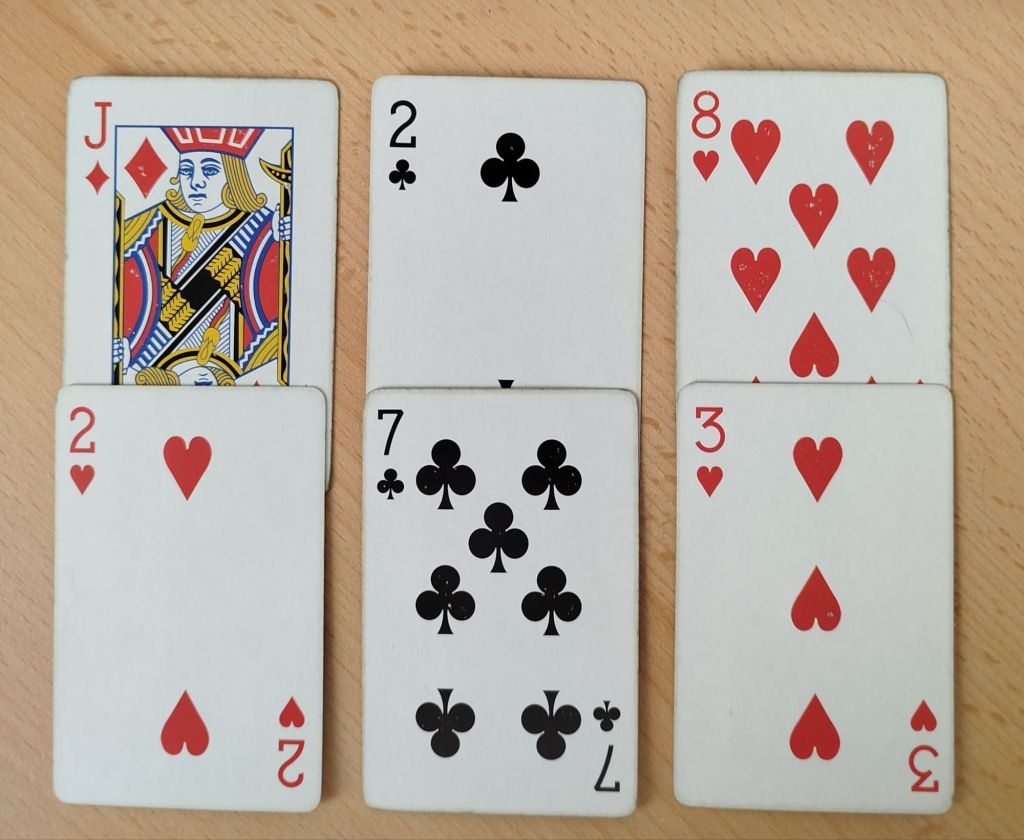
As you may have guessed, this is a very short spread to receive information quickly. Here is an example from the recent past with my husband as a guinea pig: his birthday was approaching and he wanted to know relatives would drop by unannounced to celebrate. These were the cards (note that I am not using Russell’s meanings, but those I am familiar with):

Will there be a surprise visit? Regina Russell’s Answer Spread

Since the question is so specific, you have the right to wonder why he thought they would throw him a surprise party. If we look at the column on the left, the one that talks about background information, we have the Jack of Diamonds and the Two of Hearts, an exciting message or a message from relatives. I didn’t know this at the time of hubby pulling the cards, but in talking to his family on his family chatgroup there had been odd remarks that had made him suspect something was being prepared. So this is the background information we need to understand the spread.

The answer, however, is somewhat disappointing. There are steps (Two of Clubs) being taken, so something is indeed being organized, but the Seven of Clubs causes trouble.

If we look at the right column, where additional information is found, we see a party (Eight of Hearts) and a gift (Three of Hearts). If these two cards had been in the center column, the answer would have been positive. As it stands though, these cards merely explains what steps had were being taken. So the answer is no, they won’t come on the day of his birthday.

It turned out that they did not come, though his brother would have liked to and was making plans for, because his mother was still recovering from a minor operation she’d had: this is the problem (Seven of Clubs). However, looking at this spread, I wouldn’t be surprised if a little celebration did take place next time we get together.

MQS

  1. Which you may buy here if interested. I’m not affiliated with them, I just think the book is a good reference to have. ↩︎

The Geomancy of Peter of Abano – Book IV Pt. 1

Previous / Back to Index / Next

Here Abano begins a discussion of how the genesis of each of the figures from other two figures can modify their meaning.

Since one is not only supposed to consider the springing of the figures from one place to the other, but also their origin and generation one from the other,1 an esposition of of the meanings of each of the figure depending on the figures it is born from is in order, without forgetting the inherent meaning of the figure, as well as that of the querent’s and quesited’s, and those figures in the angles, and those conjoined to them.

Acquisitio

From Populus and Acquisitio: recovering one’s losses or recovery from damage; gain, profitable journey.
From Amissio and Via: dishonorable journey, but useful, recovering something lost.
From Fortuna Major and Conjunctio: good luck, mediocre gain, and [it is positive for] the thing asked.
From Fortuna Minor and Carcer: love between husband and wife,2 and [it is good for] the thing asked.
From Puella and Cauda Draconis: gain, usefulness in things of merchandise, and gain from difficulties.

From Puer and Laetitia: gain from minerals, gain from merchandise.
From Tristitia and Rubeus: fortitude, stability in everything, good outcome, victory, loss of merchandise.
From Conjunctio and Fortuna Major: good luck, mediocre gain.
From Carcer and Fortuna Minor: usefulness; kings and lords, noble people.
From Albus and Caput Draconis: good luck in material things, loss of objects.

Amissio

From Populus and Amissio: loss, trouble, good luck for the ill and the imprisoned, good for traveling.
From Acquisitio and Via: damage, trouble, loss, the lost or stolen thing is not found, vain friends or servants.
From Carcer and Fortuna Major: trouble, problems, little gain.
From Caput Draconis and Puer: good luck in things connected with women; in other questions, gaining what one wants results in damage.
From Rubeus and Cauda Draconis: misfortune [or accident], injury, fear, fighting, trouble, damage, illness.

From Conjunctio and Fortuna Minor: loss of animals, lots of trouble, desperation for the thing lost.
From Albus and Laetitia: freedom from illness or prison, the absent party will come back, white clothes, mobile things, quick ending.
From Puella and Tristitia: poverty, vile things, trouble due to secrets, desperation, mirth, luck in debauched things.
From Fortuna Major and Carcer: recovering the lost or stolen thing.3

Fortuna Maior

From Populus and Fortuna Maior: luck in everything, getting what one wishes to get, but with delay.
From Carcer and Amissio: being very lucky and obtaining what one wants, but with difficulties.
From Albus and Tristitia: it means good news, messenger, usefulness, dignity, good salary [remuneration].
From Caput Draconis and Rubeus: great accident or misfortune, hanging, health problems, violent death.

From Amissio and Carcer: accident, problems, prison, good ending but with difficulties.
From Fortuna Minor and Via: fighting, good news, quick dispatch, honorable journeys.
From Acquisitio and Conjunctio: good fortune, prosperity, getting one’s wish.
From Puer and Cauda: good fortune, tranquillity after much trouble, getting one’s wish with much delay.
From Puella and Laetitia: mediocrity in everything, good things.

Fortuna Minor

From Populus and Fortuna Minor: its meaning has more virtue in good as in bad depending on the question.
From Acquisitio and Carcer: stability, certainty, mediocre fortune.
From Amissio and Conjunctio: good but mediocre fortune, especially in mobile things, less in stable things.
From Fortuna Major and Via: great virtue, great good fortune.

From Caput and Puella: good luck, especially in friendship and marriage.
From Albus and Cauda Draconi: mediocre good luck, especially in feminine things.
From Laetitia and Rubeus: very noble things, luck in mobile, outgoing things.
From Puer and Tristitia: mediocrity, but more bad and mutable than otherwise.

MQS

Footnotes
  1. This seems to imply that we must consider how the figures are generated on the shield. Whether this applies only to the Judge is not clear, though Abano seems to hint at the need to consider all figures, since he also considers those that cannot be Judge. ↩︎
  2. Admittedly, some of these explanations are hard to follow. I do not know, for instance, why this combination should indicate positive things between husband and wife. ↩︎
  3. Abano does not present all possible combinations. It is not clear whether he forgot or he thought it was enough to give some examples. Note also that some explanation almost seem contrary to reason. ↩︎

Vera Sibilla Cards Connected With Work

In the Vera Sibilla there are a couple of cards that connect more or less directly to the topic of work. Here we review them quickly to show their similarities and differences. As usual, this isn’t meant to be exclusive.

Six of Hearts – Money

Not directly related to work per se, the Six of Hearts is the money card, and as such it shows where money comes from, where it goes, whether one has it or not, etc. However, in a consultation about work, it can also indicate whether the pay is good or not, whether the business one works for flourishes or not, etc.

Seven of Hearts – The Scholar

This card is always welcome when we want to know whether we’ll get a job, as it can show the signing of a contract. It is also related to talent in one’s field, as well as certain types of job (intellectual or desk jobs).

Ace of Clubs – Marriage

Again a card that can represent the signing of something. Marriage is anything that gives us rights and obligations with respect to someone else, and a job contract is exactly that. It is also an important card for business deals and partnerships

Six of Clubs – The Surprise

This is a small money card, but because it represents money being received, it can symbolize the wages and therefore being employed. For instance, together with the House card it can sometimes represent the place where you gain money, i.e. the workplace.

Seven of Clubs – Realization

The Seven of Clubs is the card of worldly ambition and it can therefore stand for the querent’s career (I’m always reminded that in German the word Beruf, work, comes from the word Ruf, fame, the name you make for yourself in the world).

Eight of Diamonds – The Handmaid

This is another card that is strongly connected with money and where it comes from and where goes toward, but it is also a card of employment (a handmaid works for someone else). When it signifies the querent’s work, it is essentially a synonym of the Merchant card.

King of Diamonds – The Merchant

This is THE work card, the one you usually want to see in a question about work, and four times out of five, when it pops up in a different kind of question it still indicates the influence of the querent’s job on question, though the card also has other less common meanings.

King of Spades – The Priest

Not directly related to the querent’s job, but this card can represent the institution or company the querent works for (especially if it is relatively big). Needless to say it can stand for many other things, such as works related with the law or religion (with specific cards) or even works where one wears a uniform (the Soldier also represents a uniform, but usually it shows less socially important types of employment, such as being a builder).

MQS

Tarot Encyclopedia – The Three of Swords

(Note: this is a collection of the meanings attributed to the cards by some occultists in the past centuries. It does not reflect my own study or opinion of the cards. It is only meant as a quick comparative reference as I develop my own take.)

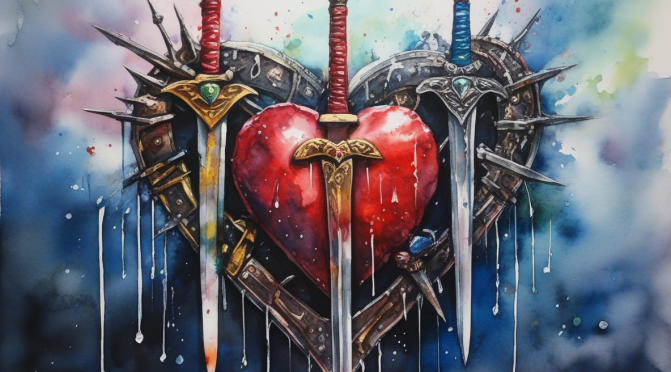
The Three of Swords from the Builders of the Adytum (BOTA) tarot deck

Paul Foster Case (and Ann Davies)

The time period is the second decanate of Libra, under the combined rulership of Saturn and Uranus, October 3 to October 12. Because Libra is involved, remember that the qualities of the Seventh house are prominent.
Well-Dignified: this is nevertheless a Key depicting sorrow, disappointment and tears, but it can be the beginning of deep understanding as to the basis and cause of our problems; disruption of friendship; interruption of cherished projects; quarrels; occasionally the position in the layout may indicate platonic friendships; in money matters this card is almost always a symbol of loss, but indicates that whatever money matters are under consideration have been fair and honest, so that no blame attaches to anyone for the loss.
Ill-Dignified: slander; selfishness and dissipation; deceit with respect to promises; loss in legal affairs.
Keyword: Sorrow
(From the Oracle of Tarot course)

A. E. Waite

Three swords piercing a heart; cloud and rain behind. Divinatory Meanings: Removal, absence, delay, division, rupture, dispersion, and all that the design signifies naturally, being too simple and obvious to call for specific enumeration. Reversed: Mental alienation, error, loss, distraction, disorder, confusion.
(From The Pictorial Key to the Tarot)

Aleister Crowley

The idea of division, of mutability, the idea of the airy quality of things, manifests itself in the Three of Swords, the Lord of Sorrow. Here one is reminded of the darkness of Binah, of the mourning of Isis; but this is not any vulgar sorrow dependent upon any individual disappointment or discontent. It is Weltschmerz, the universal sorrow; it is the quality of melancholy.

[…]

Binah, the Great Mother, here rules the realm of Air. This fact involves an extremely difficult doctrine which must be studied at length in The Vision and the Voice: Aethyr 14.
Binah is here not the beneficent Mother completing the Trinity with Kether and Chokmah. She represents the darkness of the Great Sea.
This is accentuated by the Celestial Lordship of Saturn in Libra.
This card is dark and heavy; it is, so to speak, the womb of Chaos. There is an intense lurking passion to create, but its children are monsters. This may mean the supreme transcendence of the natural order. Secrecy is here, and Perversion.
The symbol represents the great Sword of the Magician, point uppermost; it cuts the junction of two short curved swords. The impact has destroyed the rose. In the background, storm broods under implacable night.
(From The Book of Thoth)

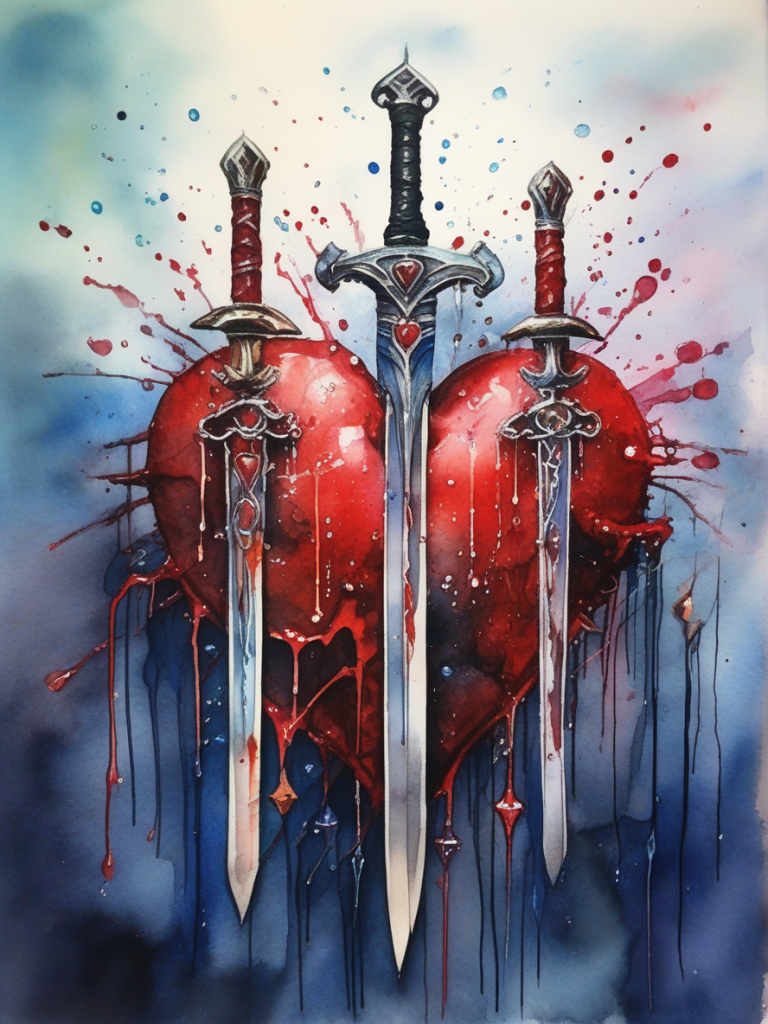
A gruesome AI-generated illustration for the Three of Swords

Golden Dawn’s Book T

THREE White Radiating Angelic Hands, issuing from clouds, and holding three swords upright (as though the central sword had struck apart the two others, which were crossed in the preceding symbol): the central sword cuts asunder the rose of five petals, which in the previous symbol grew at the junction of the swords; its petals are falling, and no white rays issue from it. Above and below the central sword are the symbols of Saturn and Libra.

Disruption, interruption, separation, quarrelling; sowing of discord and strife, mischief-making, sorrow and tears; yet mirth in Platonic pleasures; singing, faithfulness in promises, honesty in money transactions, selfish and dissipated, yet sometimes generous: deceitful in words and repetitions; the whole according to dignity.
Binah of HB:V (Unhappiness, sorrow, and tears).
Herein rule the Great Angels HB:HRYAL and HB:HQMYH as Lords of the Decan.

Etteilla

Removal
Upright. This card, as far as the medicine of the spirit is concerned, means, in its natural position: estrangement, Departure, Absence, Discarding, Dispersion, Remoteness, Delay. – Contempt, Repugnance, Aversion, Hatred, Disgust, Horror. – Incompatibility, Contrariness, Opposition, Unsociability, Misanthropy, Incivility. – Separation, Division, Breaking, Antipathy, Section, Cutting off.
Reversed. Misdirection, Dementia, Vanity, Alienation of spirit, Distraction, Insane conduct. – Error, Miscalculation, Loss, Deviation, Discard, Dispersion.

MQS

Answering Airy-Fairy Questions… Meaningfully (Example Reading)

As someone who advocates a grounded approach to divination, you’d expect me to scoff at questions that deal with more philosophical or spiritual themes. But this is not so. Airy-fairy is in the eye of the beholder, or rather, of the reader. Just like many airy-fairy readers can drown concrete topics in a deluge of commonplace spiritual-but-not-religious buzzwords, so can a grounded reader approach complex, ‘soulful’ topics from a grounded standpoint, while always following what the oracle says.

Someone asked me what was the goal of her current incarnation. Right off the bat we are confronted with a dilemma: firstly, the question presupposes that there is such a thing as reincarnation, which I don’t believe (at least, not in a sense that is compatible with what most people think of as reincarnation);1 secondly, it presupposes that this happens with a goal.

The first problem (reincarnation) we may circumvent by simply asking what’s the goal of the querent’s life. The second question (the goal) is trickier, but as I show in the example, it is not unanswerable.

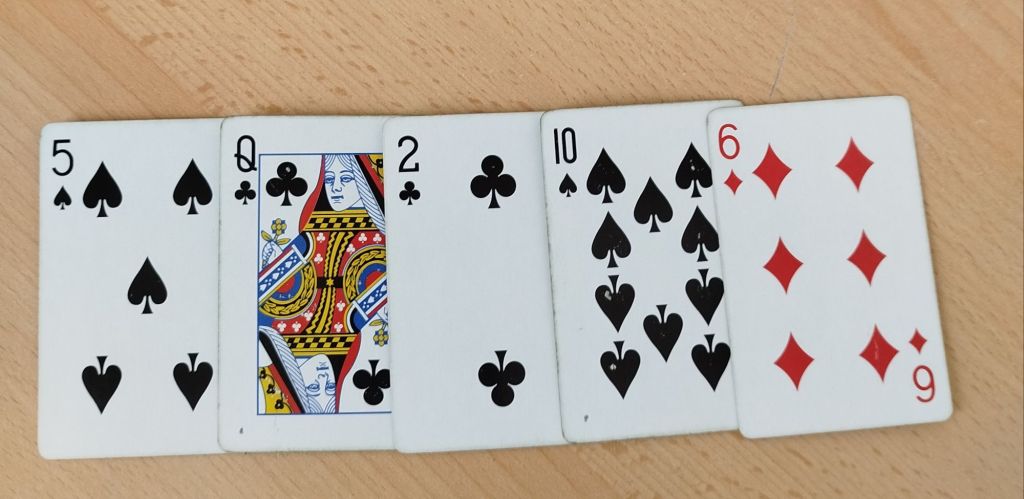
What is my life’s goal? Playing card divination

Since we have absolutely nothing to go off on, we can start by noting that the querent’s significator shows up (the Queen of Clubs), though not in a very good spot. She comes after the Five of Spades which is the card of sacrifice, imprisonment and the inability to move. So we can already sort of guess that the querent is feeling trapped in some form or another.

The spread ends with the Six of Diamonds, which represents worry, insecurity and the like. Often it shows financial problems, but not necessarily: it can be a card of general nervousness and uncertainty. The spread is now starting to reek of psychological hang-ups.

Usually, the Two of Clubs after a person card indicates the person taking steps. Toward what? Toward the Ten of Spades. This is the card of secrets, of the night and of unknown situations.

At this point I asked the querent if she’s someone who never leaps into unclear, unknown situations. She said that that was one of the things keeping her from enjoying life, since she always prefers to avoid risk or put off taking it until she feels prepared, which is never.

Bingo. This is the answer: she must learn to step into the dark, take risks and be ok with not having everything figured out. She must learn to swim by swimming rather than by reading up on how to swim. If she doesn’t do it, she will spend her whole life by the poolside waiting for every condition to be perfect.

So, have the cards talked about the purpose of the querent’s whole life? You may disagree with me, but I don’t think so. I do not think that this is the purpose of her whole life (I think there is much, much more to anyone’s life), nor do I think that this is the reason she was born or has reincarnated (if you believe in reincarnation at all). And I told the querent as much, in the spirit of transparency.

What I do mean is that, at least at this juncture in her life, this is a recurring pattern that weighs her down and that needs addressing because it influences her general quality of life. That’s already enough to be worth being mentioned by the cards.

Ultimately, almost every airy-fairy woo woo question is the voluntary or involuntary corruption and modernization of some kind of longing that is deeply seated in the human soul. Questions about the purpose of one’s life may be often answered with the usual mix of mind body spirit platitudes, but the human desire for purpose is not to be lightly dismissed, whether the purpose is really there or not. And divination can address this desire in some form or another.

I believe that divination should be able to run the whole gamut of the human experience, from the most concrete questions to the most abstract, because this is the extension of the human soul. The problem arises only when we try to reduce one order of problems (Will I the chicken cross the street?) to another order of problems (What kind of psychospiritual drama do you think caused the chicken to want to cross the street?)

MQS

  1. I will probably discuss it more at length in another section, but my belief is that there is only one, universal soul that is constantly incarnating and reincarnating through everything. ↩︎

The Little Old Chinese Learner

Every year I look for something new to learn. This year I had in mind to start learning Chinese, but my time was absorbed by the Bolognese Tarot (I am in contact with a traditional practitioner of this deck who is teaching me) as well as by the move. Finally, this August I decided to put my nose to the grindstone

My sorry attempt at a sentence

MQS

Enneagram Comparisons – Type Seven and Type Eight

Enneagram Type Seven and Enneagram Type Eight can be very similar and are often confused. Sevens are a Head type, who cope with their fear, pain and anxiety by getting lost in a world of pleasure-seeking and fun distractions. Eights are a Body type, and they seek to protect their independence by being assertive and bold and forcing others to deal with them and take them into account.

Both Sevens and Eights are very assertive and outgoing on the surface. Sevens find it easy to attract interesting people and adventures, since remaining confined in a routine can cause them to become restless or even to suffer. Eights are more guarded and do not trust people very much, but they do come out of their inner fortress to mark their territory against others and to let them know that they (the Eight) are not to be messed with. Thus they often end up either submitting others or guiding them.

Both types tend to have a somewhat materialistic view of reality and seek earthly pleasures. Generally speaking, Sevens seek variety and change in order to be constantly dazzled and stimulated and stay hyped about something positive, so that they can avoid being sucked into a cycle of fear. Eights on the other hand usually seek intensity in powerful experiences, as they enjoy the feeling of having something outside of them offer them resistance, and they enjoy conquering it in the end, to prove that they are the ones who are still standing (it is typical, for instance, for alcoholic Eights to want to prove that they can handle one more glass).

passion

Both types often come across as action-oriented. Eights attack problems from an instinctive standpoint, throwing brute force (either literal or metaphorical) against the obstacle until it is destroyed. Sevens are more intellectually versatile (not necessarily more intelligent) and they often quickly come up with plans to overcome obstacles in order to reap the rewards, the rewards usually being meterial comfort and/or the ability to pursue their many passions.

Socially, average Eights operate on a friend/enemy level: they quickly sort other people out in either one of the two camps. For them, life is a battle and they need to know whom they are going to defend and whom they are going to attack. Sevens are not naive, but they see the world more as their oyster, and while they know that there are difficult people in the world, they seek to look past them in anticipation of the fun time to be had after dealing with them.

Eights tend to be more unshakably dedicated to the small handful of people they call friends. Sevens are also very good friends, but they also often look to create different groups of friends based on their interests (the group they go dancing with, the group they watch movies with, etc.) although they too often have a small core of best friends.

MQS