Living at the intersection of occultism, fiction and philosophy, I travel the planes at a moderately quick pace. I read, I do magic, I cook for hubby. Confused by the number of things I talk about? Good, confusion is a nice thing ;)
This is not the first time I do a reading for someone who has a crush on a colleague. The girl in question asked me if a love story could start with him
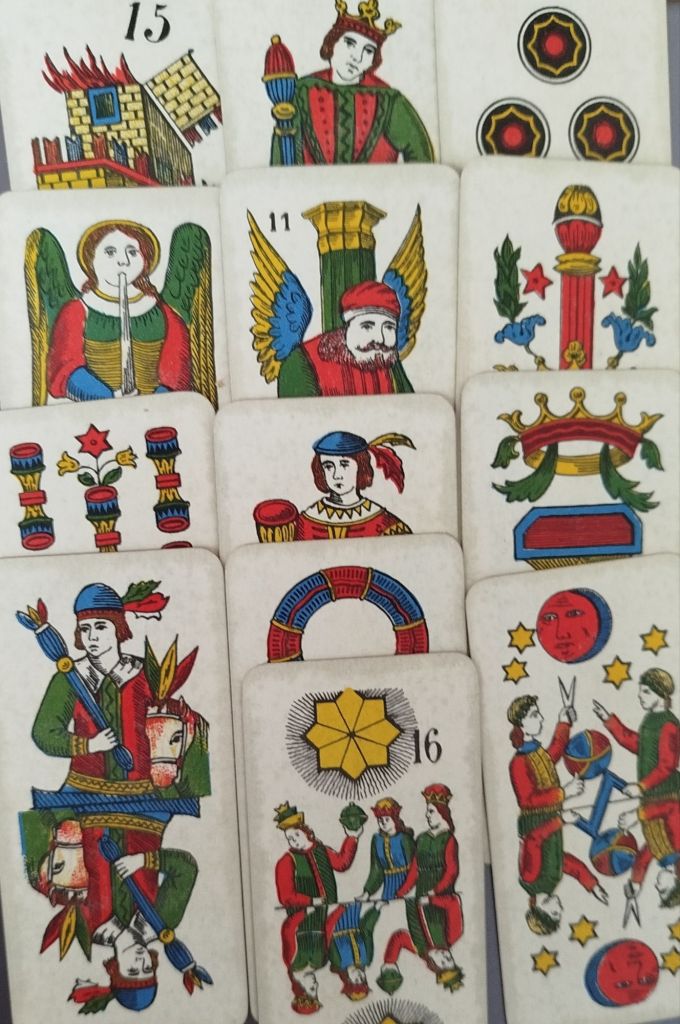
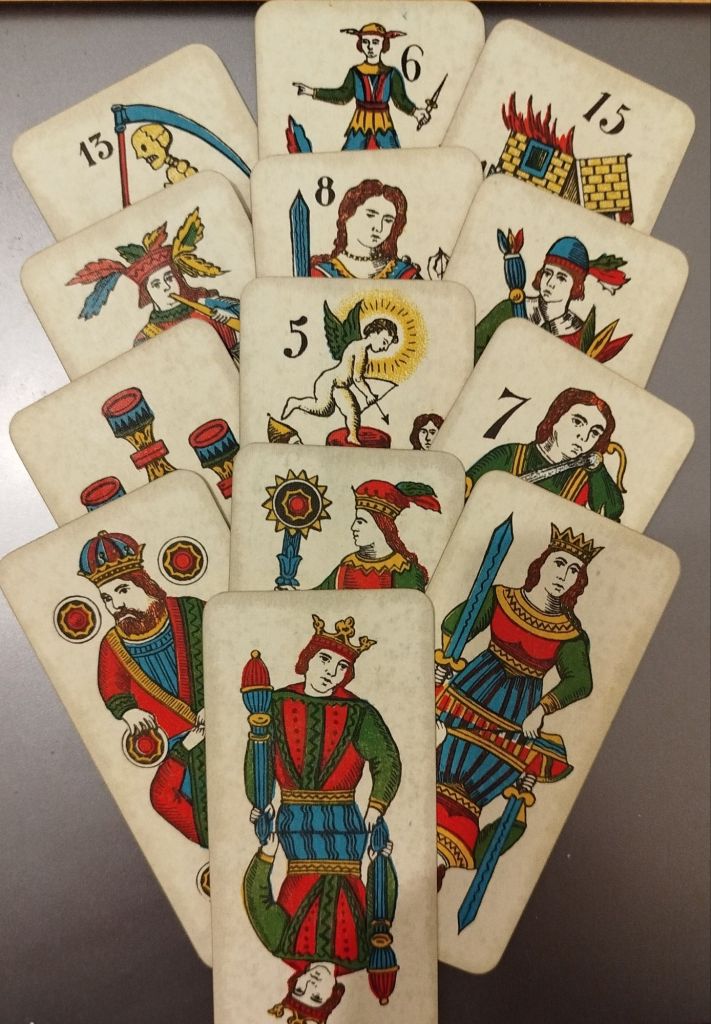
A love reading using the Bolognese Tarot (Thirteen Card Spread)
This is one of those spreads that let themselves be interpreted in more than one direction: not just horizontally but vertically as well. The First two things that caught my eye were the first line, with the King of Wands (him) trapped between the Tower (prison) and the Seven of Coins (tears); and the vertical line on the right, with the Ace of Wands and the Ace of Cups together, indicating a family, but the two cards are hemmed in by the tears and the Moon (again, negativity).
So this isan unhappy man we are talking about. In the following line, the Angel card, which would provide happiness and solutions or at least peace, is blocked by the Hermit. Note that the Ace of Wands, which can indicate attraction, is also affected by the blockage, so while he may be somewhat attracted by the querent, he is not gonna act out on it.
The following line was a bit harder to decipher, but I saw it as him having a daughter and being especially attached to her: note the Page of Cups, the girl, of the house (Ace of Cups) brings him jollity or happiness (Ten of Cups). It later turned out he has more than one child but he is more attached to the girl. It is possibly one of the things that keep him in the marriage.
In the end, there is probably going to be no relationship with the man: the relationship card (te Ace of Swords) is negatively affected by the Moon, and the querent will only have a business relationship (Star) with him.
One thing I need to emphasize is that the querent knew the dude is married, but didn’t tell me, not because she wanted to try me, but because in her mind she thought it was somehow “obvious”. It is always interesting to see how querents take our ability to see things for granted (only to be sorely disappointed when we make the most minor mistake).
(Note: this is a collection of the meanings attributed to the cards by some occultists in the past centuries. It does not reflect my own study or opinion of the cards. It is only meant as a quick comparative reference as I develop my own take.)
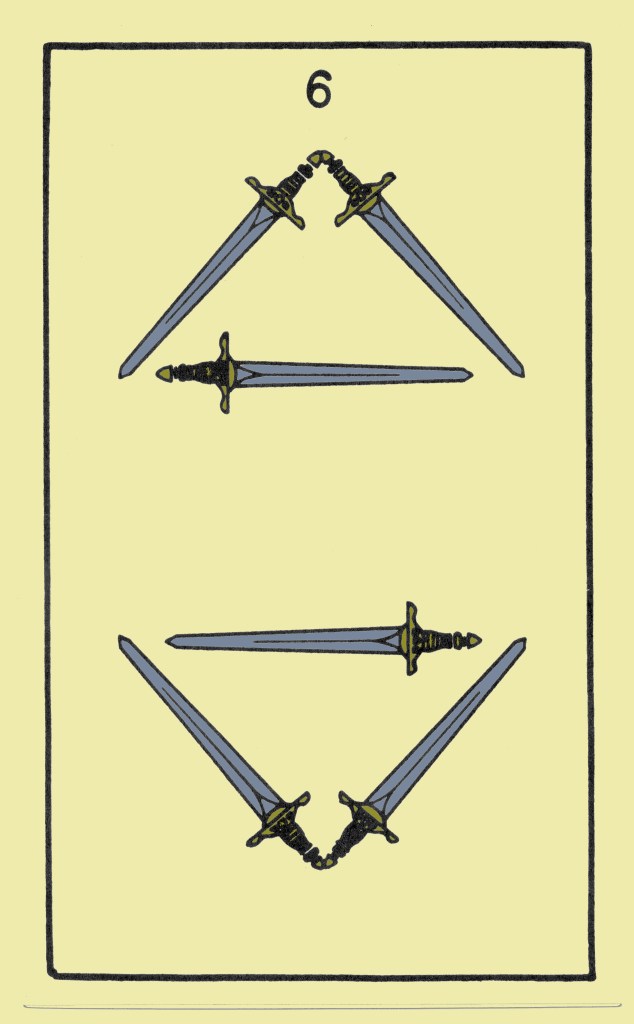
The Six of Swords from the Builders of the Adytum (BOTA) tarot deck
Paul Foster Case (and Ann Davies)
The Six of Swords corresponds to the second decanate of Aquarius under the rulership of Mercury, January 30 to February 8. Well-Dignified: success after a period of trouble or anxiety; difficulties overcome; change of scene, possibly a journey by water; something mysterious effects a change o f circumstances for the better; success earned by the Querent’s laborious efforts. Ill-Dignified: sudden changes; circumstances dominate the Querent; he is in danger of being over-confident or conceited; too much effort expended for small results. Keyword: Patience (From the Oracle of Tarot course)
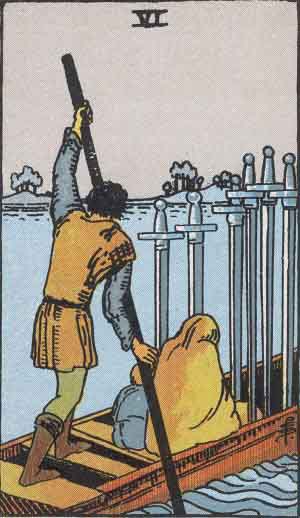
A.E. Waite
A ferryman carrying passengers in his punt to the further shore. The course is smooth, and seeing that the freight is light, it may be noted that the work is not beyond his strength. Divinatory Meanings: journey by water, route, way, envoy, commissionary, expedient. Reversed: Declaration, confession, publicity; one account says that it is a proposal of love. (From The Pictorial Key to the Tarot)
The Six of Swords from the Rider Waite Smith tarot
Aleister Crowley
The Six of Swords is called Science. Its ruler is Mercury, so that the element of success turns away from the idea of division and quarrel; it is intelligence which has won to the goal.
[…]
Tiphareth shows the full establishment and balance of the idea of the suit. This is particularly the case with this card, as the intellect itself is also referred to the number Six. Mercury, in Aquarius, represents the celestial Energy influencing the Kerub of the Man, thus showing intelligence and humanity.
But there is much more than this in the symbol. The perfect balance of all mental and moral faculties, hardly won, and almost impossible to hold in an ever-changing world, declares the idea of Science in its fullest interpretation.
The hilts of the Swords, which are very ornamental, are in the form of the hexagram. Their points touch the outer petals of a red rose upon a golden cross of six squares, thus showing the Rosy Cross as the central secret of scientific truth. (From The Book of Thoth)
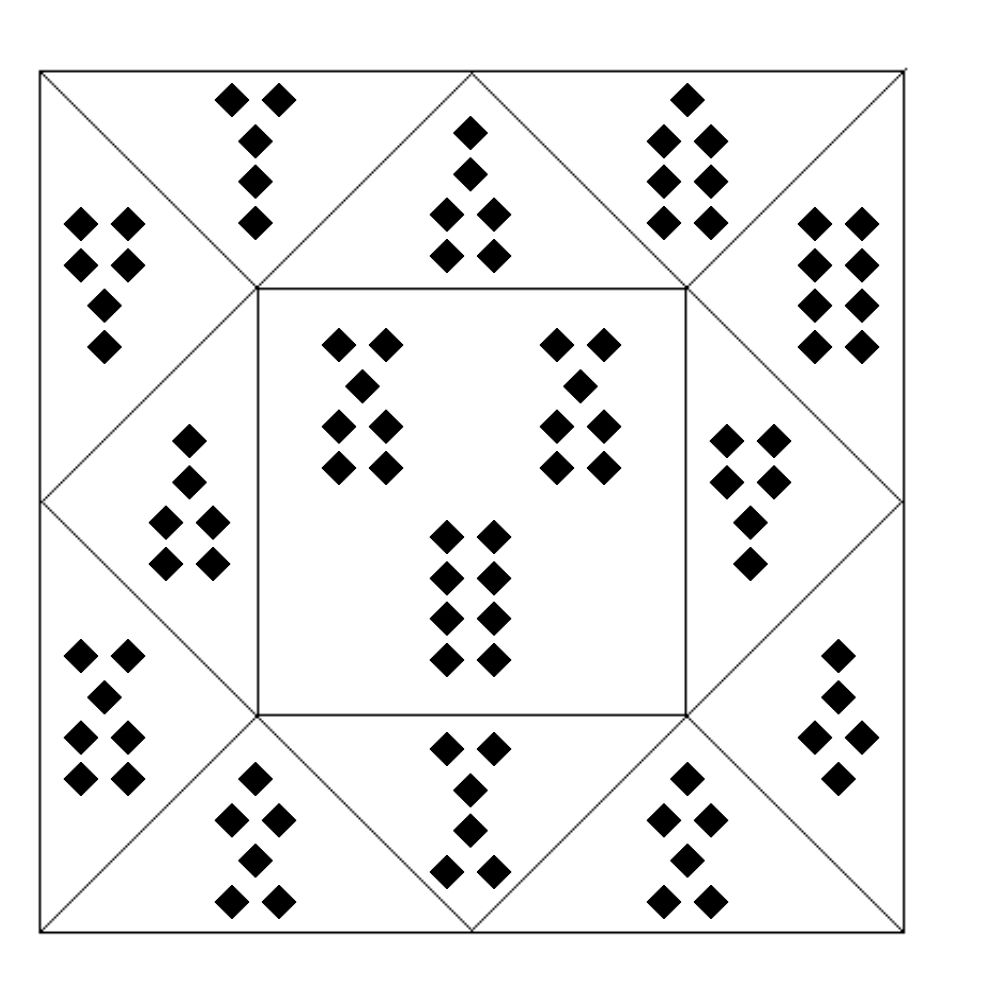
The Six of Swords from the Thoth Tarot deck
Golden Dawn’s Book T
TWO hands, as before, each holding two swords which cross in the centre. Rose re-established thereon. Mercury and Aquarius above and below, supported on the points of two short daggers or swords.
Success after anxiety and trouble; self-esteem, beauty, conceit, but sometimes modesty therewith; dominance, patience, labour, etc.
Tiphareth of HB:V (Labour, work, journey by water). Ruled by the Great Angels HB:RHa’aAL and HB:YYVHL.
Etteilla
Road Upright. This card, as far as the medicine of the spirit is concerned, means, in its natural position: Road, Avenue, Walk, Course, Passage, Path, Way. – Path, Tract, Gait, Origin, Conduct, Means, Manner, Way, Expedient, Run, Career, Walk, Pattern to be followed, Track, Footprint, Sending, Commissary [= Deliveryman]. Reversed. Declaration, Declaratory act, Development, Explanation, Interpretation. – Charter, Constitution, Diploma, Manifest law, Ordinance. – Publication, Proclamation, Ostensibility, Manifesto, Publicity, Authenticity, Notoriety. – Denunciation, Census. – Enumeration. – Knowledge, Discovery, Unveiling, Vision, Revelation, Apparition, Appearance, Admission, Confession, Protest, Approval, Authorization.
After getting our little Ciuffy, we were on the lookout for another ‘tiel. I kept browsing through the ads for a young, tame male, but I kept seeing either clear scams or birds with other issues. I did a geomancy reading, asking if I would soon find one that fit the bill of what we were looking for:
Geomancy reading: will we find a young tame male? App used: simple geomancy
I am signified by the ruler of the Ascendant, Fortuna Minor. Small animals are a Sixth House matter. Technically, if this was a horary chart, I would have to turn the chart (will I get someone else’s bird? Sixth from the Seventh, i.e., the radical Twelfth). However, I have found that Geomancy is less prescious about this kind of stuff. Let’s see how the chart speaks and let us follow it instead of trying to impose ideas on it.
The Sixth House is occupied by Puer: a male! That bodes well. The Judge, however, is Populus, which doesn’t say much. Worse still, Populus comes from two Rubeus. Still, we also find that Fortuna Major connects the Ascendant ruler with the Sixth House, since it is found both in the Seventh and the Twelfth house. A positive figure connecting two positive figures is a positive sign (Puer is more neutral, but still good in context).
Fortuna Minor, furthermore, usually indicates shorter timespans, and it moves to an angle (the Tenth house), which is also a generally positive sign as far as time is concerned.
The reading was done a couple of weeks ago, and we found Zazu yesterday.
Zazu, also known as Pollo
I am still unsure about that Geomantic Court, with two Rubeus and Populus as judge. It is sometimes said that Populus has little to say, but I don’t believe that. One possible interpretation is that, since Rubeus has the quality of being excessive, the Populus resulting from two Rubeus might show too many birds (a crowd of too many), which is why the person I got it from wanted to get rid of him (or rather, his wife wanted to get rid of him). The court could also simply be warning about potential scams or questionable deals (and I had to sift through a fair share of those).
Be it as it may, I am not too worried about the Court, since the Judge of the Judge (Judge + First House) gives Fortuna Minor, a positive sign for the long run. I’ll update the post if something comes up.
Fludd explains some of the meanings of Acquisitio, Amissio, Laetitia and Tristitia in the various houses.
Of the Nature and Meaning of the Sixteen Figures in Each of the Houses of the Shield
Acquisitio
In the First house, riches, prudence, profit, good end (or aim)1 luck, receiving what one wishes, but this figure is not good for selling;2 but it is truthful. In the Second house, wealth, gain, profit, good luck in commerce, reception of something promised, recovery of lost property, increase of all good things. In the Third house, good luck from relatives, good relatives, siblings, neighbors, good journey, good sense (or feeling).3
In the Fourth house, good inheritance, good and useful house, in which one will acquire riches, rich father, positive solution to all things connected with inheritance. In the Fifth house, gain from one’s children,4 good children, good letters, good clothes, happiness in the heart, delighting in women, the fruits of the inheritance.5 In the Sixth house, long illness,6 which however will be cured, good animals, good servants.
In the Seventh house, a chaste and submissive woman,7 good company, good dealings, peace, reconciliation with enemies, whether it be in litigation or in war. In the Eighth house, redress, natural death, gain in foreign land, freedom from fear of death, the enemy is happy and rich.8 In the Ninth house, gain from death, path or travel, fear of God, positive journey, benefit, good dreams, good sense in all actions, piety and religious devotion, good in things of church.
In the Tenth house, profit from (or for) the master or king, peaceful and happy masters, obtaining one’s wish, good sentence from the judge. In the Eleventh house, good luck, good friends, gain from commerce, immediate reception of gain. In the Twelfth house, poverty or incarceration due to debts, profit for (or from) servants and beasts,9 long prison sentence, good in case of illness and in being paid back a debt.
In the Thirteenth house, loss and change in profits,10 good journey, acquisition in everything, receipt, implementation of the wish of the absent person.11 In the Fourteenth house, gain in everything one wishes, long life, luck, usefulness, goodness. In the Fifteenth house, good in everything, recovery of lost things, delay in one’s journey.
Note that this figure in the first house shows a man who is handsome, with yellow or beautiful hair, mediocre build, a red face, a merchant.12
Amissio
In the First house, a bold, unstable man, full of crime and deception, receiving nothing. in the Second house loss of merchandise and goods, no profit, loss of all goods from robbers. In the Third house enmity between relatives, parents, brothers, neighbors full of deception, fear on the way.
In the Fourth house falsity and loss of inheritance and patrimony, bad end of the city or house.13 In the fifth house loss of fruits of the inheritance,14 bad and unstable children, bad letters,15 no pleasure in the love of unserious women. In the Sixth house escape from disease, loss of animals, flight of slaves, likewise injury and perversity.
In the Seventh house an evil woman, a quarrel with one’s master16 or partner, an unstable and lustful woman, loss of merchandise, fugitive robbers, inimical partners, changeable and deceitful, bad change (or removal).17 In the Eighth house loss from death, loss of sense, no profit in the place where one goes, poor enemies, loss a woman’s dowry. In the Ninth house a long journey without pleasure, no knowledge, some evil for the querent from the Church.
In the Tenth house evil lords, loss of honour, dominion or office, unstable lords, troubles of kingdoms, obstacles to honour. In the Eleventh house loss of friends, loss of merchandise, false hope, changeable and useless friends. In the Twelfth house loss of animals, escape from debts, bad change, escape from prison, friends full of falsehood, changeable and derisive.
In the Thirteenth house loss and change in authority or government, bad luck. In the Fourteenth house loss of friends, much toil in every matter.18 In the Fifteenth house a reception of nothing, a bad conclusion.
note, when this figure Loss is found in the first house, it signifies a pale man, a liar, a predator, a thief.
Laetitia
In the First house judges, wise men, a good and upright life, fullness of joy and exaltation, joy to the querent in all things. In the Second house a multitude of honors, a life full of fidelity and joy. In the Third house good fortune through one’s brothers, no fear of God,19 good love of brothers, neighbors, parents, much joy in everything.
In the Fourth house profit from inheritances and from all things on earth,20 a happy end, happiness through real estate, happiness of parents, peaceful inheritance. In the Fifth house profitable children, long life, happiness in all things, happy and delightful letters and news, happiness from women and all good things. In the Sixth house servants, animals cured from disease, joyful and cheerful servants.
In the Seventh house a good marriage, profitable partners or profit from partners, victory due to a cheerful and chaste woman, cheerful company, peace and harmony, good change (or removal). In the Eighth house profits inherited from the dead, escape from fear, profit and profits in the place where one removes to. In the Ninth house, journeys, fear of God, knowledge, faithfulness, cheerfulness, a holy man,21 business of the church, good news, fine arts, devotion and love of the church.
In the Tenth house exaltation to great honors, bishops and prelates, help from the lords, a happy and cheerful office, beautiful temples, a good judge, a just and good opinion, a warm place.22 In the Eleventh house good fortune from associates, profitable animals,23 joyous love, good hope from a good man, cheerful and good friends, a prudent man and of good knowledge, profit in trade. In the Twelfth house profitable beasts and slaves, coming out of prison, deliverance from debt, and from all tribulation, peace and reconciliation with enemies.
In the Thirteenth house, profit from a journey, from the king, from the lord, positive change. In the Fourteenth house good hope of fulfilling one’s will, happy hope, the fulfillment of one’s wishes, joy and exaltation.
When this figure is found in the first house, it signifies a bishop, a prelate of the church, religious and ecclesiastical, a long beard, some evil existing in the finger,24 remaining in high places.
Tristitia
In the First house, sad thoughts, debts, poverty, hidden loss, obligations, prison, roadblocks, bad change, unbelieving and without hope.25 In the Second house fortune and commerce,26 avarice, loss of property, an unfortunate usurer, dishonor. In the Third house bitterness with relatives, silent hatred with neighbors and relatives, a secret obstacle on the way.27
In the Fourth house loss of inheritance and in battles, loss of house, trouble, bad house, bad luck, poverty of parents, loss. In the Fifth house bad and poor children, false letters, sadness and anguish of heart, secrets in love of sad women, poor food and clothes. In the Sixth house evil servants, fear of captivity and poverty, timid and useless animals, long illness or death, poverty, rejection without injury and confusion.28
In the Seventh house a bad woman, a victorious man,29 a thief in the night, poor condition, loss, bad change (or removal), a sad woman. In the Eighth house being poor from the death of another, loss in a foreign nation, damage from the absent person.30
In the Ninth house the road is unprofitable, hindrances in the journey and loss, a man without wisdom and knowledge, a crude understanding, the downfall of the church and benefits.
In the Tenth house, loss and degradation of men, the exaltation of the wicked,31 loss of duties, sad lords, fear of kings and kingdoms, wrong judgment of judges, a fall from honor. In the Eleventh house, contemptuous friends, bad luck which will last for a long time, but still with hope, a poor friend, no failure in business.32 In the Twelfth house, debts, enemies, loss, long imprisonment or death in prison, a timid and poor enemy, trouble, fear of obligations and debts, long or incurable illness.33
In the Thirteenth house evil on the road and sadness. In the Fourteenth house, bad luck, small journeys, anxiety and trouble, despair and irreparable evil.
When this figure is found in the first house, it signifies a dark man,34 having torn clothes, and who deals in dark, foul, and vile things.
MQS
Footnotes
It is unclear to me whether he means a good end to the matter at hand or a positive aim in mind. ↩︎
Because it implies receiving rather than giving away. ↩︎
This sentence is not clear to me, nor why Acquisitio would imply loss. ↩︎
“Implementum desiderii absentis.” This is obscure to me. ↩︎
Fludd attributes, like many others, physical descriptions to the figures when they are in the First House. This is typical of traditional astrology, where the first house represents the querent. Note that these descriptions are rather limiting and conform to old stereotypes. Plus, they imply that the same querent would always be represented by the same figure whenever they come to the geomancer for a consultation, which is highly unlikely. They are still useful on occasion, but one must “mix discretion with art”. ↩︎
In addition to one’s home, the Fourth house indicates the city. ↩︎
Again because the Fifth is the second from the Fourth. However, the Fourth house also rules orchards and lands, so the Fifth can indicate literal fruits from the lands. ↩︎
There is some confusion in traditional astrology on which house rules letters. Some say the Third house, some the Fifth, some the Ninth. As far as I can rationalize this matter, the Third house represents communication and private correspondence; the Fifth house represents messengers because it is the second from the Fourth, the Fourth house being the city, and the second house from any house indicates that thing’s representatives (for instance, my Second house would indicate my lawyer, who represents me in a court of law.) ↩︎
It’s unclear why the Seventh would indicate the master. ↩︎
The Seventh house represents “there”, while the Firsth house is “here”. ↩︎
The Thirteenth and Fourteenth houses, i.e., the Witnesses, generally receive their signification (as we have seen in Abano’s case) from the two houses they derive from on the Shield: the Right Witness from the Ninth and Tenth, the Left Witness from the Eleventh and Twelfth. ↩︎
It is unclear whether this is positive or negative, as fear of God was considered the beginning of wisdom. As for why it is attributed to the Third house instead of the Ninth, in some very old Astrological texts the Third House is the house of the Goddess, and in Christian times it possibly came to represent how one’s faith affected one’s everyday life. ↩︎
The Fourth house, the Imum Coeli, is the earth. ↩︎
All these positive religious connotations stem from Acquisitio’s attribution to Jupiter. ↩︎
The Tenth house, the M.C., represents the sky and therefore the weather. ↩︎
The reference to absent people is due to how common it was to ask astrologers or geomancers about people who had simply gone away or vanished. This is understandable, considering astrology was probably the only tracking device available at the time. ↩︎
Because the Tenth House is the highest place in the chart and Tristitia indicates downward movement and lowly things or people, it can show the elevation of someone unworthy or the downfall of someone who is in a high place. ↩︎
This last part is unclear to me. Possibly because the failure announced by Tristitia is mitigated by the positivity of the house. ↩︎
Typically we assign illness to the Sixth house. However, there are old handbooks that assign illness (especially serious illness) to the Twelfth house. Some distinguish between the Illness (Sixth House) and the confinement that derives from it (Twelfth House). ↩︎
In another article, I discussed the technique called translation of light, which occurs when a planet collects the influence of one significator and translates it to the other.
There is another technique which is, in many ways, the opposite of translation, but has the same effect. This is called collection of light. It happens when a slower-moving planet has been in contact with a faster one, thus receiving its influence, and then another planet also comes into contact with the slow planet. Contact can happen by conjunction or by (usually) positive aspect, that is, sextile or trine, or at least with reception. As with translation, collection usually implies the presence of third parties or external circumstances bringing things together.
Whereas translation can only be effected by a fast planet, and therefore the Moon (or sometimes Mercury) is the most likely culprit, collection of light can only be caused by a slow planet, and therefore Saturn or Jupiter are the most likely intermediaries here.
Example: Is The Book Arriving At All?
My Bolognese Tarot teacher, who is now a good friend, has recently written a follow-up to her book on the 50-card method, and she wanted to send me a dedicated copy. She posted the parcel before Christmas 2024, but by January 6 it hadn’t arrived and I was worried it might have been lost or forgotten in some dispatchment center. So I asked the heavens.
Is the gift arriving at all? App used: Aquarius2Go
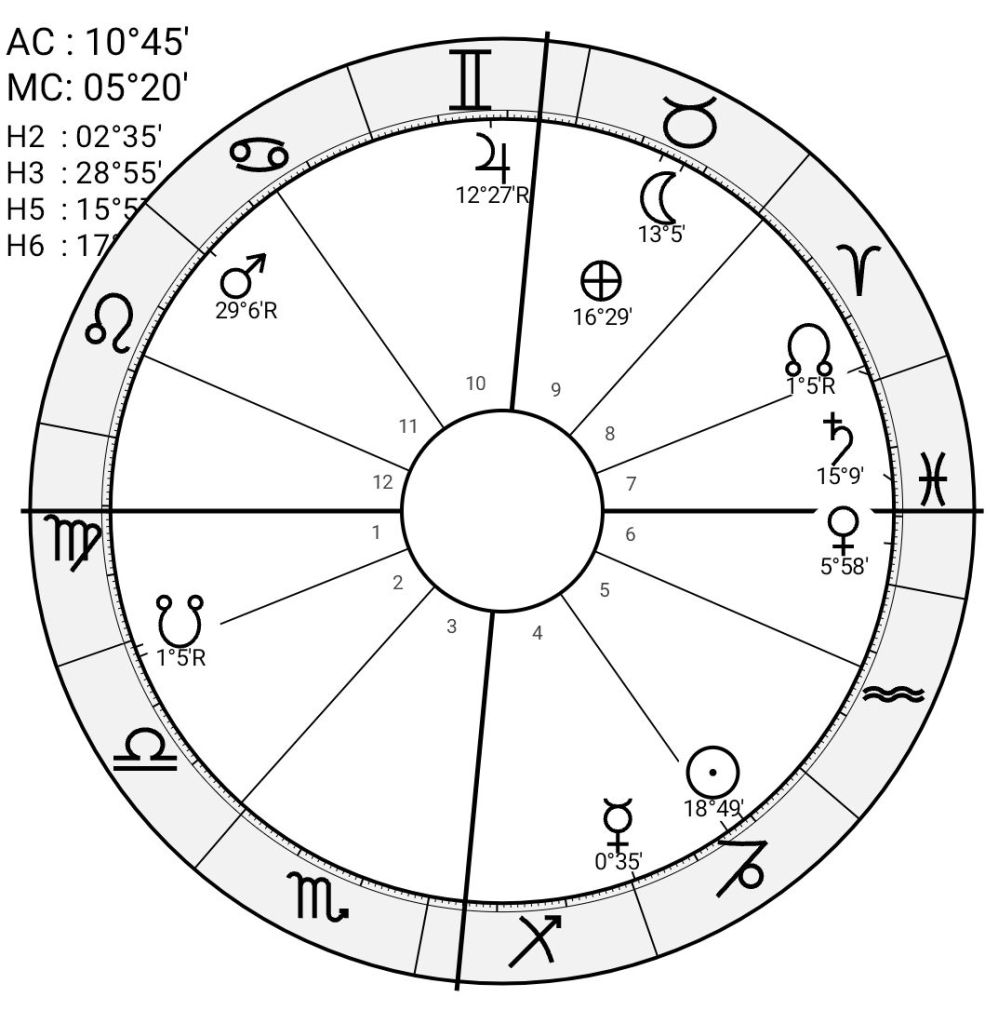
I am signified by Mercury, ruler of the ascendant. My teacher sent me the book in her quality of personal friend (it wasn’t part of a course or anything), so she is signified by the Eleventh House ruler, the Moon. The Moon also represents the flow of the action (keep that in mind for later). Her gift for me is her second house, that is, the second house from the Eleventh, i.e., the radical Twelfth, ruled by the Sun. My stuff is signified by Venus, ruler of my second house.
So, ideally, we would want the Sun to be reached by Mercury. How do we get them together? Well, we don’t, clearly, or at least not for a while and not before the Sun has left Capricorn. That’s a problem.
However, we note that the Sun has just sextiled Saturn, having been received by it as well. What is Saturn? Well, it rules the Fifth and Sixth Houses, so the closest thing I can think of is the courier/delivery service (Sixth, house of servants).
What happens to Saturn next? It is sextiled by the Moon. The Moon is the ruler of the Eleventh, my teacher/friend, but it doesn’t make sense (she sent the book, she’s not gonna receive it). However, in most horary charts, the Moon also signifies the flow of the action. So the flow of the action moves favorably (sextile) with the courier (Saturn): the book hasn’t been lost. What happens next is that my significator (Mercury) and the significator of my stuff (Venus) almost simultaneously meet Saturn: Mercury by sextile with reception by sign, Venus by conjunction with reception by exaltation. Even if we chose to disqualify the Venus conjunction because Venus squares Jupiter first, Mercury makes no other aspect before the Saturn sextile.
Thankfully, the book arrived yesterday (I’m gonna review it in the near future). Note that timing in this chart seems to fail: the chart was made on January 8, the parcel arrived on January 15. If we take the Moon sextile it is two degrees away (two days, two weeks), if we take the Mercury sextile it is 15/16something degrees away (again, 16 days). The only aspect that seems to come closer is the Venus conjunction with around 10 degrees (10 days, though it took 7). It is probable that the chart was simply responding to my core question: yes, it will arrive, and took timing for granted. It could also be that I’ve misread the chart and got lucky. If you have an idea, drop a line!
Either way, we’ve finally answered the age-old question: Why is Saturn so fat and slow? The better to collect your light!
There are plenty of cards, in the Vera Sibilla, that can indicate individuals (see here for groups). Here are the most common (keeping in mind that most of the cards have other associations as well, and may indicate concepts or situations):
Seven of Hearts – The Scholar The Scholar can represent the figure of a lawyer, a notary, or more in general a professional. Traditionally he is said to be in his 40s or early 50s, but we need to be flexible with age. He can also be a member of the family or even a partner.
Eight of Hearts – Hope There are two schools of thought concerning the Hope card. According to some it doesn’t represent a woman, while according to others it can (traditionally, a younger or blonde woman). I have found that it is rare for this to be the case, but it could happen.
Nine of Hearts – Faithfulness The Faithfulness card can represent support, and occasionally it will show up alone indicating a concrete someone, i.e., a friend, who shows us support.
Jack of Hearts – The Boyfriend It is common for this card to indicate an actual person, often the unmarried male querent or a male who is in love, or positive, or belonging to the family.
Queen of Hearts – The Girlfriend Same as with the Jack, only applying to women.
King of Hearts – The Gentleman The King of Hearts is traditionally the figure of a protector or benefactor, someone who aids us. He is typically in a good position to do so. He can be a father or loving husband (when upright), but can also represent the married male querent or a boyfriend who is older or has a position in society.
Four of Clubs – The Friend The Friend card can represent friendship as a concept, as well as partnerships and other situations where people come together for a common goal. However, it can often indicate a female friend or relative.
Jack of Clubs – The Servant The Jack often represents a younger man, one up to 30 years of age, or unmarried. However, it can also represent a colleague or friend, regardless of age. It can also indicate a son, if relevant. Usually he is already known to the querent (the Italian word ‘domestico’ can mean servant but it also implies familiarity with the house).
Queen of Clubs – The Maiden The Maidan can be the female counterpart of the Servant, showing a younger unmarried woman, sometimes a daughter.
King of Clubs – The Doctor The Doctor card often indicates health issues or the need to take care of something. However, it can also represent a man with a certain social position or with a degree (if next to a female card, then he turns into a woman with those characteristics). It can show the figure of a professional whose advice or help will be required, or a boss.
Seven of Diamonds – The Child Often it is a metaphorical child, but sometimes the Seven of Diamonds can represent a literal one, usually very young (toddler). It can combine with other cards (the Servant or Maiden, for instance) to indicate a teenager. It is the card of pets as well.
Eight of Diamonds – The Handmaid A card strongly connected with the coming and going of money and with work, the Handmaid can also be the figure of a female colleague or a female servant (like a cleaning lady). Traditionally she is from a different town, but this is not always the case. She can also be a stranger or a foreigner.
Ten of Diamonds – The Thief Rarely a literal person, but in connection with negative cards it can show someone who steals, either literally or metaphorically.
Jack of Diamonds – The Messenger Rarely a person card, the Messenger often heralds the arrival of news and the knowledge of facts. However, it can occasionally represent a young man, traditionally dark-haired.
Queen of Diamonds – The Wife A card that often represents what it says on the tin, the wife shows a woman who is married and may have children. It can indicate a woman who has achieved some level of success (could be a colleague or boss).
King of Diamonds – The Merchant Usually this card signifies the querent’s work life. However, it occasionally signifies a literal merchant or someone who a transactional view of life and relationships.
Two of Spades – The Old Lady Often one of the most complex cards in the deck, the Old Lady has a whole host of metaphorical meanings. The literal meaning, though, is that of representing an older woman, a grandmother, a widow, someone close to retirement, a woman of 60+, and so on. The card can also stand for an ex (your old woman).
Three of Spades – The Widower As with the Old Lady, so with the Widower, but for men. It can represent an older man, a grandfather, an ex, a widower or divorced man. It is somewhat rarer for the Widower to be a literal person, compared to the Old Lady.
Ten of Spades – The Soldier Another often cryptic card to interpret, the Soldier can also indicate a young man, in his 30s or early 40s (again, taking it with a pinch of salt), who is muscular or sexy or who wears a uniform. It can also indicate a stranger or a foreigner.
Jack of Spades – The Enemy (male) The male enemy card can stand for a literal enemy, or for someone who is against the querent for some reason, either as a rule or in a particular situation (your uncle whose car you crashed into a tree can be your enemy too, when he finds out). It can also represent a place where people are inimical to the querent.
Queen of Spades – The Enemy (female) Same as with the Jack, but for women.
King of Spades – The Priest The King of Spades often indicates an institution, the government, a judge, etc. It can also sometimes represent an older man who is not inimical to the querent, but who is somewhat cold toward him or her, but is still fair (unless the card is reversed).
When a person sits in front of a diviner, a number of preconceptions have often already been set off in their mind, and sometimes even in the mind of the diviner.
We must always remember that, nowadays, many people don’t visit an astrologer or card reader by chance, nor (usually) as their first go-to choice. Often, they have made a deliberate choice to step outside of the norm, for better or for worse, meaning that they have found the norm to be lacking in its ability to provide certainty. For many, therefore, the underlying presupposition seems to be: “I accept to take part in something that operates outside of consensus reality as long as it gives me the certainty I can’t find any other way.”
As diviners, we instinctively know it, and we may feel pressured to play into this presupposition or swim directly against it, thus falling into the opposite error.
Some diviners may feel they need to provide the querent with the unreasonable all-knowledge that only God can gift them with, only to end up providing uncertain information with unreasonable confidence. Others may push in the direction of vague self-help: We may not know if Mr. Right is behind the corner for our love-starved querent, but her divine feminine or other buzzword can still derive important lessons and “aha moments” from reflecting on the whole situation.
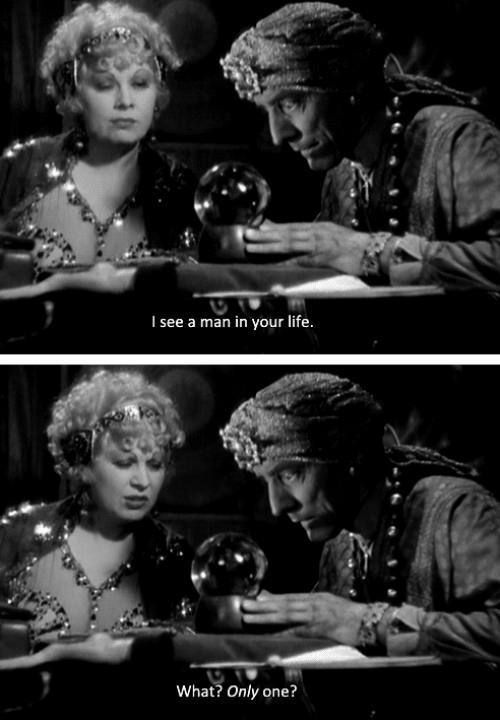
Mae West said it best. Picture by Sophie Charlotte on Pinterest
There are many dimensions to divination, some of which are indeed very deep. However, as far as our relationship with querents is concerned, we are simply an added means of intelligence-gathering, which, like all tools at our disposal, may fail for a variety of reasons, not the least of which is the diviner’s limited knowledge (our knowledge is always limited).
“But I came here to have undebiable, clearcut answers,” one might argue. To which I anwer: Tough titties! If you want undeniable clearcut answers shake a magic eightball. Divination is, quite literally, a divine language, and is not always so cleacut, either in itself or due to our limitations, or sometimes simply because the situation isn’t clearcut in itself. This is especially the case for issues involving human emotions.
As a rule, honesty is the best policy. I believe in voicing my procress to the querent, and the querent has a right to as clear an answer as I am capable of giving them, but we should never feel pressured to give them more certainty than we can truly see in the oracle.
It is perfectly acceptable to talk to the querent about our doubts or about the possible interpretations we are seeing in the oracle. For instance, it is ok to say “it seems like x, but y is also a possibility, while z seems less likely and w is out of the question.” It is also acceptable to say “these cards seem to point to such and such being the case, but I’m uncertain, as this other interpretation might also be right”. More often than not, the querent will say that both interpretations apply, and when this is not the case they can help us disambiguate the oracle.
Ultimately, the fact that divination has no legitimate place in our society implies as a consequence that, because our society believes itself to be held together by reasonable rules and processes, then divination must be either complete poppycock for delusional idiots or it must be capable of unreasonable fits of prowess in other to justify its existence in spite of its current ostracism.
This in turn creates expectations and hang-ups on both ends of the divination process that need to be analyzed and clarified to avoid them subconsciously ruling our practice. Doing so can make divination much more valuable and much more enjoyable.
Master Feiyu scolded his pupil, Qiang, for consulting the I Ching by tossing coins instead of using the meditative yarrow stalks.
Mortified, Qiang, who’d been deriving great benefit from the oracle, set about manipulating the sticks. He asked if he’d been wrong in using coins. He got Hexagram 7, The Army. Not understanding the answer, he abandoned the divination.
Later he asked again, but tossed his coins instead. Again he got Hexagram 7, which he still didn’t understand. What Qiang did understand was that there was nothing wrong in his choice of method, but plenty in his choice of master.
Plenty of readings this time of year, and an above average number on health issues. An acquaintance of ours, an elderly man whom we know from theater, had to go under the knife for major surgery, my husband and I decided to see how the situation would evolve. I used the 45-card Bologna tarot system and the 13 card spread.
Recovery from Surgery. Spread with the Bologna
I am immediately reassured by the lack of dramatic sequences. However, the first row is interesting: Death can indicate a major turning point, the Chariot is the bed card in this tradition, and the Tower is a place of suffering, such as a hospital. Death and Tower can be a tragedy or painful situation. Technically you’d need the Knight of Swords together with the Chariot and Tower to predict surgery, but considering I didn’t even need to predict it (I knew it already) the cards are being remarkably specific.
We also find that his thoughts (the Knight of Wands) are not at ease (the Fool and Justice, that is, irrgularities on his idea of what is right). It could simply indicate bewilderment at the question of how he is going to move on from this. Note that the Tower weighs his thoughts down.
In the following row we see that there is love and care around him (Seven of Cups and Love) and that this care is going to have to last quite a while (Temperance). The recovery is going to take its time. Finally, the cards reassure us that the people and doctors taking care of him mean well and know what they are doing (the Queen of Coins is the truth, wisdom and knowledge).
Since I’ve started studying horary astrology, my teacher has encouraged me to take on questions to learn on battlefield, as it were. I probably only need some exra push to start offering cheap readings here. This horary was asked by a social media contact of mine, who wants to know how her mental health will evolve.
Mental health. App used: Aquarius2Go
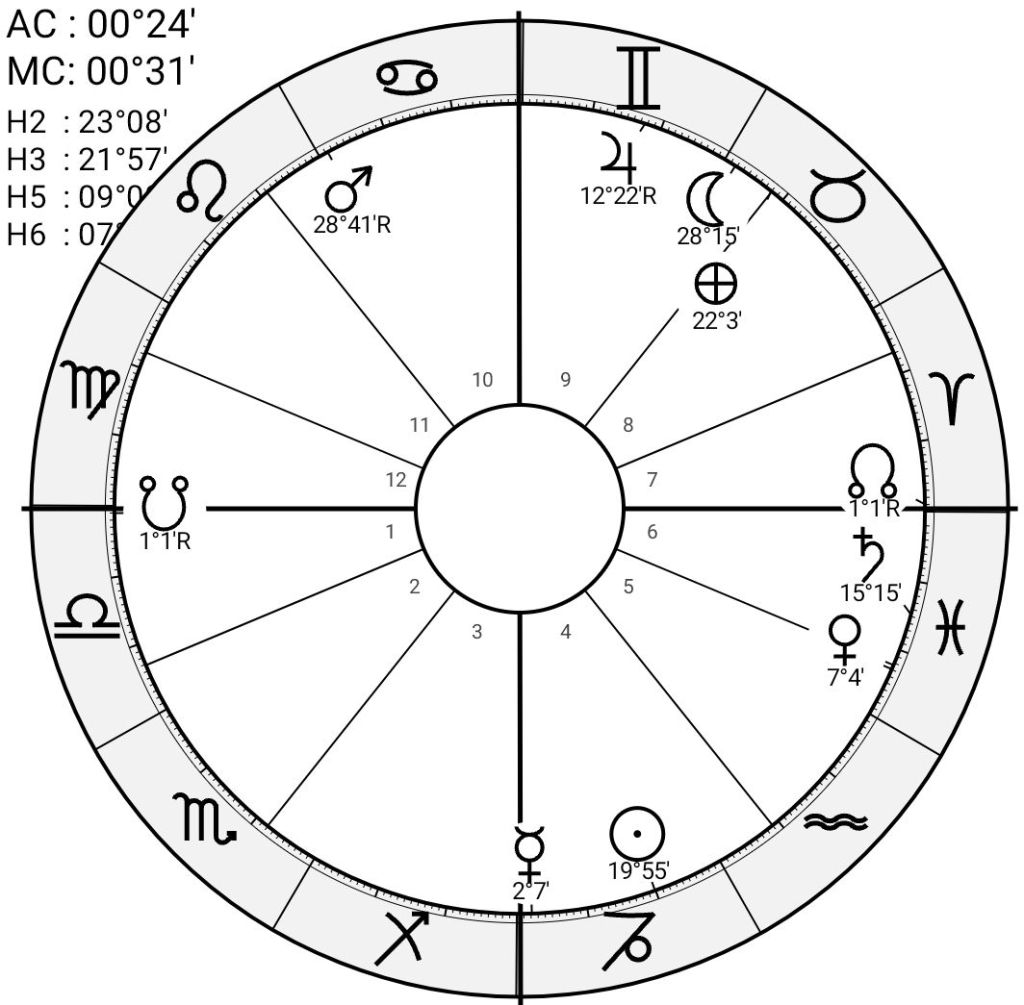
An immediate giveaway that something is off is the conjunction of the South Node of the Moon to the Ascendant. This is the “bad” node, traditionally attributed to the nature of the malefics, Mars and Saturn. It is as if the chart wanted to tell us “hey, there IS something wrong, go look!”
The querent is represented by the ruler of the Ascendant, Venus. Venus is exalted in Pisces, but conjunct the cusp of the malefic Sixth House of sickness. The Moon shows us the flow of the action. She, too, is exalted in Taurus, but conjunct some evil fixed stars and cadent in the Ninth House. She is sextiling Mars.
Venus is not terribly afflicted, but it is in a bad place in the chart. Since we are talking about mental health, and Venus is conjunct a house of sickness, it is probably reasonable to conclude that the querent is experiencing mental trouble of some sort. Considering that Pisces is a common sign, the trouble is probably recurring, coming and going.
Venus is approaching conjunction with a bad Saturn in the Sixth, and before that a square aspect with the ruler of the Sixth house, Jupiter, which is cadent, retrograde and in detriment. Since the square is approaching, the trouble is intensifying, at least at present. Still, there is reception between Venus and Jupiter, which tells me that the querent does have some inner strength to deal with it and work through it, especially with someone’s help. Note that both Venus and the Moon are exalted, which argues that the mental trouble is due to excessive expectations being disappointed.
The Moon is quickly approaching the sextile aspect with Mars. Mars is ruler of the Third and Eighth house. The Eighth house is the house of death, but also of mental anguish. But the sextile is a positive aspect and it happens with reception, so once again we have an image of the potential for overcoming the trouble.
All in all, the chart depicts a situation of suffering but it is encouraging. The querent is not as helpless as she may think and can find the strategies to go through the period of difficulty.