All posts by MQS

Living at the intersection of occultism, fiction and philosophy, I travel the planes at a moderately quick pace. I read, I do magic, I cook for hubby. Confused by the number of things I talk about? Good, confusion is a nice thing ;)

Stuff You Don’t HAVE to Believe: Karma

I talked about manifestation, now let’s tackle karma. This is one of those things that grind my gears about the spiritual community, largely because it unveils how derivative, unoriginal and moralistic it often is.

To understand this we need to remind ourselves of one of Nietzsche’s criticisms of his philosophical predecessors, who, according to him, were trying to safeguard religious morality even after doing away (overtly or covertly) with the concept of God.

This exact same thing happened to the spiritual community, which often reacts allergically to Christianity, yet seeks to safeguard the moralistic notion of hell (“if you do X you will be metaphysically punished”) by transfering its role to a vaguely defined “universe” whose task is, somehow, to uphold the believer’s social, political and spiritual views and punishing those who contravene them by causing bad things to happen to them.

Let us grant that this is somewhat of a misunderstanding of the original concept of karma found in some Eastern philosophies, even though it is not THAT much of a misunderstanding. The fact remains that, as used by most Western “alternative” thinkers (who somehow always end up believing the exact same crap), karma is just a lazy excuse for maintaining the holier-than-thou attitude they accuse traditional religion of: hey, enough with the badly understood Christian superstition! Time for the badly understood Oriental superstition!

Except that at least traditional religion has something grandiose and awe-inspiring about it (some passages from the Bible could be turned into a cool metal opera). The alternative spirituality of many girlypops has a way of pettifying everything: wow you left your girlfriend via message? That’s bad karma! What? You acted like a douche your whole life and suffered no consequences for it? That’s for another life then! If this is not the epitome of bitchy passive aggression I don’t know what is.

As many silly beliefs, this, too, has its glimmer of truth hidden in it. The Platonic myth of the soul, according to which our soul chooses what to incarnate as, offers much food for thought and meditation on the nature of our choices and how we must then live with the traces that those choices invite into our soul. There is no need to add metaphysical burdens on top of it.

MQS
Same Behavior, Different Motivations

In Enneagram work, what matters is not so much what we do, but why we do it. Each type is characterized by a core motivation, and even though each core motivation tends to produce, on occasion, similar behaviors across different individuals, relying too much on the what instead of the why can lead us astray.

A Type Two, for instance, might very well be constantly distracted by ideas on how to make themselves useful to others as a way of eliciting love, affection or appreciation. Fives may also try to make themselves useful, but this is usually done in order to boost their sense of being intelligent or capable, that is, of proving to themselves that they are not inept. Of course, the style in which the help is delivered also varies: Twos tend to be personable and warm, while Fives are generally concentrated on giving others facts or conceptual tools.

In many Enneagram groups, a useful exercise is simply that of settling into a meditation, with one’s attention kept on a short leash, and then becoming aware of where the attention naturally drifts to. Our core mechanism is so ingrained in us that it often takes conscious effort to act contrary to it, and even then, the mechanism that we push out of the door comes back through the window (the typical example is that of a Two who consciously tries not to be helpful, and ends up justifying it to himself or herself by saying “so I can catch my breath to be more helpful in the future”).

This exercise is very useful, but we need, again, not to concentrate too much on the what. Sometimes our attention is caught by thoughts that appear random, but once the motivation behind those thoughts is questioned, the Enneatype becomes clear. For instance, a Three’s attention during meditation may drift toward some kind of task that they need to complete, or even simply to what they are going to eat for lunch. There is nothing inherently specific in any of these thoughts, but often the Three will have these thoughts as a reflection of their mechanism, e.g., they may think about what to have for lunch so they can cross that item off their mental to-do list and optimize their schedule.

That being said, there is also another risk, and that is of becoming so fixated on catching ourselves in the act that we forget to live life. Our character is not a curse. It can become one if we wrap it too tightly around our life, but as long as we learn to wear it loosely and see it with some irony, it actually affords us gifts, tools and opportunities.

MQS

On The Esoteric Meaning of Meditation (and Where Magic Power Comes From)

Often people associate meditation with the quest for aha-moments. There is more than one kind of meditation. While realizations can come from any kind, the one that tends to produce them is discursive meditation, where attention is fixed on a symbol, image, phrase, prayer or problem.

Meditation, understood as simply sitting somewhere, catching one’s attention in the act of wandering off and bringing it back, does not necessarily entail the reaching of any conclusion on any particular subject, although it can foster clarity, which is conducive of finding solutions.

Many occult schools and spiritual organizations recommend meditation, and even though I am no longer part of any of them at the current stage, I think it is for good reason. The stilling of the “monkey mind” before ritual work is only the most obvious of the benefits of meditating.

Deeper than that is the fact that meditation is not a state we get into. It is a state we get out of and must return to consciously. Our attention’s natural place is here, next to us. Our attention is like a blade: it belongs sheathed on our belt, ready for action when needed. Instead, we spend our time swinging it about maniacally, blunting it by hitting it against anything that crosses our path.

There is tremendous power in keeping our attention by ourselves, in the present moment. Here and now, being and changing coincide one with the other, and together they coincide the the state of initial void from which the power needed for magic comes.

All too often I hear phrases like “you are the magic” or “the power comes from you.” Although these are supposed to be empowering statements and they mean well, they are founded on an egocentric misunderstanding typical of our age, where old ideas that would otherwise be dismissed as superstitions, like magic, seek to survive by psychologizing themselves.1

But Magic is the art of creating vessels for spiritual forces to dwell in. We, too, are vessels. Magic comes through us, not from us. In meditation, with our attention sheathed by our side, we slowly make room from something other than our ego to incarnate through us.

MQS

  1. This is not meant to discredit psychological work, which can and often is necessary in our line of work. But psychology is not spirituality or occultism. ↩︎

Bolognese Tarot Spreads – The Thirteen Card Spread

Nothing prohibits anyone from using whatever spread they prefer, or even just from laying out a row of cards. However, traditionally, the smallest spread used with the Bolognese Tarot is the thirteen card spread, which is a small tableau of cards used to answer a specific question or explore a specific theme (although nothing prevents you from laying it out for a general reading. It will respond anyway). This is a spread I have already presented, and it is one that is used with many decks in Central and Northern Italy in particular. The layout is as follows:

123
456
789
101112
13
The Thirteen Card Spread

Some readers take out the significator for the querent or even the significator for the question and put them on top of the layout (above card 2) before starting to shuffle. I prefer to have all cards in the deck and have not found it necessary, but feel free to experiment.

The cards may be read in rows or in columns, and which direction is the primary one depends on which tradition you come from. Personally I tend to see rows as the primary reading direction, but I will look at columns if there is clear information contained in them. I have found that the columns tend to describe the situation rather than to predict it. But don’t force yourself to read in every direction possible: simply read the information where it is found, and leave the rest.

There is no strict differentiation between past, present and future. However, I have found, personally, that at least the first row, or sometimes two (and on occasion even three), contains the past or present of the situation. Occasionally the cards simply jump ahead into the future from the start.

Be open about it: it may sound confusing in theory but in practice it is often quite clear. For instance, if you see the cards changing from good to bad or vice versa (or simply changing “tone”) in the first row or two, that’s usually a sign that the cards before the change happens are the past/present, and the others the future. In doubt, simply ask the querent: we are not there to play Nostradamus, so it’s fine to ask for help in interpreting the spread.

The final card, number 13, doesn’t have any specific preassigned meaning. However, I have found that it can either simply be a regular part of the spread (simply coming after card 12 or under card 11), or it can highlight an important detail, or something that will be true, regardless of what the previous cards say. For instance, if the spread is a disaster but the thirteenth card is good, it can tell us the querent will have some kind of satisfaction, or will be protected.

Yes-or-No Questions

Now we come to an odd bit of tradition. I will relay it as it has been taught to me, and then I’ll give you my two cents. Although the thirteen card spread is not unique to the Bolognese Tarot, the Bolognese Tarot adds another layer to the spread.

This is relevant only when the question is a yes-or-no question. If it is, then, according to some traditions, the answer is yes if the Death card comes up in the spread or while cutting the deck (it says: “yes, as sure as the fact we all die”). If the Angel card comes up, according to some it’s a maybe, while according to others it’s a no but with positive developments; if the Death and Angel cards both come up, not necessarily together, it’s the best possible outcome (a super yes, as it were). If neither card comes up, it’s a no.

Some also add that if the Death card doesn’t come up but the Angel and Devil card come up in the spread, not necessarily together, it’s also a yes (the Devil card alone would be a no, but if you remember the combinations, Angel+Devil means good news or satisfaction). Others still also believe the answer is yes if three or four Kings come up in the spread.

Now I’m going to tell you what my experience is. My experience is that there is something to these rules, but it is not all so cut-and-dry. The spread always needs to be interpreted as describing a concrete situation, and the yes or no comes from our evalutation of whether the picture presented by the cards matches what the querent wants or not. It’s happened more than once that the Death card was present but the answer (confirmed by experience) was a no, or vice versa, the answer was yes with no yes-marker present.

Focus on interpreting the cards. If the Death card comes up, what does it say in the context? Does it show some sharp change? Does it show inner suffering? Does it confirm something? If so, look at the cards around it: what is it saying yes to? Sometimes it is obvious that the Death card comes up for no reason other than to say “yes” to the question, while at other times it is a regular card, like the others. Again, be flexible, record your experience and learn from it.

MQS

Exploring the Present Or Scrying the Future?

As a diviner, I have no objection to making predictions about what is likely to happen. I see the current taboo about the future as a mix of delusion and ignorance. Our current culture comes at the tail-end of the myth of the self-made man that has animated much of our recent (and even not-so-recent) past. This myth has strongly influenced the Zeitgeist of the current occult wave, which started at the end of the XVIII century and continues, though declining–putrefying, even–to this day.

The occult developments have in turn trickled down into pop spirituality and have fostered the belief, now extremely popular, that all it takes to change one’s reality is to tune into the wavelength where one’s delusion corresponds to objective facts, and that nothing about one’s identity is more than a socially-conditioned self-identification that can be simply deconstructed and cast off like a cloak in favor of something else as the whim of the day dictates.

This implies the idea that the future is a completely blank slate and that therefore divination can only be used as a tool for self-reflection on the present to facilitate this process of self-making and self-remaking. Unfortunately, the self-reflection in question regularly resolves itself into simply telling the querent what they already think or would like to think of themselves, but packaged in empowering language within a context in which they assume they are communing with divinity. “Wow, the Gods think exactly the same as I do! How wise!”

Anyone who lives in actual reality and has spent five minutes reflecting on it know that this view of existence is demonstrably false (although, like many false things, it contains faint traces of truth). Each of us has a path in life that is unique, containing specific challenges and opportunities, possibilities and impossibilities. Divination is good at detecting these patterns and their likely outcome in the near future.

Still, I find that there is value in employing traditional divination in exploring the present. The language of traditional divination is frank, crisp and concrete, as it comes from a deep understanding of the fact that, if what is above is as what is below and what is within is as what is without, then what is above or within cannot be a metaphysical soup of saccarine inanities, but must correspond to the complex interplay of pleasure and sorrow of the below and without.

In other words, if a tiktok psychic might tell you that you always end up with the wrong guy because you have a soul contract that stipulates that you need to come into contact with your inner queen, traditional divination is more than happy to let you know that it’s because you are a basic harlot who chooses basic idiots.

This is not to say that there is a god or a spirit judging the querent through us or through the oracle: it is merely a dispassionate look at your life from a dispassionate observer on a simple example of causality. It also does not imply that we, as diviners, shouldn’t learn to speak with tact and diplomacy. However, the employment of actual divination techniques allows us to shed light on the querent’s present in terms that might actually be helpful to them.

We never leave a divination session unaltered. The knowledge we gain changes us necessarily: me knowing about X is not the same as me not knowing about it. If X is in my hands, then knowing about it can give me some power over it. If it isn’t in my hands, then knowing about it gives me awareness of the limits that define my unique path through life. That’s growth, too.

MQS

Tarot Encyclopedia – The Seven of Cups

(Note: this is a collection of the meanings attributed to the cards by some occultists in the past centuries. It does not reflect my own study or opinion of the cards. It is only meant as a quick comparative reference as I develop my own take.)

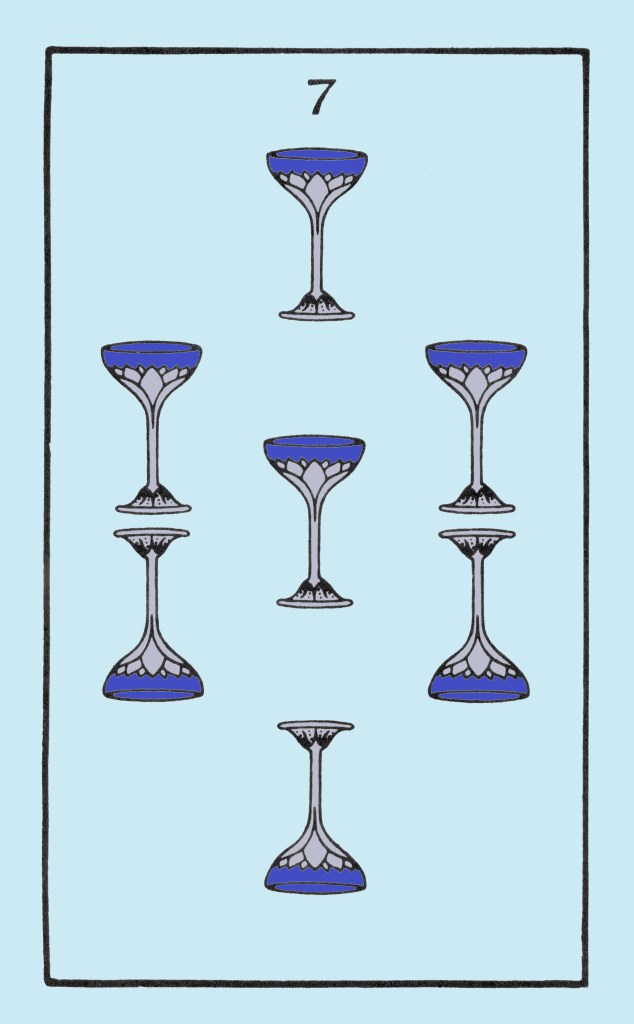
The Seven of Cups from the Builders of the Adytum (BOTA) tarot deck

Paul Foster Case (and Ann Davies)

The time period is the third decanate of Scorpio, November 11 to November 20, under the subrulership of the Moon.
Well-Dignified: possible victory, but the person to whom the card applies may be too indolent to take advantage of his opportunities for commanding circumstance. Success may be gained, but not followed up; necessity for choosing only the highest objectives.
lll-Dignified: illusionary success; lying and deceit; drunkenness; violence, even lust.
Keyword: Illusion
(From the Oracle of Tarot course)

A. E. Waite

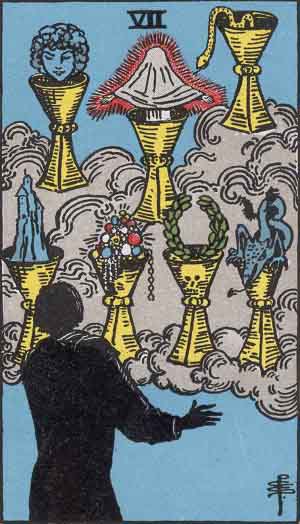
Strange chalices of vision, but the images are more especially those of the fantastic spirit. Divinatory Meanings: Fairy favours, images of reflection, sentiment, imagination, things seen in the glass of contemplation; some attainment in these degrees, but nothing permanent or substantial is suggested. Reversed: Desire, will, determination, project.
(From The Pictorial Key to the Tarot)

The Seven of Cups from the Rider Waite Smith Tarot Deck

Aleister Crowley

The Seven of Cups is called Debauch. This is one of the worst ideas that one can have; its mode is poison, its goal madness. It represents the delusion of Delirium Tremens and drug addiction; it represents the sinking into the mire of false pleasure. There is something almost suicidal in this card. It is particularly bad because there is nothing whatever to balance it-no strong planet to hold it up. Venus goes after Venus, and Earth is churned into the scorpion morass.

[…]

This card refers to the Seven, Netzach, in the suit of Water. Here recurs the invariable weakness arising from lack of balance; also, the card is governed by Venus in Scorpio. Her dignity is not good in this Sign; one is reminded that Venus is the planet of Copper, “external splendour and internal corruption”. The Lotuses have become poisonous, looking like tiger-lilies; and, instead of water, green slime issues from them and overflows, making the Sea a malarious morass. Venus redoubles the influence of the number Seven.

The cups are iridescent, carrying out the same idea. They are arranged as two descending triangles interlaced above the lowest cup, which is very much larger than the rest. This card is almost the “evil and averse” image of the Six; it is a wholesome reminder of the fatal ease with which a Sacrament may be profaned and prostituted.

Lose direct touch with Kether, the Highest; diverge never so little from the delicate balance of the Middle Pillar; at once the holiest mysteries of Nature become the obscene and shameful secrets of a guilty conscience.
(From The Book of Thoth)

The Seven of Cups from the Thoth Tarot

Golden Dawn’s Book T

THE seven cups are arranged as two descending triangles above a point: a hand, as usual, holds lotus stems which arise from the central lower cup. The hand is above this cup and below the middle one. With the exception of the central lower cup, each is overhung by a lotus flower, but no water falls from these into any of the cups, which are all quite empty. Above and below are the symbols of the Decanate Venus and Scorpio.

Possible victory, but neutralized by the supineness of the person: illusionary success, deception in the moment of apparent victory. Lying, error, promises unfulfilled. Drunkenness, wrath, vanity. Lust, fornication, violence against women, selfish dissipation, deception in love and friendship. Often success gained, but not followed up. Modified as usual by dignity.

Netzach of HB:H (Lying, promises unfulfilled; illusion, deception, error; slight success at outset, not retained).
Herein the Angels HB:MLHAL and HB:ChHVYH rule.

Etteilla

Thought
Upright. This card, as far as the medicine of the spirit is concerned, means, in its natural position: Thought, Soul, Spirit, Intelligence, Idea, Memory, Imagination, Understanding, Conception, Meditation, Contemplation, Reflection, Deliberation, Viewpoint, Opinion, Feeling.
Reversed. Plan, Design, Intention, Desire, Will, Resolution, Determination, Forethought.

MQS

The Neighbors (Update on Reading)

In this article I discussed a horary reading I did for myself on whether the new house we moved to would be good. My interpretation was that the house was generally good, but that there might be problems with the neighbors due to Saturn, ruler of the third house, afflicting the cusp. It turned out that the neighbors were normal people, it seemed, and that there was a problem with the manager.

Well, that was until last week, when the new manager contacted my husband, who represents the homeowners, to tell him that one of our neighbors hasn’t been paying his share of the bills for some months. Hopefully we won’t have to end up in front of a judge, but it is turning out to be quite an annoyance.

There is a small lesson to be learned, I think, from this whole thing. Often when I read for others, they contact me after a week telling me that they were excited about the prediction but nothing has come to pass. It is easy, right after a reading, to forget that readings can take months (sometimes many months) to materialize.

This is also where we, as readers, need to be honest with the querent. It is easy to turn our sitters into addicts hanging on to our every word, asking for a reading on whether they should shift their weight on their right or left ass cheek when sitting on the toilet, needing to be reassured every week of what we are saying.

Personally, I rarely accept to redo readings unless enough time has passed, or unless something absolutely new and unforeseen comes up that I hadn’t predicted. Still, it is normal for querents (and for us, when we are the querent) to assume that the first thing that happens is the materialization of the final result instead of a step in its unfoldment.

MQS