(Note: this is a collection of the meanings attributed to the cards by some occultists in the past centuries. It does not reflect my own study or opinion of the cards. It is only meant as a quick comparative reference as I develop my own take.)
Paul Foster Case (and Ann Davies)
The time period is the third decanate of Gemini, June 11 to June 21, under the rulership of Saturn and Uranus.
Well-Dignified: in spiritual matters, the end of delusion; the overthrow of limiting conditions; break-up of restrictions. In material affairs, sudden and unexpected changes, not always unfortunate in the long run, but disappointing when experienced: interference from from others. and.loss through indiscretion in writmg or signing contracts.
lll-Dignifled: failure, desolation, misery.
Keyword: Destruction
(From the Oracle of Tarot course)
A. E. Waite
A prostrate figure, pierced by all the swords belonging to the card. Divinatory Meanings: Whatsoever is intimated by the design; also pain, affliction, tears, sadness, desolation. It is not especially a card of violent death. Reversed: Advantage, profit, success, favour, but none of these are permanent; also power and authority.
(From The Pictorial Key to the Tarot)

Aleister Crowley
The Ten of Swords is called Ruin. It teaches the lesson which statesmen should have learned, and have not; that if one goes on fighting long enough, all ends in destruction.
Yet this card is not entirely without hope. The Solar influence rules; ruin can never be complete, because disaster is a sthenic disease. As soon as things are bad enough, one begins to build up again. When all the Governments have smashed each other, there still remains the peasant. At the end of Candide’s misadventures, he could still cultivate his garden.
[…]
The number Ten, Malkuth, as always, represents the culmination of the unmitigated energy of the idea. It shows reason run mad, ramshackle riot of soulless mechanism; it represents the logic of lunatics and (for the most part) of philosophers. It is reason divorced from reality. The card is also ruled by the Sun in Gemini, but the mercurial airy quality of the Sign serves to disperse his rays; this card shows the disruption and disorder of harmonious and stable energy.
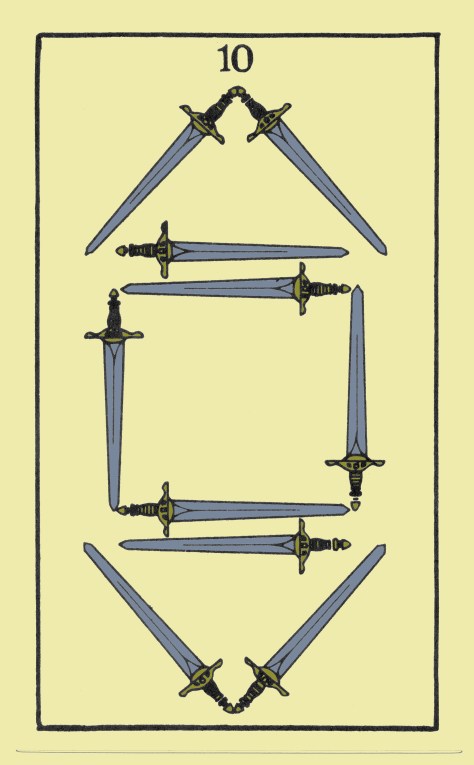
The hilts of the Swords occupy the positions of the Sephiroth, but the points One to Five and Seven to Nine touch and shatter the central Sword (six) which represents the Sun, the Heart, the child of Chokmah and Binah. The tenth Sword is also in splinters. It is the ruin of the Intellect, and even of all mental and moral qualities.
In the Yi King, Sol in Gemini is the virtue of the 43rd Hexagram, Kwai, the Watery modification of the Phallus; also, by the interlacing interpretation, the harmony of these two same Trigrams.
The signification is perfectly harmonious with that of the Ten of Swords It represents the damping down of the Creative impulse, weakness, corruption, or mirage affecting that principle itself. But, viewing the Hexagram as a weapon or method of procedure, it counsels the ruler to purge the state of unworthy officers. Curiously, the invention of written characters to replace knotted strings is ascribed among Chinese scholars to the use of this hexagram by the sages. Gemini is ruled by Thoth; 10 is the key of the Naples Arrangement; and Apollo (Sol) is the patron of literature and the arts: so his suggestion might appear at least no less suitable to the Qabalistic correspondences than to their double emphasis on Water and the Sun. Apart from this, however, the parallelism is complete.
(From the Book of Thoth)

Golden Dawn’s Book T
FOUR hands holding eight swords, as in the preceding symbol; the points falling away from each other. Two hands hold two swords crossed in the centre, as though their junction had disunited the others. No rose, flower or bud, is shewn. Above and below are Sun and Gemini, representing the Decan.
Almost a worse symbol than the Nine of Swords. Undisciplined, warring force, complete disruption and failure. Ruin of all plans and projects. Disdain, insolence and impertinence, yet mirth and jollity therewith. A marplot, loving to overthrow the happiness of others; a repeater of things; given to much unprofitable speech, and of many words. Yet clever, eloquent, etc., according to dignity.
Malkuth of HB:V (Ruin, death, defeat, disruption).
Herein the Angels HB:DMBYH and HB:MNQAL reign
Etteilla
Affliction
Upright. In terms of spiritual medicine, this card, in its natural position, signifies: Crying, Tears, Sobbing, Moaning, Sighing, Lamenting, Complaining, Afflictions, Regrets, Sadness, Pain, Wailing, Lamentations [= Poetic lamentations], Desolation.
Reversed. Advantage, Gain, Profit, Success. – Grace, Favor, Benefit. – Ascendant, Power, Empire, Authority, Might, Usurpation.
MQS

Discover more from Moderately Quick Silver
Subscribe to get the latest posts sent to your email.
