
Working on my review of Andrea Vitali and Terry Zanetti’s book on the Bolognese tarot I came across some interesting information that matches what some Bolognese tarot readers have confirmed.
If you read my section on the card meanings of the Bolognese tarot, you will see that I call the King of Swords “Spadino”, which literally means “little sword” or, more appropriately in this context, “little sword bearer” (the ‘bearer’ part is implied). This is because the people I have chiefly learnt from all agreed on this one name, independently from one another.
When we read Zanetti’s section on the divinatory meanings of the cards, though, we find that she calls the Page of Swords ‘Spadino’, identifying the figure with a young man. This is in contrast with the tradition I’ve received, whereby the Page of Swords is just a letter or message. Zanetti does say that the card can also sometimes signify a disquieting letter, but she chiefly identifies the Page with a young man.
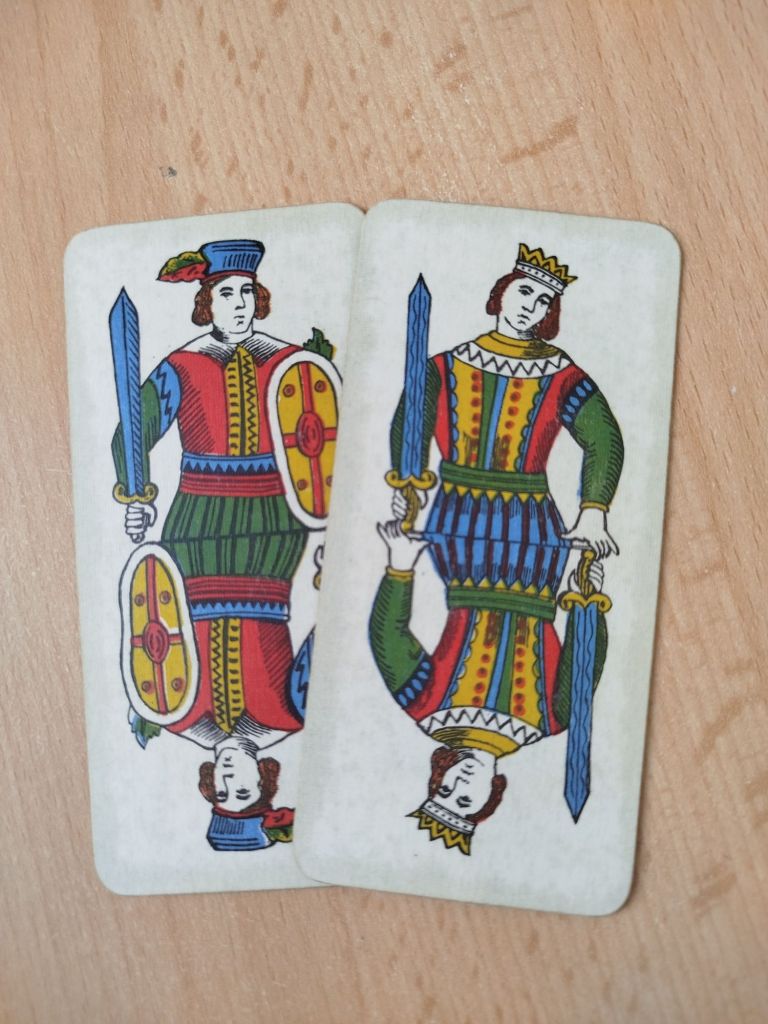
I must say I find this option strangely titillating, as the Page of Swords, Spadino, would then be a male counterpart to the Page of Cups, Coppina, ‘little cup bearer’. The ending -ino, which in Italian points to something small or young, definitely fits the Page more than the King. Zanetti denies that this parallel between Coppina and Spadino exists, because the Coppina is supposed to be always negative (she’s traditionally the little floozy who snatches hubby away). But I have not found this to be the case: the Page of Cups is just a young (or younger) woman.
Ultimately, as my understanding and practice with the Bolognese tarot evolves, I know I will have to create my own deck (all traditional readers seem to have done so, preserving a part of tradition and integrating it with their own discernment and experience). Tradition is, after all, not something fixed, but something that is handed over to us (from the Latin tradere) and that we must administer intelligently.
Another interesting fact is that Zanetti emphasizes the intellectual aspect of Spadino, calling the card “young man and his thoughts”. This is in contrast with what I’ve learned from Germana Tartari, my teacher for the 50-card method, whose grandma taught her that the Knight of Swords can sometimes represent the King of Swords’ thoughts, in a kind of parallel to the Knight of Wands being the thoughts of the King of Wands.
The fact that so many traditions seem to exist should not discourage us from engaging with them. Keep in mind that the Bolognese tarot tradition evolved locally, with each city, village or even street having slightly different versions of it. Thus, this is less a matter of who is right or wrong and more one of systemic preference and whether integrating different system together leads to new systems that work, or whether it is best to keep them separate. This is something that can be established only through trial and error.
MQS

Discover more from Moderately Quick Silver
Subscribe to get the latest posts sent to your email.
