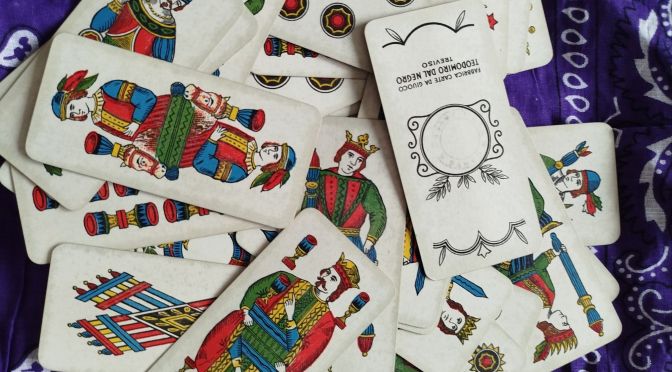
It wouldn’t make sense, at this point, to talk about each single card individually, but I think the cards do warrant a bit more discussion. I am referring to the 45-card system, even though most considerations will apply to the other systems as well.
The Aces
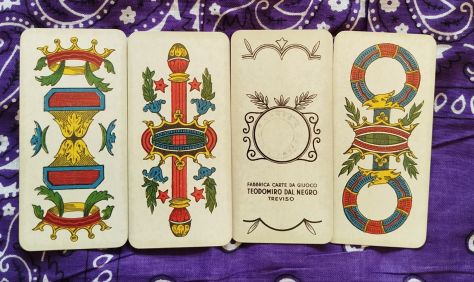
Ace of Cups. This is the card of the home environment and of the family, as in many fortune-telling and divination traditions. Its presence usually indicates that the issue somehow relates to the family or the house. However, the card can also occasionally function as a sort of adjective, in that it can indicate a situation or environment is like family. Broadly speaking, the cards surrounding it generally show us whether the family is positive or negative, or is going through a rough patch, etc. I have found that sometimes, when the home or familiar situations simply cannot be part of the interpretation, the Ace of Cups can hint at the intimate life of a person, their inner side, or the intimate relationship between two people.
Ace of Wands. This is a somewhat more complex card. In the main it is a card of sex and sexual interest (or interest in general). However, it represents anything done by two people together, especially marriage (or a strong relationship) or partnership. It portends great vigor, energy, creativity. Another important meaning of this card is that of achievement, personal triumph or personal success, i.e., the ability to reach one’s aims and fulfill one’s aspirations. It is a powerful, active card.
Ace of Coins. In the most ancient set of meanings, this is the card of the table, and it therefore represents sitting together for whatever reason. This meaning has been retained, as well as its metaphorical extensions (conviviality, etc.) It represents daylight. Its most frequent meaning, however, is that of representing finances. Compared to the other money card, i.e., the Ten of Coins, the Ace represents a bigger amount. Whether the amount is coming or going depends on the question and cards surrounding it. Metaphorically it can sometimes portend great satisfaction or a prize.
Ace of Swords. The most common meaning found attached to this card is that of symbolizing the door knockers (see design). The image of the door knockers is widespread in Italian cartomancy and is found in many traditional Italian card reading systems. It symbolizes something about to happen, because it is knocking at the door. However, the card symbolism has also been interpreted as representing two wedding bands being exchanged or a pair of handcuffs. Broadly speaking, therefore, it can show a commitment or a binding situation for better or worse, from marriage to prison, from a contract to an obligation, from an oath to an addiction. The emphasis here is on the binding aspect of it, which limits us, whereas in the Ace of Wands the emphasis is more on doing or achieving something together with someone else.
The Sevens
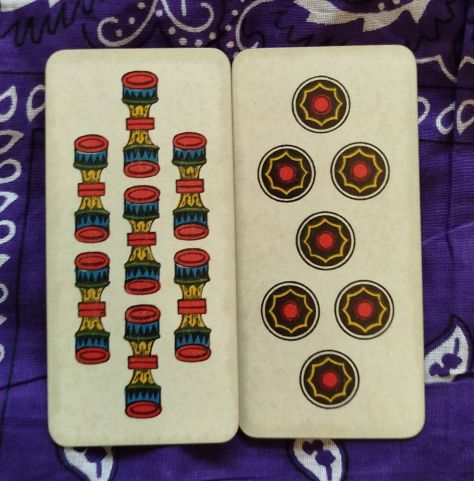
Seven of Cups. Called the card of the roof or the rooftops. Like all cups, it is strongly connected to the home environment. It is still a card of familiarity and closeness, but in a more extended sense than the Ace of Cups. Therefore, it also symbolizes the city or homeland (depending on the scope of the question). Due to its connection to the roof, it carries a certain connotation of protection with it. It is also another card that can show a quick timeframe.
Seven of Coins. The Seven of Coins is the card of tears. It shows melancholy, sadness, dissatisfaction. In itself it is not a tragic card, but it does indicate loss of heart, feeling down or blue, etc. When it falls together with other difficult cards, though, it compounds their effect, making it worse and showing that it affects the querent emotionally. On rare occasion, when with very positive cards (like the Sun and the Angel) it can show tears or joy, emotional relief in general. This is rare though. Note: some diviners use the Six of Coins instead of the Seven to symbolize tears.
The Eights
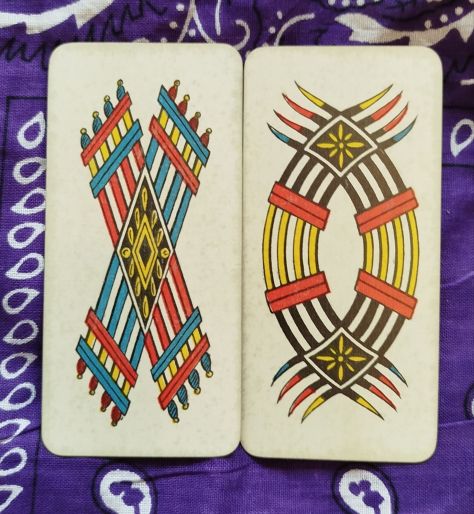
Eight of Wands. The Eight of Wands is the card of the road or path. The road can be literal, representing a short journey (as opposed to the World), even just going out to meet or visit someone, or it can be metaphorical, indicating something that is moving or requires movement or evolution (e.g., a professional path, a study course, the trajectory of a relationship, etc.) In itself, the card tends to be positive, indicating a situation that is ‘open‘ (like a road) and still developing, but with negative cards it can show the opposite. It can also represent something that is on the way, and therefore, like the Ace of Swords, is about to happen. Note that some diviners use the Six of Wands instead of the Eight.
Eight of Swords. This card is traditionally called ‘passione’, i.e., passion, but more in the sense of the passion of the Christ. It represents torment, suffering and similar fun concepts. It is connected to pain in all its manifestations, whether physical, mental, psychophysical or of different kind. It is also connected with addictions, again literal or metaphorical (as when you make yourself dependent on what your ex thinks or does). Some diviners use the Six of Swords instead of the Eight.
The Tens
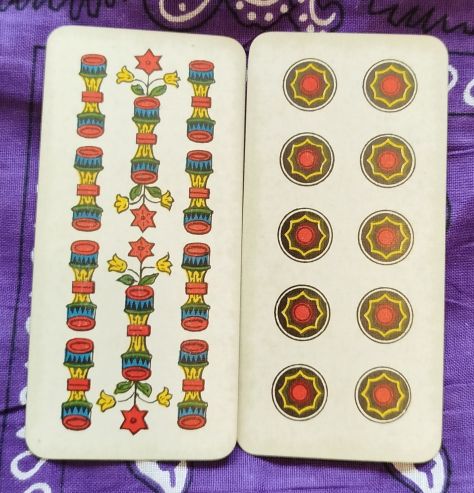
Ten of Cups. As the image suggests, this is the card of all things that bloom and flourish. It shows rebirth and increase in all fields of life, and situations that metaphorically sprout, bringing mirth. It is the card of fun, of jollity, of parties and of drinking, so with cards showing excess it can indicate alcoholism. It is also the card of blood, so if the other cards seem to point to a stay at the hospital, it doesn’t mean the querent is having the time of his life, only that he is being cut open and blood is coming out.
Ten of Coins. This is again a money card, but its amount is smaller than the Ace. Still, by itself it is a positive card, showing satisfaction and well-being. It represents a positive flow of things, a situation that is calm, tranquil, without major ups and downs (unless the surrounding cards are negative, in which case the calmness is denied, as it were.) With negative cards it can show the querent has little money or little satisfaction.
The Pages
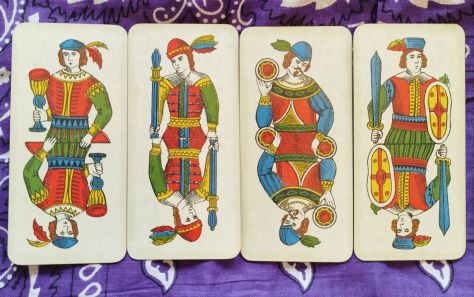
Page of Cups. The Page of Cups has the traditional name of ‘coppina‘, i.e., little/young female cup-bearer. It signifies a young, younger or youthful woman, usually belonging to the family or to the querent’s everyday life. With negative cards confirming it, it can represent a rival in love (the fresh young thing snatching hubby from you) or an immature woman. When exploring a woman’s past, it can show “when she was young”. This is one of the hardest cards for me to read, as sometimes it shows up seemingly for no reason, even though there is no young woman involved. I have figured that in these situations she is still a small cup-bearer, cups being joyful, so it can represent the arriving or giving of small joys or satisfactions.
Page of Wands. In the Tarocchino Bolognese, we have not only cards for the male and female querents, but also for their thoughts. The Page of Wands represents the female querent’s thoughts, beliefs, plans, memories, character and inner side.
Page of Coins. This is the card of words, talks, conversations, dialogues. It heralds the arrival of meetings where situations are talked over, agreed on, clarified, etc. Cards surrounding the Page will show either the nature of the words (angry, loving, etc.) their content (work, love, money) or their outcome (agreement, disagreement and so on).
Page of Swords. Traditionally the letter card. Like the Page of Coins, it is a card of communication, but usually written or, nowadays, in the form of messages. It can symbolize documents and things made of paper. It also embodies the broader notion of contacts, developing contacts, coming into contact with others. This is especially relavant when we are not talking about a single specific letter or message.
The Knights
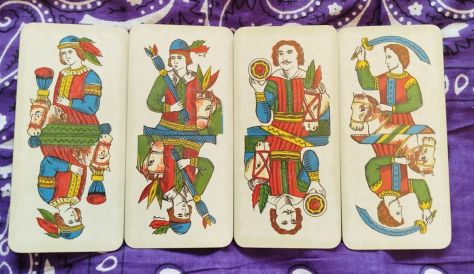
Knight of Cups. In Italian, ‘accomodamento’, literally adjustment, compromise, agreement or even repair. This card’s main meaning is simple, but its applications are many: it shows situations that bring conciliation (or reconciliation), healing and the solution of trouble, or at least a way of dealing with it positively. It heralds harmonious interpersonal relationships, smooth sailing ahead, the ironing out of disagreements or difficulties, positive developments.
Knight of Wands. This is the male counterpart to the Page of Wands: the Knight represents the thoughts of the male querent or of a male figure that is involved in the situation. It is the thoughts, beliefs, character, memories and inner side of this male figure. Note, however, that sometimes, when it doesn’t make sense for this (and the Page) to represent thoughts, it can be taken as a secondary significator for the querent: if I show up not as a physical person (King) but as my thoughts (Knight) I am still there, the spread still talks about me.
Knight of Coins. This is the card of the ambassador, as it brings news, developments and similar things connected with the situation we are exploring. It can indicate knowledge of facts from third parties or other sources, but in general it is the card of news. In itself the news is implied to be good news (one of its traditional names is ‘cavallo di buona nuova’, ‘the horse(man) of good news’), because it brings a coin, and coins were considered good in traditionally poor Italian society. However, if the cards surrounding it are bad, the news may be less than positive, or the good news may be blocked or delayed. Sometimes this card can be ‘christened‘ as a young man, if you’ve run out of court cards.
Knight of Swords. The Knight of Swords is the opposite of the Knight of Cups. Where the Knight of Cups adjusts and irons out, the Knight of Swords complicates, twists, brings trouble, difficult situations that are not linear nor smooth (note the curved sword). Where the Knight of Cups conciliates, the Knight of Swords attacks. In interpersonal relationships it brings disagreements, misunderstandings and hurtful words (one of its names is ‘malalingua’, literally evil tongue). If the Knight of Cups brings healing and goodness, the Knight of Swords brings suffering and evil. One of its main symbolic connections is with cuts, either literal (cutting yourself, getting hurt, being cut open by a surgeon, wounds, breaking something) or figurative (cutting words, situations that hurt, etc.)
The Queens
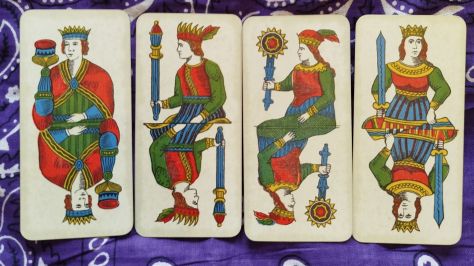
Queen of Cups. A mother or a woman in your family, usually. If not in your family, then a friend or someone who acts in your interest. Or should. Always look at the cards surrounding her, as she can be a bad mother or friend if they confirm it, but one who is emotionally invested in you somehow. Mostly, though, it represents the figure of someone who holds you (look how she holds the cup) and has your back. Traditionally she is dark-haired or of dark complexion. Others say she is of medium complexion. Either way, we obviously need to be very careful with descriptions. The Queen of Cups can indicate femininity.
Queen of Wands. If the querent is female, then the Queen of Wands is going to represent her, and the Page of Wands her thoughts. If the querent is male, the Queen can be his partner, or it can be a woman who is somehow important in the situation. Note that when we are talking about triangles, the Queen of Wands is the person who is in the male querent’s heart, regardless of whether she is the official partner.
Queen of Coins. Traditionally ‘the truth‘. This is rarely a physical person. More often than not, it represents truth, reality, authenticity, wisdom, knowledge, education, exactitude, clarity, understanding and the like. It can also say that a situation is as it seems. Or isn’t, if it is surrounded by cards of deceit, indicating the truth is hidden. According to some, it can also sometimes stand for a blonde woman or a wise woman. A traditional phrase attached to this card is ‘di verità conferma’, meaning ‘confirming the truth’ or ‘and that’s the truth’: sometimes this card comes up at the end of a spread or of a group of cards, and acts like a sort of period, as if saying “and that’s exactly it.”
Queen of Swords. Its traditional name is ‘affliction.’ When this card doesn’t represent a woman, it indicates a situation that brings affliction, either physical or psychological. More often than not, though, it does indicate a woman. Tradition says she is gray-haired or a redhead. Others say she is dark. Again, I would advise caution. The Queen of Swords isn’t necessarily evil: she is another woman, usually less accomodating than the Queen of Cups, but not bad. She can be rigid, or she can be a competent but stern professional. With bad cards then she is a rival, the other woman, or a woman who is out to get you.
The Kings
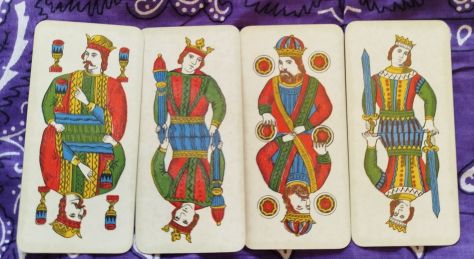
King of Cups. The King of Cups is the male counterpart to the Queen of the same suit. He is typically the father or a man in your family. If not in your family, a friend, a wise male influence, someone who has a good word for you, who will help you (like the Queen, he can be a good boss or coworker). It can embody masculinity in general.
King of Wands. As with the Queen so with the King. This is the male querent, or the female querent’s partner, or another man that is important in the question at hand. The Knight of Wands indicates his thoughts. Again, in a triangle this is the man in the querent’s heart, regardless of whether he is the official partner.
King of Coins. It has several titles in the tradition: ‘uomo/vecchio da soldi’ (man/old man bringing money), doctor, important person, a good lord etc. More than a particular person, it represents a role: that of a professional, of someone who has an important job and/or money. Traditionally it shows someone with a degree, from back when degrees were something special. Being called the doctor, it indicates situations that bring healing and care for the querent’s needs. It can indicate a boss or superior. It can also indicate a situation, whether a job or a relationship or something else, which is helpful or nourishing or ‘important’. Traditionally the King is a man for obvious socio-historical reasons, but nowadays it can indicate a woman as well, especially if next to a female court card.
King of Swords. The male counterpart to the Queen, his traditional name is ‘spadino’, i.e., little/young sword-bearer. It can represent a man who is young and/or immature, like the Page of Cups, such as a son or nephew. When exploring a man’s past, it can indicate ‘when he was younger’. It can show a new entry in the querent’s love life, someone who hasn’t yet been promoted to King of Wands. He can be a rival or a problematic man, if with negative cards, or a problematic or immature situation in general. More often than not, it is a literal male figure. Whether positive or negative, it is shown by the other cards. In some traditions it can show a military man, a soldier, a policeman or similar. Look at the other cards for confirmation.
MQS

Discover more from Moderately Quick Silver
Subscribe to get the latest posts sent to your email.
