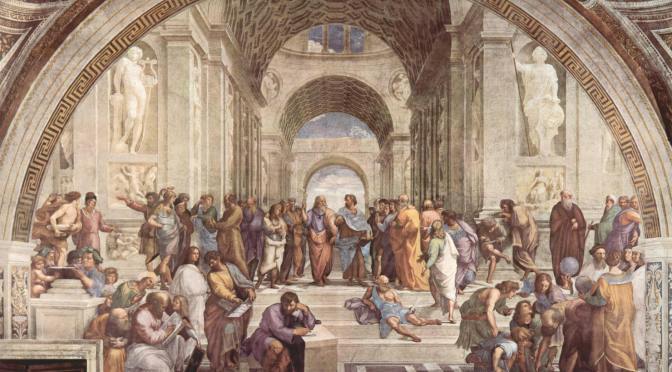
There is a common myth that the West doesn’t have its own spiritual tradition. Although it is true that the West, in its history, is marked by a strong ideological unpredictability, there are important strands of the spiritual tradition intertwined in our history, especially if we look back at before Christianity took over (and this, by the way, is not an attempt at disparating Christianity, which actually added to the tradition).
I am planning a series of articles on Platonic spirituality. Aside from my study of philosophy, I’ve been lucky enough to find mentors and teachers throughout my life who were well within this tradition, which I consider to be part of my personal brand. It is not an easy task: Platonism is not merely a set of practices but it is, first and foremost, a philosophical tradition, so it becomes hard to write a “breviary” of Platonism, for the simple fact that the Platonic and Neoplatonic traditions were never meant to be reduced to a simple catechism (and this is part of the reason why Neoplatonism lost in its battle to Christianity and was assimilated within it).
Still, I think it has to be done, in light of the fact that we are slowly entering a post-Christian era in the West which has many similarities with the Hellenistic period in which Neoplatonism thrived as a spiritual and magical tradition. Post-Christianity can never be pre-Christianity, and history only moves on and never really goes back. Still, in the past we can often find seeds that may be planted again in new soil. In this sense, it is worth it to see which parts of Platonism are alive and which are dead.
MQS

Discover more from Moderately Quick Silver
Subscribe to get the latest posts sent to your email.
