Previous / Back to Index / Next
In this chapter, Abano discusses what happens when a figure changes from one house to another, and also geomantic perfection.
It is very necessary that you know how figures change from one place to another, as shown above,1 for it is of great signification. We have three species of mutation: Mutation, Translation, Occupation and Conjunction. Mutation is when the first figure of the querent is found in other houses such as the third or ninth or other places, whether near to or far from the house that signifies the quesited.2 Similarly, Mutation is when the quesited does the same with the querent.
For instance, let there be a question about a sick person, who wants to know whether he shall heal. In this case the first is the querent and the sixth his being sick, and the eighth is death, and the tenth is the house of well-being and the twelfth the house of the graveyard. If the first goes to the third and also to the tenth or eleventh, this is a mutation of place; and similarly if the sixth goes to the ninth or eleventh house, this is also a mutation.
And Mutation has a double meaning, because depending on where it happens it changes its signification and virtue for good or ill depending on the house. If the said figures are in the tenth, which means well-being, or the eleventh which is next to the tenth, it means healing, especially if it is both in the tenth and the eleventh; but if the first or sixth goes to the eighth it means dying, or if to the twelfth also, because it means the graveyard, especially if the figures are earthy and unfortunate.
Another example. Let there be a question about whether one shall have the woman he desires. The first is the querent and the seventh the quesited. If the first, being fortunate, moves to the fourth and the seventh, similarly fortunate, moves to the third, he shall have her, because both figures are fortunate and they are next to each other: they have mutated place. However, this shows that he shall not have her at his place or even at hers, but it will happen in the house of a neighbor or relative of his, and this because both figures are found in the first four houses, which represent the querent. If it had been on her side of the chart, i.e., in the following four figures, it would have happened in the house of someone she knows. And if it were in the ninth, tenth and eleventh, in a distant place. But if the figures are unfortunate, it shows contrarieties, partly due to him and partly due to the persons signified by the houses involved. But if the figure is fortunate but it changes to the twelfth, it means he shall not have her due to hidden enemies.
Translation is when the first figure or the second, which is associated to it, moves to the house of the quesited or next to it, or vice versa. And if the figures are good and accompanied by good figures,3 it shows a happy end, but if it is a mixed bag, the greater part wins4. However, it is better when the translation is made by the first figure and not by the second.5 It is also a translation when the figure of the quesited is found in the house next to the querent, that is, the second. It is also a translation when the first or second are not only in the house before the the quesited, but also in the house afterward.
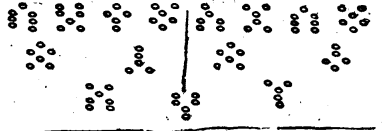
Example. If the question is about marriage, whether it will happen or not, and through what means, and the first figure is Acquisitio and the second Laetitia, which are both good (and the first is better), and the seventh is Albus and the eighth Laetitia, which is better than Albus, this all shows that the marriage will happen easily and will happen through one’s relatives, especially if the fourth and tenth are close to one another and to the second, which is airy, and to the querent and the first figure is found in the Witnesses. For instance:
Occupation can happen in two ways: the first is when the figure of the querent occupies the house of the quesited. For instance, if the question is about a (contested) inheritance and whether one shall have it or will need to get it from an enemy, and if the first figure is Albus and the same figure is found in the fourth house, which indicates houses, fields, possessions, inheritance and stable goods, this is called Occupation, because the first figure occupies the fourth house, i.e., that of the quesited. It indicates obtaining what you wish, especially because Albus is a good figure. No geomantic configuration is better than occupation, but only, again, if the figure is good.
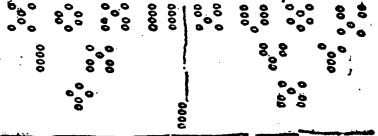
Even more does it indicate obtaining the quesited because Acquisitio is in the second house, which means gain, and the ninth and tenth are fortunate, being houses assigned to the querent.
Another way of occupation is when the house of the quesited is found to hold the opposite figure of that of the querent. So, for instance, if with Albus in the first, one should find Rubeus in the fourth. This is also a form of occupation, but this is a worse kind, especially if the figure of the quesited thus obtained is unfortunate.6
Conjunction is also of two kinds. The first is when the first moves next to the house of the quesited, or vice versa when the quesited moves next to the house of the querent, that is, in the second house. The second type of conjunction is when not only one finds the two figures together as just said above, but one finds them together also far away, that is, in the ninth, tenth or eleventh.
Example. The question is if one shall get back a lost or stolen item or a fugitive servant. The first figure is Major, which moves to the fifth house next to the sixth of the lost thing or the runaway servant. Major is a good, entering figure. Furthermore the sixth figure is found in the second house next to the querent. The judgment is therefore that one shall get back the lost item. Furthermore, the figure of the quesited is conjunct to the first in the second, which shows the querent’s gain, and things are further facilitated by the fact that the sixth house has Populus in it, which means the waxing Moon. Finally, it is even more fortunate because Populus is found in the tenth and Major in the ninth and eleventh, and even more so because the first is found in the Witnesses, and the sixth as the Judge.

All these configurations are called conjunction, whereby the ninth figure is said to be conjunct the first and the second because it is born from them,7 and the tenth is conjunct the third and fourth because it is born from them, and the eleventh is conjunct the fifth and the sixth because it is born from them, and the twelfth is cojunct the seventh and eighth, because it is born from them. And furthermore the Right Witness is conjunct to the ninth and tenth because it is born from them, and the Left Witness is conjunct to the eleventh and twelfth, because it is born from them.8
Let’s make the example of one asking about a lost item, and the first figure is Major, which however does not move to the house of the lost item, nor does it conjunct it, but moves to the third house, and similarly the sixth figure, which is Acquisitio, does not conjunct the first immediately, but moves to the tenth house, wherefore one shall judge that he shall soon get the lost item back, because the figure of the querent is found in the third house and Conjunctio is in the fourth, and the sixth figure is Acquisitio and is found in the tenth, which is born from Major in the third and Conjunctio in the fourth.9 Therefore, querent and quesited are said to be in Conjunction, especially when they are fixed and fortunate and entering, and the Witnesses are the Judge are exiting, and this means a change of place of the quesited to the place where the figure is found.

The reason for all these methods of Mutation or Translation and Occupation and Conjunction is that every time a figure moves from its original house, it is always found in the place wherein it moves, and not in its original place, because no change happens without cause and without meaning something. Nevertheless, always it maintains the meaning of the person or thing inquired about in their original place, only changing its fortune or misfortune and its time-frame (past or future) in the way we have discussed above.
However it is not always the case that a good figure diminishes its good fortune or a bad figure its bad fortune; in fact, sometimes it increases them, depending that it is found in a better Mutation or Conjunction, so that if the first moves by Translation or Conjunction in another place, or if it occupies it, the figure still indicates the person of the querent, but it shows greater virtue of said figure in the question inquired about, and it means a more particular effect than if it were found only in the first house.
The same is to be observed if the second figure goes next to the house of the quesited or moves to its exact house, or next to the figure of said house, if they are good, and vice versa if they are bad the misfortune is greater [than if the figure hadn’t moved], always keeping in mind the limits of the question and of the figures it requires, and of the places and houses of the quesited. So that if the first goes to the seventh, which is a bad place, contrary to that which the querent seeks, being the house of the enemy, and it means fighting, anger, discord, then it means contrarieties surrounding the obtaining of what one wishes, unless if the question is about marriage, love, friendship, business, travel, lack of peace, and similar things, in which case finding the first in the seventh is excellent, if the figure is positive and fortunate.10
In other questions, if the first moves to the twelfth or sixth or seventh, if it is a good figure, it diminishes its goodness, but if it is a bad figure it augments its evil, except if the first figure is accompanied by a good figure in the second or ninth or eleventh.
And when the second, ninth and eleventh are fortunate and good and the questions are about an absent messenger, good news, money coming from afar and other similar things, and if you find in these houses the fifth or sixth figure or the seventh, twelfth, eleventh or thirteenth, it means good news, good messenger, a messenger coming from afar, money approaching. If the second or ninth and third or also the thirteenth move or translate to the seventh, eighth or twelfth it means good things from afar, especially if the Judge agrees.
If the seventh or eighth moves to the fourth they show good news and durable situations, if the figure is good, and the opposite if they are unfortunate.
The best houses are the first, fifth, tenth and eleventh.
The second, third, fourth and ninth houses follow.
The worst are the sixth, seventh, eighth and twelfth.
Every good figure that you find in a good place increases its virtue due to being in a good place, but if you find it in a bad place it diminishes it. Every bad figure you find in a bad place increases its malice, but if you find it in a good place it diminishes it, except in the first house, where it always keeps its own properties and meaning. And every figure you find accompanied or conjunct by others diminishes or increases its goodness or malice depending on the figure it is accompanied by.
Therefore, if the first is good and fortunate and the second good, and the ninth also good,11 it does not increase the goodness of the first, but if it is bad it decreases the goodness of the first or second, keeping also in mind the question and the querent’s desire and the houses involved in it and the meaning of the house of the querent. The same is valid for the tenth house with respect to the third and fourth house, of the eleventh with respect to the fifth and sixth, of the twelfth with respect to the seventh and eighth, of the Right Witness with respect to the ninth and tenth, of the Left Witness with respect to the eleventh and twelfth, as said above.
MQS
Footnotes
- Book II, Part 7 ↩︎
- In other words, mutation implies change of house, regardless of whether it brings the querent near the quesited, although in this case we have, of course, perfection. Note that usually we consider a Mutation to happen when two figures move to places that are next to each other, but Abano, as many other Medieval authorities, doesn’t seem to fixated on precise language. ↩︎
- “Accomagnate cun bone”. It is unclear if this refers to the company of houses. ↩︎
- That is, if the figures are mostly good, it is positive, and vice versa ↩︎
- This seems to imply that translation happens even if the querent’s figure causes it. This is in contrast with modern practice. ↩︎
- This technique has not survived in modern practice. However, it would be interesting to test it out. ↩︎
- This assertion made by Abano is of incredible interest for those trying to make more of the Geomantic Shield. Apparently, we do not consider figures to be next to each other just in the order of the Astrological houses, but also when they are next to each other ‘genealogically’, so to speak, on the Geomantic Shield. ↩︎
- As shown in other examples before, Abano seems to consider the Witnesses to be similar to the other houses, and therefore potentially in conjunction with them. ↩︎
- In other words, the two figures are conjunct by moving to houses that Abano consider to be next to each other, i.e., the third and the ninth. ↩︎
- Abano seems to be saying that when a house that is meaningful to the reading has its figure move to another house, it is always significant, but the good or bad import is decided by the kind of question. ↩︎
- The Ninth House is considered by Abano therefore to be in company with the first, in a way, or at least to be close to it, so that a figure in it influences the querent. ↩︎
Discover more from Moderately Quick Silver
Subscribe to get the latest posts sent to your email.
