
Enneagram Type Six, sometimes called the Loyalist or the Skeptic, belongs to the Head triad. Those of this Enneatype tend to feel the need for an external source of security, whether it be in the form of social connections, love, a political ideology or religion, etc. They are often friendly and want to show themselves as dependable and trustworthy to avoid danger and controversy, but they also have a skeptical streak that undermines their ability to find the security they need. They are often given to catastrophizing, questioning and poking holes into everything in hopes of finding the one thing that they can trust, but once they feel they have found it, they rarely question it.
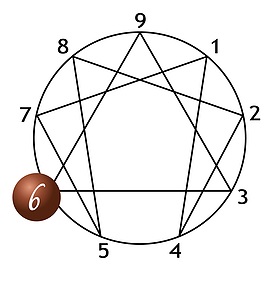
Enneatype Six Grows: Move to Nine
The beginning of a Six’s fear lies in their inability to give themselves the security and stable ground that they need. Because they lack a sense of inner guidance, they usually look outside of themselves, finding it in people, institutions, systems of all type, etc. Ultimately, Sixes want their anchor to be beyond doubt (that is, in a way, perfect).
This is obviously a problem, since an honest look at anything and anyone will reveal their flaws. Although some Sixes manage to convince themselves to stick to something even if imperfect, the nagging sense of uncertainty remains.
When a Six learns to trust themselves, their decisions, their own processes and learn to see the difference between a healthy dose of skepticism and an excessive one, they can also relax and, in doing so, they pick up certain qualities of healthy Nines. Enneagram Type Nine is often trusting of others and allows space for honest interaction without the drama that average Sixes often stir up when they haven’t yet sorted a person in trustworthy or dangerous.
Usually, Nines tend to see beyond division and can capture the unitary essence of all processes, including interpersonal ones. In integrating aspects of Enneatype Nine, Sixes, usually become much calmer and more capable of seeing the simple essence of a situation without getting lost in a myriad contradictions and doubts. More importantly, healthy Sixes develop the kind of self-assurance that they usually lack.

Enneatype Six Under Stress: Move to Three
Enneatype Six tends to create secure and stable social connections, which they reinforce by being trustworthy and friendly. Largely they do it to reduce the uncertainty of life (it wouldn’t be a stretch to say that the Six’s socially cohesive instinct is what brought humanity together and created the basis for society)
Unfortunately, this strategy is not always effective. Depending on their particular situation, Sixes may feel that their life is too unpredictable and dangerous. They may feel like they are swimming in a sea of ungraspable alternatives whose consequences they can’t pin down and anticipate. When this happen, a Six may still try to create certainty, but if the strategy fails, they will go to their stress point, where they embody the less healthy qualities of Ennneagram Type Three.
Threes are the workaholics of the Enneagram, constantly trying to emerge and establish themselves as worthy of respect. At their worst, Threes are unreasonably competitive and tend to see everyone as an opponent to outdo, outfox, outperform at any cost and using any trick possible. Stressed Six embody this more antisocial aspect of Type Three, as they feel they can no longer trust others and must therefore learn to compete with them.
Highly cynical and with a generally negative outlook, unhealthy Six can try to constantly undermine others, as though doing this was necessary to deactivate the potential threat associated with other untrustworthy human beings. This behavior is often seen together with panicked responses to every minor setback and a tendency toward authoritarianism as a coping mechanism.
MQS

Discover more from Moderately Quick Silver
Subscribe to get the latest posts sent to your email.
