
There is a general stigma toward certain forms of divination such as cartomancy with playing cards, namely that they are good at discussing mundane issues, while the Tarot should be used for deeper questions. This presupposes two things: that deeper questions don’t take place in the same world as regular life and that the Tarot is too deep to talk about everyday occurences. Both these beliefs are wrong.
The Tarot is perfectly capable of talking about whatever it wishes, just like playing cards, the Sibilla deck and every other oracle. The first presupposition, though, is more insidious and requires a bit more discussion.
The oldest extant series of tarot meanings has been retrieved in Bologna. The meanings there are what you would expect from a fortune-telling deck: the Ace of Swords is a letter, the Ace of Cups the house, the Hermit an old person etc. Furthermore, some rare examples of tarot fortune-telling in pre-modern Italian literature confirm that the Tarot has probably been used for such aims long before the occult revival started by Court de Gébelin, which slowly removed the Tarot from real life and confined it to the realm of “higher metaphysics”, that is to say, of psychological onanism.
In order to justify this “higher” (I would say emptier) use, several hypotheses on the Tarot’s origins have been put forth, depending on what was considered fashionable and not too easily disproven at the time. First it was the Egyptians, then the Kabbalists, then the Cathars, etc. Instead of being seen for what it obviously is, namely a wonderful product of European Neoplatonic Christian art that anyone before the Enlightenment would have immediately understood and considered familiar, and that only the ignorance of our post-Enlightenment metaphysicians could try to disguise as a distant voice coming from distant secret masters to apply in the understanding of distant matters, rather than an immediately obvious tool to mirror immediately obvious real life situations, which are all instances of an eternal story that constantly tells itself.
So yes, the Tarot can talk about daily experience. In the same way, other, more apparently mundane forms of fortune-telling can talk about problems that some would consider ‘deep’. Just like the Tarot, they can talk about it in immediate terms, immediately understood by anyone with who has some understanding of symbols.
Here’s an example of playing cards used for a ‘deeper’ reading. The querent is a woman I met at an Enneagram convention. She asked what was the reason for her constant bouts of depression. These are the cards:
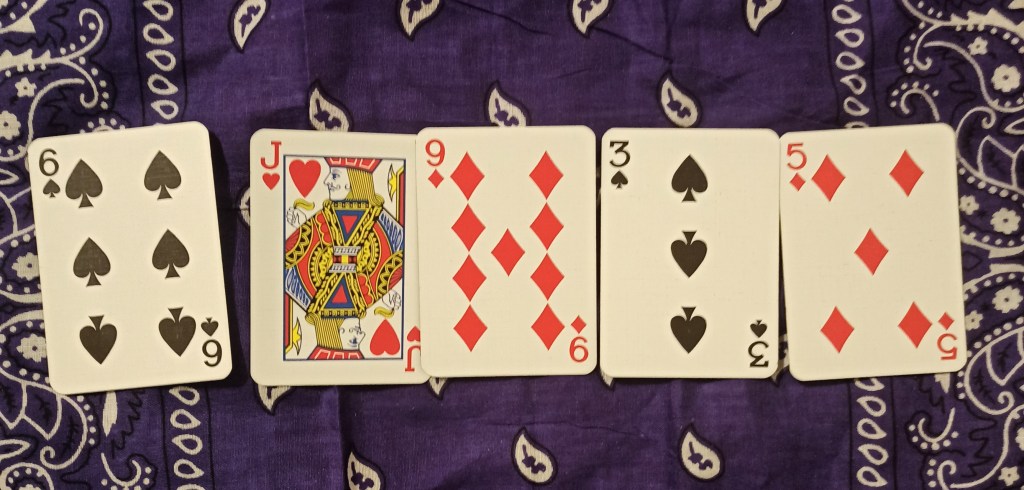
There is a sickness in her life, signaled by the Six of Spades. There are no cards of deep trauma, but something definitely needs healing. This card falling first sets the tone. The Jack of Hearts represents a child, a project, etc. Next we have the Nine of Diamonds, which is a card that represents the realization of ambitions, but more broadly can represent ambition. Then we have the Three of Spades and the Five of Diamonds. These two cards oftne indicate turning away from something. But the Three of Spades also comes directly before the ambition card. So she has turned away from some ambition. Two possible interpretations that came to mind are that she had the ambition of having a child but couldn’t or that she turned away from a childhood ambition.
I asked her, and it was the second possibility. She’d had big dreams for her life when was a child, but some disappointments had led to seeing them as unrealistic and she had let go of them. I told her that she hadn’t really let go of them, otherwise the Six of Spades wouldn’t have shown up: those ambitions still fester inside of her, and the fact that she is not doing anything about them could make her sick if she isn’t careful. These cards clearly show that she needs to go after her dreams, perhaps in her free time. Alternatively, if she doesn’t want to, she needs to truly let go of them and move on.
MQS
Discover more from Moderately Quick Silver
Subscribe to get the latest posts sent to your email.

„…psychological onanism.“PERFECT description. Lol!
LikeLiked by 1 person