
Often Known As: Doubter, Skeptic, Loyalist, Underdog (note that names are as limiting as they are revealing.)
Sin/Passion: Fear
Focus: on security
Fear: of not finding any stable protection
Energy Center: Head (energy is suppressed)
Social Stance: Compliant
Key Positive Traits (embodied at their best): Dependable, Friendly, Supportive, Dutiful, Mild, Reasonable, Gregarious, Courageous, Cooperative, Group-conscious, Good partner, A buddy, With good hunches, Encouraging, Loyal, Funny, Hardy, Good at foreseeing problems
Key Negative Traits (embodied at their worst): Fearful, Critical, Cynical, Cowardly, Mindless, Ideological, Catastrophizing, Alternating between following blindly and rebelling blindly, between conformism and mutiny, A deer in the headlights, Given to unwarranted fight or flight behavior
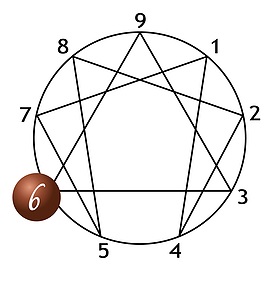
Growth and Stress Directions: to Nine and Three respectively
Introduction
In a way, Type Six represents Joe Citizen. Supportive, generally friendly, Sixes are usually mild-mannered and dependable with others. They tend to form strong and stable bonds and they are normally there for the people they have bonded with. Often capable of a great spirit of sacrifice in the name of fairness and friendship, they are always willing to fight for the underdog and try to be good neighbors with their fellow humans.
They often have incredible hunches that almost invariably turn out to be true. This is nothing supernatural. It is the consequence of a life spent trying to anticipate and prevent uncertainties and dangers. When a Six tells you that something is off about someone or something, they are probably right.
Sixes value loyalty–loyalty to ideas and to people. It is rare for them to question the motives of people they trust, and they usually go well out of their way to justify friends and associates. There is little they dislike more than untrustworthy people and traitors. They also occasionally display an obdurate unwillingless to trust others and have trouble with authority figures (unless they blindly trust them).
Sixes often have a good sense of humor, but also a cynical streak. Occasionally they make skeptical remarks that feel unwarranted or exaggerated, and they are seldom satisfied with the level of proof required by others in order to feel confident in a situation: Sixes need more.

Core Mechanism
It is incredibly hard to pin down Type Six in a single description. In a way, it is the most complex type. Sixes can and often do showcase opposite tendencies at different times, or even at the same time, and sometimes it is hard to see what links them to other Sixes. From a behavioral standpoint, Sixes are probably the most heterogeneous Enneagram type.
Sixes often swing between extremes of obedience and rebellion, mindless acceptance and rejection, aggression and passivity, fight and flight, faith and skepticism. The reason is that they lack any inner sense of certainty about life.
In the introduction I said that Sixes are always willing to fight for the underdog. This is because Sixes often feel like they are underdogs. Their worldview is one of great uncertainty. In a way, Sixes feel like they have been cast into the world with no protection–a world full of wolves that are waiting to attack.
Sixes are a Head type, but unlike the major head type, Fives, who trust only their own mind and relish in endless doubt and uncertainty, Sixes don’t trust themselves to have something figured out for good, but they do want to figure it out for good. Their mental processes are forever undermining their choices and their sense of certainty: “What if this happens? What if that happens? What is the worst that could happen?”
To compensate for their lack of inner guidance, Sixes seek a source of guidance outside of themselves (something Fives would never do). Once this source of guidance (which may be a person, a political ideology, a religion, an institution, etc.) is selected, the Six is unlikely to question them, and will become a brave little soldier fighting for the cause. Sixes also tend to find strength in number and in networking with other people they deem dependable, often on the assumption that they are all potential victims of this uncertain world and so they can help each other.
As soon as the cracks start showing in whatever source of certainty the Six has selected (after all, nothing and no one is perfect one hundred percent of the times) Sixes may try to overlook them by becoming more mindless, but if the cracks become impossible to ignore, Sixes turn on their “protectors” becoming the stereotype of the torch-bearing villagers. Once the rebellion is over, Sixes look for another anchor, and the cycle starts over.
Passion
The passion of Enneagram Type Six is Fear. To understand this we must take a step back and recognize that fear is, in a way, the foundation of every form of life. As soon as an organism exists, it seeks to perpetuate itself and to avoid what damages it, which it fears.
Sixes embody this idea in a visceral and almost archetypal way. Their primary concern is with their safety (and that of the people they care about, of course). Their fear stems from the fact that they cannot find anything around them that they can one hundred percent rely upon.
This leads them to their famous trait of catastrophizing about everything under the sun. Paradoxically, Sixes do this because it calms them, as it allows them to come up with endless Plans B (and C, and D) in case something goes south.
Unfortunately, their fear interferes with this focus on certainties, as eventually they’ll manage to poke a hole even in their fifth, sixth and seventh wheel, leading to a breakdown of their view of reality as it is, and not in a positive sense.
Fear is the constant companion of a Six’s life. It manifests as an ocean of variables when they don’t know what or whom to trust; when they have found this solid rock, fear manifests as a mute, nagging sensation that all is not well, that something is escaping them and will bite them in the ass one day.
In relation to the passion of fear, we distinguish two possible reactions on the Six’s part: the phobic reaction, which consists in running away from fear, and the contraphobic reaction, which consists in ramming through fear (if you’ve seen a herbivore attack a predator in a fearful frenzy, you’ve seen a contraphobic Six). Most Sixes fall somewhere between the two extremes, but some crystallize on one end or the other of the spectrum.

Misconceptions
A common misconception about Sixes is that, because they tend to undermine people’s credibility when they do not fully trust them, they are personally out to get them. Although it can be difficult to deal with a Six in these circumstances, their cynicism and snide remarks are not to be taken personally (which does not make them acceptable, of course).
Sixes are constantly looking for an anchor, something in the world that they can rely on, something that won’t change or be found faulty. As is often the case with psychological mechanisms, other people are simply casualities in our war with ourselves. Knowing this can help you in defusing difficult situations.
Another common misconception is that, because Hitler was supposedly a contraphobic Six, then every contraphobic Six is Hitler or a potential serial killer. I’ve heard this from a number of supposed authorities on the Enneagram. In an age where all it takes to be called Hitler is to mildly disagree with someone with funny hair, it should perhaps be pointed out that, since most Sixes have contraphobic tendencies buried more or less deep within them, and since Six is probably the most common type, it would be silly to say that more than one ninth of the population is made up of deranged dictators, but maybe this is a conversation for a more sane age.
Under normal circumstances, a contraphobic Six is simply someone who has a tendency to react to fear by moving toward and against it (it’s the “fight” part of “fight or flight”). This is not in itself a negative thing. It is just yet another survival strategy.
Wings
6w5: Sixes with a Five wing have definite intellectual, even scientific bent. They are very systematic in their survey of all possibilities, variables and factors, and they are likewise very systematic in their attempt at finding the solution to all of them. They often come up with ponderous defenses of the ideas that give them certainty, which tend to be somewhat more conventional than the ideas a pure Type Five might be interested in, but less than what a pure Six would find comforting.
6w7: Sixes with a Seven wing are very friendly and very entertaining. They often have a sharp sense of humor and a tendency to like and to be liked by others. The Six’s strategy to make friends with everyone so as not to end up eaten by wolves finds application, in part, through the Seven-ish drive toward enjoying time with others and networking. Less intellectual and more practical in their orientation, they fare well in social contexts, especially in group efforts.
(note that wings can have some minor descriptive power in terms of superficial behavior, but they are irrelevant in terms of what motivates the person. Many people have no noticeable wing, while few show signs of both.)
MQS

Discover more from Moderately Quick Silver
Subscribe to get the latest posts sent to your email.
