
Often Known As: Perfectionist, Reformer, Idealist, Judge, Critic (note that names are as limiting as they are revealing.)
Sin/Passion: Anger
Focus: What is right or good
Fear: Of being wrong, imperfect or at fault
Energy Center: Body (energy is transformed)
Social Stance: Compliant
Key Positive Traits (embodied at their best): Just, Fair, Idealistic, Perfectionistic, Consistent, Principled, Tidy, Moral, Orderly, Disciplined, Sober, Rational, Impartial, Objective, Organized, Straightforward, Driven by rules and ideals rather than by personal profit
Key Negative Traits (embodied at their worst): Critical, Judgmental, Angry, Moralistic, Authoritarian, Uncompromising, “On the right side of history”, Castrating, Controlling, Unbending, Nitpicky, Soapboxing, Self-Righteous
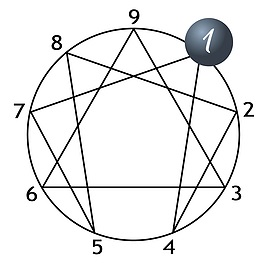
Growth and Stress Direction: to Seven and Four respectively
Introduction
Type One is the person that walks toward you and you suddenly become aware that you have your zipper down. They have an incredibly keen eye for what needs to be done to improve the situation and to do things right. Nor do they stand by the wayside, but often get involved personally.
This ability that Ones have to see what ought to be done means that they are also keenly aware of what is wrong in every situation, that is, they immediately see when, where and how the standard is not being met. A healthy One is definitely someone whose advice you want to listen to, as they often have incredible foresight in predicting the consequences of letting small imperfections snowball into bigger and bigger ones.
Ones are usually fair in an impersonal and impartial sort of way. If anything, when they highlight your faults, they tend to do it out of love. They often cannot conceive how someone could be driven by anything except what’s right (either morally or technically), because they themselves seek to identify what they want with what is right.
However, Ones are famous in the Enneagram community for being the ones with the loudest and harshest inner critic. Their every action tends toward conformity with what the critic says. Whenever an action has been carried out (by them or by someone next to them) the inner critic’s sentence immediately highlights what has been done wrong and what could have been done better.
Although Ones can at times appear to be very mental or rational in their behavior, they have very strong beliefs that they rarely question, since these form the basis for their action in the world, and therefore removing them would remove One’s justification for acting. And Ones are, despite all, people of action.
Core Mechanism
Ones see the world as a place to reform or straighten out. Out of all the types, Ones most clearly embody the archetype of the reformer or the activist (although Sixes also fulfill this latter role, in another sense.) Ones give themselves ideals to follow and toward which to direct their great energy.
This happens because, on some level, Ones do not feel that they can just be in the world, but need to justify their own existence by complying with some higher standard. With Ones it is rarely “I want this” but rather “It ought to be this way”. They often seek to sublimate their subjective will by checking it against higher laws. The more Ones seek to sublimate themselves to match an ideal or to transform themselves and reality, the more they move the goalpost of what they consider to be perfect, or even just okay.
The world, and their own life, becomes by definition “not okay”, and while in average Ones this can be a stimulus to improve things, in more difficult cases it can lead to situations where the more Ones seek to perfect life, the more they become aware of every imperfection, leading them down spirals of self-hatred, puritanism and intolerance.
Sin/Passion
Type One’s passion is anger. All Body types (Eight, Nine and One) center around the issue of autonomy and self-assertion. Their basic energy is essentially choleric in the traditional sense. However, Ones are incapable of asserting themselves directly and immediately.
Instead, they seek to justify their self-assertion as autonomous beings by complying with standards, rules, morals, etc. Their unspoken contract with themselves is “I have a right to be here if I do my best to perfect myself or the world around me.”
Anger stems from their sense of impotence in making themselves and the world around them match the vision of them that would justify their existence. Ones see the difference between what is and what ought to be, and choler builds up in them. In other words, the normal flow of choleric energy that forms part of everyone’s bodily existence finds itself flowing through the strictures of One’s inner critic, turning from natural assertive drive into wrath–at themselves and at the world.
Ones are often very controlled in their behavior, exactly because their bodily energy is deviated in its course by normative structures, yet they often do not seem very relaxed. Their being in control of themselves usually betrays signs of an inner tension, an unresolved struggle for peace. Their anger often transpires as frustration toward life, themselves and others, depending on their particular life patterns and individual condition.

Misconceptions
The biggest misconception about Type One is that they delight in criticizing others. In fact, delight may be the last thing a One feels when being critical of what other people do. There is never anything personal in an average One’s criticism (this doesn’t necessarily make it ok, though.)
Although sometimes they may relish in being the ones who “told you so”, by and large Ones abide by standards and seek to enforce them, and often simply don’t see how others may either have different standards or not be dedicated to enforcing them. Usually, when a One criticizes you, it’s not the person that speaks: it’s the rule. By extension, Ones often believe they are helping you by criticizing you.
Furthermore, Ones’ attention to what you do and how you do it is often an indirect reflection of their own inner discourse toward themselves. Usually, their criticism of others and their criticism of themselves coincide. See it like this: in speaking on behalf of the standard or rule, Ones seek to become embodiments of it, and become aware of their own inability to ever bridge the gap between ideal and reality. In this process, they also become aware of your inability to do so, but often they fail to realize that this may not be your problem.
Wings
1w9 – Ones with a Nine wing tend to have a more laid-back demeanor, although One’s inner tension is still quite noticeable. They are often more accomodating on the surface, but their strictness usually manages to transpire anyway, especially in passive-aggressive ways (passive-aggressive behavior being something that Ones share with Nines, in different forms.) Also, the ideals they serve tend to be more all-encompassing and broad.
1w2 – Ones with a Two wing have a more marked interpersonal quality. They are usually highly involved in other people’s lives, on whose behalf and (supposed) best interest they act. Their actions, which are usually carried out in service of an ideal, can have an additional, albeit shallower, layer of motivation in pleasing others. Also, their activism tends to be based on solving concrete problems in their immediate surroundings.
(note that wings can have some minor descriptive power in terms of superficial behavior, but they are irrelevant in terms of what motivates the person. Many people have no noticeable wing, while few show signs of both.)
MQS

Discover more from Moderately Quick Silver
Subscribe to get the latest posts sent to your email.
